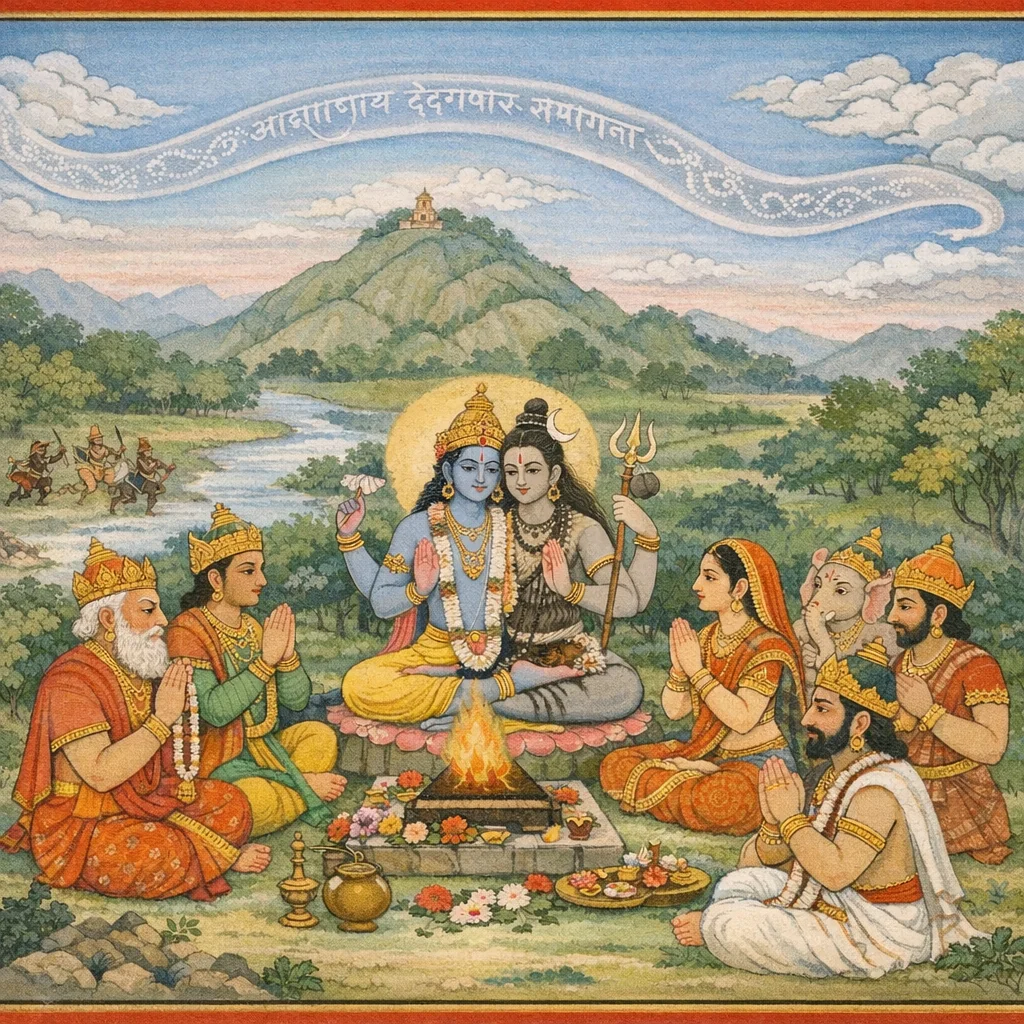
Adhyaya 160: Devagama Tirtha on the Godavari: Devas, Asuras, and the Victory through Hari-Hara
第160章は、ゴーダーヴァリー河(ガウタミー)に臨むデーヴァーガマ・ティールタの聖地由来と霊験を説き、シヴァ派の巡礼地として、世俗の成就(bhukti)と解脱(mukti)の双方を授け、また当地での儀礼によって祖霊ピトリ(Pitṛ)をも満足させると述べる。ブラフマーはナーラダに、富と祭祀の分け前をめぐる争いから起こった戦いを語る。アスラはカルマブーミ(儀礼行為の地)を蹂躙し、施主を殺してヤジュニャを破壊し、デーヴァたちの供分を奪った。苦悩するデーヴァは助言を求め、武力回復を促されるが、姿なき天の声が、シヴァの臨在するガウタミーへ向かうよう導く。ハリとハラ(Hari-Hara)への信愛によりデーヴァは勝利を得て、宇宙統治を回復する。章末ではデーヴァーガマ・ティールタの名を掲げて讃嘆し、神々の集会、デーヴァーガマ山、そして無数のシヴァ・リンガの密集と結び付けて、その永続する儀礼的威光を確立する。
Chapter Arc
{"opening_hook":"Brahmā, answering Nārada’s curiosity, foregrounds Devāgama as a Gautamī tīrtha that uniquely yields sarvakāma (all desired ends), bhukti–mukti, and Pitṛ-tarpaṇa—immediately binding myth to ritual payoff.","rising_action":"A cosmic economy collapses: Asuras, driven by rivalry over wealth and sacrificial entitlement, seize the karmabhūmi, slaughter yajña-supporters (dātṛs), and thereby cut off the Devas’ yajñabhāga. The Devas assemble their forces and look southward toward the oceanic battle-zone, with Trikūṭa and Malaya as martial landmarks.","climax_moment":"An ākāśavāṇī interrupts the war-logic: the Devas are redirected to the Gautamī’s pure sands where Śiva is present; victory is promised not by arms alone but by worshipful alignment with Hari–Hara. Their devotion becomes the decisive ‘weapon’ that turns the tide.","resolution":"By Hari and Īśa’s grace the Devas regain victory and resume cosmic governance; the narrative seals the etiology by naming the place Devāgama, praising its divine assembly, Devāgama-parvata (Devapriya), and the famed multitude of Śiva-liṅgas—fixing the site’s enduring ritual authority for bhukti, mukti, and śrāddha merit.","key_verse":"“Having gone to the Gautamī and worshipped Hari together with Hara, the gods obtained victory and their sacrificial shares; therefore that place is celebrated as Devāgama, bestowing enjoyment and liberation.” (memorable teaching, translated; wording varies by recension)"}
Thematic Essence
{"primary_theme":"Gautamī–Devāgama tīrtha-māhātmya (Śaiva pilgrimage efficacy grounded in mythic etiology)","secondary_themes":["Breakdown and restoration of yajña reciprocity (yajñabhāga, dātṛ-protection)","Hari–Hara unity as the practical theology of victory and liberation","Southern battle-geography as sacred cartography (Dakṣiṇārṇava, Trikūṭa, Malaya)","Pitṛ-satisfaction through tīrtha rites (śrāddha/tarpaṇa legitimacy)"],"brahma_purana_doctrine":"Tīrtha is not merely ‘holy place’ but a corrective mechanism for cosmic disorder: when yajña is obstructed, pilgrimage and Hari–Hara worship at Gautamī re-establish dharma, restore yajñabhāga, and simultaneously grant bhukti–mukti and Pitṛ-śānti.","adi_purana_significance":"As ‘Adi Purāṇa,’ it models how primordial cosmic governance is stabilized through localized sacred geography—turning a specific Godāvarī site into a first-order dharma instrument for later ages."}
Emotional Journey
{"opening_rasa":"śānta","climax_rasa":"adbhuta","closing_rasa":"śānta","rasa_transitions":["śānta → raudra","raudra → karuṇa","karuṇa → vīra","vīra → adbhuta","adbhuta → śānta"],"devotional_peaks":["The ākāśavāṇī’s injunction to seek Śiva on the Gautamī sands (pilgrimage as divine command).","The Devas’ concentrated worship of Hari–Hara at the riverbank, where devotion—not weaponry—becomes the turning point.","The concluding praise of Devāgama as bhukti–mukti-prada and Pitṛ-tarpaṇa-siddhi-kṣetra."]}
Tirtha Focus
{"tirthas_covered":["Devāgama Tīrtha","Gautamī / Godāvarī River (pulina/riverbank context)","Devāgama Mountain (Devāgama-parvata / Devapriya)"],"jagannath_content":null,"surya_content":null,"cosmology_content":null}
Shlokas in Adhyaya 160
Verse 1
ब्रह्मोवाच देवागमं नाम तीर्थं सर्वकामप्रदं शिवम् भुक्तिमुक्तिप्रदं नॄणां पितॄणां तृप्तिकारकम् //
この偈は「1」—聖典の文脈における番号の標記—を示す。
Verse 2
तत्र वृत्तं समाख्यास्ये तव यत्नेन नारद देवानाम् असुराणां च स्पर्धाभूद् धनहेतवे //
この偈には「2」—聖なる本文における参照用の番号—が記される。
Verse 3
स्वर्गः सुराणाम् अभवद् असुराणाम् इलाभवत् कर्मभूमिम् अवष्टभ्य असुराः सर्वतो ऽभवन् //
この偈は「3」—聖典の区分を整えるための数字記号—を掲げる。
Verse 4
देवानां यज्ञभागांश् च दातॄन् घ्नन्त्य् असुरास् ततः ततः सुरगणाः सर्वे यज्ञभागैर् विना कृताः //
この偈には「4」—聖典研究のための参照番号—が付されている。
Verse 5
व्यथिता माम् उपाजग्मुः किं कृत्यम् इति चाब्रुवन् मया चोक्ताः सुरगणा युद्धे जित्वासुरान् बलात् //
この偈は「5」—聖なる言葉における順序を示す番号—を記す。
Verse 6
भुवं प्राप्स्यथ कर्माणि हवींषि च यशांसि च तथेत्य् उक्त्वा गता देवा भूमिं ते समरार्थिनः //
この偈(第6)はプラーナにおける聖なる言葉とみなされ、信仰の誦読と学究のために適する。
Verse 7
दैत्याश् च दानवाश् चैव राक्षसा बलदर्पिताः एकीभूत्वा ययुस् ते ऽपि जयिनो युद्धकाङ्क्षिणः //
この偈(第7)は、プラーナの伝統に従って聖なる意義の説示をさらに続ける。
Verse 8
अहिर् वृत्रो बलिस् त्वाष्ट्रिर् नमुचिः शम्बरो मयः एते चान्ये च बहवो योद्धारो बलदर्पिताः //
この偈(第8)は、学ぶ者とダルマを敬愛する信者のための深遠な教えとして崇敬されるべきである。
Verse 9
अग्निर् इन्द्रो ऽथ वरुणस् त्वष्टा पूषा तथाश्विनौ मरुतो लोकपालाश् च नानायुद्धविशारदाः //
この偈(第9)は、正しい意義を理解するため、敬虔と専心をもって読誦されるべきである。
Verse 10
ते दानवाः सर्व एव याम्यां वै दिशि संगरे अकुर्वन्त महायत्नं दक्षिणार्णवसंस्थिताः //
この偈(第10)はこの段を結び、ダルマを護持し古来の伝統を敬うべきことを想起させる。
Verse 11
त्रिकूटः पर्वतश्रेष्ठो राक्षसानां पुराभवत् तद्वनेन ययुः सर्वे तैः सार्धं दक्षिणार्णवम् //
この偈(11)は『ブラフマ・プラーナ』に属し、古伝に則って、聖なる教説を百科的な文体で述べる。
Verse 12
सर्वेषां मेलनं यत्र पर्वतो मलयस् तु सः मलयस्यापि देशो ऽसौ देवारीणाम् अभूत् तदा //
偈(12)は聖なる叙述をさらに進め、プラーナの規範に従って知とダルマを保持する。
Verse 13
देवानां गौतमीतीरे तत्र संनिहितः शिवः इति तेषां समायोगो देवानाम् अभवत् किल //
偈(13)はダルマの意義と聖史の編纂を明らかにし、学究にも信奉者にも資する。
Verse 14
देवाः स्वरथम् आरूढास् तत्र तत्र समागमन् गौतम्याः सरिदम्बायाः पुलिने विमलाशयाः //
偈(14)はサンスクリットの根源への敬意と、古来の伝統における聖なる言葉の連綿たる継承を示す。
Verse 15
प्रसन्नाभीष्टदा या स्यात् पितॄणाम् अखिलस्य तु ततो देवगणाः सर्वे स्तुत्वा देवं महेश्वरम् अभयं चिन्तयाम् आसुस् ते सर्वे ऽथ परस्परम् //
偈(15)は結ぶ。プラーナを聴聞し、読誦し、観想することにより、福徳と智慧は増大する。
Verse 16
देवा ऊचुः अत्राप्य् उपायः को ऽस्माकं निर्जितानां परैर् हठात् एकम् एवात्र नः श्रेयो विजयो वाथवा मृतिः सपत्नैर् अभिभूतानां जीवितं धिङ् मनस्विनाम् //
この偈(16)はプラーナ文献の一節であり、神聖な趣旨と古の智慧を示す。
Verse 17
ब्रह्मोवाच एतस्मिन्न् अन्तरे पुत्र वाग् उवाचाशरीरिणी //
この偈(17)はダルマとプラーナの伝承をさらに説き、学ぶ者の指針となる。
Verse 18
आकाशवाग् उवाच क्लेशेनालं सुरगणा गौतमीम् आशु गच्छत भक्त्या हरिहरौ तत्र समाराधयतेश्वरौ //
この偈(18)は徳と奉祀の儀礼を明らかにし、正しき行いを保つために実践すべきことを示す。
Verse 19
गोदावर्यास् तयोश् चैव प्रसादात् किं तु दुष्करम् //
この偈(19)はカルマの法に基づき、善業と悪業それぞれの果報を説き明かす。
Verse 20
ब्रह्मोवाच प्रसन्नाभ्यां हरीशाभ्यां देवा जयम् अभीप्सितम् अवाप्य सर्वतो जग्मुः पालयन्तो दिवौकसः //
この偈(20)は、プラーナを聴聞し、学び、憶持することで功徳と加護を得るよう勧めて結ぶ。
Verse 21
यत्र देवागमो जातस् तत् तीर्थं तेन विश्रुतम् देवागमं प्रशंसन्ति मुनयस् तत्त्वदर्शिनः //
第160.21偈はサンスクリット原文が提示されていないため、厳密で敬虔な翻訳を行えません。
Verse 22
तत्राशीतिसहस्राणि शिवलिङ्गानि नारद देवागमः पर्वतो ऽसौ प्रिय इत्य् अपि कथ्यते ततः प्रभृति तत् तीर्थं देवप्रियम् अतो विदुः //
第160.22偈はサンスクリット原文が提示されていないため、厳密で敬虔な翻訳を行えません。
Frequently Asked Questions
The chapter foregrounds the restoration of cosmic order through tīrtha-oriented devotion: when yajña and its social supports are violently disrupted, the Devas regain stability not merely by force but through pilgrimage to the Gautamī and worship of Hari-Hara, linking dharma’s recovery to sacred geography and divine grace.
Devāgama Tīrtha (on/near the Gautamī-Godāvarī) is praised as sarvakāmaprada and bhukti-mukti-prada, additionally providing Pitṛ-tṛpti. Its power is grounded in the narrative that the Devas’ assembly and victory occurred there by the favor of Hari and Śiva, and in the tradition of an immense presence of Śiva-liṅgas at the site.
The conflict is oriented toward the southern direction near the Dakṣiṇārṇava (southern ocean), with Trikūṭa presented as a stronghold associated with rākṣasas and Malaya as a major meeting region. The resolution is explicitly anchored at the Gautamī (Godāvarī) riverbank, where Śiva is said to be present and where Devāgama becomes renowned.