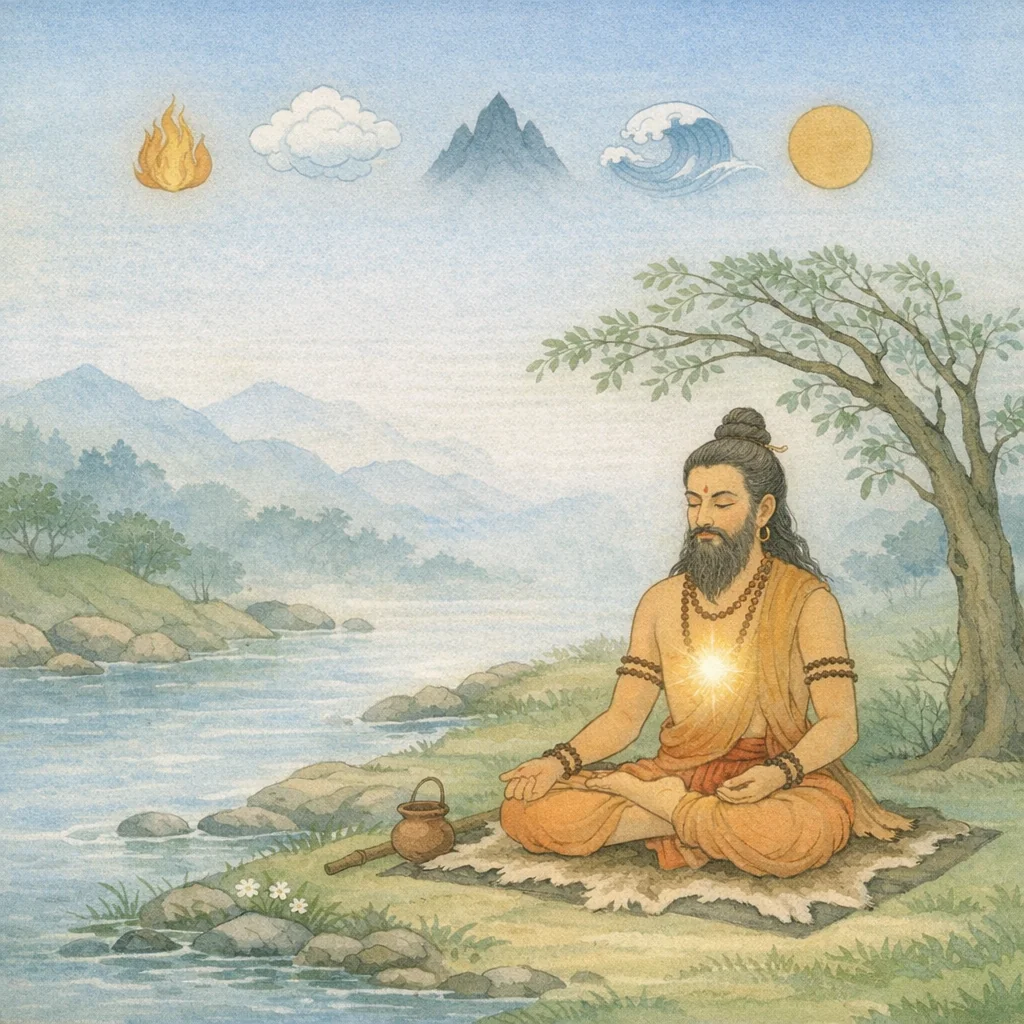
Adhyaya 40
Adhyāya 40: Brahmā on Mahān (The Great Principle) and the All-Pervading Puruṣa
Upa-parva: Ātma-Mahattva (Mahān-Ātman) Upadeśa — Brahmā’s Discourse on the Great Principle
This chapter is structured as a compact doctrinal exposition introduced by ‘Brahmā said.’ It first states that the Mahān—described as a great-souled, great-minded principle—arises prior to the manifest (avyakta), and is named the first creation and the origin associated with the guṇas. It then enumerates synonymous designations and functional correlates: the Mahān is identified through epithets such as Viṣṇu, Viśva, and Śambhu, and through cognitive-ethical capacities including buddhi (discernment), prajñā (insight), upalabdhi (apprehension), khyāti (recognition), dhṛti (steadfastness), and smṛti (memory). The discourse asserts that knowing this principle prevents delusion in the learned listener. The chapter further portrays the puruṣa as all-pervasive—having hands, feet, eyes, heads, mouths everywhere—standing while pervading all, and residing in the heart of all beings as a radiant, imperishable light. It concludes by characterizing those who attain this ‘mahattva’ as renunciant, meditative, truth-bound, sense-controlled, non-greedy, free from possessiveness and egoism; such knowledge is presented as the highest auspicious path, with Viṣṇu described as self-existent in primordial creation.
Chapter Arc: ब्रह्मवाणी में शिष्य के सामने ‘महत्तत्त्व’ और ‘परमात्मतत्त्व’ का द्वार खुलता है—अव्यक्त से उत्पन्न महानात्मा, और उसके अनेक नाम-रूपों का संकेत देकर जिज्ञासा को तीक्ष्ण किया जाता है। → परम पुरुष के पर्यायवाचक नामों (महानात्मा, मति, विष्णु, जिष्णु, शम्भु, बुद्धि, प्रज्ञा, स्मृति आदि) की शृंखला के साथ यह प्रश्न उभरता है कि एक ही सत्य इतने रूपों में कैसे जाना जाए; फिर हृदयस्थ परमात्मा की अणिमा-लघिमा आदि विभूतियों और साधक-लक्षणों (ध्यान, नित्ययोग, सत्यसंधता, जितेन्द्रियता) से साधना का कठोर पथ सामने आता है। → अहंकार से पंचमहाभूतों की उत्पत्ति और प्रलय में उन्हीं के विनाश का वर्णन आते ही चरम बिंदु बनता है—जब महाभूत-विनाश के समय समस्त प्राणियों में ‘महद् भय’ उठता है, तब जो धीर पुरुष परमात्मतत्त्व को जानता है वह मोह में नहीं पड़ता। → ज्ञान का फल स्पष्ट किया जाता है: जो ब्राह्मण/विद्वान परमात्मा को इन पर्यायों के पार एक तत्त्व रूप में पहचान लेता है, वह प्रमोह से बचता है; प्रलय-भय के बीच भी धैर्य और विवेक से स्थित रहता है।
Shlokas
Verse 1
पम्प बछ। अऑ-छकऋ--> चत्वारिशो< ध्याय: महत्तत््वके नाम और परमात्मतत्त्वको जाननेकी महिमा ब्रह्मोवाच अव्यक्तात् पूर्वमुत्पन्नो महानात्मा महामतिः । आदिर्गुणानां सर्वेषां प्रथम: सर्ग उच्यते,ब्रह्माजी बोले-महर्षिगण! पहले अव्यक्त प्रकृतिसे महान् आत्मस्वरूप महाबुद्धितत्त्व उत्पन्न हुआ। यही सब गुणोंका आदि तत्त्व और प्रथम सर्ग कहा जाता है
Brahmā said: “From the Unmanifest (Prakṛti) there first arose the Great Principle—Mahān, the great self, the vast intelligence. It is called the origin of all the guṇas and is spoken of as the first act of creation.”
Verse 2
महानात्मा मतिर्विष्णुर्जिष्णु: शम्भुश्न वीर्यवान् । बुद्धि: प्रज्ञोपलब्धिश्व॒ तथा ख्यातिर्धति: स्मृति:,महान् आत्मा, मति, विष्णु, जिष्णु, शम्भु, वीर्यवान्, बुद्धि, प्रज्ञा, उपलब्धि, ख्याति, धृति, स्मृति--इन पर्यायवाची नामोंसे महान् आत्माकी पहचान होती है। उसके तत्त्वको जाननेवाला दविद्दान् ब्राह्मण कभी मोहमें नहीं पड़ता
Vāyudeva said: “The Great Self is known by these synonymous names—Great Soul, Intelligence, Viṣṇu, the Victorious One, Śambhu, the Mighty; also as understanding, wisdom, direct apprehension, renown, steadfastness, and memory. A learned brāhmaṇa who truly knows that reality of the Great Self never falls into delusion.”
Verse 3
पर्यायवाचकै: शब्दैर्महानात्मा विभाव्यते । तं जानन ब्राह्मणो विद्वान प्रमोहें नाधिगच्छति,महान् आत्मा, मति, विष्णु, जिष्णु, शम्भु, वीर्यवान्, बुद्धि, प्रज्ञा, उपलब्धि, ख्याति, धृति, स्मृति--इन पर्यायवाची नामोंसे महान् आत्माकी पहचान होती है। उसके तत्त्वको जाननेवाला दविद्दान् ब्राह्मण कभी मोहमें नहीं पड़ता
The Great Self is to be understood through words that serve as its synonyms. A learned brāhmaṇa who truly knows that Reality does not fall into delusion. Names such as “Mahān Ātmā,” “Mati,” “Viṣṇu,” “Jiṣṇu,” “Śambhu,” “Vīryavān,” “Buddhi,” “Prajñā,” “Upalabdhi,” “Khyāti,” “Dhṛti,” and “Smṛti” are used to indicate that Great Self; one who grasps its essence is not overcome by confusion.
Verse 4
सर्वतःपाणिपादश्च सर्वतो$क्षिशिरोमुख: । सर्वतः:श्रुतिमॉल्लोके सर्व व्याप्प स तिष्ठति,परमात्मा सब ओर हाथ-पैरवाला, सब ओर नेत्र, सिर और मुखवाला तथा सब ओर कानवाला है; क्योंकि वह संसारमें सबको व्याप्त करके स्थित है
Vāyu said: The Supreme Self has hands and feet on every side; eyes, heads, and faces on every side; and ears everywhere. For, pervading all beings throughout the world, He abides—present within and around all, the unseen ground of moral order and life.
Verse 5
महाप्रभाव: पुरुष: सर्वस्य हृदि निश्चित: । अणिमा लघिमा प्राप्तिरीशानो ज्योतिरव्यय:,सबके हृदयमें विराजमान परम पुरुष परमात्माका प्रभाव बहुत बड़ा है। अणिमा, लघिमा और प्राप्ति आदि सिद्धियाँ उसीके स्वरूप हैं। वह सबका शासन करनेवाला, ज्योतिर्मय और अविनाशी है
Vāyu-deva said: The Supreme Person, of immeasurable majesty, is firmly established in the heart of every being. The powers such as becoming minute (aṇimā), becoming light (laghimā), and reaching all things (prāpti) arise from Him. He is the sovereign Lord of all, self-luminous, and imperishable—thus the inner ruler who grounds spiritual discipline and ethical restraint in the awareness of the indwelling Self.
Verse 6
तत्र बुद्धिविदो लोका: सद्धभावनिरताश्न ये । ध्यानिनो नित्ययोगाश्न सत्यसंधा जितेन्द्रिया:,संसारमें जो कोई भी मनुष्य बुद्धिमान, सद्भाव-परायण, ध्यानी, नित्य योगी, सत्यप्रतिज्ञ, जितेन्द्रिय, ज्ञानवान् लोभहीन, क्रोधको जीतनेवाले, प्रसन्नचित्त, धीर तथा ममता और अहंकारसे रहित हैं, वे सब मुक्त होकर परमात्माको प्राप्त होते हैं। जो सर्वश्रेष्ठ परमात्माकी महिमाको जानता है, उसे पुण्यदायक उत्तम गति मिलती है
There, those people who are discerning, devoted to noble intention, contemplative, ever steadfast in yoga, true to their vows, and self-controlled—such persons, freed from worldly bondage, attain the Supreme Self. Whoever truly knows the glory of the Supreme Lord gains a supremely auspicious, merit-bearing destination.
Verse 7
ज्ञानवन्तश्न ये केचिदलुब्धा जितमन्यव: । प्रसन्नमनसो धीरा निर्ममा निरहंकृता:,संसारमें जो कोई भी मनुष्य बुद्धिमान, सद्भाव-परायण, ध्यानी, नित्य योगी, सत्यप्रतिज्ञ, जितेन्द्रिय, ज्ञानवान् लोभहीन, क्रोधको जीतनेवाले, प्रसन्नचित्त, धीर तथा ममता और अहंकारसे रहित हैं, वे सब मुक्त होकर परमात्माको प्राप्त होते हैं। जो सर्वश्रेष्ठ परमात्माकी महिमाको जानता है, उसे पुण्यदायक उत्तम गति मिलती है
Vāyu said: Those people in the world who are truly wise—free from greed, having conquered anger, serene in mind, steadfast, without possessiveness and without ego—become liberated and attain the Supreme Self. And whoever understands the glory of that Supreme Lord gains a supremely auspicious, merit-bearing destination.
Verse 8
विमुक्ता: सर्व एवैते महत्त्वमुपयान्त्युत । आत्मनो महतो वेद य: पुण्यां गतिमुत्तमाम्,संसारमें जो कोई भी मनुष्य बुद्धिमान, सद्भाव-परायण, ध्यानी, नित्य योगी, सत्यप्रतिज्ञ, जितेन्द्रिय, ज्ञानवान् लोभहीन, क्रोधको जीतनेवाले, प्रसन्नचित्त, धीर तथा ममता और अहंकारसे रहित हैं, वे सब मुक्त होकर परमात्माको प्राप्त होते हैं। जो सर्वश्रेष्ठ परमात्माकी महिमाको जानता है, उसे पुण्यदायक उत्तम गति मिलती है
Vāyu said: “All such persons, once freed (from bondage), indeed attain the Supreme Greatness. Whoever truly knows the majesty of the Great Self (the Supreme Lord) reaches the highest, merit-bearing destination.”
Verse 9
अहंकारात् प्रसूतानि महाभूतानि पञ्च वै । पृथिवी वायुराकाशमापो ज्योतिश्व॒ पठचमम्,पृथ्वी, वायु, आकाश, जल और पाँचवाँ तेज--ये पाँचों महाभूत अहंकारसे उत्पन्न होते हैं
Vāyu-deva said: “From ego-sense (ahaṅkāra) arise the five great elements indeed—earth, wind, space, water, and as the fifth, fire/light. Thus the embodied world is traced back to the inner principle of ‘I’-making, reminding one to restrain pride and cultivate discernment.”
Verse 10
तेषु भूतानि युज्यन्ते महा भूतेषु पजचसु । ते शब्दस्पर्शरूपेषु रसगन्धक्रियासु च,उन पाँचों महाभूतों तथा उनके कार्य शब्द, स्पर्श, रूप, रस, गन्ध आदिसे सम्पूर्ण प्राणी युक्त हैं
Vāyu-deva said: “All living beings are constituted through those five great elements. And they are bound up with the elements’ functions as well—sound, touch, form, taste, smell, and the activities that proceed from them.”
Verse 11
महाभूतविनाशान्ते प्रलये प्रत्युपस्थिते । सर्वप्राणभूतां धीरा महदुत्पद्यते भयम्
Vāyu said: “When the dissolution (pralaya) arrives—at the end of the destruction of the great elements—then even for the steadfast among all living beings, a great fear arises.”
Verse 12
विष्णुरेवादिसर्गेषु स्वयम्भूर्भवति प्रभु:,आदिसर्ममें सर्वसमर्थ स्वयम्भू विष्णु ही स्वयं अपनी इच्छासे प्रकट होते है। जो इस प्रकार बुद्धिरूपी गुहामें स्थित, विश्वरूप, पुराणपुरुष, हिरण्मय देव और ज्ञानियोंकी परम गतिरूप परम प्रभुको जानता है, वह बुद्धिमान् बुद्धिकी सीमाके पार पहुँच जाता है
Vāyu said: “In the primordial creations, it is indeed Viṣṇu—the sovereign Lord—who becomes self-manifest (svayambhū).” The teaching underscores that the Supreme is not produced by any external cause; by His own will He appears at the beginning of creation. Knowing that supreme Lord—abiding in the ‘cave’ of the intellect as the inner ruler, universal in form, the primeval Person, radiant (hiraṇmaya), and the highest goal of the wise—one transcends the limits of ordinary intellect and attains the highest state.
Verse 13
एवं हि यो वेद गुहाशयं प्रभु परं पुराणं पुरुष विश्वरूपम् । हिरण्मयं बुद्धिमतां परां गतिं स बुद्धिमान बुद्धिमतीत्य तिषछठति,आदिसर्ममें सर्वसमर्थ स्वयम्भू विष्णु ही स्वयं अपनी इच्छासे प्रकट होते है। जो इस प्रकार बुद्धिरूपी गुहामें स्थित, विश्वरूप, पुराणपुरुष, हिरण्मय देव और ज्ञानियोंकी परम गतिरूप परम प्रभुको जानता है, वह बुद्धिमान् बुद्धिकी सीमाके पार पहुँच जाता है
Vāyu said: Whoever truly knows the Supreme Lord who dwells in the secret cave of the heart—transcendent, primeval, the Cosmic Person of universal form—radiant like gold and the highest goal of the wise, that person becomes truly wise and stands beyond the limits of ordinary intellect. The teaching places inner realization above mere reasoning: by recognizing the self-manifest, all-sufficient Lord within, one crosses the boundary of mental calculation and attains the highest good.
Verse 39
इस प्रकार श्रीमह्याभारत आश्वमेधिकपर्वके अन्तर्गत अनुगीतापर्वमें गुरु-शिष्य- संवादविषयक उनतालीसवाँ अध्याय पूरा हुआ
Thus ends the thirty-ninth chapter, concerned with the dialogue between teacher and disciple, within the Anugītā section of the Aśvamedhika Parva of the revered Mahābhārata. This closing colophon signals the completion of a didactic exchange meant to ground ethical conduct and disciplined understanding after the upheavals of war.
Verse 40
इति श्रीमहाभारते आश्वमेधिके पर्वणि अनुगीतापर्वणि गुरुशिष्यसंवादे चत्वारिंशो5ध्याय:
Thus ends the fortieth chapter in the Anugītā section of the Aśvamedhika Parva of the Śrī Mahābhārata, in the dialogue between teacher and disciple. (This is a colophon marking the close of the chapter rather than a spoken doctrinal verse.)
Verse 113
स धीर: सर्वलोकेषु न मोहमधिगच्छति । धैर्यशाली महर्षियो! जब पञ्चमहाभूतोंके विनाशके समय प्रलयकाल उपस्थित होता है, उस समय समस्त प्राणियोंको महान् भयका सामना करना पड़ता है। किंतु सम्पूर्ण लोगोंमें जो आत्मज्ञानी धीर पुरुष है, वह उस समय भी मोहित नहीं होता
Vāyu said: The steadfast, self-possessed person does not fall into delusion in any world. When the time of dissolution arrives—the cosmic end in which the five great elements break down—all beings are seized by overwhelming fear; yet the truly wise and resolute knower of the Self is not bewildered even then.
Frequently Asked Questions
The chapter targets pramoha (delusion/confusion) and presents knowledge of the Mahān and the indwelling, all-pervading puruṣa as the corrective that stabilizes discernment and conduct.
Understanding the Mahān as primordial intelligence and recognizing the puruṣa as immanent and universal supports a disciplined life—truthfulness, sense-control, non-attachment, and ego-reduction—framed as a superior path toward liberation-oriented clarity.
Yes in functional form: it states that the learned person who knows this principle does not fall into delusion, and that those embodying the described virtues ‘attain mahattva,’ implying an elevated spiritual state within a mokṣa-oriented framework.