Adhyaya 26
आदि पर्व (अध्याय 26) — गरुडस्य वालखिल्य-रक्षणम्, कश्यपोपदेशः, देवोत्पात-प्रसङ्गः
Upa-parva: Garuḍotpatti (Garuḍa Episode) — Vālakhilya-Saṃrakṣaṇa and Amṛta-Haraṇa Prelude
Sauti narrates that Garuḍa, merely touching a tree with his feet, breaks a great branch yet supports it to prevent immediate destruction. He notices the Vālakhilya sages hanging beneath, in danger of being harmed, and—out of protective intent—holds the branch in his beak while searching for a safe place to set it down. Reaching Gandhamādana, he encounters his father Kaśyapa in tapas. Kaśyapa recognizes Garuḍa’s intent and warns him against rash action that could provoke the Vālakhilyas; he conciliates the sages and frames Garuḍa’s undertaking as oriented to public welfare, obtaining their assent. Garuḍa asks where to release the branch; Kaśyapa directs him to an uninhabited, inaccessible mountain. Garuḍa rapidly transports the load over immense distance, releases the branch with a resonant impact, and the mountain trembles, shedding blossoms and fragments. Settling on a peak, Garuḍa consumes the elephant and tortoise (gaja-kacchapa). As he departs, extraordinary portents arise among the devas: Indra’s vajra flares, weapons agitate, winds and meteors intensify, and ominous phenomena disturb the celestial order. Indra consults Bṛhaspati, who attributes the disturbance to Indra’s prior fault and to the Vālakhilyas’ tapas producing a formidable being—Kaśyapa’s son by Vinātā—approaching to seize soma/amṛta. The devas then organize a guarded defensive posture around the amṛta, equipped with armor and weapons, forming a luminous, battle-ready perimeter.
Chapter Arc: सौति जनमेजय के सर्पसत्र-प्रसंग में उस अद्भुत दृश्य का वर्णन उठाते हैं जब इन्द्र, कद्रू के स्तुत होने पर, नागों को प्रसन्न करने हेतु आकाश के मेघों को अमृत-तुल्य शीतल वर्षा का आदेश देते हैं। → मेघ घनघोर गर्जना करते, विद्युत् और पवन से कम्पित होकर निरन्तर धाराएँ बरसाते हैं; चन्द्र-किरण तक लुप्त हो जाते हैं और पृथ्वी चारों ओर जल से भरने लगती है—वर्षा की प्रचण्डता स्वयं एक भय-रूप ले लेती है। → अतुल जलराशि की अविराम वर्षा से आकाश ‘संवर्त’ के समान प्रतीत होता है; शीतल, निर्मल जल रसातल तक पहुँच जाता है और नागों में परम हर्ष उमड़ पड़ता है—इन्द्र की कृपा का चरम प्रकाशन। → वर्षा से तृप्त होकर नाग-समुदाय प्रसन्न होता है; कद्रू की स्तुति का फल प्रकट होता है और इन्द्र की देव-शक्ति लोक-व्यवस्था को शान्ति की ओर मोड़ देती है। → नागों की यह तृप्ति और इन्द्र-कृपा आगे गरुड-नाग वैर तथा अमृत-प्रसंग की दिशा में कथा को कैसे मोड़ेगी—यह संकेत देकर अध्याय समाप्त होता है।
Shlokas
Verse 1
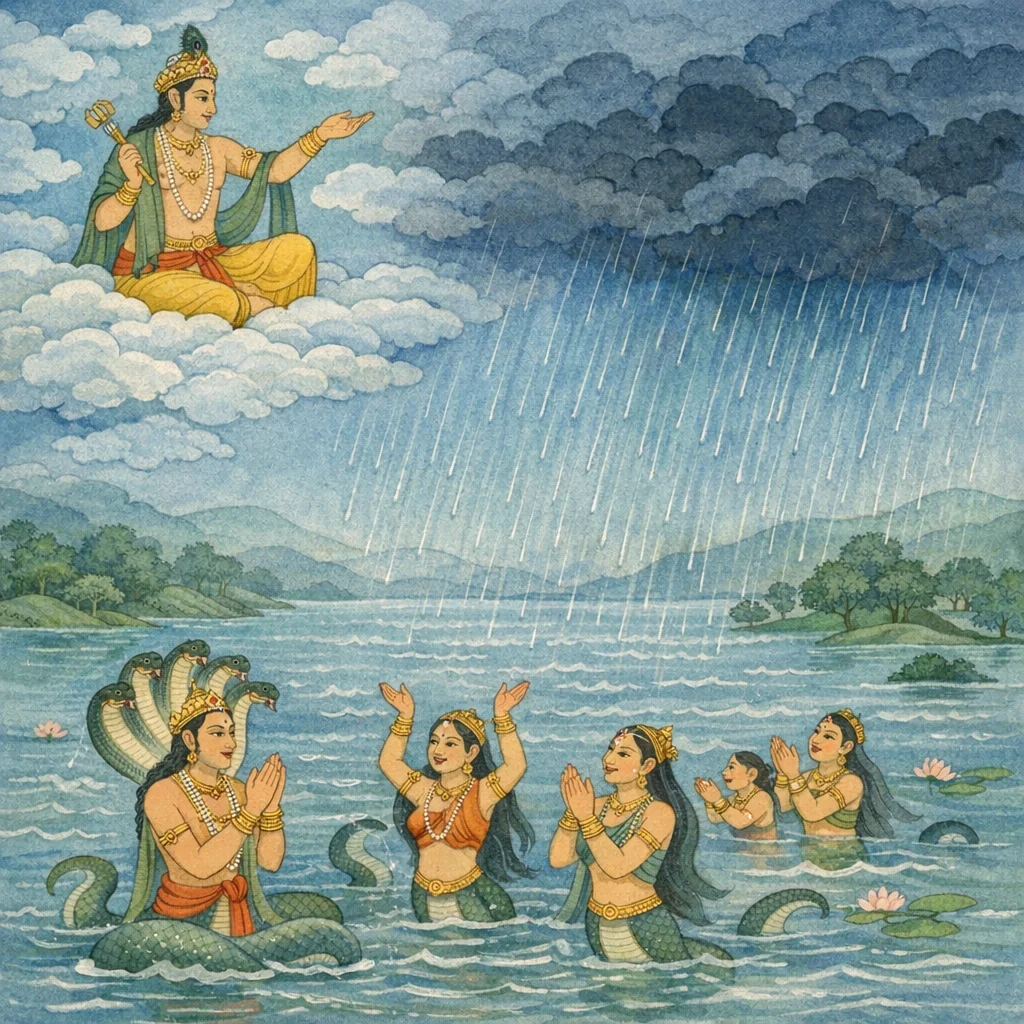
अ्---#क्रत षड्विशो<5ध्याय: इन्द्रद्वारा की हुई वषसि सर्पोकी प्रसन्नता सौतिर्वाच एवं स्तुतस्तदा कद्र्वा भगवान् हरिवाहन: । नीलजीमूतसंघातै: सर्वमम्बरमावृणोत्,उग्रश्रवाजी कहते हैं--नागमाता कद्रूके इस प्रकार स्तुति करनेपर भगवान् इन्द्रने मेघोंकी काली घटाओंद्वारा सम्पूर्ण आकाशको आच्छादित कर दिया
Sauti said: Thus praised at that time by Kadrū, the blessed Lord—he whose mount bears Indra—covered the entire sky with masses of dark, blue-black rain-clouds. The scene signals divine responsiveness to devotion and sets the stage for the serpents’ satisfaction through the life-giving rains.
Verse 2
मेघानाज्ञापयामास वर्षध्वममृतं शुभम् । ते मेघा मुमुचुस्तोयं प्रभूतं विद्युदुज्ज्वला:,साथ ही मेघोंको आज्ञा दी--'तुम सब शीतल जलकी वर्षा करो।” आज्ञा पाकर बिजलियोंसे प्रकाशित होनेवाले उन मेघोंने प्रचुर जलकी वृष्टि की
The Grandsire commanded the clouds, “Pour down auspicious, nectar-like rain.” Obeying his order, the clouds—bright with flashes of lightning—released abundant water. The scene underscores the moral authority of an elder whose word restores balance and well-being through beneficent nature.
Verse 3
परस्परमिवात्यर्थ गर्जन्त: सततं दिवि । संवर्तितमिवाकाशं जलदैः सुमहाद्भुतै:,वे परस्पर अत्यन्त गर्जना करते हुए आकाशसे निरन्तर पानी बरसाते रहे। जोर-जोरसे गर्जने और लगातार असीम जलकी वर्षा करनेवाले अत्यन्त अद्भुत जलधरोंने सारे आकाशको घेर-सा लिया था। असंख्य धारारूप लहरोंसे युक्त वह व्योमसमुद्र मानो नृत्य-सा कर रहा था
The clouds, as if challenging one another, roared exceedingly and unceasingly in the sky. Those vast and wondrous rain-bearers seemed to wrap and churn the whole firmament, pouring down water without pause—so that the heavens themselves appeared like an ocean in motion, heaving with countless streaming waves. In the narrative frame, the image heightens awe (adbhuta) and signals a moment of overwhelming natural power that dwarfs human action, reminding listeners of the cosmic scale within which dharma and destiny unfold.
Verse 4
सृजद्धिरतुलं तोयमजसं सुमहारवै: । सम्प्रनृत्तमिवाकाशं धारोमिभिरनेकश:,वे परस्पर अत्यन्त गर्जना करते हुए आकाशसे निरन्तर पानी बरसाते रहे। जोर-जोरसे गर्जने और लगातार असीम जलकी वर्षा करनेवाले अत्यन्त अद्भुत जलधरोंने सारे आकाशको घेर-सा लिया था। असंख्य धारारूप लहरोंसे युक्त वह व्योमसमुद्र मानो नृत्य-सा कर रहा था
With tremendous, unceasing roars, the cloud-masses poured down immeasurable water without pause. The sky, crowded on all sides by those wondrous rain-bearers, seemed like a vast ocean aloft; with countless wave-like streams of rain, it appeared as though the very firmament were dancing.
Verse 5
मेघस्तनितनिर्धोषैर्विद्युत्पवनकम्पितै: । तैमेंघै: सततासारं वर्षद्धिरनिशं तदा,भयंकर गर्जन-तर्जन करनेवाले वे मेघ बिजली और वायुसे प्रकम्पित हो उस समय निरन्तर मूसलाधार पानी गिरा रहे थे। उनके द्वारा आच्छादित आकाशमें चन्द्रमा और सूर्यकी किरणें भी अदृश्य हो गयी थीं। इन्द्रदेवके इस प्रकार वर्षा करनेपर नागोंको बड़ा हर्ष हुआ
Bhīṣma said: “Then those clouds—terrifying with thunder’s roar, shaken by lightning and wind—poured down an unbroken, ceaseless torrent. The sky became so covered that even the rays of the moon and the sun were no longer seen. As Indra thus sent down the rain, the Nāgas were filled with great delight.”
Verse 6
नष्टचन्द्राककिरणमम्बरं समपद्यत | नागानामुत्तमो हर्षस्तथा वर्षति वासवे,भयंकर गर्जन-तर्जन करनेवाले वे मेघ बिजली और वायुसे प्रकम्पित हो उस समय निरन्तर मूसलाधार पानी गिरा रहे थे। उनके द्वारा आच्छादित आकाशमें चन्द्रमा और सूर्यकी किरणें भी अदृश्य हो गयी थीं। इन्द्रदेवके इस प्रकार वर्षा करनेपर नागोंको बड़ा हर्ष हुआ
Bhīṣma said: “The sky became such that the rays of the moon and the sun were lost from sight. And as Vāsava (Indra) poured down rain in that manner, the Nāgas were filled with the greatest joy.”
Verse 7
आपूर्यत मही चापि सलिलेन समन्ततः । रसातलमनुप्राप्त शीतलं विमलं जलम्,पृथ्वीपर सब ओर पानी-ही-पानी भर गया। वह शीतल और निर्मल जल रसातलतक पहुँच गया
The earth, on every side, became completely filled with water. That cool, crystal-clear flood spread downward until it reached Rasātala, conveying the overwhelming force of the deluge and the cosmic scale of the event as described by the Grandsire.
Verse 8
तदा भूरभवच्छन्ना जलोरमिभिरनेकश: । रामणीयकमागच्छन् मात्रा सह भुजड़मा:,उस समय सारा भूतल जलकी असंख्य तरंगोंसे आच्छादित हो गया था। इस प्रकार वर्षसिे संतुष्ट हुए सर्प अपनी माताके साथ रामणीयक द्वीपमें आ गये
Then the entire surface of the earth became covered on all sides by countless waves of water. Thus satisfied by the rain, the serpents (Nāgas) came, together with their mother, to the island called Ramaṇīyaka—signaling a restoration of balance after distress and a return to a fitting abode once their need had been met.
Verse 25
इस प्रकार श्रीमह्या भारत आदिपव॑के अन्तर्गत आस्तीकपवरर्में गरुडचरित्रविषयक पचीसवाँ अध्याय पूरा हुआ
Thus, in the revered Mahābhārata, within the Ādi Parva and specifically in the Āstīka section, the twenty-fifth chapter dealing with the account of Garuḍa comes to an end. The closing formula signals a completed narrative unit and frames the episode as part of the larger ethical arc of the epic, where lineage, vows, and the consequences of actions are carefully organized into distinct sections.
Verse 26
इति श्रीमहाभारते आदिपर्वणि आस्तीकपर्वणि सौपर्णे षड्विंशो5ध्याय:
Thus ends the twenty-sixth chapter of the Sauparṇa section within the Āstīka sub-parva of the Ādi Parva of the sacred Mahābhārata. This is a colophon marking the close of the chapter and situating it within the epic’s larger structure.
Frequently Asked Questions
The central dilemma is how an overwhelmingly powerful actor should act when ordinary movement risks unintended harm: Garuḍa must balance urgency of purpose with the obligation to protect ascetics, choosing restraint and consultation over expedience.
Power is ethically legitimate only when governed by discernment and deference to tapas-based authority; counsel (especially paternal/teacher guidance) converts force into dharmically regulated action.
No explicit phalaśruti appears in this passage; the meta-level significance lies instead in the causal framing—portents and Bṛhaspati’s diagnosis—showing how actions ripple into cosmic and institutional responses within the epic’s moral historiography.