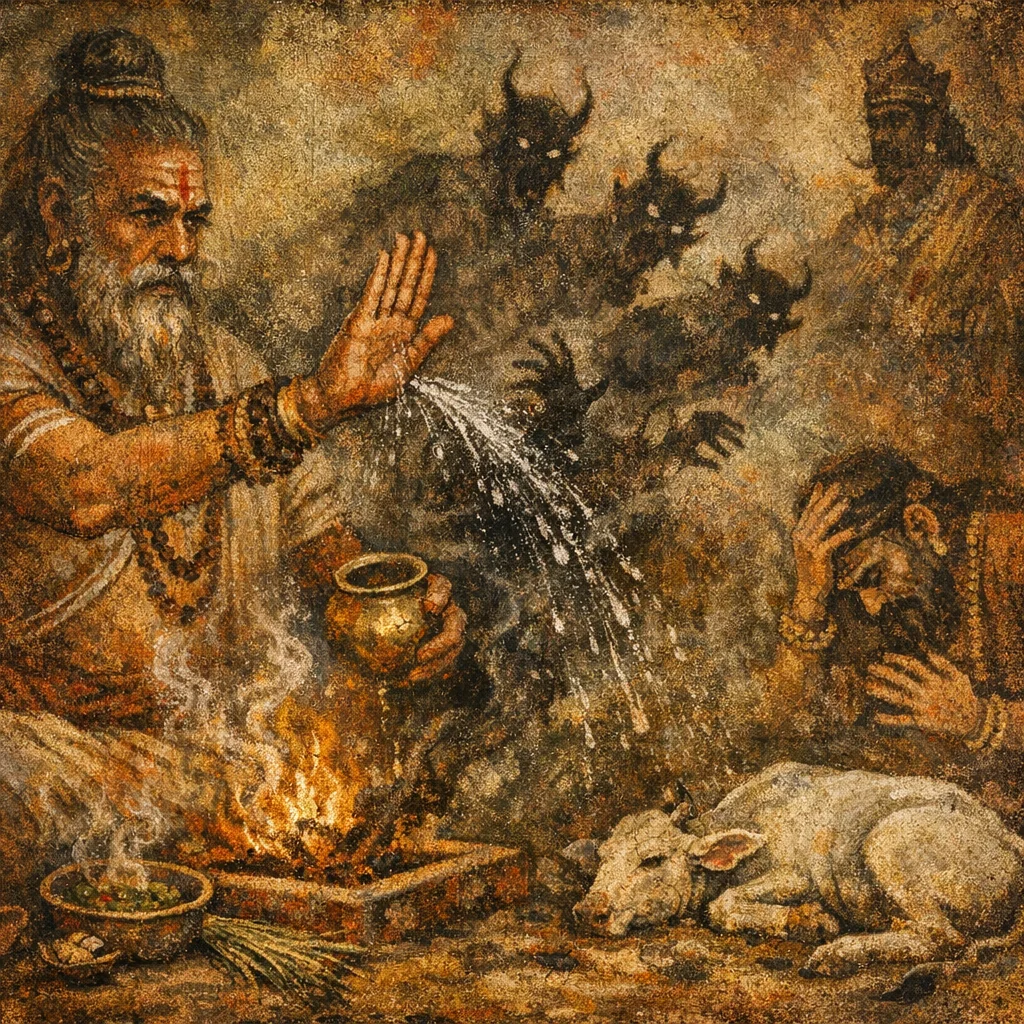
Sukta 19
Rishi: Atharvanic tradition (Anukramaṇī attribution for AV 5.19 commonly to Atharvan/Angiras-type seers; consult edition-specific Anukramaṇī for exact name).
Devata: Āpas (Waters) and the Devas as adjudicators; the ‘brahmajya’ as the ritual target.
Chandas: Anuṣṭubh (4 pādas of ~8 syllables; AV practice with minor irregularities).
Mantras
Mantra 1
ब्रह्मगवि अतिमात्रमवर्धन्त नोदिव दिवमस्पृशन्। भृगुं हिंसित्वा सृञ्जया वैतहव्याः पराभवन्
The brahman-cows waxed beyond measure; yet reached they not, as though from on high, unto the heaven. Having done hurt to Bhṛgu, the Sṛñjayas—the Vaitahavyas—fell to overthrow.
Mantra 2
ये बृहत्सामानमाङ्गिरसमार्पयन् ब्राह्मणं जनाः । पेत्वस्तेषामुभयादमविस्तोकान्यावयत्
They who bestowed the great Bṛhat-sāman, Angirasa-born, upon the Brahman—those folk, the Pētvas—Amavi from either side did ward, and kept their drops (their little boons) from harm.
Mantra 3
ये ब्राह्मणं प्रत्यष्ठीवन् ये वास्मिञ्छुल्कमीषिरे। अस्नस्ते मध्ये कुल्यायाः केशान् खादन्त आसते
They who have spat in scorn against a Brahman, or who within this realm have sought to exact a fee—unbathed, in the midst of a ditch, they sit abiding, gnawing at their own hair.
Mantra 4
ब्रह्मगवी पच्यमाना यावत् साभि विजङ्गहे । तेजो राष्ट्रस्य निर्हन्ति न वीरो जायते वृषा
So long as the Brahman’s cow is being cooked, so long she assails: she smites away the kingdom’s fiery might; no hero, no bull-like champion is born.
Mantra 5
क्रूरमस्या आशसनं तृष्टं पिशितमस्यते । क्षीरं यदस्याः पीयते तद् वै पितृषु किल्बिषम्
Cruel is the eating of her—her flesh is devoured in greedy thirst; and the milk of her that is drunk, that verily is guilt among the Fathers.
Mantra 6
उग्रो राजा मन्यमानो ब्राह्मणं यो जिघत्सति । परा तत् सिच्यते राष्ट्रं ब्राह्मणो यत्र जीयते
A fierce king, deeming himself mighty, who would slay a Brahman—then is that realm poured away to ruin, where the Brahman is made to be conquered.
Mantra 7
अष्टापदी चतुरक्षी चतुःश्रोत्रा चतुर्हनुः । द्व्याऽस्या द्विजिह्वा भूत्वा सा राष्ट्रमव धूनुते ब्रह्मज्यस्य
Eight-footed, four-eyed, four-eared, four-jawed—becoming two-faced and two-tongued, she shakes the kingdom down, the dread power that cleaves to the Brahman-injurer.
Mantra 8
तद् वै राष्ट्रमा स्रवति नावं भिन्नामिवोदकम्। ब्रह्माणं यत्र हिंसन्ति तद् राष्ट्रं हन्ति दुच्छुना
Verily that realm runneth out and away, as water from a boat that is cloven. Where men do violence unto the Brahman, that realm—by evil ill-luck—he smiteth down.
Mantra 9
तं वृक्षा अप सेधन्ति छायां नो मोपगा इति । यो ब्राह्मणस्य सद् धनमभि नारद मन्यते
Him do the trees thrust back: ‘Approach not thou our shade,’ say they—whoso, O Nārada, doth set his thought upon the rightful wealth of a Brahman.
Mantra 10
विषमेतद् देवकृतं राजा वरुणोऽब्रवीत्। न ब्राह्मणस्य गां जग्ध्वा राष्ट्रे जागार कश्चन
‘A perilous thing is this, ordained of gods,’ King Varuṇa hath proclaimed: ‘No man, having eaten the Brahman’s cow, within the realm keepeth watch in safety.’
Mantra 11
नवैव ता नवतयो या भूमिर्व्यऽधूनुत । प्रजां हिंसित्वा ब्राह्मणीमसंभव्यं पराभवन्
Even nine—those companies of ninety—whom Earth cast off and scattered: for, having harmed the folk and wrought outrage upon a Brahmin woman, they fell to ruin, a deed intolerable.
Mantra 12
यां मृतायानुबध्नन्ति कूद्यंऽ पदयोपनीम्। तद् वै ब्रह्मज्य ते देवा उपस्तरणमब्रुवन्
That which they bind upon a dead woman—(as) a wall-covering, a foot-laid upper cloth—this verily the gods have ordained as bedding for the brahman-hurter.
Mantra 13
अश्रूणि कृपमानस्य यानि जीतस्य वावृतुः । तं वै ब्रह्मज्य ते देवा अपां भागमधारयन्
The tears of him that piteously lamenteth—those which have encompassed the conquered—him, verily, as Brahman-slayer, the Gods have held back from the Waters’ portion.
Mantra 14
येन मृतं स्नपयन्ति श्मश्रूणि येनोन्दते । तं वै ब्रह्मज्य ते देवा अपां भागमधारयन्
That wherewith they wash the dead, wherewith they moisten the beard—him, verily, as Brahman-slayer, the Gods have held back from the Waters’ portion.
Mantra 15
न वर्षं मैत्रावरुणं ब्रह्मज्यमभि वर्षति । नास्मै समितिः कल्पते न मित्रं नयते वशम्
No Mitra-Varuṇa rain raineth upon the Brahman-slayer; for him no assembly is made ready; no friend bringeth (aught) under his control.
Frequently Asked Questions
It ritually marks the offender as ineligible for purification and prosperity by declaring that the Devas withhold from him the ‘share of the Waters,’ i.e., access to cleansing rites and communal benefit.
In Vedic thought, waters carry purification, blessing, and reintegration. If waters are withheld, the person remains publicly and ritually ‘stuck’ in pollution, which enforces exclusion until expiation.
Both. The abhicarika edge excludes the offender, while the broader aim is protective: it defends Brahmins, stabilizes the kingdom (rāṣṭra), and reinforces the rule that harming Brahmanic persons/power endangers everyone.