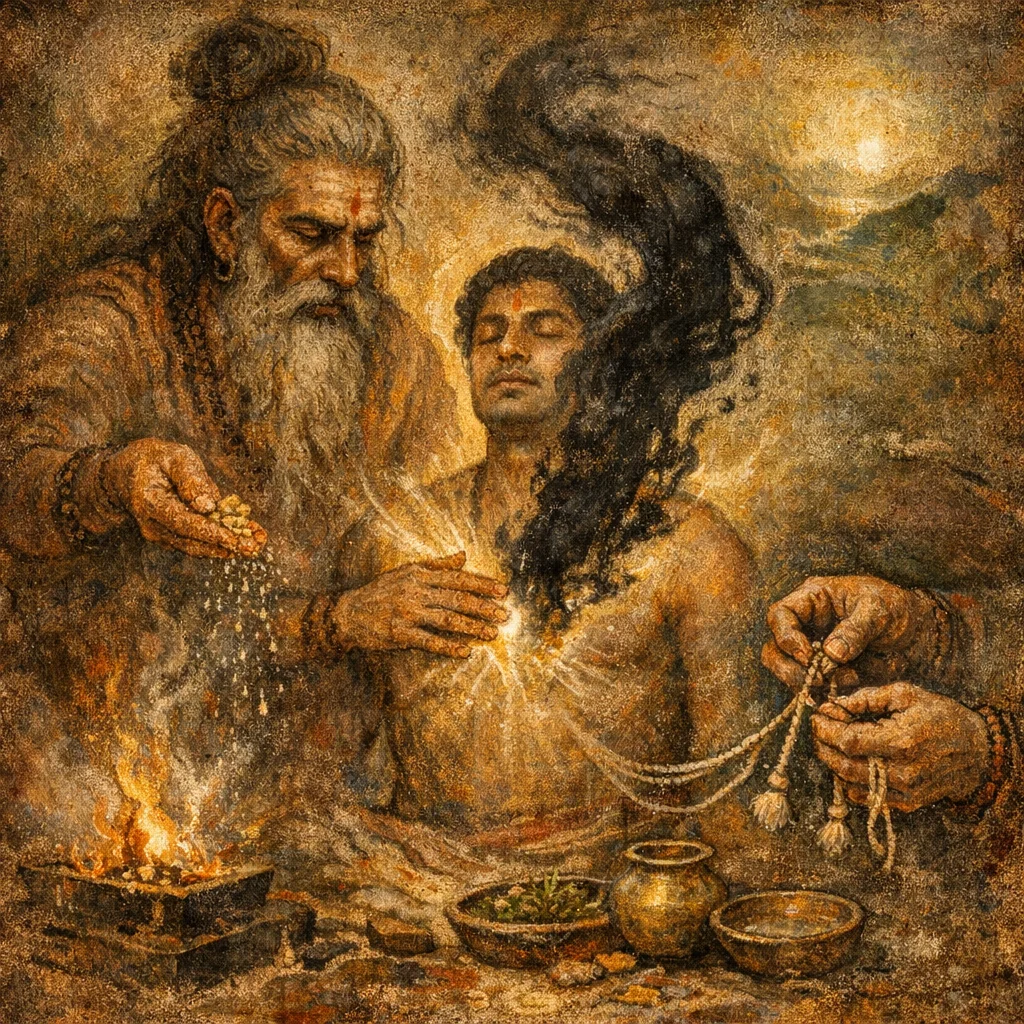
Sukta 11
Rishi: Atharvanic healer tradition (often Atharvan/Angirasic attribution for bhaiṣajya hymns)
Devata: Indra-Agni; also implicitly Yakṣma and Grahi as adversarial agents
Chandas: Triṣṭubh (probable; requires metrical verification)
Mantras
Mantra 1
दीर्घायुः प्राप्तिः। मुञ्चामि त्वा हविषा जीवनाय कमज्ञातयक्ष्मादुत राजयक्ष्मात्। ग्राहिर्जग्राह यद्येतदेनं तस्या इन्द्राग्नी प्र मुमुक्तमेनम्
Attainment of long life. With oblation I loose thee forth for life, from unknown wasting and from royal wasting. If the Seizer have seized him with this, then from that grasp, O Indra and Agni, do ye wholly release him.
Mantra 2
यदि क्षितायुर्यदि वा परेतो यदि मृत्योरन्तिकं नीत एव। तमा हरामि निरृतेरुपस्थादस्पार्शमेनं शतशारदाय
If his life be spent, or if he be departed, if verily he hath been led nigh unto Death—him do I bring back from Nirṛti’s very lap, making him untouched, for a hundred autumns.
Mantra 3
सहस्राक्षेण शतवीर्येण शतायुषा हविषाहार्षमेनम्। इन्द्रो यथैनं शरदो नयात्यति विश्वस्य दुरितस्य पारम्
With thousand-eyed power, with hundredfold might, with hundredfold life—by oblation I cheer him. So may Indra lead him through the autumns, across unto the farther shore of every ill.
Mantra 4
शतं जीव शरदो वर्धमानः शतं हेमन्तान् छतमु वसन्तान्। शतं त इन्द्रो अग्निः सविता बृहस्पतिः शतायुषा हविषाहार्षमेनम्
Live thou a hundred years, waxing through a hundred autumns; a hundred winters, yea a hundred springs. For thee may Indra, Agni, Savitar, and Bṛhaspati—by oblation and by a life of hundred years—have made this man to prosper.
Mantra 5
प्र विशतं प्राणापानावनड्वाहाविव व्रजम्। व्य१न्ये यन्तु मृत्यवो यानाहुरितरान् छतम्
Enter ye forth, O Breath and Out-breath, like two strong oxen into the stall. Away let the other Deaths depart—those which men name, the rest, a hundred more.
Mantra 6
इहैव स्तं प्राणापानौ माप गातमितो युवम्। शरीरमस्याङ्गानि जरसे वहतं पुनः
Here verily stand ye, Breath and Out-breath; go not away from hence, ye twain. Bear back again his body and his members, onward unto old age.
Mantra 7
जरायै त्वा परि ददामि जरायै नि धुवामि त्वा । जरा त्वा भद्रा नेष्ट व्य१न्ये यन्तु मृत्यवो यानाहुरितरान् छतम्
Unto old age I give thee over; unto old age I firmly set thee. May kindly Old Age lead thee on; away let the other Deaths depart—those which men name, the rest, a hundred more.
Mantra 8
अभि त्वा जरिमाहित गामुक्षणमिव रज्ज्वा । यस्त्वा मृत्युरभ्यधत्त जायमानं सुपाशया । तं ते सत्यस्य हस्ताभ्यामुदमुञ्चद् बृहस्पतिः
Upon thee hath Age been laid, as with a rope one bindeth cow or bull. What Death, with well-knit noose, hath fastened on thee from thy very birth—that bond for thee did Bṛhaspati, with the hands of Truth, unloose and draw forth.
Frequently Asked Questions
It targets wasting illness (yakṣma), seizure-like affliction by a grahi (a “seizer”), and the approach of death understood as a binding/noose. The hymn’s aim is release, restored breathing, and long life.
As a pair they represent force and purifying fire acting in tandem: they break hostile grasp, burn away affliction, and re-establish order in the patient’s life-forces. In 3.11.1 they are directly asked to free the patient from the grahi’s hold.
The hymn calls prāṇa and apāna to “enter” properly again (3.11.5), treating stable respiration as the sign and instrument of restored life. Once breath is re-seated, the text commands the many forms of death to depart.