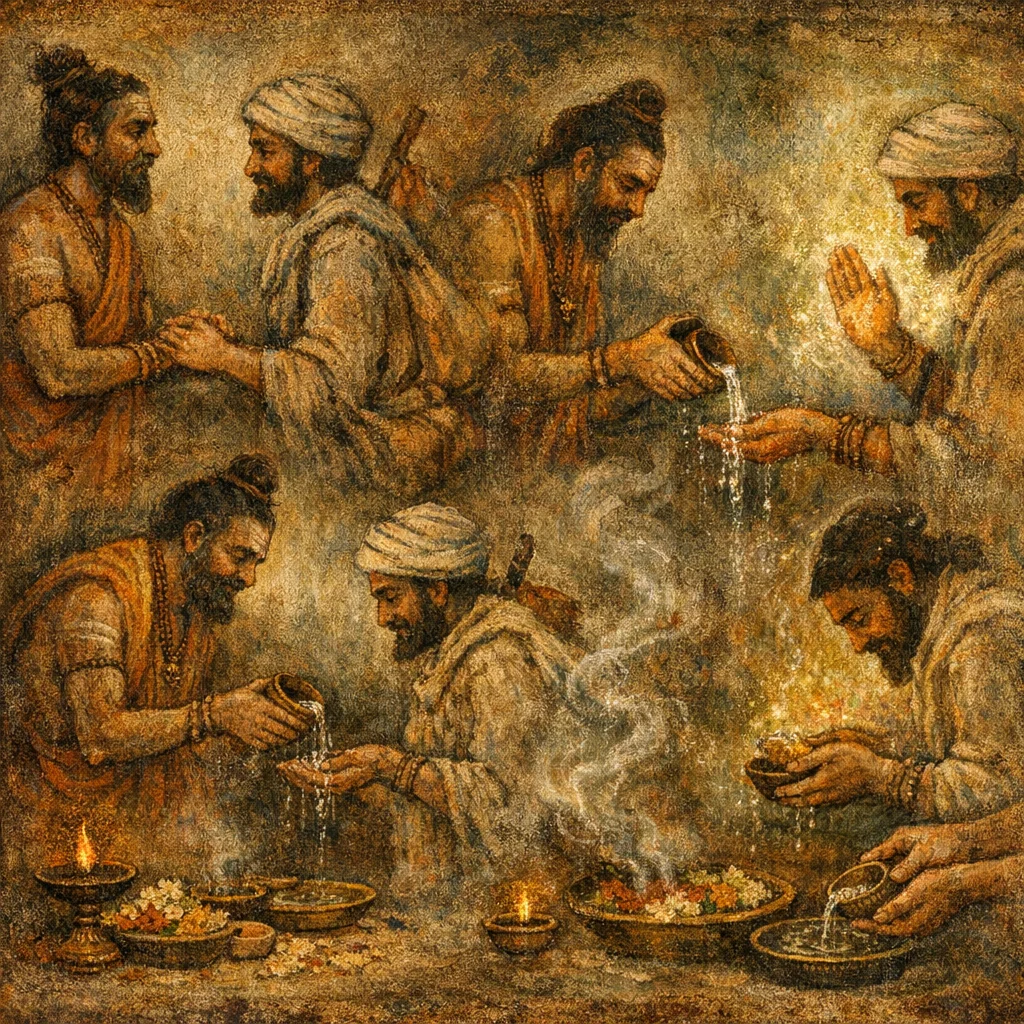
Sukta 11
Rishi: Vrātya-speculation section (traditional attribution varies; often treated as Atharvanic/brāhmaṇa-style prose-verse without a single fixed ṛṣi in later lists)
Devata: Vrātya (as empowered ritual persona); efficacy grounded in ‘speech-as-power’
Chandas: Mixed/irregular (late Atharvanic style; not a strict RV meter)
Mantras
Mantra 1
तद् यस्यैवं विद्वान् व्रात्योऽतिथिर्गृहानागछेत्
Whoso, thus instructed, hath the Vrātya for a guest come unto his house—(for him this ordinance holds).
Mantra 2
स्वयमेनमभ्युदेत्य ब्रूयाद् व्रात्य क्वाऽवात्सीर्व्रात्योदकं व्रात्य तर्पयन्तु व्रात्य यथा ते प्रियं तथास्तु व्रात्य यथा ते वशस्तथास्तु व्रात्य यथा ते निकामस्तथास्त्विति
Let him himself go forth to meet him, and say: ‘O Vrātya, where hast thou lodged? O Vrātya, (take) water; O Vrātya, let them refresh thee. O Vrātya, as is thy pleasure, so be it; O Vrātya, as is thy will, so be it; O Vrātya, as is thy desire, so be it.’
Mantra 3
यदेनमाह व्रात्य क्वाऽवात्सीरिति पथ एव तेन देवयानानव रुन्द्धे
In that he saith unto him, ‘O Vrātya, where hast thou lodged?’—thereby he verily maketh fast the paths, even the god-going paths.
Mantra 4
यदेनमाह व्रात्योदकमित्यप एव तेनाव रुन्द्धे
In that he saith unto him, ‘O Vrātya, (here is) water,’—thereby he verily maketh fast the Waters.
Mantra 5
यदेनमाह व्रात्य तर्पयन्त्विति प्राणमेव तेन वर्षीयांसं कुरुते
In that he saith unto him, ‘O Vrātya, let them refresh thee,’—thereby he maketh the vital breath itself more abundant.
Mantra 6
यदेनमाह व्रात्य यथा ते प्रियं तथास्त्विति प्रियमेव तेनाव रुन्द्धे
When the Vrātya saith to him, ‘As is thy dear wish, so be it,’—by that (utterance) he verily secures for himself the very thing that is dear.
Mantra 7
ऐनं प्रियं गच्छति प्रियः प्रियस्य भवति य एवं वेद
Unto him cometh the dear (boon); dear he becometh unto the dear—whoso thus hath knowledge.
Mantra 8
यदेनमाह व्रात्य यथा ते वशस्तथास्त्विति वशमेव तेनाव रुन्द्धे
When the Vrātya saith to him, ‘As is thy mastery, so be it,’—by that he verily secures for himself mastery.
Mantra 9
ऐनं वशो गच्छति वशी वशिनां भवति य एवं वेद
Unto him cometh mastery; a master he becometh among masters—whoso thus hath knowledge.
Mantra 10
यदेनमाह व्रात्य यथा ते निकामस्तथास्त्विति निकाममेव तेनाव रुन्द्धे
When the Vrātya saith to him, ‘As is thy full desire, so be it,’—by that he verily secures for himself fulfilment of desire.
Mantra 11
ऐनं निकामो गच्छति निकामे निकामस्य भवति य एवं वेद
Unto him cometh Fulfilled-Desire; in Fulfilled-Desire he is established; he becometh the possessor of Fulfilled-Desire—whoso thus knoweth.
Frequently Asked Questions
In this hymn the Vrātya functions as an empowered ritual persona: a figure whose authoritative speech and formulas are treated as effective forces that produce prosperity and acceptance.
Priya means what is dear—often favor, affection, and social acceptance. The sukta frames it as something secured by the Vrātya’s performative blessing: ‘As is your dear wish, so be it.’
Because the text grounds results in correct understanding: knowledge of how the formula works is itself the means of attainment, culminating in nikāma—fulfilled desire—being said to ‘come’ to the knower.