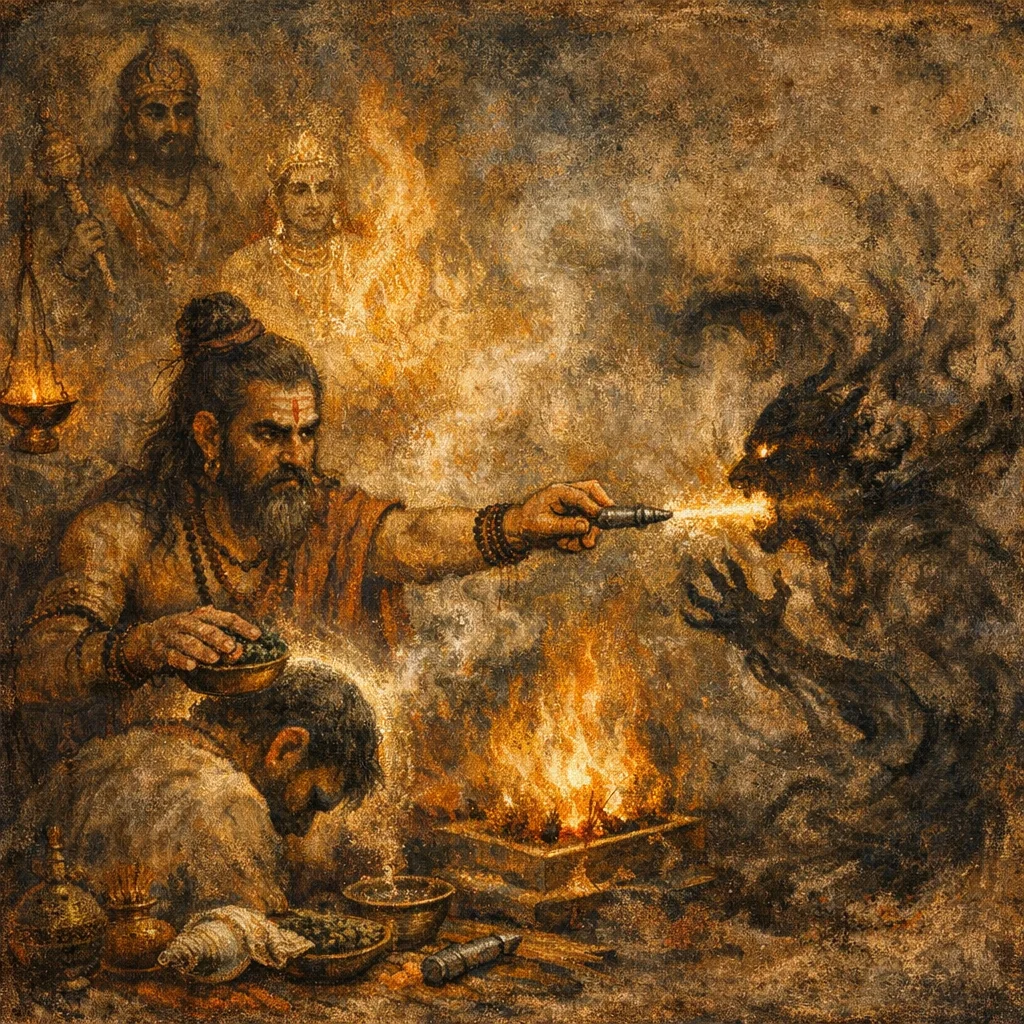
Sukta 16
Rishi: Atharvanic tradition (seer not securely individualized for this single verse in common indices)
Devata: Lead as apotropaic power (material devatā) under the authority of Varuṇa, Agni, and Indra; functional devatā: yātucātana (expulsion of yātu).
Chandas: Anuṣṭubh (4 pādas of ~8 syllables; Atharvanic anuṣṭubh with minor irregularities possible)
Mantras
Mantra 1
शत्रुबाधनम्। येऽमावास्यां३ रात्रिमुदस्थुर्व्राजमत्त्रिणः । अग्निस्तुरीयो यातुहा सो अस्मभ्यमधि ब्रवत्
Enemy-crushing. Whoso on the new-moon night have risen up—devourers—against the cattle-fold: Agni, the Fourth, the slayer of sorcery, he hath spoken his decree over us.
Mantra 2
सीसायाध्याह वरुणः सीसायाग्निरुपावति । सीसं म इन्द्रः प्रायच्छत् तदङ्ग यातुचातनम्
With lead, Varuṇa hath spoken it; with lead doth Agni draw near to aid. Lead Indra hath bestowed on me: that, verily, is the yātu-expeller.
Mantra 3
इदं विष्कन्धं सहत इदं बाधते अत्त्रिणः । अनेन विश्वा ससहे या जातानि पिशाच्याः
This overcomes Viṣkandha; this drives away the Devourers. By means of this I have subdued them all—whatsoever Pisāca-born brood have come to birth.
Mantra 4
यदि नो गां हंसि यद्यश्वं यदि पूरुषम्। तं त्वा सीसेन विध्यामो यथा नोऽसो अवीरहा
If thou smite our cow, if our horse, if a man of ours,—thee will we pierce with lead, that thou, O thou, mayest be no slayer of our heroes.
Frequently Asked Questions
It is used to repel yātu—hostile sorcery and spirit-attack—and to protect cattle, horses, and people from afflictions like Viṣkandha and Piśāca-type ‘devourers.’
Lead is treated as a sealing, protective material that can be mantra-empowered into an amulet and, ritually, into a ‘piercing’ counter-force that blocks and drives away harmful agencies.
The verses foreground lead rather than naming a specific plant; the practical tradition typically uses a mantra-charged object (‘idam’) as the medium, with lead as the primary substance.