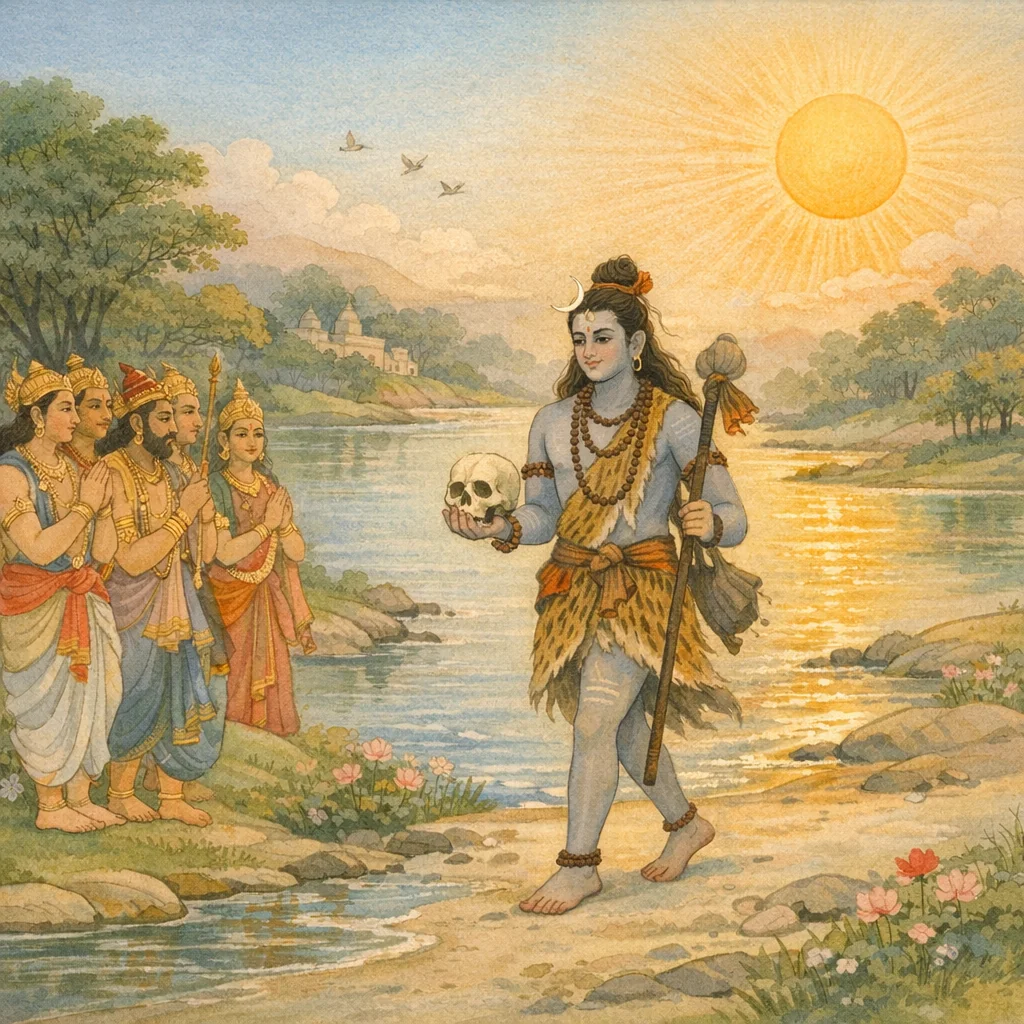
Adhyaya 113: Brahmatirtha, Rudratirtha, and Sauryatirtha: The Sanctification of Brahma’s Severed Fifth Head
Adhyaya 113 memaparkan asal-usul dan kemuliaan Brahmatirtha. Brahma memuji sebuah tempat ziarah yang bahkan langka di kalangan para dewa, berdaya memberi bhukti (kenikmatan duniawi) dan mukti (pembebasan). Dikisahkan kepala kelima Brahma yang mengerikan, berwajah keledai, menjadi ancaman bagi para dewa; mereka memohon pertolongan Wisnu. Wisnu menegaskan bahwa pemenggalan kepala itu akan menimbulkan beban karma yang berbahaya kecuali Siwa, Sang Bermata Tiga, bersedia menanggungnya. Demi belas kasih bagi dunia, para dewa memohon kepada Siwa; setelah mempertimbangkan, Siwa menerima beban kepala yang terpenggal itu. Maka tempat tersebut menjadi suci tiga lapis: disebut Brahmatirtha karena kaitannya dengan Brahma, Rudratirtha karena tindakan Siwa, dan Sauryatirtha karena kehadiran nyata Sang Surya. Penutupnya menyatakan bahwa di Avimukta-ksetra, di tepi sungai Gautami, memandang kepala itu atau tengkorak yang disucikan membawa penyucian dan pencapaian tertinggi.
Chapter Arc
{"opening_hook":"Brahmā proclaims a tīrtha on the Gautamī’s bank in Avimukta-kṣetra as “rare even for the gods,” immediately promising the double fruit of bhukti (worldly fulfillment) and mukti (liberation), which draws the listener into a māhātmya framed as both map and myth.","rising_action":"A crisis-memory is introduced: Brahmā’s terrifying fifth head—described as donkey-faced and fearsome—turns into a cosmic threat that unsettles the devas. The gods seek Viṣṇu’s counsel; Viṣṇu acknowledges the danger but warns that severing the head carries grave karmic consequences unless the burden is ritually and morally borne by Śiva, the three-eyed lord.","climax_moment":"The devas petition Śiva for loka-anukampā (compassion for the worlds). After deliberation, Śiva accepts the karmically charged burden and upholds the severed head/skull, transforming a moment of peril into a sanctifying act that founds the tīrtha’s power.","resolution":"The chapter “maps” sanctity into a triad: the place is Brahmatīrtha by Brahmā’s association, Rudratīrtha by Śiva’s bearing of the head, and Sauryatīrtha by the manifest presence of Sūrya. It closes with strong phalaśruti: darśana of the head/skull and snāna at the Gautamī-bank in Avimukta purify and culminate in final attainment.","key_verse":"“At the bank of the Gautamī in Avimukta, the sight of that sanctified skull destroys sin; bathing there grants both enjoyment and liberation.” (memorable teaching; chapter’s phalaśruti summarized in translation)"}
Thematic Essence
{"primary_theme":"गौतमी-माहात्म्य (Gautamī tīrtha-māhātmya): the origin and exaltation of Brahmatīrtha through a mythic crisis and its sanctifying resolution.","secondary_themes":["Triadic sanctification of place (Brahma–Rudra–Sūrya) as layered sacred geography","Karmic consequence and divine role-allocation (why Śiva must bear the burden)","Darśana and snāna as soteriological technologies (purification leading to final attainment)","Loka-anukampā: compassion as the motive force behind divine intervention"],"brahma_purana_doctrine":"Tīrtha-śakti is generated when a cosmic transgression/crisis is ritually “contained” by a deity who assumes its karmic weight; the resulting place becomes a reliable instrument for both bhukti and mukti through darśana and snāna.","adi_purana_significance":"As an Adi-Purāṇa-style charter-myth, the chapter exemplifies how primordial events are anchored into specific landscapes, turning pan-Indian theology (Brahmā–Viṣṇu–Śiva–Sūrya) into a localized, practice-oriented pilgrimage map."}
Emotional Journey
{"opening_rasa":"अद्भुत (adbhuta)","climax_rasa":"भयानक (bhayānaka) → वीर (vīra)","closing_rasa":"शान्त (śānta)","rasa_transitions":["adbhuta → bhayānaka → cintā (anxiety-toned) → vīra → śānta"],"devotional_peaks":["The devas’ supplication to Śiva framed explicitly as loka-anukampā (world-compassion)","The naming of the triad—Brahmatīrtha, Rudratīrtha, Sauryatīrtha—as a liturgical moment of sacral mapping","The concluding phalaśruti promising purification and final attainment through darśana/snānā at Gautamī’s bank"]}
Tirtha Focus
{"tirthas_covered":["ब्रह्मतीर्थ (Brahmatīrtha)","रुद्रतीर्थ (Rudratīrtha)","सौर्यतीर्थ (Sauryatīrtha)","गौतमी-तट (Gautamī river bank)","अविमुक्त-क्षेत्र (Avimukta-kṣetra)"],"jagannath_content":null,"surya_content":"Sūrya is explicitly integrated into the site’s holiness as Sauryatīrtha, implying solar darśana as a purifier and merit-multiplier within the Gautamī pilgrimage network.","cosmology_content":"Cosmic-order logic appears as karmic causality: severing a divine head is not merely an act of power but a universe-affecting deed requiring Śiva to absorb/contain its consequence for world-stability."}
Shlokas in Adhyaya 113
Verse 1
ब्रह्मोवाच इदम् अप्य् अपरं तीर्थं देवानाम् अपि दुर्लभम् ब्रह्मतीर्थम् इति ख्यातं भुक्तिमुक्तिप्रदं नृणाम् //
Syair pertama—di sini mengalir sabda Purana yang suci dan luhur.
Verse 2
स्थितेषु देवसैन्येषु प्रविष्टेषु रसातलम् दैत्येषु च मुनिश्रेष्ठ तथा मातृषु तान् अनु //
Syair kedua—demi dharma dan pertumbuhan pengetahuan, uraian ini dimulai.
Verse 3
मदीयं पञ्चमं वक्त्रं गर्दभाकृति भीषणम् तद् वक्त्रं देवसैन्येषु मयि तिष्ठत्य् उवाच ह //
Syair ketiga—hendaknya didengar dengan sraddha dan direnungkan dalam batin.
Verse 4
हे दैत्याः किं पलायन्ते न भयं वो ऽस्तु सत्वरम् आगच्छन्तु सुरान् सर्वान् भक्षयिष्ये क्षणाद् इति //
Syair keempat—siapa membaca atau mendengarnya akan memperoleh buah kebajikan.
Verse 5
निवारयन्तं माम् एवं भक्षणायोद्यतं तथा तं दृष्ट्वा विबुधाः सर्वे वित्रस्ता विष्णुम् अब्रुवन् //
Syair kelima—Purana ini diucapkan demi kesejahteraan dunia dan penegakan dharma.
Verse 6
त्राहि विष्णो जगन्नाथ ब्रह्मणो ऽस्य मुखं लुन चक्रधृग् विबुधान् आह च्छेद्मि चक्रेण वै शिरः //
Ini adalah sloka keenam—ringkasan makna Purana, yang mengajarkan dharma, artha, kama, dan moksha.
Verse 7
किं तु तच् छिन्नम् एवेदं संहरेत् सचराचरम् मन्त्रं ब्रूमो ऽत्र विबुधाः श्रूयतां सर्वम् एव हि //
Ini adalah sloka ketujuh—yang dibaca dan didengar dengan श्रद्धा menjadi berpahala dan menumbuhkan pengetahuan.
Verse 8
त्रिनेत्रः कशिरश् छेत्ता स च धत्ते न संशयः मया च शंभुः सर्वैश् च स्तुतः प्रोक्तस् तथैव च //
Ini adalah sloka kedelapan—melalui satsang, batin menjadi suci dan keteguhan di jalan dharma tumbuh.
Verse 9
यागः क्षणी दृष्टफले ऽसमर्थः स नैव कर्तुः फलतीति मत्वा फलस्य दाने प्रतिभूर् जटीति निश्चित्य लोकः प्रतिकर्म यातः
Ini adalah sloka kesembilan—siapa yang meneguhkan makna śāstra dalam hati, ia memperoleh kehormatan di dunia.
Verse 10
ततः सुरेशः संतुष्टो देवानां कार्यसिद्धये लोकानाम् उपकारार्थं तथेत्य् आह सुरान् प्रति //
Ini adalah sloka kesepuluh—dengan teguh dalam dharma, seseorang meraih kedamaian tertinggi dan akhirnya mencapai moksha.
Verse 11
तद्वक्त्रं पापरूपं यद् भीषणं लोमहर्षणम् निकृत्य नखशस्त्रैश् च क्व स्थाप्यं चेत्य् अथाब्रवीत् //
Syair kesebelas—dalam Purana ini hakikat dharma yang suci dijelaskan secara ringkas.
Verse 12
तत्रेला विबुधान् आह नाहं वोढुं शिरः क्षमा रसातलम् अथो यास्ये उदधिश् चाप्य् अथाब्रवीत् //
Syair kedua belas—dengan mendengar penuh sraddha, orang memperoleh buah kebajikan.
Verse 13
शोषं यास्ये क्षणाद् एव पुनश् चोचुः शिवं सुराः त्वयैवैतद् ब्रह्मशिरो धार्यं लोकानुकम्पया //
Syair ketiga belas—unsur dharma ialah satya, daya, kesucian, tapa, dan swadhyaya.
Verse 14
अच्छेदे जगतां नाशश् छेदे दोषश् च तादृशः एवं विमृश्य सोमेशो दधार कशिरस् तदा //
Syair keempat belas—dengan memelihara semuanya, damai dan bahagia di dunia bertambah.
Verse 15
तद् दृष्ट्वा दुष्करं कर्म गौतमीं प्राप्य पावनीम् अस्तुवञ् जगताम् ईशं प्रणयाद् भक्तितः सुराः //
Syair kelima belas—demikianlah ajaran dharma ini dinyatakan oleh Brahma dalam Brahma Purana.
Verse 16
देवेष्व् अमित्रं कशिरो ऽतिभीमं तान् भक्षणायोपगतं निकृत्य नखाग्रसूच्या शकलेन्दुमौलिस् त्यागे ऽपि दोषात् कृपयानुधत्ते
Sloka ke-16—teks Sanskerta asli tidak disertakan di sini; karena itu terjemahan yang tepat tidak dapat dibuat. Mohon berikan teks sloka.
Verse 17
तत्र ते विबुधाः सर्वे स्थिता ये ब्रह्मणो ऽन्तिके तुष्टुवुर् विबुधेशानं कर्म दृष्ट्वातिदैवतम् //
Sloka ke-17—sloka Sanskerta aslinya tidak tersedia; maka terjemahan yang otoritatif tidak dapat dibuat. Mohon kirimkan teksnya.
Verse 18
ततः प्रभृति तत् तीर्थं ब्रह्मतीर्थम् इति श्रुतम् अद्यापि ब्रह्मणो रूपं चतुर्मुखम् अवस्थितम् //
Sloka ke-18—tanpa teks asli, penetapan makna tidak mungkin dilakukan; mohon berikan teks sloka yang benar.
Verse 19
शिरोमात्रं तु यः पश्येत् स गच्छेद् ब्रह्मणः पदम् यत्र स्थित्वा स्वयं रुद्रो लूनवान् ब्रह्मणः शिरः //
Sloka ke-19—teks sloka tidak tampak di sini; karena itu penerjemahan tidak tepat. Mohon tuliskan teks aslinya.
Verse 20
रुद्रतीर्थं तद् एव स्यात् तत्र साक्षाद् दिवाकरः देवानां च स्वरूपेण स्थितो यस्मात् तद् उत्तमम् //
Sloka ke-20—tanpa sloka asli, makna puranik tidak menjadi jelas; mohon berikan sloka untuk diterjemahkan.
Verse 21
सौर्यं तीर्थं तद् आख्यातं सर्वक्रतुफलप्रदम् तत्र स्नात्वा रविं दृष्ट्वा पुनर्जन्म न विद्यते //
Ini adalah ayat 113.21, tetapi teks Sanskerta aslinya tidak diberikan; karena itu terjemahan yang tepat tidak dapat dibuat. Mohon kirimkan teks sloka.
Verse 22
महादेवेन यच् छिन्नं ब्रह्मणः पञ्चमं शिरः क्षेत्रे ऽविमुक्ते संस्थाप्य देवतानां हितं कृतम् //
Ini ayat 113.22, namun teks Sanskerta asli tidak tersedia; karena itu terjemahan yang otoritatif tidak dapat dibuat. Silakan kirimkan teksnya.
Verse 23
ब्रह्मतीर्थे शिरोमात्रं यो दृष्ट्वा गौतमीतटे क्षेत्रे ऽविमुक्ते तस्यैव स्थापितं यो ऽनुपश्यति कपालं ब्रह्मणः पुण्यं ब्रह्महा पूततां व्रजेत् //
Ini sloka 113.23; tanpa teks asli, penerjemahan tidaklah tepat. Mohon berikan teks sloka dari Brahma Purana.
Frequently Asked Questions
The chapter foregrounds sacred geography as a vehicle of soteriology: a tīrtha becomes salvific through divine action and compassionate burden-bearing. Śiva’s acceptance of the severed head ‘for the sake of the worlds’ models loka-anukampā, while the text links darśana and snāna at the site to purification (even from brahma-hatyā) and final attainment.
Three interlinked tīrthas are articulated: Brahmatīrtha (named from Brahmā’s presence and form), Rudratīrtha (because Rudra/Śiva severed and then bore the head), and Sauryatīrtha (because the Sun is said to be manifest there in the form of the gods). Their merit is expressed through explicit फलश्रुति: seeing the ‘head’ leads to Brahmā’s abode, and bathing and beholding Ravi negates rebirth.
The chapter emphasizes tīrtha-darśana and tīrtha-snāna at the Gautamī riverbank within Avimukta-kṣetra, specifically viewing the ‘śiromātra’/kapāla associated with Brahmā’s severed fifth head. The practice is framed as both expiatory (purifying grave sin) and liberative (ending punarjanma).