Adhyaya 8
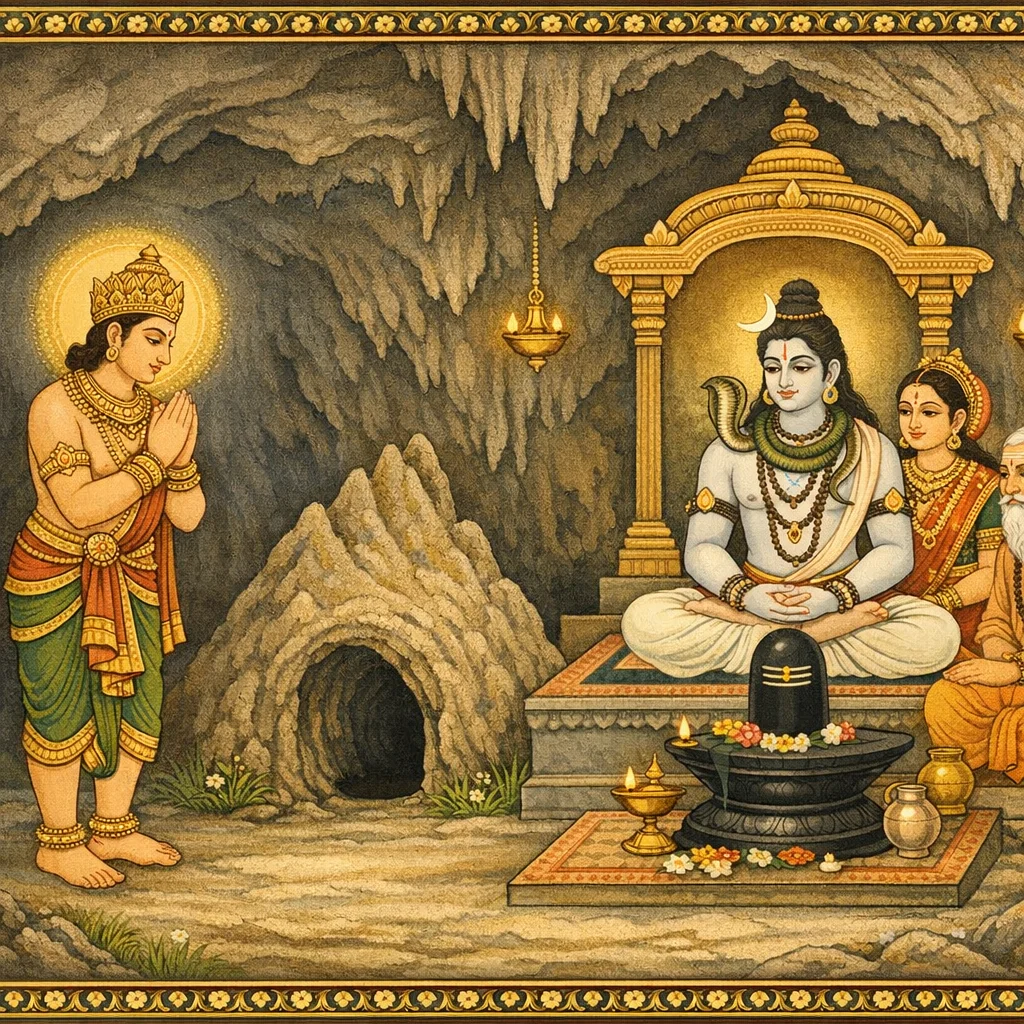
Sūta recounts the rise of a tīrtha famed in the three worlds, connected with Triśaṅku’s wondrous ascent achieved through Viśvāmitra’s power. The chapter declares this holy place untouched by Kali’s corruption and able to annul even grave sins; bathing there—and even dying there—leads to Śiva’s realm, with its grace extending even to animals. As people come to rely on a single act—bathing and devotion to the liṅga—other yajñas and ascetic observances decline, and the gods grow anxious as their sacrificial shares cease. Indra orders the site choked with dust; in time an anthill becomes a nāga-bila, a serpent passage between pātāla and the earth. The narrative then turns to Indra’s brahmahatyā incurred after the deceitful slaying of Vṛtra (whose austerities, boons, and conflict with the gods are recalled). Though Indra circuits many tīrthas, the impurity remains until a divine voice directs him through the nāga-bila down to pātāla; there he bathes in Pātāla-Gaṅgā and worships Hāṭakeśvara, instantly regaining purity and radiance. The chapter ends by warning that the passage must be sealed again to prevent uncontrolled access, and with a phalaśruti promising supreme attainments to devoted reciters and listeners.
Shlokas
Verse 1
। सूत उवाच । एवं स्वर्गमनुप्राप्ते त्रिशंकौ नृपसत्तमे । सशरीरे द्विजश्रेष्ठा विश्वामित्रसमुद्यमात्
Sūta said: Thus, O best of kings, Triśaṅku attained heaven with his very body, through the mighty endeavor of the foremost of brāhmaṇas, Viśvāmitra.
Verse 2
तत्तीर्थं ख्यातिमायातं समस्ते भुवनत्रये । ततःप्रसूति लोकानां धर्मकामार्थमोक्षदम्
That tīrtha became renowned throughout the three worlds; from it arises benefit for beings, granting dharma, desire (kāma), prosperity (artha), and liberation (mokṣa).
Verse 3
अस्पृष्टं कलिदोषेण तथान्यैरुपपातकैः । ब्रह्महत्यादिकैश्चैवत्रिपुरारेः प्रभावतः
This tīrtha is untouched by the taint of the Kali age and by other subsidiary sins—such as brahmin-slaying; by the power of Tripurāri (Śiva) it remains ever pure.
Verse 4
यस्तत्र त्यजति प्राणाञ्छ्रद्धा युक्तेन चेतसा । स मोक्षमाप्नुयान्मर्त्यो यद्यपि स्यात्सुपापकृत्
Whoever gives up life there with a mind endowed with faith—such a mortal attains liberation (mokṣa), even if he had committed very great sins.
Verse 5
कृमिपक्षिपतंगा ये पशवः पक्षिणो मृगाः । तेऽपि तत्र मृता यांति शिवलोकमसंशयम्
Worms, birds, insects, cattle, fowl, and wild animals—if they die there, they too go to Śiva’s world, without doubt.
Verse 6
स्नानं ये तत्र कुर्वंति श्रद्धापूतेन चेतसा । त्रिशंकुरिव ते स्वर्गे प्रयांत्यपि विधर्मिणः
Those who bathe there with a mind purified by faith go to heaven like Triśaṅku—even if they are outsiders to proper dharma.
Verse 7
घर्मार्त्ता वा तृषार्ता वा येऽवगाहंति तज्जलम् । तेऽपि यांति परं स्थानं यत्र देवो महेश्वरः
Whether tormented by heat or tormented by thirst, those who merely immerse in that water also reach the supreme abode where the Lord Maheśvara dwells.
Verse 8
विश्वामित्रोऽपि तद्दृष्ट्वा तीर्थमाहात्म्यमुत्तमम् । कुरुक्षेत्रं परित्यज्य तत्र वासमथाकरोत्
Even Viśvāmitra, seeing the unsurpassed greatness of that tīrtha, left Kurukṣetra and then made his dwelling there.
Verse 9
तथान्ये मुनयः शांतास्त्यक्त्वा तीर्थानि दूरतः । तत्राश्रमपदं कृत्वा प्रयाताः परमं पदम्
So too, other peaceful sages, abandoning distant tīrthas, established hermitages there and attained the supreme state.
Verse 10
तथैव मनुजाः सर्वे दूरादागत्य सत्वराः । तत्र स्नात्वा दिवं यांति कृत्वा पापशतान्यपि
In the same way, all people, hastening from afar, bathe there and go to heaven—even if they have committed hundreds of sins.
Verse 11
एवं तस्य प्रभावेण तीर्थस्य द्विजसत्तमाः । गच्छमानेषु लोकेषु सुखेन त्रिदिवालयम्
Thus, O best of the twice-born, by the sheer power of that sacred ford (tīrtha), people depart from this world and, with ease, reach the heavenly abode.
Verse 12
अग्निष्टोमादिका सर्वाः समुच्छेदं गताः क्रियाः । न कश्चिद्यजते मर्त्यो न व्रतं कुरुते नरः
All rites such as the Agniṣṭoma and the rest fell into decline; no mortal performed sacrifice, and no man observed vows.
Verse 13
न यच्छति तथा दानं न च तीर्थं निषेवते । केवलं कुरुते स्नानं लिंगभेदे समाहितः
He neither gives charity as prescribed nor properly resorts to the tīrtha; he merely performs bathing, intent upon sectarian distinctions of emblems.
Verse 14
ततः प्रगच्छति स्वर्गं विमानवरमाश्रितः
Thereafter he goes to heaven, having attained a splendid celestial chariot (vimāna).
Verse 15
ततः प्रपूरिताः सर्वे स्वर्गलोका नरैर्द्विजाः । ब्रह्मविष्णुशिवेन्द्रादीन्स्पर्धमानैः सुरोत्तमान्
Then, O twice-born, all the heavenly worlds were filled with men—who, vying even with Brahmā, Viṣṇu, Śiva, Indra, and the foremost gods, pressed in from every side.
Verse 16
ततो देवगणाः सर्वे यज्ञभागविवर्जिताः । कृच्छ्रं परमनुप्राप्ता मन्त्रं चक्रुः परस्परम्
Then all the hosts of gods, deprived of their shares in the sacrifice, fell into great distress and consulted one another.
Verse 17
हाटकेश्वरमाहात्म्यात्स्वर्गलोकः प्रपूरितः । ऊर्ध्वबाहुभिराकीर्णः स्पर्धमानैः समंततः
By the glory of Hāṭakeśvara, the heavenly world became crowded—filled everywhere with those who, raising their arms aloft, clamored and competed all around.
Verse 18
तस्मात्तत्क्रियतां कर्म येनोच्छेदं प्रगच्छति । तीर्थमेद्धरापृष्ठे हाटकेश्वरसंज्ञितम्
Therefore, let that act be carried out by which this is brought to an end—the tīrtha upon the earth’s surface known as Hāṭakeśvara.
Verse 19
ततः संवर्तको वायुः शक्रादेशात्समंततः । तत्क्षेत्रं पूरयामास पांसुभिर्द्विजसत्तमाः
Then, by Indra’s command, the Saṃvartaka wind blew from every direction and filled that sacred field with dust, O best of the twice-born.
Verse 20
एवं नाशमनुप्राप्ते तस्मिंस्तीर्थे स्थलोच्चये । जाते जाताः क्रियाः सर्वा भूयोऽपि क्रतुसंभवाः
Thus, when that tīrtha-site and its raised ground were brought to destruction, all ritual acts arose once again—along with sacrifices born of rites duly performed.
Verse 21
ततः कालेन महता वल्मीकः समपद्यत । तस्मिन्क्षेत्रे स पाताले संप्रयातः शनैःशनैः
Then, after a long passage of time, an anthill (valmīka) came to be formed. In that sacred field it gradually sank down into Pātāla, the netherworld, little by little.
Verse 22
अथ पातालतो नागास्तेन मार्गेण कौतुकात् । मर्त्यलोकं समायांति भ्रमंति च धरातले
Then, out of curiosity, the Nāgas come up from Pātāla by that very passage; they reach the world of mortals and wander upon the earth.
Verse 23
तत्र ते मानवान्भोगान्भुक्त्वा चैव यथेच्छया । पुनर्निर्यांति तेनैव मार्गेण निजमंदिरम्
There they enjoy human pleasures as they wish; and then they depart again, returning by that same passage to their own abode.
Verse 24
ततो नागबिलः ख्यातः स सर्वस्मिन्धरातले । गतागतेन नागानां स वल्मीको द्विजोत्तमाः
Therefore that anthill became renowned across the whole earth as “Nāgabila,” O best of the twice-born, for the Nāgas continually passed to and fro through it.
Verse 25
कस्यचित्त्वथ कालस्य भगवान्पाकशासनः । ब्रह्महत्यासमोपेतो निस्तेजाः समपद्यत
Then, at a certain time, the lord Pākaśāsana (Indra) was afflicted with the sin of brahma-slaughter (brahmahatyā), and his splendor waned away.
Verse 26
ततः पितामहादेशं लब्ध्वा मार्गेण तेन सः । प्रविश्य चेक्षयामास पाताले हाट केश्वरम्
Then, having received the command of the Grandsire (Brahmā), he entered by that very route and beheld Hāṭakeśvara in Pātāla.
Verse 27
अथाऽभूत्पापनिर्मुक्तस्तत्क्षणात्तस्य दर्शनात् । तेजसा च समायुक्तः पुनः प्राप त्रिविष्टपम्
At that very moment, by the mere sight of Him, he was freed from sin; endowed again with splendor, he returned to Triviṣṭapa (heaven).
Verse 28
स दृष्ट्वा तत्प्रभावं तल्लिंगं देवस्य शूलिनः । हाटकेश्वरसंज्ञस्य भयं चक्रे नरोद्भवम्
Seeing that power—the liṅga of the trident-bearing Lord, known as Hāṭakeśvara—he grew fearful that it might become accessible to human beings.
Verse 29
यदि कश्चित्पुमानत्र त्रिशंकुरिव भूपतिः । पूजयिष्यति तल्लिंगं विपाप्मा श्रद्धया सह
If any man here—even like King Triśaṅku—worships that liṅga with faith, he becomes free from sin.
Verse 30
यापयिष्यति तन्नूनं मामस्मात्त्रिदशालयात् । तस्मात्संपूरयाम्येनं मार्गं पाता लसंभवम्
Surely that would drive me away from this abode of the gods; therefore I shall block up this passage that arises from Pātāla.
Verse 31
ततश्च त्वरया युक्तो रक्तशृंगं नगोत्तमम् । प्रचिक्षेप बिले तस्मिन्स्वयमेव शतक्रतुः
Then, moved by urgency, Śatakratu (Indra) himself hurled the excellent mountain named Raktśṛṅga into that very cavern.
Verse 32
ऋषय ऊचुः । ब्रह्महत्या कथं जाता देवेन्द्रस्य महात्मनः । कस्मिन्काले च सर्वं नो विस्तरात्सूत कीर्तय
The sages said: “How did the sin of brahmin-slaying (brahma-hatyā) arise for the great-souled Lord of the Devas, Indra? And at what time did it occur? O Sūta, recount everything to us in detail.”
Verse 33
रक्तशृंगो गिरिः कोऽयं संक्षिप्तस्तत्र तेन यः । मानुषाणां भयं तस्य कतमस्य शचीपतेः
“What is this mountain called Raktśṛṅga, and why was it cast there by him? From which deed of Śacī’s lord (Indra) did fear arise among human beings?”
Verse 34
सूत उवाच । पुरा त्वष्ट्रा द्विजश्रेष्ठा हिरण्यकशिपोः सुता । विवाहिता रमानाम श्रेष्ठरूपगुणान्विता
Sūta said: “In former times, Tvaṣṭṛ, the foremost among brāhmaṇas, married the daughter of Hiraṇyakaśipu, named Ramā, endowed with excellent beauty and virtues.”
Verse 35
अथ तस्या ययौ कालः सुप्रभूतः सुतं विना । ततो वैराग्यसंपन्ना सुतार्थं तपसि स्थिता
In time, many days passed for her without a son. Then, filled with detachment, she undertook austerities for the sake of obtaining a child.
Verse 36
ध्यायमाना सुराधीशं देवदेवं महेश्वरम् । बलिपूजोपहारेण सम्यक्छ्रद्धासमन्विता
Meditating upon Maheśvara—the God of gods, the Lord of the deities—she worshipped with offerings and oblations, endowed with steadfast faith.
Verse 37
नियता नियताहारा स्नानजप्यपरायणा । यच्छमाना द्विजाग्र्येभ्यो दानानि विविधानि च
Self-restrained and moderate in diet, devoted to sacred bathing and the recitation of prayers, she continually gave various gifts in charity to eminent brāhmaṇas.
Verse 38
ततो वर्षसहस्रांते तस्यास्तुष्टो महेश्वरः । उवाच वरदोऽस्मीति वृणुष्व यदभीप्सितम्
Then, at the end of a thousand years, Maheśvara, pleased with her, said: “I am the giver of boons—choose whatever you desire.”
Verse 39
सा वव्रे मम पुत्रोऽस्तु भगवंस्त्वत्प्रसादतः । शूरः शस्त्रैरवध्यश्च विप्रदानवरूपधृक्
She chose and prayed: “O Lord, by your grace let a son be born to me—heroic, invulnerable to weapons, and able to assume the forms of both brāhmaṇa and dānava.”
Verse 40
वेदाध्ययन संपन्नो यज्ञकर्मसमुद्यतः । तेजसा यशसा ख्यातः सर्वेषामपि देहिनाम्
“Let him be accomplished in Vedic study, diligent in the works of sacrifice, and renowned among all embodied beings for his splendor and fame.”
Verse 41
भगवानुवाच । भविष्यति न संदेहः पुत्रस्ते बलवान्सुधीः । अवध्यः सर्वशस्त्राणां महातेजोभिरन्वितः
The Blessed Lord said: “It shall happen—of this there is no doubt. Your son will be strong and wise, invulnerable to all weapons, and endowed with great splendor and spiritual might.”
Verse 42
यज्वा दानपतिः शूरो वेदवेदांगपारगः । ब्राह्मणोक्ताः क्रियाः सर्वाः करिष्यति स कृत्स्नशः । अजेयः संगरे चैव कृत्स्नैरपि सुरासुरैः
“He will be a sacrificer, a lord of generosity, and a hero—fully accomplished in the Vedas and their auxiliaries. He will perform in full all rites as enjoined by the brāhmaṇas, and in battle he will be unconquerable even by the entire hosts of gods and demons.”
Verse 43
एवमुक्त्वा स देवेशस्ततश्चादर्शनं गतः । ऋतौ सापि दधे गर्भं सकाशाद्विश्वकर्मणः
Having spoken thus, that Lord of the gods then vanished from sight. In due season, she too conceived a child from Viśvakarman’s presence.
Verse 44
ततश्च सुषुवे पुत्रं दशमे मासि शोभनम् । द्वादशार्कप्रतीकाशं सर्वलक्षणलक्षितम्
Then, in the tenth month, she gave birth to a splendid son—radiant like twelve suns and adorned with every auspicious mark.
Verse 45
तस्य चक्रे पिता नाम प्राप्ते द्वादशमे दिने । प्रसिद्धं वृत्र इत्येव पूजयित्वा द्विजोत्तमान्
On the twelfth day, the father performed the naming rite and bestowed the renowned name “Vṛtra,” after honoring the foremost of the twice-born brāhmaṇas.
Verse 46
अथासौ ववृधे बालः शुक्लपक्षे यथोडुराट् । पितृमातृकृतानंदो बन्धुवर्गेण लालितः
Thereafter the boy grew day by day, like the moon in the bright fortnight—bringing joy to his father and mother, and being lovingly nurtured by his kin.
Verse 47
ततोऽस्य प्रददौ काले व्रतं विप्रजनोचितम् । समभ्येत्य स्वयं शुक्रो दानवस्यापि संद्विजः
Then, at the proper time, a sacred vow befitting brāhmaṇa-born students was bestowed upon him. Śukra himself came in person—the preceptor of the Dānavas and a revered twice-born.
Verse 48
स चापि चतुरो वेदान्ब्रह्मचारिव्रते स्थितः । वेदांगैः सहितान्वृत्रः पपाठ गुरुवत्सलः
And Vṛtra, abiding in the vow of brahmacarya, studied the four Vedas together with the Vedāṅgas, devoted and affectionate toward his teacher.
Verse 49
ततो यौवनमासाद्य भूमिपालानशेषतः । जित्वा धरां वशे चक्रे पातालं तदनंत रम्
Then, upon attaining youth, he conquered all the kings without remainder; having subdued the earth, he brought it under his sway—and thereafter even Pātāla, the netherworld.
Verse 50
ततश्चेंद्रजयाकांक्षी समासाय सुरालयम् । सहस्राक्षमुखान्देवान्युद्धे चक्रे पराङ्मुखान्
Thereafter, longing to conquer Indra, he drew near the abode of the gods and, in battle, drove back the gods led by the thousand-eyed one (Indra).
Verse 51
अथ तेन समं वज्री चक्रेऽष्टादश संयुगान् । एकस्मिन्नपि नो लेभे विजयं द्विजसत्तमाः
Then Vajrī (Indra), matching him in battle, fought eighteen full engagements; yet not even in a single one did he gain victory, O best of the twice-born.
Verse 52
हतशेषैः सुरैः सार्धं सर्वांगक्षतविक्षतैः । ततो जगाम वित्रस्तो ब्रह्मलोकं दिवा लयात्
Then, together with the surviving gods—wounded and torn in every limb—he departed in fear to Brahmaloka, leaving the heavenly realm behind.
Verse 53
वृत्रोऽपि बुभुजे कृत्स्नं त्रैलोक्यं सचराचरम् । शाक्रं पदं समास्थाय निहताशेषकंटकम्
Vṛtra too came to enjoy the whole of the three worlds, with all that moves and does not move; having taken his seat in Śakra’s (Indra’s) station, he removed every remaining thorn of opposition.
Verse 54
यज्ञभागभुजश्चक्रे दानवान्बल गर्वितान् । देवस्थानेषु सर्वेषु यथोक्तेषु महाबलः
That mighty one made the Dānavas—proud of their strength—into the enjoyers of the sacrificial portions in every divine sanctuary, as previously ordained.
Verse 55
एवं त्रैलोक्यराज्येऽपि लब्धे तस्य द्विजोत्तमाः । न संतोषश्च संजज्ञे ब्रह्मलोकाभि कांक्षया
Thus, even after obtaining sovereignty over the three worlds, he felt no contentment, O best of brāhmaṇas, because of his craving for Brahmaloka.
Verse 56
ततः शुक्रं समाहूय प्रोवाच मधुरं वचः । विनयावनतो भूत्वा चतुर्भिः सचिवैः सह
Then, summoning Śukra, he spoke gentle words—bowing with courtesy—together with his four ministers.
Verse 57
वृत्र उवाच । ब्रह्मलोकं गतः शक्रो भयाद्गुरुकुलोद्वह । कथं गतिर्भवेत्तत्र मम ब्रूहि यथातथम्
Vṛtra said: “Śakra has gone to Brahmaloka out of fear, O foremost of the teacher’s lineage. Tell me truly and exactly—how might I gain access there?”
Verse 58
येन शक्रं विरंचिं च सूदयिष्ये तथाखिलम् । तुभ्यं दत्त्वा ब्रह्म लोकं भोक्ष्यामि त्रिदिवं स्वयम्
“By what means shall I slay Śakra and even Virañci (Brahmā), and all besides? Having given Brahmaloka to you, I myself will enjoy Tridiva (heaven).”
Verse 59
शुक्र उवाच । न गतिर्विद्यते तत्र तव दानवसत्तम । तस्मात्त्रैलोक्यराज्येन संतोषं कर्तुम र्हसि
Śukra said: “There is no passage for you there, O best among the Dānavas. Therefore be content with sovereignty over the three worlds.”
Verse 60
वृत्र उवाच । यावत्तिष्ठति सुत्रामा तावन्नास्ति सुखं मम । तस्मान्निष्कंटकार्थाय यतिष्येऽहं द्विजोत्तम
Vṛtra said: “So long as Sutrāmā (Indra) remains, so long there is no happiness for me. Therefore, to make all free of thorns (rivals), I shall strive, O best of the twice-born.”
Verse 61
कथं शक्रस्य संजाता गतिस्तत्र भृगूद्वह । न भविष्यति मे ब्रूहि कथं साऽद्य महामते
“O best of the Bhṛgus, how did Śakra (Indra) attain that blessed state there? Tell me plainly—how is it that the same attainment does not come to me today, O great-minded one?”
Verse 62
शुक्र उवाच । तेन पूर्वं तपस्तप्तं नैमिषे दानवोत्तम । यावद्वर्षसहस्रांतं ध्यायमानेन शंकरम्
Śukra said: “Formerly, O best of the Dānavas, he performed austerity at Naimiṣa, meditating on Śaṅkara (Śiva) until a thousand years were completed.”
Verse 63
तत्प्रभावाद्गतिस्तस्य तत्र जाता सदैव हि । सभृत्यपरिवारस्य नान्यदस्तीह कारणम्
“By the power of that (austerity at the tīrtha), his attainment became established there indeed—forever. For him, together with his attendants and retinue, there is no other cause here.”
Verse 64
योऽन्योऽपि नैमिषारण्ये तद्रूपं कुरुते तपः । ब्रह्मलोके गतिस्तस्य जायते नात्र संशयः
Even anyone else who, in the forest of Naimiṣa, performs austerity of that very kind—his passage to Brahmā’s world comes to be; of this there is no doubt.
Verse 65
सूत उवाच । तच्छ्रुत्वा सत्वरं गत्वा नैमिषं तीर्थमुत्तमम् । तपश्चक्रे ततस्तीव्रं ध्यायमानो महेश्वरम्
Sūta said: “Hearing this, he quickly went to Naimiṣa, the supreme tīrtha, and then undertook fierce austerity, meditating upon Maheśvara.”
Verse 66
त्रैलोक्यरक्षणार्थाय संनिरूप्य दनूत्त मान् । महाबलसमोपेताञ्छक्राधिकपराक्रमान्
For the protection of the three worlds, (the gods) assessed the foremost among the sons of Danu—endowed with great strength and possessing valor surpassing even Śakra.
Verse 67
वर्षास्वाकाशस्थायी स हेमन्ते सलिलाश्रयः । पंचाग्निसाधको ग्रीष्मे स वभूवा निलाशनः
In the rainy season he remained exposed beneath the open sky; in winter he took refuge in water; in summer he practiced the discipline of the five fires; and he lived, feeding only on air.
Verse 68
एवं तस्य व्रतस्थस्य जग्मुर्वर्षशतानि च । तत्र भीतास्ततो देवा ब्रह्मविष्णुपुरःसराः
Thus, while he remained steadfast in his vow, hundreds of years passed. Then the gods—led by Brahmā and Viṣṇu—became afraid because of that austerity.
Verse 69
चक्रुश्च सततं मंत्रं तद्विनाशाय केवलम् । वीक्षयंति च च्छिद्राणि न च पश्यंति दुःखिताः
They continually performed a mantra solely for his destruction. Yet, though they searched for vulnerabilities, they found none—and, distressed, they could not perceive any opening.
Verse 70
अथाब्रवीत्स्वयं विष्णुश्चिरं निश्चित्य चेतसा । वधोपायं समालोक्य वृत्रस्य प्रमुदान्वितः
Then Viṣṇu himself spoke, after long deliberation in his mind; and, having discerned a means for the slaying of Vṛtra, he became filled with joy.
Verse 71
विष्णुरुवाच । तस्य शक्र वधोपायो मया ज्ञातोऽधुना ध्रुवम् । तच्छ्रुत्वा कुरु शीघ्रं त्वमुपायो नास्ति कश्चन
Viṣṇu said: “O Śakra, I have now certainly found the means to slay him. Having heard it, act quickly—there is no other remedy.”
Verse 72
अवध्यः सर्वशस्त्राणां स कृतः शूलपाणिना । तस्मादस्थिमयं वज्रं तद्वधार्थं निरूपय
“He has been made invulnerable to all weapons by the Trident-bearer (Śiva). Therefore, devise a thunderbolt made of bone for the purpose of killing him.”
Verse 73
इन्द्र उवाच । अस्थिभिः कस्य जीवस्य वज्रं देव भविष्यति । गजस्य शरभस्याथ किं वान्यस्य वदस्व मे
Indra said: “O God, from the bones of what living being will the thunderbolt be made? Of an elephant, of a śarabha, or of someone else—tell me.”
Verse 74
विष्णुरुवाच । शतहस्तप्रमाणं तत्षडस्रि च सुराधिप । मध्ये क्षामं तु पार्श्वाभ्यां स्थूलं रौद्रसमाकृति
Viṣṇu said: “O lord of the gods, it shall measure a hundred hands in length and be six-edged; slender in the middle, yet thick on both sides—terrible in form.”
Verse 75
इंद्र उवाच । न तादृग्दृश्यते सत्त्वं त्रैलोक्येपि सुरेश्वर । यस्यास्थिभिर्विधीयेत वजमेवंविधाकृति
Indra said: “O Lord of the gods, no such being is seen even in the three worlds, from whose bones a thunderbolt (vajra) of such a form could be fashioned.”
Verse 76
विष्णुरुवाच । दधीचिर्नाम विप्रोऽस्ति तपः परममा स्थितः । द्विगुणं च तथा दीर्घः सरस्वत्यां कृताश्रमः
Viṣṇu said: “There is a brāhmaṇa named Dadhīci, established in supreme austerity. He is of extraordinary stature, and he has made his hermitage on the Sarasvatī.”
Verse 77
तं गत्वा प्रार्थयाशु त्वं स्वान्यस्थीनि प्रदास्यति । नादेयं विद्यते किंचित्तस्य संप्रार्थितस्य हि
“Go to him and quickly request him; he will give his own bones. For truly, nothing exists that is ‘not to be given’ by him when properly entreated.”
Verse 79
ततः शक्रः सुरैः सार्धं गत्वा तस्य तदाश्रमम् । प्राचीसरस्वतीतीरे पुष्करे द्विजसत्तमाः
Then Śakra (Indra), accompanied by the gods, went to his hermitage—on the bank of the eastern Sarasvatī, at Puṣkara, O best of brāhmaṇas.
Verse 80
स प्रणम्य सहस्राक्षं तथान्यानपि सन्मुनिः । अर्घ्यादिभिस्ततः पूजां चक्रे तेषां ततः परम्
That noble sage, having bowed to Sahasrākṣa (Indra) and to the others as well, then performed worship for them with arghya and the customary offerings thereafter.
Verse 81
ततः प्रोवाच हृष्टात्मा विनयावनतः स्थितः । स्वयमेव सहस्राक्षं प्रणिपत्य मुहुर्मुहुः
Then, joyful at heart and standing bowed with humility, he spoke—himself repeatedly prostrating before Sahasrākṣa (Indra) again and again.
Verse 82
दधीचिरुवाच । किमर्थमागता देवाः कृत्यं चाशु निवेद्यताम् । धन्योऽहमागतो यस्य गृहे त्वं बलसूदन
Dadhīci said: “For what purpose have the gods come? Tell me at once the task that is to be done. Blessed indeed am I, for you—O slayer of Bala—have come to my house.”
Verse 83
शक्र उवाच । वृत्रेण निर्जिताः सर्वे वयं ब्राह्मणसत्तम । स वध्यो नहि शस्त्राणां सर्वेषां वरपुष्टितः
Śakra said: “O best of brāhmaṇas, we have all been conquered by Vṛtra. Empowered by boons, he cannot be slain by any weapon whatsoever.”
Verse 84
सोऽस्थिसंभववज्रस्य वध्यः स्यादब्रवीद्धरिः । शतहस्तप्रमाणस्य न च जीवोस्ति तादृशः
Hari declared: “He would be slain only by a thunderbolt fashioned from bone. And there is no living being of such measure—of a hundred hands (in length)—as required.”
Verse 85
त्वां मुक्त्वा ब्राह्मणश्रेष्ठ तस्मादस्थीनि यच्छ नः । स्वकीयानि भवेद्येन वज्रं तस्य विनाशकम्
Therefore, O foremost brāhmaṇa—apart from you there is no other help—grant us your bones, so that from your own body may arise the Vajra, the thunderbolt that will destroy him.
Verse 86
कुरु कृत्यं द्विजश्रेष्ठ देवानामार्तिनाशनम् । अन्यथा विबुधाः सर्वे नाशं यास्यंति कृत्स्नशः
Perform this duty, O best of the twice-born—remove the gods’ distress. Otherwise all the celestials will utterly fall to ruin.
Verse 87
सूत उवाच । तच्छ्रुत्वा संप्रहृष्टात्मा दधीचिर्भगवान्मुनिः । अत्यजज्जीवितं तेषां हितार्थाय दिवौकसाम्
Sūta said: Hearing this, the blessed sage Dadhīci—his heart filled with joy—gave up his life for their benefit, for the welfare of the dwellers of heaven.
Verse 88
ततो देवाः प्रहृष्टास्ते गृहीत्वास्थीनि कृत्स्नशः । ततश्चक्रुर्महावज्रं यादृशं विष्णुनोदितम्
Then those gods, rejoicing, took all the bones and fashioned a great Vajra-thunderbolt, exactly as Viṣṇu had instructed.
Verse 89
अथ शक्रस्तदादाय नैमिषाभिमुखो ययौ । भयेन महता युक्तो वेपमानो निशागमे
Then Śakra, taking it up, set out toward Naimiṣa; seized by great fear, he trembled as night approached.
Verse 90
तत्र ध्यानस्थितं वृत्रं दूरस्थस्त्रिदशाधिपः । वज्रेण ताडयामास पलायनपरायणः
There, beholding Vṛtra seated in meditation, Indra, lord of the thirty gods, struck him from afar with the vajra, his mind fixed only on escape.
Verse 91
सोऽपि वजप्रहारेण भस्मसात्सम पद्यत । वृत्रो दानवशार्दूलो वह्निं प्राप्य पतंगवत्
He too, struck by the blow of the vajra, was reduced to ashes. Vṛtra, tiger among the Dānavas, met the fire like a moth rushing into flame.
Verse 92
शक्रोऽपि भयसंत्रस्तो गत्वा सागरमध्यगम् । पर्वतं सुदुरारोहं तुंगशृंगं समाश्रितः
Even Śakra (Indra), shaken with fear, went to a mountain set in the midst of the ocean and took refuge upon its lofty, hard-to-climb peak.
Verse 93
न जानाति हतं वृत्रं वज्रघातेन तेन तम् । केवलं वीक्षते मार्गं वृत्रागमनसंभवम्
He does not even realize that Vṛtra has been slain by that blow of the vajra; he only keeps watching the path, expecting Vṛtra’s return.
Verse 94
एतस्मिन्नंतरे देवाः संप्रहृष्टतनूरुहाः । सूत्रं विनिहतं दृष्ट्वा तुष्टुवुस्त्रिदशाधिपम्
Meanwhile, the gods, thrilled so that their hairs stood on end, seeing the foe laid low, praised Indra, the lord of the thirty gods.
Verse 95
न जानंति भयान्नष्टं तस्मिन्सागरपर्वते । अन्विष्य चिरकालेन कृच्छ्रात्संप्राप्य तं ततः
Not knowing this, out of fear he had vanished upon that ocean-like mountain. They searched for a long time and, with great difficulty, finally found him there.
Verse 96
वीक्षांचक्रुः समासीनं विषमे गिरिगह्वरे । तेजोहीनं तथा दीनं ब्रह्महत्यापरिप्लुतम्
They saw him seated in a rugged mountain-cave—bereft of radiance, wretched, and overwhelmed by the taint of brahmahatyā (the sin of slaying a brāhmaṇa).
Verse 97
गात्रदुर्गंधितासंगैः पूरयन्तं दिशो दश
And the foul stench clinging to his limbs was filling all ten directions.
Verse 98
अथोवाच चतुर्वक्त्रो दृष्ट्वा शक्रं तथाविधम् । समस्तान्देवसंघातान्दूरस्थः पापशंकया
Then the Four-faced One (Brahmā), seeing Indra in such a condition, spoke to the assembled hosts of gods—standing at a distance out of fear of sin’s contagion.
Verse 99
शक्रोऽयं विबुधश्रेष्ठा ब्रह्महत्यापरिप्लुतः । तस्मातत्त्याज्यः सुदूरेण नो चेत्पापमवाप्स्यथ
“This Śakra, O best of the gods, is overwhelmed by brahmahatyā; therefore he must be avoided from afar—otherwise you too will incur sin.”
Verse 100
पश्यध्वं सर्वलिंगानि ब्रह्महत्यान्वितानि च । अस्य गात्रेषु दृश्यंते तस्माद्गच्छामहे दिवि
Behold—upon his limbs are seen all the marks bound to the sin of brahmahatyā. Therefore let us depart to heaven, keeping away from him.
Verse 102
पितामहमुखान्दृष्ट्वा देवान्प्राप्तान्सुराधिपः । पराङ्मुखानकस्माच्च संजातान्विस्मयान्वितः । ततः प्रोवाच संभ्रांतः किमिदं गम्यते सुराः । दृष्ट्वापि मामनाभाष्य कच्चित्क्षेमं गृहे मम
Seeing the gods arrive with Brahmā at their head, the Lord of the gods was astonished when they suddenly turned their faces away. Then, bewildered, he said: “What is this—why do you depart, O gods? Though you see me, you do not speak. Is all well within my abode?”
Verse 103
कच्चित्स निहतस्तेन मम वज्रेण दानवः । कच्चिन्न मां स युद्धार्थमन्वेष यति दुर्मतिः
“Has that demon truly been slain by my vajra, my thunderbolt? And does that wicked-minded one no longer seek me out for battle?”
Verse 104
ब्रह्मोवाच । निहतः स त्वया शक्र तेन वज्रेण दानवः । गतो मृत्युवशं पापो न भयं कर्तुमर्हसि
Brahmā said: “Indeed, O Śakra, that demon has been slain by you with that thunderbolt, the vajra. The sinful one has gone under the sway of Death; you need not fear.”
Verse 105
परं तस्य वधाज्जाता ब्रह्महत्या सुगर्हिता । तव शक्र न तेनाद्य स्पृशामोऽस्पृश्यतां गतम्
“Yet from his killing, O Śakra, there has arisen upon you the greatly condemned sin of brahmahatyā. Because of that, today we do not touch you—you have fallen into a state of ritual untouchability.”
Verse 106
इन्द्र उवाच । मया विनिहताः पूर्वं बहवः किल दानवाः । ब्रह्महत्या न संजाता मम हत्याधुना कथम्
Indra said: “Formerly I slew many demons, yet the sin of brahmahatyā did not arise—how has it arisen now from my killing?”
Verse 107
ब्रह्मोवाच । ते त्वया निहता युद्धे क्षात्रधर्मेण वासव । विशुद्धा दानवाः सर्वे तेन जातं न पातकम्
Brahmā said: “You slew them in battle according to kṣatriya-duty, O Vāsava. Those dānavas were thereby purified; therefore no sin arose.”
Verse 108
एष यज्ञोपवीताढ्यो विशेषात्तपसि स्थितः । छलेन निहतः शक्र तेन त्वं पापसंयुतः
“But this one wore the sacred thread and was especially established in austerity. He was slain by deceit, O Śakra; therefore you are now burdened with sin.”
Verse 109
इन्द्र उवाच । जानाम्यहं चतुर्वक्त्र स्वं कायं पापसंयुतम् । चिह्नैर्ब्रह्मवधोद्भूतैस्तस्माच्छुद्धिं वदस्व मे
Indra said: “O Four-faced One, I know my body is tainted with sin, marked by signs born of brahma-vadha, the slaying of a brahmin. Therefore tell me the means of purification.”
Verse 110
यया याति द्रुतं पापं ब्रह्महत्यासमुद्भवम् । स्पृश्यो भवामि सर्वेषां देवानां प्रपितामह
“By what means does the sin born of brahmahatyā quickly depart, so that I may again become fit to be touched by all the gods, O Prāpitāmaha?”
Verse 111
ब्रह्मोवाच । तीर्थयात्रां सुरश्रेष्ठ तदर्थं कर्तुमर्हसि । तया विना न ते पापं नाशमायाति कृत्स्नशः
Brahmā said: “O best of the gods, for that very purpose you should undertake a pilgrimage to the sacred tīrthas. Without it, your sin will not be destroyed in full.”
Verse 112
सूत उवाच । ततस्तद्वचनाच्छक्रस्तीर्थयात्रापरायणः । बभ्राम सकलां पृथ्वीं स्नानं कुर्वन्पृथक्पृथक्
Sūta said: “Then, heeding those words, Śakra devoted himself to pilgrimage to the tīrthas. He roamed over the whole earth, performing purifying baths at each sacred place in turn.”
Verse 113
तीर्थेषु सुप्रसिद्धेषु नदीनदयुतेषु च । वाराणस्यां प्रयागे च प्रभासे कुरुजांगले
In the most renowned tīrthas, and in countless rivers and streams—at Vārāṇasī, at Prayāga, at Prabhāsa, and in the region of Kurujāṅgala—(I performed the rites of pilgrimage).
Verse 115
अहं स्नातः समस्तेषु तीर्थेषु धरणीतले । न च पापेन निर्मुक्तः किं करोमि च सांप्रतम्
“I have bathed at all the tīrthas upon the earth, yet I have not been freed from sin. What, then, should I do now?”
Verse 116
किं पतामि गिरेः शृंगाद्विषं वा भक्षयामि किम् । त्रैलोक्यराज्यविभ्रष्टो नाहं जीवितुमुत्सहे
“Should I fall from a mountain peak, or should I consume poison? Deprived of sovereignty over the three worlds, I have no heart to go on living.”
Verse 117
एवं वैराग्यमापन्नो गिरिमारुह्य वासवः । यावत्क्षिपति चात्मानं मरणे कृतनिश्चयः
Thus Vāsava, fallen into sorrowful detachment (vairāgya), climbed a mountain; resolved upon death, he was about to cast himself down.
Verse 118
तावद्देवोत्थिता वाणी गगनाद्द्विजसत्तमाः । मा शक्र साहसं कार्षीर्वैराग्यं प्राप्य चेतसि
Just then a divine voice arose from the sky, O best of the twice-born: “O Śakra, do not commit rashness, even though detachment has seized your mind.”
Verse 119
त्वया राज्यं प्रकर्तव्यं स्वर्गेऽद्यापि युगाष्टकम् । तस्मात्पापविशुद्ध्यर्थं शृणु शक्र समा हितः
You must still carry out kingship in heaven for eight yugas. Therefore, for the sake of purification from sin, listen, O Śakra, to what is beneficial and well-intended.
Verse 120
कुरुष्व वचनं शीघ्रं भावनीयं न चान्यथा । यत्त्वया पांसुभिः पूर्वं विवरं परिपूरितः
Do as I say quickly—this must be kept in mind, and not otherwise: the opening that you once filled up with dust is the key to your remedy.
Verse 121
हाटकेश्वरजे क्षेत्रे यत्र देवः स्वयं हरः । तत्र नागबिलो जातो वल्मीकात्त्रिदशाधिप
In the sacred field of Hāṭakeśvara—where Hara (Śiva) himself is present—there a Nāgabila, a serpent-cavern, has arisen from an anthill, O lord of the gods.
Verse 122
येन नागा धरापृष्ठे निर्गच्छंति व्रजंति च । तेन मार्गेण गत्वा त्वं पाताले हाटकेश्वरम् । स्नात्वा पातालगंगायां पूजयस्व महेश्वरम्
By that very path by which the nāgas emerge upon the earth’s surface and also return, go by that route to Hāṭakeśvara in Pātāla. Having bathed in the Pātāla-Gaṅgā, worship Maheśvara.
Verse 123
ततः पापविनिर्मुक्तो भविष्यसि न संशयः । संप्राप्स्यसि च भूयोऽपि देवराज्यमकण्टकम्
Then you will be freed from sin—there is no doubt—and you will again attain the untroubled sovereignty of the gods.
Verse 124
सूत उवाच । अथ शक्रः समाकर्ण्य तां गिरं गगनोत्थिताम् । जगाम सत्वरं तत्र यत्र नागबिलः स च
Sūta said: Then Śakra (Indra), having heard that voice arisen from the sky, hastened at once to that very place where the Nāgabila, the serpent-cavern, was.
Verse 125
ततः प्रविश्य पातालं गंगातोयपरिप्लुतः । पूजयामास तल्लिंगं हाटकेश्वरसंज्ञितम्
Then, entering the nether realm of Pātāla and being drenched in the waters of the Gaṅgā, he worshipped that liṅga known by the name Hāṭakeśvara.
Verse 126
अथ तस्य क्षणाज्जातं शरीरं मलवर्जितम् । दुर्गन्धश्च गतो नाशं तेजोवृद्धिर्बभूव ह
At that very moment his body became free from impurity; the foul odor vanished, and his radiance increased greatly.
Verse 127
एतस्मिन्नंतरे प्राप्ता ब्रह्मविष्णुमुखाः सुराः । प्रोचुश्च देवराजं तं मुक्तपापं प्रहर्षिताः
Meanwhile, the gods headed by Brahmā and Viṣṇu arrived, and in joy addressed that king of the gods, now freed from sin.
Verse 128
प्राप्तस्तु मेध्यतां शक्र विमुक्तो ब्रह्महत्यया । तस्मादागच्छ गच्छामः सहितास्त्रिदशालयम्
They said: “O Śakra, you have attained purity and are released from the sin of brahma-slaughter; therefore come—let us go together to the abode of the Thirty-three.”
Verse 129
एतन्नाग बिलं शक्र पुनः पूरय पांसुभिः । नो चेदागत्य चानेन मानुषाः सिद्धिहेतवः
“O Śakra, fill this Nāgabila again with earth; otherwise, by coming here through it, humans may attain extraordinary accomplishments (siddhis).”
Verse 130
एतल्लिंगं समभ्यर्च्य स्नात्वा भागीरथीजले । अपि पापसमायुक्ता यास्यंति परमां गतिम्
Having duly worshipped this liṅga and bathed in the waters of the Bhāgīrathī (Gaṅgā), even those burdened with sins will attain the supreme goal.
Verse 132
ततो जज्ञे महांस्तत्र स्वर्गे वृत्रवधोत्सवः । देवेन्द्रत्वमनुप्राप्ते पुनः शक्रे द्विजोत्तमाः
Thereupon, O best of the twice-born, a great celebration arose in heaven—the festival of Vṛtra’s slaying—when Śakra once again attained the status of Lord of the Gods.
Verse 133
सूत उवाच । एतद्वः सर्वमाख्यातं हाटकेश्वरसंभवम् । माहात्म्यं ब्राह्मणश्रेष्ठाः सर्वपातकनाशनम्
Sūta said: Thus have I fully narrated to you, O best of brāhmaṇas, the account concerning Hāṭakeśvara—its greatness that destroys all sins.
Verse 134
यश्चैतत्कीर्तयेद्भक्त्या शृणोति च समाहितः । स याति परमं स्थानं जरा मरणवर्जितम्
Whoever, with devotion, recites this or listens to it with a concentrated mind, attains the supreme abode—free from old age and death.