Adhyaya 76
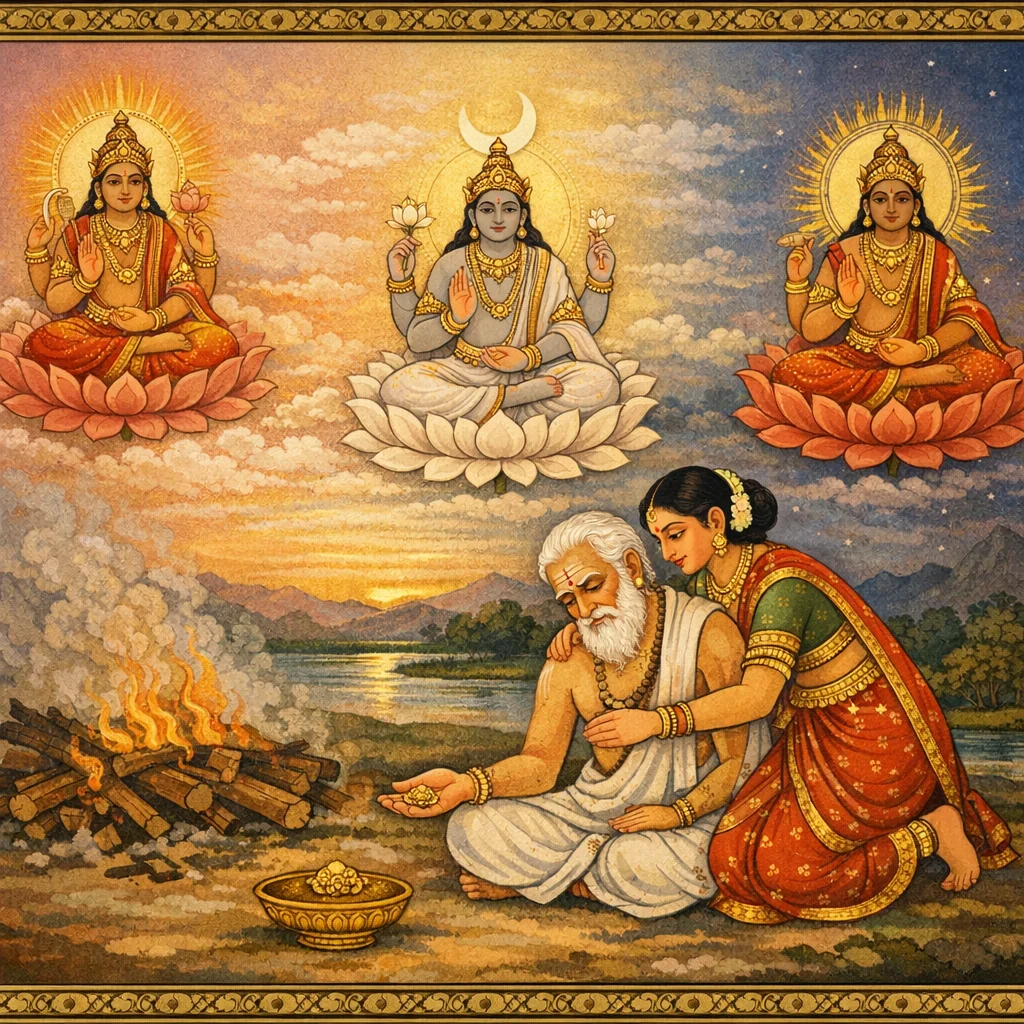
The chapter begins with Sūta describing the “bhāskara-tritaya,” three auspicious manifestations of the Solar Lord whose timely darśana can bestow liberation. They are named Muṇḍīra, Kālapriya, and Mūlasthāna, each linked to a specific solar transition—night’s end/dawn, midday, and dusk/nightfall. The ṛṣis ask how these forms arose and how they are situated within Hāṭakeśvaraja-kṣetra. Sūta then relates an instructive history: a brāhmaṇa stricken with severe kuṣṭha and his devoted wife seek cures in vain. A traveling guest recounts his own healing through sequential worship of the three Bhāskaras over three years, observing fasting, restraint, Sunday vows, vigil, and hymns. The Solar Deity appears in a dream, reveals the karmic cause (theft of gold), removes the disease, and enjoins ethical reform—do not steal, and give according to one’s capacity. Moved by this, the afflicted couple journeys toward Muṇḍīra; the man, weakened, contemplates death, but the wife refuses to abandon him. As they prepare a funeral pyre, three radiant persons appear—revealed as the three Bhāskaras—grant healing, and agree to remain there if three temples are established so devotees may obtain darśana at all three times (tri-kāla). The brāhmaṇa installs the three solar forms on a Sunday, worships them with flowers and incense at the day’s three junctions, and at life’s end attains the abode of Bhāskara. The concluding phala declares that timely darśana of this triad fulfills even difficult desires, presenting a “universal remedy” narrative grounded in moral transformation.
Shlokas
Verse 1
। सूत उवाच । तथान्यदपि तत्रास्ति भास्करत्रितयं शुभम् । यैस्तुष्टैस्त्रिषु लोकेषु मानवो मुक्तिमाप्नुयात्
Sūta said: Moreover, in that very place there exists an auspicious triad of Bhāskaras (solar manifestations). When they are pleased, a human being attains mokṣa, renowned through the three worlds.
Verse 2
मुण्डीरं प्रथमं तत्र कालप्रियं तथापरम् । मूलस्थानं तृतीयं च सर्वव्याधिविनाशनम्
There, the first is Muṇḍīra; the second likewise is Kālapriya; and the third is Mūlasthāna—(a manifestation) that destroys all diseases.
Verse 3
तत्र संक्रमते सूर्यो मुंडीरे रजनीक्षये । कालप्रिये च मध्याह्ने मूलस्थाने क्षपागमे
There the Sun is said to “pass into” (be specially manifest): at Muṇḍīra at the end of night, at Kālapriya at midday, and at Mūlasthāna at the coming of night.
Verse 4
तस्मिन्काले नरो भक्त्या पश्येदप्येकमेवच । कृतक्षणो नरो मोक्षं सत्यं याति न संशयः
At that very time, if a person with devotion beholds even a single one (of these forms), that moment becomes fulfilled; truly he attains liberation (mokṣa)—of this there is no doubt.
Verse 5
ऋषय ऊचुः । मुंडीरः पूर्वदिग्भागे धरित्र्याः श्रूयते किल । मध्ये कालप्रियो देवो मूलस्थानं तदन्तरे
The sages said: “Muṇḍīra is indeed heard to be in the eastern quarter of the land; in the middle is the deity Kālapriya; and between them lies Mūlasthāna.”
Verse 6
तत्कथं ते त्रयस्तत्र संजाताः सूत भास्कराः । हाटकेश्वरजे क्षेत्रे सर्वं नो ब्रूहि विस्तरात्
How, then, did those three Bhāskaras arise there, O Sūta? In the sacred region of Hāṭakeśvara, tell us everything in detail.
Verse 7
सूत उवाच । अस्ति सागरपर्यंते विटंकपुरमुत्तमम् । समुद्रवीचिसंसक्तप्रोच्चप्राकारमण्डनम्
Sūta said: On the edge of the ocean there is an excellent city named Viṭaṃkapura, adorned with lofty ramparts, touched by the ocean’s waves.
Verse 8
तत्राभूद्ब्राह्मणः कश्चित्कुष्ठव्याधिसमन्वितः । पूर्वकर्मविपाकेन यौवनेसमुपस्थिते
There lived a certain brāhmaṇa afflicted with the disease of leprosy, which had come upon him in youth as the ripening of deeds from a former life.
Verse 9
तस्य भार्याऽभवत्साध्वी कुलीना शीलमंडना । तथाभूतमपि प्रायः सा पश्यति यथा स्मरम्
His wife was a virtuous woman—well-born and adorned with noble conduct. Though he had fallen into such affliction, she still, for the most part, beheld him as she would her beloved.
Verse 10
औषधानि विचित्राणि महार्घ्याण्यपि चाददे । तदर्थमुपलेपांश्च पथ्यानि विविधानि च
She procured medicines of many kinds, even those of great cost; and for that purpose she also obtained healing pastes and many forms of fitting, wholesome regimen.
Verse 11
तथा भिषग्वरान्नित्यमानिनाय च सादरम् । तदर्थे न गुणस्तस्य तथापि स्याच्छरीरजः
In the same manner, she respectfully brought the finest physicians each day. Yet no benefit came to him thereby; the bodily affliction still endured.
Verse 12
यथायथा स गृह्णाति भेषजानि द्विजोत्तमाः । कुष्ठेन सर्वगात्रेषु व्याप्यते च तथातथा
O best of brāhmaṇas, as he took the medicines again and again, so too did the leprosy spread correspondingly through all his limbs.
Verse 13
अथैवं वर्तमानस्य तस्य विप्रवरस्य च । गृहेऽतिथिः समायातः कश्चित्पांथः श्रमान्वितः
Now, while that excellent brāhmaṇa was living thus, a certain traveler—wearied by the road—arrived at his house as a guest.
Verse 14
अथ विप्रं गृहं प्राप्तं दृष्ट्वा तस्य सती प्रिया । अज्ञातमपिसद्भक्त्या सूपचारैरतोषयत्
Seeing the brāhmaṇa who had come to their home, his virtuous beloved wife—though not knowing him—pleased him with sincere devotion and fitting courtesies.
Verse 15
अथ तं स्नातमाचांतं कृताहारं द्विजोत्तमम् । विश्रान्तं शयने विप्रः प्रोवाच स गृहाधिपः
Then, when that best of brāhmaṇas had bathed, performed ācamana, taken food, and rested upon a bed, the householder brāhmaṇa spoke to him.
Verse 16
तेजोऽन्वितं यथा भानुं रूपौदार्यगुणान्वितम् । यौवने वर्तमानं च मूर्तं काममिवापरम्
He was radiant like the sun, endowed with beauty, nobility, and virtues—dwelling in youth, as though another embodied Kāma stood there.
Verse 17
कुष्ठ्युवाच । कुत आगम्यते विप्र क्व यास्यसि वदाऽधुना । एवं लावण्ययुक्तोऽपि किमेकाकी यथार्तिभाक्
The leper said: “O brāhmaṇa, from where have you come, and where are you going now? Though endowed with such beauty, why are you alone, as if burdened with distress?”
Verse 18
पथिक उवाच । अस्ति कान्तीपुरीनाम पुरंदरपुरी यथा । सुस्थितैः सेविता नित्यं जनैर्धर्मव्रतान्वितैः
The traveler said: “There is a city named Kāntīpurī, like the city of Purandara (Indra)—ever inhabited and honored by steadfast people devoted to dharma and holy vows.”
Verse 19
तस्यामहं कृतावासो गृहस्थाश्रममावहन् । ग्रस्तः कुष्ठेन रौद्रेण यथा त्वं द्विजसत्तम
There I dwelt, upholding the householder’s āśrama; yet I was seized by fierce leprosy—just as you are, O best among brāhmaṇas.
Verse 20
ततः श्रुतं मया तावत्पुराणे स्कान्दसंज्ञिते । भास्करत्रितयं भूमौ सर्वव्याधिविनाशनम्
Then I heard in the Purāṇa known as the Skanda: upon the earth there is the sacred place called Bhāskara-tritaya, ‘Three Suns,’ which destroys all diseases.
Verse 21
ततो निर्वेदमापन्नो भेषजैः क्लेशितश्चिरम् । क्षारैश्चाम्लैः कषायैश्च कटुकैरथ तिक्तकैः
Then I fell into deep disillusionment, having long been tormented by medicines—alkaline and sour remedies, astringent, pungent, and bitter treatments—and I turned away from mere cures.
Verse 22
ततो विनिश्चयं चित्ते कृत्वा गृह्य धनं महत् । मुण्डीरस्वामिनं गत्वा स्थितस्तस्यैव सन्निधौ
Then, forming a firm resolve in my heart and taking considerable wealth, I went to Muṇḍīrasvāmin and remained there, close to the deity’s very presence.
Verse 23
ततः प्रातः समुत्थाय नित्यं पश्यामि तं विभुम् । पूजयामि स्वशक्त्या च प्रणमामि ततः परम्
Thereafter, rising early each morning, I behold that all-pervading Lord each day; I worship Him according to my capacity, and then I bow down again and again in reverence.
Verse 24
सूर्यवारे विशेषेण निराहारो यतेन्द्रियः । करोमि जागरं रात्रौ गीतवादित्रनिःस्वनैः
Especially on Sundays, fasting and with the senses restrained, I keep vigil through the night, accompanied by the resonant sounds of hymns and musical instruments.
Verse 25
ततः संवत्सरस्यांते तं प्रणम्य दिनाधिपम् । कालप्रियं ततः पश्चाच्छ्रद्धया परया युतः
Then, at the end of a year, having bowed to that Lord of the day (the Sun), and thereafter—endowed with supreme faith—he proceeded to Kālapriya.
Verse 26
तेनैव विधिना विप्र तस्यापि दिवसेशितुः । पूजां करोमि मध्याह्ने श्रद्धा पूतेन चेतसा
O brāhmaṇa, by that very same procedure I also perform worship of that Lord of the day at midday, with a mind purified by faith.
Verse 27
ततोऽपि वत्सरस्यांते तं प्रणम्याथ शक्तितः । मूलस्थानं गतो देवमपरस्यां दिशि स्थितम्
Then again, at the end of another year, having bowed to Him according to his ability, he went to the original seat (mūlasthāna), to the deity situated in the western direction.
Verse 28
तेनैव विधिना पूजा तस्यापि विहिता मया । संध्याकाले द्विजश्रेष्ठ यावत्संवत्सरं स्थितः
O best of the twice-born, by that very same method I performed worship of that deity as well at twilight, and I stayed there for a full year.
Verse 29
ततः संवत्सरस्यांते स्वप्ने मां भास्करोऽब्रवीत् । समेत्य प्रहसन्विप्रः संप्रहृष्टेन चेतसा
Then, at the year’s end, Bhāskara (the Sun) spoke to me in a dream—approaching with a smile, the brāhmaṇa’s heart was filled with delight.
Verse 30
परितुष्टोऽस्मि ते विप्र कर्मणाऽनेन भक्तितः । ममाराधनजेनैव तस्मात्कुष्ठं प्रयातु ते
“O brāhmaṇa, I am pleased with you for this deed done in devotion. By the power born solely of My worship—therefore, let your leprosy depart.”
Verse 31
गच्छ शीघ्रं द्विजश्रेष्ठ श्रांतोऽसि निजमंदिरम् । पश्य बंधुजनं सर्वं सोत्कण्ठं तत्कृते स्थितम्
“Go quickly, O best of brāhmaṇas; you are weary—return to your own home. Behold all your kinsmen standing there, anxious and longing for your sake.”
Verse 32
त्वया हृतं पुरा रुक्मं ब्राह्मणस्य महात्मनः । तेन कर्मविपाकेन कुष्ठव्याधिरुपस्थितः
“Formerly you stole gold from a great-souled brāhmaṇa; by the ripening of that karma, the disease of leprosy came upon you.”
Verse 33
स मया नाशितस्तुभ्यं प्रहृष्टेनाधुना द्विज । एतज्ज्ञात्वा न कर्तव्यं सुवर्णहरणं पुनः
“That affliction has now been destroyed for you by Me, O brāhmaṇa, with gladness. Knowing this, you must never again commit the theft of gold.”
Verse 34
दृश्यन्ते ये नरा लोके कुष्ठव्याधिसमाकुलाः । सुवर्णहरणं सर्वैस्तैः कृतं पापकर्मभिः
Those people seen in the world who are afflicted with leprosy—by all such sinners the sinful deed of stealing gold has been committed.
Verse 35
तस्माद्देयं यथाशक्त्या न स्तेयं कनकं बुधैः । इच्छद्भिः परमं सौख्यं स्वशरीरस्य शाश्वतम्
Therefore, one should give according to one’s capacity; the wise must not steal gold. Those who seek the highest well-being and lasting ease for their own body should act in this way.
Verse 36
एवमुक्त्वा सहस्रांशुस्ततश्चादर्शनं गतः । अहं च विस्मयाविष्टः प्रोत्थितः शयनाद्द्रुतम्
Having spoken thus, Sahasrāṃśu (the Sun-Lord) then vanished from sight. And I, filled with wonder, quickly rose from my bed.
Verse 37
यावत्पश्यामि देहं स्वं कुष्ठव्याधिपरिच्युतम् । द्वादशार्कप्रभं दिव्यं यथा त्वं पश्यसे द्विज
Then I beheld my own body, freed from the disease of leprosy—divine, radiant like twelve suns—just as you see it, O Brāhmaṇa.
Verse 38
तस्मात्त्वमपि विप्रेंद्र भक्त्या तद्भास्करत्रयम् । अनेन विधिना पश्य येन कुष्ठं प्रशाम्यति
Therefore, you too, O foremost of Brāhmaṇas, with devotion behold that triad of Suns (Bhāskara-traya) by this very method—by which leprosy is pacified.
Verse 39
किमौषधैः किमाहांरैः कटुकैरपि योजितैः । सर्वव्याधिप्रणाशेशे स्थितेऽस्मिन्भास्करत्रये
What need is there of medicines, or of pungent mixtures and preparations, when this Bhāskara-traya stands here—supreme in destroying all diseases?
Verse 40
स्वस्ति तेऽस्तु गमिष्यामि सांप्रतं तां पुरीं प्रति । गृहेऽद्य तव विश्रांतो यथा विप्र निजे गृहे
May well-being be yours. I shall now go toward that city. Today I have rested in your house, O Brāhmaṇa, as one rests in one’s own home.
Verse 41
एवमुक्तः स पांथेन तेन विप्रः स कुष्ठभाक् । वीक्षांचक्रे ततो वक्त्रं स्वपत्न्या दुःखसंयुतः
Thus addressed by that traveler, the brāhmaṇa—afflicted with leprosy—then looked upon the face of his own wife, his heart weighed down with sorrow.
Verse 42
साऽब्रवीद्युक्तमुक्तं ते पांथेनानेन वल्लभ । तस्मात्तत्र द्रुतं गच्छ यत्र तद्भास्करत्रयम्
She said, “Beloved, what this traveler has told you is indeed fitting. Therefore go quickly to that place where that triad of Bhāskaras (Sun-deities) is found.”
Verse 43
अहं त्वया समं तत्र शुश्रूषानिरता सती । गमिष्यामि न संदेहस्तस्माद्गच्छ द्रुतं विभो
“I too will go there with you—steadfast in service and fidelity. There is no doubt of it; therefore, O noble one, go quickly.”
Verse 44
एवमुक्तस्तया सोऽथ वित्तमादाय भूरिशः । प्रस्थितः कांतया सार्धं मुण्डीरस्वामिनं प्रति
Thus, urged by her words, he gathered abundant wealth and set out with his beloved, journeying toward Muṇḍīrasvāmin.
Verse 45
प्रतिज्ञया गमिष्यामि द्रष्टुं तद्देवतात्रयम् । मुंडीरं कालनाथं च मूल स्थानं च भास्करम्
“By my vow, I shall go to behold that triad of deities—Muṇḍīra, Kālanātha, and Bhāskara at his original seat (mūlasthāna).”
Verse 46
ततः कृच्छ्रेण महता कुष्ठव्याधिसमाकुलः । हाटकेश्वरजे क्षेत्रे संप्राप्तः स द्विजोत्तमाः
Then, with great difficulty—tormented by the disease of leprosy—that excellent brāhmaṇa arrived in the sacred region belonging to Hāṭakeśvara.
Verse 47
तद्दृष्ट्वा सुमहत्क्षेत्रं तापसौघनिषेवितम् । निर्विण्णः कुष्ठरोगेण पथि श्रांतोऽब्रवीत्प्रियाम्
Seeing that vast sacred region, frequented by multitudes of ascetics, he—disheartened by leprosy and worn out on the road—spoke to his beloved wife.
Verse 48
अहं निर्वेदमापन्नो रोगेणाथ बुभुक्षया । मुण्डीरस्वामिनं यावन्न शक्रोमि प्रसर्पितुम्
“I have fallen into despair—stricken by illness and hunger. I am not able to crawl forward as far as Muṇḍīrasvāmin.”
Verse 49
तस्मादत्रैव देहं स्वं विहास्यामि न संशयः । त्वं गच्छ स्वगृहं कांते सार्थमासाद्य शोभनम्
Therefore, I shall cast off my body right here without doubt. O beloved, you must return to your home, joining a safe caravan.
Verse 50
पत्न्युवाच । अभुक्ते त्वयि नो भुक्तं कदाचित्कांत वै मया । एकांतेऽपि महाभाग न सुप्तं जाग्रति त्वयि
The wife said: 'O beloved, never have I eaten when you had not eaten. Even in private, O fortunate one, I have never slept while you remained awake.'
Verse 51
तस्मादेतन्महाक्षेत्रं संप्राप्य त्वां व्यवस्थितम् । परलोकाय संत्यज्य कथं गच्छाम्यहं गृहम्
Therefore, having reached this great sacred region and finding you resolved for the world beyond, how can I abandon you and return home?
Verse 52
दर्शयिष्ये मुखं तेषां त्वया हीना अहं कथम् । बांधवानां गुरूणां च अन्येषां सुदृदा मपि
How could I show my face—bereft of you—to our kinsmen, to our teachers, and even to others who are close and steadfast?
Verse 53
तस्मात्त्वया समं नाथ प्रवेक्ष्यामि हुताशनम् । स्नेहपाशविनिर्बद्धा सत्येनात्मानमालभे
Therefore, O Lord, I shall enter the fire together with you. Bound fast by the bonds of love, I offer my very self in truth.
Verse 54
यावतस्तव संजाता उपवासा महामते । तावंतश्च तथास्माकं कथं गच्छामि तद्गृहम्
O great-minded one, as many fasts as have arisen for you, so many are for me as well. How, then, can I go back to that home?
Verse 55
एवं तस्या विदित्वा स निश्चयं ब्राह्मणस्तदा । चितिं कृत्वा तु दाहार्थं तया सार्धे ततोऽविशत्
Knowing her resolve thus, the Brahmin then built a funeral pyre for burning, and entered it thereafter together with her.
Verse 56
भास्करं मनसि ध्यात्वा यावदग्निं समाददे । तावत्पश्यति चाग्रस्थं सुदीप्तं पुरुषत्रयम्
As he meditated in his mind on the Sun and was about to take up the fire, he beheld before him three men, blazing with radiance.
Verse 57
तद्दृष्ट्वा विस्मयाविष्टः क एते पुरुषास्त्रयः । न कदाचिन्मया दृष्टा ईदृक्तेजःसमन्विताः
Seeing that, he was seized with wonder: “Who are these three persons? Never have I seen beings endowed with such splendor.”
Verse 58
पुरुषा ऊचुः । मा त्वं मृत्युपथं गच्छ कृत्वा वैराग्यमाकुलः । व्यावृत्य स्वगृहं गच्छ स्व भार्यासहितो द्विज
The radiant beings said: “Do not go upon the road of death, agitated by a turmoil of renunciation. Turn back and go to your own home, O twice-born, together with your wife.”
Verse 59
ब्राह्मण उवाच । प्रतिज्ञाय मया पूर्व गृहं मुक्तं निजं यतः । मुण्डीरस्वामिनं दृष्ट्वा तथाऽन्यं कालवल्लभम्
The Brahmin said: “Formerly I made a vow; therefore I left my own home. Having beheld Muṇḍīrasvāmin—and also another, Kālavallabha.”
Verse 60
मूलस्थानं च कर्तव्यं ततः सस्यप्रभक्षणम् । सोऽहं तानविलोक्याथ कथं गच्छामि मन्दिरम् । भक्षयामि तथा सस्यं तेन त्यक्ष्यामि जीवितम्
“I must undertake the discipline of living on roots, and thereafter the eating of grain. Now that I have seen you, how can I return to my dwelling? Even so I shall eat grain, and by that I will give up my life.”
Verse 61
पुरुषा ऊचुः । वयं ते भास्करा ब्रह्मंस्त्रयोऽत्रैव समागताः । त्वद्भक्त्याकृष्टमनसो ब्रूहि किं करवामहे
The men said: “O Bhāskara (Sun), O venerable brāhmaṇa—three of us Bhāskaras have gathered here, drawn by your devotion. Tell us: what shall we do?”
Verse 62
ब्राह्मण उवाच । यदि यूयं समायाताः स्वयमेव ममांतिकम् । त्रयोऽपि भास्करा नाशमेष कुष्ठः प्रगच्छतु
The brāhmaṇa said: “Since you have come of your own accord to me—O three Bhāskaras—let this leprosy now depart and be destroyed.”
Verse 63
तथाऽत्रैव सदा स्थेयं क्षेत्रे युष्माभिरेव हि । सांनिध्यं त्रिषु लोकेषु गन्तव्यं च यथा पुरा
“So too, you must remain always right here in this sacred field; and, as before, you shall also proceed to grant your divine presence throughout the three worlds.”
Verse 64
भास्करा ऊचुः । एवं विप्र करिष्यामः स्थास्यामो ऽत्र सदा वयम् । त्वं चापि रोगनिर्मुक्तः सुखं प्राप्स्यस्यनुत्तमम्
The Bhāskaras said: “So be it, O brāhmaṇa; we shall do thus. We will dwell here always, and you too—freed from disease—shall attain unsurpassed happiness.”
Verse 65
प्रासादत्रितयं तस्मादस्मदर्थं निरूपय । येन त्रिकालमासाद्य गच्छामः संनिधिं द्विज
“Therefore, O brāhmaṇa, arrange three temples for our sake, so that—when approached at the three times of day—we may bestow our sacred presence, O twice-born.”
Verse 66
एवमुक्त्वा तु ते सर्वे गताश्चाद्दर्शनं ततः । सोऽपि पश्यति कायं स्वं यावद्रोगविवर्जितम्
Having spoken thus, they all departed from sight. Then he too looked upon his own body, now entirely free from disease.
Verse 67
द्वादशार्क प्रतीकाशं सर्वलक्षणलक्षितम् । ततः प्रोवाच तां भार्यां विनयावनतां स्थिताम्
His body shone like twelve suns and bore every auspicious mark. Then he spoke to his wife, who stood there bowed in humility.
Verse 68
पश्य त्वं सुभ्रूर्मे गात्रं यादृग्रूपं पुनः स्थितम् । प्रसादाद्देवदेवस्य भास्करस्यांशुमालिनः
“Look, O fair-browed one, at my body—how it has been restored to its former form—by the grace of Bhāskara, the God of gods, the garlanded with rays.”
Verse 69
सोऽहमत्र स्थितो नित्यं पूजयिष्यामि भास्करम् । न यास्यामि पुनः सद्म सत्यमेतन्मयोदितम्
Therefore I shall remain here forever and worship Bhāskara, the Lord Sun. I shall not return again to my home—this is the truth I have spoken.
Verse 72
त्रयाणामपि तेषां तु साध्वर्चाः शास्त्रसूचिताः । स्थापयामास सूर्याणां हस्तार्के सूर्यवासरे
For all three of them, the proper modes of worship—enjoined by the scriptures—were duly performed; and he installed the Sun-images when the Sun was in the Hasta nakṣatra, on a Sunday.
Verse 73
ततस्ताः पुष्पधूपाद्यैः समभ्यर्च्य चिरं द्विजः । त्रिसंध्यं क्रमशः प्राप्तो देहांते भास्करालयम्
Then the twice-born man worshipped them for a long time with flowers, incense, and the like; and, observing the three daily sandhyās in due order, at the end of his life he attained the abode of Bhāskara, the Sun.
Verse 74
सूत उवाच । एवं ते तत्र संजातास्त्रयोऽपि द्विजसत्तमाः । भास्करा भक्तलोकस्य सर्वव्याधिविनाशकाः
Sūta said: Thus, O best of the twice-born, those three indeed arose there as Bhāskaras, solar forms; and for the community of devotees they became destroyers of all diseases.
Verse 75
यस्तान्पश्यति काले स्वे यथोक्ते सूरर्यवासरे । स वांछितांल्लभेत्कामान्दुर्लभानपि मानवैः
Whoever beholds them at the proper time, on the Sun’s day as prescribed, obtains the desired wishes—even those that are difficult for human beings to gain.