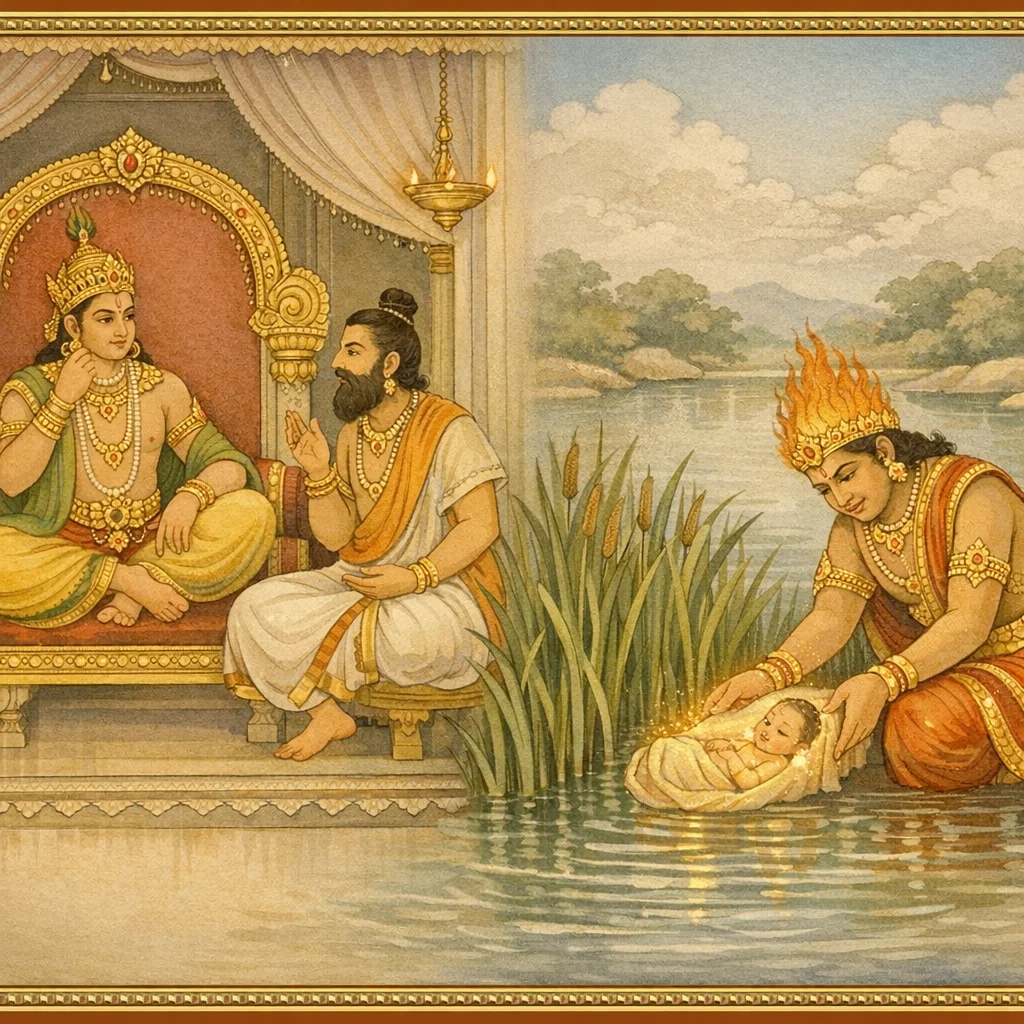
Adhyaya 70
Chapter 70 begins with Sūta pointing out a sin-destroying śakti (weapon/power) connected with Kārttikeya and a large kuṇḍa of clear water said to have arisen in relation to that power. Bathing and worship there are praised as immediately removing pāpa and granting liberation from sins accumulated across one’s life. The ṛṣis ask about the time, purpose, and efficacy of this śakti. Sūta then relates an origin-legend: Tāraka, a mighty dānava descended from Hiraṇyākṣa’s line, performs fierce tapas at Gokarṇa until Śiva appears and grants him a boon of near invincibility against the devas (with the implicit limit that Śiva himself will not kill him). Empowered, Tāraka wages a long war on the devas, who repeatedly fail despite weapons and stratagems. Indra consults Bṛhaspati, who offers a theological solution: since Śiva will not destroy his own beneficiary, a son of Śiva must be brought forth and appointed senānī to defeat Tāraka. Śiva agrees and withdraws with Pārvatī to Kailāsa; but the devas, pressed by Tāraka, send Vāyu to disrupt the generative act. Śiva contains the potent vīrya; Agni is chosen to bear it, yet cannot endure it and deposits it on earth in a reed-bed (śarastamba). The six Kṛttikās appear as guardians of the seed, foreshadowing Skanda/Kārttikeya’s birth and linking the tīrtha’s merit to a sacred chain of power, containment, transfer, and the sanctification of the purifying water-site.
Shlokas
Verse 1
। सूत उवाच । तथान्यापि च तत्रास्ति शक्तिः पापप्रणाशिनी । कार्तिकेयेन निर्मुक्ता हत्वा वै तारकं रणे
Sūta said: Moreover, there also exists there another sacred Spear (śakti), a destroyer of sins—released by Kārttikeya after he slew Tāraka in battle.
Verse 2
तथास्ति सुमहत्कुण्डं स्वच्छोदकसमावृतम् । तेनैव निर्मितं तत्र यः स्नात्वा तां प्रपूजयेत् । स पापान्मुच्यते सद्य आजन्ममरणांति कात्
Likewise, there is a very great pond there, filled with clear and pure water, fashioned in that place by him alone. Whoever bathes in it and then worships that Śakti—the sacred Spear—is immediately freed from sins, from those gathered from birth up to the approach of death.
Verse 3
ऋषय ऊचुः । कस्मिन्काले विनिर्मुक्ता सा शक्तिस्तेन नो वद । किमर्थं स्वामिना तत्र किंप्रभावा वद स्वयम्
The sages said: “At what time was that Śakti released by him? Tell us. For what purpose did its Lord place it there? And what is its power—declare it yourself.”
Verse 4
सूत उवाच । पुरासीत्तारकोनाम दानवोऽतिबलान्वितः । हिरण्याक्षस्य दायादस्त्रैलोक्यस्य भयावहः
Sūta said: In former times there was a Dānava named Tāraka, endowed with immense strength—an heir of Hiraṇyākṣa—who became a terror to the three worlds.
Verse 5
स ज्ञात्वा जनकं ध्वस्तं विष्णुना प्रभविष्णुना । तपस्तेपे ततस्तीव्रं गोकर्णं प्राप्य पर्वतम्
When he learned that his father had been destroyed by Viṣṇu, the mighty Lord, he then undertook fierce austerities, having reached the mountain of Gokarṇa.
Verse 6
यावद्वर्षसहस्रांतं शीर्णपर्णा शनः स्थितः । ध्यायमानो महादेवं कायेन मनसा गिरा
For a full thousand years he remained there, gradually wasting away, while meditating on Mahādeva with body, mind, and speech.
Verse 7
वरुपूजोपहारैश्च नैवेद्यैर्विविधैस्ततः । ततो वर्षसहस्रांते स दैत्यो दुःखसंयुतः
There, with offerings of worship and various kinds of food-presentations, when the thousand years were completed, that Daitya still remained weighed down by suffering.
Verse 8
ज्ञात्वा रुद्रमसंतुष्टं ततो रौद्रं तपोऽकरोत् । विनिष्कृत्त्यात्ममांसानि जुहोतिस्म हुताशने
Knowing that Rudra was not yet pleased, he then performed a dreadful austerity: cutting off pieces of his own flesh, he offered them into the sacrificial fire.
Verse 9
ततस्तुष्टो महादेवो वृषारूढ उमापतिः । सर्वैरेव गणैः सार्धं तस्य संदर्शनं ययौ
Then Mahādeva, the Bull-rider, the Lord of Umā, being pleased, went to grant him an audience—accompanied by all his Gaṇas.
Verse 10
तत्र प्रोवाच संहृष्टस्तारनादेन नादयन् । दिशः सर्वा महादेवो हर्ष गद्गदया गिरा
There Mahādeva spoke in delight, resounding with a clear, ringing roar that filled all directions, his voice trembling with joy.
Verse 11
भोभोस्तारक तुष्टोऽस्मि साहसं मेदृशं कुरु । प्रार्थयस्व मनोऽभीष्टं येन ते प्रददाम्यहम्
“O Tāraka, I am pleased. Show me the bold request you seek. Ask for what your heart desires, so that I may grant it to you.”
Verse 12
तारक उवाच । अजेयः सर्वदेवानां त्वत्प्रसादादहं विभो । यथा भवामि संग्रामे त्वां विहाय तथा कुरु
Tāraka said: “O Lord, by Your favor make me unconquerable by all the gods, so that in battle I remain invincible—save only in relation to You. Grant it thus.”
Verse 13
भगवानुवाच । मत्प्रसादादसंदिग्धं सर्वमेतद्भविष्यति । त्वया यत्प्रार्थितं दैत्य त्वमेको बलवानिह
The Blessed Lord said: “By My grace, all this shall surely come to pass, without doubt. O Daitya, what you have prayed for will be granted; here you shall stand as one of surpassing might.”
Verse 14
एवमुक्त्वा महादेवः स्वमेव भवनं गतः । तारकश्चापि संहृष्टस्तथैवनिज मन्दिरम्
Having spoken thus, Mahādeva returned to His own abode. Tāraka too, greatly delighted, likewise went back to his own palace-temple.
Verse 15
ततो दानवसैन्येन महता परिवारितः । गतः शक्रपुरीं योद्धुं विख्याताममरावतीम्
Then, surrounded by a vast army of Dānavas, he marched forth to fight Śakra’s city—Amarāvatī, famed throughout the worlds.
Verse 16
अथाभवन्महायुद्धं देवानां दानवैः सह । यावद्वर्षसहस्रांते मृत्युं कृत्वा निवर्तनम्
Then a great war arose between the Devas and the Dānavas. For a thousand years it endured, dealing death; only then did they withdraw and turn back.
Verse 17
तत्राभवत्क्षयो नित्यं देवानां रणमूर्धनि । विजयो दानवानां च प्रसादाच्छूलपा णिनः
There, on the very forefront of the battlefield, the Devas suffered continual loss; and victory went to the Dānavas—by the favor of the Trident-bearing Lord.
Verse 18
ततश्चक्रुरुपायांस्ते विजयाय दिवौकसः । वर्माणि सुविचित्राणि यन्त्राणि परिखास्तथा
Then the dwellers of heaven devised means for victory: wondrously fashioned armors, war-machines, and also defensive trenches.
Verse 19
अन्यान्यपि शरीरस्य रक्षणार्थं प्रयत्नतः । तथैव योधमुख्यानां विशेषाद्द्विजसत्तमाः
And with great effort they arranged other protections as well for the body—especially for the foremost warriors, O best of the twice-born.
Verse 20
ससृजुस्ते सुराधीशा दानवेभ्यो दिवानिशम्
Those lords of the gods unleashed their forces and weapons against the Dānavas, by day and by night.
Verse 21
मुद्गरा भिंडिपालाश्च शतघ्न्योऽथ वरेषवः । प्रासाः कुन्ताश्च भल्लाश्च तस्मिन्काले विनिर्मिताः । विशेषाहवसंबन्धव्यूहानां प्रक्रियाश्च याः
In that time were fashioned maces (mudgara), bhiṇḍipālas, śataghnīs, and excellent arrows; also javelins (prāsa), spears (kunta), and bhalla-darts—together with specialized procedures for battle-formations suited to particular modes of combat.
Verse 22
तथान्यानि विचित्राणि कूटयुद्धान्यनेकशः । भीषिकाः कुहकाश्चैव शक्रजालानि कृत्स्नशः
Likewise, many other wondrous and strange stratagem-wars were devised again and again—terrifying contrivances, deceptive devices, and, in their entirety, Indra-like nets of illusion.
Verse 23
न च ते विजयं प्रापुस्तथापि द्विजसत्तमाः । दानवेभ्यो महायुद्धे प्रहारैर्जर्जरीकृताः
Yet they did not attain victory, O best of the twice-born; in that great war they were battered and shattered by the blows of the Dānavas.
Verse 24
अथ प्राह सहस्राक्षो भयत्रस्तो बृहस्पतिम् । दिनेदिने वयं दैत्यैर्विजयामो द्विजोत्तम
Then Sahasrākṣa (Indra), shaken with fear, spoke to Bṛhaspati: “O best of the twice-born, day after day we are being overcome by the Dānavas.”
Verse 25
यथायथा रणार्थाय सदुपायान्करोम्यहम् । तथातथा पराभूतिर्जायते मे महाहवे
“No matter what good strategies I undertake for the sake of battle, so too, in that very great war, defeat keeps arising for me again and again.”
Verse 26
तदुपायं सुराचार्य स्वबुद्ध्या त्वं प्रचिन्तय । येन मे स्याज्जयो युद्धे तव कीर्तिरनिन्दिता ०
“Therefore, O preceptor of the gods, consider with your own discernment that means by which victory may be mine in war—and by which your fame remains beyond reproach.”
Verse 27
सूत उवाच । ततो बृहस्पतिः प्राह चिरं ध्यात्वा शचीपतिम् । प्रहृष्टवदनो ज्ञात्वा जयोपायं महाहवे
Sūta said: Then Bṛhaspati, after long contemplation of Śacī’s lord (Indra), spoke—his face radiant with joy, having understood the means to victory in that great battle.
Verse 28
मया शक्र परिज्ञातः स उपायो महाहवे । जीयन्ते शत्रवो येन लीलयैवापि भूरिशः
“O Śakra, I have discerned that means in the great battle by which the enemies are conquered—even effortlessly, as though in sport, O mighty lord.”
Verse 29
यदाभीष्टं वरं तेन प्रार्थितस्त्रिपुरांतकः । तदैवं वचनं प्राह प्रणिपत्य मुहुर्मुहुः
When he petitioned Tripurāntaka (Śiva) for the boon he desired, then—bowing down again and again—he spoke these words.
Verse 30
अजेयः सर्वदेवानां त्वत्प्रसादादहं विभो । यथा भवामि संग्रामे त्वां विहाय तथा कुरु
“O Lord, by your favor I am unconquerable to all the gods. Arrange it so that in battle I may be as I am—even when I am without you, without your direct presence.”
Verse 31
न तं स्वयं महादेवः स्वशिष्यं सूदयिष्यति । विषवृक्षमपि स्थाप्य कश्छिनत्ति पुनः स्वयम्
“Mahādeva will not himself slay that one—his own disciple. After planting even a poisonous tree, who then cuts it down with his own hand?”
Verse 32
यो वै पिता स पुत्रः स्याच्छ्रुतिवाक्यमिदं स्मृतम् । तस्माज्जनयतु क्षिप्रं हरस्तन्नाशकृत्सुतम्
It is remembered as a saying of Śruti: “He who is the father becomes the son.” Therefore let Hara swiftly beget a son who shall bring about his destruction.
Verse 33
येन सेनाधिपत्ये तं विनियोज्य महाहवम् । कुर्मो दैत्यैः समं शस्त्रैः प्राप्नुयाम ततो जयम्
By appointing him commander of the army and sending him into the great battle, we shall meet the Dānavas with equal weapons—and then attain victory.
Verse 34
एष एव उपायोऽत्र मया ते परिकीर्तितः । विजयाय सहस्राक्ष नान्योऽस्ति भुवनत्रये
This alone is the means I have declared to you here for victory, O Thousand-Eyed Indra; in all the three worlds there is no other way.
Verse 35
ततो देवगणैः सर्वैः समेतः पाकशासनः । तमर्थं प्रोक्तवाञ्छंभुं विनयावनतः स्थितः
Then Indra, the chastiser of Pāka, accompanied by all the hosts of gods, approached Śambhu and, standing in humility with bowed head, stated his purpose.
Verse 36
सुतस्य जननार्थाय कुरु यत्नं वृषध्वज । येन सेनाधिपत्ये तं योजयामि दिवौकसाम्
“Make effort, O Bull-bannered Lord, to bring forth a son—so that I may appoint him as commander of the heavenly hosts.”
Verse 37
प्राप्नोम्यहं च संग्रामे विजयं त्वत्प्रसादतः । निहत्य दानवान्सर्वांस्तारकेण समन्वितान्
By your grace I shall attain victory in battle, after slaying all the Dānavas allied with Tāraka.
Verse 38
नान्यथा विजयो मे स्यात्संग्रामे दानवैः सह । इति मां प्राह देवेज्यो ज्ञात्वा सम्यङ्महामतिः
Otherwise I would have no victory in battle against the Dānavas. Thus spoke to me Deveśya (Bṛhaspati), the great-minded one, having rightly understood the situation.
Verse 39
अथोवाच विहस्योच्चैः शंकरस्त्रिदशेश्वरम् । करिष्यामि वचः क्षिप्रं तव शक्र न संशयः
Then Śaṅkara, laughing aloud, said to the lord of the Thirty (the gods): “O Śakra, without doubt I shall swiftly fulfill your request.”
Verse 40
पुत्रमुत्पादयिष्यामि सर्वदैत्यविनाशकम् । यं त्वं सेनापतिं कृत्वा जयं प्राप्स्यसि सर्वदा
“I shall bring forth a son who will destroy all the Daityas. Making him your general, you will attain victory always.”
Verse 41
एवमुक्त्वा महादेवो गत्वा कैलास पर्वतम् । गौर्या समं ततश्चक्रे कामधर्मं यथोचितम्
Having spoken thus, Mahādeva went to Mount Kailāsa and, together with Gaurī, engaged in the rite of love in the fitting manner.
Verse 42
हावैर्भावैः समोपेतं हास्यैरन्यैस्तदात्मिकैः । यावद्वर्षसहस्रांतं दिव्यं चैव निमेषवत्
Accompanied by playful gestures and tender moods, with laughter and other such expressions, that divine time—lasting until the end of a thousand years—passed as though it were but a moment.
Verse 43
अथ देवगणाः सर्वे भयसंत्रस्तमानसाः । चक्रुर्मंत्रं तदर्थं हि तारकेण प्रपीडिताः
Then all the hosts of gods, their minds shaken by fear, devised a mantra for that very purpose, for they were being oppressed by Tāraka.
Verse 44
सहस्रं वत्सराणां तु रतासक्तस्य शूलिनः । अतिक्रांतं न देवानां तेन कृत्यं विनिर्मितम्
For a thousand years, Śūlin (Śiva), absorbed in amorous union, had remained so; and during all that time the gods could not bring about the intended task that depended upon him.
Verse 45
तस्माद्गच्छामहे तत्र यत्र देवो महेश्वरः । संतिष्ठते समं गौर्या कैलासे विजने स्थितः
Therefore let us go to that place where the god Maheśvara abides—together with Gaurī—dwelling in the solitude of Kailāsa.
Verse 46
ततस्तत्रैव संजग्मुः सर्वे देवाः सवासवाः । उद्वहन्तः परामार्तिं तारकारिसमुद्भवाम्
Then, right there, all the gods—together with Vāsava (Indra)—assembled, bearing a great distress that had arisen in connection with Tārakāri (Skanda, the slayer of Tāraka).
Verse 47
अथ कैलासमासाद्य यावद्यांति भवांतिकम् । निषिद्धा नंदिना तावन्न गंतव्यमतः परम्
Then, having reached Kailāsa, as they advanced to the very vicinity of Bhava (Śiva), Nandin forbade them: “You must not go beyond this point.”
Verse 48
रहस्ये भगवान्सार्धं पार्वत्या समवस्थितः । अस्माकमपि नो गम्यं तस्मात्तावन्न गम्यताम्
“The Blessed Lord abides in secrecy together with Pārvatī; even for us entry is not permitted. Therefore, for now, do not proceed further.”
Verse 49
ततस्तैर्विबुधैः सर्वैः प्रेषितस्तत्र चानिलः । किं करोति महादेवः शीघ्रं विज्ञायतामिति
Then all those gods dispatched Anila (Vāyu) there, saying: “Quickly find out what Mahādeva is doing.”
Verse 50
अथ वायुर्गतस्तत्र यत्रास्ते भगवाञ्छिवः । गौर्या सह रतासक्त आनन्दं परमं गतः
Then Vāyu went to the place where the Blessed Śiva was; with Gaurī, absorbed in union, he had entered supreme bliss.
Verse 51
अथ प्रचलिते शुक्रे स्थानादप्राप्तयोनिके । देवेन वीक्षितो वायुर्नातिदूरे व्यवस्थितः
And when the semen began to stir—before it had reached its destined place or womb—Vāyu, standing not far away, was noticed by the God.
Verse 52
ततो व्रीडा समोपेतस्तत्क्षणादेव चोत्थितः । भावासक्तां प्रियां त्यक्त्वा मा मोत्तिष्ठेतिवादिनीम्
Then, overcome with modesty, he rose at that very moment, leaving his beloved absorbed in affection—she who was saying, “Do not rise.”
Verse 53
अब्रवीदथ तं वायुं विनयावनतं स्थितम् । किमर्थं त्वमिहायातः कच्चित्क्षेमं दिवौकसाम्
Then he spoke to Vāyu, who stood there bowed in humility: “For what purpose have you come here? Is all well with the dwellers in heaven?”
Verse 54
वायुरुवाच । एते शक्रादयो देवा नंदिना विनिवारिताः । तारकेण हतोत्साहास्तिष्ठंति गिरिरोधसि
Vāyu said: “These gods—Indra and the rest—have been turned back by Nandin. Their courage broken by Tāraka, they now remain halted on the mountain-slope.”
Verse 55
तस्मादेतान्समाभाष्य समाश्वास्य च सादरम् । प्रेषयस्व द्रुतं तत्र यत्र ते दानवाः स्थिताः
“Therefore, speak to them, reassure them with due respect, and quickly send them to the place where those Dānavas are stationed.”
Verse 56
अथ तानाह्वयामाम तत्क्षणात्त्रिपुरांतकः । संप्राह चविषण्णास्यः कृतांजलिपुटान्स्थितान्
Then Tripurāntaka immediately called them near, and spoke to those who stood with palms joined in reverence, their faces downcast with distress.
Verse 57
श्रीभगवानुवाच । युष्मत्कृते समारंभः पुत्रार्थं यो मया कृतः । स्वस्थानाच्चलिते शुक्रे कृतो मोघोद्य वायुना
The Blessed Lord said: “For your sake I undertook this endeavor to bring forth a son. But today, when Vāyu displaced the seed from its proper place, that undertaking has been rendered fruitless.”
Verse 58
एतद्वीर्यं मया धैर्यात्स्तंभितं लिंगमध्यगम् । अमोघं तिष्ठते सर्वं क्व दधामि निवेद्यताम्
“By steadfastness I have checked this potent energy and held it within the liṅga. It remains wholly unfailing—tell me, where shall I place it?”
Verse 59
येन संजायते पुत्रो दानवांतकरः परः । सेनानाथश्च युष्माकं दुर्द्धरः समरे परैः
“From it will be born a son—supreme, a destroyer of the Dānavas—who will become your commander-in-chief, irresistible to enemies in battle.”
Verse 60
एतत्कल्पाग्निसंकाशं धर्तुं शक्नोति नापरः । विना वैश्वानरं तस्माद्दधात्वेष सनातनम्
“This is like the fire at the end of an age; none other can bear it. Therefore, let Vaiśvānara (Agni) receive and hold this eternal power.”
Verse 61
येन तत्र प्रमुञ्चामि सुताय विजयाय च । एतद्वीर्यं महातीव्रं द्वादशार्कसमप्रभम्
“So that I may release it there for the birth of that son and for victory: this potency is exceedingly intense, radiant like twelve suns.”
Verse 62
अथ प्राहुः सुराः सर्वे वह्निं संश्लाघ्य सादराः । त्वं धारयाग्ने वक्त्रांते वीर्यमेतद्भवोद्भवम्
Then all the gods, reverently praising Agni, said: “O Fire, hold within your mouth this potency—born of Bhava (Śiva).”
Verse 63
ततः प्रसारयामास स्ववक्त्रं पावको द्रुतम् । कुर्वञ्छक्रसमादेशमविकल्पेन चेतसा
Thereupon Pāvaka (Agni) swiftly opened his mouth, carrying out Indra’s command with an unwavering mind.
Verse 64
शंकरोऽप्यक्षिपत्तत्र कामबाणप्रपीडितः । गौरीं भगवतीं ध्यायन्नानन्दं परमं गतः
There, even Śaṅkara (Śiva), tormented by the arrows of Kāma, cast it forth; and, meditating upon the Blessed Goddess Gaurī, he attained the supreme bliss.
Verse 65
पावकोऽपि भृशं तेन कल्पाग्निसदृशेन च । दह्यमानोऽक्षिपद्भूमौ शरस्तंबे सुविस्तरे
Even Fire, scorched fiercely by that blaze—like the cosmic fire at the end of an age—dropped it upon the earth, into a broad thicket of reeds.
Verse 66
एतस्मिन्नंतरे प्राप्ता भ्रममाणा इतस्ततः । भार्यास्तत्र मुनीनां ताः षण्णां षट्कृत्तिकाः शुभाः
Just then, wandering here and there, there arrived the auspicious Six Kṛttikās—the wives of those six sages.
Verse 67
तासां निदेशयामास स्वयमेव शतक्रतुः । एतद्बीजं त्रिनेत्रस्य परिपाल्यं प्रयत्नतः
Then Śatakratu (Indra) himself instructed them: “This seed of the Three-eyed Lord must be safeguarded with utmost effort.”
Verse 68
अत्र संपत्स्यते पुत्रो द्वादशार्कसमप्रभः । भवतीनामपि प्रायः पुत्रत्वं संप्रयास्यति
“Here a son will come to be, radiant like twelve suns; and for you as well, in a special way, motherhood will manifest.”