Adhyaya 48
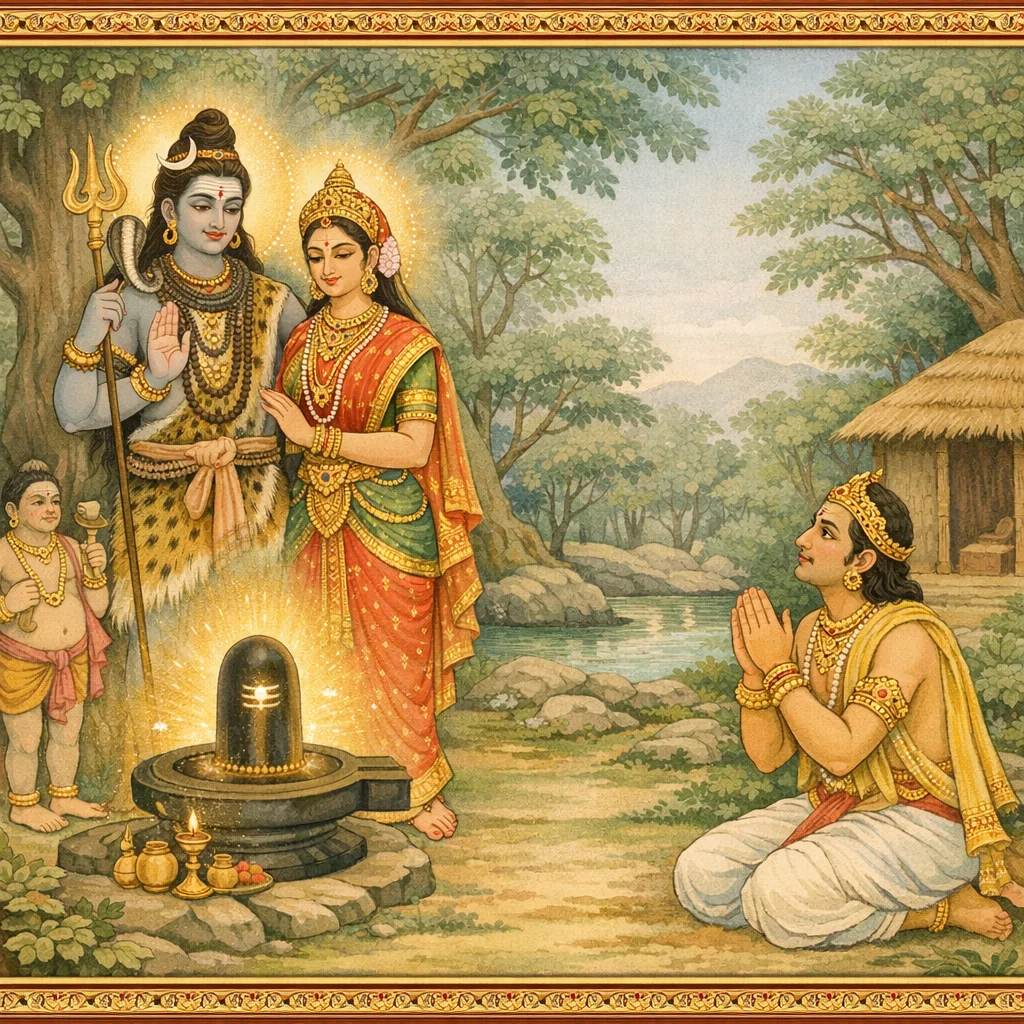
Sūta describes a famed āśrama in King Hariścandra’s realm, shaded by many trees, where the king performed severe tapas and sustained Brahmins through dāna, granting gifts as desired. Hariścandra is praised as an ideal Sūryavaṃśa ruler whose reign enjoys civic steadiness and natural abundance, yet he suffers one lack—no son. Seeking an heir, he undertakes intense austerities in the kṣetra of Cāmatkārapura and, with devotion, establishes a liṅga. Śiva appears with Gaurī and attendants; through a lapse in proper reverence to the Goddess, a conflict arises and a curse is uttered that the son will bring death-born grief even in childhood. Hariścandra does not waver, continuing worship, offerings, ascetic discipline, and further dāna. Śiva and Pārvatī appear again, and Devī affirms her word: the child will die, yet by her grace will soon regain life and become long-lived, victorious, and fit to bear the dynasty. The chapter proclaims the enduring power of the site—those who worship Umā–Maheśvara there, especially on pañcamī, gain desired progeny and other aims. Hariścandra also asks for an obstacle-free rājasūya; Śiva assents, and the king returns, leaving a model of consecration for later devotees.
Shlokas
Verse 1
। सूत उवाच । तत्रैवास्य समुद्देशे हरिश्चंद्रस्य भूपतेः । आश्रमो ऽस्ति सुविख्यातो नानाद्रुमसमावृतः
Sūta said: “Right there, in that very region, there is a renowned hermitage (āśrama) of King Hariścandra, surrounded by many kinds of trees.”
Verse 2
यत्र तेन तपस्तप्तं संस्थाप्योमामहेश्वरौ । यच्छता विविधं दानं ब्राह्मणेभ्योऽभिवांछितम्
“There he performed austerities; and having installed Umā and Maheśvara, he bestowed many kinds of gifts upon the brāhmaṇas—gifts truly desired and fitting.”
Verse 3
आसीद्राजा हरिश्चंद्रस्त्रिशंकुतनयः पुरा । अयोध्याधिपतिः श्रीमान्सूर्यवंशसमुद्भवः
Long ago there was a king named Hariścandra, the son of Triśaṅku—an illustrious lord of Ayodhyā, born of the Solar Dynasty (Sūryavaṃśa).
Verse 4
न दुर्भिक्षं न च व्याधिर्नाकालमरणं ध्रुवम् । तस्मिञ्छासति धर्मेण न च चौरकृतं भयम्
In his realm there was no famine, no disease, and no untimely death; and because he ruled in dharma, there was no fear caused by thieves.
Verse 5
कालवर्षी सदा मेघः सस्यानि प्रचुराणि च । रसवंति च तोयानि सर्वर्तुफलिता द्रुमाः
The clouds rained in due season; the crops were abundant; the waters were sweet and full of vitality; and the trees bore fruit in every season.
Verse 6
दंडस्तत्राभवद्वास्तौ गृहरोधोऽक्षदेवने । एको दोषाकरश्चंद्रः प्रियदोषाश्च कौशिकाः
There, ‘faults’ existed only in playful meanings: a ‘staff’ was merely an object in the house; ‘house-arrest’ occurred only in the game of dice; the moon alone was the ‘maker of night’; and the owls were the ‘lovers of night’.
Verse 7
स्नेहक्षयश्च दीपेषु विवाहे च करग्रहः । वृत्तभंगस्तथा गद्ये दानोत्थितिर्गजानने
‘Diminution of oil’ occurred only in lamps; ‘seizing of the hand’ only in marriage; ‘breaking of meter’ only in prose; and ‘rising due to gifts’ only in the case of Gaṇeśa, the elephant-faced Lord.
Verse 8
तस्यैवं गुणयुक्तस्य सार्वभौमस्य भूपतेः । एक एव महानासीद्दोषः पुत्रविवर्जितः
Though that sovereign king was endowed with such virtues, he had one great deficiency alone: he was without a son.
Verse 9
ततः पुत्रकृते गत्वा चकार सुमहत्तपः । चमत्कारपुरे क्षेत्रे लिंगं संस्थाप्य भक्तितः
Then, for the sake of obtaining a son, he went forth and performed severe austerities; in the sacred field of Camatkārapura he devotedly established a Śiva-liṅga.
Verse 10
पंचाग्निसाधको ग्रीष्मे वर्षास्वाकाशसंस्थितः । जलाश्रयश्च हेमंते स ध्यायति महेश्वरम्
Practising the austerity of the five fires in summer, remaining exposed beneath the open sky during the rains, and staying in water in the winter, he meditated upon Maheśvara (Śiva).
Verse 11
ततो वर्षसहस्रांते तस्य तुष्टो महेश्वरः । प्रत्यक्षोऽभूत्समं गौर्या गणसंघैः समावृतः
Then, at the end of a thousand years, Maheśvara—pleased with him—became manifest before him, together with Gaurī, surrounded by hosts of Gaṇas.
Verse 13
ततस्तं प्रणिपत्योच्चैः स्तुत्वा सूक्तैः श्रुतैरपि । प्रोवाच विनयोपेतः कृतांजलिपुटः स्थितः
Then, bowing down to him and praising him aloud with hymns known from the Veda, he spoke—filled with humility—standing with hands joined in reverence.
Verse 14
त्वत्प्रसादात्सुरश्रेष्ठ यत्किंचिद्धरणीतले । तदस्ति मे गृहे सर्वं वांछितं स्वेन चेतसा
O best among the gods, by your grace whatever exists upon the earth—everything my own mind desires—already abides within my house.
Verse 19
यस्मात्त्वया महामूर्ख न प्रणामः कृतो मम । हरादनंतरं तस्माच्छापं दास्याम्यहं तव
Since you, great fool, did not bow to me in reverence—though I stand immediately after Hara (Śiva)—therefore I shall bestow a curse upon you.
Verse 20
तव संलप्स्यते पुत्रो यथोक्तः शूलपाणिना । परं तन्मृत्युजं दुःखं त्वं शिशुत्वेपि लप्स्यसे
Your son shall indeed be born, as declared by the Trident-bearer (Śiva); yet you will suffer intense sorrow born of death, even while he is still a child.
Verse 21
एवमुक्त्वा भगवती सार्धं देवेन शंभुना । अदर्शनं ययौ पश्चात्तथान्यैरपि पार्श्वगैः
Having spoken thus, the Blessed Goddess, together with the god Śambhu (Śiva), thereafter vanished from sight, and the other attendants at her side disappeared as well.
Verse 22
सोऽपि राजा वरं लब्ध्वा शापं च तदनंतरम् । न जगाम गृहं भूयश्चकार सुमहत्तपः
That king too, having received a boon and then immediately a curse, did not return home; instead he once more undertook very great austerities (tapas).
Verse 23
एकासनं समारूढौ कृत्वा गौरी महेश्वरौ । ततश्चाराधयामास समं पुष्पानुलेपनैः
Having prepared a single seat for Gaurī and Maheśvara to sit together, he then worshipped them both as one, with flowers and fragrant unguents.
Verse 24
विशेषेण ददौ दानं ब्राह्मणेभ्यो महीपतिः । भूमिशायी प्रशांतात्मा षष्ठकालकृताशनः
With special intent the lord of the land bestowed charity upon the brāhmaṇas; sleeping upon the ground, serene in spirit, he ate only at the sixth time, after long intervals of fasting.
Verse 25
ततः संवत्सरस्यांते भगवान्वृषभध्वजः । पार्वत्या सहितो भूयस्तस्य संदर्शनं गतः
Then, at the year’s end, the Blessed Lord—he whose banner bears the bull—again came into his sight, accompanied by Pārvatī.
Verse 26
ततः स नृपतिस्ताभ्यां युगपद्विधिपूर्वकम् । कृत्वा नतिं ततो वाक्यं विनयादिदमब्रवीत्
Thereupon the king, bowing to them both at once in due and proper manner, spoke these words with humility.
Verse 27
पुरा देवि मयानंदपूरे व्याकुल चेतसा । न नता त्वं न मे कोपं तस्मात्त्वं कर्तुमर्हसि
Formerly, O Goddess, in Ānandapura, my mind being distressed, I did not bow to you; therefore you should not be angered with me.
Verse 28
देहार्धधारिणी देवि सदा त्वं शूलधारिणः । तदैकस्मिन्नते कस्मान्न नता त्वं वदस्व मे
O Goddess who bears half the body of Śiva, you are ever one with the Trident-bearer. Why then, when I bowed to him alone, did you not accept my reverence? Tell me.
Verse 30
तथापि च पृथक्त्वेन मया त्वं तु नता सह । एकासनं समारूढा तत्समं देवि पूजिता
Yet even so, O Goddess, I did bow to you separately as well; and since you were seated upon the same seat as Śiva, I worshipped you equally.
Verse 31
तस्मात्कुरु प्रसादं मे यः पुरोक्तः पुरारिणा । सोस्तु वै सफलः सद्यो वरः पुत्रकृते मम
Therefore, show me your grace: let the boon earlier spoken by the Foe of Tripura (Śiva) become fruitful at once—for the sake of a son for me.
Verse 32
यया वंशधरः पुत्रो दीर्घायुर्दृढविक्रमः । त्वत्प्रसादाद्भवेद्देवि तथा त्वं कर्तुमर्हसि
O Goddess, please act so that—by your grace—a son may be born who sustains the lineage, is long-lived, and possesses steadfast valor.
Verse 33
श्रीदेव्युवाच । नान्यथा मे वचो राजञ्जायतेऽत्र कथंचन । तस्माद्बालोऽपि ते पुत्रः पंचत्वं समुपैष्यति
The Goddess said: “My word does not become otherwise here in any way, O King. Therefore your son, even while still a child, will meet the state of ‘the five’ (death).”
Verse 34
दर्शयित्वा तु ते दुःखमल्पमृत्युसमुद्भवम् । भूयः संप्राप्स्यति प्राणानचिरान्मे प्रसादतः
But after showing you sorrow arising from a brief death, he will soon regain life again—by my grace.
Verse 35
भविष्यति च दीर्घायुस्ततो वंशधरो जयी । सार्वभौमप्रधानश्च दानी यज्वा च धर्मवित्
And thereafter he will be long-lived—an upholder of the lineage, victorious, foremost among rulers, generous in gifts, devoted to sacrifice, and a knower of dharma.
Verse 36
तस्माद्राजन्गृहं गत्वा कुरु राज्यमभीप्सितम् । संप्राप्स्यसि सुतं श्रेष्ठं यादृशं कीर्तितं मया
Therefore, O King, return to your home and undertake the sovereignty you desire. You shall obtain an excellent son—just as I have described.
Verse 37
अन्योऽपि मानवो यो मां रूपेणा नेनसंस्थिताम् । पूजयिष्यति चात्रैव समं देवेन शंभुना
And any other person who worships me here, established in this very form, shall gain merit equal to that of worshipping the god Śambhu himself.
Verse 38
तस्याहं संप्रदास्यामि पुत्रान्हृदयवांछितान् । तथान्यदपि यत्किंचिदचिरान्नात्र संशयः
To such a devotee I shall grant sons desired in the heart—and whatever else he may seek as well, swiftly; of this there is no doubt.
Verse 39
श्रीमहादेव उवाच । भूय एव नृपश्रेष्ठ मत्तः प्रार्थय वांछितम् । न वृथा दर्शनं मे स्यात्सत्यमेतद्ब्रवीमि ते
Śrī Mahādeva said: Once more, O best of kings, ask of me what you desire. My appearing before you shall not be in vain—this I tell you in truth.
Verse 40
हरिश्चंद्र उवाच । कृतकृत्योस्मि देवेश सर्वमस्ति गृहे मम । पुत्रं त्यक्त्वा त्वया सोऽपि दत्तो वंशधरो जयी
Harīścandra said: O Lord of the gods, I am fulfilled; everything is in my house. You have removed my lack of a son and granted me even that—a victorious heir who will uphold the lineage.
Verse 41
तथापि न तवादेशो व्यर्थः कार्यः कथंचन । एतस्मात्कारणाद्देव याचयिष्यामि वांछितम्
Yet your command should not be rendered fruitless in any way. For this reason, O God, I shall ask for the boon I desire.
Verse 42
राजसूयकृतेऽस्माकं सदा बुद्धिः प्रवर्तते । निषेधयंति मां सर्वे मन्त्रिणः सुहृदस्तदा
My mind is always set upon performing the Rājasūya sacrifice. Yet at that time all my ministers and well-wishers restrain me.
Verse 43
सर्वैस्तैर्जायते यज्ञः पार्थिवैः करदीकृतैः । युद्धं विना करं तेऽपि न यच्छन्ति यतो विभो
That sacrifice is accomplished only when all those kings have been made tributary. For without war, they do not offer tribute—hence, O Lord.
Verse 44
ततो युद्धार्थिनं मां ते वारयंति हितैषिणः । कृतोत्साहं मखप्राप्तौ नीतिमार्गसमाश्रिताः
Therefore, those well-wishers restrain me when I seek war. Though my zeal is set on attaining the sacrifice, they take refuge in the path of prudent policy and counsel.
Verse 45
तस्मात्तव प्रसादेन राजसूयो भवेन्मखः । अविघ्नः सिद्धिमायातु मम नान्यद्वृणोम्यहम्
Therefore, by your grace, may the Rājasūya sacrifice come to be. May it attain success without obstacles. I choose nothing else for myself.
Verse 46
सूत उवाच । स तथेति प्रतिज्ञाय जगामादर्शन हरः । सोऽपि लब्धवरो भूपः स्वमेव भवनं गतः
Sūta said: “So be it.” Hara (Śiva) gave his promise and then vanished from sight. The king too—having obtained the boon—returned to his own palace.
Verse 47
एवं तेन नरेन्द्रेण पूर्वं तत्र विनिर्मितौ । उमामहेश्वरौ पश्चान्निर्मितावितरैरपि
Thus, that king first established there (the shrines or images of) Umā and Maheśvara; later, others too built or installed them as well.
Verse 48
यस्ताभ्यां कुरुते पूजां संप्राप्ते पंचमी दिने । फलैः सर्वेषु गात्रेषु यावत्संवत्सरं द्विजाः । सुतं प्राप्नोति सोऽभीष्टं स्ववंशोद्धरणक्षमम्
O Brāhmaṇas, whoever worships those two (Umā and Maheśvara) when the fifth lunar day, Pañcamī, arrives—offering fruits in full measure for a year—obtains the desired son, able to uphold and redeem his lineage.
Verse 529
यस्तं नमति देवेशं तेन त्वं सर्वदा नता । नतायां त्वयि देवेशो नतः स्यादिति मे मतिः
Whoever bows to the Lord of the gods—by that very act you too are ever bowed to and honored. When you are bowed to, the Lord of the gods is bowed to as well—such is my understanding.