Adhyaya 207
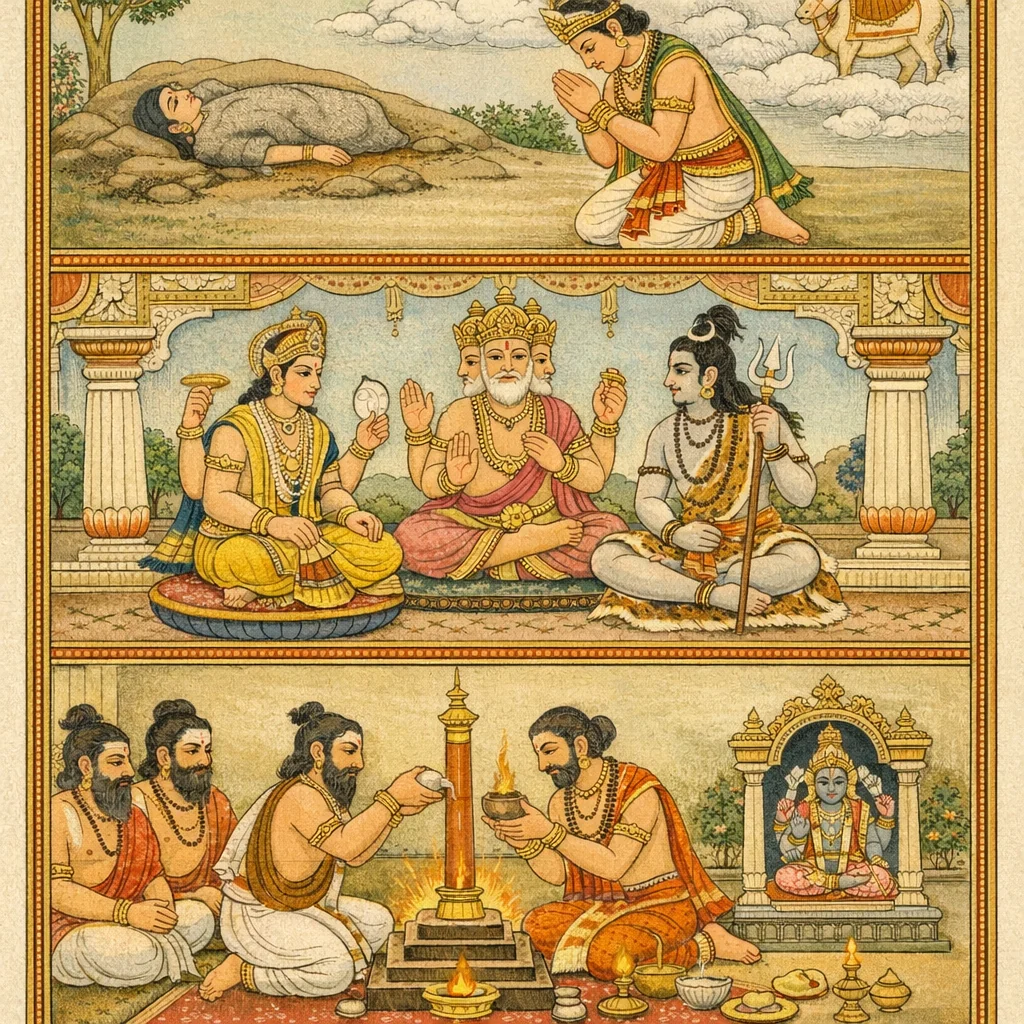
This chapter unfolds through linked dialogues that establish the charter of the Indra Mahotsava. Viśvāmitra first proclaims the tīrtha’s power to purify—its bathing merit and the exact calendrical timing. Ānarta then asks why Indra’s worship on earth is restricted to five nights and in what season it should be observed. Viśvāmitra recounts the Gautama–Ahalyā episode: Indra’s transgression, Gautama’s curse (loss of virility, a thousand marks upon the face, and the threat of head‑splitting if worshipped on earth), Ahalyā’s transformation into stone, and Indra’s withdrawal. With the cosmos distressed by the absence of Indra’s kingship, Bṛhaspati and the gods petition Gautama; Brahmā, with Viṣṇu and Śiva, mediates—upholding restraint according to dharma and the virtue of forgiveness, while preserving the inviolability of spoken words. The curse is partly softened: Indra receives ram‑derived organs, and the facial marks become eyes, earning him the name Sahasrākṣa, “Thousand‑Eyed.” Indra seeks restoration of human worship; Gautama institutes a five‑night terrestrial festival (pañcarātra), promising public welfare—health, no famine, no political collapse—where it is kept. Ritual limits are set: Indra’s icon is not to be worshipped; instead a tree‑born staff (yāṣṭi) is installed with Vedic mantras, and the vrata is tied to ethical correction and release from certain sins. The phalaśruti adds that reciting or hearing this grants a year free from disease, and an arghya‑mantra is said to remove a specific demerit.
Shlokas
Verse 1
विश्वामित्र उवाच । एतत्ते सर्वमाख्यातं यत्पृष्टोऽस्मि नराधिप । बालमंडनमाहात्म्यं सर्वपातकनाशनम्
Viśvāmitra said: “O king, I have told you all that you asked of me—the greatness of Bālamaṇḍana, the destroyer of every sin.”
Verse 2
यत्रैकस्मिन्नपि स्नाने कृते पार्थिवसत्तम । सर्वेषां लभ्यते पुण्यं तीर्थानां स्नानसंभवम् । माघमासे त्रयोदश्यां शुक्लपक्ष उपस्थिते
“In that place, O best of kings, even by a single bath all gain the merit that arises from bathing in many tīrthas—especially when the thirteenth day of the bright fortnight comes in the month of Māgha.”
Verse 3
आनर्त उवाच । कस्माच्छक्रस्य संस्थानं पंचरात्रं धरातले । नाधिकं जायते तेषां यथान्येषां दिवौकसाम्
Ānarta said: “Why is Śakra’s (Indra’s) stay upon the earth limited to five nights? Why does it not last longer for him, as it does for other dwellers of heaven?”
Verse 4
वर्षांते कानि चाहानि येषु शक्रो धरातले । समागच्छति को मास एतत्सर्वं ब्रवीहि मे
“At the end of the rains, on which days does Śakra come to the earth? In which month does he arrive? Tell me all of this.”
Verse 5
विश्वामित्र उवाच । श्रूयतामभिधास्यामि कथा मेनां धराधिप । पंचरात्रात्परं शक्रो यथा न स्याद्धरातले
Viśvāmitra said: “Listen, O lord of the earth—I shall recount this tale to you, so it may be understood why Śakra does not remain on the earth beyond five nights.”
Verse 6
आसीत्पूर्वं बृहत्कल्पे जयत्सेनः सुरेश्वरः । त्रैलोक्यस्य समस्तस्य स्वामी दानवदर्पहा
In former times, in the great aeon, there was a lord of the gods named Jayatsena—master of all the three worlds, the crusher of the demons’ pride.
Verse 7
त्रैलोक्ये सकले पूजां भजमानः सदैव हि । कस्यचित्त्वथ कालस्य गौतमस्य मुनेः प्रिया
He was indeed always receiving worship throughout the entire three worlds. Then, at a certain time, (there was) the beloved wife of the sage Gautama—
Verse 8
अहिल्यानाम भार्याऽभूद्रूपे णाप्रतिमा भुवि । तां दृष्ट्वा चकमे शक्रः कामदेववशं गतः
Her name was Ahilyā, a wife unmatched in beauty upon the earth. Seeing her, Śakra desired her, falling under the sway of Kāma, the god of desire.
Verse 9
नित्यमेव समागत्य स्वर्गलोकात्स कामभाक् । गौतमे निर्गते राजन्समिदिध्मार्थमेव हि । दर्भार्थं फलमूलार्थं स्वयमेव महात्मभिः
Coming again and again from heaven, he—consumed by desire—waited for the moment when Gautama had gone out, O King, to gather fuel-sticks and firewood, or to collect darbha grass, fruits, and roots—tasks undertaken personally by great sages.
Verse 11
तच्छ्रुत्वा सहसा तूर्णं गौतमो गृहमभ्यगात् । यावत्पश्यति देवेशं सह पत्न्या समागतम्
Hearing that, Gautama hurried home at once—and there he saw the lord of the gods together with his wife.
Verse 12
शक्रोऽपि गौतमं दृष्ट्वा पलायनपरायणः । निर्जगामाश्रमात्तस्माद्विवस्त्रोऽपि भयाकुलः
Śakra too, seeing Gautama, became intent only on flight; terrified, he rushed out from that hermitage—even without garments.
Verse 13
अहिल्यापि भयत्रस्ता दृष्ट्वा भर्तारमागतम् । अधोमुखी स्थिता राजंस्तदा व्याकुलितेंद्रिया
Ahilyā too, struck with fear on seeing her husband arrive, stood with her face cast down, her senses shaken in distress, O King.
Verse 14
गौतमोऽपि च तद्दृष्ट्वा सम्यग्भार्याविचेष्टितम् । ददौ शापं महाराज कोपसंरक्तलोचनः
O King, Gautama too, having clearly seen the improper conduct involving his wife, his eyes reddened with wrath, pronounced a curse.
Verse 15
यस्माच्छक्र पापकर्म कृतमीदृग्विगर्हितम् । भार्या मे दूषिता साध्वी तस्मादवृषणो भव
‘Since you, O Śakra, have committed this sinful and blameworthy deed—defiling my virtuous wife—therefore become without testicles.’
Verse 16
सहस्रं च भगानां ते वक्त्रे भवतु मा चिरम् । येन त्वं विप्लवं यासि त्रैलोक्ये सचराचरे
‘And soon, without delay, let a thousand vulva-marks appear upon your face—by which you shall become a cause of scandal throughout the three worlds, moving and unmoving.’
Verse 17
अपरं मर्त्यलोकेऽत्र यद्यागच्छसि वासव । पूजाकृते ततो मूर्धा शतधा ते भविष्यति
Further, O Vāsava, if you come again here to the world of mortals, then when you draw near for worship, your head shall split into a hundred parts.
Verse 18
एवं शप्त्वा च तं शक्रं ततोऽहिल्यामुवाच सः । कोपसंरक्तनेत्रस्तु भर्त्सयित्वा मुहुर्मुहुः
Having thus cursed Śakra, he then addressed Ahalyā; with eyes reddened by anger, he repeatedly reproached her.
Verse 19
यस्मात्पापे त्वया कर्म कृतमेतद्विगर्हितम् । तस्माच्छिलामयी भूत्वा त्वं तिष्ठ वसुधातले
Since you, O sinful one, have done this condemned deed, therefore become stone-made and remain upon the surface of the earth.
Verse 20
ततः सा तत्क्षणाज्जाता तस्य भार्या शिलात्मिका । इन्द्रोऽपि च परित्यक्तो वृषणाभ्यां तथाऽभवत्
Then, at that very moment, his wife became stone-natured; and Indra too, being deprived of his testicles, became so.
Verse 21
सहस्रभगचिह्नस्तु वक्त्रदेशे बभूव ह
Indeed, the mark of a thousand “bhaga” signs appeared upon his facial region.
Verse 22
अथ मेरोः समासाद्य कंदरं विजनं हरिः । सव्रीडः सेवते नित्यं न जगाम निजां पुरीम्
Then Hari (Indra), reaching a lonely and desolate cave on Mount Meru, dwelt there in constant shame and did not return to his own city.
Verse 23
ततो देवगणाः सर्वे सोद्वेगास्तेन वर्जिताः । नो जानंति च तत्रस्थं कन्दरान्वेषणे रताः ओ
Thereupon all the hosts of gods, anxious because he had abandoned them, did not know where he was staying and busied themselves in searching the caves.
Verse 24
पीड्यंते दानवै रौद्रैः स्वर्गे जाते विराजके
When Virājaka came to be in heaven, the fierce Dānavas began to oppress the worlds.
Verse 25
एतस्मिन्नन्तरे जीवः शक्राण्या भयभीतया । सोद्वेगया परिपृष्टः क्व गतोऽथ पुरंदरः
Meanwhile, Jīva was anxiously questioned by Śakrāṇī (Indrāṇī), who was terrified with fear: “Where has Purandara (Indra) gone?”
Verse 26
अथ जीवश्चिरं ध्यात्वा दृष्ट्वा तं ज्ञानचक्षुषा । जगाम सहितो देवैः प्रोवाचाथ सुनिष्ठुरम्
Then Jīva, after meditating for a long time and beholding him with the eye of spiritual knowledge, went together with the gods and spoke sternly.
Verse 27
किमित्थं राज्यभोगांस्त्वं त्यक्त्वा विजनमाश्रितः । किं त्वया विहितं ध्यानं किं रौद्रं संश्रितं तपः
“Why have you abandoned royal enjoyments and taken refuge in solitude? What kind of meditation (dhyāna) have you undertaken, and what fierce austerity (tapas) have you resorted to?”
Verse 28
बृहस्पतेर्वचः श्रुत्वा भगवक्त्रः पुरंदरः । प्रोवाच लज्जया युक्तो दीनो बाष्पपरिप्लुतः
Hearing Bṛhaspati’s words, Purandara (Indra)—his face downcast—spoke, filled with shame, wretched, and overwhelmed with tears.
Verse 29
नाहं राज्यं करिष्यामि त्रैलोक्येऽपि कथंचन । पश्य मे यादृशी जाता ह्यवस्था गौतमान्मुनेः
“I will not take up kingship—not in the three worlds, by any means. See what a condition has befallen me because of the sage Gautama.”
Verse 31
मर्त्यलोकोद्भवा पूजा नष्टा मम बृहस्पते । गौतमस्य मुनेः शापात्कस्मिंश्चित्कारणांतरे
“O Bṛhaspati, the worship that arose from the mortal world for me has been ruined—due to the curse of the sage Gautama, for some intervening cause.”
Verse 32
तच्छ्रुत्वा देवराजस्य बृहस्पतिरुवाचह । दुःखेन महता युक्तः सर्वैर्देवैः समावृतः । गौतमस्य समीपे च गत्वा प्रोवाच तं स्वयम्
Hearing this from the king of the gods, Bṛhaspati spoke. Burdened with great sorrow and surrounded by all the gods, he went to Gautama and addressed him personally.
Verse 33
एतच्छक्रपरित्यक्तं त्रैलोक्यमपि चाखिलम् । पीड्यते दानवैर्विप्र नष्टयज्ञोत्सवक्रियम्
O brāhmaṇa, this entire threefold world—forsaken by Śakra (Indra)—is being oppressed by the Dānavas, and the rites of sacrifice and festival have been destroyed.
Verse 34
नैष वांछति राज्यं स्वं लज्जया परया युतः । तस्मादस्य प्रसादं त्वं यथावत्कर्तुमर्हसि । अनुग्रहेण शापस्य मम वाक्याद्द्विजोत्तम
He does not desire his own kingdom, being filled with profound shame. Therefore, O best of the twice-born, you should properly grant him your favor—by graciously relaxing the curse, at my request.
Verse 35
तच्छ्रुत्वा गौतमः प्राह न मे वाक्यं भवेन्मृषा । न वाक्यं लोपयिष्यामि यदुक्तं स्वयमेव हि
Hearing this, Gautama said: “My word shall not become false. I will not withdraw what I myself have spoken.”
Verse 36
ततः प्रोवाच ते विष्णुः स्वयं चापि महेश्वरः । तथा देवगणाः सर्वे विनयावनता स्थिताः
Then Viṣṇu spoke to him, and Maheśvara too spoke in person; and all the hosts of gods stood there, bowed down in humility.
Verse 37
अन्यथा ब्रह्मणो वाक्यं न ते कर्तुं प्रयुज्यते । तस्मात्कुरुष्व विप्रेन्द्र शापस्यानुग्रहं हरेः
Otherwise, the word of Brahmā would not be fit to be carried out by you. Therefore, O best of brāhmaṇas, transform the curse into a grace—for the sake of Hari.
Verse 38
दृष्ट्वा तन्मनसो दार्ढ्यं सुरा विष्णुपुरोगमाः । ब्रह्मणोंऽतिकमभ्येत्य तस्मै सर्वं न्यवेदयन्
Seeing the firmness of his resolve, the gods—led by Viṣṇu—approached Brahmā and reverently reported everything to him.
Verse 39
शापं शक्रस्य संजातं तथा तस्मान्महामुनेः
They spoke of the curse that had arisen for Śakra (Indra), and likewise of the matter that had come about through that great sage.
Verse 40
यथा विडंबना जाता देवराजस्य गर्हिता । तथा च दानवैः सर्वं त्रैलोक्यं व्याकुलीकृतम्
They told how a disgraceful, blameworthy humiliation had come upon the king of the gods, and how, because of it, the Dānavas threw all the three worlds into turmoil.
Verse 41
यथा न कुरुते राज्यं व्रीडितः स शचीपतिः । तच्छ्रुत्वा पद्मजस्तूर्णं हरिशंभुसमन्वितः
They told how Śacī’s lord (Indra), ashamed, would not carry on his kingship. Hearing this, the Lotus-born Brahmā quickly set out, accompanied by Hari and Śambhu.
Verse 42
जगाम तत्र यत्रास्ते दुःखितः पाकशासनः । गौतमं च समानीय तत्रैव च पितामहः
He went to the place where Pākaśāsana (Indra) sat in sorrow; and there itself the Grandfather, Brahmā, brought Gautama along as well.
Verse 43
ततः प्रोवाच प्रत्यक्षं देवानां वासवस्य च । अयुक्तं देवराजेन विहितं मुनिसत्तम
Then, in the very presence of the gods and of Vāsava (Indra), he said: “O best of sages, what the king of the gods has done is improper.”
Verse 44
यत्ते प्रदूषिता भार्या कामोपहतचेतसा । न ते दोषोऽस्ति यच्छप्तश्छिद्रे चास्मिन्पुरंदरः । परं प्रशस्यते नित्यं मुनीनां परमा क्षमा
“Since your wife was violated by one whose mind was overpowered by desire, you bear no fault in having cursed him—especially as Puraṃdara had indeed acted through a moral lapse. Yet the supreme forgiveness of sages is always praised.”
Verse 45
यथा त्रैलोक्यराज्यं स्वं प्रकरोति शतक्रतुः । त्वया स्वयं प्रसादेन तथा नीतिर्विधीयताम्
“Just as Śatakratu (Indra) regains and establishes his own sovereignty over the three worlds, so, by your direct grace, let the proper course of action be ordained.”
Verse 46
दत्त्वाऽस्य वृषणौ भूयो नाश यित्वा भगानिमान् । मर्त्यलोके गतिश्चास्य यथा स्यात्तत्समाचर
“After restoring his testicles again, and then destroying these ‘bhagas’ (marks/eyes) here, act in such a way that his course in the mortal world will be as it should be.”
Verse 47
तच्छ्रुत्वा वचनं तेषां स मुनिर्देवगौरवात् । वृषणौ मेषसंभूतौ योजयामास तौ तदा
Hearing their words, that sage—out of reverence for the gods—then affixed to him a pair of testicles that had arisen from a ram.
Verse 48
तान्भगान्पाणिना स्पृष्ट्वा चक्रे नेत्राणि सन्मुनिः । ततः प्रोवाच तान्देवान्गौतमश्च महातपाः
Touching those ‘bhagas’ with his hand, the holy sage fashioned them into eyes. Then Gautama, the great ascetic, spoke to those gods.
Verse 49
सहस्राक्षो मया शक्रो निर्मितोयं सुरोत्तमाः । स मेषवृषणश्चापि स्वं च राज्यं करिष्यति । शोभाऽस्य नेत्रजा वक्त्रे सुरम्या संभविष्यति
“O best of gods, I have fashioned this Śakra as ‘Sahasrākṣa’—the thousand-eyed. Though bearing the testicles of a ram, he will surely secure his own kingdom; and a most delightful radiance, born of those eyes, will arise upon his face.”
Verse 50
पुंस्त्वं च मेषजोत्थाभ्यां वृषणाभ्यां भविष्यति । न च मर्त्ये गतिश्चास्य पूजार्थं संभविष्यति
“And his manhood will indeed be sustained by those two testicles born of a ram; yet he will not obtain a course in the mortal realm for the sake of receiving human worship.”
Verse 51
एतस्मिन्नन्तरे जातः सहस्राक्षः पुरंदरः । शोभया परया युक्तो मुनेस्तस्य प्रभाव तः
At that very moment Puraṃdara (Indra) became ‘Sahasrākṣa’, the thousand-eyed; and by the power of that sage he was endowed with surpassing beauty.
Verse 52
ततः संगृह्य पादौ च गौतमस्य महात्मनः । प्रोवाच वचनं शक्रः सर्वदेवसमागमे
Then Śakra, clasping the feet of the great-souled Gautama, spoke these words in the assembly of all the gods.
Verse 53
दुर्लभा मर्त्यलोकोत्था पूजा ब्राह्मणसत्तम । सा मे तव प्रसादेन यथा स्यात्तत्समाचर
O best of brāhmaṇas, worship that arises in the mortal world is hard to obtain. Act so that, by your grace, such worship may come to me.
Verse 54
त्रैलोक्यपतिजा संज्ञा मा नाशं यातु मे द्विज । प्रसादात्तव सा नित्यं यथा स्यात्तद्विधीयताम्
O twice-born one, let not my designation as “lord of the three worlds” perish. By your grace, let that title remain for me always—let it be so ordained.
Verse 55
तच्छ्रुत्वा लज्जयाविष्टः कृपया चाथ सन्मुनिः । तमूचे सर्वदेवानां प्रत्यक्षं पाकशासनम्
Hearing that, the virtuous sage—overcome with shame, yet moved by compassion—spoke to Indra, the chastiser of Pāka, who stood there manifest before all the gods.
Verse 56
पंचरात्रं च ते पूजा मर्त्यलोके भविष्य ति । अनन्यां तृप्तिमभ्येषि यथा चैव तु वत्सरम्
And in the world of mortals, a five-night worship in your honor shall take place; through it you will attain a singular, unsurpassed satisfaction—as though for a full year.
Verse 57
यत्र देशे पुरे ग्रामे पंचरात्रं महोत्सवः । तत्र संवत्सरं यावन्नीरोगो भविता जनः
In whatever land—city or village—a Pañcarātra great festival is held, the people there shall remain free from disease for as long as a year.
Verse 58
आधयो व्याधयो नैव न दुर्भिक्षं कथंचन । न च राज्ञो विनाशः स्यान्नैव लोकेऽसुखं क्वचित्
In that realm there shall be no afflictions of the mind and no diseases of the body; no famine of any kind; no ruin of the king—and nowhere in that world shall suffering be found.
Verse 59
यत्र स्थाने महो भावी तावकश्च पुरंदर । प्रभूतपयसो गावः प्रभविष्यंति तत्र च । सुभिक्षं सुखिनो लोकाः सर्वोपद्रववर्जिताः
O Puraṃdara, in whatever place this great festival of yours is held, there cows rich in milk shall flourish; food will be abundant, the people will be happy, and all calamities will be absent.
Verse 60
इन्द्र उवाच । यद्येवं शरदि प्राप्ते सर्व सत्त्वमनोहरे । सप्तच्छदसमाकीर्णे बन्धूकसुविराजिते
Indra said: “If so—then when autumn arrives, delightful to the minds of all beings, with saptacchada blossoms spread about and resplendent with bandhūka flowers—”
Verse 61
मालतीगन्धसंकीर्णे नवसस्यसमाकुले । चंद्रज्योत्स्नाकृतोद्द्योते षट्पदाराव संकुले
“—filled with the fragrance of mālatī, rich with fresh harvests, illuminated by moonlight, and resonant with the humming of bees—”
Verse 62
कुमुदोत्पलसंयुक्ते तत्र स्यात्सुमहोत्सवः । येन बालोऽपि वृद्धोऽपि संहृष्टस्तत्समाचर
“—adorned with kumuda and utpala lotuses—let a most splendid festival be held there; perform it so that both the young and the old are filled with joy.”
Verse 63
गौतम उवाच । अद्य श्रवणनक्षत्रे तव दत्तो महोत्सवः । वैष्णवे पुण्यनक्षत्रे सर्वपापविवर्जिते
Gautama said: “Today, under the Śravaṇa constellation, your great festival is granted—on this Vaiṣṇava, auspicious nakṣatra, free from all sin.”
Verse 64
त्वया मे धर्षिता भार्या पौष्णे नक्षत्रसंज्ञिते । तस्मिन्भविष्यति व्यक्तं तव पातः पुरंदर
“You violated my wife when the nakṣatra called Pauṣṇa was in force; therefore, O Puraṃdara, your downfall will become manifest on that very occasion.”
Verse 65
येनैषा मामकी कीर्तिस्तावकं वक्तु कर्म तत् । विख्यातिं यातु लोकेऽत्र न कश्चित्पापमाचरेत्
Let that deed of yours be proclaimed by which this fame of mine is upheld. May it become renowned in this world, and may no one here commit sin.
Verse 66
श्रवणादीनि पंचैव नक्षत्राणि पृथक्पृथक् । तव पूजाकृते पंच क्रतुतुल्यानि तानि च । भविष्यंति न संदेहः सर्वतीर्थमयानि च
The five lunar mansions beginning with Śravaṇa—each distinct—when observed for your worship, will be equal to five Vedic sacrifices. Without doubt, they will embody the merit of all holy places.
Verse 67
यो यं काममभिध्याय पूजां तव करिष्यति । विशेषात्फलपुष्पैश्च स तं कृत्स्नमवाप्नुयात्
Whoever, contemplating a particular desire, performs worship of you—especially with offerings of fruits and flowers—will obtain that wish in full.
Verse 68
परं मूर्तिर्न ते पूज्या कुत्रापि च भविष्यति । त्वया मे दूषिता भार्या ब्राह्मणी प्राणसंमता
No other image of you shall be worshipped anywhere. For you have violated my wife—a Brāhmaṇa woman, dear to me as life itself.
Verse 69
तस्माद्वृक्षोद्भवां यष्टिं ब्राह्मणा वेदपारगाः । तावकैः सकलैर्मंत्रैः स्थापयिष्यंति शक्तितः
Therefore, Brāhmaṇas learned in the Vedas will, with all your mantras, duly establish a staff made from a tree, according to their power and rite.
Verse 70
पंचरात्रविधानेन यथान्येषां दिवौकसाम् । ततः संक्रमणं कृत्वा पूजा मर्त्यसमुद्भवा । त्वया ग्राह्या सहस्राक्ष तृप्तिश्चैव भविष्यति
By the Pañcarātra procedure—just as for other gods in heaven—then, after performing the rite of saṅkramaṇa, worship arising from mortals is to be accepted by you, O Thousand-eyed one; and satisfaction will surely follow.
Verse 71
यो यथा चैव ते यष्टिं सुप्तामुत्थापयिष्यति । तस्य तस्याधिका सिद्धिः संभविष्यंति वासव
In whatever manner a person awakens and raises your sleeping staff, in that same measure greater success will arise for him, O Vāsava (Indra).
Verse 72
पंचरात्रव्रतरतो यो ब्रह्मचर्यपरायणः । प्रकरिष्यति ते पूजां फलपुष्पैर्यथोदितैः
Whoever is devoted to the Pañcarātra vow and steadfast in celibacy will perform your worship with the fruits and flowers as prescribed.
Verse 73
परदारकृतात्पापात्स सर्वान्मुक्तिमेष्यति
From all sins arising from relations with another’s spouse, he shall attain release (mokṣa).
Verse 74
नमः शक्राय देवाय शुनासीराय ते नमः । नमस्ते वज्रहस्ताय नमस्ते वज्रपाणये
Homage to Śakra, the divine; homage to you, Śunāsīra. Homage to you with the thunderbolt (vajra) in hand; homage to you, the thunderbolt-bearer (Vajrapāṇi).
Verse 76
यश्चेदं तव संवादं मया सार्धं पुरंदर । कीर्तयिष्यति सद्भक्त्या तथैवाकर्णयिष्यति
O Purandara (Indra), whoever with true devotion recites this dialogue of yours with me—and likewise listens to it—shall gain the declared merit.
Verse 77
तस्य संवत्सरं यावन्नैव रोगो भविष्यति । तच्छ्रुत्वा विबुधाः सर्वे तथेत्युक्त्वा प्रहर्षिताः
For such a person, for as long as a year, no illness shall arise. Hearing this, all the gods, saying “So be it,” rejoiced.
Verse 78
जग्मुः शक्रं समादाय पुनरेवामरावतीम् । गौतमोऽपि निजा वासं गतः कोपसमाश्रितः
Taking Śakra (Indra) with them, they went back again to Amarāvatī. Gautama too returned to his own dwelling, filled with anger.
Verse 207
इति श्रीस्कान्दे महापुराण एकाशीतिसाहस्र्यां संहितायां षष्ठे नागरखण्डे हाटकेश्वरक्षेत्रमाहात्म्य इन्द्रमहोत्सववर्णनंनाम सप्तोत्तरद्विशततमोऽध्यायः
Thus, in the revered Skanda Mahāpurāṇa, in the Ekāśītisāhasrī Saṃhitā, in the sixth book—the Nāgara Khaṇḍa—within the Māhātmya of the sacred region of Hāṭakeśvara, ends the two-hundred-and-seventh chapter, entitled “Description of the Indra Festival.”
Verse 785
मन्त्रेणानेन यश्चार्घ्यं तव शक्र प्रदास्यति । परदारकृतं पापं तस्य सर्वं प्रयास्यति
O Śakra (Indra), whoever, with this mantra, offers you arghya (a ritual libation), all the sin he has incurred by violating another’s marriage-bed shall depart.