Arunachala Mahatmya
Arunachala Mahatmya
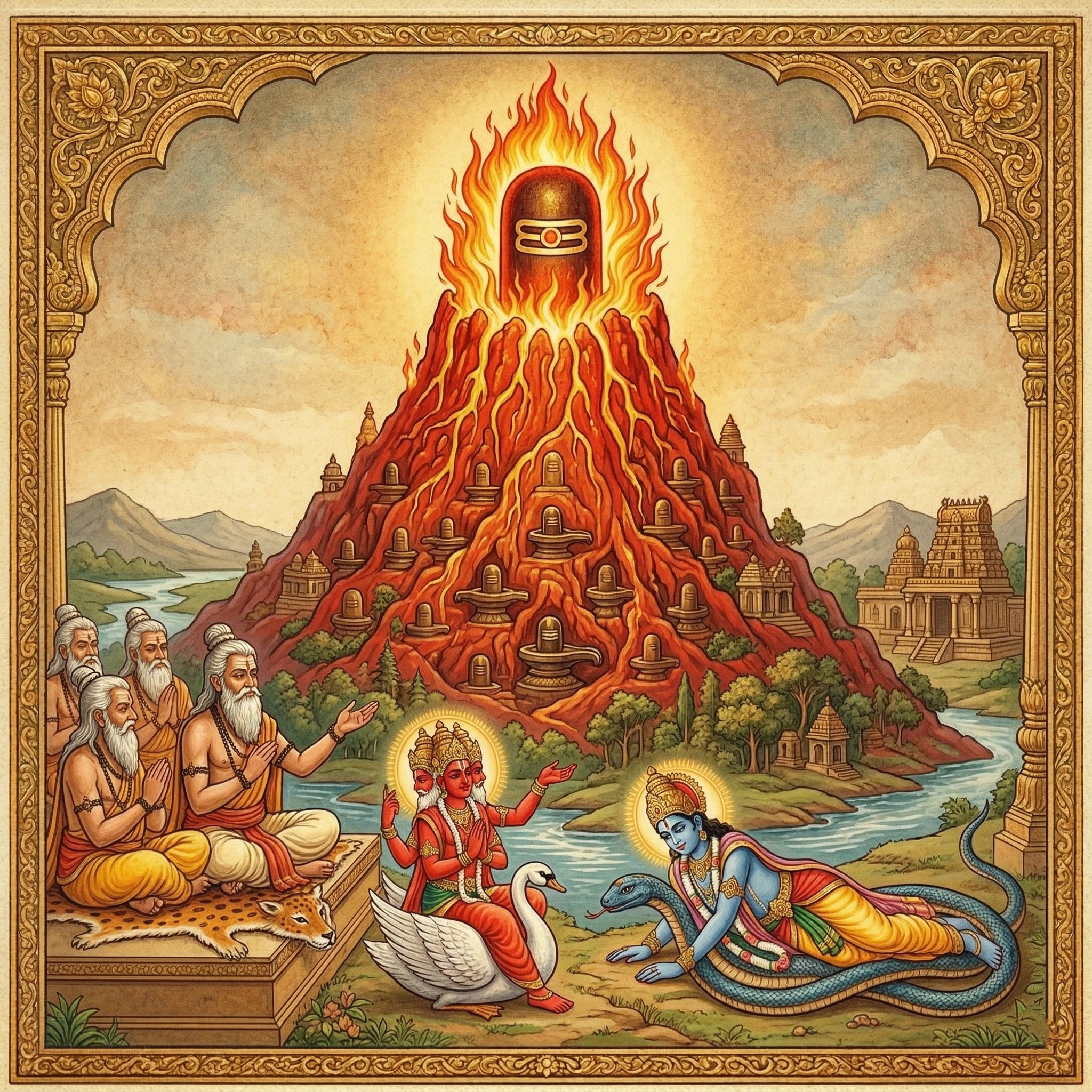
This section is anchored in the sacral geography of Aruṇācala (Aruṇagiri), widely identified with the Tiruvaṇṇāmalai region of Tamil Nadu. In puranic mapping, the site is treated not merely as a pilgrimage destination but as a theologically charged landscape where divine presence is conceptualized as luminous manifestation (tejas) and as liṅga-form. The narrative treats the mountain as an axis of revelation—an intersection of cosmic symbolism (the pillar of fire/light) and regional devotional culture—thereby integrating pan-Indic Śaiva metaphysics with localized place-memory and pilgrimage ethics.
Adhyayas in Arunachala Mahatmya
13 chapters to explore.
Adhyaya 1
अग्निस्तम्भ-प्रादुर्भावः (The Manifestation of the Fiery Pillar and the Humbling of Rivalry)
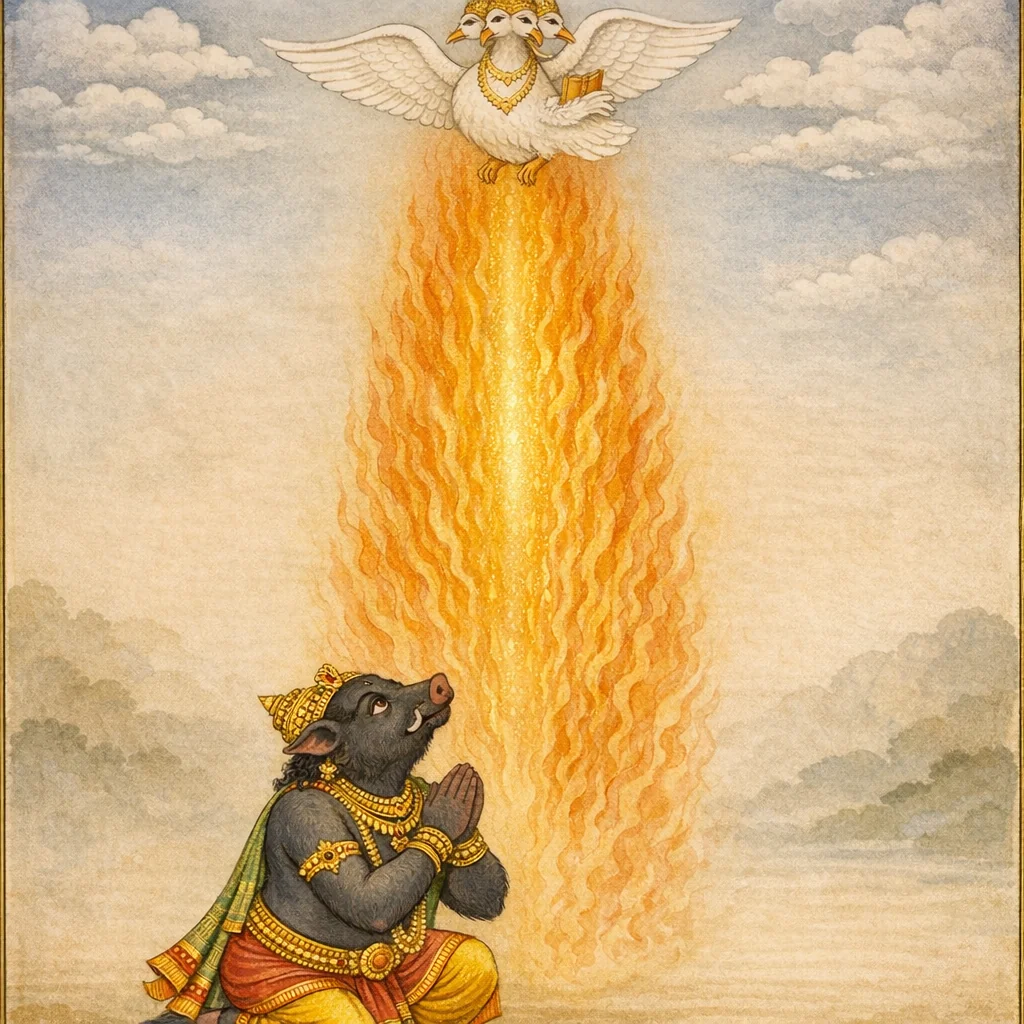
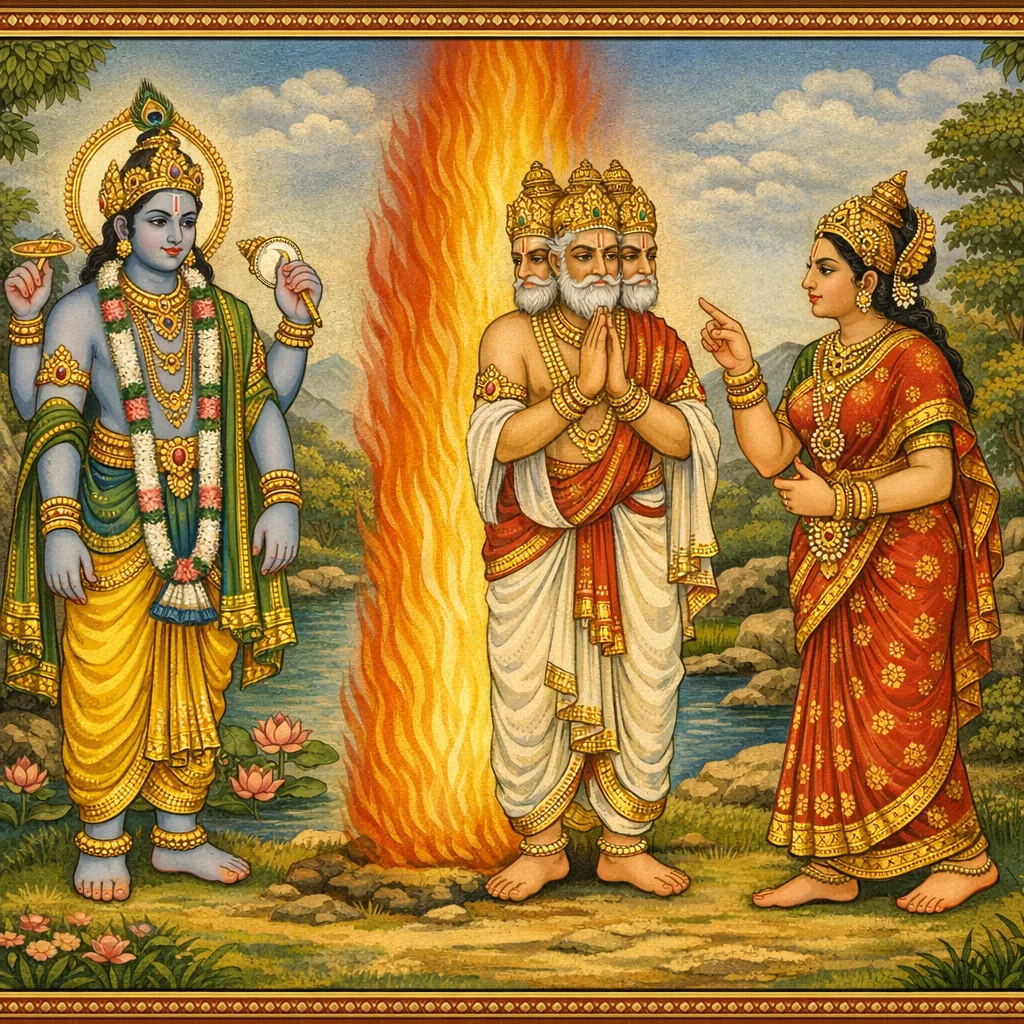
The chapter begins with an invocation and sets the narration at Naimiṣāraṇya, where the sages ask Sūta to recount the Aruṇācalamāhātmya. Sūta relates an earlier dialogue in Satyaloka, in which Sanaka questions Brahmā about Śaiva liṅgas and about the saving power of merely remembering the Divine Name. Pleased, Brahmā tells a primeval episode: Brahmā and Nārāyaṇa fall into rivalry over cosmic supremacy. To avert the world’s ruin, Sadāśiva manifests between them as an anādi–ananta fiery pillar (tejaḥ-stambha), without beginning or end. A bodiless voice commands them to find its source and limit; Viṣṇu becomes Varāha to seek the base, while Brahmā becomes Haṃsa to seek the summit. After immense striving, both fail; their pride collapses and they turn to Śiva as their refuge. The chapter teaches that sacred manifestation reveals the limits of knowledge and demands humility, presenting Aruṇācala as the emblematic form of that revelation.
Adhyaya 2
Tīrtha–Kṣetra Saṅgraha and the Saṃsāra Diagnosis (Aruṇācala Māhātmya, Adhyāya 2)
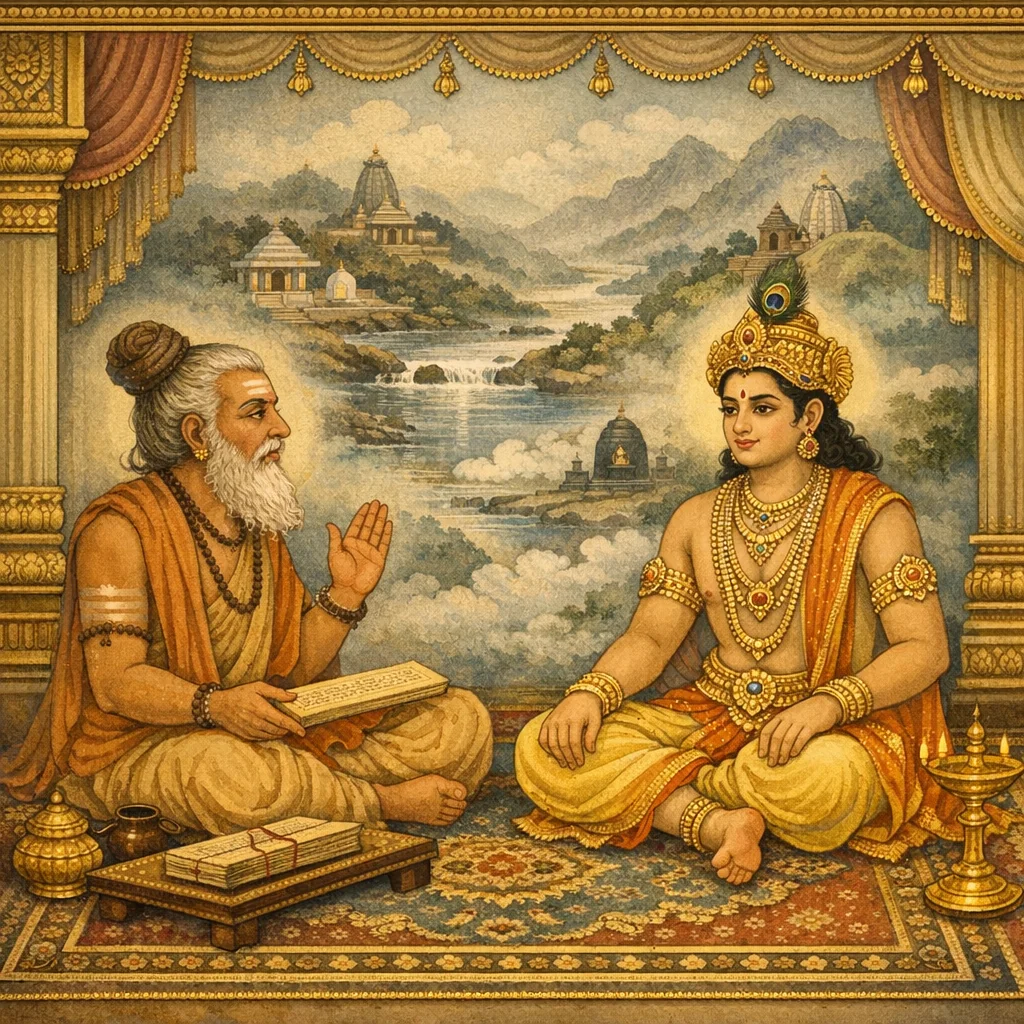
Nandikeśvara answers a sage’s question about a “place” (sthāna) that benefits all beings, explaining embodied life as ruled by karmic fitness and repeated birth through many kinds of wombs. He diagnoses saṃsāra as stubbornly enduring even when one has minor merits or only partial knowledge, portraying the round of birth and death through a cyclical, mechanical image like a water-wheel. The discourse then turns into a sweeping sacred geography: sages and divine residents are said to dwell along numerous riverbanks and holy locales, culminating in a named catalogue of renowned kṣetras across the subcontinent. Vārāṇasī (Avimukta), Gayā, Prayāga, Kedāra, Badarikāśrama, Naimiṣa, Oṃkāra/Amareśa, Puṣkara, Śrīśaila (Mallikārjuna), Kāñcī, Setubandha (Rāmanātha), Somnātha, Gokarṇa, Tripurāntaka, Jvālāmukha, and others appear as key nodes in a pan-Indic Śaiva pilgrimage map. The chapter closes with reverent transmission: the compassionate speaker blesses the devoted listener, affirming continuity of teaching and the humility proper to devotion.
Adhyaya 3
Nandikeśa as Guru: Ṛṣi-Assembly, Inquiry into Universal Fruit, and the Efficacy of Remembrance
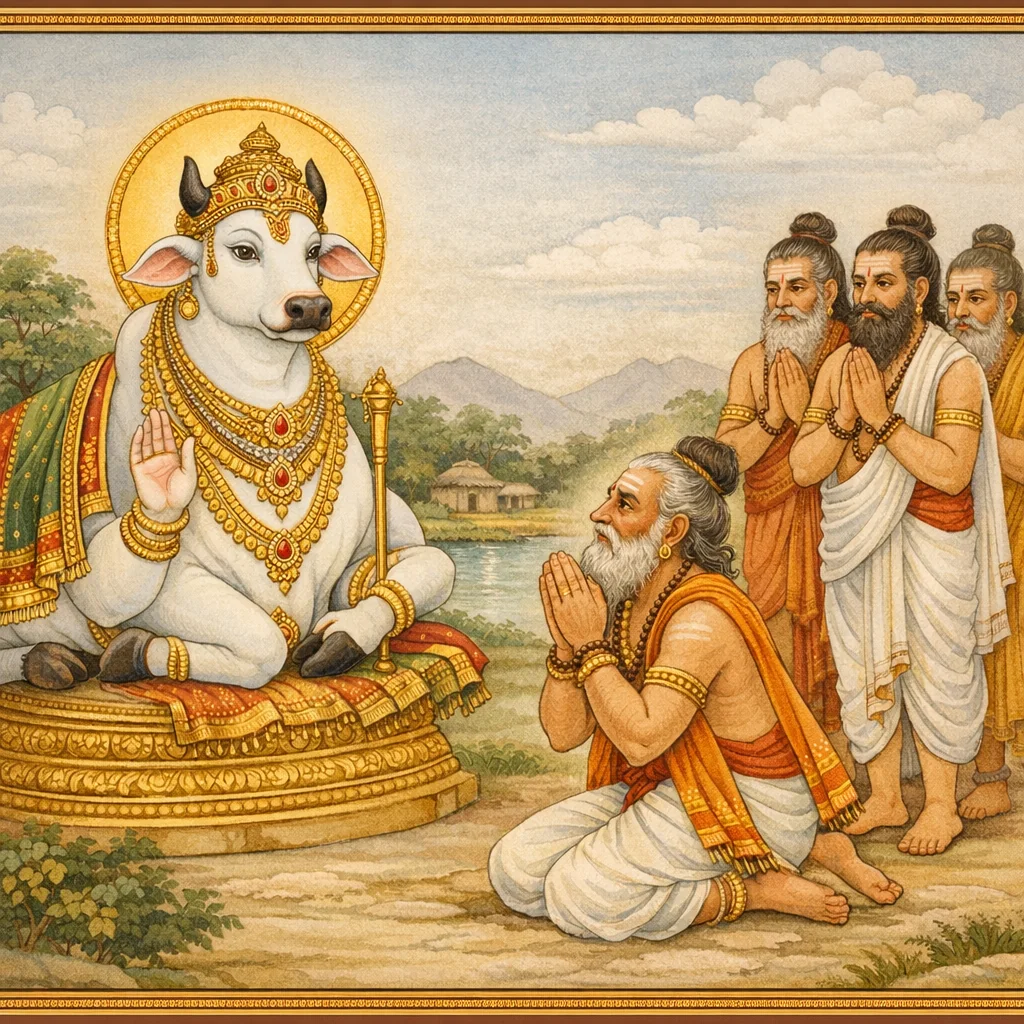
Chapter 3 is framed as a formal petition by Mārkaṇḍeya to Nandikeśa. He asks (i) which single sacred place among those previously described bestows “all fruits” (sarvaphala), and (ii) what is that locus whose mere remembrance grants liberation to beings, whether they know it or not. The chapter then heightens Nandikeśa’s authority by listing a great assembly of ṛṣis gathered around him for question-and-answer service, affirming by lineage that he is an āgama-competent teacher and foremost among the Māheśvaras. The teaching is presented as a “secret” (rahasya) disclosed through the guru, with devotion and divine compassion invoked as prerequisites. The closing verse portrays Nandikeśa’s reply as bestowing elevated Śiva-bhakti and implying attainment of Śiva through prior devotion and disciplined listening.
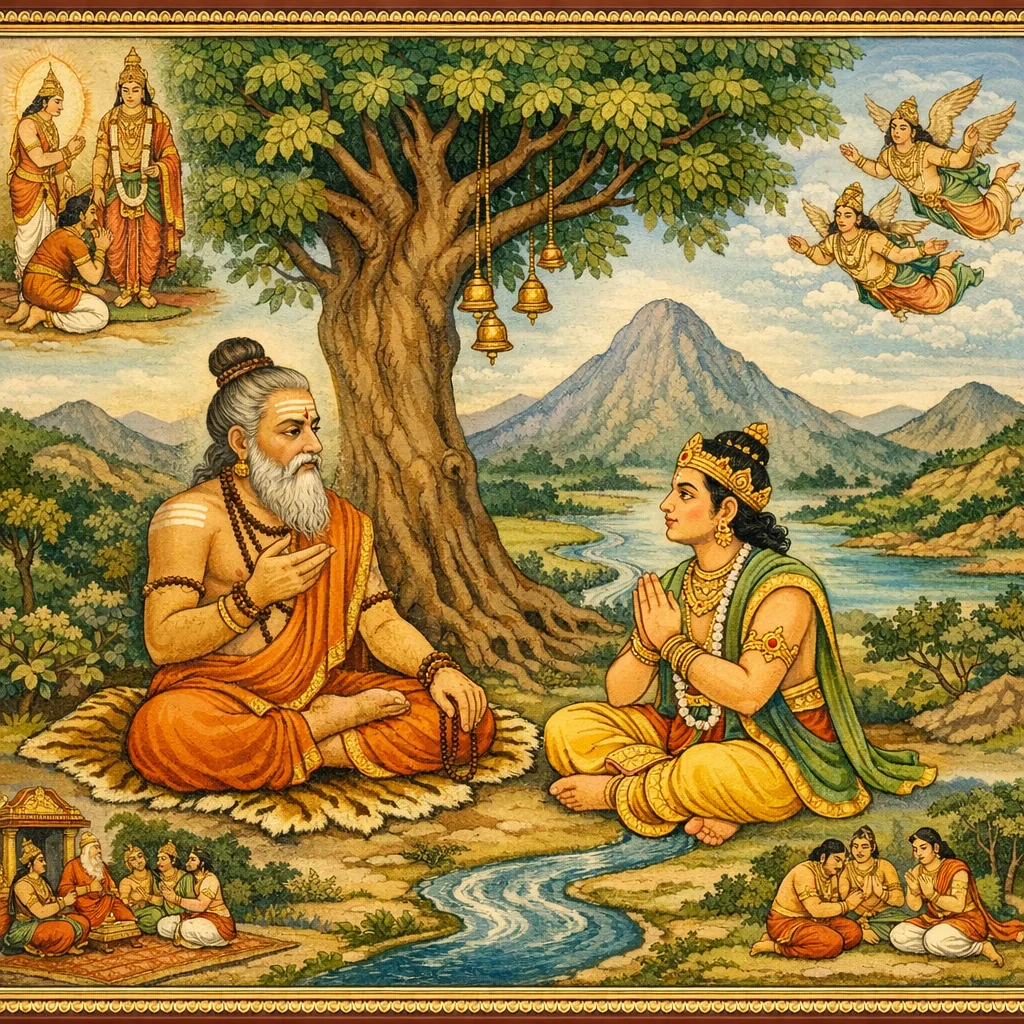
Adhyaya 4
अरुणाचलक्षेत्ररहस्योपदेशः — The Esoteric Instruction on the Arunācala Kṣetra
Chapter 4 unfolds as a guru–śiṣya transmission. Nandikeśvara addresses a sage who has been tested and proven as a devotee, affirming his maturity in Śaiva dharma and bhakti, and pointing to signs of divine favor—such as Yama being restrained under Śiva’s authority. The teacher then declares his intent to disclose a “guhya” (esoteric) kṣetra, to be rightly grasped through faith, a disciplined mind, and mantra-remembrance, including Śaṅkarī-vidyā and praṇava (ॐ) recitation. Arunācala is located in the southern Drāviḍa region, defined as a sacred expanse of three yojanas, and identified as Śiva’s heart-space; Śiva is said to have assumed a mountain-body for the welfare of the worlds. A dense catalogue of praise follows: siddhas and celestial beings dwell there; flora and fauna become worship-symbols; the landscape is described with attendant hills in the four directions; and yogic imagery (iḍā–piṅgalā–suṣumnā), jyotiḥ-stambha resonances, and allusions to Brahmā and Viṣṇu’s search motif appear. The narrative records exemplary tapas and installations: Gautama’s austerities and vision of Sadāśiva, Gaurī’s connection with the Pravālādriśvara liṅga, Durgā’s bestowal of mantra-siddhi, and named tīrthas/liṅgas such as Khaḍga-tīrtha and Pāpanāśana-liṅga with purificatory effects. The chapter culminates in a phalāśruti proclaiming Arunācala/Śoṇādri as unsurpassed, after which the disciple asks about karma, suffering, and the logic of consequences.
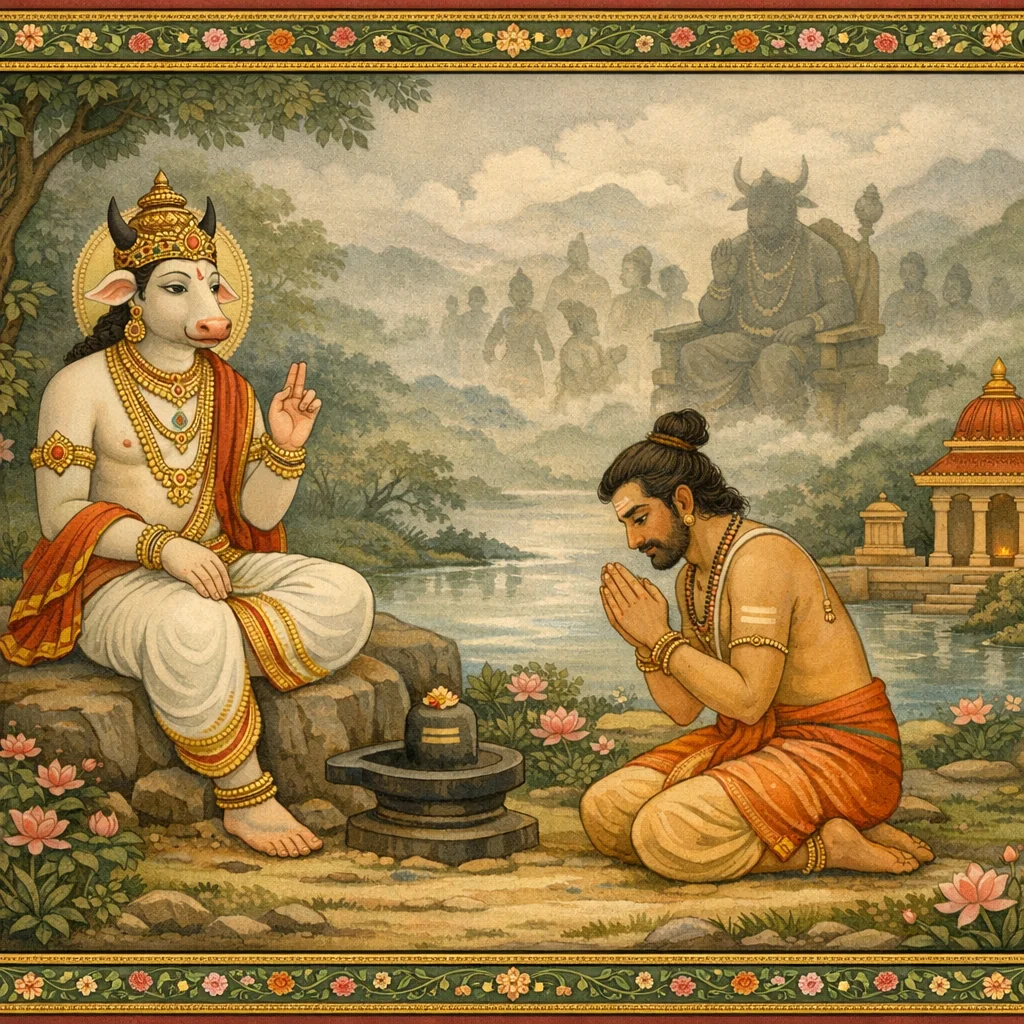
Adhyaya 5
Narakavarṇana and Prāyaścitta-Preraṇā (Description of Consequences and Impulse toward Expiation)
Chapter 5 is an ethical, didactic discourse attributed to Nandikeśvara. It opens by contrasting the rarity of a śuddha-sattva (pure, lucid) disposition with the widespread dominance of rajas and tamas, establishing a moral psychology for what follows. It then teaches the principle of karmic specificity (vaicitrya): varied deeds yield varied results. The text lists narakas (hell-realms), punitive conditions, adverse rebirths, and bodily afflictions, mapping particular transgressions—such as brahmahatyā, surāpāna, theft, sexual misconduct, betrayal, falsehood, and denigration of religion—to their corresponding consequences, and depicting Yama’s agents administering punishments. The conclusion turns prescriptive: having understood the pāpaphala (fruit of sin), one should undertake prāyaścitta (expiation) as corrective discipline. It explicitly recommends that the faithful perform it properly in Aruṇa-kṣetra, and the listener petitions for the means of pacification and remedy.
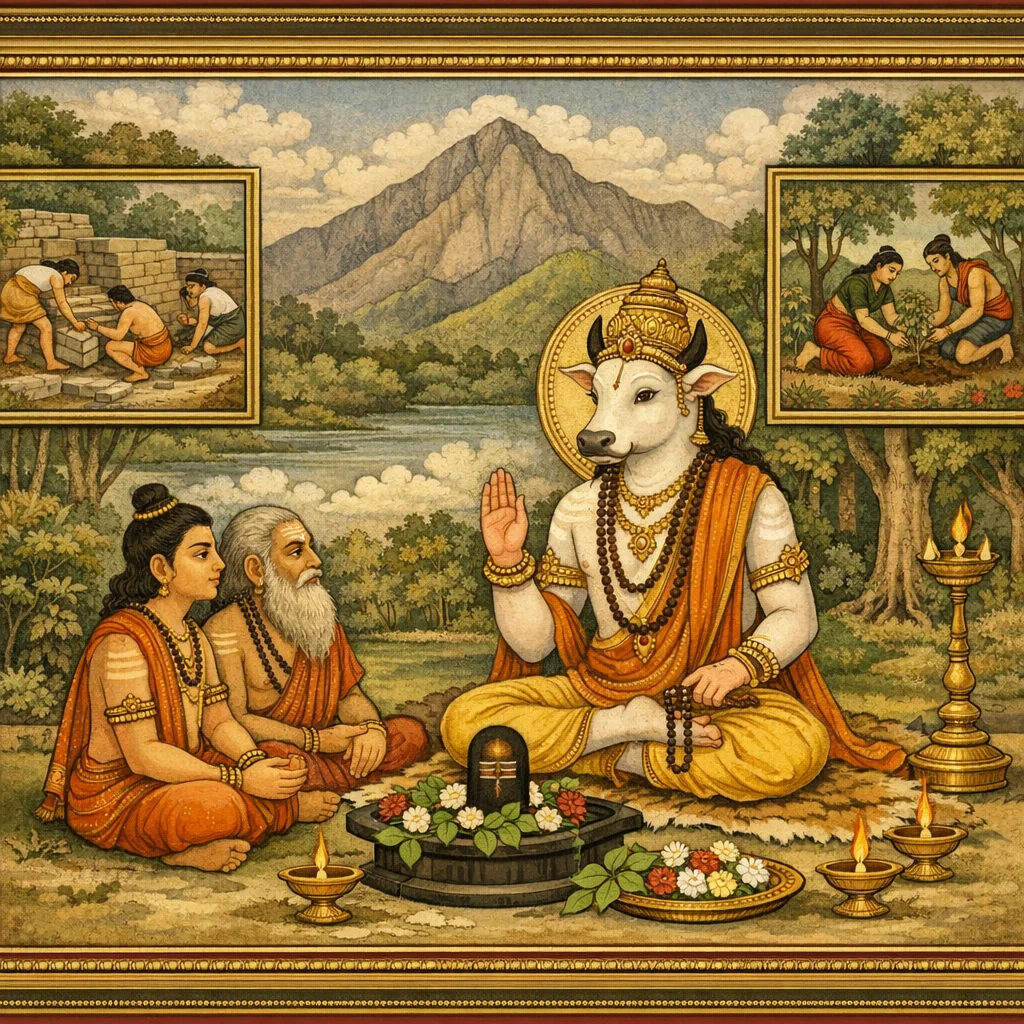
Adhyaya 6
Prāyaścitta-vidhāna at Śoṇakṣetra (Aruṇācala): Ritual Remedies and Kṣetra-Phala
Chapter 6 is Nandikeśvara’s step-by-step teaching on prāyaścitta (ritual and ethical expiation) for mahāṃhasa—grave sins—when undertaken in Aruṇācala/Śoṇakṣetra. It lists major offenses such as brahmahatyā (killing a brāhmaṇa), surāpāna (drinking liquor), suvarṇasteya (stealing gold), gurudāra-gamana (violating the guru’s wife), harms connected with another’s wife, poisoning, slander, arson, dharma-nindā (reviling dharma), pitṛ-droha (betraying the ancestors), concealed wrongdoing, false speech, and violations of property. For each offense it prescribes time-bound residence in the sacred field, modes of worship (bilva-leaf archana, flower and lamp offerings), mantra-japa (pañcākṣara/ṣaḍakṣara and the Aruṇeśvara-mantra), and social-ritual acts such as feeding brāhmaṇas, gifting wealth or cows, and building tanks, gardens, and temples. A phala-centered theology exalts Aruṇācala as exceptionally potent: even minimal acts—name-recitation or brief residence—are said to bring powerful purification. The chapter culminates in promises of access to Śiva-loka and Śiva-sāyujya (union with Śiva), and closes by noting the listener’s further inquiry into calendrical and honorific procedures, including daily, seasonal, and annual sequences of worship.
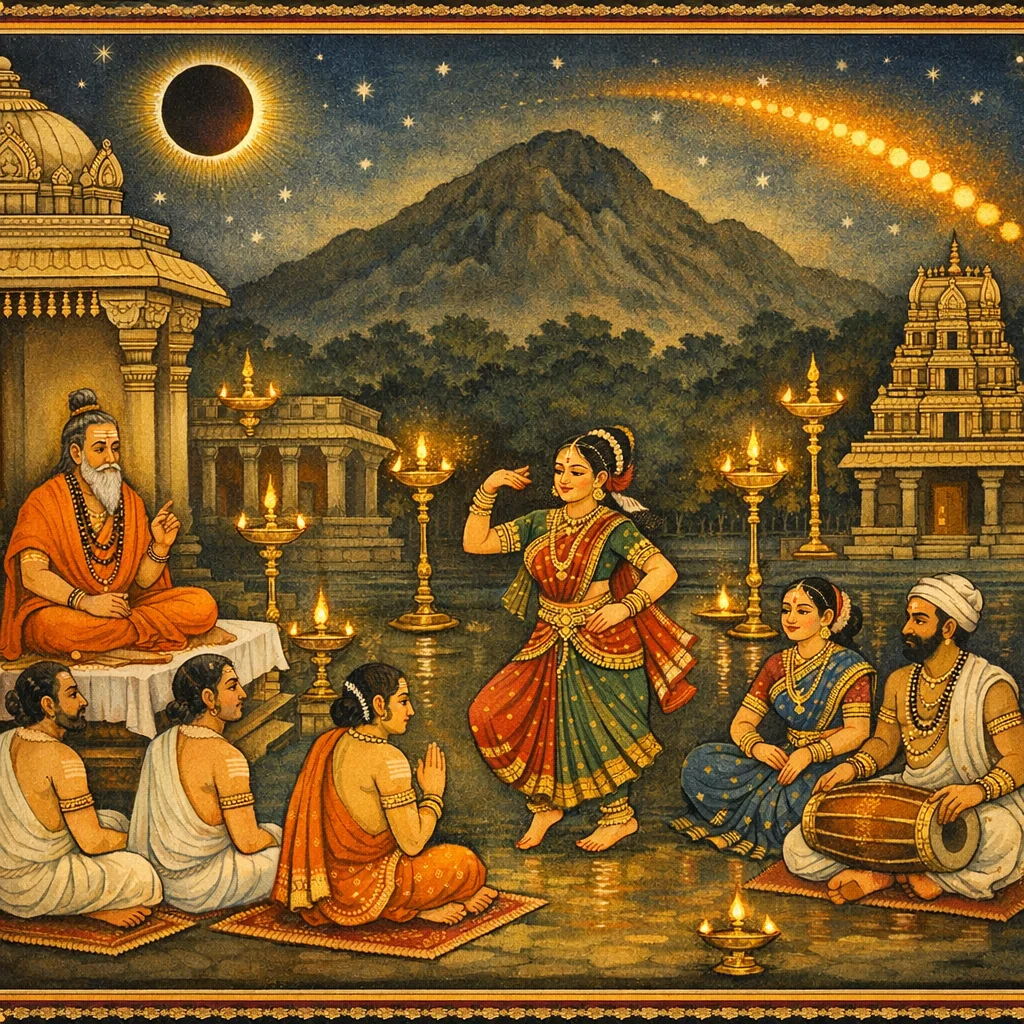
Adhyaya 7
Aruṇācala Worship by Vāra–Tithi–Nakṣatra Offerings (Weekday, Lunar-Day, and Asterism-Based Pūjā)
Chapter 7 gives a technical, prescriptive catalogue of worship of Aruṇācala-Śiva arranged by ritual time. It first links weekday (vāra) worship to specific flowers and promised fruits—varieties of lotus, karavīra, campaka, mallikā, jāti, and others—forming a day-by-day devotional schedule. It then lists tithi-based offerings from pratipad through pūrṇimā and kuhū, largely food offerings such as pāyasa, dadhi-anna, apūpa, many rice and wheat preparations, and fruits like panasa. Each offering is paired with a stated result, ranging from prosperity and social honor to health and freedom from fear. The chapter extends the calendar mapping to nakṣatra-based gifts—cloth, ornaments, lamps, silver, sandal, camphor, pearls, vehicles, and more—highlighting “mahāpūjā” as the culminating frame. It also prescribes special snāna/abhiṣeka sequences during eclipses, ayana transitions, and viṣuva (equinoxes), associating pañcāmṛta, pañcagavya, milk, and water with mantra-forms such as pañcākṣara, ṣaḍakṣara, and praṇava. Finally, it notes which flowers suit different times of day, enjoins Śivarātri worship with bilva and other offerings, and lists monthly festival observances. It concludes with a strong kṣetra-māhātmya claim that Aruṇakṣetra surpasses famed sacred cities, and that even remembering, hearing, seeing, or praising it swiftly purifies.
Adhyaya 8
Śoṇādri-Śiva-māhātmya Prastāvaḥ (Prologue on the Greatness of Śiva at Śoṇādri)
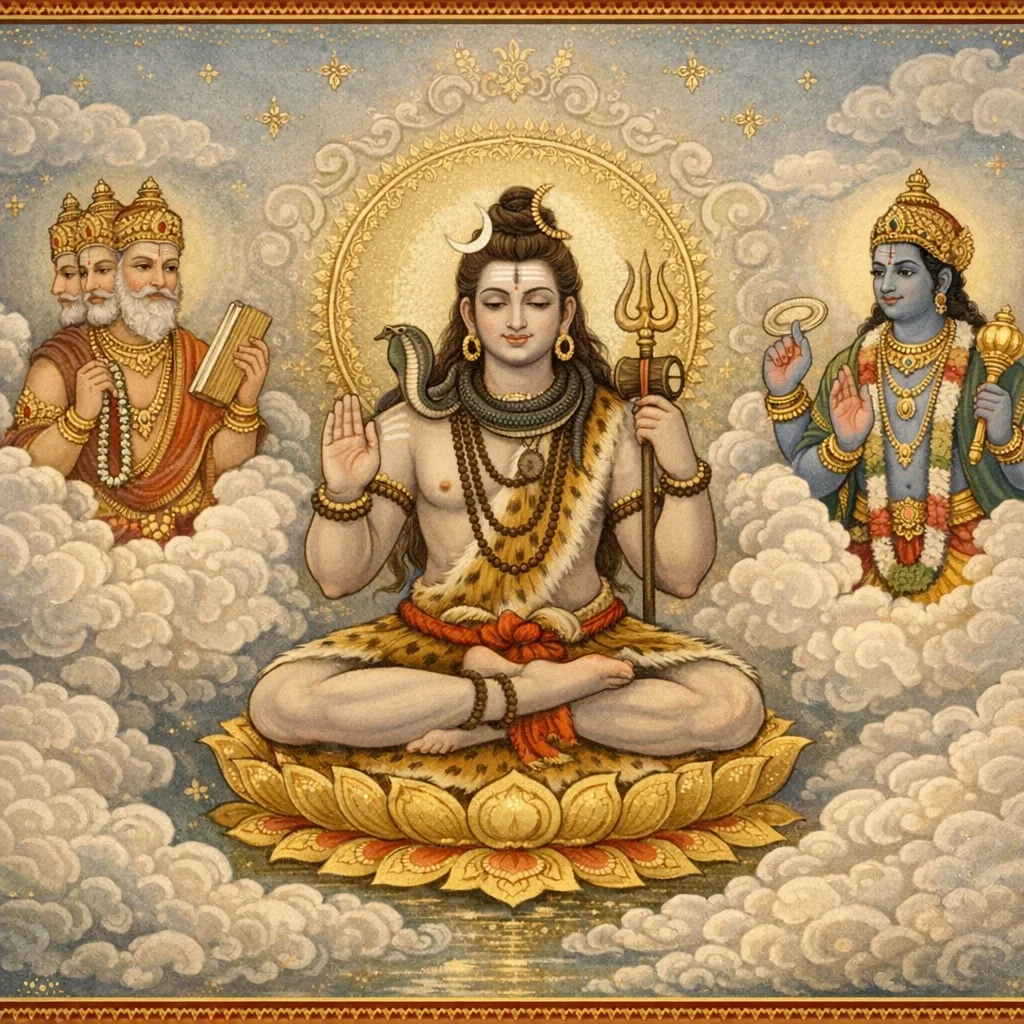
Chapter 8 begins with Nandikeśvara responding to Mārkaṇḍeya’s request for a fuller account of Aruṇācala’s greatness. He stresses that the Śaiva “carita” of Śoṇādri/Śoṇācala is exceedingly hard to relate in its entirety—its marvel cannot be exhausted even by the wise—yet he agrees to speak of it in portions. The teaching then turns to a cosmological setting: at the dawn of the divine age, Maheśvara is portrayed as nirvikalpa, yet freely manifesting the universe. Seeking agents for ongoing creation and protection, he brings forth Brahmā and Viṣṇu, assigns rajas to Brahmā and sattva to Viṣṇu, and establishes their administrative functions. A brief genealogy follows, describing the arising of sages such as Marīci, social orders, and diverse beings through Brahmā’s creative activity, filling the world through their descendants. The chapter closes with a moral-theological tension: in time, Brahmā (and even Viṣṇu, engaged in worldly forms) forget Maheśvara, and pride arises from a sense of self-sufficiency. This sets the narrative ground for reasserting Śiva’s supremacy and the sanctity of Śoṇādri.
Adhyaya 9
Brahmā–Viṣṇu Garva-vivāda and the Disruption of Cosmic Order (ब्रह्मविष्ण्वोर्गर्वविवादः)
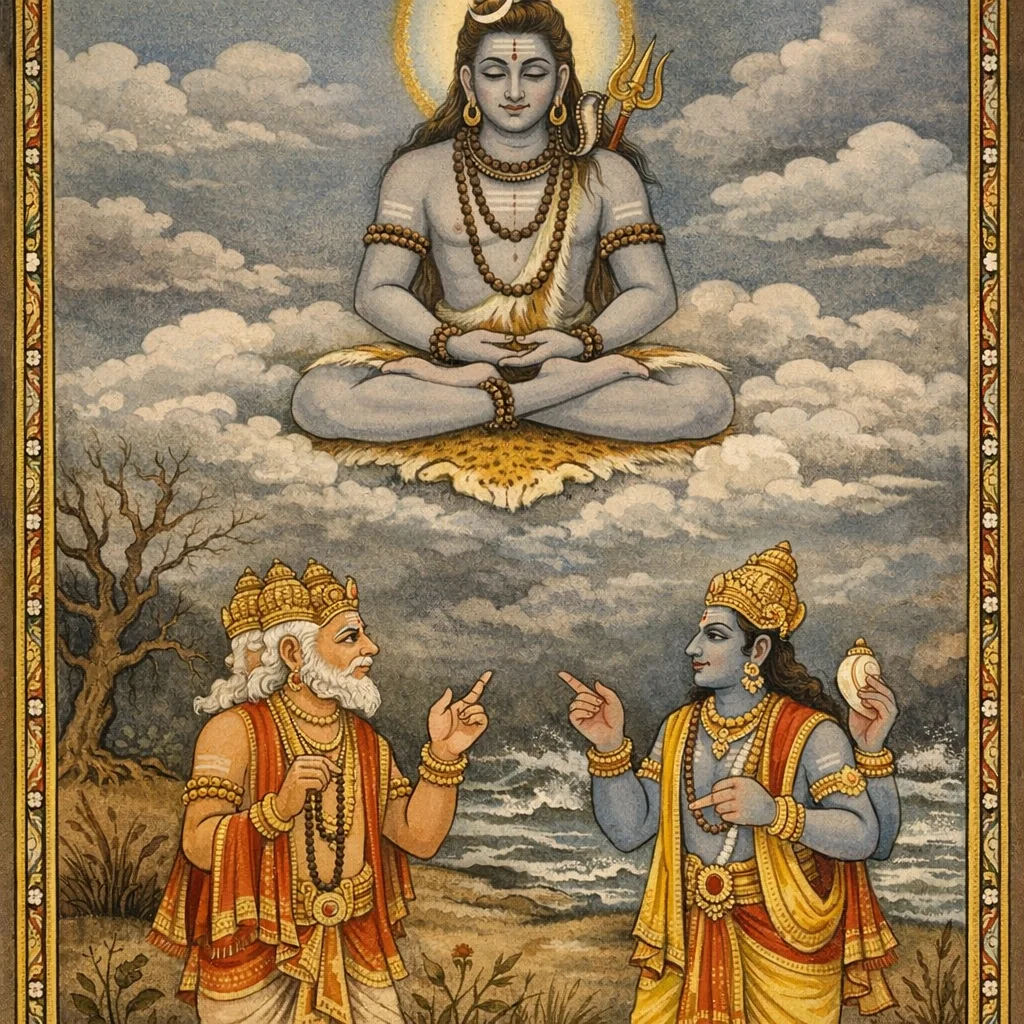
Chapter 9 records Nandikeśvara’s account of a theological quarrel born of delusion (moha) and heightened pride (garva) between Brahmā (Virañci/Dhātṛ) and Viṣṇu (Nārāyaṇa/Keśava). Brahmā claims supremacy by citing creation, the manifestation of the Vedas, and his cosmic governance, while Viṣṇu counters by stressing Brahmā’s dependence—his birth from the navel-lotus—and by recalling his own saving deeds, such as slaying Madhu–Kaiṭabha and assuming avatāra forms to restore order and dharma. The dispute hardens into a prolonged metaphysical stalemate that disrupts cosmic rhythms: the luminaries fail, winds cease, fire will not blaze, directions and earth lose clarity, oceans churn, mountains tremble, vegetation dries, and the measures of time (day and night, seasons) collapse—an apocalyptic semblance driven by ignorance. Seeing the crisis, Bhūtanātha (Śiva) recognizes māyā as the veiling cause that makes even great deities forget the ultimate source of power. Out of guardianship for beings and compassion for the worlds, Śiva resolves to remove their delusion, and the chapter closes by praising the crescent-crested Lord whose merciful intervention arises even when the erring have fallen into fault.
Adhyaya 10
तेजःस्तम्भ-वर्णनम् (Description of the Pillar of Radiance) — Chapter 10
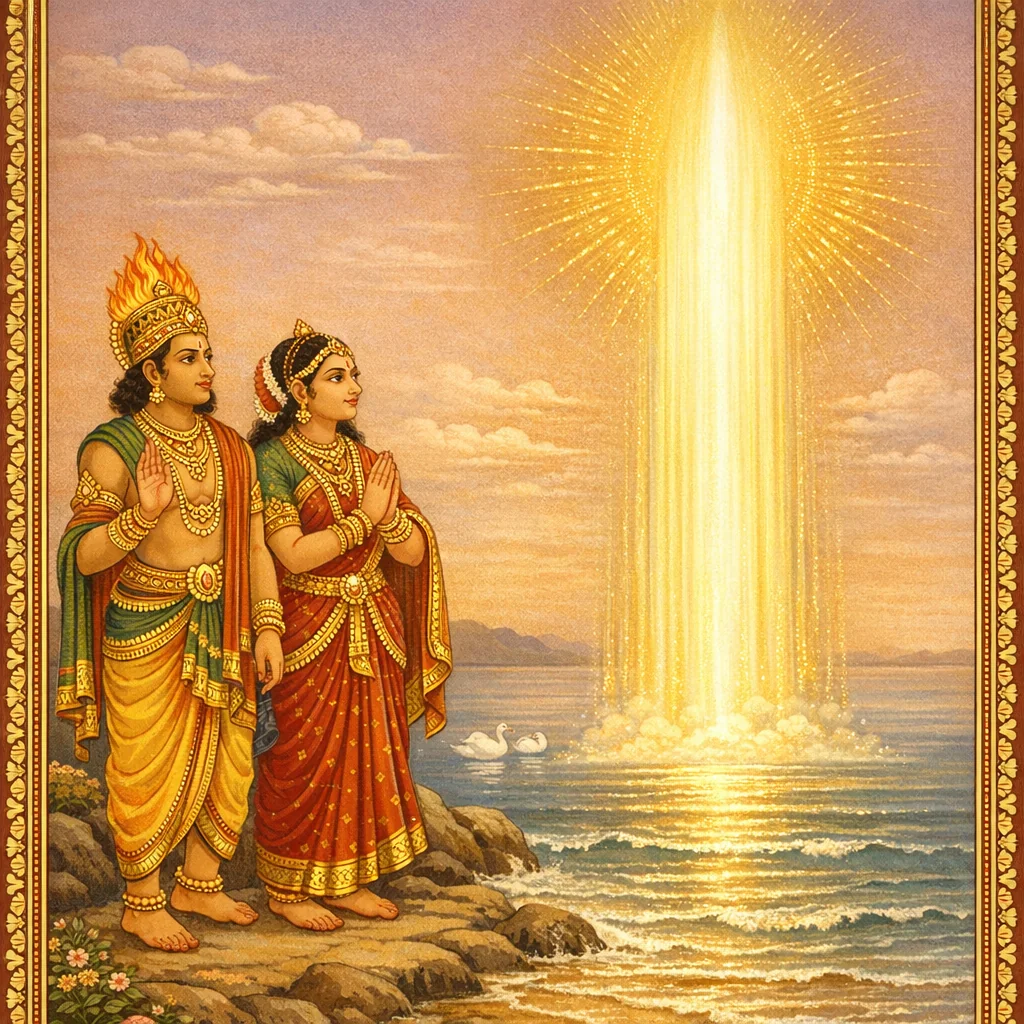
Chapter 10 unfolds as a reverent dialogue: Mārkaṇḍeya asks how the eternal Śambhu showed grace amid the rivalry of Vaikuṇṭha (Viṣṇu) and Paramēṣṭhin (Brahmā). Nandikeśvara replies with a fuller narration, setting forth the meaning of the divine sign. As the two contend, a cosmic jyotis-stambha—a pillar of radiance—manifests between them, as though arresting the horizons and flooding all directions, the oceans, and the earth with a reddish-golden brilliance. The sky seems to darken, the seas grow still, and the landscapes are tinted with light, emphasizing the vastness and the felt, ungraspable nature of the theophany. Overwhelmed in understanding, Viṣṇu and Brahmā take the event as a “touchstone” to test supremacy, yet concede that its beginning and end cannot be known by ordinary means. The chapter teaches epistemic humility before transcendent reality and affirms that this mighty manifestation is not destructive, but a mark of grace rather than mere force.
Adhyaya 11
Tejastambha-anveṣaṇa: Viṣṇoḥ Varāhāvatāreṇa Mūlānveṣaṇam (Search for the Pillar of Light: Viṣṇu as the Boar Seeks the Base)
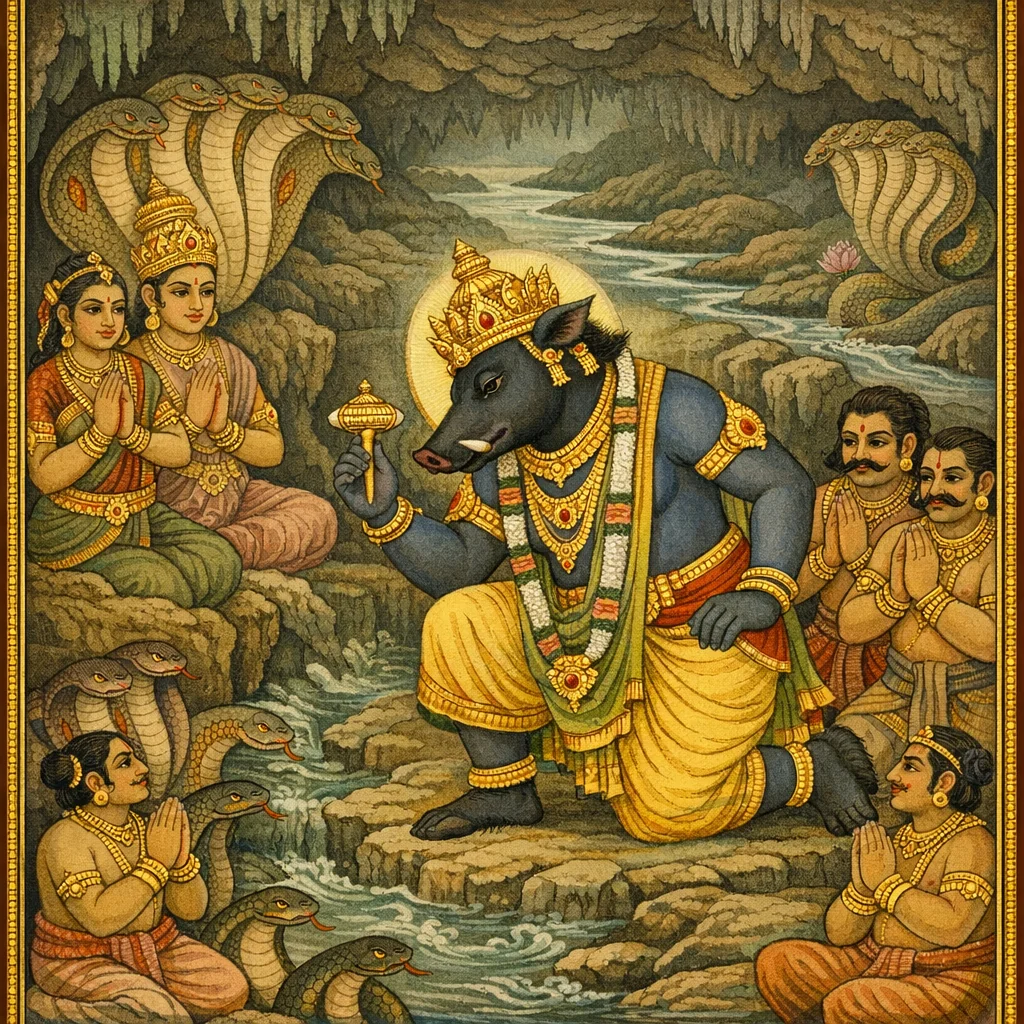
Nandikeśvara recounts a theological episode in which cosmic authorities seek to determine the limits of a radiant pillar of light (tejaḥ-stambha). Brahmā takes the form of a swan to ascend, while Viṣṇu becomes Varāha, the firm-bodied boar, to descend in search of the pillar’s base. The chapter follows Viṣṇu through the subterranean realms, enumerating the seven pātālas (Atala through Mahātala) and describing cosmic supports such as Ādikacchapa, the primal tortoise, the elephants of the directions, a great frog motif, and the underlying sustaining power (adhāra-śakti) by which bearers like Śeṣa and kūrma uphold the world. Though he strives for “thousands of years,” Viṣṇu cannot find the root of the pillar. Weariness breaks pride, and the narrative turns from competitive measurement to epistemic humility. It concludes with Viṣṇu’s resolve to seek refuge in Śiva, teaching surrender and recognition of transcendence as the intended ethical and philosophical lesson.
Adhyaya 12
तेजोमयस्तम्भानुसरणं तथा केतकीच्छदसंवादः (Pursuit of the Pillar of Light and the Ketakī Leaf Dialogue)
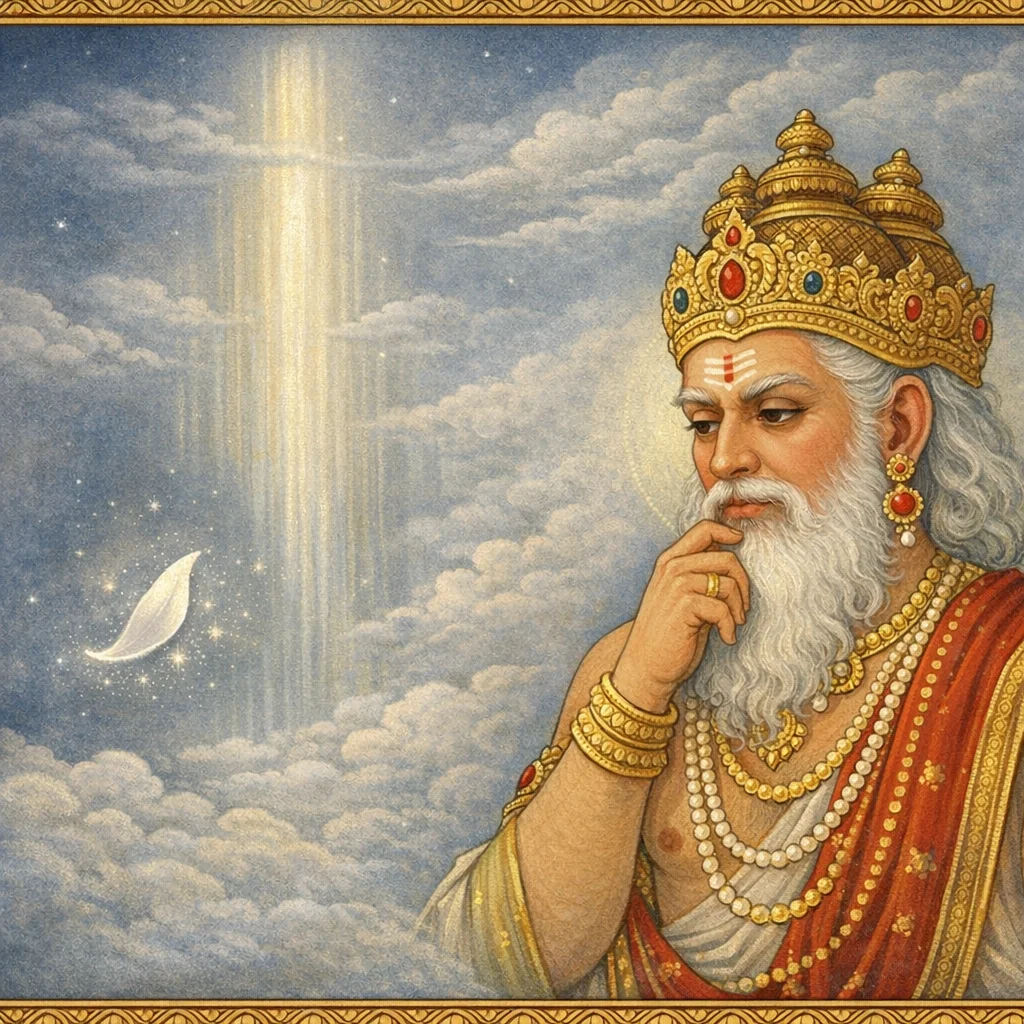
In this chapter, spoken by Nandikeśvara, the sacred account of the radiant pillar of light (tejomaya-stambha) continues—a form that surpasses all ordinary cosmic measure. Brahmā, taking the form of a swan (haṃsa), rises through the sky to seek the pillar’s summit, yet the pillar remains unbroken to his sight, limitless and unending. Though he presses on with extraordinary speed and endurance, Brahmā is overcome by fatigue, doubt, and anxiety that he will fail his vow in rivalry with Viṣṇu. His inner speech turns from competitive resolve to self-reproach and a longing to dissolve pride and ego-sense (ahaṃkāra). At that moment he beholds a pure, moonlike streak in the heavens and recognizes it as a Ketakī blossom/leaf (ketakī). The Ketakī leaf—described as moving by Śiva’s command—tells him it has long rested upon Śiva’s “head” at the pillar’s apex and now descends intending to reach the earthly realm. Relieved, Brahmā questions it about the distance to the pillar’s end, preparing the next turn of the legend concerning testimony, authority, and the ethics of truth in divine contest.
Adhyaya 13
Tejaḥstambha-viṣaye Brahmaṇaḥ Vinayaḥ (Humility of Brahmā before the Pillar of Radiance)
This chapter continues the teaching on the tejaḥstambha, the “pillar of radiance,” using dialogue to correct both conduct and understanding. Ketakī speaks scornfully to Nandikeśvara, stressing that the Reality to which countless universes cling is immeasurable, and that no finite standard can certify its extent. Brahmā then approaches in reverence, laying down pride and confessing his ignorance and his rivalry with Viṣṇu—an overreach born of arrogance and forgetfulness of Śiva’s majesty. He recounts the attempt to find the pillar’s limits by assuming forms (within the wider mythic cycle appear the haṃsa and boar images), and admits exhaustion and failure. Yet even after confession, status-seeking remains. Brahmā asks Ketakī to help by delivering, before Viṣṇu, a strategically framed statement that Brahmā has seen the summit, so as to secure superiority or at least equality. Nandikeśvara concludes that Ketakī, moved by Brahmā’s repeated petition, goes to convey Brahmā’s words to Viṣṇu near the tejaḥstambha. The chapter thus sets repentance beside lingering ambition, highlighting the purāṇic critique of pride and the ethical complexity of speech and testimony.
FAQs about Arunachala Mahatmya
Aruṇācala is presented as a manifestation of Śiva’s luminous reality—often framed as an immeasurable tejas (divine light) that functions as both metaphysical proof and sacred-site identity.
The section emphasizes purification through remembrance, hearing, and devotion; pilgrimage is framed as ethically transformative—reducing egoic pride and orienting the seeker toward surrender and Śiva-centered contemplation.
A central legend is the appearance of Śiva as a limitless pillar of fire/light between Brahmā and Viṣṇu, functioning as a narrative demonstration of divine supremacy and a charter-myth for the site’s sanctity.