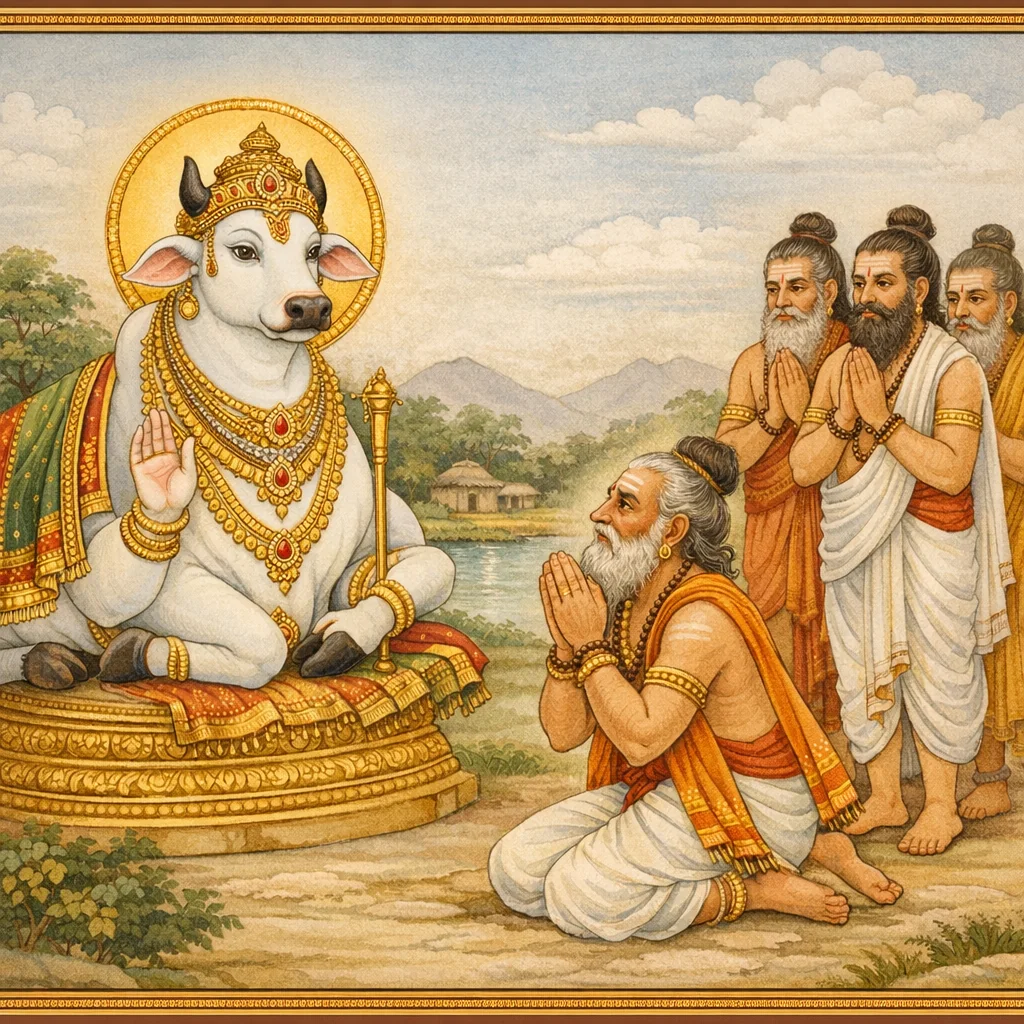
Adhyaya 3
Chapter 3 is framed as a formal petition by Mārkaṇḍeya to Nandikeśa. He asks (i) which single sacred place among those previously described bestows “all fruits” (sarvaphala), and (ii) what is that locus whose mere remembrance grants liberation to beings, whether they know it or not. The chapter then heightens Nandikeśa’s authority by listing a great assembly of ṛṣis gathered around him for question-and-answer service, affirming by lineage that he is an āgama-competent teacher and foremost among the Māheśvaras. The teaching is presented as a “secret” (rahasya) disclosed through the guru, with devotion and divine compassion invoked as prerequisites. The closing verse portrays Nandikeśa’s reply as bestowing elevated Śiva-bhakti and implying attainment of Śiva through prior devotion and disciplined listening.
Shlokas
Verse 1
सनक उवाच । भगवन्नरुणाद्रीश माहात्म्यमिदमद्भुतम् । श्रुतं शिवप्रसादेन दयया ते जगद्गुरोः
Sanaka said: O Blessed Lord, O Lord of Aruṇādri, this wondrous greatness has been heard—by Śiva’s grace and by your compassion, O Teacher of the world.
Verse 2
आश्चर्यमेतन्माहात्म्यं सर्वपापविनाशनम् । आराधयन्पुनः के वा वरदं शोणपर्वतम्
This greatness is wondrous and destroys all sins. Who indeed, after worshipping the boon-bestowing Śoṇa Mountain, would ever turn back from devotion to it?
Verse 3
अनादिरंतरहितः शिवः शोणचलाकृतिः । युवयोस्तपसा देव वरदानाय संस्थितः
Śiva—beginningless and without any inner division—abides in the form of Śoṇācala; and, O Lord, by the power of your austerities, he is present there to grant boons.
Verse 4
सकृत्संकीर्तिते नाम्नि शोणाद्रिरिति मुक्तिदे । सन्निधिः सर्वकामानां जायते चाघनाशनम्
If the name ‘Śoṇādri’ is sung even once, it bestows liberation; it brings the holy presence through which all desires are fulfilled, and it destroys sin.
Verse 5
शिवशब्दामृतास्वादः शिवार्चनकथाक्रमः । इति तद्वचनं श्रुत्वा देवदेवः पितामहः
Thus spoke Sanaka, savoring the nectar of the word “Śiva” and unfolding the account of Śiva’s worship. Hearing those words, Pitāmaha—the Grandsire, the god of gods—(responded).
Verse 6
उवाच करुणामूर्तिररुणाद्रीशमानमन् । ब्रह्मोवाच । श्रूयतां वत्स पार्वत्याश्चरितं यत्पुरातनम्
Then Brahmā, compassionate in form and reverent toward the Lord of Aruṇādri, spoke: “Listen, dear child, to the ancient sacred account of Pārvatī.”
Verse 7
अरुणाद्रीशमाश्रित्य यथा सा निर्वृताभवत् । आससाद महादेवः कदाचित्पार्वतीपतिः
How, by taking refuge in the Lord of Aruṇādri, she attained deep contentment—this I shall tell. Once, Mahādeva, the Lord and husband of Pārvatī, approached (her).
Verse 8
रत्नसिंहासनं दिव्यं रत्नतोरणसंयुतम् । रत्नपुष्पफलोपेत कल्पद्रुममनोहरम्
There was a divine throne of jewels, adorned with a jeweled archway—charming with wish-fulfilling kalpadruma trees laden with jeweled flowers and fruits.
Verse 9
परार्ध्य दृषदास्तीर्णं बद्धमुक्तावितानकम् । विमुक्तपुष्पप्रकरदिव्यधूपोरुसौरभम्
It was spread with exceedingly precious stone slabs, canopied with strings of fastened pearls, and filled with the rich fragrance of heavenly incense and heaps of freshly strewn blossoms.
Verse 10
प्रलंबमालिकाजालनिनदद्भृंगसंकुलम् । दिव्यतूर्यघनारावप्रनृत्यद्गुहवाहनम्
It resounded amid nets of hanging garlands, thronged with humming bees; and to the thunderous blare of divine instruments, Guha’s mount danced in delight.
Verse 11
पार्वतीसिंहसंचारपरित्रस्तमहागजम् । अप्सरोभिः प्रनर्त्ताभिर्गायंतीभिश्च केवलम्
Great elephants were startled as Pārvatī’s lion moved about; and everywhere there were apsarases alone—dancing and singing.
Verse 12
आसेवितपुरोरंगं दिक्पालकनिषेवितम् । ऋग्यजुःसामजैर्मंत्रैः स्तुवद्भिर्मुनिपुंगवैः
The foremost hall was attended upon, served by the guardians of the directions; and it was praised by the best of sages, chanting mantras from the Ṛg, Yajus, and Sāman.
Verse 13
ब्रह्मर्षिभिस्तथा देवैः सिद्धै राजर्षिभिवृतम् । गणैश्च विविधाकारैर्भस्मालंकृतविग्रहैः
It was surrounded by brahmarṣis, by gods, by siddhas, and by royal seers; and also by Śiva’s gaṇas of many forms, their bodies adorned with sacred ash.
Verse 14
रुद्राक्षधारसुभगैरापूर्णं शिवतत्परैः । वीणावेणुमृदंगादितौर्यत्रिकजनिस्वनैः
It was filled with devotees wholly devoted to Śiva, beautiful with rudrākṣa garlands; and it rang with the sounds born of the threefold music—vīṇā, flute, mṛdaṅga, and the like.
Verse 15
घंटाटंकारसुभगैर्वेदध्वनिविमिश्रितैः । मनोहरं महादिव्यमासनं पार्वतीसखः
With the pleasing peal of bells blended with the sound of the Veda, Pārvatī’s companion, Śiva, made that enthronement-seat wondrous and supremely divine.
Verse 16
अलंचकार भगवन्भक्तानुग्रहकाम्यया । आस्थाय विमलं रूपं सर्वतेजोमयं शिवम्
The Blessed Lord, wishing to bestow grace upon his devotees, assumed a spotless form—Śiva, composed of the radiance of all splendors.
Verse 17
अंबिकासहितः श्रीमान्विजहार दयानिधिः । संगीतेन कथाभेदैर्द्यूतक्रीडाविकल्पनैः
The glorious ocean of compassion, together with Ambikā, sported—through music, through varied stories, and through the diversions of games of dice.
Verse 18
गणानां विकटैर्नृत्यै रमयामास पार्वतीम् । विसृज्य सकलान्देवानृषींश्चापि सभासदः
He delighted Pārvatī with the gaṇas’ wondrous, exuberant dances; and dismissing all the gods and sages present in the hall, he remained at ease.
Verse 19
वरान्प्रदाय विविधान्भक्तलोकाय वाञ्छितान् । आगमेषु विचित्रेषु सर्वर्तुकुसुमेषु च
Granting many kinds of desired boons to the community of devotees, he delighted amid wondrous sacred settings and gardens where flowers of every season bloomed.
Verse 20
विजहारोमया सार्द्धं रत्नप्रासादपंक्तिषु । वापिकासु मनोज्ञासु रत्नसोपानपंक्तिषु
Together with Umā, he sported amid rows of jewel-like palaces, and beside charming ponds adorned with flights of jeweled steps.
Verse 21
केलिपर्वतशृंगेषु हेमरंभावनांतरे । गंगातरंगशीतेन फुल्लपंकजगंधिना
On the peaks of pleasure-mountains, within golden plantain groves, cooled by the chill of Gaṅgā’s rippling waves and perfumed by blossoming lotuses—
Verse 22
वातेन मंदगतिना विहारविहतश्रमः । स्वकामतः स्वयं देवः प्रेयसीमभ्यनन्दयत्
Refreshed from fatigue by the softly moving breeze after their roaming, the Lord himself—according to his own sweet will—gladdened his beloved.
Verse 23
रतिरूपां शिवां देवीं सर्वसौभाग्यसुन्दरीम् । कदाचिद्रहसि प्रीता निजाज्ञावशवर्त्तिनम्
That Goddess Śivā—embodiment of love, the beauty of all auspicious fortune—once, in private, being pleased, found him obedient to her own command.
Verse 24
रमणं जानती मुग्धा पश्चादभ्येत्य सादरम् । कराभ्यां कमलाभाभ्यां त्रिणेत्राणि जगद्गुरोः
Knowing him to be her beloved, the enchanting one came up from behind with affection, and with her lotus-like hands covered the three eyes of the World-Teacher.
Verse 25
पिदधे लीलया शंभोः किमेतदिति कौतुकात् । चन्द्रादित्याग्निरूपेण पिहितेष्वक्षिषु क्रमात्
Out of playful curiosity—“What is this?”—she covered Śambhu’s eyes; and as those eyes, in the forms of Moon, Sun, and Fire, were shut one after another,
Verse 26
अन्धकारोऽभवत्तत्र चिरकालं भयंकरः । निमिषार्द्धेन देवस्य जग्मुर्वत्सरकोटयः
Thereupon a dreadful darkness prevailed for a long time; and in but half a blink of the Lord, crores of years passed.
Verse 27
देवीलीलासमुत्थेन तमसाभूज्जगत्क्षयः । तमसा पूरितं विश्वमपारेण समन्ततः
From the darkness born of the Goddess’s playful act, the world moved toward dissolution; the entire universe was filled on every side with boundless gloom.
Verse 28
शून्यं ज्योतिः प्रचारेण विनाशं प्रत्यपद्यत । न व्यजृंभत विबुधा न च वेदाश्चकाशिरे
As the radiance vanished, even the expanse of light became as emptiness and tended toward ruin; the gods could not act, and the Vedas themselves did not shine forth.
Verse 29
नापि जीवाः समभवन्नव्यक्तं केवलं स्थितम् । जगतामपि सर्वेषामकाले वीक्ष्य संक्षयम्
No embodied beings had come into existence; only the Unmanifest (Avyakta) remained. Seeing the untimely dissolution of all the worlds, the sages reflected upon this mystery.
Verse 30
तपसा लब्धस्फूर्तीनां विचारः समपद्यत । किमेतत्तमसो जन्म भुवनक्षयकारणम्
For those whose inner clarity had arisen through austerity, a question took shape: “What is this birth of darkness, the cause of the world’s destruction?”
Verse 31
भगवानपि सर्वात्मा न नूनं कालमाक्षिपत् । देवी विनोदरूपेण पिधत्ते पुरजिद्दृशः
Even the Blessed Lord, the Self of all, surely did not cast forth Time; rather, the Goddess—taking the form of playful sport—veiled the vision of the Slayer of the Triple City (Śiva).
Verse 32
तेनेदमखिलं जातं निस्तेजो भुवनत्रयम् । अकालतमसा व्याप्ते सकले भुवनत्रये
From that, all this came to be: the three worlds became deprived of radiance. The entire triple world was pervaded by untimely darkness.
Verse 33
का गतिर्लब्धराज्यानां तपसो देवजन्मनाम् । न यज्ञाः संप्रवर्तंते न पूज्यन्ते सुरा भुवि
What becomes of those who gained sovereignty through austerity, of those born as gods? Sacrifices no longer proceed, and the gods are not worshipped on earth.
Verse 34
इति निश्चित्य मनसा वीक्ष्य ते ज्ञानचक्षुषा । नित्यास्ते सूरयो भक्त्या शंभुमागम्य तुष्टुवुः
Having thus resolved in their minds and beheld the truth with the eye of knowledge, those eternal sages approached Śambhu in devotion and praised Him.
Verse 35
नमः सर्वजगत्कर्त्रे शिवाय परमात्मने । मायया शक्तिरूपेण पृथग्भावमुपेयुषे
Salutations to Śiva, the Supreme Self, the maker of the entire universe—who, through māyā as Śakti, assumes differentiation and manifoldness.
Verse 36
अविनाभाविनी शक्तिराद्यैका शिवरूपिणी । लीलया जगदुत्पत्तिरक्षासंहृतिकारिणी
That inseparable Power—primordial, one, and of Śiva’s very nature—through divine play brings about the world’s creation, protection, and dissolution.
Verse 37
अर्धांगी सा तव देव शिवशक्त्यात्मकं वपुः । एक एव महादेवो न परे त्वद्विना विभो
She is Your half-body, O God—Your form is of the essence of Śiva and Śakti. You alone are Mahādeva; there is no other apart from You, O Lord.
Verse 38
लीलया तव लोकोयमकाले प्रलयं गतः । करुणा तव निर्व्याजा वर्द्धतां लोकवर्द्धनी
By Your play this world has fallen into untimely dissolution. May Your causeless compassion increase—O You whose grace makes the worlds flourish.
Verse 39
भवतो निमिषार्द्धेन तेजसामुपसंहृतेः । गतान्यनेकवर्षाणि जगतां नाशहेतवे
Because your radiance was withdrawn for but half a blink, countless years have passed—bringing the worlds to the brink of ruin.
Verse 40
ततः प्रसीद करुणामूर्त्ते काल सदाशिव । विरम प्रणयारब्धादमुष्माल्लोकसंक्षयात्
Therefore be gracious, O embodiment of compassion—O Time, O Sadāśiva. Desist from this world-destroying calamity that has arisen from playful love.
Verse 41
इति तेषां वचः श्रुत्वा भक्तानां सिद्धिशालिनाम् । विसृजाक्षोणि गौरीति करुणामूर्त्तिरब्रवीत्
Hearing these words of the devoted Siddhas, rich in spiritual attainment, the Compassionate One said: “O Gaurī, release the covering from the eyes.”
Verse 42
विससर्ज च सा देवी पिधानं हरचक्षुषाम् । सोमसूर्याग्निरूपाणां प्रकाशमभवज्जगत्
And the Goddess removed the covering from Hara’s eyes; then the world again shone with the radiance of the Moon, the Sun, and Fire.
Verse 43
कियान्कालो गतश्चेति पृष्टैः सिद्धैश्च वै नतैः । उक्तं त्वन्निमिषार्द्धेन जग्मुर्वत्सरकोटयः
When the bowing Siddhas asked, “How much time has passed?”, it was said: “In just half your blink, crores of years have elapsed.”
Verse 44
अथ देवः कृपामूर्त्तिरालोक्य विहसन्प्रियाम् । अब्रवीत्परमोदारः परं धर्मार्थसंग्रहम्
Then the God, the very form of compassion, looked upon his beloved and smiled; the supremely generous Lord spoke a lofty teaching that gathers the essence of dharma.
Verse 45
अविचार्य कृतं मुग्धे भुवनक्षयकारणात् । अयुक्तमिह पश्यामि जगन्मातुस्तवैव हि
O innocent one, you acted without reflection, becoming a cause of the worlds’ decline. I see this as unfitting here—especially for you, the Mother of the universe.
Verse 46
अहमप्यखिलांल्लोकान्संहरिष्यामि संक्षये । प्राप्ते काले त्वया मौग्ध्यादकाले प्रलयं गताः
I too withdraw all worlds—when the time of dissolution arrives. But through your innocent folly, dissolution has come at an untimely hour.
Verse 47
केयं वा त्वादृशी कुर्यादीदृशं सद्विगर्हितम् । कर्म नर्मण्यपि सदा कृपामूर्तिर्न बाधते
What woman like you would do such a deed—ever censured by the good? Even in play, the Compassionate One never countenances such conduct.
Verse 48
इति शम्भोर्वचः श्रुत्वा धर्मलोपभयाकुला । किं करिष्यामि तच्छांत्या इत्यपृच्छत्स्म तं प्रिया
Hearing Śambhu’s words, his beloved—agitated by fear of dharma’s decline—asked him: “What shall I do to pacify and set this right?”
Verse 49
अथ देवः प्रसन्नात्मा व्याजहार दयानिधिः । देव्यास्तेनानुतापेन भक्त्या च तोषितः शिवः
Then the Lord—his heart pleased, an ocean of compassion—spoke. Śiva was gratified by the Goddess’s remorse and by her devotion.
Verse 50
मन्मूर्तेस्तव केयं वा प्रायश्चित्तिरिहोच्यते । अथापि धर्ममार्गोयं त्वयैव परिपाल्यते
O you who are of my very form, what expiation could even be spoken of here? Yet this path of dharma must indeed be upheld by you.
Verse 51
श्रुतिस्मृतिक्रियाकल्पा विद्याश्च विबुधादयः । त्वद्रूपमेतदखिलं महदर्थोस्मि तन्मयः
The Vedas and Smṛtis, ritual procedures, the sciences, and even the gods and the rest—this entire expanse is your very form. I too am one with that great Reality, pervaded by it.
Verse 52
मान्ययाभिन्नया देव्या भाव्यं लोकसिसृक्षया
O revered Goddess, inseparable from me: for the sake of creating (and guiding) the worlds, this must be undertaken.
Verse 53
तस्माल्लोकानुरूपं ते प्रायश्चित्तं विधीयते । षड्विधो गदितो धर्मः श्रुतिस्मृतिविचारतः
Therefore, an expiation appropriate for the world’s understanding is ordained for you. Dharma has been taught as sixfold, upon reflection on Śruti and Smṛti.
Verse 54
स्वामिना नानुपाल्येत यदि त्याज्योऽनुजीविभिः । न त्वां विहाय शक्नोमि क्षणमप्यासितुं क्वचित्
If a master does not protect those dependent on him, he should be abandoned by those who live under his care. Yet I cannot leave you and remain anywhere—even for a moment.
Verse 55
अहमेव तपः सर्वं करिष्याम्यात्मनि स्थितः । पृध्वी च सकला भूयात्तपसा सफला तव
“I alone, abiding in my own Self, shall perform all the austerity; and by your tapas, may the entire earth become fruitful and blessed.”
Verse 56
त्वत्पादपद्मसंस्पर्शात्त्वत्तपोदर्शनादपि । निरस्यंति स्वसान्निध्याद्दुष्टजातमुपद्रवम्
“By the touch of your lotus-feet, and even by the sight of your austerity, they drive away—through mere proximity—calamities arising from wicked beings.”
Verse 57
कर्मभूमेस्त्वमाधिक्यहेतवे पुण्यमाचर । त्वत्तपश्चरणं लोके वीक्ष्य सर्वोपि संततम्
“Practice merit for the exaltation of this land of action. Seeing your performance of austerity in the world, everyone continually will be inspired toward dharma.”
Verse 58
धर्मे दृढतरा बुद्धिं निबध्नीयान्न संशयः । कृतार्थयिष्यति महीं दया ते धर्मपालनैः
“Fix your mind even more firmly in dharma—without doubt. Through your compassionate guardianship of dharma, the earth will be fulfilled in its purpose.”
Verse 59
त्वमेवैतत्सकलं प्रोक्ता वेदैर्देवि सनातनैः । अस्ति कांचीपुरी ख्याता सर्वभूतिसमन्विता
“O Goddess, you indeed are that All—so declare the eternal Vedas. There is a renowned city called Kāñcīpurī, endowed with every kind of prosperity and auspicious attainment.”
Verse 60
या दिवं देवसंपूर्णा प्रत्यक्षयति भूतले । यत्र कृतं तपः किंचिदनंतफलमुच्यते
That Kāñcī, filled with the gods like heaven itself, makes the heavenly realm manifest upon the earth. Whatever little austerity (tapas) is performed there is said to yield endless fruit.
Verse 61
देवाश्च मुनयः सर्वे वासं वांछंति संततम् । तत्र कंपेति विख्याता महापातकनाशिनी
All the gods and sages continually desire to dwell there. In that region, the famed Kampā is renowned as the destroyer of great sins.
Verse 62
यत्र स्थितानां मर्त्यानां कम्पन्ते पापकोटयः । तत्र चूतद्रुमश्चैको राजते नित्यपल्लवः
Where mortals abide, crores of sins tremble and fall away. There also shines a single mango tree, ever fresh with new leaves.
Verse 63
संपूर्णशीतलच्छायः प्रसूनफलपल्लवैः । तत्र जप्तं हुतं दत्तमनन्तफलदं भवेत्
With fully cooling shade, rich in blossoms, fruits, and tender leaves—there, whatever is recited in japa, offered in fire (homa), or given in charity (dāna) becomes a bestower of endless reward.
Verse 64
गणाश्च विविधाकारा डाकिन्यो योगिनीगणाः । परितस्त्वां निषेवंतां विष्णुमुख्यास्तथा पराः
Gaṇas of many forms, ḍākinīs, and hosts of yoginīs attend upon you all around; and so too do the higher divine beings, with Viṣṇu foremost among them.
Verse 65
अहं च निष्कलो भूत्वा तव मानसपंकजे । सन्निधास्यामि मा भूस्त्वं देवि मद्विरहाकुला
I too, becoming formless, shall abide within the lotus of your mind. O Goddess, do not be distressed by separation from me.
Verse 66
इत्युक्ता देवदेवेन देवी कंपांतिकं ययौ । तपः कर्तुं सखीयुक्ता विस्मयाक्रान्तलोचना
Thus addressed by the God of gods, the Goddess went to the vicinity of the Kampā, accompanied by her companions, her eyes filled with wonder, to undertake austerities.
Verse 67
कंपां च विमलां सिन्धुं मुनिसमघनिषेविताम् । आलोक्य कोमलदलमेकाम्रं दृष्टिवारणम्
Beholding the pure Kampā stream, attended by multitudes of sages, she also saw the single mango tree with tender leaves—so captivating that it held the gaze.
Verse 68
फलपुष्पसमाकीर्णं कोकिलालापसंकुलम् । प्रससाद पुनर्देवं सस्मार च महेश्वरम्
Filled with fruits and blossoms and resonant with the songs of cuckoos, she became serene again; and she remembered the Lord, Maheśvara.
Verse 69
कामाग्निपरिवीतांगी तपःक्षामेव साऽभवत् । अभ्यभाषत सा गौरी विजयां पार्श्ववर्त्तिनीम्
Enveloped in the fire of longing, Gaurī’s limbs grew as though thinned by austerity itself. Then that Goddess addressed Vijayā, who stood close at her side.
Verse 70
कामशोकपरीतांगी पुरारिविरहाकुला
Her body was overcome by love’s sorrow, and she was anguished by separation from Śiva, the Foe of Tripura.
Verse 71
इममघहरमागतानिशं स्वयमपि पूजयितुं तपोभिरीशम् । अयमभिनवपल्लवप्रसूनः स्मरयति मां स्मरबन्धुरेकचूतः
“By night I have come here to worship, through austerities, the Lord who removes sin. Yet this lone mango tree, lovely with fresh shoots and blossoms, awakens in me the memory of Kāma, his dear companion.”
Verse 72
कथमिव विरहः शिवस्य सह्यः क्षुभितधियात्र भृशं मनोभवेन । तदपि च तरुणेंदुचूडपादस्मरणमहौषधमेकमेव दृष्टम्
“How can separation from Śiva be borne, when the mind here is violently shaken by Manobhava (Kāma)? Yet I see only one great medicine: remembrance of the feet of Him whose crest bears the young moon.”