Adhyaya 47
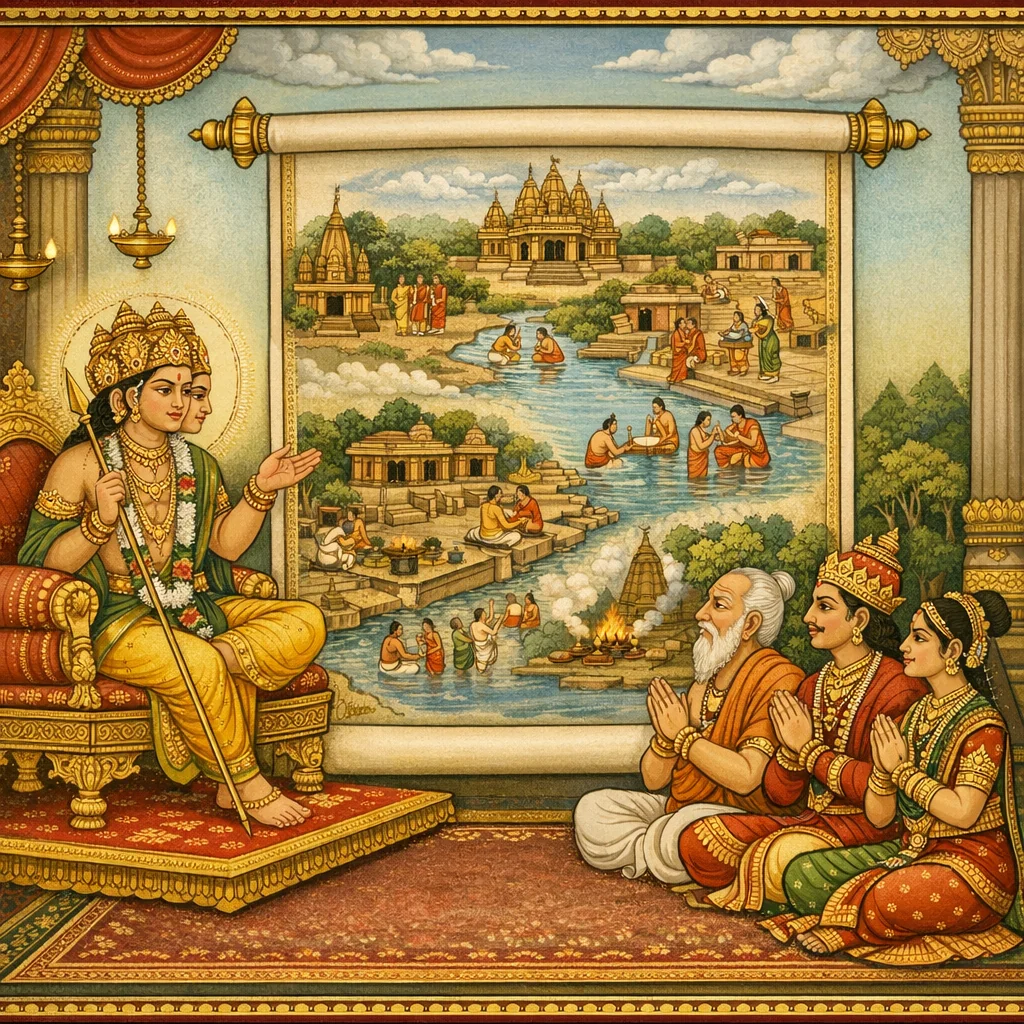
This chapter marks a solar tīrtha in Kāśī: to the north lies the eminent pond Arkakuṇḍa, presided over by the radiant deity “Uttarārka,” revered as Kāśī’s protector and dispeller of afflictions. Skanda relates an origin-legend. The Brahmin Priyavrata of the Ātreya lineage—upright and hospitable—burns with anxiety to find a worthy husband for his virtuous, accomplished daughter. That worry becomes an incurable cintā-jvara (“fever of concern”) and causes his death; his wife, upholding the pativratā ideal, follows him in death, leaving the daughter orphaned. The girl embraces firm brahmacarya and performs severe tapas near Uttarārka. A she-goat (ajā-śāvī) appears daily as a silent witness. Śiva, with Pārvatī, beholds her steadiness and offers a boon; she asks first for grace for the goat, embodying paropakāra (altruistic intent). The deities praise her ethical insight: material hoards do not endure, but deeds that benefit others do. Pārvatī grants that the girl will become her beloved companion, endowed with divine qualities, and also declares her a royal daughter of Kāśī who will enjoy worldly prosperity and attain unsurpassed liberation. The chapter prescribes an annual observance at Arkakuṇḍa/Uttarārka in the month of Puṣya on a Sunday, with early bathing in a calm, cool-minded state. Arkakuṇḍa is also named Barkarīkuṇḍa, and the girl’s image is to be worshipped there. The concluding phalaśruti says that hearing this account (including the Lolārka–Uttarārka cycle) brings freedom from disease and poverty.
Shlokas
Verse 1
स्कंद उवाच । अथोत्तरस्यामाशायां कुंडमर्काख्यमुत्तमम् । तत्र नाम्नोत्तरार्केण रश्मिमाली व्यवस्थितः
Skanda said: Now, in the northern direction there is an excellent pond known as Arka. There the Sun, garlanded with rays, abides under the name ‘Uttarārka’.
Verse 2
तापयन्दुःखसंघातं साधूनाप्याययन्रविः । उत्तरार्को महातेजाः काशीं रक्षति सर्वदा
Scorching masses of sorrow and nourishing the righteous, the Sun—mighty in splendor as Uttarārka—ever protects Kāśī.
Verse 3
तत्रेतिहासो यो वृत्तस्तं निशामय सुव्रत । विप्रः प्रियव्रतो नाम कश्चिदात्रेय वंशजः
Hear, O you of good vow, the account of what happened there: a certain brāhmaṇa named Priyavrata, born in the lineage of Ātreya.
Verse 4
आसीत्काश्यां शुभाचारः सदातिथिजनप्रियः । भार्या शुभव्रता तस्य बभूवातिमनोहरा
In Kāśī he was of noble conduct, ever dear to guests and the people. His wife, steadfast in auspicious vows, was exceedingly charming.
Verse 5
भर्तृशुश्रूषणरता गृहकर्मसुपेशला । तस्यां स जनयामास कन्यामेकां सुलक्षणाम्
Devoted to serving her husband and highly skilled in household duties, she bore him a single daughter endowed with auspicious marks.
Verse 6
मूलर्क्षप्रथमेपादे तथा केंद्रे बृहस्पतौ । ववृधे सा गृहे पित्रोः शुक्ले पक्षे यथा शशी
With Mūla-nakṣatra in its first quarter and Bṛhaspati (Jupiter) placed in an auspicious central position, she grew up in her parents’ home like the moon waxing in the bright fortnight.
Verse 7
सुरूपा विनयाचारा पित्रोश्च प्रियकारिणी । अतीव निपुणा जाता गृहोपस्करमार्जने
Beautiful and refined in conduct, ever pleasing to her parents, she became exceedingly skilled in maintaining and cleaning the household implements.
Verse 8
यथायथा समैधिष्ट सा कन्या पितृमंदिरे । तथातथा पितुस्तस्याश्चिंता संववृधेतराम्
As the maiden flourished more and more in her father’s house, so too her father’s worry for her grew ever greater.
Verse 9
कस्मै देया वरा कन्या सुरम्येयं सुलक्षणा । अस्या अनुगुणो लभ्यः क्व मया वर उत्तमः
“To whom should I give this excellent maiden—so charming and auspicious? Where shall I find a groom truly worthy and fitting for her?”
Verse 10
कुलेन वयसा चापि शीलेनापि श्रुतेन च । रूपेणार्थेनसंयुक्तः कस्मै दत्ता सुखं लभेत्
“Endowed with lineage and fitting maturity, with character and learning, and also with beauty and means—given to whom will she attain happiness?”
Verse 11
इति चिंतयतस्तस्य ज्वरोभूदतिदारुणः । यश्चिंताख्यो ज्वरः पुंसामौषधैर्नापि शाम्यति
As he pondered thus, a most dreadful fever arose in him—the “fever called worry” in men, which does not subside even with medicines.
Verse 12
तन्मूलर्क्षविपाकेन चिंताख्येन ज्वरेण च । स विप्रः पंचतां प्राप्तस्त्यक्त्वा सर्वं गृहादिकम्
Through the fated fruition connected with the Mūla-nakṣatra, and through the fever called anxiety, that brāhmaṇa met his end—leaving behind home and all possessions.
Verse 13
पितर्युपरते तस्याः कन्यायाः सा जनन्यपि । शुभव्रता परित्यज्य तां कन्यां पतिमन्वगात्
When the girl’s father had passed away, even her mother—faithful to her noble vow—left the maiden behind and followed her husband.
Verse 14
धर्मोयं सहचारिण्या जीवताजीवतापि वा । पत्या सहैव स्थातव्यं पतिव्रतयुजा सदा
This is declared the dharma of the devoted companion-wife: whether in life or in death, she should ever remain with her husband—such is the path of the pativratā.
Verse 15
नापत्यं पाति नो माता न पिता नैव बांधवाः । पत्युश्चरणशुश्रूषा पायाद्वै केवलं स्त्रियम्
Neither children protect, nor mother, nor father, nor any kin. For a woman, truly, only devoted service at her husband’s feet becomes her safeguard.
Verse 16
सुलक्षणापि दुःखार्ता पित्रोः पंचत्वमाप्तयोः । और्ध्वदैहिकमापाद्य दशाहं विनिवर्त्य च
Though endowed with auspicious marks, she was overwhelmed with grief when her parents met their end. Having performed the post-funeral rites and completed the ten-day observances, she returned.
Verse 17
चिंतामवाप महतीमनाथा दैन्यमागता । कथमेकाकिनी पित्रा मात्राहीना भवांबुधेः
Helpless and fallen into misery, she was seized by great anxiety: “How shall I, all alone—bereft of father and mother—cross this ocean of worldly becoming?”
Verse 18
दुस्तरं पारमाप्स्यामि स्त्रीत्वं सर्वाभिभावि यत् । न कस्मैचिद्वरायाहं पितृभ्यां प्रतिपादिता
“How shall I reach the far shore of what is hard to cross, when womanhood is overpowered by all? I was not given by my parents to any bridegroom.”
Verse 19
तददत्ता कथं स्वैरमहमन्यं वरं वृणे । वृतोपि न कुलीनश्चेद्गुणवान्न च शीलवान्
“Since I have not yet been bestowed (in marriage), how could I, of my own will, freely choose another husband? And even if chosen, what worth is he if he is not of noble lineage—nor virtuous, nor of good conduct?”
Verse 20
स्वाधीनोपि न तत्तेन वृतेनापि हि किं भवेत् । इति संचिंतयंती सा रूपौदार्यगुणान्विता
“Even if he were compliant, what would be gained by such a chosen man?” Thus she reflected—she who was endowed with beauty, generosity, and virtues.
Verse 21
युवभिर्बहुभिर्नित्यं प्रार्थितापि मुहुर्मुहुः । न कस्यापि ददौ बाला प्रवेशं निज मानसे
Though many young men sought her again and again, the maiden allowed no one entrance into her heart.
Verse 22
पित्रोरुपरतिं दृष्ट्वा वात्सल्यं च तथाविधम् । निनिंद बहुधात्मानं संसारं च निनिंद ह
Seeing her parents’ passing, and recalling such tender affection, she reproached herself in many ways, and she also condemned saṃsāra itself.
Verse 23
याभ्यामुत्पादिता चाहं याभ्यां च परिपालिता । पितरौ कुत्र तौ यातौ देहिनो धिगनित्यताम्
“By whom I was brought forth, and by whom I was nurtured—where have those two parents gone? Fie upon the impermanence of embodied beings!”
Verse 24
अहो देहोप्यहोंगत्वं यथा पित्रोः पुरो मम । इति निश्चित्य सा बाला विजितेंद्रिय मानसा
“Alas—this body too! Alas—this bodiless state, as once befell my parents!” Thus resolved, the maiden—her senses and mind subdued—stood firm in her vow.
Verse 25
ब्रह्मचर्यं दृढं कृत्वा तप उग्रं चचार ह । उत्तरार्कस्य देवस्य समीपे स्थिरमानसा
Firmly embracing brahmacarya, she undertook severe austerities; with unwavering resolve she kept her mind steady near the deity known as Uttarārka.
Verse 26
तस्यां तपस्यमानायामेकाच्छागी लघीयसी । तत्र प्रत्यहमागत्य तिष्ठेत्तत्पुरतोऽचला
As she was engaged in austerity, a small doe came there each day and stood unmoving before her.
Verse 27
तृणपर्णादिकं किंचित्सायमभ्यवहृत्य सा । तत्कुंडपीतपानीया स्वस्वामिसदनं व्रजेत्
In the evening she would nibble a little grass and leaves; then, having drunk water from that pond, she would go to her own master’s dwelling.
Verse 28
तत इत्थं व्यतीतासु पंचषा सुसमासु च । लीलया विचरन्देवस्तत्र देव्या सहागतः
Then, when five or six auspicious months had passed in this manner, the Lord, roaming in divine play, came there together with the Goddess.
Verse 29
सन्निधावुत्तरार्कस्य तपस्यतीं सुलक्षणाम् । स्थाणुवन्निश्चलां स्थाणुरद्राक्षीत्तपसा कृशाम्
Near Uttarārka, the Lord Sthāṇu beheld that auspicious, well-marked woman engaged in austerity—motionless like a pillar, and made lean by her tapas.
Verse 30
ततो गिरिजया शंभुर्विज्ञप्तः करुणात्मना । वरेणानुगृहाणेमां बंधुहीनां सुमध्यमाम्
Then Girijā appealed to Śambhu, the compassionate one: “Please show favor to this woman—bereft of kin and slender-waisted—by granting her a boon.”
Verse 31
शर्वाणीगिरमाकर्ण्य ततः शर्वः कृपानिधिः । समाधिमीलिताक्षीं तामुवाच वरदो हरः
Hearing Śarvāṇī’s words, Śarva—an ocean of mercy—spoke to her who sat with eyes closed in samādhi; Hara, the giver of boons, addressed her.
Verse 32
सुलक्षणे प्रसन्नोस्मि वरं वरय सुव्रते । चिरं खिन्नासि तपसा कस्तेऽस्तीह मनोरथः
“O auspicious one, I am pleased. O woman of noble vow, choose a boon. You have long been worn by austerity—what desire do you hold here?”
Verse 33
सापि शंभोर्गिरं श्रुत्वा मुखपीयूषवर्षिणीम् । महासंतापशमनीं लोचने उदमीलयत्
Hearing Śambhu’s words—like nectar raining from his mouth, soothing great distress—she opened her eyes.
Verse 34
त्र्यक्षं प्रत्यक्षमावीक्ष्य वरदानोन्मुखं पुरः । देवीं च वामभागस्थां प्रणनाम कृतांजलिः
Seeing the Three-eyed Lord manifest before her, poised to grant a boon, and beholding the Goddess seated at His left, she bowed down with hands folded in reverence.
Verse 35
किं वृणे यावदित्थं सा चिंतयेच्चारुमध्यमा । तावत्तयानिरैक्षिष्ट वराकी बर्करी पुरः
While the fair, slender-waisted lady was still pondering, “What boon shall I choose?”, the wretched she-goat Barkarī was meanwhile brought into her sight, standing right before her.
Verse 36
आत्मार्थं जीवलोकेस्मिन्को न जीवति मानवः । परं परोपकारार्थं यो जीवति स जीवति
In this world of living beings, what human does not live for oneself? Yet the one who lives for the sake of helping others—he alone truly lives.
Verse 37
अनया मत्तपोवृत्ति साक्षिण्या बह्वनेहसम् । असेव्यहं तदेतस्यै वरयामि जगत्पतिम्
With this one as witness—she who has beheld the course of my austerities and conduct, and who abounds in selfless striving—therefore I shall choose for her the Lord of the world as the boon.
Verse 38
परामृश्य मनस्येतत्प्राह त्र्यक्षं सुलक्षणा । कृपानिधे महादेव यदि देयो वरो मम
Reflecting upon this within her heart, Sulakṣaṇā spoke to the Three-eyed Lord: “O Mahādeva, treasure-house of compassion—if a boon is to be granted to me…”
Verse 39
अजशावी वराक्येषा तर्हि प्रागनुगृह्यताम् । वक्तुं पशुत्वान्नोवेत्ति किंचिन्मद्भक्तिपेशला
“This poor creature is a goat-sheep; let her first be shown grace. Because of her animal state she cannot speak—yet she bears a tender inclination toward devotion to me.”
Verse 40
इति वाचं निशम्येशः परोपकृतिशालिनीम् । सुलक्षणाया नितरां तुतोष प्रणतार्तिहा
Hearing these words—so full of concern for others—the Lord, the remover of the distress of the surrendered, was exceedingly pleased with Sulakṣaṇā.
Verse 41
देवदवस्ततः प्राह देवि पश्य गिरींद्रजे । साधूनामीदृशी बुद्धिः परोपकरणोर्जिता
Then the Lord spoke to the Goddess: “See, O daughter of the Mountain—such is the understanding of the virtuous, exalted by the power of benefiting others.”
Verse 42
ते धन्याः सर्वलोकेषु सर्वधर्माश्रयाश्च ते । यतंते सर्वभावेन परोपकरणाय ये
Blessed are they in all worlds; they are the very refuge of all dharmas—those who strive with their whole being for the welfare of others.
Verse 43
संचयाः सर्ववस्तूनां चिरं तिष्ठति नो क्वचित् । सुचिरं तिष्ठते चैकं परोपकरणं प्रिये
Stores of every possession do not last long anywhere; but one thing endures for a very long time, O beloved—service rendered for the good of others.
Verse 44
धन्या सुलक्षणा चैषा योग्याऽनुग्रहकर्मणि । ब्रूहि देवि वरो देयः कोऽस्यैच्छाग्यै च कः प्रिये
Truly blessed is this Sulakṣaṇā; she is worthy of the act of grace. Speak, O Goddess—what boon should be granted to her, and what does she desire, O beloved?
Verse 45
श्रीदेव्युवाच । सर्वसृष्टिकृतां कर्तः सर्वज्ञप्रणतार्तिहन् । सुलक्षणा शुभाचारा सखी मेस्तु शुभोद्यमा
Śrī Devī said: O Maker of all creation, O omniscient Lord who removes the distress of those who bow to You—may there be for me a companion of auspicious marks, virtuous and of good conduct, ever engaged in blessed endeavors.
Verse 46
यथा जया च विजया यथा चैव जयंतिका । शुभानंदा सुनंदा च कौमुदी च यथोर्मिला
Just as (she is) Jayā and Vijayā, just as Jayantikā; as Śubhānandā and Sunandā; as Kaumudī, and as Urmilā—so may she be, endowed with such auspiciousness.
Verse 47
यथा चंपकमाला च यथा मलयवासिनी । कर्पूरलतिका यद्वद्गंधधारा यथा शुभा
May she be as lovely as a garland of campaka blossoms; as fragrant as one who dwells on the Malaya hills; like a creeper of camphor; and like an auspicious stream of perfume—so may she be.
Verse 48
अशोका च विशोका च यथा मलयगंधिनी । यथा चंदननिःश्वासा यथा मृगमदोत्तमा
May she be Aśokā—free from sorrow—and Viśokā—dispelling grief; fragrant like Malaya’s sandal-scent; like the very breath of sandalwood; and excellent like the finest musk.
Verse 49
यथा च कोकिलालापा यथा मधुरभाषिणी । गद्यपद्यनिधिर्यद्वदनुक्तज्ञा यथा च सा
May she be melodious as the cuckoo’s song, sweet of speech, a treasury of prose and poetry, and one who understands even what is left unsaid.
Verse 50
दृगंचलेंगितज्ञा च यथा कृतमनोरथा । गानचित्तहरा यद्वत्तथास्त्वेषा सुलक्षणा
May she understand the signals of the eyes and the edge of the glance; may her wishes be fulfilled; and may her singing enchant the mind—thus may this well-marked maiden be.
Verse 51
अतिप्रिया भवित्री मे यद्बाल ब्रह्मचारिणी । अनेनैव शरीरेण दिव्यावयवभूषणा
May this young maiden, a brahmacāriṇī vowed to celibate discipline, become exceedingly dear to me—adorned, in this very body, with divine limbs and ornaments.
Verse 52
दिव्यांबरा दिव्यगंधा दिव्यज्ञानसमन्विता । समया मां सदैवास्तां चंचच्चामरधारिणी
Clad in divine garments, bearing divine fragrance, endowed with divine knowledge—may she remain with me always at the appointed time, holding the swiftly waving cāmara, the yak-tail fan, in devoted service.
Verse 53
एषापि काशिराजस्य कुमार्यस्त्विह बर्करी । अत्रैव भोगान्संप्राप्य मुक्तिं प्राप्स्यत्यनुत्तमाम्
This maiden too—Barkarī, daughter of the king of Kāśī—having enjoyed here itself the rightful pleasures, will attain unsurpassed liberation (mokṣa).
Verse 54
अनया त्वर्ककुंडेस्मिन्पुष्ये मासि रवेर्दिने । स्नातं त्वनुदिते सूर्ये शीतादक्षुब्धचित्तया
In this Arkakuṇḍa, in the month of Puṣya, on a Sunday, she bathed before sunrise, her mind unshaken even by the cold.
Verse 55
राजपुत्री ततः पुण्यादस्त्वेषा शुभलोचना । वरदानप्रभावेण तव विश्वेश्वर प्रभो
“By this merit, may this fair-eyed maiden become a princess—by the power of the boon you have granted, O Lord Viśveśvara.”
Verse 57
उत्तरार्कस्य देवस्य पुष्ये मासि रवेर्दिने । कार्या सा वत्सरीयात्रा न तैः काशीफलेप्सुभिः
“For the deity Uttarārka, in the month of Puṣya, on a Sunday, that annual pilgrimage should be performed by those who seek the full fruit of Kāśī.”
Verse 58
मृडान्याभिहि तं सर्वं कृत्वैतद्विश्वगो विभुः । विश्वनाथो विवेशाथ प्रासादं स्वमतर्कितः
Having done all this as Mṛḍānī (Pārvatī) had spoken, the all-pervading Lord—Viśvanātha—then entered his palace, his purpose fulfilled.
Verse 59
स्कंद उवाच । लोलार्कस्य च माहात्म्यमुत्तरार्कस्य च द्विज । कथितं ते महाभाग सांबादित्यं निशामय
Skanda said: “O twice-born one, O fortunate sage, I have told you the greatness of Lolārka and of Uttarārka. Now listen to the account of Sāmbāditya.”
Verse 60
श्रुत्वैतत्पुण्यमाख्यानं शुभं लोलोत्तरार्कयोः । व्याधिभिर्नाभिभूयेत न दारिद्र्येण बाध्यते
Having heard this auspicious, meritorious account of Lolārka and Uttarārka, one is not overcome by disease, nor afflicted by poverty.
Verse 96
बर्करीकुंडमित्याख्या त्वर्ककुंडस्य जायताम् । एतस्याः प्रतिमा पूज्या भविष्यत्यत्र मानवैः
Let Arka-kuṇḍa come to be known by the name “Barkarī-kuṇḍa”; and here, in times to come, people shall worship her sacred image (pratimā).