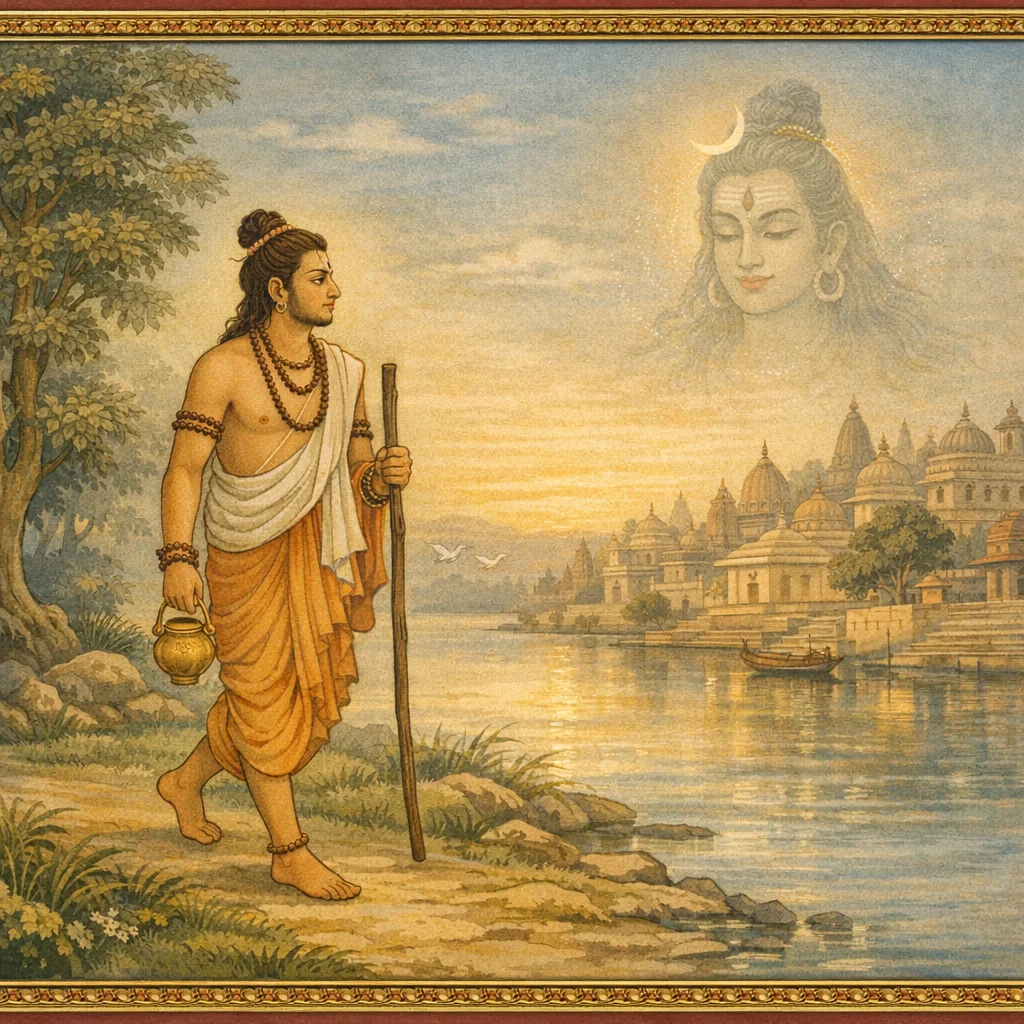
Adhyaya 32
Agastya asks Skanda to identify Harikeśa—his lineage, austerity, and how he becomes dear to the Lord while also coming to be linked with civic authority (daṇḍanāyaka/daṇḍapāṇi motifs). Skanda recounts a yakṣa genealogy from Gandhamādana: Ratnabhadra and his son Pūrṇabhadra. Though prosperous, Pūrṇabhadra grieves for lack of offspring, lamenting that wealth and palace-splendor are hollow without a “garbha-rūpa,” an heir. His wife Kanakakuṇḍalā offers a practical theological counsel: human effort and prior karma converge, yet the decisive remedy is refuge in Śaṅkara; devotion to Śiva grants both worldly aims and the highest attainment. Examples such as Mṛtyuñjaya, Śvetaketu, and Upamanyu are cited to affirm the power of Śiva-sevā. Pūrṇabhadra worships Nādeśvara/Mahādeva and is blessed with a son named Harikeśa. Harikeśa is marked by exclusive Śiva-bhakti: he fashions dust-liṅgas, recites Śiva’s names, and sees no reality apart from the Three-eyed Lord. When his father urges household training and wealth-management, Harikeśa, distressed, leaves home. Remembering the saying that the refuge-less find Vārāṇasī as their refuge, he goes to Kāśī—praised as Ānandavana/Ānandakānana—where death brings liberation. Śiva’s discourse to Pārvatī extols Kāśī’s liberative power, even liberation in one birth and protection for kṣetra-renouncers, setting the stage for Harikeśa’s later elevation.
Shlokas
Verse 1
अगस्त्य उवाच । बर्हियान समाचक्ष्व हरिकेशसमुद्भवम् । कोसौ कस्य सुतः श्रीमान्कीदृगस्य तपो महत्
Agastya said: O Barhiyāna, tell me of the one born from Harikeśa. Who is that illustrious person—whose son is he, and what is the nature of his great austerity?
Verse 2
कथं च देवदेवस्य प्रियत्वं समुपेयिवान् । काशीवासिजनीनोभूत्कथं वा दंडनायकः
How did he attain the dear favor of the God of gods? And how did he come to be born among the residents of Kāśī—and how, indeed, did he become the Daṇḍanāyaka, wielder of authority and punishment?
Verse 3
एतदिच्छाम्यहं श्रोतुं प्रसादं कुरु मे विभो । अन्नदत्वं च संप्राप्तः कथमेष महामतिः
This I wish to hear; be gracious to me, O Lord. How did this great-souled one attain the state of being an Annada—one who grants food and thus sustains life?
Verse 4
संभ्रमो विभ्रमश्चोभौ कथं तदनुगामिनौ । विभ्रांतिकारिणौ क्षेत्रवैरिणां सर्वदा नृणाम्
And how are ‘Saṃbhrama’ and ‘Vibhrama’—both of them—his attendants? How do they ever remain as deluders, bringing confusion to those men who are hostile to the sacred Kṣetra, Kāśī?
Verse 5
स्कंद उवाच । सम्यगापृच्छि भवता काशीवासिसमाहितम् । कुंभसंभव विप्रर्षे दंडपाणि कथानकम्
Skanda said: You have asked rightly, O Kumbha-born best of brāhmaṇas, about the account of Daṇḍapāṇi—devoted to Kāśī and absorbed in its sacredness.
Verse 6
यदाकर्ण्य नरः प्राज्ञ काशीवासस्य यत्फलम् । निष्प्रत्यूहं तदाप्नोति विश्वभर्त्तुरनुग्रहात्
O wise one, upon hearing of the fruit of dwelling in Kāśī, a person attains that merit without obstruction—by the grace of the Sustainer of the universe.
Verse 7
रत्नभद्र इति ख्यातः पर्वते गंधमादने । यक्षः सुकृतलक्षश्रीः पुरा परम धार्मिकः
Formerly, on Mount Gandhamādana, there was a Yakṣa famed as Ratnabhadra—endowed with the prosperity born of many good deeds, and supremely righteous.
Verse 8
पूर्णभद्रं सुतं प्राप्य सोऽभूत्पूर्णमनोरथः । वयश्चरममासाद्य भुक्त्वा भोगाननेकशः
Having obtained a son named Pūrṇabhadra, he became fulfilled in his desires; and when he reached the final stage of life, he had enjoyed many pleasures in abundance.
Verse 9
शांभवेनाथ योगेन देहमुत्सृज्य पार्थिवम् । आससादाशवं शांतं शांतसर्वेंद्रियार्थकः
Then, by Śāmbhava-yoga, abandoning the earthly body, he attained a tranquil state—his senses and their objects fully pacified.
Verse 10
पितर्युपरतेसोऽथ पूर्णभद्रो महायशाः । सुकृतोपात्तविभव भवसंभोगभुक्तिभाक्
When his father had passed away, the illustrious Pūrṇabhadra—possessing wealth gained through merit—became one who enjoyed the experiences and pleasures of worldly existence.
Verse 11
सर्वान्मनोरथांल्लेभे विना स्वर्गैकसाधनम् । गार्हस्थ्याश्रम नेपथ्यं पथ्यं पैतामहं महत्
He attained all the aims he longed for—save that single means to heaven. He took up the garb and discipline of the householder’s āśrama, the wholesome and venerable path handed down by the forefathers.
Verse 12
संसारतापसंतप्तावयवामृतसीकरम् । अपत्यं पततां पोतं बहुक्लेशमहार्णवे
A child is like a sprinkling of amṛta upon limbs scorched by the heat of worldly life; for those who are sinking, it is a boat upon the vast ocean of many hardships.
Verse 13
पूर्णभद्रोऽथ संवीक्ष्य मंदिरं सर्वसुंदरम् । तद्बालकोमलालाप विकलं त्यक्तमंगलम्
Then Pūrṇabhadra, having looked upon the mansion—beautiful in every way—became distressed; for it lacked the tender, sweet prattle of a child, and so its auspiciousness seemed departed.
Verse 14
शून्यं दरिद्रहृदिव जीर्णारण्यमिवाथवा । पांथवत्प्रांतरमिव खिन्नोऽतीवानपत्यवान्
To him who had no child, it felt empty—like the heart of the poor, like a worn-out forest, like a lonely wasteland for a traveler; thus he was exceedingly downcast.
Verse 15
आहूय गृहिणी सोऽथ यक्षः कनककुंडलाम् । उवाच यक्षिणीं श्रेष्ठां पूर्णभद्रो घटोद्भव
Then that Yakṣa, Pūrṇabhadra—born of a pot—summoned his wife, the noble Yakṣiṇī wearing golden earrings, and spoke to her.
Verse 16
न हर्म्यं सुखदं कांते दर्पणोदरसुंदरम् । मुक्ता गवाक्षसुभगं चंद्रकांतशिलाजिरम्
Beloved, this palace is not truly a giver of happiness—though lovely with mirror-like inner halls, adorned with pearl-like windows, and inlaid with slabs of moonstone.
Verse 17
पद्मरागेंद्रनीलार्चिरर्चिताट्टालकं क्वणत् । विद्रुमस्तंभशोभाढ्यं स्फुरत्स्फटिककुड्यवत्
Its lofty terraces resound, glittering with the radiance of rubies and sapphires; it is enriched by the beauty of coral pillars, with walls that shine like flashing crystal.
Verse 18
प्रेंखत्पताकानिकरं मणिमाणिक्यमालितम् । कृष्णागुरुमहाधूप बहुलामोदमोदितम्
Its clusters of banners sway; it is garlanded with gems and precious stones; and it is gladdened by abundant fragrance from great incense of black aloe-wood.
Verse 19
अनर्घ्यासनसंयुक्तं चारुपर्यंकभूषितम् । रम्यार्गलकपाटाढ्यं दुकूलच्छन्नमंडपम्
It is furnished with priceless seats and adorned with lovely couches; it has beautiful bolted doors, and pavilions canopied with fine cloth.
Verse 20
सुरम्यरतिशालाढ्यं वाजिराजिविराजितम् । दासदासीशताकीर्णं किंकिणीनादनादितम्
It abounds in exquisitely charming pleasure-halls; it shines with rows of splendid horses; it is thronged with hundreds of male and female servants, and it rings with the sound of tinkling bells.
Verse 21
नूपुरारावसोत्कंठ केकिकेकारवाकुलम् । कूजत्पारावत कुलं गुरुसारीकथावरम्
It longs with the jingling of nūpura-anklets; it is filled with the cries of peacocks; there are cooing flocks of pigeons, and the charming, weighty talk of mynah birds.
Verse 22
खेलन्मरालयुगलं जीवं जीवककांतिमत् । माल्याहूत द्विरेफाणां मंजुगुंजारवावृतम्
There were playful pairs of swans, and jīva-birds—bright like the jīvakā—while bees, drawn by garlands, filled the place with a sweet humming sound.
Verse 23
कर्पूरैण मदामोद सोदरानिलवीजितम् । क्रीडामर्कटदंष्ट्राग्री कृतमाणिक्यदाडिमम्
It was fanned by breezes fragrant like camphor and honeyed intoxication; and pomegranates, like rubies, appeared as though fashioned by playful monkeys’ sharp teeth.
Verse 24
दाडिमीबीजसंभ्रांतशुकतुंडात्तमौक्तिकम् । धनधान्यसमृद्धं च पद्मालयमिवापरम्
Pearls seemed to have been taken from parrots’ beaks as they fluttered about for pomegranate seeds; and the place was rich in wealth and grain—like another abode of Lakṣmī.
Verse 25
कमलामोदगर्भं च गर्भरूपं विना प्रिये । गर्भरूपमुखं प्रेक्ष्ये कथं कनककुडले
“Beloved—though I behold the lotus-scented face called ‘Garbha-rūpa’, I do not possess the very child-form itself. How, O Kanakakuṇḍala, shall I ever behold that infant form?”
Verse 26
यद्युपायोऽस्ति तद्ब्रूहि धिगपुत्रस्य जीवितम् । सर्वशून्यमिवाभाति गृहमेतदनंगजम्
“If there is a means, tell me. Fie upon the life of one without a son! This house appears utterly empty, as though devoid of a child.”
Verse 27
पुण्यवानितरो वापि मम क्षेत्रस्य सेवया । मुक्तो भवति देवेशि नात्र कार्या विचारणा
“Whether one is virtuous or otherwise, by serving My sacred field one becomes liberated, O Lady of the Lord—there is no need for doubt in this.”
Verse 28
प्रलपंतमिव प्रोच्चैः प्रियं कनककुंडला । बभाषेंऽतर्विनिःश्वस्य यक्षिणी सा पतिव्रता
As though he were lamenting aloud, that Yakṣiṇī—faithful to her husband—spoke to her beloved Kanakakuṇḍala, sighing deeply within.
Verse 29
कनककुंडलोवाच । किमर्थं खिद्यसे कांत ज्ञानवानसि यद्भवान् । अत्रोपायोऽस्त्यपत्याप्त्यै विस्रब्धमवधारय
Kanakakuṇḍala said: “Why do you grieve, beloved, when you are wise? Here there is a means for obtaining offspring—listen with full confidence.”
Verse 30
किमुद्यमवतां पुंसां दुर्लभं हि चराचरे । ईश्वरार्पितबुद्धीनां स्फुंरंत्यग्रे मनोरथाः
“For men of effort, what indeed is difficult in the moving and unmoving worlds? For those whose minds are offered to the Lord, their aims shine forth before them and are fulfilled.”
Verse 31
दैवं हेतुं वदंत्येवं भृशं कापुरुषाः पते । स्वयं पुराकृतं कर्म दैवं तच्च न हीतरत्
“Fate is the cause,” say the timid, O Lord, and they proclaim it again and again. Yet that “fate” is only one’s own karma done in former times—nothing else.
Verse 32
ततः पौरुषमालंब्य तत्कर्म परिशांतये । ईश्वरं शरणं यायात्सर्वकारणकारणम्
Therefore, relying on one’s own righteous effort, to soothe the consequences of those deeds, one should take refuge in the Lord—the Cause of all causes.
Verse 33
अपत्यं द्रविणं दारा हारा हर्म्य हया गजाः । सुखानि स्वर्गमोक्षौ च न दूरे शिवभक्तितः
Children, wealth, spouse, ornaments, mansions, horses, elephants—worldly comforts, and even heaven and liberation—are not far from one who has devotion to Śiva.
Verse 34
विधातुः शांभवीं भक्तिं प्रिय सर्वे मनोरथाः । सिद्धयोष्टौ गृहद्वारं सेवंते नात्र संशयः
O dear one, for the Creator (Brahmā), through devotion to Śambhu, all cherished aims become attainable; and the eight siddhis themselves wait at one’s very doorstep—of this there is no doubt.
Verse 35
नारायणोपि भगवानंतरात्मा जगत्पतिः । चराचराणामविता जातः श्रीकंठसेवया
Even Lord Nārāyaṇa—the inner Self and Lord of the universe, protector of all that moves and all that is unmoving—attained his exalted station through service to Śrīkaṇṭha (Śiva).
Verse 36
ब्रह्मणः सृष्टिकर्त्तृत्वं दत्तं तेनैव शंभुना । इंद्रादयो लोकपाला जाता शंभोरनुग्रहात्
To Brahmā, that very Śambhu bestowed the office of Creator; and Indra and the other guardians of the worlds arose through Śambhu’s grace.
Verse 37
मृत्युंजयं सुतं लेभे शिलादोप्यनपत्यवान् । श्वेतकेतुरपि प्राप जीवितं कालपाशतः
Śilāda, though without offspring, obtained a son—Mṛtyuñjaya; and Śvetaketu too regained life, freed from the noose of Time (Kāla).
Verse 38
क्षीरार्णवाधिपतितामुपमन्युरवाप्तवान् । अंधकोप्यभवद्भृंगी गाणपत्यपदोर्जितः
Upamanyu attained lordship over the Ocean of Milk; and even Andhaka became Bhṛṅgī, winning the exalted rank among Śiva’s gaṇas.
Verse 39
जिगाय शार्ङ्गिणं संख्ये दधीचिः शंभुसेवया । प्राजापत्यपदं प्राप दक्षः संशील्य शंकरम्
Dadhīci conquered Śārṅgin in battle through service to Śambhu; and Dakṣa attained the office of Prajāpati by devotedly honoring Śaṅkara.
Verse 40
मनोरथपथातीतं यच्च वाचामगोचरम् । गोचरो गोचरीकुर्यात्तत्पदं क्षणतो मृडः
That state beyond the pathways of desire and beyond the reach of words—Merciful Mṛḍa makes it directly accessible in an instant.
Verse 41
अनाराध्य महेशानं सर्वदं सर्वदेहिनाम् । कोपि क्वापि किमप्यत्र न लभेतेति निश्चितम्
Without worshiping Maheśāna—who bestows all upon all embodied beings—no one, anywhere, gains anything at all in this world; this is certain.
Verse 42
तस्मात्सर्वप्रयत्नेन शंकरं शरणं व्रज । यदिच्छसि प्रियं पुत्रं प्रियसर्वजनीनकम्
Therefore, with every effort, take refuge in Śaṅkara. If you desire a beloved son—dear to all people—seek Him as your shelter.
Verse 43
इति श्रुत्वा वचः पत्न्याः पूर्णभद्रः स यक्षराट् । आराध्य श्रीमहादेवं गीतज्ञो गीतविद्यया
Hearing his wife’s words, Pūrṇabhadra—the lord of the Yakṣas—worshipped Śrī Mahādeva, skilled in sacred song and in worship through the science of hymns.
Verse 44
दिनैः कतिपयैरेव परिपूर्णमनोरथः । पुत्रकाममवापोच्चैस्तस्यां पत्न्यां दृढव्रतः
In only a few days, his wish was fulfilled. Steadfast in his vow, he attained through that wife of his the longed-for boon of a son.
Verse 45
नादेश्वरं समभ्यर्च्य कैः कैर्नापि स्वचिंतितम् । तस्मात्काश्यां प्रयत्नेन सेव्यो नादेश्वरो नृभिः
Without duly worshipping Nādeśvara, no one’s cherished aim is fulfilled. Therefore, in Kāśī, people should strive to serve and worship Nādeśvara.
Verse 46
अंतर्वत्न्यथ कालने तत्पत्नी सुषुवे सुतम् । तस्य नाम पिता चक्रे हरिकेश इति द्विज
In due course, when she was with child, his wife gave birth to a son. The father then bestowed on him the name Harikeśa, O twice-born one.
Verse 47
प्रीतिदायं ददौ चाथ भूरिपुत्राननेक्षणात् । पूर्णभद्रस्तथागस्त्य हृष्टा कनककुंडला
Then, rejoicing at the sight of the face of his abundant offspring, Pūrṇabhadra bestowed celebratory gifts; and Kanakakuṇḍalā too was filled with delight, O Agastya.
Verse 48
बालोऽपि पूर्णचंद्राभ वदनो मदनोपमः । वृद्धिं प्रतिक्षणं प्राप शुक्लपक्ष इवोडुराट्
Even as a child, his face shone like the full moon, and he was lovely like Kāma. He grew with every moment—like the moon waxing in the bright fortnight.
Verse 49
यदाष्टवर्षदेशीयो हरिकेशोऽभवच्छिशुः । नित्यं तदाप्रभृत्येवं शिवमेकममन्यत
When the boy Harikeśa reached about eight years of age, from that time onward he constantly regarded Śiva alone as his sole refuge and supreme reality.
Verse 50
पांसुक्रीडनसक्तोपि कुर्याल्लिंगं रजोमयम् । शाद्वलैः कोमलतृणैः पूजयेच्च स कौतुकम्
Even while absorbed in playing with sand, he would fashion a liṅga out of dust, and with fresh tender grasses he would worship it—doing so with joyful eagerness.
Verse 51
आकारयति मित्राणि शिवनाम्नाऽखिलानि सः । चंद्रशेखरभूतेश मृत्युंजय मृडेश्वरः
He would call his friends only by the Names of Śiva—“Candraśekhara,” “Bhūteśa,” “Mṛtyuṃjaya,” “Mṛḍeśvara,” and the like.
Verse 52
धूर्जटे खंडपरशो मृडानीश त्रिलोचन । भर्गशंभोपशुपते पिनाकिन्नुग्रशंकर
O Dhūrjaṭa, O wielder of the battle-axe, O Lord of Mṛḍānī, O Three-eyed One; O Bharga, O Śambhu, O Paśupati, O bearer of the Pināka bow—O fierce and auspicious Śaṅkara!
Verse 53
त्वमंत्यभूषां कुरु काशिवासिनां गले सुनीलां भुजगेंद्र कंकणाम् । भालेसु नेत्रां करिकृत्तिवाससं वामेक्षणालक्षित वामभागाम्
Become the final and supreme adornment of the residents of Kāśī—You whose throat is deep blue, whose bracelets are the lordly serpent, whose forehead bears the Eye, who is clad in elephant-hide, and whose left side is marked by the glance of the Goddess on Your left.
Verse 54
अजिनांबरदिग्वासः स्वर्धुनी क्लिन्नमौलिज । विरूपाक्षाहिनेपथ्य गृणन्नामावलीमिमाम्
Clad in a skin-garment and the directions themselves as raiment, with matted locks damp from the heavenly river, adorned with serpents and bearing the unequaled Eye—thus one should chant this garland of Names.
Verse 55
सवयस्कानिति मुहुः समाह्वयति लालयन् । शब्दग्रहौ न गृह्णीतस्तस्यान्याख्यां हरादृते
Cooing and fondling, he repeatedly calls out, “O companions of my own age!”—yet his two “word-catchers” (ears) do not seize any other name for him apart from “Hara”.
Verse 56
पद्भ्यां न पद्यते चान्यदृते भूतेश्वराजिरात् । द्रष्टुं रूपांतरं तस्य वीक्षणेन विचक्षणे
With his feet he steps nowhere else—save into the courtyard of Bhūteśvara; and with discerning sight he cannot endure to behold any other form.
Verse 57
रसयेत्तस्य रसना हरनामाक्षरामृतम् । शिवांघ्रिकमलामोदाद्घ्राणं नैव जिघृक्षति
His tongue tastes the nectar of the syllables of Hara’s Name; and his nose, intoxicated by the fragrance of Śiva’s lotus-feet, longs for no other scent.
Verse 58
करौ तत्कौतुककरौ मनो मनति नापरम् । शिवसात्कृत्यपेयानि पीयते तेन सद्धिया
His hands delight only in that service; his mind turns to nothing else. With lucid understanding, he ‘drinks’ only what has first been offered to Śiva, receiving it as sanctified.
Verse 59
भक्ष्यते सर्वभक्ष्याणि त्र्यक्षप्रत्यक्षगान्यपि । सर्वावस्थासु सर्वत्र न स पश्येच्छिवं विना
He may partake of every kind of food—even that obtained in the very presence of the Three-eyed Lord—yet in every state and everywhere, he sees nothing apart from Śiva.
Verse 60
गच्छन्गायन्स्वपंस्तिष्ठञ्च्छयानोऽदन्पिबन्नपि । परितस्त्र्यक्षमैक्षिष्ट नान्यं भावं चिकेति सः
Whether walking, singing, sleeping, standing, lying down, eating, or drinking—on every side he beholds the Three-eyed Lord; he acknowledges no other reality.
Verse 61
क्षणदासु प्रसुप्तोपि क्व यासीति वदन्मुहुः । क्षणं त्र्यक्ष प्रतीक्षस्व बुध्यतीति स बालकः
Even when asleep at night, he repeatedly says: “Where are You going? O Tryakṣa, wait a moment!”—and thus the child awakens (only to Śiva).
Verse 62
स्पष्टां चेष्टां विलोक्येति हरिकेशस्य तत्पिता । अशिक्षयत्सुतं सोऽथ गृहकर्मरतो भव
Seeing his son Harikeśa’s conduct plainly, his father then instructed him: “Be devoted to the duties of the household.”
Verse 63
एते तुरंगमा वत्स तवैतेऽश्वकिशो रकाः । चित्राणीमानि वासांसि सुदुकूलान्यमूनि च
“Dear child, these are your horses—fine young steeds. And these are the many-variegated garments, including these excellent silken cloths.”
Verse 64
रत्नान्याकरशुद्धानि नानाजातीन्यनेकशः । कुप्यं बहुविधं चैतद्गोधनानि महांति च
“Here are gems refined from the mines, of many kinds in abundance; and many sorts of valuables and great herds of cattle as well.”
Verse 65
अमत्राणि महार्हाणि रौप्य कांस्यमयानि च । पणनीयानि वस्तूनि नानादेशोद्भवान्यपि
“There are also costly vessels—made of silver and bronze—and trade-goods as well, brought from many different lands.”
Verse 66
चामराणि विचित्राणि गंधद्रव्याण्यनेकशः । एतान्यन्यानि बहुशस्त्वनेके धान्यराशयः
There are ornate chowries, many kinds of fragrant substances, and many other things besides—indeed, heaps of grain in abundance.
Verse 67
एतत्त्वदीयं सकलंवस्तुजातं समंततः । अर्थोपार्जनविद्याश्च सर्वाः शिक्षस्व पुत्रक
This entire collection of goods is yours in every way. Learn, my son, all the skills and disciplines by which wealth is rightly acquired.
Verse 68
चेष्टास्त्यज दरिद्राणां धूलिधूसरिणाममूः । अभ्यस्यविद्याः सकला भोगान्निर्विश्य चोत्तमान्
Abandon these behaviors of the poor—dust-covered and mean. Master all branches of learning, and then enjoy the finest pleasures.
Verse 69
तां दशां चरमां प्राप्य भक्तियोगं ततश्चर । असकृच्छिक्षितः पित्रेत्यवमन्य गुरोर्गिरम्
Having reached the final stage, then practice the yoga of devotion (bhakti). Yet, though repeatedly instructed by his father, he disregarded the words of his elder and teacher.
Verse 70
रुष्टदृष्टिं च जनकं कदाचिदवलोक्य सः । निर्जगाम गृहाद्भीतो हरिकेश उदारधीः
At one time, seeing his father’s angry look, Harikeśa—though noble-minded—became afraid and went out from the house.
Verse 71
ततश्चिंतामवापोच्चैर्दिग्भ्रांतिमपि चाप्तवान् । अहो बालिशबुद्धित्वात्कुतस्त्यक्तं गृहं मया
Then he fell into great anxiety and even became directionless. “Alas! Through childish folly—why have I abandoned my home?”
Verse 72
क्व यामि क्व स्थिते शंभो मम श्रेयो भविष्यति । पित्रा निर्वासितश्चाहं न च वेद्म्यथ किंचन
“Where shall I go, and where can I stay, O Śambhu? What will become my true welfare? I have been driven out by my father, and I do not know anything at all—what to do next.”
Verse 73
इति श्रुतं मया पूर्वं पितुरुत्संगवर्तिना । गदतस्तातपुरतः कस्यचिद्वचनं स्फुटम्
“While I sat before my father, resting in his lap, I once clearly heard someone speaking these words.”
Verse 74
मात्रा पित्रा परित्यक्ता ये त्यक्ता निजबंधुभिः । येषां क्वापि गतिर्नास्ति तेषां वाराणसी गतिः
“Those who are abandoned by mother and father, those rejected by their own relatives—those who have no refuge anywhere: for them, Vārāṇasī is the refuge.”
Verse 75
जरया परिभूता ये ये व्याधिविकलीकृताः । येषां क्वापि गतिर्नास्ति तेषां वाराणसी गतिः
“Those overwhelmed by old age, those crippled and weakened by disease—those who have no refuge anywhere: for them, Vārāṇasī is the refuge.”
Verse 76
पदे पदे समाक्रांता ये विपद्भिरहर्निशम् । येषां क्वापि गतिर्नास्ति तेषांवाराणसी गतिः
Those assailed at every step by calamities, day and night—those who have no refuge anywhere: for them, Vārāṇasī is the refuge.
Verse 77
पापराशिभिराक्रांता ये दारिद्र्य पराजिताः । येषां क्वापि गतिर्नास्ति तेषां वाराणसी गतिः
Those overwhelmed by heaps of sin, those defeated by poverty—those who have no refuge anywhere: for them, Vārāṇasī is the refuge.
Verse 78
संसार भयभीताय ये ये बद्धाः कर्मबंधनैः । येषां क्वापि गतिर्नास्ति तेषां वाराणसी गतिः
Those terrified of saṃsāra, those bound by the fetters of karma—those who have no refuge anywhere: for them, Vārāṇasī is the refuge.
Verse 79
श्रुतिस्मृतिविहीना ये शौचाचारविवर्जिताः । येषां क्वापि गतिर्नास्ति तेषां वाराणसी गतिः
Those lacking the guidance of Śruti and Smṛti, those bereft of purity and right conduct—those who have no refuge anywhere: for them, Vārāṇasī is the refuge.
Verse 80
ये च योगपरिभ्रष्टास्तपो दान विवर्जिताः । येषां क्वापि गतिर्नास्ति तेषां वाराणसी गतिः
Those who have fallen away from yoga, those devoid of tapas and charity—those who have no refuge anywhere: for them, Vārāṇasī is the refuge.
Verse 81
मध्ये बंधुजने येषामपमानं पदे पदे । तेषामानंददं चैकं शंभोरानंदकाननम्
Those who, even among their own kinsmen, meet humiliation at every step—for them there is one giver of joy: Śambhu’s Ānandakānana, the Bliss-Grove (Kāśī).
Verse 82
आनंदकानने येषां रुचिर्वै वसतां सताम् । विश्वेशानुगृहीतानां तेषामानंदजोदयः
For those virtuous souls who truly delight in dwelling in the Grove of Bliss (Ānandakānana), and who are favored by Viśveśa (Lord of the Universe), there arises an ever-increasing dawning of spiritual bliss.
Verse 83
भर्ज्यते कर्मबीजानि यत्र विश्वेशवह्निना । अतो महाश्मशानं तदगतीनां परा गतिः
There, by the fire of Viśveśa, the very seeds of karma are roasted away; therefore that place is called the Great Cremation-ground (Mahāśmaśāna), the supreme refuge for those who have no other refuge.
Verse 84
हरिकेशो विचार्येति यातो वाराणसीं पुरीम् । यत्राविमुक्ते जंतूनां त्यजतां पार्थिवीं तनुम्
Reflecting thus, Harikeśa set out for the city of Vārāṇasī—Avimukta—where, for living beings who cast off their earthly body, the kṣetra’s liberating ordinance prevails.
Verse 85
पुनर्नो तनुसंबंधस्तनुद्वेषिप्रसादतः । आनंदवनमासाद्य स तपः शरणं गतः
“May I have no further bondage to a body, by the grace of the Body-hater (Śiva, who dissolves embodiedness).” Reaching Ānandavana, he took refuge in tapas, making austerity his shelter.
Verse 86
अथ कालांतरे शंभुः प्रविश्यानंदकानमम् । पार्वत्यै दर्शयामास निजमाक्रीडकाननम्
Then, after some time, Śambhu entered the most blissful grove called Ānandakānana and showed Pārvatī His own garden of delight—His divine forest-playground.
Verse 87
अमंदामोदमंदारं कोविदारपरिष्कृतम् । चारुचंपकचूताढ्यं प्रोत्फुल्लनवमल्लिकम्
It was filled with mandāra trees pouring forth unceasing fragrance, adorned with kovidāras, abundant in lovely campakas and mangoes, and radiant with newly blossoming jasmine.
Verse 88
विकसन्मालतीजालं करवीरविराजितम् । प्रस्फुटत्केतकिवनं प्रोद्यत्कुरबकोर्जितम्
There were nets of blooming mālatī creepers, splendid with karavīra blossoms; ketakī groves burst open in flower, and the place was enlivened by kurabaka in full, rising bloom.
Verse 89
जृंभद्विचकिलामोदं लसत्कंकेलिपल्लवम् । नवमल्लीपरिमलाकृष्टषट्पदनादितम्
It was fragrant with the opening scent of blossoming aśoka, bright with fresh kankeli shoots, and resonant with bees drawn by the perfume of newly blooming jasmine.
Verse 90
पुष्प्यपुन्नागनिकरं बकुलामोदमोदितम् । मेदस्विपाटलामोद सदामोदित दिङ्मुखम्
It held clusters of flowering punnāga, gladdened by the fragrance of bakula; and the very quarters seemed ever-delighted by the rich perfume of pāṭalā blossoms.
Verse 91
बहुशोलंबिरोलंब मालामालितभूतलम् । चलच्चंदनशाखाग्र रममाणपि काकुलम्
The ground was carpeted with garlands hanging down in many swaying festoons; and as the tips of sandalwood branches gently moved, the place seemed joyfully alive and bustling.
Verse 92
गुरुणाऽगुरुणामत्त भद्रजातिविहंगमम् । नागकेसरशाखास्थ शालभंजि विनोदितम्
He revealed a delightful grove where auspicious birds, intoxicated by sweet fragrance, sported; and where a śālabhañjikā maiden, poised upon a nāgakesara branch, playfully enchanted the scene.
Verse 93
मेरुतुंग नमेरुस्थच्छायाक्रीडितकिंनरम् । किंनरीमिथुनोद्गीतं गानवच्छुककिंशुकम्
There the Kiṃnaras played in the cool shade of lofty Meru-like peaks; and the aśoka/kiṃśuka trees seemed to sing, as if echoing the music raised by pairs of Kiṃnarīs in melodious chorus.
Verse 94
कदंबानां कदंबेषु गुंजद्रोलंबयुग्मकम् । जितसौवर्णवर्णोच्च कर्णिकारविराजितम्
Among the kadamba trees, pairs of humming bees hung in clusters; and the grove shone with karṇikāra blossoms whose radiant golden hue seemed to surpass even gold itself.
Verse 95
शालतालतमालाली हिंताली लकुचावृतम् । लसत्सप्तच्छदामोदं खर्जूरीराजिराजितम् । नारिकेल तरुच्छन्न नारंगीरागरंजितम्
It was enclosed by rows of śāla, tāla, and tamāla trees, along with hiṃtāla and lakuca; fragrant with blossoming saptacchada; adorned by lines of date-palms; shaded by coconut trees and further brightened by the red glow of orange groves.
Verse 96
फलिजंबीरनिकरं मधूकमधुपाकुलम् । शाल्मली शीतलच्छायं पिचुमंद महावनम्
He showed a great forest, dense with fruit-laden jambu trees, thronged with bees drawn to madhūka blossoms; śālmalī trees cast cooling shade, and broad stands of pichumanda spread far.
Verse 97
मधुरामोद दमनच्छन्नं मरुबनोदितम् । लवलीलोललीलाभृन्मंदमारुतलोलितम्
It was carpeted with damana plants and filled with sweet fragrance; it flourished like a desert-grove revived, while lavalī creepers swayed playfully, stirred by gentle breezes.
Verse 98
भिल्ली हल्लीसकप्रीति झिल्लीरावविराविणम् । क्वचित्सरः परिसरक्रीडत्क्रोडकदंबकम्
It delighted the bhillī and hallīsaka vines and resounded with the chirping of crickets; and in places there were lakes, around which herds of boars played amid clusters of kadamba trees.
Verse 99
मरालीगलनालीस्थ बिसासक्तसितच्छदम् । विशोककोकमिथुनक्रीडाक्रेंकारसुंदरम्
There, white-feathered birds clung to lotus-stalks near the haṃsas; and the lake was made beautiful by playful pairs of kokas, whose calls rang out sweetly, free from sorrow.
Verse 100
बकशावकसंचारं लक्ष्मणासक्त सारसम् । मत्तबर्हिणसंघुष्टं कपिंजलकुलाकुलम्
It was alive with young herons moving about; with sārasas devoted to their mates; loud with peacocks as if intoxicated with joy; and crowded with flocks of kapiñjala birds.
Verse 110
चंद्रकांतशिलासुप्तकृष्णैणहरितोडुपम् । तरुप्रकीर्णकुसुम जितस्वर्लोकतारकम् । दर्शयन्नित्थमाक्रीडं देव्यै देवोविशद्वनम्
Thus the God showed the Goddess that grove of delight: slabs of candrakānta moonstone gleaming like greenish stars, as though dark antelopes slept upon them; and trees scattering blossoms everywhere, outshining even the stars of heaven—so clear and sacred was that forest.
Verse 120
ब्रह्मज्ञानं न विंदंति योगैरेकेन जन्मना । जन्मनैकेन मुच्यंते काश्यामंतकृतो जनाः
Even through yogic disciplines, people do not attain Brahman-knowledge in a single lifetime; yet those whose end comes in Kāśī are liberated in that very life.
Verse 130
विधाय क्षेत्रसंन्यासं ये वसंतीह मानवाः । जीवन्मुक्तास्तु ते देवि तेषां विघ्नं हराम्यहम्
O Goddess, those who undertake renunciation with respect to this sacred kṣetra and dwell here become jīvanmukta—liberated while still living; I myself remove their obstacles.
Verse 140
सत्वावलंबितप्राणमायुःशेषेणरक्षितम् । निःश्वासोच्छासपवनवृत्तिसूचितजीवितम्
Life, upheld by the vital breath sustained through inner steadiness, is preserved only by the remaining span of one’s allotted time; its continuance is known merely by the movement of wind as exhalation and inhalation.
Verse 150
श्रुत्वोदितां तस्य महेश्वरो गिरं मृद्वीकया साम्यमुपेयुषीं मृदु । भक्तस्य धीरस्य महातपोनिधे ददौ वराणां निकर तदा मुदा
Hearing his words—gentle and sweet as grapes—Maheśvara rejoiced and granted to that steadfast devotee, a great treasure-house of austerity, a multitude of boons.
Verse 160
मद्भक्तियुक्तोपि विना त्वदीयां भक्तिं न काशी वसतिं लभेत । गणेषु देवेषु हि मानवेषु तदग्रमान्यो भव दंडपाणे
Even one devoted to me would not gain residence in Kāśī without devotion to you. Therefore, O Daṇḍapāṇi, among my gaṇas, among the gods, and among humans too—be the foremost and most honored.
Verse 170
धन्यो यक्षः पूर्णभद्रो धन्या कांचनकुंडला । ययोर्जठरपीठेभूर्दंडपाणे महामते
Blessed is the Yakṣa Pūrṇabhadra, and blessed is Kāñcanakuṇḍalā—O wise Daṇḍapāṇi—for upon the seat of whose belly the earth itself rests.
Verse 217
धिगेतत्सौधसौंदर्यं धिगेतद्धनसंचयम् । विनापत्यं प्रियतमे जीवितं च धिगावयोः
Fie upon the beauty of mansions; fie upon the hoarding of wealth. O beloved, without children—fie even upon our very life.