Adhyaya 30
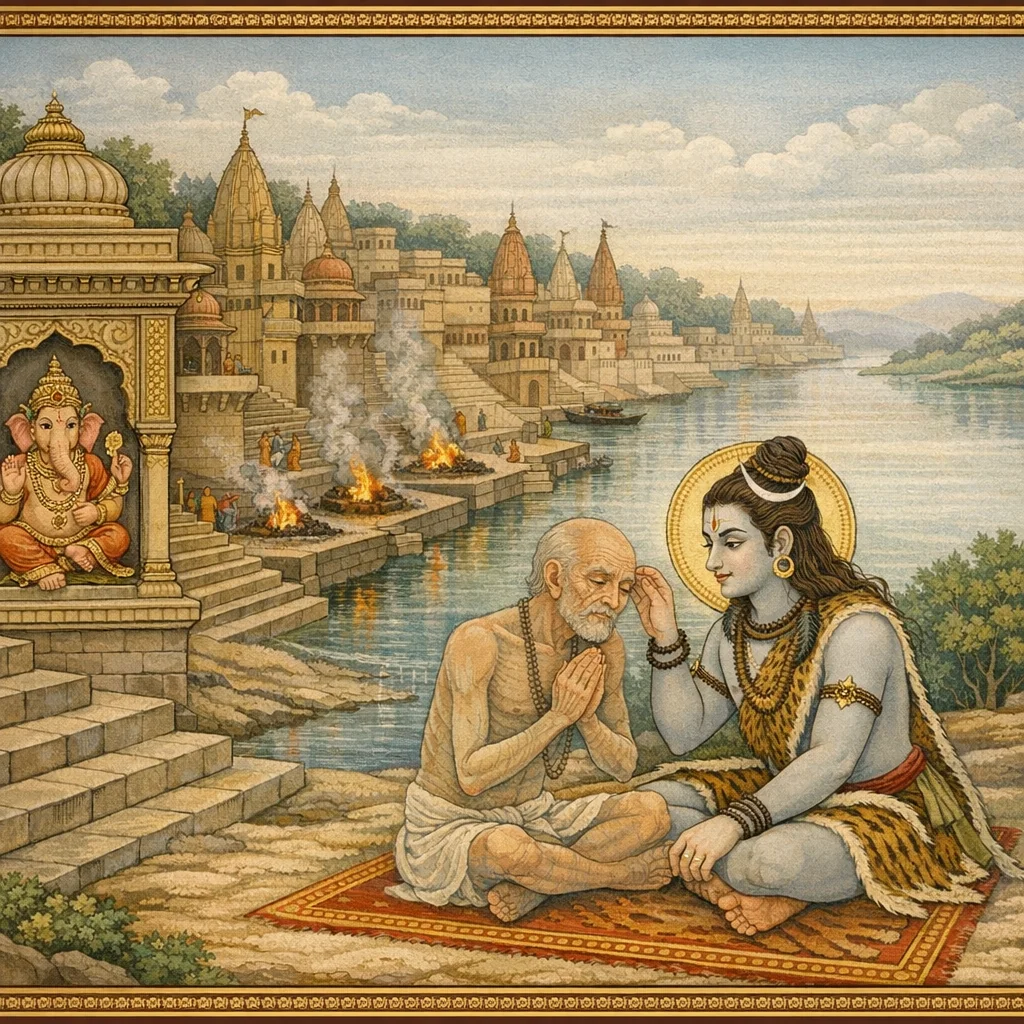
Skanda speaks to Agastya, highlighting Bhagiratha’s sacred task of bringing Gaṅgā down for the welfare of the three worlds, and culminating in her association with Maṇikarṇikā in Kāśī. The chapter deepens the theology of Avimukta: Kāśī is never abandoned by Śiva and stands as a supreme field of salvation, where liberation is attainable even without the usual disciplines of philosophical practice, through Śiva’s grace and the “tāraka” instruction bestowed at the moment of death. It then explains the kṣetra’s protective geography and regulated access. The gods establish protective agencies and the boundary rivers Asi and Varaṇā, giving rise to the name Vārāṇasī. Śiva appoints guardians (including a Vināyaka) to control entry; those lacking Viśveśa’s authorization are said to be unable to remain or gain the holy fruit of the place. An embedded exemplum tells of the merchant Dhanañjaya, devoted to his mother, carrying her remains; through events involving a carrier’s theft and the theme of unauthorized movement, the text teaches that kṣetra-fruit depends on sanctioned entry and right orientation. The closing portion offers an extended eulogy of Vārāṇasī’s incomparable salvific status, affirming that beings of many kinds who die there attain an exalted end under Śiva’s oversight.
Shlokas
Verse 1
स्कंद उवाच । शृण्वगस्त्यमहाभाग स च राजा भगीरथः । आराध्य श्रीमहादेवमुद्दिधीर्षुः पितामहान्
Skanda said: Listen, O noble Agastya. King Bhagīratha, desiring to deliver his forefathers, worshipped the glorious Mahādeva.
Verse 2
ब्रह्मशाप विनिर्दग्धान्सर्वान्राजर्षिसत्तमः । महता तपसा भूमिमानिनाय त्रिवर्त्मगाम्
That best of royal seers, through great austerity, brought down to the earth the (Gaṅgā) who moves along the three paths, for the sake of all those scorched by Brahmā’s curse.
Verse 3
त्रयाणामपि लोकानां हिताय महते नृपः । समानैषीत्ततो गंगां यत्रासीन्मणिकर्णिका
For the great welfare of all three worlds, the king then brought the Gaṅgā to the place where Maṇikarṇikā was situated.
Verse 4
आनंदकाननं शंभोश्चक्रपुष्करिणी हरेः । परब्रह्मैकसुक्षेत्रं लीलामोक्षसमर्पकम्
It is Śambhu’s Ānandakānana; it is Hari’s Cakrapuṣkariṇī; it is the singular, most excellent sacred field of the Supreme Brahman—bestowing liberation as a divine play (līlā).
Verse 5
प्रापयामास तां गंगां दैलीपिः पुरतश्चरन् । निर्वाणकाशनाद्यत्र काशीति प्रथिता पुरी
Going before her as guide, Dailīpi brought that sacred Gaṅgā into the city—where, because it illumines nirvāṇa, the city is famed as “Kāśī”.
Verse 6
अविमुक्तं महाक्षेत्रं न मुक्तं शंभुना क्वचित । प्रागेव हि मुनेऽनर्घ्यं जात्यं जांबूनदं स्वयम्
O sage, Avimukta is the great sacred kṣetra that Śambhu (Śiva) never abandons at any time. Indeed, of itself it is beyond price—like pure, native Jāmbūnada gold.
Verse 7
पुनर्वारितरेणापि हीरेणयदि संगतम् । चक्रपुष्करणीतीर्थं प्रागेव श्रेयसांपदम्
Even were something joined to a diamond refined again and again, Cakrapuṣkaraṇī Tīrtha is, from the very beginning, the very abode of auspiciousness and the highest good.
Verse 8
ततः श्रेष्ठतरं शंभोर्मणिश्रवणभूषणात् । आनंदकानने तस्मिन्नविमुक्ते शिवालये
More excellent even than Śambhu’s jeweled ear-ornament is that abode of Śiva—Avimukta—there in the blissful forest, Ānandakānana.
Verse 9
प्रागेव मुक्तिः संसिद्धा गंगासंगात्ततोधिका । यदा प्रभृति सा गंगा मणिकर्ण्यां समागता
Liberation there was already fully accomplished; yet it became even greater through union with the Gaṅgā—ever since the Gaṅgā came to Māṇikarṇī.
Verse 10
तदाप्रभृति तत्क्षेत्रं दुष्प्रापं त्रिदशैरपि । कृत्वा कर्माण्यनेकानि कल्याणानीतराणि वा
From that time onward, that sacred kṣetra became difficult to attain even for the gods—though beings may perform countless deeds, auspicious or otherwise.
Verse 11
तानि क्षणात्समुत्क्षिप्य काशीसंस्थोऽमृतोभवेत् । तस्यां वेदांतवेद्यस्य निदिध्यासनतो विना
Casting those (karmic burdens) away in an instant, one who abides in Kāśī becomes deathless. There, even without deep contemplative absorption (nididhyāsana) upon the One known through Vedānta…
Verse 12
विना सांख्येन योगेन काश्यां संस्थोऽमृतो भवेत् । कर्मनिर्मूलनवता विना ज्ञानेन कुंभज
Even without Sāṅkhya or Yoga, one who dwells in Kāśī becomes deathless. O Kumbhaja (Agastya), even without that knowledge which uproots karma…
Verse 13
शशिमौलिप्रसादेन काशीसंस्थोऽमृतो भवेत् । यत्नतोऽयत्नतो वापि कालात्त्यक्त्वा कलेवरम्
By the grace of the Moon-crested Lord (Śiva), one who abides in Kāśī becomes deathless—whether one leaves the body at the destined time with effort or without effort.
Verse 14
तारकस्योपदेशेन काशीसंस्थोऽमृतो भवेत् । अनेकजन्मसंसिद्धैर्बद्धोऽपि प्राकृतैर्गुणैः
Through the instruction of the Tāraka, one who abides in Kāśī becomes deathless—even if bound by natural qualities ingrained and strengthened through many births.
Verse 16
देहत्यागोऽत्र वै योगः काश्यां निर्वाणसौख्यकृत् । प्राप्योत्तरवहां काश्यामतिदुष्कृतवानपि
Here indeed, ‘yoga’ itself is the relinquishing of the body; in Kāśī it brings about the bliss of nirvāṇa. Even one weighed down by exceedingly evil deeds, upon reaching Kāśī on the northern-flowing Gaṅgā…
Verse 17
यायात्स्वं हेलया त्यक्त्वा तद्विष्णोः परमं पदम् । यमेंद्राग्निमुखा देवा दृष्ट्वा मुक्तिपथोन्मुखान्
Casting off their own abodes as though they were trifles, they hastened toward that supreme station of Viṣṇu. Seeing beings turning toward the path of liberation, the gods—Yama, Indra, Agni, and the rest—became vigilant.
Verse 18
सर्वान्सर्वे समालोक्य रक्षां चक्रुः पुरापुरः । असिं महासिरूपां च पाप्यसन्मतिखंडनीम्
All of them, surveying everything, set protections in place, city by city. And they established a sword—of the form of a great blade—meant to cut down sin and corrupt understanding.
Verse 19
दुष्टप्रवेशं धुन्वानां धुनीं देवा विनिर्ममुः । वरणां च व्यधुस्तत्र क्षेत्रविघ्ननिवारिणीम्
The gods fashioned a sacred stream that shakes off and repels the entry of the wicked. There they also established the Varaṇā, the remover of obstacles that threaten the holy kṣetra.
Verse 20
दुर्वृत्तसुप्रवृत्तेश्च निवृत्तिकरणीं सुराः । दक्षिणोत्तरदिग्भागे कृत्वाऽसिं वरणां सुराः
To bring about restraint—turning back the ill-conducted and guiding the well-disposed—the gods established these powers. In the southern and northern quarters they set Asi and Varaṇā in place.
Verse 21
क्षेत्रस्य मोक्षनिक्षेप रक्षां निर्वृतिमाप्नुयुः । क्षेत्रस्य पश्चाद्दिग्भागे तं देहलिविनायकम्
Thus they attained peace by guarding the kṣetra, the very repository of liberation. And on the western side of the sacred field they स्थापित Dehalī‑Vināyaka, Gaṇeśa at the threshold.
Verse 22
स्वयं व्यापारयामास रक्षार्थं शशिशेखरः । अनुज्ञातप्रवेशानां विश्वेशेन कृपावता
Śaśiśekhara, the moon-crested Lord (Śiva), Himself undertook the work of protection, so that those granted entry by compassionate Viśveśa might be kept safe.
Verse 23
ते प्रवेशं प्रयच्छंति नान्येषां हि कदाचन । इत्यर्थे कथयिष्येऽहमितिहासं पुरातनम् । आश्चर्यकारिपरमं काशीभक्तिप्रवर्धनम्
They grant entry—and never, at any time, to others. To convey this meaning, I shall recount an ancient tale, supremely wondrous, that increases devotion to Kāśī.
Verse 24
स्कंद उवाच । दक्षिणाब्धितटे कश्चित्सेतुबंधसमीपतः । वणिग्धनंजयो नाम मातृभक्तिसमन्वितः
Skanda said: On the shore of the southern ocean, near Setubandha, there lived a merchant named Dhanaṃjaya, endowed with devotion to his mother.
Verse 25
पुण्यमार्गार्जित धनो धनतोषितमार्गणः । मार्गणस्फारितयशा यशोदातनयार्चकः
His wealth was earned by the path of righteousness; with his riches he satisfied those who begged. His renown spread through generosity, and he was a worshipper of Yaśodā’s son (Kṛṣṇa).
Verse 26
समुन्नतोपि संपत्त्या विनयानतकंधरः । आकरोपि गुणानां हि गुणिष्वाकारगोपकः
Though raised high by prosperity, he bowed his neck in humility. Though a mine of virtues, he hid his excellence among the virtuous.
Verse 27
रूपसंपदुदारोपि परदारपराङ्मुखः । ससंपूर्णकलोप्यासीन्निष्कलंकोदयः सदा
Though endowed with handsome form and noble prosperity, he ever turned away from another man’s wife. Though accomplished in every art, he remained always stainless in conduct.
Verse 28
ससत्यानृतवृत्तिश्च प्रायः सत्यप्रियो मुने । वर्णेतरोप्यभूल्लोके सुवर्णकृतवर्णनः
He moved between truth and untruth, yet for the most part, O sage, he loved truth. Though born outside the recognized social orders, in the world he became famed as one who “made gold”—a maker of splendid renown.
Verse 29
सदाचरणगोप्येष सुखयानचरः कृती । अदरिद्रोपि मेधावी सोभूत्पापदरिद्रधीः
His misdeed lay hidden beneath a cloak of good conduct; he moved in comfort, accomplished and capable. Though not poor in wealth and though intelligent, through sin he became “poor in mind”.
Verse 30
तस्यैवं वर्तमानस्य कदाचित्कालपर्ययात् । जननी निधनं प्राप्ता व्याधिताऽतिजरातुरा
While he lived in this manner, once—by the turning of time—his mother met her death, afflicted by disease and worn out by extreme old age.
Verse 31
तया च यौवनं प्राप्य मेघच्छायातिचंचलम् । प्रावृण्नदीपूरसमं स्वपतिः परिवंचितः
And she, having attained youth—fickle like the shadow of a cloud, and turbulent like a river in the rainy season—deceived her own husband.
Verse 32
दिन त्रिचतुरस्थायि या नारी प्राप्य यौवनम् । भर्तारं वंचयेन्मोहात्साऽक्षयं नरकं व्रजेत्
A woman who, after attaining youth—which lasts as though only three or four days—deceives her husband out of delusion, goes to an unending hell.
Verse 33
शीलभंगेन नारीणां भर्ताधर्मपरोपि हि । पतेद्दुःखार्जितात्स्वर्गाच्छीलं रक्ष्यं ततः स्त्रिया
By the breaking of a woman’s chastity, even her husband—though devoted to dharma—may fall from the heaven he earned through hardship. Therefore a woman should guard her virtue.
Verse 34
विष्ठागर्ते च निरये स्वयं पतति दुर्मतिः । आभूतसंप्लवं यावत्ततः स्याद्ग्रामसूकरी
That evil-minded one falls of her own accord into the hell of a pit of filth; and until the cosmic dissolution, thereafter she becomes a village sow.
Verse 35
स्वविष्ठापायिनी चाथ वल्गुली वृक्षलंबिनी । उलूकी वा दिवांधा स्याद्वृक्षकोटरवासिनी
And then she becomes one who feeds on her own filth; or a bat hanging from trees; or an owl—blind by day—dwelling in the hollows of trees.
Verse 36
रक्षणीयं महायत्नादिदं सुकृतभाजनम् । वपुः परस्य दुःस्पर्शात्सुखाभासात्मकात्स्त्रिया
This body—a vessel for meritorious deeds—must be guarded with great effort, kept far from the harmful touch of another man’s wife, whose pleasure is only the semblance of happiness.
Verse 37
अनेनैव शरीरेण भर्तृसाद्विहितेन हि । किं सती न च तस्तंभ भानुमुद्यंतमाज्ञया
With this very body—made feeble by her husband’s affliction—did not the chaste wife, by her command, even halt the Sun as he was rising?
Verse 38
अत्रिपत्न्यनसूया किं भर्तृभक्तिप्रभावतः । दधार न त्रयीं गर्भे पतिव्रत परायणा
Did Anasūyā, the wife of Atri—wholly devoted as a pativratā—not, by the power of her devotion to her husband, sustain the “threefold Veda” within her womb?
Verse 39
इह कीर्तिश्च विपुला स्वर्गेवासस्तथाऽक्षयः । पातिव्रत्यात्स्त्रिया लभ्यं सखित्वं च श्रिया सह
From a woman’s pativratā virtue arise great fame in this world, an imperishable abode in heaven, and even companionship with Śrī (Fortune) herself.
Verse 40
सादुर्वृत्त्या परित्यज्य पतिधर्मं सनातनम् । स्वच्छंदचारिणी भूत्वामृतानिरयमुद्ययौ
But she, through wicked conduct, abandoned the eternal duty owed to her husband; becoming one who acted by mere whim, she died and went to hell.
Verse 41
धनंजयोपि च मुने केनचिच्छिवयोगिना । सार्धं तपोदयादित्थं सोऽभवद्धर्मतत्परः
And Dhanaṃjaya too, O sage—through association with a certain Śiva-yogin and by the rise of austerity—thus became devoted to dharma.
Verse 42
धनंजयोपि धर्मात्मा मातृभक्तिपरायणः । आदायास्थीन्यथो मातुर्गंगा मार्गस्थितोऽभवत्
Dhanaṃjaya also—righteous-souled and devoted to reverence for his mother—took up his mother’s bones and set out upon the road to the Gaṅgā.
Verse 43
पंचगव्येन संस्नाप्य ततः पंचामृतेन वै । यक्षकर्दमलेपेन लिप्त्वा पुष्पैः प्रपूज्य च
He bathed (the remains) with pañcagavya, and then indeed with pañcāmṛta; he anointed (them) with the paste of yakṣa-kardama, and worshipped with flowers as well.
Verse 44
आवेष्ट्य नेत्रवस्त्रेण ततः पट्टांबरेण वै । ततः सुरसवस्त्रेण ततो मांजिष्ठवाससा
Wrapping (them) first with fine cloth, then indeed with silk garments; then with fragrant cloth, and thereafter with cloth dyed with mañjiṣṭhā.
Verse 45
नेपालकंबलेनाथ मृदाचाऽथ विशुद्धया । ताम्रसंपुटके कृत्वा मातुरंगान्यहो वणिक्
Then, with a Nepal woolen blanket and also with purified clay, he placed his mother’s remains into a copper casket—ah, that merchant!
Verse 46
अस्पृष्टहीनजातिः स शुचिष्मान्स्थंडिलेशयः । आनयञ्ज्वरितोप्यासीन्मध्ये मार्गं धनंजयः
Though of low birth, deemed “untouchable,” he was pure and slept upon the bare ground; even fever-stricken, Dhanaṃjaya kept carrying (the remains) along the middle of the road.
Verse 47
भारवाहः कृतस्तेन कश्चिद्दत्त्वोचितां भृतिम् । किं बहूक्तेन घटज काशी प्राप्ताऽथ तेन वै
He engaged someone as a porter and paid him suitable wages. What more need be said, O Pot-born one (Agastya)? In due course he indeed reached Kāśī.
Verse 48
धृत्वा संभृतिरक्षार्थं भारवाहं धनंजयः । जगामापणमानेतुं किंचिद्वस्त्वशनादिकम्
To safeguard his stored goods, Dhanañjaya kept the porter on duty and went to the marketplace to bring some items—food and the like.
Verse 49
भारवाह्यंतरं प्राप्य तस्य संभृतिमध्यतः । ताम्रसंपुटमादाय धनं ज्ञात्वा गृहं ययौ
Entering the porter’s quarters, from the midst of those stored goods he took a copper casket; realizing it contained money, he went home.
Verse 50
वासस्थानमथागत्य तमदृष्ट्वा धनंजयः । त्वरावान्संभृतिं वीक्ष्य ताम्रसंपुटवर्जिताम्
When Dhanañjaya returned to the lodging and did not see him, he hurriedly inspected the stored goods and found them bereft of the copper casket.
Verse 51
हाहेत्याताड्य हृदयं चक्रंद बहुशो भृशम् । इतस्ततस्तमालोक्य गतस्तदनुसारतः
Crying “Alas!”, striking his own chest, he wept again and again in grievous anguish. Looking about here and there, he went forth, following after him.
Verse 52
अकृत्वा जाह्नवीस्नानमनवेक्ष्य जगत्पतिम् । तस्य संवसथं प्राप्तो भारवोढुर्धनंजयः
Without performing the sacred bath in the Jāhnavī (Gaṅgā), and without beholding the Lord of the world, Dhanañjaya the burden-bearer reached his dwelling.
Verse 53
भारवाडप्यरण्यान्यां ताम्रसंपुटमध्यतः । दृष्ट्वास्थीनि विनिःश्वस्य तानि त्यक्त्वा गृहं ययौ
In the forest, the porter too, opening the copper casket, saw bones within. Sighing deeply, he cast them away and went back home.
Verse 54
वणिक्च तद्गृहं प्राप्य शुष्ककंठोष्ठतालुकः । दृष्ट्वाऽथ चैलशकलं तृणकुट्यंतरे तदा
The merchant, reaching that house with throat, lips, and palate parched, then noticed a piece of cloth inside the grass-hut.
Verse 55
आशया किंचिदाश्वस्य तत्पत्नीं परिपृष्टवान् । सत्यं ब्रूहि न भेतव्यं दास्याम्यन्यदपि ध्रुवम्
With some hope, consoling her a little, he questioned that man’s wife: “Speak the truth—do not fear; I will surely give you something else as well.”
Verse 56
वसु क्व ते गतो भर्ता मातुरस्थीनिमेऽर्पय । वयं कार्पटिका भद्रे भवामो न च दुःखदाः
“Where has your husband gone with the wealth? Hand over these bones of your mother. Dear lady, we are poor folk in rags—we are not the ones who cause harm.”
Verse 57
अज्ञात्वा लोभवशतस्तेन नीतोऽस्थिसंपुटः । तस्यैष दोषो नो भद्रे मातुर्मे कर्म तादृशम्
“Without knowing its true nature, driven by greed, he carried off the casket of bones. The fault lies with him alone, O good lady—not with my mother; her deed was not of that sort.”
Verse 58
अथवा न प्रसू दोषो मंदभाग्योऽस्मि तत्सुतः । सुतेनकृत्यं यत्कृत्यं तत्प्राप्तिर्नास्ति भिल्लि मे
“Or else the mother is not at fault at all; I—her son—am the ill-fated one. Whatever duty ought to be done by a son, that attainment has not come to me, O Bhillī.”
Verse 59
उद्यमं कृतवानस्मि न सिद्ध्येन्मंदभाग्यतः । आयातु सत्यवाक्यान्मे मा बिभेतु वनेचरः
“I have made the effort, yet it does not succeed because of my ill fortune. May the forest-dweller come back by the power of my truthful words; may he not be afraid of me.”
Verse 60
अस्थीनि दर्शयत्वाशु धनं दास्येऽधिकं ततः । इत्युक्ता तेन सा भिल्ली व्याजहार निजं पतिम्
“Show me the bones at once; then I will give you even more wealth.” Thus addressed by him, that Bhillī spoke to her own husband.
Verse 61
लज्जानम्रशिराःसोऽथ वृत्तांतं विनिवेद्य च । निनाय तामरण्यानीं शबरस्तं धनंजयम्
Then, with his head bowed in shame, he reported the matter and led Dhanaṃjaya into the forest wilderness—the Śabara (hunter/tribesman) taking him along.
Verse 62
वनेचरोऽथ तत्स्थानं दैवाद्विस्मृतवान्मुने । दिग्भ्रांतिं समवाप्याथ परिबभ्राम कानने
Then the forest-dweller, by fate, forgot that place, O sage. Falling into disorientation, he wandered about in the woodland.
Verse 63
इतोरण्यात्ततो याति ततोरण्यादितो व्रजेत् । वनाद्वनांतरं भ्रांत्वा खिन्नः सोपि वनेचरः
From this forest he went to that one; from that forest he returned again to this. Wandering from wood to wood, even that forest-dweller became exhausted.
Verse 64
विहाय मध्येऽरण्यानि तं ययौ च स्वपक्कणम् । द्वित्राण्यहानि संभ्रम्य स कार्पटिकसत्तमः
Leaving the forests behind, he went to his own dwelling. After roaming in agitation for two or three days, that best of kārpaṭika (mendicants)…
Verse 66
तन्मंदभाग्यतां श्रुत्वा लोकात्कार्पटिको मुने । कृत्वा गयां प्रयागं च ततः स्वविषयं ययौ
Hearing from the people of that ill fortune, O sage, the kārpaṭika (pilgrim) visited Gayā and Prayāga; thereafter he went to his own country.
Verse 67
काश्यां प्रवेशं प्राप्यापि तदस्थीनि घटोद्भव । विना वैश्वेश्वरीमाज्ञां बहिर्यातानि तत्क्षणात्
Even after gaining entry into Kāśī, those bones—O Ghaṭodbhava (Agastya)—without the command of Vaiśveśvarī, were cast out at that very moment.
Verse 68
एवं काश्यां प्रविश्यापि पापी धर्मानुषंगतः । न क्षेत्रफलमाप्नोति बहिर्भवति तत्क्षणात्
Thus, even if a sinful person enters Kāśī, if he remains tainted by a merely superficial attachment to dharma, he does not obtain the fruit of the sacred Kṣetra; in that very moment he is cast outside.
Verse 69
तस्माद्विश्वेश्वराज्ञैव काशीवासेऽत्र कारणम् । असिश्च वरणा यत्र क्षेत्ररक्षाकृतौ कृते
Therefore, it is by the command of Viśveśvara Himself that dwelling in Kāśī is so efficacious here—where Asi and Varaṇā were established for the protection of the sacred territory.
Verse 70
वाराणसीति विख्याता तदारभ्य महामुने । असेश्च वरणायाश्च संगमं प्राप्य काशिका
From that time onward, O great sage, Kāśikā became renowned as ‘Vārāṇasī’, having reached the confluence of the Asi and the Varaṇā.
Verse 71
वाराणसीह करुणामयदिव्यमूर्तिरुत्सृज्य यत्र तु तनुं तनुभृत्सुखेन । विश्वेशदृङ्महसि यत्सहसा प्रविश्य रूपेण तां वितनुतां पदवीं दधाति
Here in Vārāṇasī, the compassionate, divine Presence—where a being casts off the body with ease—suddenly enters the radiance of Viśveśa’s gaze and, by its new form, attains that expanded, exalted state.
Verse 72
जातो मृतो बहुषु तीर्थवरेषु रे त्वं जंतो न जातु तव शांतिरभून्निमज्य । वाराणसी निगदतीह मृतोऽमृतत्वं प्राप्याधुना मम बलात्स्मरशासनः स्याः
Born and dead again and again at many excellent tīrthas, O creature—you never found peace, even after bathing and immersion. But Vārāṇasī declares: “Whoever dies here attains immortality”; now, by my power, you shall become a conqueror of Kāma, of passion.
Verse 73
अन्यत्र तीर्थ सलिले पतितोद्विजन्मा देवादिभावमयते न तथा तु काश्याम् । चित्रं यदत्र पतितः पुनरुत्थितिं न प्राप्नोति पुल्कसजनोपि किमग्र जन्मा
Elsewhere, a twice-born who falls into the waters of a tīrtha may rise again to divine states—but not so in Kāśī. Wondrous indeed: one who falls here does not regain worldly rising again; if even one born a pulkasa is thus freed, what then of one of higher birth?
Verse 74
नैषा पुरी संसृतिरूपपारावारस्य पारं पुरहा पुरारिः । यस्यां परं पौरुषमर्थमिच्छन्सिद्धिं नयेत्पौरपरंपरांसः
This city is not merely a town, but the far shore of the ocean that is saṃsāra—revealed by the Slayer of the Tripura-forts, the Enemy of the demon Pura. In it, one who seeks the highest aim of human life is led to perfection (siddhi), even down through the very lineages of its residents.
Verse 75
तीर्थांतराणि मनुजः परितोऽवगाह्य हित्वा तनुं कलुषितां दिवि दैवतं स्यात् । वाराणसीपरिसरे तु विसृज्य देहं संदेहभाग्भवति देहदशाप्तयेपि
A man may bathe in many other tīrthas and, casting off a tainted body, become a deva in heaven. But if he relinquishes the body in the precincts of Vārāṇasī, he becomes subject to doubt—even about attaining another embodied state, for rebirth is cut off.
Verse 76
वाराणसी समरसीकरणादृतेपि योगादयोगिजनतां जनतापहंत्री । तत्तारकं श्रवणगोचरतां नयंती तद्बह्मदर्शयति येन पुनर्भवो न
Vārāṇasī—removing the afflictions of the people, whether yogins or non-yogins, even without any forced “equalizing”—brings the saving Tāraka truth within the reach of hearing, and reveals that Brahman by which there is no return to rebirth.
Verse 77
वाराणसी परिसरे तनुमिष्टदात्रीं धर्मार्थकामनिलयामहहाविसृज्य । इष्टं पदं किमपि हृष्टतरोभिलष्य लाभोस्तुमूलमपि नो यदवाप शून्यम्
Alas—having cast off the body within the precincts of Vārāṇasī, bestower of desired boons and abode of dharma, artha, and kāma—one joyfully longs for some cherished supreme state; let there be true gain, for here even its very root is not void: it is surely attained.
Verse 78
आःकाशिवासिजनता ननु वंचिताभूद्भाले विलोचनवतावनितार्धभाजा । आदाय यत्सन्ध्यकृतभाजनमिष्टदेहं निर्वाणमात्रमपवर्जयतापुनर्भु
Alas! The people dwelling in Kāśī were, it seems, deprived by the Three‑eyed Lord who bears the Goddess as half His body: He took away that cherished body fashioned by their sandhyā worship, granting them only nirvāṇa and withholding further rebirth.
Verse 79
वाराणसी स्फुरदसीमगुणैकभूमिर्यत्र स्थितास्तनुभृतःशशिभृत्प्रभावात् । सर्वे गले गरलिनोऽक्षियुजो ललाटे वामार्धवामतनवोऽतनवस्ततोंऽते
Vārāṇasī is the singular ground where limitless excellences shine. By the power of the Moon‑crested Lord, all embodied beings who dwell there become: in the throat, like the bearer of poison; on the brow, like the Three‑eyed One; and in form, as though sharing the auspicious left half—thus, in the end, they attain His bodiless state, liberation.
Verse 80
आनंदकाननमिदं सुखदं पुरैव तत्त्रापि चक्रसरसी मणिकर्णिकाऽथ । स्वः सिंधुसंगतिरथो परमास्पदं च विश्वेशितुः किमिह तन्न विमुक्तये यत्
This Ānandakānana has, from ancient times, bestowed joy. Within it are the Cakrasarasī—Maṇikarṇikā—and the confluence of the heavenly river. It is the supreme abode of Viśveśvara (Śiva). What is here that does not lead to liberation?
Verse 81
वाराणसीह वरणासि सरिद्वरिष्ठा संभेदखेदजननी द्युनदी लसच्छ्रीः । विश्रामभूमिरचलाऽमलमोक्षलक्ष्म्याहैनां विहाय किमुसीदति मूढजंतुः
O Vārāṇasī—O Varaṇā—best of rivers, a celestial stream radiant with splendor, dissolving division and bringing weariness to an end! You are the unmoving ground of rest, endowed with the pure fortune of mokṣa. Having abandoned you, why indeed should a deluded creature sink into worldly ruin?
Verse 82
किं विस्मृतं त्वहहगर्भजमामनस्यं कार्तांतदूतकृतबंधन ताडनं च । शंभोरनुग्रह परिग्रह लभ्य काशीं मूढो विहाय किमु याति करस्थ मुक्तिम्
Have you forgotten—alas—the suffering that begins in the womb, and the bondage and beating inflicted by the messengers of Yama? Kāśī is gained only through the gracious acceptance and favor of Śambhu (Śiva). If a fool abandons Kāśī, how could he ever attain the liberation that seems already to rest in his very hand?
Verse 83
तीर्थांतराणि कलुषाणि हरति सद्यः श्रेयो ददत्यपि बहु त्रिदिवं नयंति । पानावगाहनविधानतनुप्रहाणैर्वाराणसी तु कुरुते बत मूलनाशम्
Other tīrthas do indeed remove impurities at once; they also bestow many forms of welfare and can lead one to heaven. But Vārāṇasī—through the disciplines of drinking its waters, ritual bathing and immersion, and even laying down the body there—truly brings about the wondrous destruction of sin at its very root.
Verse 84
काशीपुरी परिसरे मणिकर्णिकायां त्यक्त्वा तनुं तनुभृतस्तनुमाप्नुवंति । भाले विलोचनवतीं गलनीललक्ष्मीं वामार्धबंधुरवधूं विधुरावरोधाः
Those embodied beings who cast off their bodies at Maṇikarṇikā, within the precincts of Kāśī, attain a divine form. Freed from every obstacle, they obtain the beloved Bride—fair of brow, radiant of eye, adorned with the auspicious blue splendor at the throat—She who is dear as the Lord’s left half (Śiva’s Śakti).
Verse 85
ज्ञात्वा प्रभावमतुलं मणिकर्णिकायां यः पुद्गलं त्यजति चाशुचिपूयगंधि । स्वात्मावबोधमहसा सहसा मिलित्वा कल्पांतरेष्वपि स नैव पृथक्त्वमेति
Knowing the incomparable power of Maṇikarṇikā, whoever casts off this bodily mass—impure and reeking of filth and pus—at once merges with the radiant splendor of Self-realization; and even through other world-ages (kalpas), he never again falls into separateness.
Verse 86
रागादिदोषपरिपूर मनो हृषीकाः काशीपुरीमतुलदिव्यमहाप्रभावाम् । ये कल्पयंत्यपरतीर्थसमां समंतात्ते पापिनो न सह तैः परिभाषणीयम्
Those whose mind and senses are filled with faults such as attachment—who, on every side, imagine the city of Kāśī, of incomparable and divine great power, to be merely equal to other pilgrimage-places—such people are sinners; one should not even engage in conversation with them.
Verse 87
वाराणसीं स्मरहरप्रियराजधानीं त्यक्त्वा कुतो व्रजसि मूढ दिगंतरेषु । प्राप्याप्यजाद्यसुलभांस्थिरमोक्षलक्ष्मीं लक्ष्मीं स्वभावचपलां किमु कामयेथाः
Having forsaken Vārāṇasī—the beloved royal capital of Smarahara (Śiva), the slayer of Kāma—why, deluded one, do you wander to far-off quarters? Having attained the steadfast Lakṣmī of liberation, hard to gain even for Brahmā and the rest, why would you still crave the Lakṣmī of worldly fortune, fickle by nature?
Verse 89
विद्या धनानि सदनानि गजाश्वभृत्याः स्रक्चंदनानि वनिताश्च नितांत रम्याः । स्वर्गोप्यगम्य इह नोद्यमभाजिपुंसि वाराणसीत्वसुलभा शलभादिमुक्तिः । धात्रा धृतानि तुलया तुलनामवैतुं वैकुंठमुख्यभुवनानि च काशिका च । तान्युद्ययुर्लघुतयान्यगियं गुरुत्वात्तस्थौ पुरीह पुरुषार्थचतुष्टयस्य
Learning, wealth, mansions, elephants, horses, servants, garlands and sandal, and women of surpassing charm—even heaven itself—are not hard to attain here for a man who strives. But the liberation that is gained in Vārāṇasī as easily as the release of a moth and the like is not so easily won elsewhere. The Creator set Vaikuṇṭha and the other foremost worlds, and Kāśikā too, upon a balance to test their weight: those worlds rose up as light, while this (Kāśī) stood firm by its very heaviness—here is the city that embodies the four aims of human life: dharma, artha, kāma, and mokṣa.
Verse 90
काशी पुरीमधिवसन्द्रिनरोनरोपिह्मारोप्यमाणैहमान्यहवैकरुद्रः । नानोपसर्गजनिसर्गजदुःखभारैःकर्मापनुद्यसविशेत्परमेशधाम्नि
Whoever dwells in the city of Kāśī—even when weighed down by many troubles and by the heavy burden of sorrows born of diverse calamities and worldly conditions—casts off his karmas and enters the supreme abode of Parameśvara, the one Rudra worthy of all honor.
Verse 91
स्थिरापायं कायं जननमरणक्लेशनिलयं विहायास्यां काश्यामहहपरिगृह्णीत न कुतः । वपुस्तेजोरूपं स्थिरतरपरानंदसदनं विमूढोऽसौ जंतुः स्फुटितमिवकांम्यं विनिमयन्
Why, alas, does a man not abandon this body—uncertain and perishable, a mere abode of the afflictions of birth and death—and instead take refuge in this Kāśī? For here the embodied being attains a form of divine radiance, a far more enduring dwelling of supreme bliss; yet the deluded creature, as though trading away a flawless jewel, barters that priceless good for what is merely desired.
Verse 92
अहो लोकः शोकं किमिह सहते हंतहतधीर्विपद्भारैः सारैर्नियतनिधनैर्ध्वसित धनैः । क्षितौ सत्यां काश्यां कथयति शिवो यत्र निधने श्रुतौ किंचिद्भूयः प्रविशति न येनोदरदरीम्
Alas—why does the world endure grief here, its understanding struck down, crushed by the heavy burden of calamities and by possessions that are only the “essence” of ruin, doomed to perish and swiftly destroyed? When true Kāśī exists upon the earth—where, at the moment of death, Śiva himself speaks into the ear—by hearing which one does not again enter the cleft of the womb, that is, does not return to rebirth.
Verse 93
काशिवासिनिजने वनेचरेद्वित्रिभुज्यपि समीरभोजने । स्वैरचारिणि जितेंद्रियेप्यहो काशिवासिनि जने विशिष्टता
Even if one who dwells in Kāśī lives like a forest-roamer—eating once, twice, or thrice, as though sustained by air alone—though moving freely and having conquered the senses, still, ah! a unique excellence belongs to the people who abide in Kāśī.
Verse 94
नास्तीह दुष्कृतकृतां सुकृतात्मनां वा काचिद्विशेषगतिरंतकृतां हि काश्याम् । बीजानि कर्मजनितानि यदूषरायां नांकूरंयति हरदृग्ज्वलितानितेषाम्
Here in Kāśī there is no special post-mortem course set apart for the evil-doer or for the virtuous; for in Kāśī the Lord who ends death itself grants the same supreme passage. The seeds born of karma, scorched by Hara’s blazing glance, do not sprout—like seeds cast upon barren ground that never germinate.
Verse 95
शशका मशका बकाः शुकाः कलविंकाश्च वृकाः सजंबुकाः । तुरगोरग वानरानरा गिरिजे काशिमृताः परामृतम्
O Girijā, whether they be hares or mosquitoes, cranes or parrots, kalaviṃka-birds, wolves with jackals, horses, serpents, monkeys, or even human beings—whoever dies in Kāśī attains the supreme nectar of immortality, the highest liberation.
Verse 96
अरुद्ररुद्राक्षफणींद्रभूषणास्त्रिपुंड्रचंद्रार्धधराधरागताः । निरंतरं काशिनिवासिनोजना गिरींद्रजे पारिषदा मता मम
O daughter of the Lord of Mountains, those who dwell unceasingly in Kāśī—adorned with Rudrākṣa beads and ornaments of the serpent-king, marked with the three sacred ash-lines and bearing the crescent moon—are, in my view, to be regarded as Śiva’s own attendants (pāriṣadas).
Verse 97
यावंत एव निवसंति च जंतवोऽत्र काश्यां जलस्थलचरा झषजंबुकाद्याः । तावंत एव मदनुग्रह रुद्रदेहा देहावसानमधिगम्य मयि प्रविष्टाः
As many beings as dwell here in Kāśī—whether moving in water or on land, such as fish, jackals, and the like—so many, upon reaching the end of their bodies, enter into Me; for by My grace they become Rudra-bodied.
Verse 98
ये तु वर्षेषवोरुद्रा दिवि देवि प्रकीर्तिताः । वातेषवोंऽतरिक्षे ये ये भुव्यन्नेषवः प्रिये
O Goddess, those Rudras who are proclaimed to preside over the rains in heaven—those who rule the winds in the mid-region, and those who abide on earth within the food-grains, O beloved—are all manifestations of one and the same divine Presence.
Verse 99
रुद्रा दश दश प्राच्यवाची प्रत्यगुदक्स्थिताः । ऊर्ध्वदिक्स्थाश्च ये रुद्राः पठ्यंते वेदवादिभिः
The Rudras are spoken of in groups of ten—those aligned with the eastern quarter, those stationed in the west and the north, and those abiding in the upward direction; such Rudras are recited by the expounders of the Veda.
Verse 100
असंख्याताः सहस्राणि ये रुद्रा अधिभूतले । तत्सर्वेभ्योऽधिका काश्यां जंतवो रुद्ररूपिणः
Countless thousands of Rudras exist upon the earth; yet in Kāśī, beings who bear Rudra’s very form are superior even to all of them.
Verse 110
दैनंदिनेऽथ प्रलये त्रिशूलकोटौ समुत्क्षिप्य पुरीं हरः स्वाम् । बिभर्ति संवर्त महास्थिभूषणस्ततो हि काशी कलिकालवर्जिता
At the daily dissolution and again at the great cosmic dissolution, Hara lifts up his own city upon the tip of his trident and bears it—he, the mighty Saṃvarta, adorned with great bones. Therefore Kāśī is free from the affliction of the Kali age.
Verse 114
अतः परं कलशज किं शुश्रूषसि तद्वद । काशीकथा कथ्यमाना ममापि परितोषकृत्
Now then, O Kalaśaja (Agastya), what more do you wish to hear? Speak that. For the telling of Kāśī’s sacred account brings delight even to me.
Verse 158
असिसंभेद योगेन काशीसंस्थोऽमृतो भवेत् । देहत्यागोऽत्र वै दानं देहत्यागोत्र वै तपः
By the yoga called Asisaṃbheda, one who abides in Kāśī becomes deathless. Here, the relinquishing of the body itself is truly dāna; the relinquishing of the body here is truly tapas.
Verse 865
क्षुत्क्षामः शुष्ककंठोष्ठो हाहेति परिदेवयन् । पुनः काशीपुरीं प्राप्तः परिम्लानमुखो वणिक्
Wasted by hunger, his throat and lips parched, crying out “Alas, alas!”, the merchant again reached the city of Kāśī—his face utterly withered.