Adhyaya 27
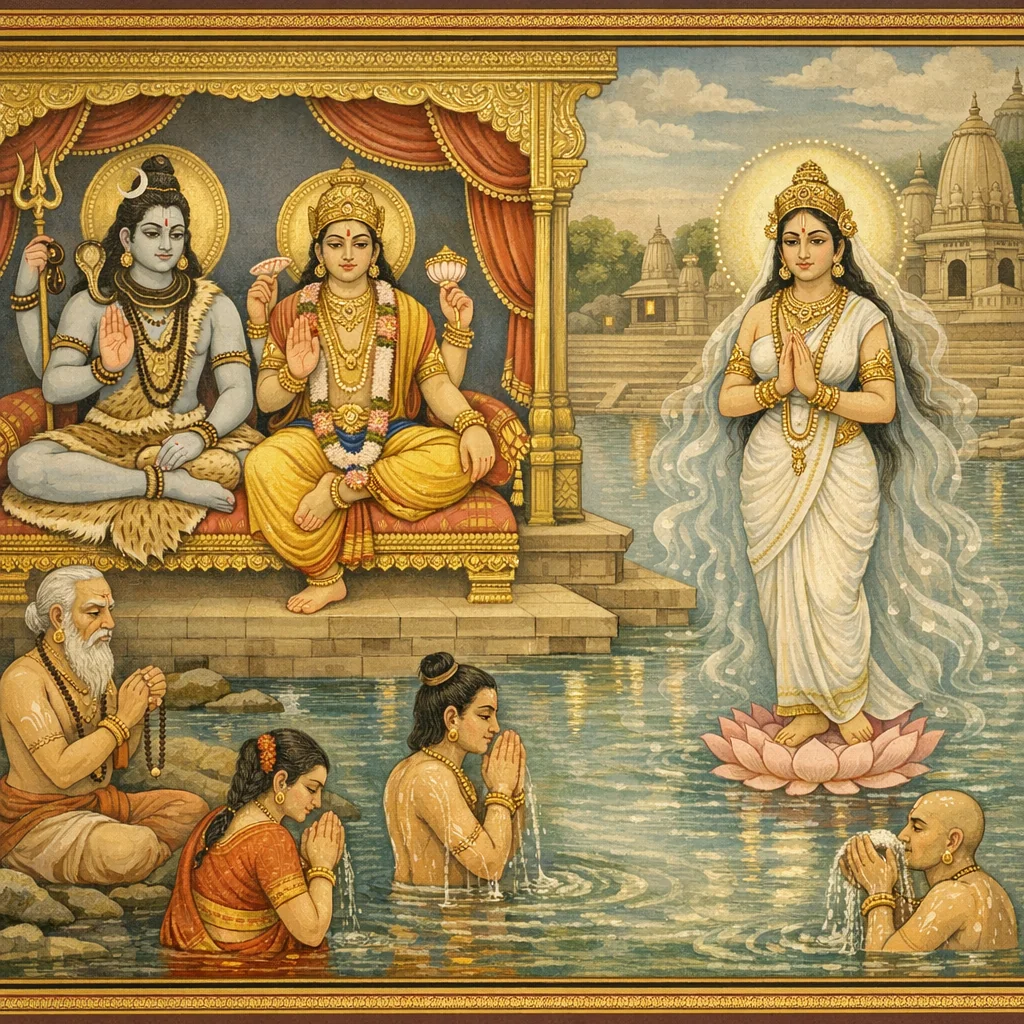
Chapter 27 opens with Skanda declaring that he will explain why Kāśī/Vārāṇasī is renowned and how its nature as an “ānanda-kānana” (forest of bliss) is to be understood through teachings ascribed to Devadeva. Īśvara then speaks to Viṣṇu and recounts the Bhāgīratha frame: the ancestral calamity in which Sagara’s sons were burned by the wrath-fire of Kapila, and the king’s resolve to undertake tapas to propitiate and bring down the holy Gaṅgā. The discourse turns from narrative to metaphysics: Gaṅgā is praised as the supreme watery form, identified with Śiva, upholding multiple cosmic orders and serving as the subtle repository of tīrthas, dharmas, and sacrificial powers. In the Kali age she is proclaimed the foremost salvific refuge, surpassing other rites; darśana, sparśa, snāna, japa of the name “Gaṅgā,” and dwelling on her bank are repeatedly taught as purifying. The chapter elaborates phalaśruti (merit and its fruits): equivalences to great sacrifices, liberation promised for liṅga-worship by Gaṅgā’s side, benefits to ancestors through offerings in Gaṅgā waters, and assurances even for those who die while journeying to her. It also warns against irreverence, skepticism, and obstructing pilgrims, and concludes with extended enumerations of merit, mantric and ritual notes, and hymnic salutations to Gaṅgā’s protective and remedial powers.
Shlokas
Verse 1
स्कंद उवाच । वाराणसीति प्रथितं यथा चानंदकाननम् । तथा च कथयामीह देवदेवेनभाषितम्
Skanda said: I shall now relate, as it is renowned, why it is called Vārāṇasī and also Ānandakānana—according to what was spoken by the God of gods.
Verse 2
ईश्वर उवाच । निशामय महाबाहो विष्णो त्रैलोक्यसुंदर । प्राप्तं वाराणसीत्याख्यामविमुक्तं यथा तथा
Īśvara said: Listen, O mighty-armed Viṣṇu, beauty of the three worlds—how this place came to bear the name Vārāṇasī, and how it is also known as Avimukta.
Verse 3
निर्दग्धान्सागराञ्छ्रुत्वा कपिलक्रोधवह्निना । अश्वमेधाश्वसंयुक्तान्पूर्वजान्स्वान्भगीरथः
Hearing that his own forefathers—the Sāgaras, connected with the horse of the Aśvamedha—had been burned by the fire of Kapila’s wrath, Bhagīratha set his mind upon their deliverance.
Verse 4
सूर्यवंशे महातेजा राजा परमधार्मिकः । आरिराधयिषुर्गंगां तपसे कृतनिश्चयः
In the Solar dynasty, a radiant king, supremely righteous, resolved to undertake austerities, intent on propitiating Gaṅgā.
Verse 5
हिमवंतं नगश्रेष्ठममात्य न्यस्तराज्यधूः । जगाम यशसां राशिरुद्दिधीर्षुः पितामहान्
Entrusting the burden of the kingdom to his minister, that treasury of fame went to Himavān, foremost of mountains, seeking to uplift and deliver his forefathers.
Verse 6
ब्रह्मशापाग्निनिर्दग्धान्महादुर्गतिगानपि । विना त्रिमार्गगां विष्णो को जंतूंस्त्रिदिवं नयेत्
Even beings scorched by the fire of Brahmā’s curse, though fallen into dreadful destinies—without the Tri-path River, Gaṅgā, O Viṣṇu, who could lead such creatures to heaven?
Verse 7
ममैव सा परामूर्तिस्तोयरूपा शिवात्मिका । ब्रह्मांडानामनेकानामाधारः प्रकृतिः परा
That Gaṅgā is truly My own supreme manifestation—formed as water and of Śiva’s very essence. She is the transcendent Prakṛti, the sustaining support of countless cosmic spheres (brahmāṇḍas).
Verse 8
शुद्धविद्यास्वरूपा च त्रिशक्तिः करुणात्मिका । आनंदामृतरूपा च शुद्धधर्मस्वरूपिणी
She is the very form of pure knowledge; she is the threefold Power, compassion itself. She is nectar wrought of bliss, and the embodied form of stainless dharma.
Verse 9
यामेतां जगतां धात्रीं धारयामि स्वलीलया । विश्वस्य रक्षणार्थाय परब्रह्मस्वरूपिणीम्
This very One—nurse and sustainer of the worlds—I uphold by My own divine play, for the protection of the universe: she whose nature is the Supreme Brahman.
Verse 10
त्रैलोक्ये यानि तीर्थानि पुण्यक्षेत्राणि यानि च । सर्वत्र सर्वे ये धर्माः सर्वयज्ञाः सदक्षिणाः
Whatever sacred ford-sites (tīrthas) exist in the three worlds, and whatever holy fields there are—indeed all dharmic merits everywhere, and all sacrifices (yajñas) complete with proper gifts (dakṣiṇā)—
Verse 11
तपांसि विष्णो सर्वाणि श्रुतिः सांगा चतुर्विधा । अहं च त्वं च कश्चापि देवतानां गणाश्च ये
All austerities, O Viṣṇu; the fourfold Veda together with its auxiliaries; I and you, and whoever else; and all the hosts of the gods—
Verse 12
पुरुषार्थाश्च सर्वे वै शक्तयो विविधाश्च याः । गंगायां सर्व एवैते सूक्ष्मरूपेण संस्थिताः
All the aims of human life indeed, and the many kinds of spiritual powers—every one of these abides within the Gaṅgā, established there in subtle form.
Verse 13
स स्नातः सर्वतीर्थेषु सर्वक्रतुषु दीक्षितः । चीर्णसर्वव्रतः सोपि यस्तु गंगां निषेवते
He has bathed at all pilgrimage-sites; he has been initiated for all sacrifices; he has observed every vow—so too is the one who devotedly resorts to the Gaṅgā.
Verse 14
तपांसि तेन तप्तानि सर्वदानप्रदः स च । स प्राप्त योगनियमो यस्तु गंगां निषेवते
By him austerities are as though fully performed; he becomes a giver of every charity. He attains the disciplines of yoga—whoever devotedly resorts to the Gaṅgā.
Verse 15
सर्ववर्णाश्रमेभ्यश्च वेदविद्भ्यश्च वै तथा । शास्त्रार्थपारगेभ्यश्च गंगास्नायी विशिष्यते
The bather in the Gaṅgā is deemed pre-eminent—even above those of all castes and stages of life, above the knowers of the Veda, and above those who have mastered the meanings of the śāstras.
Verse 16
मनोवाक्कायजैर्दोषैर्दुष्टो बहुविधैरपि । वीक्ष्य गंगां भवेत्पूतः पुरुषो नात्र संशयः
Even one defiled by many faults born of mind, speech, and body is purified merely by beholding the sacred Gaṅgā—of this there is no doubt.
Verse 17
कृते सर्वत्र तीर्थानि त्रेतायां पुष्करं परम् । द्वापरे तु कुरुक्षेत्रं कलौ गंगैव केवलम्
In the Kṛta age, tīrthas are found everywhere; in Tretā, Puṣkara is supreme; in Dvāpara, Kurukṣetra is foremost; but in Kali-yuga, Gaṅgā alone is the sole refuge, the pre-eminent tīrtha.
Verse 18
पूर्वजन्मांतराभ्यास वासनावशतो हरे । गंगातीरे निवासः स्यान्मदनुग्रहतः परात्
O Hari, by the force of impressions and tendencies formed through practice across former births, and by my supreme grace, one gains residence upon the bank of the Gaṅgā.
Verse 19
ध्यानं कृते मोक्षहेतुस्त्रेतायां तच्च वै तपः । द्वापरे तद्द्वयं यज्ञाः कलौ गंगैव केवलम्
In the Kṛta age, meditation is the cause of liberation; in Tretā, the same goal is attained through tapas (austerity); in Dvāpara, through both together as yajña (sacrifice); but in Kali-yuga, Gaṅgā alone is the sole means.
Verse 20
यो देहपतनाद्यावद्गंगातीरं न मुंचति । स हि वेदांतविद्योगी ब्रह्मचर्यव्रती सदा
Whoever does not abandon the bank of the Gaṅgā until the body falls—he is truly a knower of Vedānta, a yogin, and ever established in the vow of brahmacarya.
Verse 21
कलौ कलुषचित्तानां परद्रव्यरतात्मनाम् । विधिहीनक्रियाणां च गतिर्गंगा विना नहि
In Kali-yuga, for those whose minds are defiled, whose hearts delight in others’ wealth, and whose deeds lack rightful ordinance—there is no true refuge, no saving course, without the holy Gaṅgā.
Verse 22
अलक्ष्मीः कालकर्णी च दुःस्वप्नो दुर्विचिंतितम् । गंगागंगेति जपनात्तानि नोपविशंति हि
Misfortune, Kālakarṇī, evil dreams, and harmful anxieties—by chanting “Gaṅgā, Gaṅgā,” these never take hold at all.
Verse 23
गंगा हि सर्वभूतानामिहामुत्र फलप्रदा । भावानुरूपतो विष्णो सदा सर्वजगद्धिता
Truly, Gaṅgā bestows fruits upon all beings—here and hereafter. O Viṣṇu, according to one’s inner disposition she grants the fitting results, ever laboring for the welfare of the whole world.
Verse 24
यज्ञ दान तपो योग जपाः सनियमा यमाः । गंगासेवासहस्रांशं न लभंते कलौ हरे
Sacrifice (yajña), charity, austerity, yoga, japa, observances and restraints—O Hari, in Kali-yuga they do not gain even a thousandth part of the merit that arises from service to Gaṅgā.
Verse 25
किमष्टांगेन योगेन किं तपोभिः किमध्वरैः । वास एव हि गंगायां ब्रह्मज्ञानस्य कारणम्
What need is there of eight-limbed yoga, what of austerities, what of elaborate sacrifices? Mere dwelling by Gaṅgā itself is a cause of Brahman-knowledge (Brahma-jñāna).
Verse 26
अपि दूरस्थितस्यापि गंगामाहात्म्यवेदिनः । अयोग्यस्यापि गोविंदभक्त्या गंगा प्रसीदति
Even for one who is far away, if he knows Gaṅgā’s greatness—indeed, even if he is unfit—Gaṅgā becomes gracious through devotion to Govinda.
Verse 27
श्रद्धा धर्मः परः सूक्ष्मः श्रद्धा ज्ञानं परं तपः । श्रद्धा स्वर्गश्च मोक्षश्च श्रद्धया सा प्रसीदति
Faith (śraddhā) itself is the supreme and subtle Dharma; faith is the highest knowledge and the highest austerity. Faith becomes heaven and liberation as well—through faith, that sacred power is pleased and grants its grace.
Verse 28
अज्ञानरागलोभाद्यैः पुंसां संमूढचेतसाम् । श्रद्धा न जायते धर्मे गंगायां च विशेषतः
In people whose minds are deluded by ignorance, attachment, greed, and the like, faith does not arise—neither in Dharma nor, especially, toward Gaṅgā.
Verse 29
बहिः स्थितं जलंयद्वन्नारिकेलांतरे स्थितम् । तथा ब्रह्मांडबाह्यस्थं परब्रह्मांबु जाह्नवी
Just as water seems to be outside yet is contained within the coconut, so too the Jāhnavī (Gaṅgā) is the water of the Supreme Brahman—abiding beyond the cosmos and yet present here.
Verse 30
गंगालाभात्परो लाभः क्वचिदन्यो न विद्यते । तस्माद्गंगामुपासीत गंगैव परमः पुमान्
No gain anywhere surpasses the gain of attaining Gaṅgā. Therefore one should worship Gaṅgā—Gaṅgā herself is the Supreme Person, the highest divine refuge.
Verse 31
शक्तस्य पंडितस्यापि गुणिनो दानशीलिनः । गंगास्नानविहीनस्य हरे जन्म निरर्थकम्
O Hari, even for one who is capable, learned, virtuous, and devoted to charity—if he is without bathing in the sacred Gaṅgā, his human birth becomes fruitless.
Verse 32
वृथा कुल वृथा विद्या वृथा यज्ञा वृथातपः । वृथा दानानि तस्येह कलौ गंगां न यो भजेत्
Fruitless are lineage, learning, sacrifices, and austerities; fruitless too are charities in this Kali-yuga for the one who does not worship Gaṅgā.
Verse 33
गुणवत्पात्रपूजायां न स्याद्वै तादृशं फलम् । यथा गंगाजलस्नान पूजने विधिना फलम्
Even the worship of a worthy recipient does not yield such a result as the fruit that arises—when done according to rule—from bathing in Gaṅgā’s water and worshipping with it.
Verse 34
ममतेजोग्निगर्भेयं ममवीर्यातिसंवृता । दाहिका सर्वदोषाणां सर्वपापविनाशिनी
This (Gaṅgā) is born of my fiery splendor, filled with my supreme power; she burns up all faults and destroys all sins.
Verse 35
स्मरणादेव गंगायाः पापसंघातपंजरम् । शतधा भेदमायाति गिरिर्वज्रहतो यथा
By merely remembering Gaṅgā, the cage-like mass of sins is shattered into a hundred pieces—like a mountain struck by a thunderbolt.
Verse 36
गंगां गच्छति यस्त्वेको यस्तु भक्त्यानुमोदयेत् । तयोस्तुल्यफलं प्राहुर्भक्तिरेवात्र कारणम्
If one person goes to the sacred Gaṅgā, and another, unable to go, rejoices and approves with devotion, they are said to gain equal fruit—for here devotion (bhakti) alone is the true cause.
Verse 37
गच्छंस्तिष्ठञ्जपन्ध्यान्भुंजञ्जाग्रत्स्वपन्वदन् । यः स्मरेत्सततं गंगां स हि मुच्येत बंधनात्
Whether walking or standing, reciting or meditating, eating, waking, sleeping, or speaking—whoever remembers the Gaṅgā constantly is indeed released from bondage.
Verse 38
पितॄनुद्दिश्य योभक्त्या पायसं मधुसंयुतम् । गुडसर्पिस्तिलैःसार्धं गंगांभसि विनिक्षिपेत्
With devotion, one who, intending it for the Pitṛs (ancestors), offers into the waters of the Gaṅgā pāyasa (rice-pudding) mixed with honey—together with jaggery, ghee, and sesame—performs a powerful ancestral offering.
Verse 39
तृप्ता भवंति पितरस्तस्य वर्षशतं हरे । यच्छंति विविधान्कामान्परितुष्टाः पितामहाः
O Hari, for a hundred years his ancestors remain satisfied; and the forefathers, well-pleased, grant him various desired blessings.
Verse 40
लिंगे संपूजिते सर्वमर्चितं स्याज्जगद्यथा । गंगास्नानेन लभते सर्वतीर्थफलं तथा
Just as, when the Liṅga is perfectly worshipped, it is as though the whole world has been worshipped—so too, by bathing in the Gaṅgā one obtains the fruit of all sacred tīrthas and pilgrimages.
Verse 41
गंगायां तु नरः स्नात्वा यो लिंगं नित्यमर्चति । एकेन जन्मना मुक्तिं परां प्राप्नोति स ध्रुवम्
But the man who bathes in the sacred Gaṅgā and then worships the Liṅga daily—within a single lifetime he surely attains the highest liberation (mokṣa).
Verse 42
अग्निहोत्रं च यज्ञाश्च व्रतदानतपांसि च । गंगायां लिंगपूजायाः कोट्यंशेनापि नो समाः
Agnihotra, sacrifices (yajñas), vows, gifts, and austerities—none of these equals even a millionth part of worshipping the Liṅga in the Gaṅgā.
Verse 43
गंगां गंतुं विनिश्चित्य कृत्वा श्राद्धादिकं गृहे । स्थितस्य सम्यक्संकल्पात्तस्य नंदंति पूर्वजाः
Having firmly resolved to go to the Gaṅgā, and having performed śrāddha and related rites at home—by that person’s well-formed intention (saṅkalpa) alone, the ancestors rejoice.
Verse 44
पापानि च रुदंत्याशु हा क्व यास्याम इत्यलम् । लोभमोहादिभिः सार्धं मंत्रयंति पुनःपुनः
And sins quickly begin to wail, “Alas—where shall we go now?”; together with greed, delusion, and the rest, they scheme again and again.
Verse 45
यथा न गंगां यात्येष तथा विघ्नं प्रकुर्महे । गंगां गतो यथा चैष न उच्छित्तिं विधास्यति
“Let us create obstacles so that he does not go to the Gaṅgā; and even if he reaches the Gaṅgā, let him not bring about our total destruction”—thus they plan.
Verse 46
गृहाद्गंगावगाहार्थं गच्छतस्तु पदेपदे । निराशानि व्रजंत्येव पापान्यस्य शरीरतः
As he sets out from home to immerse himself in the sacred Gaṅgā, at every step his sins depart from his body, hopeless of remaining.
Verse 47
पूर्वजन्मकृतैः पुण्यैस्त्यक्त्वा लोभादिकं हरे । व्युदस्य सर्वविघ्नौघान्गंगां प्राप्नोति पुण्यवान्
By merits earned in former births, the virtuous abandon greed and the like, cast away floods of obstacles, and attain the Gaṅgā.
Verse 48
अनुषंगेण मौल्येन वाणिज्येनापि सेवया । कामासक्तोपि वा मर्त्यो गंगास्नातो दिवं व्रजेत्
Even if a mortal is attached to desires, if he bathes in the Gaṅgā—by incidental contact, by payment, through trade, or by service—he may go to heaven.
Verse 49
अनिच्छयापि संस्पृष्टो दहनो हि यथा दहेत् । अनिच्छयापि संस्नाता गंगा पापं तथा दहेत्
Just as fire burns even when touched unintentionally, so too the Gaṅgā: even when one bathes without intent, she burns away sin.
Verse 50
तावद्धमति संसारे यावद्गंगां न सेवते । संसेव्य गंगां नो जंतुर्भवक्लेशं प्रपश्यति
So long as one does not serve and revere the Gaṅgā, one toils in saṃsāra; but having served the Gaṅgā, a being no longer beholds the affliction of worldly becoming.
Verse 51
यो गंगांभसि निस्नातो भक्त्या संत्यक्तसंशयः । मनुष्यचर्मणा नद्धः स देवो नात्र संशयः
Whoever bathes in the sacred waters of the Gaṅgā with devotion, having cast off doubt—though clothed in human skin—truly is a god; of this there is no doubt.
Verse 52
गंगास्नानार्थमुद्युक्तो मध्येमार्गं मृतो यदि । गंगास्नानफलं सोपि तदाप्नोति न संशयः
If one sets out intending to bathe in the Gaṅgā and dies midway on the journey, even he attains the fruit of Gaṅgā-bathing—there is no doubt.
Verse 53
माहात्म्यं ये च गंगायाः शृण्वंति च पठंति च । तेप्यशेषैर्महापापैर्मुच्यंते नात्र संशयः
Those who hear and those who recite the greatness of the Gaṅgā are freed even from all great sins—of this there is no doubt.
Verse 54
दुर्बुद्धयो दुराचारा हैतुका बहुसंशयाः । पश्यंति मोहिता विष्णो गंगामन्य नदीमिव
O Viṣṇu, those of poor understanding, bad conduct, argumentative temper, and many doubts—deluded—see the Gaṅgā as though she were just another river.
Verse 55
जन्मांतरकृतैर्दानैस्तपोभिर्नियमैर्व्रतैः । इह जन्मनि गंगायां नृणां भक्तिः प्रजायते
Through gifts, austerities, disciplines, and vows performed in other births, devotion to the Gaṅgā arises for people in this present life.
Verse 56
गंगाभक्तिमतामर्थे महेंद्रादि पुरेषु च । हर्म्याणि रम्यभोगानि निर्मितानि स्वयंभुवा
For the sake of those devoted to the Gaṅgā, in the cities of Mahendra and the other gods, Svayambhū (Brahmā) himself has fashioned splendid mansions and delightful enjoyments.
Verse 57
सिद्धयः सिद्धिलिंगानि स्पर्शलिंगान्यनेकशः । प्रासादा रत्नरचिताश्चिंतामणिगणा अपि
Here are many siddhis, many Liṅgas that grant success, and countless ‘touch-Liṅgas’ whose contact bestows merit. There are also palaces wrought of jewels, and even multitudes of wish-fulfilling gems, the cintāmaṇis.
Verse 58
गंगाजलांतस्तिष्ठंति कलिकल्मषभीतितः । अतएव हि संसेव्या कलौ गंगेष्टसिद्धिदा
Out of fear of the sins of the Kali age, the holy powers abide within the waters of the Gaṅgā. Therefore, in Kali-yuga the Gaṅgā should indeed be diligently served, for she grants the desired attainments.
Verse 59
सूर्योदये तमांसीव वज्रपातभयान्नगाः । तार्क्ष्येक्षणाद्यथासर्पा मेघा वाताहता इव
As darkness vanishes at sunrise; as mountains tremble in fear of a thunderbolt; as serpents flee at the glance of Tārkṣya (Garuḍa); and as clouds are scattered by the wind—
Verse 60
तत्त्वज्ञानाद्यथा मोहः सिंहं दृष्ट्वा यथा मृगाः । तथा सर्वाणि पापानि यांति गंगेक्षणात्क्षयम्
Just as delusion perishes through knowledge of reality, and just as deer scatter upon seeing a lion, so all sins go to destruction merely by beholding the Gaṅgā.
Verse 61
दिव्यौषधैर्यथा रोगा लोभेन च यथा गुणाः । यथा ग्रीष्मोष्मसंपत्तिरगाधह्रद मज्जनात्
Just as diseases are cured by divine medicines, and just as virtues are ruined by greed; and just as the oppressive heat of summer is relieved by immersing in a deep lake—
Verse 62
तूलशैलः स्फुलिंगेन यथा नश्यति तत्क्षणात् । तथा दोषाः प्रणश्यंति गंगांभः स्पर्शनाद्ध्रुवम्
As a mountain of cotton is instantly consumed by a mere spark, so do faults and impurities surely perish through the touch of Gaṅgā’s water.
Verse 63
क्रोधेन च तपो यद्वत्कामेन च यथा मतिः । अनयेन यथा लक्ष्मीर्विद्या मानेन वै यथा
Just as austerity is spoiled by anger; just as understanding is spoiled by desire; just as prosperity is ruined by injustice; and just as learning is ruined by pride—
Verse 64
दंभ कौटिल्य मायाभिर्यथाधर्मो विनश्यति । तथा नश्यंति पापानि गंगाया दर्शनेन तु
Just as dharma is destroyed by hypocrisy, crookedness, and deceit—so sins are destroyed, indeed, by the very sight of the Gaṅgā.
Verse 65
मानुष्यं दुर्लभं प्राप्य विद्युत्संपातचंचलम् । गंगां यः सेवते सोत्र बुद्धेः पारं परं गतः
Having attained this human birth—so rare, and as fleeting as a flash of lightning—whoever serves the Gaṅgā here has crossed beyond the far shore of ordinary understanding.
Verse 66
विधूतपापा ये मर्त्याः परं ज्योतिःस्वरूपिणीम् । सहस्रसूर्यप्रतिमां गंगां पश्यंति ते भुवि
Those mortals whose sins have been shaken off—on earth they behold the Gaṅgā, whose very nature is supreme light, radiant like a thousand suns.
Verse 67
साधारणांभसा पूर्णां साधारण नदीमिव । पश्यंति नास्तिका गंगां पापोपहतलोचनाः
Blinded by sin, the unbelievers behold the Gaṅgā as though she were merely an ordinary river filled with common water.
Verse 68
संसारमोचकश्चाहं जनानामनुकंपया । गंगातरंगरूपेण सोपानं निर्ममे दिवः
Out of compassion for beings, I became the liberator from saṃsāra, fashioning the waves of the Gaṅgā as a staircase leading up to heaven.
Verse 69
सर्व एव शुभः कालः सर्वो देशस्तथा शुभः । सर्वो जनो दानपात्रं श्रीमती जाह्नवी तटे
On the auspicious bank of the glorious Jāhnavī (Gaṅgā), every time is sacred, every place is sacred, and every person becomes a worthy recipient for charity.
Verse 70
यथाश्वमेधो यज्ञानां नगानां हिमवान्यथा । व्रतानां च यथा सत्यं दानानामभयं यथा
Just as the Aśvamedha is foremost among sacrifices, and Himavān among mountains; just as truth is foremost among vows, and fearlessness among gifts—so too the praised tīrtha is pre-eminent.
Verse 71
प्राणायामश्च तपसां मंत्राणां प्रणवो यथा । धर्माणामप्यहिंसा च काम्यानां श्रीर्यथा वरा
Just as prāṇāyāma is foremost among austerities, and Praṇava (Oṃ) among mantras; just as non-violence (ahiṃsā) is supreme among dharmas, and Śrī the best among desired boons—so too does the praised tīrtha excel.
Verse 72
यथात्मविद्या विद्यानां स्त्रीणां गौरी यथोत्तमा । सर्वर्दवेगणानां च यथा त्वं पुरुषोत्तम
Just as self-knowledge (ātma-vidyā) is highest among knowledges, and Gaurī is foremost among women; and just as You, O Puruṣottama, are supreme among all divine hosts—so too is the praised sacred reality pre-eminent.
Verse 73
सर्वषामेव पात्राणां शिवभक्तो यथा वरः । तथा सर्वेषु तीर्थेषु गंगातीर्थं विशिष्यते
Just as a devotee of Śiva is the finest among all worthy recipients, so among all sacred fords (tīrthas) the Gaṅgā-tīrtha is distinguished as supreme.
Verse 74
हरेयश्चावयोर्भेदं न करोति महामतिः । शिवभक्तः स विज्ञेयो महापाशुपतश्च सः
The truly great-souled one makes no difference between Hari and us; know that person to be a devotee of Śiva—indeed, a great Pāśupata.
Verse 75
पापपांसुमहावात्या पापद्रुमकुठारिका । पापेंधनदवाग्निश्च गंगेयं पुण्यवाहिनी
This Gaṅgā, the bearer of merit, is a mighty whirlwind scattering the dust of sin; an axe felling the trees of sin; and a forest-fire consuming the fuel of sin.
Verse 76
नानारूपाश्च पितरो गाथा गायंति सर्वदा । अपि कश्चित्कुलेस्माकं गंगास्नायी भविष्यति
The Pitṛs, assuming many forms, ever sing this refrain: “Will there be, at least, someone in our lineage who will bathe in the sacred Gaṅgā?”
Verse 77
देवर्षीन्परिसंतर्प्य दीनानाथांश्च दुःखितान् । श्रद्धया विधिना स्नात्वा दास्यते सलिलांजलिम्
Having duly satisfied the devarṣis, and also the poor, the helpless, and the afflicted, one should bathe with faith according to proper rite, and then offer the salilāñjali—an añjali of sacred water.
Verse 78
अपि नः स कुले भूयाच्छिवे विष्णौ च साम्यदृक् । तदालयकरो भक्त्या तस्य संमार्जनादिकृत्
May such a one be born in our lineage—one who regards Śiva and Viṣṇu with equal reverence, who in devotion builds their shrine, and who performs services such as cleaning and upkeep for it.
Verse 79
अकामो वा सकामो वा तिर्यग्योनिगतोपि वा । गंगायां यो मृतो मर्त्यो नरकं स न पश्यति
Whether desireless or desire-driven—even if one has fallen into an animal birth—any mortal who dies in the Gaṅgā does not behold hell.
Verse 80
तीर्थमन्यत्प्रशंसंति गंगातीरे स्थिताश्च ये । गंगां न बहु मन्यंते ते स्युर्निरयगामिनः
Those who, while dwelling on the bank of the Gaṅgā, praise other tīrthas and do not hold the Gaṅgā in high esteem—such people become destined for hell.
Verse 81
मां च त्वां चैव यो द्वेष्टि गंगां च पुरुषाधमः । स्वकीयैः पुरुषैः सार्धं स घोरं नरकं व्रजेत्
That lowest of men who hates me, and you as well, and also the sacred Gaṅgā—he, together with his own people, would go to a dreadful hell.
Verse 82
षष्टिर्गणसहस्राणि गंगां रक्षंति सर्वदा । अभक्तानां च पापानां वासे विघ्नं प्रकुर्वते
Sixty thousand hosts of gaṇas always protect the Gaṅgā, and they create obstacles to the dwelling there of the sinful and the faithless.
Verse 83
कामक्रोधमहामोहलोभादि निशितैः शरैः । घ्नंति तेषां मनस्तत्र स्थितिं चापनयंति च
With sharp arrows such as desire, anger, great delusion, greed, and the like, they strike down the minds of such people and also drive away their capacity to remain settled there.
Verse 84
गंगां समाश्रयेद्यस्तु स मुनिः स च पंडितः । कृतकृत्यः स विज्ञेयः पुरुषार्थचतुष्टये
But the one who takes refuge in the Gaṅgā—he is a sage, he is a learned man; he should be known as one who has fulfilled life’s aims with respect to the four puruṣārthas.
Verse 85
गंगायां च सकृत्स्नातो हयमेधफलं लभेत् । तर्पयंश्च पितॄंस्तत्र तारयेन्नरकार्णवात्
Even by bathing once in the Gaṅgā one attains the fruit of an Aśvamedha sacrifice; and by offering tarpaṇa to the ancestors there, one delivers them from the ocean of hell.
Verse 86
नैरंतर्येण गंगायां मासं यः स्नाति पुण्यवान् । शक्रलोके स वसति यावच्छक्रः सपूर्वजः
That meritorious one who bathes in the Gaṅgā without interruption for a month dwells in Śakra’s world, together with his forefathers, for as long as Śakra himself remains there.
Verse 87
अब्दं यः स्नाति गंगायां नैरंतर्येण पुण्यभाक् । विष्णोर्लोकं समासाद्य स सुखं संवसेन्नरः
Whoever bathes in the Gaṅgā continuously for a full year becomes a sharer in great merit; attaining Viṣṇu’s world, that person dwells there in happiness.
Verse 88
गंगायां स्नाति यो मर्त्यो यावज्जीवं दिनेदिने । जीवन्मुक्तः स विज्ञेयो देहांते मुक्त एव सः
That mortal who bathes in the Gaṅgā day after day for as long as life lasts is to be known as liberated while living; and at the end of the body, they are indeed liberated.
Verse 89
तिथिनक्षत्रपर्वादि नापेक्ष्यं जाह्नवी जले । स्नानमात्रेण गंगायां संचिताघं विनश्यति
In the waters of the Jāhnavī (Gaṅgā), there is no need to wait for lunar days, stars, festivals, and the like; by bathing in the Gaṅgā alone, accumulated sin is destroyed.
Verse 90
पंडितोपि स मूर्खः स्याच्छक्तियुक्तोप्यशक्तिकः । यस्तु भागीरथीतीरं सुखसेव्यं न संश्रयेत्
Even if learned, one becomes as though foolish; even if endowed with power, one becomes as though powerless—if one does not take refuge on the easily approachable bank of the Bhāgīrathī (Gaṅgā).
Verse 91
किंवायुपाप्यरोगेण विकासिन्याथ किं श्रिया । किं वा बुद्ध्या विमलया यदि गंगां न सेवते
What worth is health untouched by disease, or vitality in full bloom? What worth is prosperity, or even a pure and lucid intellect, if one does not serve the sacred Gaṅgā?
Verse 92
यः कारयेदायतनं गंगाप्रतिकृतेर्नरः । भुक्त्वा स भोगान्प्रेत्यापि याति गंगा सलोकताम्
Whoever has a shrine—an abode for an image or representation of the Gaṅgā—constructed, enjoys delights here; and even after death attains the same world as the Gaṅgā.
Verse 93
शृण्वंति महिमानं ये गंगाया नित्यमादरात् । गंगास्नानफलं तेषां वाचकप्रीणनाद्धनैः
Those who, with reverence, regularly listen to the greatness of the Gaṅgā obtain the fruit of bathing in the Gaṅgā—especially by pleasing the reciter with gifts of wealth.
Verse 94
पितॄनुद्दिश्य यो लिंगं स्नपयेद्गांग वारिणा । तृप्ताः स्युस्तस्य पितरो महानिरयगा अपि
Whoever, intending their ancestors, bathes the Śiva-liṅga with Gaṅgā water—his forefathers become satisfied, even if they have gone to a great hell.
Verse 95
अष्टकृत्वो मंत्रजप्तैर्वस्त्रपूतैः सुगंधिभिः । प्रोचुर्गांगजलैः स्नानं घृतस्नानाधिकं बुधाः
The wise have declared that bathing with Gaṅgā water—taken eight times, sanctified by mantra-recitation, filtered through cloth, and made fragrant—is superior even to a bath in ghee.
Verse 96
अष्टद्रव्यविमिश्रेण गंगातोयेन यः सकृत् । मागधप्रस्थमात्रेण ताम्रपात्रस्थितेन च
Whoever, even once, uses or bathes with Gaṅgā water mixed with eight sacred substances—measured as one Māgadha-prastha and kept in a copper vessel—attains great merit.
Verse 97
भानवेऽर्घं प्रदद्याच्च स्वकीय पितृभिः सह । सोतितेजो विमानेन सूर्यलोके महीयते
One should offer arghya to the Sun, together with one’s own forefathers. Such a devotee is honored in Sūrya’s world, conveyed there by a radiant, blazing celestial vimāna.
Verse 98
आपः क्षीरं कुशाग्राणि घृतं मधुगवांदधि । रक्तानि करवीराणि रक्तचंदनमित्यपि
Water, milk, the tips of kuśa grass, ghee, honey, cow’s curd, red karavīra (oleander) blossoms, and red sandalwood—these too are prescribed as sacred materials.
Verse 99
अष्टांगार्घो यमुद्दिष्टस्त्वतीव रवितोषणः । गांगैर्वार्भिः कोटिगुणो ज्ञेयो विष्णोऽन्यवारितः
This eightfold arghya, as taught, is exceedingly pleasing to Ravi, the Sun. When offered with Gaṅgā water, know it to yield merit a hundred million times greater—so Viṣṇu declares, without contradiction.
Verse 100
गंगातीरे स्वशक्त्या यः कुर्याद्देवालयं सुधीः । अन्यतीर्थप्रतिष्ठातो भवेत्कोटिगुणं फलं
A wise person who, according to his means, builds a temple on the bank of the Gaṅgā gains a fruit a hundred million times greater than establishing it at any other pilgrimage place.
Verse 110
गोभूहिरण्यदानेन भक्त्या गंगातटे शुभे । नरो न जायते भूयः संसारे दुःखकंटके
By devotedly giving cows, land, and gold on the auspicious bank of the Gaṅgā, a person is not born again into this world—this thicket of sorrow and thorns.
Verse 120
तद्भूमित्रसरेणूनां संख्यया युगमानया । महेंद्र चंद्रलोकेषु भुक्त्वा भोगान्मनःप्रियान्
For a span of ages measured by the number of dust-particles from that sacred ground, one enjoys mind-delighting pleasures in the realms of Mahendra (Indra) and of the Moon.
Verse 130
चंद्रसूर्यग्रहे लक्षं व्यतीपातेत्वनंतकम् । अयुतं विषुवे चैव नियुतं त्वयनद्वये
On lunar or solar eclipses the merit is a hundred-thousandfold; on Vyatīpāta it is endless. On the equinox it is ten-thousandfold, and on the two solstices it is a millionfold.
Verse 140
स्वाहांतः प्रणावादिश्च भवेद्विंशाक्षरो मनुः । पूजादानं जपो होमो ऽनेनैव मनुना स्मृतः
Beginning with the praṇava (Oṁ) and ending with svāhā is the twenty-syllabled mantra. Worship, gifting, japa, and homa are all enjoined to be performed with this very mantra.
Verse 150
यथाशक्ति स्वर्णरूप्य ताम्रपृष्ठविनिर्मितान् । अभ्यर्च्य गंधकुसुमैर्गंगायां प्रक्षिपेद्व्रती
According to his means, the votary should have offerings made of gold, silver, or copper, worship them with fragrance and flowers, and then cast them into the Gaṅgā.
Verse 160
संसारविषनाशिन्यै जीवनायै नमोस्तु ते । तापत्रितय संहंत्र्यै प्राणेश्यै ते नमोनमः
Obeisance to You, O Life-giving One, destroyer of the poison of saṃsāra. Repeated salutations to You, O mistress of the life-breath, who annihilates the threefold afflictions.
Verse 170
प्रणतार्ति प्रभंजिन्यै जगन्मात्रे नमोस्तुते । सर्वापत्प्रतिपक्षायै मंगलायै नमोनमः
Salutations to You, the Mother of the world, who shatters the distress of those who bow to You. Homage again and again to the Auspicious One who stands opposed to every calamity.
Verse 180
तस्यां दशम्यामेतच्च स्तोत्रं गंगाजले स्थितः । यः पठेद्दशकृत्वस्तु दरिद्रो वापि चाक्षमः
On that tenth lunar day, whoever—standing in the waters of the Gaṅgā—recites this hymn ten times, even if poor or otherwise incapable of elaborate rites, attains the stated merit.
Verse 205
ब्रह्मांडांतरसंस्थेषु भुंजन्भोगान्मनोरमान् । सर्वैः संपूजितो विष्णो यावदाभूतसंप्लवम्
Dwelling within the realms of the cosmic spheres, enjoying delightful pleasures, and honored by all—O Viṣṇu—this state endures until the dissolution of beings at the great cosmic deluge.