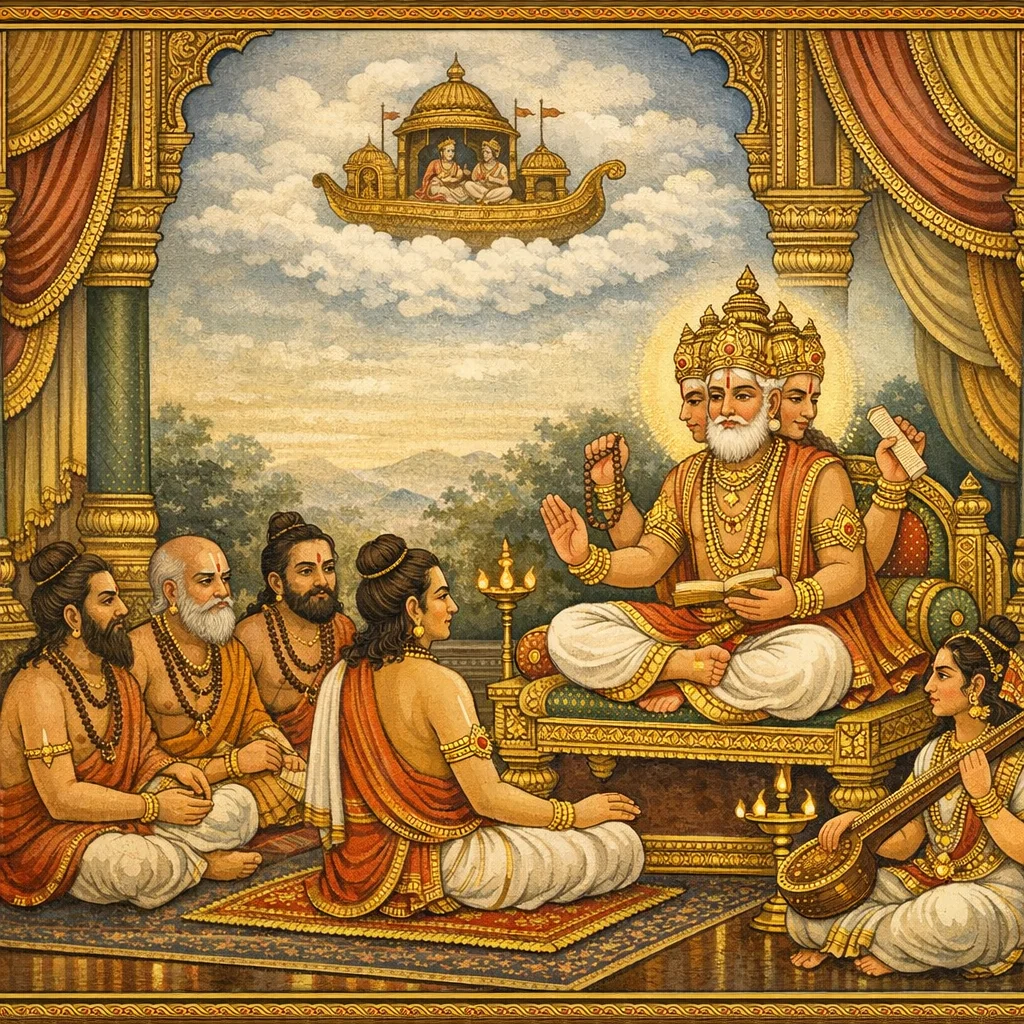
Adhyaya 22
Adhyāya 22 unfolds as a swift, guided journey: the brāhmaṇa Śivaśarmā is borne in a rapid vimāna by Śiva’s gaṇas through ever higher realms. They point out Maharloka as the abode of long-lived ascetics purified by tapas and sustained by remembrance of Viṣṇu; then Janaloka, linked with Brahmā’s mind-born sons (such as Sanandana) and steadfast brahmacārins. Tapoloka is portrayed through an extensive catalogue of austerities—enduring heat and cold, fasting, breath-restraint, and immobility—presenting tapas as a disciplined means of purification and inner steadiness. When Satyaloka comes into view, Brahmā receives the visitors and delivers a normative teaching: Bhārata is affirmed as karma-bhūmi, where one can conquer the senses and vices (lobha, kāma, krodha, ahaṃkāra, moha, pramāda) through dharma grounded in śruti–smṛti–purāṇa and exemplified by the virtuous. The chapter then turns to comparative sacred geography: heavens and even pātālas are praised for pleasures, yet Bhārata—and within it certain regions and tīrthas—are ranked higher for salvific power. Prayāga is exalted as tīrtharāja with strong purificatory merit, even through mere name-remembrance; but the climax declares that liberation is gained most directly at death in Kāśī/Avimukta under the sovereignty of Viśveśvara. Ethical gatekeeping is explicit: harmful conduct, exploitation, and disloyalty to Viśveśvara disqualify one for Kāśī-residence; Kāśī is depicted as beyond Yama’s jurisdiction, while Kālabhairava disciplines transgressors.
Shlokas
Verse 1
शिवशर्मोवाच । ध्रुवाख्यानमिदं रम्यं महापातकनाशनम् । महाश्चर्यकरं पुण्यं श्रुत्वा तृप्तोस्मि भो गणौ
Śivaśarman said: “This delightful account of Dhruva destroys great sins. It is holy and wondrous; having heard it, O assembly, I am satisfied.”
Verse 2
अगस्त्य उवाच । इत्थं यावद्द्विजो ब्रूते विमानं वायुवेगगम् । तावत्प्राप महर्लोकं स्वर्लोकात्परमाद्भुतम्
Agastya said: While the brāhmaṇa was speaking thus, that aerial chariot—swift as the wind—at once reached Maharloka, a realm even more wondrous than Svargaloka.
Verse 3
द्विजोऽथ लोकं संवीक्ष्य सर्वतो महसा वृतम् । तौ गणौ प्रत्युवाचेदं कोयं लोको मनोहरः
Then the brāhmaṇa, beholding that world enveloped on every side by radiance, addressed the two divine attendants: “What is this delightful realm?”
Verse 4
तावूचतुस्ततो विप्रं निशामय महामते । अयं स हि महर्लोकः स्वर्लोकात्परमाद्भुतः
Then those two said to the brāhmaṇa: “Listen, O wise one—this indeed is Maharloka, more wondrous even than Svargaloka.”
Verse 5
कल्पायुषो वसंत्यत्र तपसा धूतकल्मषाः । विष्णुस्मरण संक्षीण समस्तक्लेशसंचयाः
There dwell those whose lifespan endures for a kalpa—sins washed away by austerity, and the entire accumulation of afflictions exhausted through remembrance of Viṣṇu.
Verse 6
निर्व्याजप्रणिधानेन दृष्ट्वा तेजोमयं जगत् । महायोगसमायुक्ता वसंत्यत्र सुरोत्तमाः
Here dwell the most excellent among the gods, united with great yoga; through guileless absorption they behold the universe as made of pure radiance.
Verse 7
इत्थं कथां कथयतोर्भगवद्गणयोः प्रिये । क्षणार्धेन विमानं तज्जनलोकं निनायतान्
O beloved, as those two divine attendants of the Lord spoke thus, the aerial chariot bore them to Janaloka in but half a moment.
Verse 8
निवसंत्यमला यत्र मानसा बह्मणः सुताः । सनंदनाद्या योगींद्राः सर्वे ते ह्यूर्ध्वरेतसः
In that realm dwell the stainless mind-born sons of Brahmā—Sanandana and the rest—lords of yogins, all steadfast in perfect continence.
Verse 9
अन्ये तु योगिनो ये वै ह्यस्खलद्ब्रह्मचारिणः । सर्वद्वंद्वविनिर्मुक्तास्ते वसंत्यतिनिर्मलाः
Other yogins too dwell there, unfaltering in the vow of brahmacarya; freed from every pair of opposites, exceedingly pure.
Verse 10
जनलोकात्तपोलोकस्तेषां लोचनगोचरः । कृतस्तेन विमानेन मनोवेगेन गच्छता
From Janaloka, Tapoloka came within their very sight, as that chariot sped onward with the swiftness of thought.
Verse 11
वैराजा यत्र ते देवा वसेयुर्दाहवर्जिताः । वासुदेवे मनो येषां वासुदेवार्पितक्रियाः
There dwell the Vairāja gods, free from the burning of suffering—those whose minds rest in Vāsudeva, and whose every act is offered to Vāsudeva.
Verse 12
तपसा तोष्य गोविंदमभिलाषविवर्जिताः । तपोलोकमिमं प्राप्य वसंति विजितेंद्रियाः
Those who, free from selfish desire, please Govinda through austerity and who have conquered their senses—having attained this Tapoloka—dwell there.
Verse 13
शिलोंछ वृत्तया ये वै दंतोलूखलिकाश्च ये । अश्मकुट्टाश्च मुनयः शीर्णपर्णाशिनश्च ये
There are those who live by gleaning fallen grains, those who grind with their teeth as with a mortar, sages who pound with stones, and those who subsist on withered leaves.
Verse 14
ग्रीष्मे पंचाग्नितपसो वर्षासु स्थंडिलेशयाः । हेमंतशिशिरार्धे ये क्षपंति सलिले क्षपाः
In summer they perform the austerity of the five fires; in the rainy season they lie upon bare ground; and in the cold season’s half they pass their nights standing in water.
Verse 15
कुशाग्रनीरविप्रूषस्तृषिता यतयोऽपिबन् । वाताशिनोतिक्षुधिताः पादाग्रांगुष्ठ भूस्पृशः
Thirsty ascetics do not drink even the drops of water found on the tips of kuśa grass; though intensely hungry, they live on air alone; and they stand so that only the tips of their toes touch the ground.
Verse 16
ऊर्ध्वदोषो रविदृशस्त्वेकांघ्रि स्थाणु निश्चलाः । ये वै दिवा निरुच्छ्वासा मासोच्छ्वासाश्च ये पुनः
Some turn their impurities upward, gaze upon the Sun, and stand unmoving like a pillar on one foot; some restrain the breath throughout the day, and others breathe only once in a month.
Verse 17
मासोपवासव्रतिनश्चातुर्मास्य व्रताश्च ये । ऋत्वंततोयपाना ये षण्मासोपवासकाः
Some observe month-long fasts; some keep the Cāturmāsya vow; some drink water only at the end of each season; and some undertake fasts lasting six months.
Verse 18
ये च वर्षनिमेषा वै वर्षधारांबु तर्षकाः । ये च स्थाणूपमां प्राप्ता मृगकंडूति सौख्यदाः
Some keep their eyes open through the rains, thirsting amid the falling streams of water; and some have become like motionless pillars, finding their only ‘comfort’ in scratches like those of deer.
Verse 19
जटाटवी कोटरांतः कृतनीडांडजाश्च ये । प्ररूढवामलूरांगाः स्नायुनद्धास्थिसंचयाः
Some have matted locks like a forest with hollows within, where birds have built nests and laid eggs; their bodies are misshapen and wasted, mere frameworks of bones bound together by sinews.
Verse 20
लताप्रतानैः परितो वेष्टितावयवाश्च ये । सस्यानि च प्ररूढानि यदंगेषु चिरस्थिति
Some have their limbs wrapped all around by spreading creepers; and even grasses and plants have grown upon their bodies, from their long, unmoving stay.
Verse 21
इत्यादि सुतपः क्लिष्टवर्ष्माणो ये तपोधनाः । ब्रह्मायुषस्तपोलोके ते वसंत्यकुतोभयाः
Thus, and in many such ways, those ascetics—whose bodies are worn by noble austerities and who are rich in tapas—dwell in Tapoloka, long-lived as Brahmā and fearless from every quarter.
Verse 22
यावदित्थं स पुण्यात्मा शृणोति गणयोर्मुखात् । तावन्नेत्रातिथीभूतः सत्यलोको महोज्ज्वलः
As long as that virtuous man listened to the words spoken by the two Gaṇas, for that very duration the brilliantly radiant Satyaloka appeared before his eyes as a guest to his sight.
Verse 23
त्वरावंतौ गणौ तत्र विमानादवरुह्य तौ । स्रष्टारं सर्वलोकानां तेन सार्धं प्रणेमतुः
Then those two swift-moving Gaṇas descended there from the celestial chariot and, together with him, bowed to the Creator of all the worlds.
Verse 24
ब्रह्मोवाच । गणावसौ द्विजो धीमान्वेदवेदांगपारगः । स्मृत्युक्ताचारचंचुश्च प्रतीपः पापकर्मसु
Brahmā said: “This brāhmaṇa is wise, accomplished in the Vedas and their auxiliaries; he is diligent in conduct enjoined by the Smṛtis, and he is firmly opposed to sinful acts.”
Verse 25
अयि द्विज महाप्राज्ञ जाने त्वां शिवशर्मक । साधूकृतं त्वया वत्स सुतीर्थप्राणमोक्षणात्
“O brāhmaṇa of great wisdom, Śivaśarman—I know you. Dear child, you have done well, for you have relinquished your life at a holy ford (su-tīrtha).”
Verse 26
सत्वरं गत्वरं सर्वं यच्चैतद्भवतेक्षितम् । दैनंदिनप्रलयतः सृजामि च पुनः पुनः
All that you behold swiftly passes and perishes. From the daily dissolution I create it again and again.
Verse 27
आ वैराजं प्रतिपदमुपसंहरते हरः । का कथा मशकाभानां नृणां मरणधर्मिणाम्
Even up to Virāja, Hara withdraws all things step by step. What then can be said of men—frail as gnats—whose very nature is mortality?
Verse 28
चतुर्षु भूतग्रामेषु ह्येक एव गुणो नृणाम् । तस्मिन्वै भारते वर्षे कर्मभूमौ महीयसि
Among the four assemblies of beings, humans alone possess this distinguishing excellence—especially in Bhārata-varṣa, the great land that is the field of karma.
Verse 29
चपलानि विनिर्जित्येंद्रियाणि मनसा सह । विहाय वैरिणं लोभं विष्वग्गुणगणस्य च
Having conquered the restless senses along with the mind, and having cast away the enemy—greed, the source of countless worldly tendencies—
Verse 30
धर्मवंशहरं काममर्थसंचयहारिणम् । जरापलितकर्तारं विनिष्कृत्य विचारतः
—and having, through clear discernment, cast out desire which destroys dharma and family-line, which steals away hoarded wealth, and which brings on old age and grey hair—
Verse 31
जित्वा क्रोधरिपुं धैर्यात्तपसो यशसः श्रियः । शरीरस्यापि हर्तारं नेतारं तामसीं गतिम्
—having conquered, by steadfastness, the enemy anger—the thief of austerity (tapas), fame, and prosperity; the very destroyer of the body and the driver toward a tamasic (dark) destiny—
Verse 32
सदा मदं परित्यज्य प्रमादैकपदप्रदम् । प्रमादैकशरण्यं च संपदां विनिवर्तकम्
Always abandon pride and intoxication, for heedlessness is the sole doorway to downfall; it is the only refuge of ruin and the force that turns prosperity back into loss.
Verse 33
सर्वत्र लघुता हेतुमहंकारं विहाय च । दूषणारोपणे यत्नं कुर्वाणं सज्जनेष्वपि
Casting aside ego—the cause of pettiness everywhere—do not strive to impute faults, even among the virtuous.
Verse 34
हित्वा मोहं महाद्रोहरोपणं मतिघातिनम् । अत्यंतमंधीकरणमंधतामिस्रदर्शकम्
Abandon delusion, which plants great treachery, slays discernment, utterly dulls the intellect, and makes one see only the darkness of blind ignorance.
Verse 35
श्रुतिस्मृतिपुराणोक्तं परिक्षुण्णं महाजनैः । धर्मसोपानमारुह्य यदिहायांति हेलया
Even after climbing the stairway of dharma—taught in Śruti, Smṛti, and the Purāṇas and well-trodden by the great—some fall away here through mere negligence.
Verse 36
कर्मभूमिं समीहंते सर्वे स्वर्गौकसो द्विज । यत्तत्रार्जितभोक्तारः पदेषूच्चावचेष्वमी
O twice-born one, all the dwellers of heaven yearn for the land of action, for there beings earn their fruits and later enjoy them—whether in higher or lower states.
Verse 37
नार्यावर्तसुमो देशो न काशी सदृशी पुरी । न विश्वेश समं लिंगं क्वापि बह्मांडमंडले
No land is as excellent as Āryāvarta; no city equals Kāśī; and nowhere in the circuit of the universe is there a liṅga equal to Viśveśa.
Verse 38
संति स्वर्गा बहुविधाः सुखेतर विवर्जिता । सुकृतैकफलाः सर्वे युक्ताः सर्वसमृद्धिभिः
There are many kinds of heavens, free from any admixture of sorrow; all are the single fruit of merit and are endowed with every prosperity.
Verse 39
स्वर्लोकादधिकं रम्यं नहि ब्रह्मांडगोलके । सर्वे यतंते स्वर्गाय तपोदानव्रतादिभिः
Within the whole sphere of the universe there is nothing more delightful than Svarga; therefore all strive for heaven through austerity, charity, vows, and the like.
Verse 40
स्वर्लोकादपिरम्याणि पातालानीति नारदः । प्राह स्वर्गसदां मध्ये पातालेभ्यः समागतः
Nārada—having come up from the Pātālas—declared in the midst of the heavenly assembly: “The netherworlds are even more delightful than Svarga.”
Verse 41
आह्लादकारिणः शुभ्रा मणयो यत्र सुप्रभाः । नागांगाभरणप्रोताः पातालं केन तत्समम्
There, radiant white gems that gladden the heart shine with surpassing splendor, strung as ornaments upon the bodies of the Nāgas—what could be equal to such a Pātāla?
Verse 42
दैत्यदानवकन्याभिरितश्चेतश्च शोभिते । पाताले कस्य न प्रीतिर्विमुक्तस्यापि जायते
In Pātāla—adorned on every side by the maidens of the Daityas and Dānavas—who would not feel delight? Even one freed from craving finds a subtle pleasure arising there.
Verse 43
दिवार्करश्मयस्तत्र प्रभां तन्वंति नातपम् । शशिनश्च न शीताय निशि द्योताय केवलम्
There, the sun’s rays spread only radiance, not scorching heat; and the moon is not for coldness, but solely for illumination in the night.
Verse 44
यत्र न ज्ञायते कालो गतोपि दनुजादिभिः । वनानि नद्यो रम्याणि सदंभांसि सरांसि च
There, even though ages pass for the Dānava-kind and others, time is not perceived; and there are delightful forests and rivers, and lakes with ever-abundant waters.
Verse 45
कलाः पुंस्को किलालापाः सुचैलानि शुचीनि च । भूषणान्यतिरम्याणि गंधाद्यमनुलेपनम्
There are arts and charming conversations; fine garments, clean and radiant; exceedingly delightful ornaments; and fragrant unguents and the like for anointing.
Verse 46
वीणावेणुमृदंगादि निस्वनाः श्रुतिहारिणः । हाटकेशं महालिंगं यत्र वै सर्वकामदम्
There are enchanting sounds of the vīṇā, flute, mṛdaṅga, and other instruments; and there stands the great Liṅga called Hāṭakeśa, which truly bestows all desired aims.
Verse 47
एतान्यन्यानि रम्याणि भोग्योग्यानि दानवैः । दैत्योरगैश्च भुज्यंते पातालांतरगोचरैः
These and many other delightful enjoyments—fit for pleasure—are experienced by the Dānavas, and by Daityas and Nāgas who dwell and move within the various regions of Pātāla.
Verse 48
पातालेभ्योपि वै रम्यं द्विज वर्षमिलावृतम् । रत्नसानुं समाश्रित्य परितः परिसंस्थितम्
Even more delightful than the Pātālas is the land called Ilāvṛta-varṣa, O twice-born—resting upon jewel-like mountain-slopes and lying encompassed all around.
Verse 49
सदा सुकृतिनो यत्र सर्वभोगभुजो द्विज । नवयौवनसंपन्ना नित्यं यत्र मृगीदृशः
There, O twice-born, the meritorious ever enjoy every delight; and there, women of doe-like eyes are perpetually endowed with fresh youth.
Verse 50
भोगभूमिरियं प्रोक्ता श्रेयो विनिमयार्जिता । भुज्यते त्वद्विधैर्लोकैस्तीर्थाभित्यक्त देहकैः
This is declared to be a ‘land of enjoyment’—obtained as though by exchanging it for higher spiritual good; it is experienced by beings like you, who have cast off the body at a sacred tīrtha.
Verse 51
अक्लीबभाषिभिश्चापि पुत्रक्षेत्राद्यहीनकैः । परोपकारसंक्षीणसुखायुर्धनसंचयैः
It is enjoyed also by those whose speech is free of cowardice, who are not bereft of sons, lands, and the like, and whose stores of happiness, lifespan, and wealth have been increased through service to others.
Verse 52
संति द्वीपा ह्यनेका वै पारावारांतरस्थिताः । जंबूद्वीपसमो द्वीपो न क्वापि जगतीतले
Many islands (continents) indeed exist, set within the vast expanse between the far shores of the cosmic ocean; yet nowhere upon the world’s surface is there any island equal to Jambūdvīpa.
Verse 53
तत्रापि नववर्षाणि भारतं तत्र चोत्तमम् । कर्मभूमिरियं प्रोक्ता देवानामपिदुर्लभा
Even there, in Jambūdvīpa, are nine regions; among them Bhārata is the foremost. This land is proclaimed karma-bhūmi, the field of action, difficult to attain even for the gods.
Verse 54
अष्टौ किंपुरुषादीनि देवभोग्यानि तानि तु । तेषु स्वर्गात्समागत्य रमंते त्रिदिवौकसः
The other eight regions—beginning with Kiṃpuruṣa—are truly realms of enjoyment for the gods; coming there from heaven, the dwellers of the three worlds delight in them.
Verse 55
योजनानां सहस्राणि नवविस्तारतस्त्विदम् । भारतं प्रथमं वर्षं मेरोर्दक्षिणतः स्थितम्
This Bhārata-varṣa extends in breadth for nine thousand yojanas; it is the first of the regions, situated to the south of Mount Meru.
Verse 56
तत्रापि हिमविंध्याद्रेरंतरं पुण्यदं परम् । गंगायमुनयोर्मध्ये ह्यंतर्वेदी भुवः पराः
Within it, the tract between the Himālaya and the Vindhya mountains is supremely merit-giving. And between the Gaṅgā and Yamunā lies the Antarvedī—an exalted realm upon the earth.
Verse 57
कुरुक्षेत्रं हि सर्वेषां क्षेत्राणामधिकं ततः । ततोपि नैमिषारण्यं स्वर्गसाधनमुत्तमम्
Kurukṣetra is indeed superior to all sacred fields; yet even beyond that, Naimiṣāraṇya is the finest means for attaining heaven.
Verse 58
नैमिषारण्यतोपीह सर्वस्मिन्क्षितिमंडले । सर्वेभ्योपि हि तीर्थेभ्यस्तीर्थराजो विशिष्यते
And even beyond Naimiṣāraṇya, here upon the whole circle of the earth, the ‘King of Tīrthas’ stands pre-eminent above all sacred fords.
Verse 60
यागाः सर्वे मया पूर्वं तुलया विधृता द्विज । तच्च तीर्थवरं रम्यं कामिकं कामपूरणात
All sacrifices were once weighed by me in a balance, O brāhmaṇa; and that lovely, most excellent tīrtha was found to be ‘Kāmika’, because it fulfills desires.
Verse 61
दृष्ट्वा प्रकृष्टयागेभ्यः पुष्टेभ्यो दक्षिणादिभिः । प्रयागमिति तन्नाम कृतं हरिहरादिभिः
Seeing that it excelled even the most splendid sacrifices—enriched by gifts and priestly fees—Hari, Hara, and the others gave it the name ‘Prayāga’.
Verse 62
नाममात्रस्मृतेर्यस्य प्रयागस्य त्रिकालतः । स्मर्तुः शरीरे नो जातु पापं वसति कुत्रचित्
For one who remembers Prayāga even by name alone—at the three times (morning, noon, and evening)—sin never dwells anywhere in that rememberer’s body.
Verse 63
संति तीर्थान्यनेकानि पापत्राणकराणि च । न शक्तान्यधिकं दातुं कृतैनः परिशुद्धितः
Many holy fords indeed exist, and they do protect one from sin; yet they are not able to grant a purification beyond the complete cleansing of sins already committed.
Verse 64
जन्मांतरेष्वसंख्येषु यः कृतः पापसंचयः । दुष्प्रणोद्यो हि नितरां व्रतैर्दानैस्तपोजपैः
The accumulation of sins gathered across countless other births is exceedingly hard to drive away—indeed, very difficult to remove even by vows, gifts, austerity, and mantra-recitation.
Verse 65
स तीर्थराजगमनोद्यतस्य शुभजन्मनः । अंगेषु वेपतेऽत्यंतं द्रुमो वातहतो यथा
When that man of auspicious birth sets out to go to the King of Tīrthas, his limbs tremble intensely—like a tree shaken by the wind.
Verse 66
ततः क्रांतार्धमार्गस्य प्रयाग दृढचेतसः । पुंसः शरीरान्निर्यातुमपेक्षेत पदांतरम्
Then, O Prayāga, when that firm-minded man has traversed half the journey, his sin seeks to depart from his body, waiting only for the next step.
Verse 67
भाग्यान्नेत्रातिथीभूते तीर्थराजे महात्मनः । पलायते द्रुततरं तमः सूर्योदये यथा
By blessed fortune, when the King of Tīrthas becomes a guest to the eyes of that great-souled one, darkness flees all the more swiftly—like night’s gloom at sunrise.
Verse 68
सप्तधातुमयी भूततनौ पापानि यानि वै । केशेषु तानि तिष्ठंति वपनाद्यांति तान्यपि
Whatever sins abide within the embodied being made of the seven bodily constituents—those sins settle in the hair; and by shaving, even those depart.
Verse 69
स्वर्गदोमोक्षदश्चैव सर्वकामफलप्रदः । प्रयागस्तन्महत्क्षेत्रं तीर्थराज इति स्मृतः
Bestowing heaven and also liberation, granting the fruits of all rightful desires—Prayāga, that great sacred field, is remembered as the King of Tīrthas.
Verse 70
पुण्यराशिं च विपुलं पुण्यान्भोगान्यथेप्सितान् । स्वर्गं प्राप्नोति तत्पुण्यान्निष्कामो मोक्षमाप्नुयात्
From that merit one gains a vast store of virtue and the desired, righteous enjoyments, and attains heaven; but one who is desireless, by that very merit, may attain liberation.
Verse 71
स्नायाद्योभिलषन्मोक्षं कामानन्यान्विहाय च । सोपि मोक्षमवाप्नोति कामदात्तीर्थराजतः
Whoever bathes here, longing for liberation and abandoning other desires—he too attains liberation from the King of Tīrthas, the grantor of boons.
Verse 72
तीर्थराजं परित्यज्य योऽन्यस्मात्काममिच्छति । भारताख्ये महावर्षे स कामं नाप्नुयात्स्फुटम्
Abandoning the King of tīrthas, if one seeks the fulfillment of desire elsewhere, then in this great land called Bhārata he will not clearly attain that desire.
Verse 73
सत्यलोके प्रयागे च नांतरं वेद्म्यहं द्विज । तत्र ये शुभकर्माणस्ते मल्लोकनिवासिनः
O brāhmaṇa, I perceive no difference between Satyaloka and Prayāga. Those who perform auspicious deeds there become dwellers in my own divine realm.
Verse 74
तीर्थाभिलाषिभिर्मर्त्यैस्सेव्यं तीर्थांतरं नहि । अन्यत्र भूमिवलये तीर्थराजात्प्रया गतः
For mortals who long for pilgrimage, no other sacred ford need be sought anywhere on the circle of the earth—apart from Prayāga, the king of tīrthas.
Verse 75
यथांतरं द्विजश्रेष्ठ भूपेत्वितरसेवके । दृष्टांतमात्रं कथितं प्रयागेतर तीर्थयोः
O best of brāhmaṇas, just as there is a vast difference between a king and one who serves another, so too—only by way of illustration—is the difference between Prayāga and other tīrthas described.
Verse 76
यथाकथंचित्तीर्थेऽस्मिन्प्राणत्यागं करोति यः । तस्यात्मघातदोषो न प्राप्नुयादीप्सितान्यपि
Whoever, in any manner, gives up life at this tīrtha does not incur the fault of self-slaying; rather, he attains even his desired ends.
Verse 77
यस्य भाग्यवतश्चात्र तिष्ठंत्यस्थीन्यपि द्विज । न तस्य दुःखलेशोपि क्वापि जन्मनि जायते
O brāhmaṇa, even if only the bones of a fortunate person remain here, not even the slightest trace of suffering arises for him in any birth.
Verse 78
ब्रह्महत्यादि पापानां प्रायश्चित्तं चिकीर्षुणा । प्रयागं विधिवत्सेव्यं द्विजवाक्यान्न संशयः
One who seeks to perform expiation for sins such as brahmahatyā should resort to Prayāga according to proper rule—this is the assured teaching of the learned brāhmaṇas.
Verse 79
किं बहूक्तेन विप्रेंद्र महोदयमभीप्सुना । सेव्यं सितासितं तीर्थं प्रकृष्टं जगतीतले
What need is there to say more, O lord of brāhmaṇas? One who desires great prosperity should resort to the excellent Sitāsita Tīrtha, supreme upon the earth.
Verse 80
प्रयागतोपि तीर्थेशात्सर्वेषु भुवनेष्वपि । अनायासेन वै मुक्तिः काश्यां देहावसानतः
Even beyond Prayāga, the lord of tīrthas, and indeed in all the worlds, liberation is obtained most effortlessly when one’s life ends in Kāśī.
Verse 81
प्रयागादपि वै रम्यमविमुक्तं न संशयः । यत्र विश्वेश्वरः साक्षात्स्वयं समधितिष्ठति
Even more delightful than Prayāga is Avimukta—of this there is no doubt—for there Viśveśvara himself abides in person.
Verse 82
अविमुक्तान्महाक्षेत्राद्विश्वेश समधिष्ठितात् । न च किंचित्क्वचिद्रम्यमिह ब्रह्मांडगोलके
Beyond Avimukta—the great sacred field presided over by Viśveśa—nowhere in this entire sphere of the cosmos is there any place more excellent.
Verse 83
अविमुक्तमिदं क्षेत्रमपि ब्रह्मांडमध्यगम् । ब्रह्मांडमध्ये न भवेत्पंचक्रोशप्रमाणतः
This sacred field, Avimukta, lies even at the very center of the brahmāṇḍa. Within the brahmāṇḍa, nothing else exists equal to it in measure—five krośas in extent.
Verse 84
यथायथा हि वर्धेत जलमेकार्णवस्य च । तथातथोन्नयेदीशस्तत्क्षेत्रं प्रलयादपि
As the waters of the single cosmic ocean rise higher and higher, so does the Lord raise that sacred region as well—even during pralaya, the dissolution.
Verse 85
क्षेत्रमेतत्त्रिशूलाग्रे शूलिनस्तिष्ठति द्विज । अंतरिक्षेन भूमिष्ठं नेक्षंते मूढबुद्धयः
O brāhmaṇa, this sacred region abides upon the tip of the Trident of the Trident-bearer, Śiva. Though established on earth, the deluded cannot perceive it, for it is also of the nature of the mid-space.
Verse 86
सदा कृतयुगं चात्र महापर्वसदाऽत्र वै । न ग्रहाऽस्तोदयकृतो दोषो विश्वेश्वराश्रमे
Here it is ever the Kṛtayuga; here indeed it is always a great holy occasion. In the abode of Viśveśvara, no fault arises from the setting or rising of the planets.
Verse 87
सदा सौम्यायनं तत्र सदा तत्र महोदयः । सदैव मंगलं तत्र यत्र विश्वेश्वरस्थितिः
There, ever, is the auspicious course (saumyāyana); there, always, is great elevation and prosperity. Ever there is blessedness—wherever Viśveśvara abides.
Verse 88
यथाभूमितले विप्र पुर्यः संति सहस्रशः । तथा काशी न मंतव्या क्वापि लोकोत्तरात्वियम्
O brāhmaṇa, though there are thousands of cities upon the earth, Kāśī should not be regarded as merely one among them; for this city is truly beyond the worlds (lokottarā).
Verse 89
मया सृष्टानि विप्रेंद्र भुवनानि चतुर्दश । अस्याः पुर्या विनिर्माता स्वयं विश्वेश्वरः प्रभुः
O foremost of brāhmaṇas, by me the fourteen worlds were created; but the maker of this city is the Lord Viśveśvara Himself.
Verse 90
पुरा यमस्तपस्तप्त्वा बहुकालं सुदुष्करम् । त्रैलोक्याधिकृतिं प्राप्तस्त्यक्त्वा वाराणसीं पुरीम्
In ancient times Yama performed severe austerities (tapas) for a long and arduous period; attaining authority over the three worlds, he departed—leaving aside the city of Vārāṇasī.
Verse 91
चराचरस्य सर्वस्य यानि कर्माणि तानि वै । गोचरे चित्रगुप्तस्य काशीवासिकृतादृते
All the deeds of the entire moving and unmoving creation come within the range of Citragupta’s record—except those performed by one who dwells in Kāśī.
Verse 92
प्रवेशो यमदूतानां न कदाचिद्द्विजोत्तम । मध्ये काशीपुरी क्वापि रक्षिणस्तत्र तद्गणाः
O best of brāhmaṇas, the messengers of Yama never—at any time—enter the heart of the city of Kāśī; for there Śiva’s hosts stand as guardians.
Verse 93
स्वयं नियंता विश्वेशस्तत्र काश्यां तनुत्यजाम् । तत्रापि कृतपापानां नियंता कालभैरवः
In Kāśī, Viśveśa (Lord Śiva) Himself is the supreme regulator of those who cast off the body there. Yet even there, for those who commit sins, Kālabhairava stands as the strict governor.
Verse 94
तत्र पापं न कर्तव्यं दारुणा रुद्रयातना । अहो रुद्रपिशाचत्वं नरकेभ्योपि दुःसहम्
Therefore, in that place one must not commit sin, for Rudra’s chastisement is terrible. Indeed, becoming a “Rudra-ghoul” is more unbearable even than the hells.
Verse 95
पापमेव हि कर्तव्यं मतिरस्ति यदीदृशी । सुखेनान्यत्र कर्तव्यं मही ह्यस्ति महीयसी
If one’s mind is truly bent on committing sin, then let that sin be done elsewhere with ease—for the earth is vast indeed. (But not in Kāśī.)
Verse 96
अपि कामातुरो जंतुरेकां रक्षति मातरम् । अपि पापकृता काशी रक्ष्या मोक्षार्थिनैकिका
Even a creature tormented by desire protects its one mother. Likewise, even if sins are committed, Kāśī alone must be safeguarded by the seeker of liberation (mokṣa).
Verse 97
परापवादशीलेन परदाराभिलाषिणा । तेन काशी न संसेव्या क्व काशी निरयः क्व सः
One who delights in slandering others and longs for another’s wife should neither dwell in nor resort to Kāśī. What has Kāśī to do with hell—and what has such a man to do with Kāśī?
Verse 98
अभिलष्यंति ये नित्यं धनं चात्र प्रतिग्रहैः । परस्वं कपटैर्वापि काशी सेव्या न तैर्नरैः
Those who ceaselessly crave wealth here by accepting gifts, or who seek another’s property through deceit—by such men Kāśī should not be frequented.
Verse 99
परपीडाकरं कर्म काश्यां नित्यं विवर्जयेत् । तदेव चेत्किमत्र स्यात्काशीवासो दुरात्मनाम्
In Kāśī one should always avoid deeds that harm others. If one commits that very harm here, what benefit could residence in Kāśī bring to the wicked-minded?
Verse 100
त्यक्त्वा वैश्वेश्वरीं भक्तिं येऽन्यदेवपरायणाः । सर्वथा तैर्न वस्तव्या राजधानी पिनाकिनः
Those who abandon devotion to Vaiśveśvara and devote themselves to other deities should by no means reside in the capital-city of Pinākin (Śiva).
Verse 110
न योगेन विना ज्ञानं योगस्तत्त्वार्थशीलनम् । गुरूपदिष्टमार्गेण सदाभ्यासवशेन च
There is no true knowledge without yoga. Yoga is the disciplined contemplation of reality’s meaning, pursued along the path taught by the guru and sustained through constant practice.
Verse 114
उक्तेति विररामाजः शृण्वतोर्गणयोस्तयोः । सोपि प्रमुदितश्चाभूच्छिवशर्मा महामनाः
Having said, “So be it,” the revered one fell silent as the two attendants listened. And the noble-minded Śivaśarmā too was filled with joy.