Adhyaya 20
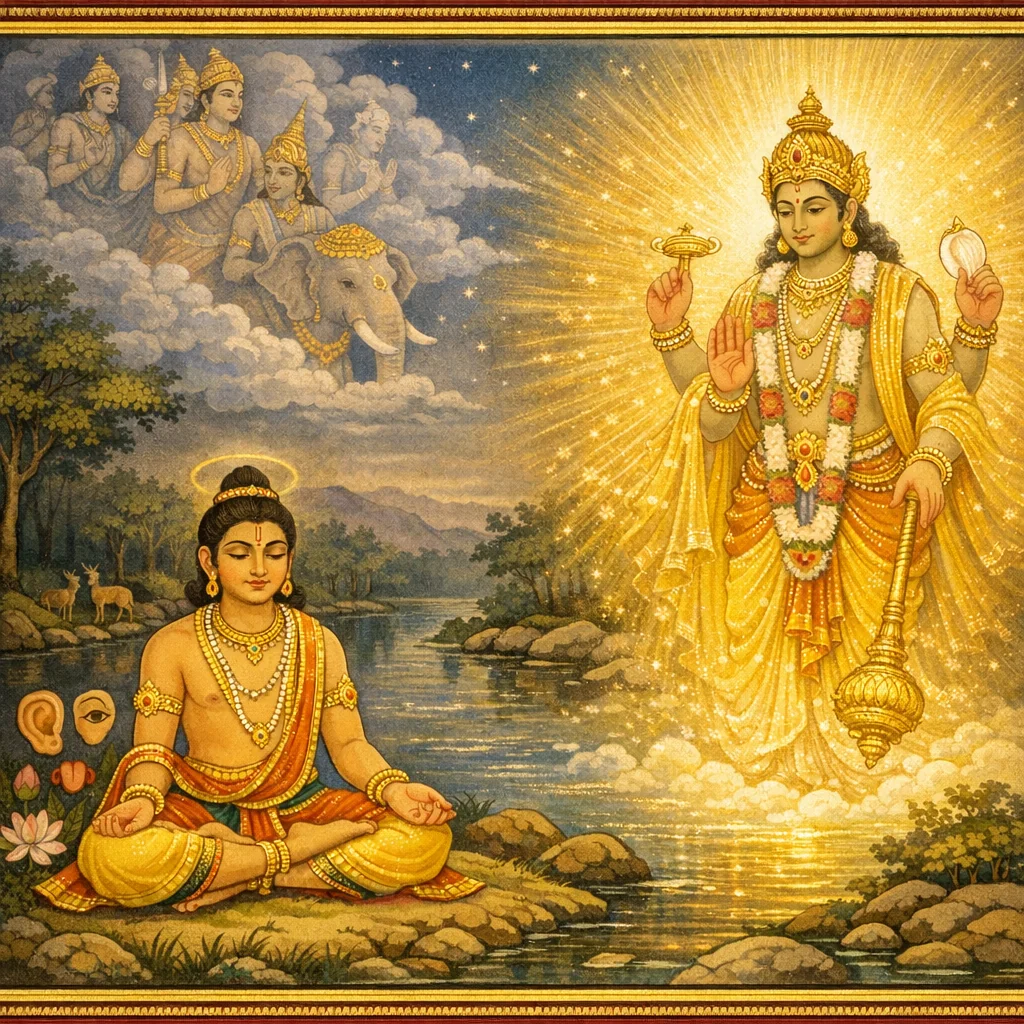
This chapter narrates Dhruva’s focused path of devotion and austerity. Reaching a sacred grove by a riverbank, he recognizes it as a supremely purifying divine place and begins japa and meditation on Vāsudeva, contemplating Hari/Viṣṇu as immanent in all directions, in rays of light, in animals and aquatic forms—the One with many forms who pervades all worlds. The senses are then reoriented in disciplined withdrawal: speech, sight, hearing, smell, touch, and mind become fixed solely on Viṣṇu’s names, feet, and qualities. Dhruva’s tapas radiates through the cosmos, unsettling the gods who fear for their stations; they seek Brahmā’s counsel, and he assures them that a true bhakta is non-hostile and that Viṣṇu will uphold every rightful order. Indra attempts to disrupt Dhruva with terrifying beings and deceptive apparitions, even a figure resembling Dhruva’s mother pleading for him to stop, but Dhruva remains unwavering and is protected by Sudarśana. At last Nārāyaṇa appears, invites him to choose a boon and to cease excessive austerity; Dhruva beholds the Lord’s luminous form and offers praise, completing the trial of steadfast bhakti.
Shlokas
Verse 1
गणावूचतुः । औत्तानपादिर्निर्गत्य ततः काननतो द्विज । रम्यं मधुवनं प्राप यमुनायास्तटे महत
The attendants said: “O brāhmaṇa, Uttānapāda’s son (Dhruva), leaving that forest, reached the delightful Madhuvana—great and renowned—on the bank of the Yamunā.”
Verse 2
आद्यं भगवतः स्थानं तत्पुण्यं हरिमेधसः । पापोपि जंतुस्तत्प्राप्य निष्पापो जायते ध्रुवम्
That is the primordial abode of the Lord—holy and sanctifying—of the sage Harimedhas; even a sinful being, upon reaching it, surely becomes free from sin.
Verse 3
जपन्स वासुदेवाख्यं परंब्रह्म निरामयम् । अपश्यत्तन्मयं विश्वं ध्यानस्तिमितलोचनः
Chanting the name of Vāsudeva—the supreme, stainless Brahman—he beheld the entire universe as permeated by Him, his eyes stilled in meditation.
Verse 4
हरिर्हरित्सु सर्वासु हरिर्हरिमरीचिषु । शिवामृगमृगेंद्रादि रूपः काननगो हरिः
Hari was in every green tree; Hari was in the rays of sunlight. Hari—moving through the forest—appeared in forms such as the auspicious deer and the lord of beasts, and more besides.
Verse 5
जले शालूरकूर्मादि रूपेण भगवान्हरिः । हरिरश्वादिरूपेण मंदुरास्वपि भूभुजाम्
In the waters, Bhagavān Hari was present in forms such as the fish and the tortoise; and Hari was present as horses and other creatures, even in the stables of kings.
Verse 6
अनंतरूपः पाताले गगनेऽनंतसंज्ञकः । एकोप्यनंततां यातो रूपभेदैरनंतकैः
In the netherworlds He is of endless forms, and in the heavens He is known as “Ananta.” Though He is One alone, by innumerable distinctions of manifestation He is spoken of as infinite.
Verse 7
देवेषु यो वसेन्नित्यं देवानां वसतिर्हि यः । स वासुदेवः सर्वत्र दीव्येद्यद्वासनावशात्
He who ever dwells among the gods—and indeed is the very abode of the gods—He is Vāsudeva. By the power of His indwelling presence, He shines and sports everywhere.
Verse 8
विष्लृव्याप्तावयंधातुर्यत्रसार्थकतां गतः । ते विष्णुनाम स्वरूपे हि सर्वव्यापनशीलिनि
Where this verbal root (viṣlṛ) finds its true fulfillment in the sense of ‘all-pervasion,’ there the very nature of the name “Viṣṇu” is established—He whose character is to pervade everything.
Verse 9
सर्वेषां च हृषीकाणामीशनात्परमेश्वरः । हृषीकेश इति ख्यातो यः स सर्वत्रसंस्थितः
Because the Supreme Lord rules over all the senses, He is renowned as Hṛṣīkeśa. He who bears this name abides everywhere.
Verse 10
न च्यवंतेपि यद्भक्ता महति प्रलये सति । अतोऽच्युतोऽखिले लोके स एकः सर्वगोऽव्ययः
Even when the great dissolution arrives, His devotees do not fall away. Therefore, in all the worlds He is called Acyuta—the One, all-pervading, imperishable Lord.
Verse 11
इदं चराचरं विश्वं यो बभार स्वलीलया । भृत्यास्वरूपसंपत्त्या सोऽत्र विश्वंभरोऽखिलम्
He who, by His own divine play, bears this universe of the moving and the unmoving, sustaining it with the fullness of servant-like care—here He is praised as Viśvambhara, the Supporter of all.
Verse 12
तस्येक्षणे समीक्षेते नान्यद्विप्णुपदादृते । निरीक्ष्यः पुंडरीकाक्षो नान्यो नियमतो ह्यतः
In the very act of seeing, nothing is to be sought apart from the station of Viṣṇu. Thus, by sacred rule, only Puṇḍarīkākṣa—the Lotus-eyed Lord—is the proper object of contemplation, and none other.
Verse 13
नान्य शब्दग्रहौ तस्य जातौ शब्दग्रहावपि । विना मुकुंद गोविंद दामोदर चतुर्भुज
No other utterance is to be taken up by his speech—no words at all—except: Mukunda, Govinda, Dāmodara, and Caturbhuja.
Verse 14
गोविंदचरणार्थार्चां तत्प्रियंकर्मवै विना । शंखचक्रांकितौ तस्य नान्यकर्मकरौकरौ
Apart from worship offered for the sake of Govinda’s feet, and apart from deeds dear to Him, his hands—marked with conch and discus—perform no other actions.
Verse 15
निर्द्वंद्वचरणद्वंद्वं तन्मनो मनुते हरेः । हित्वान्यन्मननं सर्वं निश्चलत्वमवाप ह
His mind contemplated Hari’s pair of feet, beyond all dualities; abandoning every other thought, it attained unwavering steadiness.
Verse 16
चरणौ विष्णुशरणौ हित्वा नारायणांगणम् । तस्य नो चरतोन्यत्र चरतो विपुलं तपः
Though he left the sheltering feet of Viṣṇu and even the courtyard of Nārāyaṇa, his feet would not go elsewhere—so vast and unwavering was the austerity he performed.
Verse 17
वाणीप्रमाणी क्रियते गोविंदगुणवर्णने । जोषं समासता तेन महासारं तपस्यता
His speech found its true measure only in praising Govinda’s virtues; through that silent absorption, his austerity became supremely substantial and essential.
Verse 18
नितांतकमलाकांत नामधेयसुधारसम् । रसयंती न रसना तस्यान्यरसस्पृहा
His tongue, savoring beyond measure the nectar-essence of the Name of Kamalākānta, no longer yearned for any other taste.
Verse 19
श्रीमुकुंद पदद्वंद्व पद्मामोदप्रमोदितम् । गंधांतरं न तद्घ्राणं परिजिघ्रत्यशीघ्रगम्
His sense of smell, delighted by the lotus-fragrance joy of Śrī Mukunda’s pair of feet, did not run after any other scent.
Verse 20
त्वगिंद्रियं मधुरिपोः परिस्पृश्य पदद्वयम् । सर्वस्पर्शसुखं प्राप तस्य भूजानिजन्मनः
By touching the two feet of Madhuripu, his sense of touch attained the bliss of all touch; for that earth-born one, every tactile delight was fulfilled therein.
Verse 21
शब्दादिविषयाधारं सारं दामोदरं परम् । ध्रुवेंद्रियाणि संप्राप्य कृतार्थान्यभवंस्तदा
Reaching the supreme Dāmodara—the essential Reality and the very ground of sound and the other sense-objects—his senses became steady, and then they were truly fulfilled.
Verse 22
लुप्तानि सर्वतेजांसि तत्तपस्तपनोदये । चंद्रसूर्यानलर्क्षाणां प्रदीपित जगत्त्रये
At the rising of the blazing sun of his austerity, all other splendors were eclipsed; the three worlds were lit as though by moon, sun, fire, and the stars together.
Verse 23
इंद्र चंद्राग्नि वरुण समीरण धनाधिपाः । यम नैरृतमुख्याश्च जाताः स्वपदशंकिताः
Indra, Candra, Agni, Varuṇa, Vāyu, Kubera, Yama, and the guardians headed by Nairṛta became anxious, fearing for their own stations.
Verse 24
वैमानिकास्तथाऽन्येपि वसुमुख्या दिवौकसः । ततो धुवात्समुत्त्रेसुः स्वाधिकारैधिताधयः
The aerial celestials and other residents of heaven—beginning with the Vasus—then rose up and hurried from Dhruva, their minds inflamed with concern for their own prerogatives.
Verse 25
यत्र यत्र ध्रुवः पादं मिनोति पृथिवीतले । धरा तस्य भराक्रांता विनमेत्तत्र तत्र वै
Wherever Dhruva set his foot upon the earth’s surface, the ground there—pressed by the weight of power born of his tapas—truly bowed down.
Verse 26
अहो तदंगसंगीनि त्यक्त्वा जाड्यं जलान्यपि । रसवंति पदस्थानि स्फुरंत्यन्यत्र तद्भयात्
Ah! Even the waters, grown dull by clinging to his limbs, cast off their heaviness; the places where his feet stood became full of sap and vitality, and, fearing his ascetic power, the currents trembled and shifted elsewhere.
Verse 27
यावंति विष्वक्तेजांसि सिद्धरूपगुणानि च । नेत्रातिथीनि तावंति तत्तपस्तेजसाऽभवन्
As many radiant perfections and accomplished forms and qualities as exist in all directions—so many became “guests of the eyes,” made manifest by the splendor of that tapas.
Verse 28
अहो निजगुणस्पर्शः सततं मातरिश्वना । दूरदेशांतरस्थोपि तत्त्वचो विषयीकृतः
Ah! By the ever-present touch of its own quality, even the Wind (Mātariśvan), though moving through far-off regions, was brought under control—made an object of mastery—by the one established in truth.
Verse 29
व्योम्नापि शब्दगुणिना ध्रुवाराधनबुद्धिना । शब्दजातस्त्वशेषोपि तत्कर्ण शरणीकृतः
Even the Sky, whose very quality is sound, with a mind intent on worshiping Dhruva, made the entire host of sounds, without remainder, take refuge in his ear and be subdued to his listening.
Verse 30
आराधितोऽनुदिवसं सभूतैरपि पंचभिः । तप एव परं मेने गोविंदार्पित मानसः
Worshiped day after day—even by the five elements themselves—yet with his mind offered to Govinda, he deemed tapas alone the supreme path.
Verse 31
कौस्तुभोद्भासितहृदः पीतकौशेयवाससः । ध्यानात्तेजोमयं विश्वं तेनैक्षि नृपसूनुना
With his chest illumined by the Kaustubha jewel and clad in yellow silken robes, through meditation the prince beheld the entire universe as made of pure light.
Verse 32
मरुत्वतातिमहती चिंताऽप्ता तत्तपोभयात् । मत्पदं चेदकांक्षिष्यदहरिष्यद्ध्रुवं धुवः
The mighty host of the Maruts was seized by anxiety, fearing that austerity: “If Dhruva should desire my station, he will surely take it away.”
Verse 33
समर्थस्त्वप्सरोवर्गो नियंतुं यमिनां यमान् । स तु यूनि प्रभवति नात्र बाले करोमि किम्
“The band of Apsarases can undo the restraints of ascetics; yet it works only upon the young. What can I do here, when the boy remains untouched?”
Verse 34
तपस्विनां तपो हंतुं द्वौ मत्साहाय्यकारिणौ । कामक्रौधौ न तावस्मिन्प्रभवेतां शिशौ ध्रुवे
“To destroy the austerity of ascetics, two allies serve me—Desire and Anger. But those two cannot prevail over that child, Dhruva.”
Verse 35
एक एव किलोपायो बाले मे प्रभविष्यति । भूतालिं भीषणाकारां प्रहिणोमीह तद्भिये
“Only one method will avail me against the boy: I shall send here a troop of terrifying bhūtas, to frighten him.”
Verse 36
बालत्वाद्भीषितो भूतैस्तपस्त्यक्ष्यत्यसौ ध्रुवम् । इति निश्चित्य भूतालिं प्रेषयामास वासवः
“Since he is only a child, surely—terrified by these bhūtas—he will abandon his austerities (tapas).” Having decided thus, Vāsava (Indra) dispatched a host of bhūtas against him.
Verse 37
भल्लूकाकारसर्वांग उष्ट्रलंबशिरोधरः । कश्चिद्दुर्दर्शदशनस्त्वभ्यधावत्तमर्भकम्
One (spirit) had a body shaped like a bear, with a camel-like long-hanging head; with dreadful fangs, hard to look upon, he rushed at that child.
Verse 38
तं व्याघ्रवदनः कश्चिद्व्यादाय विकटाननम् । द्विपोच्च देहसंस्थानो मुहुर्गर्जन्समभ्यगात्
Another, tiger-faced, opened his monstrous jaws; elephantine in bodily build, he repeatedly roared and advanced upon him.
Verse 39
रयात्तु मांसकं भुंजन्कश्चिद्विकटदंष्ट्रकः । रोषात्तमभिदुद्राव दृष्ट्वा संतर्जयन्निव
Another, with grotesque tusks, hurriedly devoured flesh; then, in fury, seeing him, he charged as though to threaten and cow him down.
Verse 40
अतितीक्ष्णैर्विषाणाग्रैस्तटानुच्चान्विदारयन् । खुराग्रैर्दलयन्भूमिं महोक्षोऽभिजगर्जतम्
A mighty bull, ripping apart the high riverbanks with the razor-sharp tips of his horns and pounding the earth with his hooves, roared thunderously as he charged on.
Verse 41
कश्चिद्धि पन्नगी भूय फटाटोपभयानकः । अतिलोलद्विरसनः पुस्फूर्जनिकषाचितम्
And again one appeared as a serpent-woman, dreadful with the hissing flourish of her hood; with two exceedingly restless tongues, she writhed and quivered in menace.
Verse 42
कश्चिच्च महिषाकारः क्षिपञ्शृंगाग्रतो गिरोन् । लांगूलताडितधरः श्वसन्वेगात्तमाप्तवान्
Another, in the form of a buffalo, hurled mountains with the tips of his horns; striking the ground with his tail and rushing on with forceful, snorting breath, he reached him.
Verse 43
कश्चिद्दावानलालीढ खर्जूरद्रुमसन्निभम् । बिभ्रदूरुद्वयंभूतो व्यात्तास्यस्तमभीषयत्
Another resembled a date-palm scorched by a forest-fire; becoming a bhūta with two massive thighs and a gaping mouth, he sought to terrify him.
Verse 44
मौलिजैरभ्रसंघर्षं कुर्वन्दीर्घकृशोदरः । निमग्नपिंगनयनः कश्चिद्भीषयति स्म तम्
Another—tall, with a long, gaunt belly—made his head-ornaments scrape against the clouds; with sunken tawny eyes, he kept trying to frighten him.
Verse 45
कृपाणपाणिर्भग्नास्यो वामहस्तकपालधृत् । प्रचंडं क्ष्वेडयन्कश्चिदभ्यधावत्तमर्भकम्
Another, sword in hand, with a broken mouth, holding a skull in his left hand, let out a fierce bellow and rushed at that child.
Verse 46
विशाल सालमादाय कुर्वन्किल किलारवम् । कश्चित्तमभितो याति कालो दंडधरो यथा
Seizing a huge śāla tree and raising a harsh, clattering cry, someone prowled all around him—like Time (Death) itself, bearing a staff.
Verse 47
तमः संकेतसदनं व्याघ्रं वै वदनं महत् । कृतांतकं दराकारं बिभ्रत्कश्चित्तमभ्यगात्
Another came toward him, bearing a dreadful form: darkness as its very dwelling, a great tiger-like face, and an appearance like Kṛtānta (the Lord of Death).
Verse 48
उलूकाकारतां धृत्वा फूत्कारैरतिदारुणैः । हृदयाकंपनैः कश्चिद्भीषयामास तं ध्रुवम्
Assuming an owl-like form, and with exceedingly dreadful hissing blasts that made the heart tremble, someone tried to terrify him again and again.
Verse 49
यक्षिणी काचिदानीय रुदंतं कस्यचिच्छिशुम् । अपिबद्रुधिरं कोष्ठाच्चखादास्थि मृणालवत्
A certain yakṣiṇī brought a crying infant belonging to someone; she drank its blood from the belly and gnawed its bones as though they were lotus-stalks.
Verse 50
पिपासिताद्य रुधिरं तेपि पास्याम्यहं धुव । यथास्य बालस्य तथा चर्वित्वास्थीनि वादिनी
I am thirsty today; I will surely drink your blood as well. Just as with this child, so too will I chew your bones! — thus she spoke.
Verse 51
अनीय तृणदारूणि परिस्तीर्य समंततः । दावाग्निं ज्वालयामास काचिद्वात्याविवर्धितम्
Bringing grasses and bits of wood and spreading them all around, another kindled a forest-fire, fanned into fury by a whirling wind.
Verse 52
वेताली रूपमास्थाय भंक्त्वा काचित्तरून्गिरीन् । रुरोध गगनाध्वानं कंपयंती च तं भृशम्
Assuming the form of a Vetālī, another shattered trees and even hills; she blocked the very pathway of the sky and made it quake violently.
Verse 53
अन्या सुनीतिरूपेण तमभिप्रेक्ष्य दूरतः । रुरोदातीवदुःखार्ता वक्षोघातं मुहुर्मुहुः
Yet another, taking the form of Sunīti, looked at him from afar and wept as though crushed by sorrow, striking her breast again and again.
Verse 54
उवाच च वचश्चाटु बहुमाया विनिर्मितम् । कारुण्यपूर्ण वात्सल्यमतीवातन्वती सती
And she spoke sweet, coaxing words—crafted by manifold illusion—spreading an air of overflowing compassion and tender affection.
Verse 55
त्वदेकशरणां वत्स बत मृत्युर्जिघांसति । रक्षरक्ष गतासुं मां शरणागतवत्सल
Child, I have no refuge but you—alas, Death seeks to slay me! Protect me, protect me; I am as good as lifeless. O you who are tender to those who seek refuge!
Verse 56
प्रतिग्रामं प्रतिपुरं प्रत्यध्वं प्रतिकाननम् । प्रत्याश्रमं प्रतिगिरिं श्रांता त्वद्वीक्षणातुरा
From village to village, from city to city—along every road and through every forest; from hermitage to hermitage and from mountain to mountain—I have wandered, worn out, tormented only by the longing to see you.
Verse 57
यदा प्रभृति रे बाल निरगात्तपसे भवान् । तदेव दिनमारभ्य निर्गताऽहं त्वदीक्षणे
O child, from the very day you departed to undertake austerities, from that same day onward I too have gone forth—only to behold you.
Verse 58
तैस्तैः सपत्नीदुर्वाक्यैर्दुनोपि त्वं यथार्भक । तथाऽहमपि दूनास्मि नितरां तद्वचोऽग्निना
Just as you, like a mere child, were pained by the harsh words of rival co-wives, so I too am scorched even more—burned by that fire of speech.
Verse 59
न निद्रामि न जागर्मि नाश्नामि न पिबाम्यहम् । ध्यायामि केवलं त्वाऽहं योगिनीव वियोगिनी
I neither sleep nor truly wake; I neither eat nor drink. I do nothing but meditate upon you—like a yoginī, yet one tormented by separation.
Verse 60
निद्रादरिद्रनयना स्वप्नेपि न तवाननम् । आनंदि सर्वथा यन्मे मंदभाग्या विलोकये
My eyes are bereft of sleep; even in dreams I do not behold your face. Yet whenever, in any manner, I glimpse it, I am filled with joy, though my fortune is small.
Verse 61
त्वदाननप्रतिनिधिर्विधुर्विधुरया मया । उदित्वरोपिनालोकि तापं वै त्यक्तुकामया
I, bereft and forlorn, gazed upon the moon—your face’s very substitute—as it rose, truly wishing to cast away my burning grief.
Verse 62
त्वदालापसमालापं कलयन्किलकाकलीम् । कोकिलोपि मयाकर्णि नालकाकीर्णकर्णया
Even the cuckoo’s sweet cooing, seeming to echo your speech, I could not truly hear; my ears were filled only with lamentation.
Verse 63
त्वदंगसंगमधुरो ध्रुवधूपितयामया । नानिलोपि मयालिंगि क्वचिद्विश्रांतया भृशम्
Even the wind—sweet as the touch of union with your limbs—did not embrace me, though I lay down somewhere to rest, utterly exhausted.
Verse 64
के देशाः काश्च सरितः के शैलास्त्वत्कृते ध्रुव । मया चरणचारिण्या राजपत्न्या न लंघिताः
What lands, what rivers, what mountains have I not crossed for your sake, O Dhruva? Though a queen, I have journeyed on foot.
Verse 65
अध्रुवं सर्वमेवैतत्पश्यंत्यंधीकृतास्म्यहम् । धात्रीं त्रायस्व मां पुत्र प्राप्य त्वंमेंऽधयष्टिताम्
Seeing that all this is uncertain and unstable, I have become as though blinded. O son, protect me—your mother—now that you have come and found me so afflicted and helpless.
Verse 66
मृदुलानि तवांगानि क्वेमानि क्व तपस्त्विदम् । परुषं पुरुषैः साध्यं परुषांगैर्नरर्षभ
Your limbs are tender—what connection do they have with this hard austerity? Severe tapas is to be accomplished by hardened men with hardened bodies, O bull among men.
Verse 67
अनेन तपसा वत्स त्वयाऽप्यं किमनेनसा । धराधीशतनूजत्वादधिकं तद्वदाधुना
By this austerity, dear child, what indeed will you gain? Because you are the son of the lord of the earth, tell me now what more (than royal fortune) you seek.
Verse 68
अनेन वयसा बाल खेलनीयं त्वयाऽनिशम् । बालक्रीडनकैरन्यैः सवयः शिशुभिः समम्
At this age, child, you should be playing continually—playing with other children, with games and toys, among youngsters of your own age.
Verse 69
ततः कौमारमासाद्य वयोऽभिध्यानशीलिना । भवता सर्वविद्यानां भाव्यं वै पारदृश्वना
Then, on reaching youth, you should become one devoted to study and contemplation; indeed, you are to become a knower of all branches of learning, O far-seeing one.
Verse 70
वयोथ चतुरं प्राप्य योषास्रक्चंदनादिकान् । निर्वेक्ष्यसि बहून्भोगानिंद्रियार्थान्कृतार्थयन्
And then, upon reaching the prime of youth, you will enjoy many delights—women, garlands, sandal and the like—thus fulfilling the aims of the senses.
Verse 71
उत्पाद्याथ बहून्पुत्रान्गुणिनो धर्मवत्सलान् । परिसंक्रामितश्रीकस्तेष्वथो त्वं तपश्चर
Then, after begetting many sons—virtuous and devoted to dharma—and after handing your prosperity over to them, then you may undertake austerity.
Verse 72
इदानीमेव तपसि बाल्ये वयसि कः श्रमः । पादांगुष्ठकरीषाग्निः कदा मौलिमवाप्स्यति
If you undertake austerity right now, in childhood, what hardship is there? When will the “cow-dung fire at the great toe” ever reach the crown of the head?
Verse 73
विपक्षपरिभूतेन हृतमानेन केनचित् । परिभ्रष्टश्रिया वापि तप्तव्यं तेषु को भवान्
If one is humiliated by enemies, or if someone has robbed him of honor, or even if he has fallen from prosperity—then austerity should be undertaken. But who are you among such persons?
Verse 74
हृतमानेन तप्तव्यं निशम्येति वचो ध्रुवः । दीर्घमुष्णं हि निःश्वस्य पुनर्दध्यौ हरिं हृदि
Hearing the words, “When honor is taken away, one should perform austerity,” Dhruva sighed long and hotly, and once again meditated on Hari within his heart.
Verse 75
जनयित्रीमनाभाष्य भूतभीतिं विहाय च । ध्रुवोऽच्युतध्यानपरः पुनरेव बभूव ह
Without speaking to his mother, and casting aside fear of beings, Dhruva once again became wholly intent on meditation upon Acyuta, the Imperishable.
Verse 76
सापि भूतावली भीतिंबहुभीषणभूषणा । दर्शयंती तमभितोऽद्राक्षीच्चक्रं सुदर्शनम्
That host of spirits too—adorned with many terrifying ornaments—while trying to display fear all around him, beheld the Sudarśana discus encircling him.
Verse 77
परितः परिवेषाभं सूर्यस्योच्चैः स्फुरत्प्रभम् । रक्षणाय च रक्षोभ्यस्तस्याधोक्षज निर्मितम्
All around, it shone like the sun’s radiant halo, blazing with lofty brilliance—fashioned by Adhokṣaja himself to protect him from the rākṣasas.
Verse 78
भूतावली तमालोक्य स्फुरच्चक्रसुदर्शनम् । ज्वालामालाकुलं तीव्रं रक्षंतं परितो ध्रुवम्
Seeing that flashing Sudarśana discus—fierce, wreathed in garlands of flame—protecting Dhruva on every side, the host of spirits was struck with alarm.
Verse 79
अतीव निष्कंपहृदं गोविदार्पितचेतसम् । तपोंकुरमिवोद्भिद्य मेदिनीं समुदित्वरम्
With a heart utterly unshaken and a mind offered to Govinda, he rose up as though splitting the earth—like a sprout of austerity breaking through the ground.
Verse 80
सापि प्रत्युतभीतातं ध्रुवं ध्रुवविनिश्चयम् । नमस्कृत्य यथायातं याताव्यर्थमनोरथा
She too, now afraid, bowed to Dhruva—whose resolve was truly steadfast—and departed by the way she had come, her hopes made futile.
Verse 81
गर्जत्कादंबिनीजालं व्योम्नि वै व्याकुलं यथा । वृथा भवति संप्राप्य मनागनिललोलताम्
Just as a roaring mass of storm-clouds in the sky is scattered and comes to nothing when it meets even a slight wavering of the wind, so their agitation proved vain.
Verse 82
अथ जंभारिणा सार्धं भीताः सर्वे दिवौकसः । संमंत्र्य त्वरिता जग्मुर्ब्रह्माणं शरणं द्विज
Then, together with Jambhāri (Indra), all the gods—frightened—took counsel and hurried to Brahmā for refuge, O twice-born one.
Verse 83
नत्वा विज्ञापयामासुः परिष्टुत्या पितामहम् । वच्रोऽवसरमालोक्य पृष्टागमनकारणाः
Having bowed, they informed Grandfather Brahmā with hymns of praise; and, watching for the right moment to speak, they were asked the reason for their coming.
Verse 84
देवा ऊचुः । धातरुत्तानपादस्य तनयेन सुवर्चसा । तपता तापिताः सर्वे त्रिलोकी तलवासिनः
The gods said: “O Dhātṛ, by the blazing austerity of Uttānapāda’s radiant son, all who dwell across the planes of the three worlds are being scorched.”
Verse 85
सम्यक्संविद्महे तात धुवस्य न मनीषितम् । पदं परिजिहीर्षुः स कस्यास्मासु महातपाः
“We do not rightly understand, dear sir, what Dhruva intends. That great ascetic seems bent on taking away a ‘pada’, a station; from which one among us does he seek to seize it?”
Verse 86
इति विज्ञापितो देवैर्विहस्य चतुराननः । प्रत्युवाचाथ तान्सर्वान्ध्रुवतो भीतमानसान्
Thus petitioned by the gods, four-faced Brahmā smiled and then replied to them all—whose minds were shaken with fear because of Dhruva.
Verse 87
ब्रह्मोवाच । न भेतव्यं सुरास्तस्माद्ध्रुवाद्ध्रुवपदैषिणः । व्रजंतु विज्वराः सर्वे न स वः पदमिच्छति
Brahmā said: “Do not fear that Dhruva, O gods who seek the Dhruva-state. Go forth, all of you, free from distress—he does not desire your positions.”
Verse 88
न तस्माद्भगवद्भक्ताद्भेतव्यं केनचित्क्वचित् । निश्चितं विष्णुभक्ता ये न ते स्युः परतापिनः
One should never fear a devotee of the Lord—anywhere, by anyone. It is certain: those who are devotees of Viṣṇu are not tormentors of others.
Verse 89
आराध्य विष्णुं देवेशं लब्ध्वा तस्मात्स्वकांक्षितम् । भवतामपि सर्वेषां पदानि स्थिरयिष्यति
Having worshiped Viṣṇu, the Lord of the gods, and obtained from Him what he desired, Dhruva will also stabilize the stations of you all.
Verse 90
निशम्येति च गीर्वाणाः प्रणीतं ब्रह्मणो वचः । प्रणिपत्य स्वधिष्ण्यानि प्रहृष्टाः परिवव्रजुः
Hearing Brahmā’s well-spoken words, the gods bowed down and, rejoicing, departed to their own abodes.
Verse 91
अथ नारायणो देवस्तं दृष्ट्वा दृढमानसम् । अनन्यशरणं बालं गत्वा तार्क्ष्यरथोऽब्रवीत्
Then Lord Nārāyaṇa, seeing the boy steadfast in mind and taking refuge in none but Him, approached—mounted on Garuḍa—and spoke.
Verse 92
श्रीविष्णुरुवाच । प्रसन्नोस्मि महाभाग वरं वरय सुव्रत । तपसोऽस्मान्निवर्तस्व चिरं खिन्नोसि बालक
Śrī Viṣṇu said: “I am pleased, O fortunate one. Choose a boon, O steadfast in vow. Turn back now from this austerity—you have been long wearied, dear child.”
Verse 93
वचोऽमृतं समाकर्ण्य पर्युन्मील्य विलोचने । इंद्रनीलमणिज्योतिः पटलीं पर्यलोकयत्
Hearing those nectar-like words, he opened his eyes and beheld a radiant expanse, shining like the light of a blue sapphire (indranīla).
Verse 94
प्रत्यग्रविकसन्नीलोत्पलानां निकुरंबकैः । प्रोत्फुल्लितां समंताच्च रोदसी सरसीमिव
It was as though heaven and earth had become a lake, everywhere blossoming with clusters of freshly opened blue lotuses.
Verse 95
लक्ष्मीदेवीकटाक्षोघैः कटाक्षितमिवाखिलम् । धुवस्तदानिरैक्षिष्ट द्यावाभूम्योर्यदंतरम्
Then Dhruva beheld all that lies between heaven and earth as though it were wholly touched by the cascading, grace-filled glances of Goddess Lakṣmī.
Verse 96
प्रोद्यत्कादंबिनीमध्य विद्युद्दामसमानरुक् । पुरः पीतांबरः कृष्णस्तेन नेत्रातिथीकृतः
Then, before him appeared Kṛṣṇa in a yellow garment, radiant like a streak of lightning amid a rising mass of rain-clouds—becoming a blessed guest to Dhruva’s eyes.
Verse 97
नभो निकष पाषाणो मेरुकांचन रेखितः । यथातथा ध्रुवेणैक्षि तदा गरुडवाहनः
Like the sky itself—like a touchstone marked with Meru’s golden lines—thus did Dhruva behold at that time the Lord who rides upon Garuḍa.
Verse 98
सुनीलगगनं यद्वद्भूषितं तु कलावता । पीतेन वाससा युक्तं स ददर्श हरिं तदा
Just as the deep-blue sky is adorned by the moon, so did he then behold Hari—clad in yellow—radiant and beautifying the world with His presence.
Verse 99
दंडवत्प्रणिपत्याथ परितः परिलुठ्य च । रुरोद दृष्ट्वेव चिरं पितरं दुःखितः शिशुः
He fell full-length in prostration, rolled about on every side, and wept—like a sorrowing child who, after a long time, has suddenly seen his father.
Verse 100
नारदेन सनंदेन सनकेन सुसंस्तुतः । अन्यैः सनत्कुमाराद्यैर्योगिभिर्योगिनां वरः
That foremost among yogins was greatly praised by Nārada, Sanandana, Sanaka, and by other sages such as Sanatkumāra and the great yogins.
Verse 103
स्पर्शनाद्देवदेवस्य सुसंस्कृतमयी शुभा । वाणी प्रवृत्ता तस्यास्यात्तुष्टावाथ ध्रुवो हरिम्
By the touch of the God of gods, auspicious and perfectly refined speech arose in his mouth; then Dhruva began to hymn Hari in praise.