Adhyaya 17
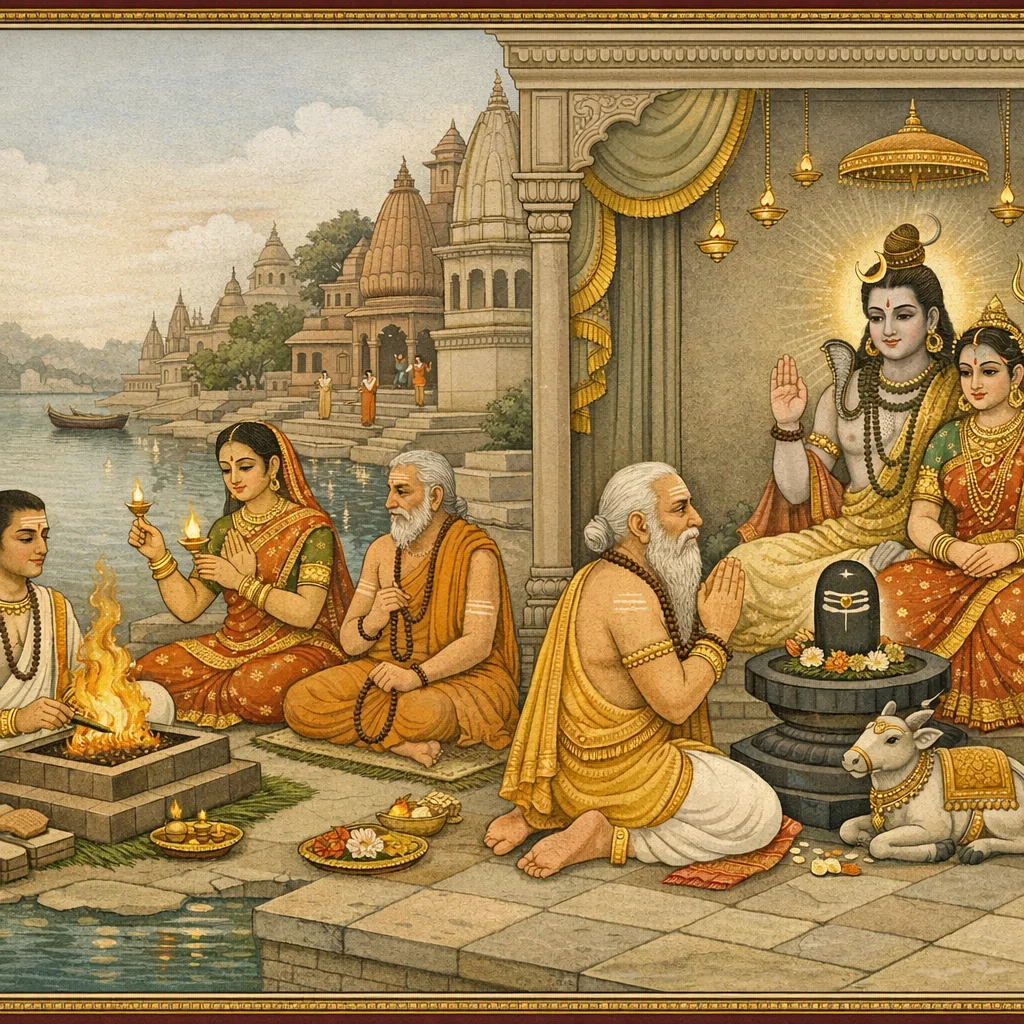
Chapter 17 unfolds in two main movements within a sacred dialogue. First, Śivaśarmā asks the gaṇas about a pure realm that removes sorrow; they recount the origin of Lohitāṅga (Māheya), born from a drop of Śambhu’s sweat during His separation from Dakṣāyaṇī. After fierce tapas at Ugrapurī, he establishes the liṅga called Aṅgārakeśvara, becomes famed as Aṅgāraka, and by Śiva’s grace attains the exalted status of a graha. The chapter then lays down observances for Aṅgāraka-caturthī—ritual bathing (especially in north-flowing waters), worship, and the teaching that offerings, japa, and homa become imperishable. Śrāddha performed under Aṅgāraka’s conjunction is said to satisfy the ancestors; Gaṇeśa’s birth is also linked to this vow, and devout residence in Vārāṇasī is connected with elevated post-mortem states. In the second movement, another Kāśī account is told: Aṅgiras’s son rises as Bṛhaspati/Vācaspati through liṅga worship and the subtle vāyavya-stotra hymn. Śiva bestows the titles Bṛhaspati, Jīva, and Vācaspati, promises refined speech and protection from graha-born afflictions through recitation, and directs Brahmā to consecrate him as the devas’ teacher. The chapter closes by locating Bṛhaspatīśvara among Kāśī’s shrines, noting a motif of guarded transmission in Kali-yuga, and declaring in its phalaśruti that hearing this adhyāya wards off graha-pīḍā and disturbances, especially for Kāśī’s residents.
Shlokas
Verse 1
शिवशर्मोवाच । शुक्रसंबंधिनी देवौ कथा श्रावि मया शुभा । यस्याः श्रवणमात्रेण प्रीणिते श्रवणे मम
Śivaśarman said: “O Goddess, I have recounted the auspicious tale connected with Śukra; by its mere hearing, my heart is gladdened in the very act of listening.”
Verse 2
कस्य पुण्यनिधेर्लोकः शोकहृत्त्वेष निर्मलः । एतदाख्यातुमुद्युक्तौ भवंतौ भवतां मम
O you two, treasures of merit—whose is this stainless realm that takes away sorrow? Be ready to explain this to me.
Verse 3
धयित्वा श्रोत्रपात्राभ्यां वाणीममृतरूपिणीम् । न तृप्तिमधिगच्छामि भवन्मुखसुखोद्गताम्
Having drunk with the vessels of my ears your speech—nectar in form, sweetly flowing from your mouths—I still do not attain satisfaction.
Verse 4
गणावूचतुः । लोहितांगस्य लोकोयं शिवशर्मन्निबोध ह । उत्पत्तिं चास्य वक्ष्यावो भूसुतोयं यथाभवत्
The Gaṇas said: “Understand, O Śivaśarman—this realm belongs to Lohitāṅga. We shall also tell you his origin, and how this one became the son of the Earth.”
Verse 5
पुरा तपस्यतः शंभोर्दाक्षायण्या वियोगतः । भालस्थलात्पपातैकः स्वेदबिंदुर्महीतले
Formerly, when Śambhu was performing austerity, separated from Dākṣāyaṇī, a single drop of sweat fell from his forehead onto the surface of the earth.
Verse 6
ततः कुमारः संजज्ञे लोहितांगो महीतलात् । स्नेहसंवर्धितः सोथ धात्र्या धात्रीस्वरूपया
Thereupon a boy, Lohitāṅga, was born from the very surface of the earth. Then he was lovingly reared by a nurse who was the very embodiment of Dhātrī, the Earth-Mother.
Verse 7
माहेय इत्यतः ख्यातिं परामेष गतः सदा । ततस्तेपे तपोत्युग्रमुग्रपुर्यां पुरानघ
Therefore he ever attained great renown as “Māheya.” Then, O sinless one, he performed exceedingly fierce austerities in Ugrapurī.
Verse 8
असिश्च वरणा चापि सरितौ यत्र शोभने । द्युनद्योत्तरवाहिन्या मिलितेऽत्र जगद्धिते
Here, in this splendid place, the rivers Asi and Varaṇā meet the northward-flowing celestial river; this confluence is for the welfare of the world.
Verse 9
सर्वगोपि हि विश्वेशो यत्र नित्यं प्रकाशते । मुक्तये सर्वजंतूनां कालोज्ज्ञित स्ववर्ष्मणाम्
For there the Lord Viśveśa, though hidden from all, shines eternally, granting liberation to all beings whose bodies are overpowered by Time.
Verse 10
अमृतं हि भवंत्येव मृता यत्र शरीरिणः । अनुग्रहं समासाद्य परं विश्वेश्वरस्य ह
Indeed, in that place even embodied beings who have died become immortal, having obtained the supreme grace of Lord Viśveśvara.
Verse 11
अपुनर्भवदेहास्ते येऽविमुक्रेतनुत्यजः । विना सांख्येन योगेन विना नानाव्रतादिभिः
Those who cast off the body in Avimukta attain a body free from rebirth—without need of Sāṃkhya, without Yoga, and without diverse vows and the like.
Verse 12
संस्थाप्य लिंगं विधिना स्वनाम्नांगारकेश्वरम् । पांचमुद्रे महास्थाने कंबलाश्वतरोत्तरे
Having duly installed a liṅga according to the prescribed rite, he named it Aṅgārakeśvara after himself, in the great sacred spot called Pāñcamudrā, to the north of Kambalāśvatara.
Verse 13
ज्वलदंगारवत्तेजो यावत्तस्यशरीरतः । विनिर्ययौ तपस्तावत्तेन तप्तं महात्मना
A radiance like blazing embers streamed forth from his body; for as long as that fiery splendor issued out, for that long the great-souled one was consumed in austerity.
Verse 14
ततोंगारक नाम्ना स सर्वलोकेषु गीयते । तस्य तुष्टो महादेवो ददौ ग्रहपदं महत्
Therefore he came to be celebrated in all the worlds by the name “Aṅgāraka”; and Mahādeva, pleased with him, bestowed upon him the exalted rank of a Graha, a planetary deity.
Verse 15
अंगारक चतुर्थ्यां ये स्नात्वोत्तरवहांभसि । अभ्यर्च्यांगारकेशानं नमस्यंति नरोत्तमाः
Those best among men who, on Aṅgāraka Caturthī, bathe in the waters of the Uttaravahā (the north-flowing stream) and worship Aṅgārakeśa, bowing in reverence—
Verse 16
न तेषां ग्रहपीडा च कदाचित्क्वापि जायते । अंगांरकेन संयुक्ता चतुर्थी लभ्यते यदि
For them, no planetary affliction ever arises at any time or place—if the sacred Caturthī is obtained in conjunction with Aṅgāraka (Mars).
Verse 17
उपरागसमं पर्व तदुक्तं कालवेदिभिः । तस्यां दत्तं हुतं जप्तं सर्वं भवति चाक्षयम्
The knowers of sacred time declare this observance to be equal to an eclipse-festival; whatever is given in dāna, offered into the fire, or repeated as japa on that day becomes inexhaustible.
Verse 18
श्रद्धया श्राद्धदा ये वै चतुर्थ्यंगारयोगतः । तेषां पितॄणां भविता तृप्तिर्द्वादशवार्षिकी
Those who, with faith, offer śrāddha on the Caturthī joined with Aṅgāraka—there arises for their ancestors a satisfaction lasting twelve years.
Verse 19
अंगारकचतुर्थ्यां तु पुरा जज्ञे गणेश्वरः । अतएव तु तत्पर्व प्रोक्तं पुण्यसमृद्धये
Indeed, in ancient times Gaṇeśvara was born on Aṅgāraka Caturthī; therefore that sacred occasion is proclaimed for the increase and flourishing of merit.
Verse 20
एकभक्तव्रती तत्र संपूज्य गणनायकम् । किंचिद्दत्त्वा तमुद्दिश्य न विघ्नैरभिभूयते
There, one who keeps the ekabhakta-vrata, having duly worshipped Gaṇanāyaka and giving even a little dāna with him in mind, is not overwhelmed by obstacles.
Verse 21
अंगारेश्वर भक्ता ये वाराणस्यां नरोत्तमाः । तेऽस्मिन्नंगारके लोके वसंति परमर्द्धयः
Those best among men who are devotees of Aṅgāreśvara in Vārāṇasī dwell in this Aṅgāraka-world, endowed with supreme prosperity.
Verse 22
अगस्त्य उवाच । इत्थं कथयतोरेव रम्यां पुण्यवतीं कथाम् । भगवद्गणयोः प्राप नेत्रातिथ्यं गुरोः पुरी
Agastya said: As those two were thus narrating that delightful and merit-bestowing account, the city of the Guru—holy Kāśī—came into the range of the Lord’s attendants’ sight, becoming a feast for their eyes.
Verse 23
नेत्रानंदकरीं दृष्ट्वा शिवशर्माऽथ तां पुरीम् । पप्रच्छाचार्यवर्यस्य कस्येयं पूरनुत्तमा
Seeing that city which delights the eyes, Śivaśarmā then asked the excellent teacher: “Whose is this incomparable city?”
Verse 24
गणावूचतुः । सखे सुखं समाख्यावो नानाख्येयं तवाग्रतः । अध्वखेदापनोदाय पुनरस्याः पुरः कथाम्
The Gaṇas said: “Friend, we shall gladly tell you—before you—what is worth recounting. To dispel the fatigue of the journey, hear again the story of this city, as we relate it.”
Verse 25
विधेर्विधित्सतः पूर्वं त्रिलोकीरचनां मुदा । आविरासुः सुताः सप्त मानसाः स्वस्यसंनिभाः
Before the Creator (Vidhātṛ/Brahmā), wishing to fashion the three worlds with joy, began creation, seven mind-born sons—resembling himself—manifested.
Verse 26
मरीच्यत्र्यंगिरो मुख्याः सर्वे सृष्टिप्रवर्तकाः । प्रजापतेरंगिरसस्तेष्वभूद्देवसत्तमः
Among them, Marīci, Atri, and Aṅgiras were foremost—each a promoter of creation. And from Prajāpati Aṅgiras there arose a son, the best among the godlike.
Verse 27
सुतश्चांगिरसो नाम बुद्ध्या विबुधसत्तमः । शांतो दांतो जितक्रोधो मृदुवाङ्निर्मलाशयः
His son, named Āṅgirasa, was—by intellect—the best among the wise: peaceful, self-restrained, conqueror of anger, gentle of speech, and pure in heart.
Verse 28
वेदवेदार्थतत्त्वज्ञः कलासु कुशलोऽमलः । पारदृश्वा तु सर्वेषां शास्त्राणां नीतिवित्तमः
He knew the essence of the Vedas and the truth of their meanings; spotless, he was skilled in the arts. Having thoroughly penetrated all the śāstras, he was foremost in understanding dharma and the principles of right governance.
Verse 29
हितोपदेष्टा हितकृदहितात्यहितः सदा । रूपवाञ्छीलसंपन्नो गुणवान्देशकालवित्
He taught what is beneficial, did what is beneficial, and was ever far removed from what is harmful. Handsome, endowed with good conduct, virtuous, and discerning of place and time, he stood as an exemplar.
Verse 30
सर्वलक्षणसंभार संभृतो गुरुवत्सलः । तताप तापसीं वृत्तिं काश्यां स महतीं दधत
Endowed with every auspicious mark and devoted to his teacher, he undertook in Kāśī a great ascetic discipline, upholding the lofty way of a tapasvin.
Verse 31
महल्लिंगं प्रतिष्ठाप्य शांभवं भूरिभावनः । अयुतं शरदां दिव्यं दिव्यतेजा महातपाः
That great ascetic, radiant with divine splendor and a mighty benefactor, established the great Śaṃbhu-liṅga; and for ten thousand divine autumns he performed intense austerities.
Verse 32
ततः प्रसन्नो भगवान्विश्वेशो विश्वभावनः । आविर्भूय ततो लिंगान्महसां राशिरब्रवीत्
Then Bhagavān Viśveśvara, the Sustainer of the universe, became gracious. Manifesting from that Liṅga as a very mass of splendor, He spoke.
Verse 33
प्रसन्नोस्मि वरं ब्रूहि यत्ते मनसि वर्तते । इति शंभुं समालोक्य तुष्टावेति स हृष्टवान्
“I am pleased. Speak the boon—whatever is in your mind.” Thus, gazing upon Śambhu, he joyfully began to hymn His praise.
Verse 34
आंगिरस उवाच । जय शंकर शांत शशांकरुचे रुचिरार्थद सर्वद सर्वशुचे । शुचिदत्त गृहीत महोपहृते हृतभक्तजनोद्धततापतते
Aṅgiras said: “Victory to You, O Śaṅkara—peace itself, radiant as the moon; Giver of beautiful aims, Giver of all, O All-Pure. You accept the great offerings given with purity, and You remove the fierce burning afflictions of Your devotees.”
Verse 35
ततसर्वहृदंबर वरदनते नतवृजिनमहावन दाहकृते । कृतविविधचरित्रतनोसुतनो तनुविशिखविशोषणधैर्यनिधे
O Bestower of boons, the inner sky of every heart; O You who burn the vast forest of sins of those who bow—You whose body enacts countless divine deeds; Treasure of steadfastness, who dries up the slender arrows of desire.
Verse 36
निधनादि विवर्जितकृतनतिकृत्कृतिविहितमनोरथपन्नगभृत् । नगभर्तृसुतार्पितवामवपुः स्ववपुःपरिपूरितसर्वजगत्
Free from death and every limitation; accomplisher of reverent salutations; fulfiller of wishes born of meritorious deeds; Bearer of the serpent. Your left side is bestowed upon the Mountain-Lord’s daughter, yet by Your own body You pervade and fill the entire universe.
Verse 37
त्रिजगन्मयरूपविरूपसुदृग्दृगुदंचनकुंचन कृतहुतभुक् । भवभूतपतेप्रमथैकपते पतितेष्वपिदत्तकरप्रसृते
Your form is the very substance of the three worlds; Your wondrous vision uplifts and restrains all; and the sacrificial Fire serves You. O Lord of beings and of becoming, sole Master of the Pramathas—you extend Your hand even to the fallen.
Verse 38
प्रसूताखिलभूतलसंवरणप्रणवध्वनिसौधसुधांशुधर । वरराजकुमारिकया परया परितः परितुष्ट नतोस्मि शिव
O Śiva, who bring forth and enfold all worlds; Bearer of the moon, whose abode resounds with the sound of Praṇava (Oṃ). Fully delighted on all sides by the supreme Princess (the Goddess), I bow to You.
Verse 39
शिवदेव गिरीश महेश विभो विभवप्रद गिरिश शिवेशमृड । मृडयोडुपतिध्र जगत्त्रितयं कृतयंत्रणभक्तिविघातकृताम्
O Divine Śiva—Girīśa, Mahēśa, all-pervading Lord, bestower of prosperity; Lord of the Mountain, Lord of Śivā (the Goddess), O Mṛḍa. O Bearer of the moon—make auspicious the three worlds and destroy the bonds that obstruct devotion.
Verse 40
न कृतांत त एष बिभेभि हरप्रहराशु महाघममोघमते । नमतांतरमन्यदवैनि शिवं शिवपादनतेः प्रणतोस्मि ततः
Death does not frighten this one, for Your swift stroke, O Hara, destroys great sin—O unfailing in wisdom. For those who bow, I know no higher refuge than Śiva; therefore I prostrate to the One before whose feet I bow.
Verse 41
विततेऽत्र जगत्यखिलेऽघहरं हर तोषणमेव परं गुणवन् । गुणहीनमहीन महावलयं प्रलयांतकमीश नतोस्मि ततः
In this vast world, O Hara, the supreme good for the virtuous is to please You—the Remover of all sin. O Lord, You are not diminished by the absence of qualities; You are the great encompassing circle, the Terminus of dissolution. Therefore I bow to You.
Verse 42
इति स्तुत्वा महादेवं विररामांगिरः सुतः । व्यतरच्च महेशानः स्तुत्या तुष्टो वरान्बहून्
Having thus praised Mahādeva, the son of Aṅgiras ceased. Pleased by that hymn, Maheśāna (Śiva) granted him many boons.
Verse 43
श्रीमहादेव उवाच । बृहता तपसानेन बृहतां पतिरेध्यहो । नाम्ना बृहस्पतिरिति ग्रहेष्वर्च्योभव द्विज
Śrī Mahādeva said: “By this mighty austerity, become the lord of the great—indeed! And by the name ‘Bṛhaspati,’ O twice-born, be worthy of worship among the planets.”
Verse 44
अस्माल्लिंगार्चनान्नित्यं जीवभूतोसि मे यतः । अतो जीव इति ख्यातिं त्रिषु लोकेषु यास्यसि
“Because through this constant worship of the Liṅga you have become, as it were, my very life, therefore you shall attain renown in the three worlds by the name ‘Jīva.’”
Verse 45
वाचां प्रपंचैश्चतुरैर्निष्प्रपंचो यतः स्तुतः । अतो वाचां प्रपंचस्य पतिर्वाचस्पतिर्भव
“Because the Transcendent One, beyond all elaboration, was praised by you through four skillful modes of speech, therefore become the lord of speech’s manifold expression—be ‘Vācaspati.’”
Verse 46
अस्य स्तोत्रस्य पठनादपि वागुदियाच्च यम् । तस्य स्यात्संस्कृता वाणी त्रिभिर्वर्षैस्त्रिकालतः
Even by merely reading this hymn, if one’s speech rises and becomes clear and capable, then within three years—by practice at the three daily times—one’s voice becomes refined and cultured.
Verse 47
समुत्पन्ने महाकार्ये न स बुद्ध्या प्रहीयते । यः पठिष्यत्यदः स्तोत्रं वायव्याख्यं दिनेदिने
When a great undertaking arises, the one who recites this hymn called the Vāyavya day after day will not be forsaken by discernment.
Verse 48
अस्यस्तोत्रस्य पठनान्नियतं मम संनिधौ । न दुर्वृत्तौ प्रवृत्तिः स्यादविवेकवतां नृणाम्
By reciting this hymn, one surely remains in my presence; even men lacking discernment will not be inclined toward evil conduct.
Verse 49
अदः स्तोत्रं पठञ्जंतुर्जातुपीडां ग्रहोद्भवाम् । न प्राप्स्यति ततो जप्यमिदं स्तोत्रं ममाग्रतः
A being who recites this hymn will never suffer affliction arising from the planets. Therefore this hymn should be repeated as japa before me.
Verse 50
नित्यं प्रातः समुत्थाय यः पठिष्यति मानवः । इमां स्तुतिं हरिष्येऽहं तस्य बाधाः सुदारुणाः
Whoever rises every morning and recites this praise daily, I shall remove—by this hymn—his most dreadful obstacles.
Verse 51
त्वत्प्रतिष्ठितलिंगस्य पूजां कृत्वा प्रयत्नतः । इमां स्तुतिमधीयानो मनोवांछामवाप्स्यति
After diligently worshipping the Liṅga established by you, whoever studies or recites this hymn of praise shall obtain the desire of the heart.
Verse 52
इति दत्त्वा वराञ्छंभुः पुनर्ब्रह्माणमाह्वयत् । सेंद्रान्देवगणान्सर्वान्सयक्षोरगकिन्नरान्
Thus, having granted the boons, Śambhu again summoned Brahmā—together with all the hosts of gods led by Indra, and also the Yakṣas, Nāgas, and Kinnaras.
Verse 53
तानागतान्समालोक्य शिवो व्रह्माणमब्रवीत् । विधेविधेहि मद्वाक्यादमुं वाचस्पतिं मुनिम्
Seeing them all assembled, Śiva spoke to Brahmā: “O Ordainer, by my command, duly appoint that sage Vācaspati.”
Verse 54
गुरुं सर्वसुरेंद्राणां परितः स्वगुणैर्गुरुम् । अभिषिंच विधानेन देवाचार्य पदे मुदे
“Consecrate him according to the proper rite—he who is the guru of all the lords of the gods, and a guru by virtue of his own qualities—to the joyous office of the Devas’ preceptor.”
Verse 55
अतीव धिषणाधीशो ममप्रीतोभविष्यति । महाप्रसाद इत्याज्ञां शिरस्याधाय तत्क्षणात्
“The Lord of wisdom will be exceedingly pleased with me.” Receiving the command as “a great grace,” he placed it upon his head at that very moment, accepting it with reverence.
Verse 56
सुरज्येष्ठः सुराचार्यं चकारांगिरसं तदा । देवदुंदुभयो नेदुर्ननृतुश्चाप्सरोगणाः
Then the foremost of the gods appointed Āṅgirasa (Bṛhaspati) as the preceptor of the gods. Divine kettledrums resounded, and hosts of Apsarases danced.
Verse 57
गुरुपूजां व्यधुः सर्वे गीर्वाणा मुदिताननाः । अभिषिक्तो वसिष्ठाद्यैर्मंत्रपूतेन वारिणा
All the gods, their faces joyful, performed worship of the Guru. He was consecrated by Vasiṣṭha and others with water sanctified by mantras.
Verse 58
पुनरन्यं वरं प्रादाद्गिरीशः पतये गिराम् । शृण्वांगिरस धर्मात्मन् देवेज्यकुलनंदन
Again Girīśa granted another boon to the Lord of Speech: “Listen, O Āṅgirasa, O righteous-souled one, delight of the lineage of the gods’ priest.”
Verse 59
भवतास्थापितं लिंगं सुबुद्धिपरिवर्धनम् । बृहस्पतीश्वर इति ख्यातं काश्यां भविष्यति
“The liṅga established by you—an increaser of right understanding—will become renowned in Kāśī as ‘Bṛhaspatīśvara’.”
Verse 60
गुरुपुष्यसमायोगे लिंगमेतत्समर्च्य च । यत्करिष्यंति मनुजास्तत्सिद्धिमधियास्यति
“When the conjunction of (the planet) Guru and the Puṣya asterism occurs, whoever among men worships this liṅga—whatever they undertake will attain fulfillment.”
Verse 61
बृहस्पतीश्वरं लिंगं मया गोप्यं कलौ युगे । अस्य संदर्शनादेव प्रतिभा प्रतिलभ्यते
This Bṛhaspatīśvara Liṅga is to be kept hidden by me in the Kali age; yet merely by beholding it, one attains inspired intelligence (pratibhā).
Verse 62
चंद्रेश्वराद्दक्षिणतो वीरेशान्नैरृते स्थितम् । आराध्य धिषणेशं वै गुरुलोके महीयते
To the south of Candreśvara and to the southwest of Vīreśa stands Dhiṣaṇeśa. By worshipping that deity, one is honored in the world of the Guru (Bṛhaspati), attaining revered status there.
Verse 63
गुर्वंगना गमनजं पापं षण्मास सेवनात् । अवश्यं विलयं याति तमः सूर्योदयाद्यथा
The sin arising from approaching the Guru’s wife is surely dissolved by six months of devoted observance, just as darkness inevitably vanishes at sunrise.
Verse 64
अतएव हि गोप्तव्यं महापातकनाशनम् । बृहस्पतीश्वरं लिंगं नाख्येयं यस्यकस्यचित्
Therefore, the Bṛhaspatīśvara Liṅga—destroyer of great sins—should indeed be guarded as a sacred secret and not proclaimed indiscriminately to just anyone.
Verse 65
इति दत्त्वा वरान्देवस्तत्रैवांतर्हितो भवत् । द्रुहिणो गुरुणा सार्धं सेंद्रोपेंद्रो बृहस्पतिम्
Thus, having granted the boons, the Lord vanished right there. Then Brahmā, together with the Guru (Bṛhaspati)—and Indra and Upendra (Viṣṇu) as well—paid homage to Bṛhaspati.
Verse 66
अस्मिन्पुरेभिषिच्याथ विसृज्येंद्रादिकान्सुरान् । अलंचकार स्वं लोकं विष्णुनाऽनुमतो द्विज
After being consecrated in this city, he dismissed Indra and the other gods; and, with Viṣṇu’s approval, O brāhmaṇa, he adorned and set in order his own world.
Verse 67
अगस्त्य उवाच । अतिक्रम्य गुरोर्लोकं लोपामुद्रे ददर्श सः । शिवशर्मा पुरी सौरेः प्रभामंडल मंडिताम्
Agastya said: “Passing beyond the Guru’s world, he beheld for you, O Lopāmudrā, Śivaśarmā—the city of the Sun—adorned with a circle of radiance.”
Verse 68
पृष्टौ तेन च तौ तत्र तां पुरीं प्रददर्शतुः । द्विजेन द्विजवर्याय गणवर्यौ शुचिस्मिते
When he questioned them there, those two excellent attendants showed him that city—those foremost gaṇas, to the foremost of brāhmaṇas—O you of pure smile.
Verse 69
गणावूचतुः । मारीचेः कश्यपाज्जज्ञे दाक्षायण्यां द्विजोष्णगुः । तस्यभार्याभवत्संज्ञा पुत्री त्वष्टुः प्रजापतेः
The gaṇas said: “From Kaśyapa, son of Marīci, and from Dākṣāyaṇī was born the brāhmaṇa Uṣṇagu. His wife was Saṃjñā, the daughter of Tvaṣṭṛ Prajāpati.”
Verse 70
भर्तुरिष्टा ततस्तस्माद्रूपयौवनशालिनी । संज्ञा बभूव तपसा सुदीप्तेन समन्विता
Beloved of her husband and endowed with beauty and youth, Saṃjñā then, through her austerities, became possessed of intensely blazing splendor.
Verse 71
आदित्यस्य हि तद्रूपं मंडलस्य तु तेजसा । गात्रेषु परिदध्यौ वै नातिकांतमिवाभवत्
That form—by the blazing energy of the Sun’s orb—settled upon her limbs; and she appeared as though no longer exceedingly pleasing to behold, overpowered by that intense brilliance.
Verse 72
न खल्वयमृतोंऽडस्थ इति स्नेहादभाषत । तदा प्रभृति लोकेयं मार्तंड इति चोच्यते
Out of affection she said, “Surely he is not dead within the egg.” From that time onward, in this world he came to be known as Mārtaṇḍa.
Verse 73
तेजस्त्वभ्यधिकं तस्य साऽसहिष्णुर्विवस्वतः । येनातितापयामास त्रैलोक्यं तिग्मरश्मिभृत्
But his radiance was exceedingly great; she could not endure Vivasvān’s blazing form—by which the bearer of sharp rays scorched the three worlds.
Verse 74
त्रीण्यपत्यानि भो ब्रह्मन्संज्ञायां महसां निधिः । आदित्यो जनयामास कन्यां द्वौ च प्रजापती
O Brāhmaṇa, the Āditya—treasury of splendor—begot three children upon Saṃjñā: a daughter and two sons, who became progenitors (prajāpatis).
Verse 75
वैवस्वतं मनुं ज्येष्ठं यमं च यमुनां ततः । नातितेजोमयं रूपं सोढुं साऽलं विवस्वतः
First she bore the eldest, Vaivasvata Manu; then Yama and Yamunā. Yet she was not able to endure Vivasvān’s exceedingly fiery form.
Verse 76
मायामयीं ततश्छायां सवर्णां निर्ममे स्वतः । प्रांजलिः प्रणता भूत्वा संज्ञां छाया तदाब्रवीत्
Then she herself fashioned a magical counterpart—Chāyā, identical in form. With hands folded and bowed low, Chāyā spoke to Saṃjñā.
Verse 77
तवाज्ञाकारिणीं देवि शाधि मां करवाणि किम् । संज्ञोवाच ततश्छायां सवर्णे शृणु सुंदरि
“Goddess, I am one who obeys your command; instruct me—what shall I do?” Then Saṃjñā said to Chāyā, “O fair Savarṇā, listen.”
Verse 78
अहं यास्यामि सदनं त्वष्टुस्त्वं पुनरत्र मे । भवने वस कल्याणि निर्विशंकं ममाज्ञया
“I shall go to the house of Tvaṣṭṛ; you, meanwhile, stay here in my home. O auspicious one, dwell without fear, by my command.”
Verse 79
मनुरेष यमावेतौ यमुना यम संज्ञकौ । स्वापत्यदृष्ट्या द्रष्टव्यमेतद्बालत्रयं त्वया
“This is Manu; these two are the twins, Yamunā and Yama. You must regard these three children with the care due to one’s own offspring.”
Verse 80
अनाख्येयमिदं वृत्तं त्वया पत्यौ शुचिस्मिते । इत्याकर्ण्याथ सा त्वाष्ट्रीं देवीं छाया जगाद ह
“This matter must not be disclosed by you to my husband, O pure-smiling one.” Hearing this, Chāyā then spoke to the goddess, the daughter of Tvaṣṭṛ.
Verse 81
आकचग्रहणान्नाहमाशापाच्च कदाचन । आख्यास्यामि चरित्रं ते याहि देवि यथासुखम्
Because you have taken my hair as a pledge, and because I hope for your protection, I shall never disclose your tale. Go, O Goddess, as you wish.
Verse 82
इत्यादिश्य सवर्णां सा तथेत्युक्ता सवर्णया । पितुरंतिकमासाद्य नत्वा त्वष्टारमब्रवीत्
Thus instructed, she assented, saying to Savarṇā, “So be it.” Then she went to her father, bowed to Tvaṣṭṛ, and spoke to him.
Verse 83
पितः सोढुं न शक्नोमि तेजस्तेजोनिधेरहम् । तीव्रं तस्यार्यपुत्रस्य काश्यपस्य महात्मनः
“Father, I cannot endure the blazing splendor of that great-souled Kāśyapa, that noble son; he is truly a treasury of radiance.”
Verse 84
निशम्योदीरितं तस्याः पित्रानिर्भर्त्सिता बहु । भर्तुः समीपं याहीति नियुक्ता सा पुनःपुनः
Hearing her words, her father rebuked her greatly, and again and again commanded her, “Go back to your husband’s side.”
Verse 85
चिंतामवाप महतीं स्त्रीणां धिक्चेष्टितं त्विति । निनिंद बहुधात्मानं स्त्रीत्वं चाति निनिंद सा
She fell into great anxiety, lamenting, “Fie on the conduct of women!” In many ways she reproached herself, and bitterly reproached her own womanhood as well.
Verse 86
स्वातंत्र्यं न क्वचित्स्त्रीणां धिगस्वातंत्र्यजीवितम् । शैशवे यौवने प्रांते पितृभर्तृसुताद्भयम्
Women have no independence anywhere—shame upon a life without autonomy! In childhood, in youth, and in old age, there is fear and dependence arising from father, husband, and son.
Verse 87
त्यक्तं भर्तृगृहं मौग्ध्याद्धंत दुवृर्त्तया मया । अविज्ञातापि चेद्यायामथ पत्युर्निकेतनम्
Alas! Through folly, I—ill-conducted as I am—have abandoned my husband’s house. Even if unrecognized, I should now go to my lord husband’s dwelling.
Verse 88
तत्रास्ति सा सवर्णा वै परिपूर्णमनोरथा । अथावतिष्ठे सात्रैव पित्रा निर्भर्त्सिताप्यहम्
There Savarṇā indeed remains, her wishes fulfilled. Yet I stay right here, even though my father has reprimanded me.
Verse 89
ततोति चंडश्चंडाशुः पित्रोरतिभयंकरः । अहो यदुच्यते लोकैरुपाख्यानमिदं हि तत्
Then arose Caṇḍa and Caṇḍāśu, exceedingly terrifying to their parents. Indeed, this is that very tale which people recount as a well-known legend.
Verse 90
स्फुटं दृष्टं मयाद्येति स्वकरांगारकर्ष णम् । नष्टं भर्तृगृहं मौग्ध्याच्छ्रेयो वा न पितुर्गृहम्
Today I have seen it clearly—like dragging embers with one’s own hand. Through folly I have ruined my husband’s home; is my father’s house any better for me?
Verse 91
वयश्च प्रथमं चारु रूपं त्रैलोक्यकांक्षितम् । सर्वाभिभवनं स्त्रीत्वं कुलं चातीव निर्मलम्
My age is in its first bloom; my beauty is lovely—desired throughout the three worlds. My womanhood overpowers all, and my lineage is exceedingly pure.
Verse 92
पतिश्च तादृक्सर्वज्ञो लोकचक्षुस्तमोपहः । सर्वेषां कर्मणां साक्षी सर्वः सर्वत्रसंचरः
Such indeed is that Lord—omniscient, the very Eye of the worlds, the remover of darkness; the witness of all beings’ deeds, all-pervading, moving everywhere.
Verse 93
मह्यं श्रेयः कथं वा स्यादिति सा परिचिंत्य च । अगच्छद्वडवा भूत्वा तपसे पर्यनिंदिता
Thinking, “How may true good be attained for me?”, she went forth—becoming a mare—irreproachable and wholly devoted to austerity.
Verse 94
उत्तरांश्च कुरून्प्राप चरंती नीरसंतृणम् । व्युत्तेपे च तपस्तीव्रं पतिमाधाय चेतसि । तपोबलेन तत्पत्युः सहिष्ये तेज इत्यलम्
She reached the northern Kurus, roaming on waterless grass. Fixing her Lord within her mind, she undertook fierce tapas, resolved: “By the power of austerity I shall endure the fiery might of that husband—enough!”
Verse 95
मन्यमानोथ तां संज्ञां सवर्णायां तदा रविः । सावर्णिं जनयामास मनुमष्टममुत्तमम्
Then Ravi (the Sun), thinking her to be Sañjñā, begot upon Savarṇā the excellent Sāvarṇi—Manu, the eighth.
Verse 96
शनैश्चरं द्वितीयं च सुतां भद्रां तृतीयिकाम् । सवर्णा स्वेष्वपत्येषु सापत्न्यात्स्त्रीस्वभावतः
She bore Śanaiścara as the second, and a daughter, Bhadrā, as the third. Savarṇā, by a woman’s natural bent and the rivalry of co-wives, showed her chief attachment to her own children.
Verse 97
चकाराभ्यधिकं स्नेहं न तथा पूर्वजेष्वथ । मनुस्तत्क्षांतवाञ्ज्येष्ठो भक्ष्यालंकारलालने
She lavished excessive affection on the younger ones, not so on the elder-born. Yet Manu, the eldest, endured it with patience, though he yearned for delicacies, ornaments, and tender attention.
Verse 98
कनिष्ठेष्वधिकं दृष्ट्वा सावर्ण्यादिषु नो यमः । कदाचिद्रोषतो बाल्याद्भाविनोर्थस्य गौरवात्
Seeing greater favor shown to the younger ones such as Sāvarṇi, Yama, out of childishness, would at times grow angry, giving grave weight to the consequence that would follow.
Verse 99
पदा संतर्जयामास यमः संज्ञासरूपिणीम् । तं शशाप च सा क्रोधात्सावर्णेर्जननी तदा
Yama threatened the one who bore Sañjñā’s form, lifting his foot. Then Sāvarṇi’s mother, in anger, cursed him.
Verse 100
जिघांसता त्वया पाप मां यदंघ्रिः समुद्यतः । अचिरात्तत्पतत्वेष तवेति भृशदुःखिता
“Sinful one! Since, intending to strike me, you raised your foot—may that very foot soon fall away from you!” Thus she spoke, grievously afflicted.
Verse 110
ततो भगवते शप्तुमुद्यते सा शशंस ह । यथावृत्तं तथा तथ्यं तुतोष भगवानपि
Then, as she was about to curse the Blessed Lord, she recounted the matter exactly as it had occurred, truthfully; and the Lord too was satisfied.
Verse 120
देवौ तस्मादजायेतामश्विनौ भिषजांवरौ । स्वरूपमनुरूपं च द्युमणिस्तामदर्शयत
From him were born the two divine Aśvins, the foremost among physicians; and Dyumaṇi revealed to them a form befitting their own nature.
Verse 129
श्रुत्वाऽध्यायमिमं पुण्यं ग्रहपीडा न जायते । नोपसर्गभयं तस्य काश्यां निवसतः सतः
Having heard this holy chapter, affliction from planets does not arise; and for that virtuous person who dwells in Kāśī, there is no fear of calamities.