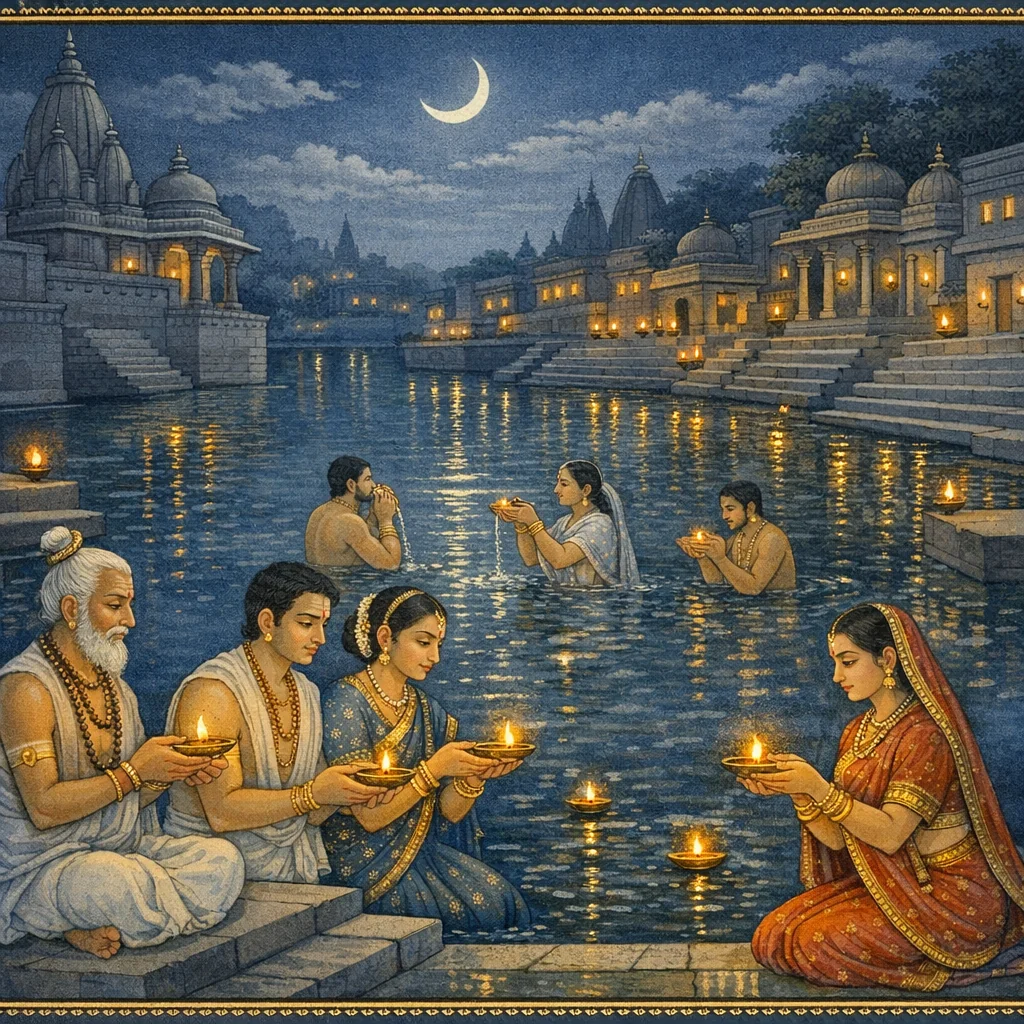
Adhyaya 14
This chapter is framed as dialogic instruction: Śiva’s gaṇas describe a sacred quarter evoked near Alakā’s “front region,” then turn to the sanctity of Kāśī in the īśānya (northeast) direction. Rudra-bhaktas and the eleven forms of Rudra are named as guardians and benefactors, establishing a protective theology of place, followed by an account of installing Īśāneśa and the merit it bestows. The discourse then unfolds a lunar myth: Atri’s tapas brings forth Soma; Soma’s fall and Brahmā’s ritual handling give rise to world-sustaining herbs. Soma finally arrives at Avimukta, where the Candreśvara liṅga is established. Mahādeva grants calendrical observances—worship on aṣṭamī/caturdaśī, full-moon (pūrṇimā) rites, and a special amāvāsyā–Monday vow involving fasting, night-vigil (jāgaraṇa), bathing with “candrodaka” water, and performing śrāddha at Candrodaka-kuṇḍa with named invocations of ancestors. The phalaśruti proclaims the fruits: ancestral satisfaction equal to the Gayā rites, release from the three debts (ṛṇa-traya), mitigation of accumulated sins, and access to Soma-loka. It concludes with an esoteric note on the Siddhayogīśvarī Pīṭha near Candreśvara, where disciplined practitioners may gain visionary confirmation and siddhi, while maintaining an ethical gatekeeping—unsuitable for nāstikas or detractors of śruti.
Shlokas
Verse 1
गणावूचतुः । अलकायाः पुरोभागे पूरैशानीमहोदया । अस्यां वसंति सततं रुद्रभक्तास्तपोधनाः
The Gaṇas said: ‘In front of Alakā lies the city called Aiśānī, most auspicious in its rise. In it dwell always the devotees of Rudra—ascetics rich in tapas.’
Verse 2
शिवस्मरणसंसक्ताः शिवव्रतपरायणाः । शिवसात्कृतकर्माणः शिवपूजारताः सदा
They are absorbed in the remembrance of Śiva, devoted to Śiva’s vows; their actions are offered and sanctified for Śiva, and they are ever engaged in Śiva’s worship.
Verse 3
साभिलाषास्तपस्यंति स्वर्गभोगोस्त्वितीह नः । तेऽत्र रुद्रपुरे रम्ये रुद्ररूपधरा नराः
They perform austerities with aspiration—“let there be heavenly enjoyment,” thus they think. Here, in this delightful city of Rudra, those men bear the very form of Rudra.
Verse 4
अजैकपादहिर्बुध्न्य मुख्या एकादशापि वै । रुद्राः परिवृढाश्चात्र त्रिशूलोद्यतपाणयः
Ajaikapād and Ahirbudhnya—chief among them—indeed all the eleven Rudras are present here, mighty and eminent, with hands uplifted bearing tridents.
Verse 5
पुर्यष्टकं च दुष्टेभ्यो देवध्रुग्भ्यो ह्यवंति ते । प्रयच्छंति वरान्नित्यं शिवभक्तजने वराः
They protect the eightfold city from the wicked—those who harm the gods. And those excellent ones ever bestow boons upon Śiva’s devotees.
Verse 6
एतैरपि तपस्तप्तं प्राप्य वाराणसीं पुरीम् । ईशानेशं महालिंगं परिस्थाप्य शुभप्रदम्
By these too, austerity was performed; and having reached the city of Vārāṇasī, they established the great Liṅga Īśāneśa, bestower of auspiciousness.
Verse 7
ईशानेश प्रसादेन दिश्यैश्यां हि दिगीश्वराः । एकादशाप्येकचरा जटामुकुटमंडिताः
By the grace of Īśāneśa, in that northeastern direction the Lords of the Quarters abide. All eleven move as one, adorned with crowns of matted locks.
Verse 8
भालनेत्रा नीलगलाः शुद्धांगा वृषभध्वजाः । असंख्याताः सहस्राणि ये रुद्रा अधिभूतलम्
They bear the eye upon the brow, blue throats, pure bodies, and the banner of the bull. Countless thousands of Rudras are there upon the earth-plane.
Verse 9
तेऽस्यां पुरि वसंत्यैश्यां सर्वभोगसमृद्धयः । ईशानेशं समभ्यर्च्य काश्यां देशांतरेष्वपि
They dwell in this Aiśāna quarter of the city, endowed with every enjoyment and prosperity. Having duly worshiped Īśāneśa in Kāśī, they move and act even in other regions as well.
Verse 10
विपन्नास्तेन पुण्येन जायंते ऽत्रपुरोहिताः । अष्टम्यां च चतुर्दश्यामीशानेशं यजंति ये
By that very merit, even those who have fallen into misfortune are born here as purohitas, ritual priests. Those who worship Īśāneśa on the eighth and the fourteenth lunar days attain such auspicious fruit.
Verse 11
त एव रुद्रा विज्ञेया इहामुत्राप्यसंशयम् । कृत्वा जागरणं रात्रावीशानेश्वर संनिधौ
They should indeed be known as Rudras—here and hereafter, without doubt—those who keep a night-long vigil in the presence of Īśāneśvara.
Verse 12
उपोष्यभूतांयांकांचिन्न नरो गर्भभाक्पुनः । स्वर्गमार्गे कथामित्थं शृण्वन्विष्णुगणोदिताम्
By observing a fast on any such sacred occasion, a man does not enter the womb again. Thus, while proceeding on the path to heaven, he hears this account as proclaimed by the attendants of Viṣṇu.
Verse 13
शिवशर्मा दिवाप्युच्चैरपश्यच्चंद्रचंद्रिकाम् । आह्लादयंतीं बहुशः समं सर्वेंद्रियैर्मनः
Śivaśarmā beheld, even by day, the moon’s cool radiance shining brightly on high; again and again it delighted the mind together with all the senses.
Verse 14
चमत्कृत्य चमत्कृत्य कोयं लोको हरेर्गणौ । पप्रच्छ शिवशर्मा तौ प्रोचतुस्तं च तौ द्विजम्
Amazed again and again, Śivaśarmā asked the two attendants of Hari, “What is this world?” And those two replied to that brāhmaṇa.
Verse 15
गणावूचतुः । शिवशर्मन्महाभाग लोक एष कलानिधेः । पीयूषवर्षिभिर्यस्य करैराप्याय्यते जगत्
The attendants said: “O fortunate Śivaśarmā, this is the realm of the Lord of the kalās (the Moon). With his nectar-raining rays, the whole world is nourished and refreshed.”
Verse 16
पिता सोमस्य भो विप्र जज्ञेऽत्रिर्भगवानृषिः । ब्रह्मणो मानसात्पूर्वं प्रजासर्गं विधित्सतः
O brāhmaṇa, the father of Soma is the blessed sage Atri, who was born earlier from Brahmā’s mind when he wished to set in motion the creation of beings.
Verse 17
अनुत्तरं नाम तपो येन तप्तं हि तत्पुरा । त्रीणिवर्षसहस्राणि दिव्यानीतीह नौ श्रुतम्
Formerly he performed an austerity called ‘Anuttara’. For three thousand divine years he undertook that tapas—so we have heard here.
Verse 18
ऊर्ध्वमाचक्रमे तस्य रेतः सोमत्वमीयिवत् । नेत्राभ्यां तच्च सुस्राव दशधा द्योतयद्दिशः
His seed rose upward and attained the state of Soma. And it flowed forth from his eyes, shining in tenfold streams and illuminating the directions.
Verse 19
तं गर्भं विधिना दिष्टा दश देव्यो दधुस्ततः । समेत्य धारयामासुर्नैव ताः समशक्नुवन्
Then, by sacred ordinance, ten goddesses received that embryo. Gathering together, they sought to bear it, yet they could not sustain it.
Verse 20
यदा न धारणे शक्तास्तस्य गर्भस्य ता दिशः । ततस्ताभिः सजूः सोमो निपपात वसुंधराम्
When the quarters of space could no longer bear that embryo, then Soma—the Moon—together with them, fell down upon the earth.
Verse 21
पतितं सोममालोक्य ब्रह्मा लो कपितामहः । रथमारोपयामास लोकानां हितकाम्यया
Seeing Soma fallen, Brahmā—the grandsire of the worlds—placed him upon a chariot, desiring the welfare of all beings.
Verse 22
स तेन रथमुख्येन सागरांतां वसुंधराम् । त्रिःसप्तकृत्वो द्रुहिणश्चकारामुं प्रदक्षिणम्
With that foremost chariot, Druhiṇa (Brahmā) circumambulated this earth, bounded by the oceans, twenty-one times.
Verse 23
तस्य यत्प्लवितं तेजः पृथिवीमन्वपद्यत । तथौषध्यः समुद्भूता याभिः संधार्यते जगत्
And the radiance of Soma that overflowed and spread upon the earth—therefrom medicinal herbs arose, by which this world is sustained.
Verse 24
सलब्धतेजा भगवान्ब्रह्मणा वर्धितः स्वयम् । तपस्तेपे महाभाग पद्मानां दशतीर्दश
Having regained his splendor and being strengthened by Brahmā himself, that blessed Soma, O great sage, performed austerities for ten tens of lotus-cycles.
Verse 25
अविमुक्तं समासाद्य क्षेत्रं परमपावनम् । संस्थाप्य लिंगममृतं चंद्रेशाख्यं स्वनामतः
Reaching Avimukta, the supremely purifying sacred field, he established an immortal liṅga, named Candreśa after himself.
Verse 26
बीजौषधीनां तोयानां राजाभूदग्रजन्मनाम् । प्रसादाद्देवदेवस्य विश्वेशस्य पिनाकिनः
By the grace of the God of gods—Viśveśa, the wielder of the Pināka—Soma became the king among the foremost-born: of seeds, of medicinal herbs, and of waters.
Verse 27
तत्र कूपं विधायैकममृतोदमिति स्मृतम् । यस्यांबुपानस्नानाभ्यां नरोऽज्ञातात्प्रमुच्यते
There he made a well known as Amṛtodaka. By drinking its water and bathing in it, a person is released even from unknown (unwitting) sins.
Verse 28
तुष्टेनदेवदेवेन स्वमौलौ यो धृतः स्वयम् । आदाय तां कलामेकां जगत्संजविनीं पराम्
Pleased, the God of gods (Śiva) himself placed him upon His own crown; and taking from that supreme, world-reviving portion (kalā), He took one part…
Verse 29
पश्चाद्दक्षेण शप्तोपि मासोने क्षयमाप्य च । आप्याय्यतेसौ कलया पुनरेव तया शशी
Later, though cursed by Dakṣa and thus waning month by month, that Moon is again nourished and restored by that very portion (kalā).
Verse 30
स तत्प्राप्य महाराज्यं सोमः सोमवतां वरः । राजसूयं समाजह्रे सहस्रशतदक्षिणम्
Having thus attained a great sovereignty, Soma—the best among those endowed with Soma’s splendour—performed the Rājasūya sacrifice, granting as priestly gifts a hundred thousand in dakṣiṇā.
Verse 31
दक्षिणामददत्सोमस्त्रींल्लोकानिति नौ श्रुतम् । तेभ्यो ब्रह्मर्षिमुख्येभ्यः सदस्येभ्यश्च भो द्विज
We have heard that Soma bestowed dakṣiṇā equal to the three worlds—giving it to those foremost among the Brahmarṣis and to the officiating members of the sacrificial assembly, O twice-born one.
Verse 32
हिरण्यगर्भो ब्रह्माऽत्रिर्भृगुर्यत्रर्त्विजोभवन् । सदस्योभूद्धरिस्तत्र मुनिभिर्बहुभिर्युतः
There Hiraṇyagarbha Brahmā, Atri, and Bhṛgu served as the officiating priests; and Hari himself became a sadasya there, accompanied by many sages.
Verse 33
तंसिनी च कुहूश्चैव द्युतिः पुष्टिः प्रभावसुः । कीर्तिर्धृतिश्च लक्ष्मीश्च नवदेव्यः सिषेविरे
Taṃsinī and Kuhū, Dyuti and Puṣṭi, Prabhāvasu, Kīrti, Dhṛti, and Lakṣmī—these nine goddesses attended upon him in service.
Verse 34
उमया सहितं रुद्रं संतर्प्याध्वरकर्मणा । प्राप सोम इति ख्यातिं दत्तां सोमेन शंभुना
Having satisfied Rudra together with Umā through the sacrificial rites, he attained the renowned name “Soma”—a fame bestowed by Śambhu through the soma-offering.
Verse 35
तत्रैव तप्तवान्सोमस्तपः परमदुष्करम् । तत्रैव राजसूयं च चक्रे चंद्रेश्वराग्रतः
There itself Soma performed an exceedingly difficult austerity; and there itself he carried out the Rājasūya, in the presence of Candreśvara, the Lord of the Moon.
Verse 36
तत्रैव ब्राह्मणैः प्रीतैरित्युक्तोसौ कलानिधिः । सोमोस्माकं ब्राह्मणानां राजा त्रैलोक्यदक्षिणः
There, that storehouse of lunar digits, Soma, was joyfully addressed by the pleased brāhmaṇas: “Soma is the king for us brāhmaṇas—one whose dakṣiṇā equals the three worlds.”
Verse 37
तत्रैव देवदेवस्य विलोचनपदं गतः । देवेन प्रीतमनसा त्रैलोक्याह्लादहेतवे
There itself he attained the “station of the gaze” of the God of gods; and that deity, pleased in mind, raised him to become the cause of delight for the three worlds.
Verse 38
त्वं ममास्य परामूर्तिरित्युक्तस्तत्तपोबलात् । जगत्तवोदयं प्राप्य भविष्यति सुखोदयम्
“You are my own supreme manifestation”—thus he was addressed; and by the power of that austerity, the world, attaining your rising, shall come to a rising of happiness.
Verse 39
त्वत्पीयूषमयैर्हस्तैः स्पृष्टमेतच्चराचरम् । भानुतापपरीतं च परा ग्लानिं विहास्यति
Touched by your nectar-like hands, this whole creation—moving and unmoving—even when scorched by the Sun’s heat, shall cast off its utmost weariness and languor.
Verse 40
एतदुक्त्वा महेशानो वरानन्यानदान्मुदा । द्विजराजतपस्तप्तं यदत्युग्रं त्वयात्र वै
Having spoken thus, Maheśāna (Śiva), rejoicing, granted other boons as well, for he recognized the exceedingly austere tapas you have performed here, O king among the twice-born.
Verse 41
यच्च क्रतु क्रियोत्सर्गस्त्वया मह्यं निवेदितः । स्थापितं यत्त्विदं लिंगं मम चंद्रेश्वराभिधम्
And the sacrificial offering, and the relinquishing of ritual fruits that you dedicated to me; and that you established here this liṅga bearing my name, ‘Candreśvara’—these deeds are especially dear to me.
Verse 42
ततोत्र लिंगे त्वन्नाम्नि सोमसोमार्धरूपधृक् । प्रतिमासं पंचदश्यां शुक्लायां सर्वगोप्यहम्
Therefore, at this liṅga named after you, I—bearing the form of Soma with the crescent-half—shall dwell here, wholly concealed, every month on the fifteenth day of the bright fortnight.
Verse 43
अहोरात्रं वसिष्यामि त्रैलोक्यैश्वर्यसंयुतः । ततोत्र पूर्णिमायां तु कृता स्वल्पापि सत्क्रिया
I shall remain here for a full day and night, endowed with sovereignty over the three worlds. Therefore, on the Full-Moon day (Pūrṇimā), even a small act of proper worship performed here becomes highly efficacious.
Verse 44
जपहोमार्चनध्यानदानब्राह्मणभोजनम् । महापूजा च सा नूनं मम प्रीत्यै भविष्यति
Japa, homa, worship, meditation, charity, and the feeding of Brāhmaṇas—such a great pūjā will surely become a cause of my delight.
Verse 45
जीर्णोद्धारादिकरणं नृत्यवाद्यादिकार्पणम् । ध्वजारोपणकर्मादि तपस्वियतितपर्णम्
Undertaking repairs and restorations, offering dance and music and the like, performing acts such as raising the temple-flag, and satisfying ascetics and renunciants—(all these are to be done as parts of the great worship).
Verse 46
चंद्रेश्वरे कृतं सर्वं तदानंत्याय जायते । अन्यच्च ते प्रवक्ष्यामि शृणु गुह्यं कलानिधे
Everything done for Candreśvara becomes a source of endless merit. And I shall tell you something further—listen to this secret, O Soma, treasure-house of rays.
Verse 47
अभक्ताय च नाख्येयं नास्तिकाय श्रुतिद्रुहे । अमावास्या यदा सोम जायते सोमवासरे
This should not be disclosed to one without devotion, nor to an atheist who betrays the Veda. When, O Soma, the New-Moon day (Amāvāsyā) falls on a Monday—
Verse 48
तदोपवासः कर्तव्यो भूतायां सद्भिरादरात् । कृतनित्यक्रियः सोम त्रयोदश्यां निशामय
Then, on that occasion, the righteous should observe a fast with reverence on the preceding Bhūtā-tithi. Having completed the daily obligatory rites, O Soma, keep vigil on the thirteenth lunar day.
Verse 49
शनिप्रदोषे संपूज्य लिंगं चंद्रेश्वराह्वयम् । नक्तं कृत्वा त्रयोदश्यां नियमं परिगृह्य च
At the Saturday pradoṣa, having duly worshipped the liṅga called Candreśvara, one should undertake the vow—observing a nakta-fast on the thirteenth tithi and adopting the prescribed restraints.
Verse 50
उपोष्य च चतुर्दश्यां कृत्वा जागरणं निशि । प्रातः सोमकुहूयोगे स्नात्वा चंद्रोदवारिभिः
Having fasted on the fourteenth tithi and kept vigil through the night, at dawn—when the Soma–Kuhū conjunction is present—one should bathe with the waters of Candroda.
Verse 51
उपास्य संध्यां विधिवत्कृतसर्वोदक क्रियः । उपचंद्रोदतीर्थेषु श्राद्धं विधिवदाचरेत्
Having duly performed the Sandhyā worship and completed the prescribed water-rites, one should then perform śrāddha there, at the subsidiary Candroda tīrthas, according to rule.
Verse 52
आवाहनार्घ्यरहितं पिंडान्दद्यात्प्रयत्नतः । वसुरुद्रादितिसुतस्वरूपपुरुषत्रयम्
With care one should offer the piṇḍas without the rites of invocation and arghya, as a triad embodying the Vasus, the Rudras, and the Ādityas.
Verse 53
मातामहांस्तथोद्दिश्य तथान्यानपि गोत्रजान् । गुरुश्वशुरबंधूनां नामान्युच्चार्य पिंडदः
Directing the rite also to the maternal grandfathers and likewise to other kinsmen of one’s lineage, the giver of piṇḍas should pronounce the names of teachers, fathers-in-law, and relatives, and then offer.
Verse 54
कुर्वञ्छ्राद्धं च तीर्थेस्मिञ्छ्रद्धयोद्धरतेखिलान् । गयायां पिंडदानेन यथा तुप्यंति पूर्वजाः
Performing śrāddha at this tīrtha with faith, one uplifts them all—just as the ancestors are satisfied by piṇḍa-offerings at Gayā.
Verse 55
तथा चंद्रोदकुंडेऽत्र श्राद्धैस्तृप्यंति पूर्वजाः । गयायां च यथा मुच्येत्सर्वर्णात्पितृजान्नरः
So too, here at the Candroda pond, the ancestors are satisfied by śrāddha; and just as at Gayā a man is freed from every ancestral debt, so is it here.
Verse 56
तथा प्रमुच्यते चर्णाच्चंद्रोदे पिण्डदानतः । यदा चंद्रेश्वरं द्रष्टुं यायात्कोपि नरोत्तमः
Likewise, by offering piṇḍas at Candroda one is released from debt; and when some excellent man sets out to behold Candreśvara,
Verse 57
तदा नृत्यंति मुदितास्तत्पूर्वप्रपितामहाः । अयं चंद्रोदतीर्थेस्मिंस्तर्पणं नः करिष्यति
Then the earlier great-grandfathers of his line rejoice and dance: ‘This man will perform our tarpaṇa at the Candroda tīrtha.’
Verse 58
अस्माकं मंदभाग्यत्वाद्यदि नैव करिष्यति । तदातत्तीर्थ संस्पर्शादस्मत्तृप्तिर्भविष्यति
‘But if, through our ill fortune, he does not perform it, then even by his mere contact with that tīrtha our satisfaction will come to be.’
Verse 59
स्पृशेन्नापि यदा मंदस्तदा द्रक्ष्यति तृप्तये । एवं श्राद्धं विधायाथ स्पृष्ट्वा चंद्रेश्वरं व्रती । संतर्प्य विप्रांश्च यतीन्कुर्याद्वै पारणं ततः
Even if a dull-minded man does not so much as touch it, at least by beholding it he brings satisfaction. Thus, having performed śrāddha and then touching Candreśvara, the votary—after satisfying and honoring brāhmaṇas and ascetics—should thereafter duly perform pāraṇa, the breaking of the fast.
Verse 60
एवं व्रते कृते काश्यां सदर्शे सोमवासरे । भवेदृणत्रयान्मुक्तो मृगांकमदनुग्रहात्
Thus, when this vow is performed in Kāśī on a Monday in the bright fortnight, one is freed from the threefold debts—by the gracious favor of Mṛgāṅka, the Moon.
Verse 61
अत्र यात्रा महाचैत्र्यां कार्या क्षेत्रनिवासिभिः । तारकज्ञानलाभाय क्षेत्रविघ्ननिवर्तिनी
Here, in the great Caitrī festival-season, the residents of the sacred kṣetra should undertake the yātrā, the pilgrimage-procession; it bestows tāraka-jñāna, the saving knowledge, and removes obstacles within the holy domain.
Verse 62
चंद्रेश्वरं समभ्यर्च्य यद्यन्यत्रापि संस्थितः । अघौघपटलीं भित्त्वा सोमलोकमवाप्स्यति
Even if one is staying elsewhere, having duly worshiped Candreśvara, one breaks through the dense mass of sins and attains Somaloka, the world of Soma.
Verse 63
कलौ चंद्रेशमहिमा नाभाग्यैरवगम्यते । अन्यच्च ते प्रवक्ष्यामि परं गुह्यं निशापते
In the Kali age, the greatness of Candreśa is not understood by the unfortunate. Yet I shall tell you something further—supremely secret, O Lord of Night, the Moon.
Verse 64
सिद्धयोगीश्वरं पीठमेतत्साधकसिद्धिदम् । सुरासुरेषु गंधर्व नागविद्याधरेष्वपि
This is the seat of the Siddha Yogīśvara, a pīṭha that bestows attainment upon sādhakas—renowned even among Devas and Asuras, Gandharvas, Nāgas, and Vidyādharas.
Verse 65
रक्षोगुह्यकयक्षेषु किंनरेषु नरेषु च । सप्तकोट्यस्तु सिद्धानामत्र सिद्धा ममाग्रतः
Among Rākṣasas, Guhyakas, Yakṣas, Kiṃnaras, and even among humans, there are seven crores of Siddhas—here they have been perfected in my very presence.
Verse 66
षण्मासं नियताहारो ध्यायन्विश्वेश्वरीमिह । चंद्रेश्वरार्चनायातान्सिद्धान्पश्यति सोऽग्रगान्
For six months, living on regulated food and meditating here upon Viśveśvarī, one beholds the foremost Siddhas as they come to worship Candreśvara.
Verse 67
सिद्धयोगीश्वरी साक्षाद्वरदा तस्य जायते । तवापि महती सिद्धिः सिद्धयोगीश्वरीक्षणात्
Siddhayogīśvarī herself becomes directly present and grants him boons; even for you, great attainment arises from but a single glimpse of Siddhayogīśvarī.
Verse 68
संति पाठान्यनेकानि क्षितौ साधकसिद्धये । परं योगीश्वरी पीठाद्भूपृष्ठेनाशु सिद्धिदम्
Many sacred places exist on earth for the accomplishment of practitioners; yet surpassing them all, the Yogīśvarī Pīṭha grants swift success even while one remains upon the earth’s surface.
Verse 69
यत्र चंद्रेश्वरं लिंगं त्वयेदं स्थापितं शशिन् । इदमेव हि तत्पीठमदृश्यमकृतात्मभिः
O Moon (Śaśin), where you established this liṅga of Candreśvara—this indeed is that very pīṭha, unseen by those whose selves are unpurified.
Verse 70
जितकामा जितक्रोधा जितलोभस्पृहास्मिताः । योगीश्वरीं प्रपश्यंति मम शक्तिपरां हिताम्
Those who have conquered desire, anger, greed, craving, and pride behold Yogīśvarī—my supreme and benevolent Śakti, who brings welfare.
Verse 71
ये तु प्रत्यष्टमि जनास्तथा प्रति चतुर्दशि । सिद्धयोगीश्वरीपीठे पूजयिष्यंति भाविताः
But those people, purified in intention, who worship at the pīṭha of Siddhayogīśvarī on each Aṣṭamī and each Caturdaśī,
Verse 72
अदृष्टरूपां सुभगां पिंगलां सर्वसिद्धिदाम् । धूपनैवेद्यदीपाद्यैस्तेषामाविर्भविष्यति
To them she will manifest—though her form is ordinarily unseen—auspicious Piṅgalā, bestower of all siddhis, when honored with incense, food-offerings, lamps, and the like.
Verse 73
इति दत्त्वा वराञ्छंभुस्तस्मै चंद्रमसे द्विज । अंतर्हितो महेशानस्तत्र वैश्वेश्वरे पुरे
Thus, having granted those boons to Candra, O brāhmaṇa, Śambhu—Maheśāna—became invisible there, in the city of Vaiśveśvara (Kāśī).
Verse 74
तदारभ्य च लोकेऽस्मिन्द्विजराजोधिपोभवत् । दिशोवितिमिराः कुर्वन्निजैः प्रसृमरैः करैः
From that time onward, in this world the Moon became sovereign among the twice-born; and with his far-reaching rays he made the quarters free of darkness.
Verse 75
सोमवारव्रतकृतः सोमपानरता नराः । सोमप्रभेणयानेन सोमलोकं व्रजंति हि
Men who observe the Monday vow and delight in Soma (ritual nectar) indeed go to the world of Soma, conveyed by a vehicle radiant with moonlike splendor.
Verse 76
चंद्रेश्वरसमुत्पत्तिं तथा चांद्रमसं तपः । यः श्रोष्यति नरो भक्त्या चंद्रलोके स इज्यते
Whoever hears with devotion the origin of Candreśvara and the Moon’s austerity—such a person is honored and worshipped in the world of Candra.
Verse 77
अगस्तिरुवाच । शिवशर्मणि शर्मकारिणीं प थि दिव्ये श्रमहारिणीं गणौ । कथयंतौ तु कथामिमां शुभामुडुलोकं परिजग्मतुस्ततः
Agastya said: Then the two attendants, who had brought joy to Śivaśarman and removed fatigue on the divine path, continued recounting this auspicious tale and thereafter proceeded to the world of the stars.