Adhyaya 4
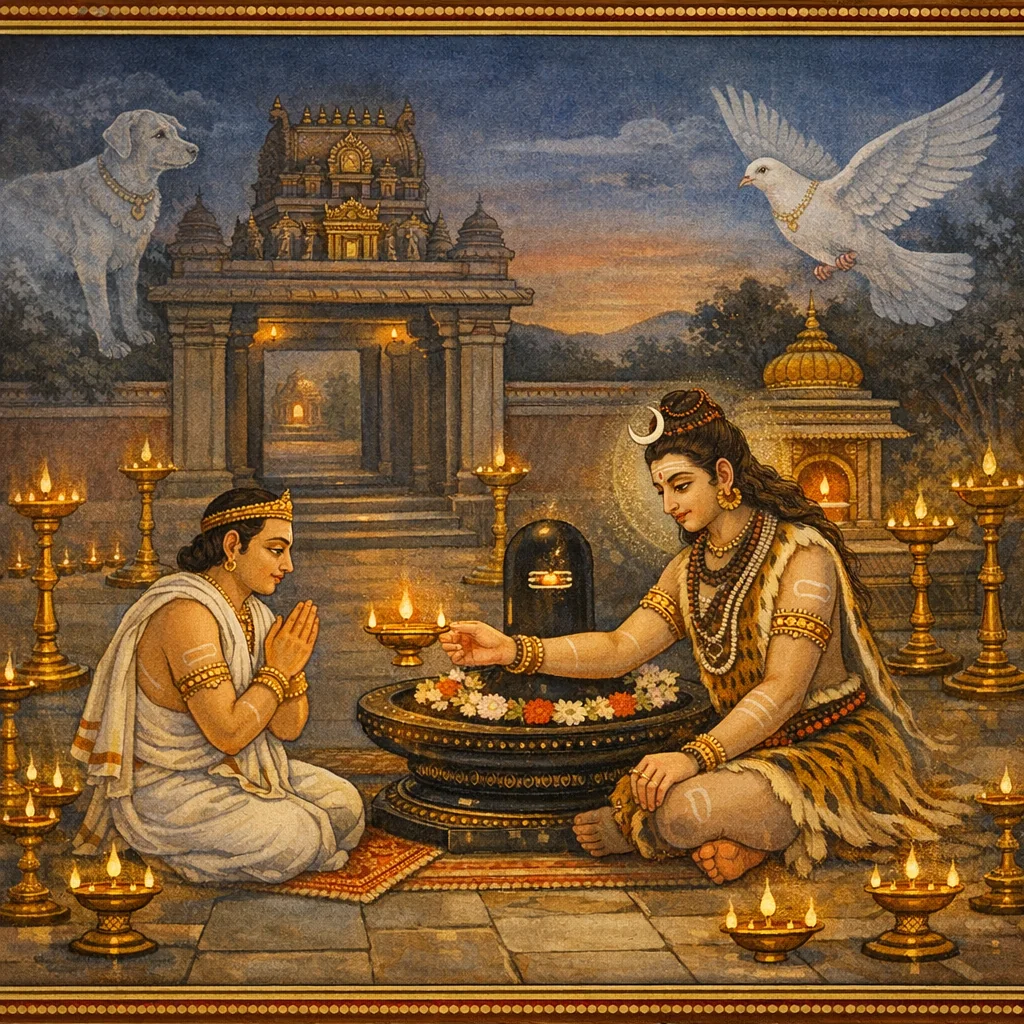
Sūta introduces an “extraordinary” account of Śiva’s greatness, declaring that Śiva-worship is a decisive means for those lost in sense-objects to cross the “ocean of demerit.” The chapter recounts King Vimardana of the Kirāta lands: though violent and morally excessive, he worships Śiva regularly, especially on the fourteenth lunar day (caturdaśī) in both bright and dark fortnights, celebrating with song and dance. His queen Kumudvatī questions this seeming contradiction, and the king explains it through karmic residues from former births. Once a dog seeking food, he repeatedly circumambulated a Śiva temple (pradakṣiṇā) and, driven away and struck, died at the gate; by that proximity and repeated circling he attained a royal birth. He also attributes his tri-kāla-jñatva—knowledge of past, present, and future—to having witnessed the caturdaśī worship and the festival of lamps. He tells of the queen’s prior birth as a flying pigeon that, fleeing a predator, circled a Śiva shrine and died there, gaining her present royal birth. The king then prophesies a series of shared rebirths across many kingdoms, culminating in renunciation, receiving brahma-jñāna from Agastya, and together attaining Śiva’s supreme abode. The concluding phalaśruti states that hearing or reciting this māhātmya leads to the highest state.
Shlokas
Verse 1
सूत उवाच । भूयोपि शिवमाहात्म्यं वक्ष्यामि परमाद्भुतम् । शृण्वतां सर्वपापघ्नं भवपाशविमोचनम्
Sūta said: Once more I shall proclaim the supremely wondrous greatness of Śiva; by hearing it, all sins are destroyed and the bonds of worldly becoming are cut away.
Verse 2
दुस्तरे दुरितांभोधौ मज्जतां विषयात्मनाम् । शिवपूजां विना कश्चित्प्लवो नास्ति निरूपितः
In the hard-to-cross ocean of sin, where those absorbed in sense-objects are drowning, no raft has been declared other than the worship of Śiva.
Verse 3
शिवपूजां सदा कुर्याद्बुद्धिमानिह मानवः । अशक्तश्चेत्कृता पूजां पश्येद्भक्तिविनम्रधीः
In this world, a wise person should always perform the worship of Śiva. If one is unable, then with a mind humbled by devotion one should at least behold the worship being performed.
Verse 4
अश्रद्धयापि यः कुर्याच्छिवपूजां विमुक्तिदाम् । पश्येद्वा सोपि कालेन प्रयाति परमं पदम्
Even one who performs the liberating worship of Śiva without faith—or even merely beholds it—he too, in time, attains the supreme state.
Verse 5
आसीत्किरातदेशेषु नाम्ना राजा विमर्दनः । शूरः परमदुर्द्धर्षो जितशत्रुः प्रतापवान्
In the lands of the Kirātas there was a king named Vimardana—valiant, utterly unconquerable, victorious over his enemies, and mighty in prowess.
Verse 6
सर्वदा मृगयासक्तः कृपणो निर्घृणो बली । सर्वमांसाशनः क्रूरः सर्ववर्णांगनावृतः
He was always addicted to hunting—miserly, pitiless, and powerful; a devourer of all kinds of meat, cruel, and surrounded by women of every social class.
Verse 7
तथापि कुरुते शंभोः पूजां नित्यमतंद्रितः । चतुर्दश्यां विशेषेण पक्षयोः शुक्लकृष्णयोः
Yet even so, he performed the worship of Śambhu daily without negligence—especially on the fourteenth lunar day in both the bright and dark fortnights.
Verse 8
महाविभवसंपन्नां पूजां कृत्वा स मोदते । हर्षेण महताविष्टो नृत्यति स्तौति गायति
Having performed worship endowed with great splendor and offerings, he rejoiced; overcome with immense delight, he danced, praised, and sang.
Verse 9
तस्यैवं वर्तमानस्य नृपतेः सर्वभक्षिणः । दुराचारस्य महिषी चेष्टितेनान्वतप्यत
As that king lived thus—eating without discernment and wholly unrighteous in conduct—his chief queen was tormented by sorrow because of his deeds.
Verse 10
सा वै कुमुद्वतीनाम राज्ञी शीलगुणान्विता । एकदा पतिमासाद्य रहस्ये तदपृच्छत
That queen—named Kumudvatī, endowed with noble character and virtues—once approached her husband in private and asked him about it.
Verse 11
एतत्ते चरितं राजन्महदाश्चर्यकारणम् । क्व ते महादुराचारः क्व भक्तिः परमेश्वरे
“O King, this conduct of yours is a cause of great astonishment. Where is your extreme wickedness—and where is your devotion to the Supreme Lord?”
Verse 12
सर्वदा सर्वभक्षस्त्वं सर्वस्त्रीजनलालसः । सर्वहिंसापरः क्रूरः कथं भक्तिस्तवेश्वरे
“You are always indiscriminate in what you eat, lustful after all women, devoted to every kind of violence, and cruel—how, then, can you have devotion to the Lord?”
Verse 13
इति पृष्टः स भूपालो विमृश्य सुचिरं ततः । त्रिकालज्ञः प्रहस्यैनां प्रोवाच सुकुतूहलः
Thus questioned, the king reflected for a long time. Knowing the three times—past, present, and future—he smiled at her and, full of curiosity, began to reply.
Verse 14
राजोवाच । अहं पूर्वभवे कश्चित्सारमेयो वरानने । पंपानगरमाश्रित्य पर्यटामि समंततः
The king said: “In a former birth, O fair-faced one, I was a dog. Dwelling near the city of Pampā, I wandered in every direction.”
Verse 15
एवं कालेषु गच्छत्सु तत्रैव नगरोत्तमे । कदाचिदागतः सोहं मनोज्ञं शिवमंदिरम्
“As time passed, there in that excellent city, I once came upon a beautiful temple of Śiva.”
Verse 16
पूजायां वर्तमानायां चतुर्दश्यां महातिथौ । अपश्यमुत्सवं दूराद्बहिर्द्वारं समाश्रितः
“When worship was underway on the great holy day of the fourteenth lunar tithi, I saw the festival from afar, staying by the outer gateway.”
Verse 17
अथाहं परमक्रुद्धैर्दंडहस्तैः प्रधावितः । तस्माद्देशादपक्रांतः प्राणरक्षापरायणः
“Then I was chased by men, furious and holding sticks; fleeing that place, I ran off intent only on saving my life.”
Verse 18
ततः प्रदक्षिणीकृत्य मनोज्ञं शिवमंदिरम् । द्वारदेशं पुनः प्राप्य पुनश्चैव निवारितः
“Then, having circumambulated that beautiful temple of Śiva, I again reached the gateway area—and once more I was driven back.”
Verse 19
पुनः प्रदक्षिणीकृत्य तदेव शिवमन्दिरम् । बलिपिंडादिलोभेन पुनर्द्वारमुपागतः
Having once again circumambulated that very temple of Śiva, he returned to its doorway again, driven by craving for the offered food-balls and the like.
Verse 20
एवं पुनःपुनस्तत्र कृत्वा कृत्वा प्रदक्षिणाम् । द्वारदेशे समासीनं निजघ्नुर्निशितैः शरैः
Thus, after circling there again and again, when he sat down near the doorway, they struck him with sharp arrows.
Verse 21
स विद्धगात्रः सहसा शिवद्वारि गतासुकः । जातोऽस्म्यहं कुले राज्ञां प्रभावाच्छिवसन्निधेः
Pierced in his body, he suddenly died at Śiva’s doorway. By the power of being near Śiva, I was then born into a lineage of kings.
Verse 22
दृष्ट्वा चतुर्दशीपूजां दीपमाला विलोकिताः । तेन पुण्येन महता त्रिकालज्ञोऽस्मि भामिनि
Because I beheld the worship of the fourteenth lunar day and saw the rows of lamps, by that great merit, O beloved, I have become a knower of the three times.
Verse 23
प्राग्जन्मवासनाभिश्च सर्वभक्षोऽस्मि निर्घृणः । विदुषामपि दुर्लंघ्या प्रकृतिर्वासनामयी
Because of the latent impressions from former births, I became a ruthless devourer of all. A nature woven of such impulses is difficult to overcome—even for the learned.
Verse 24
अतोऽहमर्चयामीशं चतुर्दश्यां जगद्गुरुम् । त्वमपि श्रद्धया भद्रे भज देवं पिनाकिनम्
Therefore I worship the Lord—the Guru of the world—on the fourteenth lunar day. You too, O noble lady, with faith, worship the God Pinākin (Śiva).
Verse 25
राज्ञ्युवाच । त्रिकालज्ञोऽसि राजेन्द्र प्रसादाद्गिरिजापतेः । मत्पूर्वजन्मचरितं वक्तुमर्हसि तत्त्वतः
The Queen said: “O king, by the grace of the Lord of Girijā (Śiva) you know the three times. Therefore, truthfully tell me the story of my former birth.”
Verse 26
राजोवाच । त्वं तु पूर्वभवे काचित्कपोती व्योमचारिणी । क्वापि लब्धवती किंचिन्मां सपिंडं यदृच्छया
The King said: “In a former birth you were a she-pigeon, moving through the sky. Somewhere, by chance, you obtained me—this lump of flesh.”
Verse 27
त्वद्गृहीतमथालोक्य गृध्रः कोप्यामिषं बली । निरामिषः स्वयं वेगाभिदुद्राव भीषणः
Seeing the meat taken by you, a powerful vulture—angered by craving for flesh—though itself without food, rushed forward at speed, terrifying.
Verse 28
ततस्तं वीक्ष्य वित्रस्ता विद्रुतासि वरानने । तेनानुयाता घोरेण मांसपिंडजिघृक्षया
Then, seeing it, you became frightened and fled, O fair-faced one—pursued by that dreadful creature, eager to seize the lump of meat.
Verse 29
दिष्ट्या श्रीगिरिमासाद्य श्रांता तत्र शिवालयम् । प्रदक्षिणं परिक्रम्य ध्वजाग्रे समुपस्थिता
By blessed fortune she reached Śrīgiri; though weary, she came to the shrine of Śiva there. Having reverently performed the rightward circumambulation (pradakṣiṇa), she stood in attendance before the temple’s flagstaff.
Verse 30
अथानुसृत्य सहसा तीक्ष्णतुंडो विहंगमः । त्वां निहत्य निपात्याधो मांसमादाय जग्मिवान्
Then, all at once, a sharp-beaked bird pursued you; striking you down, it killed you and cast you to the ground, and departed carrying away the flesh.
Verse 31
प्रदक्षिणप्रक्रमणाद्देवदेवस्य शूलिनः । तस्याग्रे मरणाच्चैव जातासीह नृपांगना
By performing the rightward circumambulation (pradakṣiṇa) of Śūlin, the God of gods, and by dying in his very presence, you have indeed been reborn as a princess, O royal lady.
Verse 32
राज्ञ्युवाच । श्रुतं सर्वमशेषेण प्राग्जन्मचरेितं मया । जातं च महदाश्चर्यं भक्तिश्च मम चेतसि । अथान्यच्छ्रोतुमिच्छामि त्रिकालज्ञ महामते । इदं शरीरमुत्सृज्य यास्यावः कां गतिं पुनः
The queen said: “I have heard in full the account of our conduct in a former birth. Great wonder—and devotion as well—has arisen in my heart. Now, O wise one who knows the three times, I wish to hear further: when we cast off this body, to what destination shall we go again?”
Verse 33
राजोवाच । अतो भवे जनिष्येऽहं द्वितीये सैंधवो नृपः
The king said: “In the next birth I shall be born as the king of Sindhu, in the second life to come.”
Verse 34
सृंजयेशसुता त्वं हि मामेव प्रतिपत्स्यसे । तृतीये तु भवे राजा सौराष्ट्रे भविताऽस्म्यहम्
You, as the daughter of the lord of the Sṛñjayas, shall indeed attain me again as your husband. And in the third birth I shall become a king in Saurāṣṭra.
Verse 35
कलिंगराजतनया त्वं मे पत्नी भविष्यसि । चतुर्थे तु भविष्यामि भवे गांधारभूमिपः
As the daughter of the king of Kaliṅga you will be my wife. And in the fourth birth I shall become the ruler of the land of Gāndhāra.
Verse 36
मागधी राजतनया तत्र त्वं मम गेहिनी । पंचमेऽवंतिनाथोऽहं भविष्यामि भवांतरे
There you will be my wife as the daughter of the king of Magadhā. In another turn of existence, in the fifth birth, I shall become the lord of Avanti.
Verse 37
दाशार्हराजतनया त्वमेव मम वल्लभा । अस्माज् जन्मनि षष्ठेऽहमानर्ते भविता नृपः
As the daughter of the Dāśārha king, you alone will be my beloved. In this course of births, in the sixth birth, I shall become a king in Ānarta.
Verse 38
ययातिवंशजा कन्या भूत्वा मामेव यास्यसि । पांड्यराजकुमारोऽहं सप्तमे भविता भवे
Becoming a maiden born in the lineage of Yayāti, you will come to me alone again. And in the seventh birth I shall be born as a prince of the Pāṇḍya king.
Verse 39
तत्र मत्सदृशो नान्यो रूपौदार्यगुणादिभिः । सर्वशास्त्रार्थतत्त्वज्ञो बलवान्दृढविक्रमः
There, none is equal to me in beauty, nobility, and virtues. He knows the true purport and essence of all śāstras—mighty, with unwavering valor.
Verse 40
सर्वलक्षणसंपन्नः सर्वलोकमनोरमः । पद्मवर्ण इति ख्यातः पद्ममित्रसमद्युतिः
Endowed with every auspicious mark, delightful to all the worlds, he is famed as ‘Padmavarṇa’, radiant with a splendor equal to his lotus-like friend.
Verse 41
भविता त्वं च वैदर्भी रूपेणाप्रतिमा भुवि । नाम्ना वसुमती ख्याता रूपावयवशोभिनी
And you, O princess of Vidarbha, will become incomparable in beauty upon the earth—renowned by the name ‘Vasumatī’, resplendent in the grace of every limb.
Verse 42
सर्व राजकुमाराणां मनोनयननंदिनी । सा त्वं स्वयंवरे सर्वान्विहाय नृपनंदनान्
Delighting the minds and eyes of all princes, you—at the svayaṃvara—will pass over all those sons of kings.
Verse 43
वरं प्राप्स्यसि मामेव दमयंतीव नैषधम् । सोऽहं जित्वा नृपान्सर्वान्प्राप्य त्वां वरवर्णिनीम्
You will choose me as your husband, just as Damayantī chose the Naiṣadha king. I shall conquer all the kings and, having won you—O fair-complexioned one—take you as mine.
Verse 44
स्वराष्ट्रस्थोऽखिलान्भोगान्भोक्ष्ये वर्षगणान्बहून् । इष्ट्वा च विविधैर्यज्ञैर्वाजिमेधादिभिः शुभैः
Established in my own realm, I shall enjoy every royal delight for many years; and I shall worship by many auspicious sacrifices—Aśvamedha and others.
Verse 45
संतर्प्य पितृदेवर्षीन्दानैश्च द्विजसत्तमान् । संपूज्य देवदेवेशं शंकरं लोकशंकरम्
Having satisfied the Pitṛs, the gods, and the ṛṣis—and by gifts the best of brāhmaṇas—having duly worshipped Śaṅkara, Lord of lords, the benefactor of the worlds.
Verse 46
पुत्रे राज्यधुरं न्यस्य गंतास्मि तपसे वनम् । तत्रागस्त्यान्मुनिवराद्ब्रह्मज्ञानमवाप्य च
Placing the burden of kingship upon my son, I shall go to the forest for austerities; and there, from the great sage Agastya, I shall attain knowledge of Brahman.
Verse 47
त्वया सह गमिष्यामि शिवस्य परमं पदम् । चतुर्दश्यां चतुर्दश्यामेवं संपूज्य शंकरम्
Together with you I shall go to Śiva’s supreme abode—having thus worshipped Śaṅkara on each fourteenth lunar day (caturdaśī).
Verse 48
सप्तजन्मसु राजस्त्वं भविष्यति वरानने । इत्येतत्सुकृतं लब्धं पूज़ादर्शनमात्रतः । क्व सारमेयो दुष्टात्मा क्वेदृशी बत सङ्गतिः
For seven births you shall be a king, O fair-faced one. Such merit is gained merely by the sight of worship. How could a wicked dog be linked with so holy an association?
Verse 49
सूत उवाच । इत्युक्तो निजनाथेन सा राज्ञी शुभलक्षणा
Sūta said: Thus addressed by her own lord, that queen, marked with auspicious signs, listened with reverent attention.
Verse 50
परं विस्मयमापन्ना पूजयामास तं मुदा । सोऽपि राजा तया सार्द्धं भुक्त्वा भोगान्यथेप्सितान्
Overcome with great wonder, she joyfully honored him. And that king too, together with her, enjoyed the delights he desired.
Verse 51
जगाम सप्तजन्मांते शंभोस्तत्परमं पदम् । य एतच्छिवपूजाया माहात्म्यं परमाद्भुतम् । शृणुयात्कीर्तयेद्वापि स गच्छेत्परमं पदम्
At the end of seven births, she went to Śambhu’s supreme abode. Whoever hears—or even proclaims—this most wondrous greatness of Śiva-worship, that person too attains the supreme state.