Sukta 168
Sukta 10.168
Traditionally, Sukta 10.168 is attributed to a Vāta-stuti seer in late Mandala 10; exact rishi requires Anukramaṇī confirmation.
Vāta (Wind)
Likely Triṣṭubh (common in nature hymns of RV X); confirm by scan.
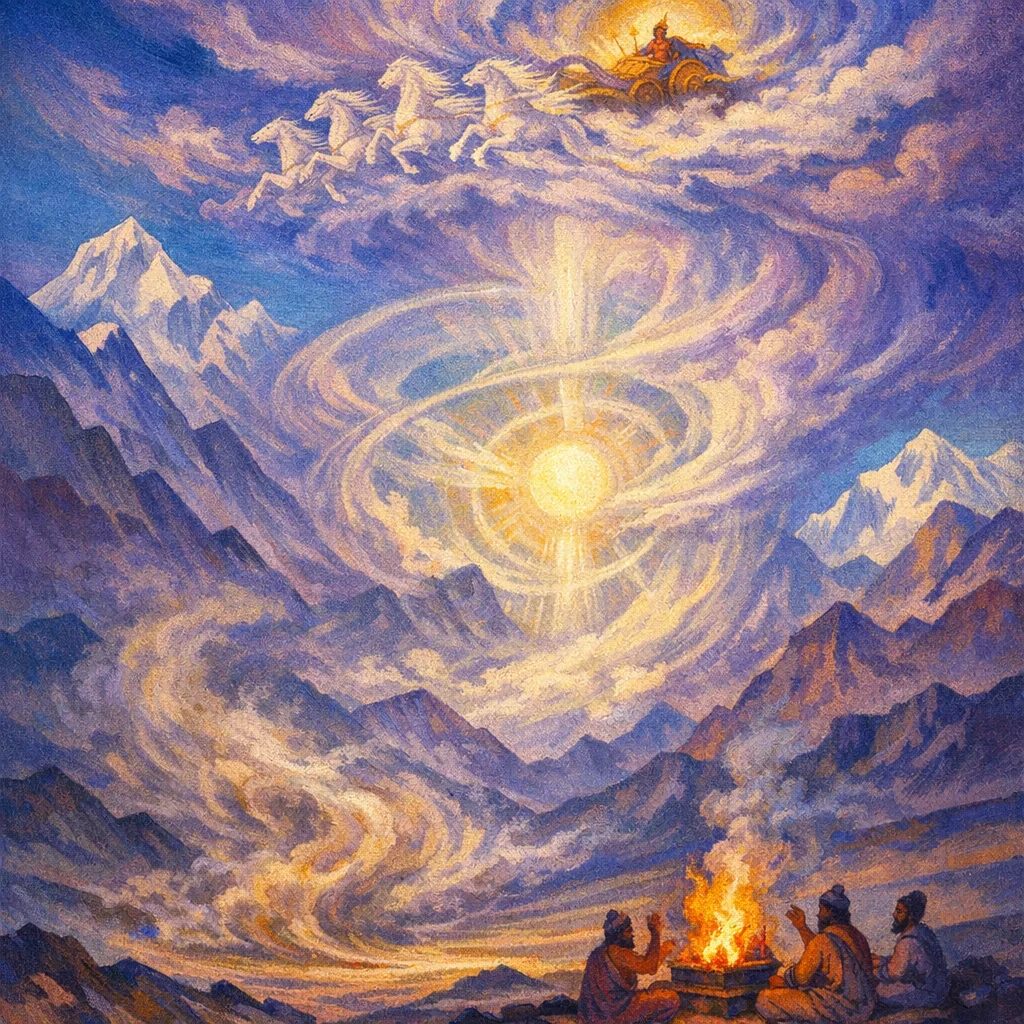
This short Vāta-stuti hymn praises Wind as an unseen yet unmistakable power: his chariot roars like thunder, touches heaven, and raises earth’s dust. It marvels at Vāta’s ceaseless motion through the midspace and his mysterious origin, then culminates by identifying him as the very “Self” of the gods and the womb/embryo of the world, worthy of oblation.
Mantras
Mantra 1
वातस्य नु महिमानं रथस्य रुजन्नेति स्तनयन्नस्य घोषः । दिविस्पृग्यात्यरुणानि कृण्वन्नुतो एति पृथिव्या रेणुमस्यन् ॥
Now the greatness of Vāta’s chariot goes forth, breaking onward; its sound thunders. Touching the heaven, it moves, making the red lights; and it goes too, casting the dust of the earth—stirring the field of life into motion.
Mantra 2
सं प्रेरते अनु वातस्य विष्ठा ऐनं गच्छन्ति समनं न योषाः । ताभिः सयुक्सरथं देव ईयतेऽस्य विश्वस्य भुवनस्य राजा ॥
Together the attendants are driven forth after Vāta; they go to meet him like maidens to an assembly. With them, yoked and in one chariot, the god moves—he, the king of all this world of becoming.
Mantra 3
अन्तरिक्षे पथिभिरीयमानो न नि विशते कतमच्चनाहः । अपां सखा प्रथमजा ऋतावा क्व स्विज्जातः कुत आ बभूव ॥
Moving on paths in the mid-world, he rests not on any day at all. Friend of the Waters, first-born, keeper of the Truth—where indeed was he born, from where has he come into being?
Mantra 4
आत्मा देवानां भुवनस्य गर्भो यथावशं चरति देव एषः । घोषा इदस्य शृण्विरे न रूपं तस्मै वाताय हविषा विधेम ॥
He is the very Self of the gods, the embryo of the world; this god moves as he wills. His sounds indeed are heard, not his form; to that Vāta we would offer the oblation—an assent of our being to the unseen mover.
Frequently Asked Questions
The hymn praises Vāta, the Wind—an invisible force known by his sound and by what he moves in sky and on earth.
Wind is not just weather: it is a life-giving cosmic power that moves through the midspace without rest, supports the world’s order, and is sensed through effects rather than seen as a form.
It highlights Vāta’s subtle nature: we perceive him by his roar, rush, and the dust or clouds he drives, while his own ‘shape’ cannot be directly grasped—so worship is offered to the unseen mover.