Sarga 74
परशुरामप्रादुर्भावः — The Appearance of Parasurama on the Return from Mithila
बालकाण्ड
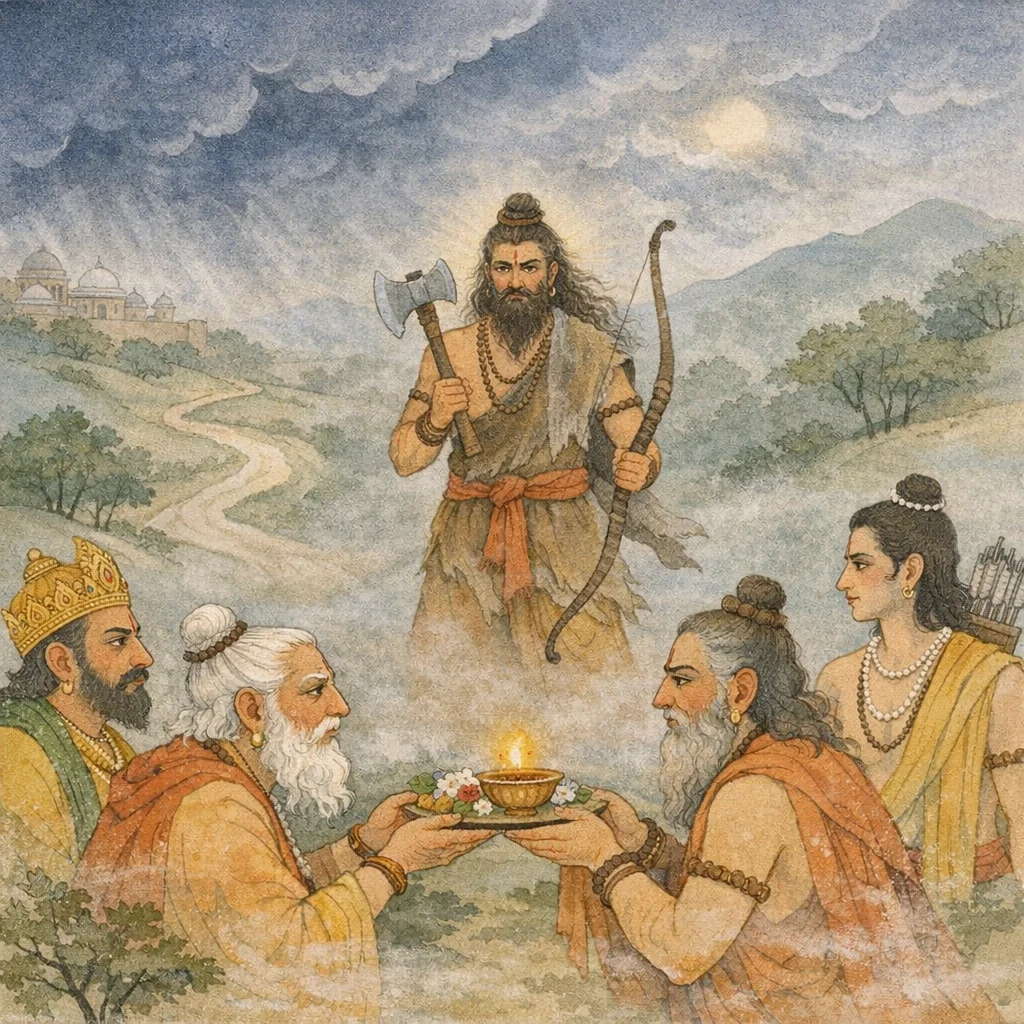
When night has passed, Viśvāmitra blesses the princes of the Raghu line and departs toward the northern mountains, in the direction of the Himālaya. Daśaratha then takes leave of Janaka and begins the journey back to Ayodhyā; Janaka accompanies him briefly and bestows abundant kanyādhana—great herds of cows, fine textiles, precious metals and gems, servants, and the fourfold army: elephants, horses, chariots, and infantry. As the king proceeds with sages leading the way, ominous cries of birds are heard, while deer move to the right as an auspicious sign. Disturbed by these mixed portents, Daśaratha questions Vasiṣṭha, who explains that the birds foretell a formidable event in accord with celestial order, whereas the deer signify pacification; thus the king should set aside grief. Suddenly a storm rises and the sun is darkened; ash-like dust envelops the host and many lose consciousness, though the king, his sons, and the foremost rishis remain steady. In that fearful gloom appears Bhārgava Jāmadagnya Paraśurāma—dreadful yet radiant, matted-haired, bearing an axe and a lightning-like bow with its chief arrow—likened to Śiva, the Tripuraghna. The assembled sages, anxious over his former rage that slew kṣatriyas, offer arghya and address him with soothing words. Paraśurāma accepts their homage and then speaks directly to Rāma Dāśarathi, setting the stage for the coming confrontation of ascetic authority, martial legitimacy, and dharmic restraint.
Shlokas
Verse 1
अथ रात्र्यां व्यतीतायां विश्वामित्रो महामुनिः।आपृष्ट्वा तौ च राजानौ जगामोत्तरपर्वतम् ।।।।आशीर्भि: पूरयित्वा च कुमारांश्च सराघवान्।
When the night had passed, the great sage Viśvāmitra, having filled the Rāghava princes with blessings and taking leave of the two kings, set out toward the northern mountains.
Verse 2
विश्वामित्रे गते राजा वैदेहं मिथिलाधिपम् ।आपृष्ट्वाऽथ जगामाशु राजा दशरथ: पुरीम्।।।।
After Viśvāmitra had departed, King Daśaratha took leave of Vaideha Janaka, the lord of Mithilā, and quickly set out for his own city, Ayodhyā.
Verse 3
गच्छन्तं तं तु राजानमन्वगच्छन्नराधिप:।।।।अथ राजा विदेहानां ददौ कन्याधनं बहु।
As King Daśaratha set out, King Janaka followed him for a distance; and then the lord of the Videhas bestowed abundant bridal gifts for his daughters.
Verse 4
गवां शतसहस्राणि बहूनि मिथिलेश्वर:।कम्बलानां च मुख्यानां क्षौमकोट्यंबराणि च।।।।हस्त्यश्वरथपादातं दिव्यरूपं स्वलङ्कृतम् ।ददौ कन्यापिता तासां दासीदासमनुत्तमम् ।।।।
The lord of Mithilā bestowed many hundreds of thousands of cows, along with choice woollen blankets and vast quantities of linen and silk garments.
Verse 5
गवां शतसहस्राणि बहूनि मिथिलेश्वर:।कम्बलानां च मुख्यानां क्षौमकोट्यंबराणि च।।1.74.4।।हस्त्यश्वरथपादातं दिव्यरूपं स्वलङ्कृतम् ।ददौ कन्यापिता तासां दासीदासमनुत्तमम् ।।1.74.5।।
The father of the brides also gave excellently adorned attendants and retainers—along with elephants, horses, chariots, and infantry—splendid in appearance and of the finest quality.
Verse 6
हिरण्यस्य सुवर्णस्य मुक्तानां विद्रुमस्य च।।।।ददौ परमसंहृष्ट: कन्याधनमनुत्तमम्।
Overjoyed, he gave unsurpassed bridal wealth as well—gold, fine gold ornaments, pearls, and coral.
Verse 7
दत्त्वा बहु धनं राजा समनुज्ञाप्य पार्थिवम्।।।।प्रविवेश स्वनिलयं मिथिलां मिथिलेश्वर:।
After giving abundant wealth and taking the king’s leave with due consent, the lord of Mithilā entered his own residence in Mithilā.
Verse 8
राजाऽप्ययोध्याधिपतिस्सह पुत्रैर्महात्मभि:।ऋषीन् सर्वान् पुरस्कृत्य जगाम सबलानुग:।।।।
King Daśaratha, lord of Ayodhyā, set out as well with his noble sons, placing all the sages at the forefront and proceeding onward with his army and attendants following behind.
Verse 9
गच्छन्तं तं नरव्याघ्रं सर्षिसङ्घं सराघवम्।।।।घोरा: स्म पक्षिणो वाचो व्याहरन्ति ततस्तत:।
As that tiger among men proceeded, accompanied by the assembly of sages and the Rāghavas, birds in various places uttered harsh cries, ominous again and again.
Verse 10
भौमाश्चैव मृगा स्सर्वे गच्छन्ति स्म प्रदक्षिणम्।।।।तान् दृष्ट्वा राजशार्दूलो वसिष्ठं पर्यपृच्छत।
All the land-dwelling animals were moving to the right; seeing this, the tiger among kings questioned Vasiṣṭha.
Verse 11
असौम्या: पक्षिणो घोरा मृगाश्चापि प्रदक्षिणा:।।।।किमिदं हृदयोत्कम्पि मनो मम विषीदति।
The birds are dreadful and inauspicious, yet the deer are moving to the right; what is this? My heart trembles, and my mind sinks into gloom.
Verse 12
राज्ञो दशरथस्यैतच्छ्रुत्वा वाक्यं महानृषि:।।।।उवाच मधुरां वाणीं श्रूयतामस्य यत्फलम्।
Having heard King Daśaratha’s words, the great sage spoke gently: “Let the outcome of this be heard.”
Verse 13
उपस्थितं भयं घोरं दिव्यं पक्षिमुखाच्च्युतम्।।।।मृगा: प्रशमयन्त्येते सन्तापस्त्यज्यतामयम्।
A dreadful fear has arisen, portended by cries that fell from the mouths of birds as though proclaiming a celestial sign. Yet these deer indicate the danger’s calming; therefore, let this grief be set aside.
Verse 14
तेषां संवदतां तत्र वायु: प्रादुर्बभूव ह।।।।कम्पयन् पृथिवीं सर्वां पातयंश्च द्रुमांच्छुभान्।
As they were conversing there, a sudden windstorm arose, shaking the whole earth and toppling beautiful trees.
Verse 15
तमसा संवृतस्सूर्य स्सर्वा न प्रबभुर्दिश।।।।भस्मना चावृतं सर्वं संमूढमिव तद्बलम्।
The sun was veiled by darkness, and the directions no longer shone. Covered in ash, the whole army seemed stunned and bewildered.
Verse 16
वसिष्ठश्चर्षयश्चान्ये राजा च ससुतस्तदा ।।।।संसज्ञा इव तत्रासन् सर्वमन्यद्विचेतनम्।
Then Vasiṣṭha and the other sages, and the king with his sons, remained as if fully aware; everyone else there lost consciousness.
Verse 17
तस्मिंस्तमसि घोरे तु भस्मच्छन्नेव सा चमू:।।।।ददर्श भीमसङ्काशं जटामण्डलधारिणम्।भार्गवं जामदग्न्यं तं राजराजविमर्दिनम्।।।।कैलासमिव दुर्धर्षं कालाग्निमिव दुस्सहम्।ज्वलंतमिव तेजोभिर्दुर्निरीक्ष्यं पृथग्जनै:।।।।स्कन्धे चासज्य परशुं धनुर्विद्युद्गणोपमम् ।प्रगृह्य शरमुख्यं च त्रिपुरघ्नं यथा शिवम्।।।।
In that dreadful darkness, when the host seemed as if covered in ash, the king beheld Bhārgava Paraśurāma, son of Jamadagni—crusher of kings: terrible in aspect, wearing a crown of matted locks; unassailable like Mount Kailāsa and unbearable like the fire of dissolution. Blazing with radiance, he was hard for ordinary people to look upon. With an axe slung on his shoulder, holding a bow like a cluster of lightning and grasping a foremost arrow, he stood like Śiva when he destroyed Tripura.
Verse 18
तस्मिंस्तमसि घोरे तु भस्मच्छन्नेव सा चमू:।।1.74.17।।ददर्श भीमसङ्काशं जटामण्डलधारिणम्। भार्गवं जामदग्न्यं तं राजराजविमर्दिनम्।।1.74.18।।कैलासमिव दुर्धर्षं कालाग्निमिव दुस्सहम्। ज्वलंतमिव तेजोभिर्दुर्निरीक्ष्यं पृथग्जनै:।।1.74.19।।स्कन्धे चासज्य परशुं धनुर्विद्युद्गणोपमम् । प्रगृह्य शरमुख्यं च त्रिपुरघ्नं यथा शिवम्।।1.74.20।।
In that fearful darkness, the host looked as though it were covered with ash. Then Daśaratha beheld Bhārgava Paraśurāma, son of Jamadagni—dreadful in form, wearing a crown-like mass of matted hair, and famed as a crusher of kings. He was unassailable like Mount Kailāsa and unbearable like the cosmic fire at dissolution; blazing with spiritual energy, he was hard for ordinary people to look upon. With an axe slung upon his shoulder, and holding a bow that flashed like a cluster of lightning along with his foremost arrow, he appeared like Śiva when he destroyed Tripura.
Verse 19
तस्मिंस्तमसि घोरे तु भस्मच्छन्नेव सा चमू:।।1.74.17।।ददर्श भीमसङ्काशं जटामण्डलधारिणम्। भार्गवं जामदग्न्यं तं राजराजविमर्दिनम्।।1.74.18।।कैलासमिव दुर्धर्षं कालाग्निमिव दुस्सहम्। ज्वलंतमिव तेजोभिर्दुर्निरीक्ष्यं पृथग्जनै:।।1.74.19।।स्कन्धे चासज्य परशुं धनुर्विद्युद्गणोपमम् । प्रगृह्य शरमुख्यं च त्रिपुरघ्नं यथा शिवम्।।1.74.20।।
He was unassailable like Mount Kailāsa, unbearable like the fire of cosmic dissolution, and as though blazing with spiritual power—impossible for ordinary people to gaze upon.
Verse 20
तस्मिंस्तमसि घोरे तु भस्मच्छन्नेव सा चमू:।।1.74.17।।ददर्श भीमसङ्काशं जटामण्डलधारिणम्। भार्गवं जामदग्न्यं तं राजराजविमर्दिनम्।।1.74.18।।कैलासमिव दुर्धर्षं कालाग्निमिव दुस्सहम्। ज्वलंतमिव तेजोभिर्दुर्निरीक्ष्यं पृथग्जनै:।।1.74.19।।स्कन्धे चासज्य परशुं धनुर्विद्युद्गणोपमम् । प्रगृह्य शरमुख्यं च त्रिपुरघ्नं यथा शिवम्।।1.74.20।।
In that fearful darkness, the host looked as though it were covered with ash. Then Daśaratha beheld Bhārgava Paraśurāma, son of Jamadagni—dreadful in form, wearing a crown-like mass of matted hair, and famed as a crusher of kings. He was unassailable like Mount Kailāsa and unbearable like the cosmic fire at dissolution; blazing with spiritual energy, he was hard for ordinary people to look upon. With an axe slung upon his shoulder, and holding a bow that flashed like a cluster of lightning along with his foremost arrow, he appeared like Śiva when he destroyed Tripura.
Verse 21
तं दृष्ट्वा भीमसङ्काशं ज्वलन्तमिव पावकम्।वसिष्ठप्रमुखा विप्रा जपहोमपरायणा:।।।।सङ्गता मुनयस्सर्वे सञ्जजल्पुरथो मिथ:।
Seeing Bhārgava Rāma—terrible in aspect, blazing like fire—Vasiṣṭha and the other brāhmaṇa sages, devoted to mantra-recitation and fire-offerings, gathered together, and all the muni spoke among themselves in hushed consultation.
Verse 22
कच्चित्पितृवधामर्षी क्षत्रं नोत्सादयिष्यति।।।।पूर्वं क्षत्रवधं कृत्वा गतमन्युर्गतज्वर:।क्षत्रस्योत्सादनं भूयो न खल्वस्य चिकीर्षितम्।।।।
Could it be that, still inflamed by the slaying of his father, he intends once more to exterminate the kṣatriyas? Formerly, after killing the kṣatriyas, his anger and fevered anguish had subsided—surely he does not wish again to destroy the kṣatriya order.
Verse 23
कच्चित्पितृवधामर्षी क्षत्रं नोत्सादयिष्यति।।1.74.22।।पूर्वं क्षत्रवधं कृत्वा गतमन्युर्गतज्वर:।क्षत्रस्योत्सादनं भूयो न खल्वस्य चिकीर्षितम्।।1.74.23।।
The father of the brides also gave excellently adorned attendants and retainers—along with elephants, horses, chariots, and infantry—splendid in appearance and of the finest quality.
Verse 24
एवमुक्त्वाऽर्घ्यमादाय भार्गवं भीमदर्शनम्।ऋषयो राम रामेति वचो मधुरमब्रुवन्।।।।
Having thus spoken, the sages took up the arghya-offering and, addressing the dread-visaged Bhārgava with gentle, sweet words, said: “Rāma, Rāma.”
Verse 25
प्रतिगृह्य तु तां पूजामृषिदत्तां प्रतापवान्।रामं दाशरथिं रामो जामदग्न्योऽभ्यभाषत।।।।
The mighty Rāma Jāmadagnya, having accepted the honor bestowed by the sages, addressed Rāma Dāśarathi, the son of Daśaratha.
Frequently Asked Questions
The chapter stages a dharma-sensitive response to fear and uncertainty: Daśaratha confronts contradictory omens and must choose between panic and disciplined inquiry; the sages then manage a potentially violent encounter by honoring Paraśurāma with arghya and measured speech, prioritizing restraint and protocol.
Vasiṣṭha’s counsel models nimitta-vicāra without fatalism: unsettling signs may indicate a powerful event, yet one should not abandon steadiness. The sarga also teaches that ritualized respect and calm address can de-escalate confrontation even when immense power is present.
Mithilā and Ayodhyā frame the political geography of departure and return; Viśvāmitra’s movement toward the northern mountains gestures to the Himālaya cultural horizon. Culturally, the sarga highlights kanyādhana (marriage-gift economy) and arghya (hospitality to ascetics) as formal instruments of alliance and social order.