Sarga 73
पम्पा-ऋष्यमूक-मार्गोपदेशः (Guidance to Pampa and Rishyamuka; counsel to befriend Sugriva)
अरण्यकाण्ड
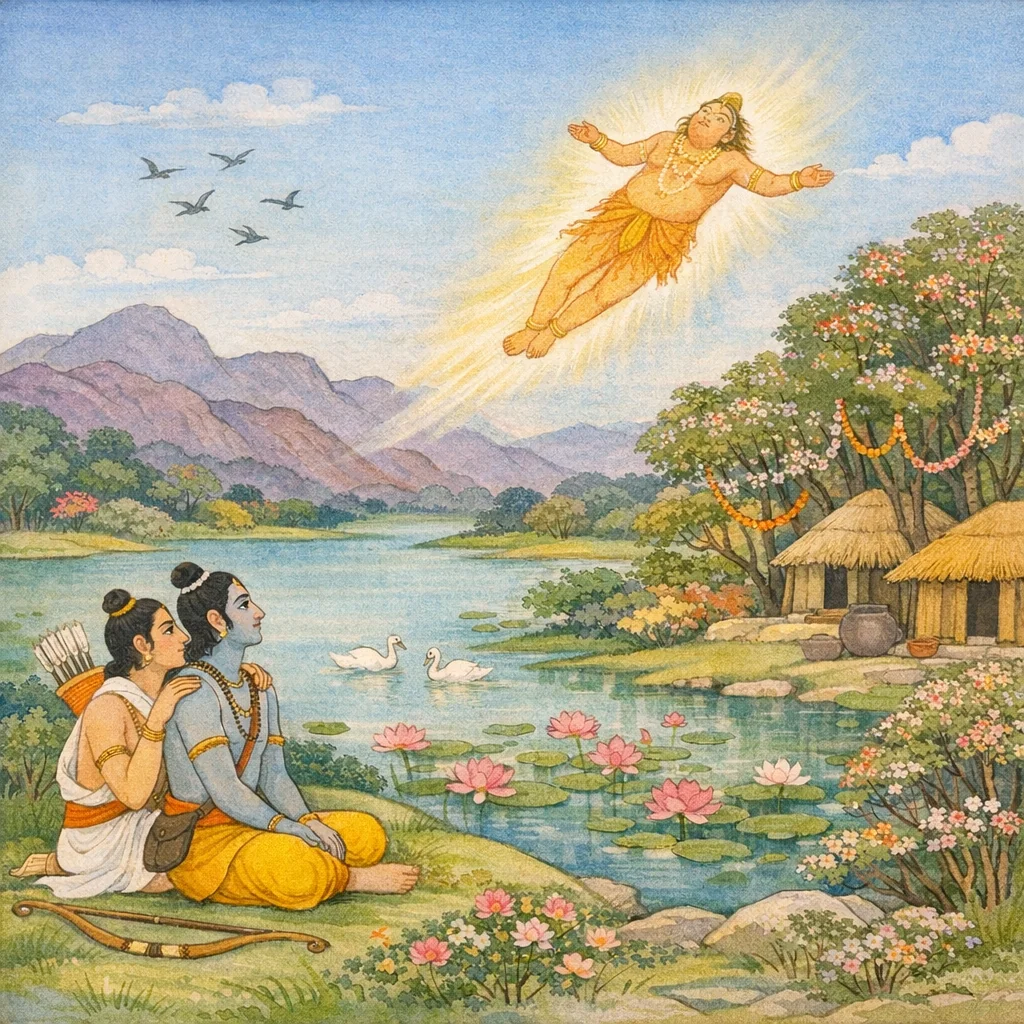
In this sarga, Kabandha, having indicated the means by which Sītā may be recovered, gives Rāma and Lakṣmaṇa his final, carefully ordered itinerary and strategic counsel. He marks out an auspicious westward route through flowering forests, naming edible fruits and portraying the landscape’s fragrances, sounds, and coolness as a healing counterpoise to grief. He then directs the brothers to Lake Pampā, with gentle banks and waters bright with lotuses and lilies, abundant in birds, fish, and forest game. Lakṣmaṇa’s service—offering food and water—is framed as disciplined companionship and steadfast support amid hardship. The discourse turns from nature to sacred geography: the region of Matanga’s āśrama, where austerity makes garlands imperishable; the continued presence of the ascetic Śabarī; and a protective injunction that keeps elephants from violating the hermitage. Kabandha further identifies Mount Ṛṣyamūka—hard to climb, guarded, and morally selective, punishing sinners—and points to a hidden cave with a cool tank where Sugrīva dwells with his companions. At the close, Kabandha assumes a radiant form and departs skyward, explicitly advising Rāma to establish friendship with Sugrīva, so that guidance through the terrain becomes the strategy for a decisive alliance.
Shlokas
Verse 1
निदर्शयित्वा रामाय सीतायाः प्रतिपादने।वाक्यमन्वर्थमर्थज्ञः कबन्धः पुनरब्रवीत्।।3.73.1।।
Having shown Rāma the proper course for recovering Sītā, Kabandha—knowing the true import of things—spoke again, in words fully aligned with their meaning.
Verse 2
एष राम शिवः पन्था यत्रैते पुष्पिता द्रुमाः।प्रतीचीं दिशमाश्रित्य प्रकाशन्ते मनोरमाः।।3.73.2।।जम्बूप्रियालपनसप्लक्षन्यग्रोधतिन्धुकाः।अश्वत्थाः कर्णिकाराश्च चूताश्चान्ये च पादापाः।।3.73.3।।धन्वना नागवृक्षाश्च तिलका नक्तमालकाः।नीलाशोकाः कदम्बाश्च करवीराश्च पुष्पिताः।।3.73.4।।अग्निमुख्या अशोकाश्च सुरक्ताः पारिभद्रकाः।
O Rāma, this is an auspicious path, shining westward with delightful trees in bloom—jambū, priyāla, jackfruit, plakṣa, banyan, tinduka, aśvattha, karṇikāra, mango, and many others; also dry-land and thorny trees, tilaka and night-blooming trees, blue-flowered aśoka, kadamba, karavīra, agnimukhya, red aśoka, and pārijāta-like pāribhadraka trees.
Verse 3
एष राम शिवः पन्था यत्रैते पुष्पिता द्रुमाः।प्रतीचीं दिशमाश्रित्य प्रकाशन्ते मनोरमाः।।3.73.2।।जम्बूप्रियालपनसप्लक्षन्यग्रोधतिन्धुकाः।अश्वत्थाः कर्णिकाराश्च चूताश्चान्ये च पादापाः।।3.73.3।।धन्वना नागवृक्षाश्च तिलका नक्तमालकाः।नीलाशोकाः कदम्बाश्च करवीराश्च पुष्पिताः।।3.73.4।।अग्निमुख्या अशोकाश्च सुरक्ताः पारिभद्रकाः।
There are jambū, priyāla, panasa, plakṣa, nyagrodha, and tindhuka trees—also aśvattha, karṇikāra, mango, and many other trees as well.
Verse 4
एष राम शिवः पन्था यत्रैते पुष्पिता द्रुमाः।प्रतीचीं दिशमाश्रित्य प्रकाशन्ते मनोरमाः।।3.73.2।।जम्बूप्रियालपनसप्लक्षन्यग्रोधतिन्धुकाः।अश्वत्थाः कर्णिकाराश्च चूताश्चान्ये च पादापाः।।3.73.3।।धन्वना नागवृक्षाश्च तिलका नक्तमालकाः।नीलाशोकाः कदम्बाश्च करवीराश्च पुष्पिताः।।3.73.4।।अग्निमुख्या अशोकाश्च सुरक्ताः पारिभद्रकाः।
O Rama, this is an auspicious path; as one goes westward, delightful trees shine forth in bloom—jambū, priyāla, panaśa, plakṣa, nyagrodha, and tindhuka; aśvattha, karṇikāra, mango, and many other trees; trees of the dry lands and nāga-trees, tilaka and night-blooming trees; blue aśoka, kadamba, and flowering karavīra; and agnimukhya aśokas, deep-red trees, and pārijāta-like pāribhadrakas.
Verse 5
तानारुह्याथवा भूमौ पातयित्वा च तान्बलात्।।3.73.5।।फलान्यमृतकल्पानि भक्षयन्तौ गमिष्यथः।
Climb those trees, or with your strength bring them down to the ground. Eat those fruits, like amṛta, and then continue on your way.
Verse 6
तदतिक्रम्य काकुत्स्थ वनं पुष्पितपादपम्।।3.73.6।।नन्दनप्रतिमं चान्यत्कुरवो ह्युत्तरा इव।
O Kakutstha, once you pass beyond that forest of flowering trees, you will reach another woodland, like Nandana itself, resembling the famed northern land of the Kurus.
Verse 7
सर्वकालफला यत्र पादपास्तु मधुस्रवाः।।3.73.7।।सर्वे च ऋतवस्तत्र वने चैत्ररथे यथा।
There the trees bear fruit in every season and drip with honey; and all the seasons seem to be present in that forest, as in Kubera’s Caitraratha grove.
Verse 8
फलभारानतास्तत्र महाविटपधारिणः।।3.73.8।।शोभन्ते सर्वतस्तत्र मेघपर्वतसन्निभाः।
There, on every side, splendid trees with mighty branches stand, bent low beneath the burden of fruit—appearing like clouds and mountains.
Verse 9
तानारुह्याथवा भूमौ पातयित्वा यथासुखम्।।3.73.9।।फलान्यमृतकल्पानि लक्ष्मणस्ते प्रदास्यति।
Lakshmana will bring you those fruits, like nectar—either by climbing the trees or by bringing them down to the ground, as you wish.
Verse 10
चङ्क्रमन्तौ वरान्देशान्शैलाच्छैलं वनाद्वनम्।।3.73.10।।ततः पुष्करिणीं वीरौ पम्पां नाम गमिष्यथः।
Travelling through fair regions—moving from hill to hill and from forest to forest—you two heroes will then reach the lotus-lake called Pampā.
Verse 11
अशर्करामविभ्रंशां समतीर्थामशैवलाम्।।3.73.11।।राम सञ्जातवालूकां कमलोत्पलशालिनीम्।
O Rāma, (Pampā) has banks free of stones and without treacherous slipping; its shores are even and unmossed, with soft sand formed along them, and it abounds in lotuses and water-lilies.
Verse 12
तत्र हंसाः प्लवाः क्रौञ्चाः कुरराश्चैव राघव।।3.73.12।।वल्गुस्वना विकूजन्ति पम्पासलिलगोचराः।
There, O Rāghava, swans, ducks, krauñca-birds, and curlews—moving about in Pampā’s waters—call out with sweet and varied cries.
Verse 13
नोद्विजन्ते नरान्दृष्ट्वा वधस्याकोविदाश्शुभाः।।3.73.13।।घृतपिण्डोपमान् स्थूलांस्तान्द्विजान्भक्षयिष्यथः।
Seeing men, those harmless birds—unaware of death—do not grow afraid; and you two may take and eat those plump birds, like lumps of ghee.
Verse 14
रोहितान्वक्रतुण्डांश्च नडमीनांश्च राघव।।3.73.14।।पम्पायामिषुभिर्मत्स्यांस्तत्र राम वरान्हतान्।निस्त्वक्पक्षानयस्तप्तानकृशानेककण्टकान्।।3.73.15।।तव भक्त्या समायुक्तो लक्ष्मणस्सम्प्रदास्यति।
O Rāghava—there in Pampā, O Rāma—Lakṣmaṇa, devoted to you, will offer you choice fish he has struck with arrows: rohita-fish, crooked-mouthed fish, and large fish, cooked on iron spits—fat, with a single bone, and described as without scales and fins.
Verse 15
रोहितान्वक्रतुण्डांश्च नडमीनांश्च राघव।।3.73.14।।पम्पायामिषुभिर्मत्स्यांस्तत्र राम वरान्हतान्।निस्त्वक्पक्षानयस्तप्तानकृशानेककण्टकान्।।3.73.15।।तव भक्त्या समायुक्तो लक्ष्मणस्सम्प्रदास्यति।
O Rāghava—there in Pampā, O Rāma—Lakṣmaṇa, devoted to you, will offer you choice fish he has struck with arrows: rohita-fish, crooked-mouthed fish, and large fish, cooked on iron spits—fat, with a single bone, and described as without scales and fins.
Verse 16
भृशते खादतो मत्स्यान्पम्पायाः पुष्पसञ्चये।।3.73.16।।पद्मगन्धि शिवं वारि सुखशीतमनामयम्।उद्धृत्य सतताक्लिष्टं रौप्यस्फाटिकसन्निभम्।।3.73.17।।असौ पुष्करपर्णेन लक्ष्मणः पाययिष्यति।
While you happily eat the fish amid Pampā’s flower-filled banks, Lakṣmaṇa will draw water—fragrant with lotus-scent, wholesome and pleasant, cool and health-giving, ever-clear like silver and crystal—and give it to you to drink in a lotus leaf.
Verse 17
भृशते खादतो मत्स्यान्पम्पायाः पुष्पसञ्चये।।3.73.16।।पद्मगन्धि शिवं वारि सुखशीतमनामयम्।उद्धृत्य सतताक्लिष्टं रौप्यस्फाटिकसन्निभम्।।3.73.17।।असौ पुष्करपर्णेन लक्ष्मणः पाययिष्यति।
While you happily eat the fish amid Pampā’s flower-filled banks, Lakṣmaṇa will draw water—fragrant with lotus-scent, wholesome and pleasant, cool and health-giving, ever-clear like silver and crystal—and give it to you to drink in a lotus leaf.
Verse 18
स्थूलान्गिरिगुहाशय्यान्वराहान्वनचारिणः।।3.73.18।।अपां लोभादुपावृत्तान्वृषभानिव नर्दतः।रूपावनितांश्च पम्पायांद्रक्ष्यसि त्वं नरोत्तम।।3.73.19।।
O best of men, at Pampā you will see great boars—forest-roamers that lie in mountain caves—coming near out of desire for water, roaring like bulls, and striking in their impressive form.
Verse 19
स्थूलान्गिरिगुहाशय्यान्वराहान्वनचारिणः।।3.73.18।।अपां लोभादुपावृत्तान्वृषभानिव नर्दतः।रूपावनितांश्च पम्पायांद्रक्ष्यसि त्वं नरोत्तम।।3.73.19।।
O best of men, at Pampā you will see great boars—forest-roamers that lie in mountain caves—coming near out of desire for water, roaring like bulls, and striking in their impressive form.
Verse 20
सायाह्ने विचरन्राम विटपीन्माल्यधारिणः।शीतोदकं च पम्पाया दृष्ट्वा शोकं विहास्यसि।।3.73.20।।
Rāma, when you stroll there in the evening and see the trees heavy with blossoms and Pampā’s cool waters, you will cast off your grief.
Verse 21
सुमनोभिश्चितांस्तत्र तिलकान्नक्तमालकान्।उत्पलानि च फुल्लानि पङ्कजानि च राघव।।3.73.21।।
O Rāghava, there you will see tilaka trees and night-blooming trees laden with blossoms, and also water-lilies and lotuses in full bloom.
Verse 22
न तानि कश्चिन्माल्यानि तत्रारोपयिता नरः।न च वै म्लानतां यान्ति न च शीर्यन्ति राघव।।3.73.22।।
O Rāghava, no one there wears those garlands—yet they neither fade nor wither, nor do they fall apart.
Verse 23
मतङ्गशिष्यास्तत्राऽसन्नृषयस्सुसमाहिताः।तेषां भाराभितप्तानां वन्यमाहरतां गुरोः।।3.73.23।।ये प्रपेतुर्महीं तूर्णं शरीरात्स्वेदबिन्दवः।तानि जातानि माल्यानि मुनीनां तपसा तदा।।3.73.24।।स्वेदबिन्दुसमुत्थानि न विनश्यन्ति राघव।
There once lived the sages—disciples of Matanga—perfectly composed in mind. As they bore forest-offerings for their teacher, burdened and weary, drops of sweat swiftly fell from their bodies to the earth. By the power of those munis’ austerity, those drops became garlands; and born of sweat-drops, they do not perish, O Rāghava.
Verse 24
मतङ्गशिष्यास्तत्राऽसन्नृषयस्सुसमाहिताः।तेषां भाराभितप्तानां वन्यमाहरतां गुरोः।।3.73.23।।ये प्रपेतुर्महीं तूर्णं शरीरात्स्वेदबिन्दवः।तानि जातानि माल्यानि मुनीनां तपसा तदा।।3.73.24।।स्वेदबिन्दुसमुत्थानि न विनश्यन्ति राघव।
Though they have long since departed, their attendant is seen even now—an ascetic woman named Śabarī, O Kakutstha, long-lived.
Verse 25
तेषां गतानामद्यापि दृश्यते परिचारिणी।।3.73.25।।श्रमणी शबरी नाम काकुत्स्थ चिरजीविनी।
Though they have long since departed, their attendant is seen even now—an ascetic woman named Śabarī, O Kakutstha, long-lived.
Verse 26
त्वां तु धर्मे स्थिता नित्यं सर्वभूतनमस्कृतम्।।3.73.26।।दृष्ट्वा देवोपमं राम स्वर्गलोकं गमिष्यति।
Ever established in dharma, she will—upon seeing you, O Rāma, godlike and revered by all beings—go to the heavenly world.
Verse 27
ततस्तद्राम पम्पायास्तीरमासाद्य पश्चिमम्।।3.73.27।।आश्रमस्थानमतुलं गुह्यं काकुत्स्थ पश्यसि।
Then, O Rāma, upon reaching the western bank of Pampā, you will behold an incomparable hermitage-site—secluded and hidden, O Kakutstha.
Verse 28
न तत्राक्रमितुं नागाश्शक्नुवन्ति तमाश्रमम्।।3.73.28।।विविधास्तत्र वै नागा वने तस्मिंश्च पर्वते।ऋषेस्तत्र मतङ्गस्य विधानात्तच्च काननम्।।3.73.29।।
There, the elephants are not able to assail that hermitage.
Verse 29
न तत्राक्रमितुं नागाश्शक्नुवन्ति तमाश्रमम्।।3.73.28।।विविधास्तत्र वै नागा वने तस्मिंश्च पर्वते।ऋषेस्तत्र मतङ्गस्य विधानात्तच्च काननम्।।3.73.29।।
Indeed, many kinds of elephants roam in that forest and on that mountain; yet that woodland is kept in order by the ordinance of the sage Mataṅga.
Verse 30
तस्मिन्नन्दनसङ्काशे देवारण्योपमे वने।नानाविहगसङ्कीर्णे रंस्यसे राम निर्वृतः।।3.73.30।।
O Rāma, in that forest—like Nandana, like the divine grove of the devas, filled with many kinds of birds—you will delight there, at peace and free from sorrow.
Verse 31
ऋष्यमूकश्च पम्पायाः पुरस्तात्पुष्पितद्रुमः।सुदुःखारोहणो नाम शिशुनागाभिरक्षितः।।3.73.31।।उदारो ब्रह्मणा चैव पूर्वकाले विनिर्मितः।
In front of Lake Pampā stands Mount Ṛṣyamūka, adorned with flowering trees; it is called “Hard-to-climb” and is guarded by young elephants. Lofty and noble, it was fashioned by Brahmā in ancient times.
Verse 32
शयानः पुरुषो राम तस्य शैलस्य मूर्धनि।।3.73.32।।यत्स्वप्ने लभते वित्तं तत्प्रबुद्धोऽधिगच्छति।
O Rāma, a man who lies down on the summit of that mountain obtains, upon waking, the very wealth he gains in his dream.
Verse 33
नत्वेनं विषमाचार पापकर्माऽधिरोहति।।3.73.33।।यस्तु तं विषमाचारः पापकर्माऽधिरोहति।तत्रैव प्रहऱन्त्येनं सुप्तमादाय राक्षसाः।।3.73.34।।
But a wicked man, one of sinful deeds and crooked conduct, does not ascend it.
Verse 34
नत्वेनं विषमाचार पापकर्माऽधिरोहति।।3.73.33।।यस्तु तं विषमाचारः पापकर्माऽधिरोहति।तत्रैव प्रहऱन्त्येनं सुप्तमादाय राक्षसाः।।3.73.34।।
But if some wicked sinner does climb it, the rākṣasas strike him down right there, seizing him while he sleeps.
Verse 35
तत्रापि शिशुनागानामाक्रन्धश्श्रूयते महान्।क्रीडतां राम पम्पायां मतङ्गारण्यवासिनाम्।।3.73.35।।
Even there, O Rāma, a mighty trumpeting is heard—the cries of the young elephants at Pampā, as they sport in Mataṅga’s forest.
Verse 36
सिक्ता रुधिरधाराभिस्संहृत्य परमद्विपाः।प्रचरन्ति पृथक्कीर्णा मेघवर्णास्तरस्विनः।।3.73.36।।
Drenched in streams of ichor, the mighty elephants—swift and cloud-dark—gather together, and then roam again, scattered apart.
Verse 37
ते तत्र पीत्वा पानीयं विमलं शीतमव्ययम्।निर्वृतास्संविगाहन्ते वनानि वनगोचराः।।3.73.37।।
There the forest-roaming elephants drink that water—pure, cool, and abundant—and, satisfied, plunge back into the woodland.
Verse 38
ऋक्षांश्च द्वीपिनश्चैव नीलकोमलकप्रभान्।रुरूनपेतापजयान् दृष्ट्वा शोकं जयिष्यसि।।3.73.38।।
On seeing bears and tigers, gleaming with the tender sheen of blue sapphire, and the antelopes—unbroken, unvanquished—you will overcome your sorrow.
Verse 39
राम तस्य तु शैलस्य महती शोभते गुहा।शिलापिधाना काकुत्स्थ दुःखं चास्याः प्रवेशनम्।।3.73.39।।
O Rāma, on that mountain there is a great cave, beautiful to behold; yet, O Kakutstha, its entrance is blocked by a stone slab, and entry into it is difficult.
Verse 40
तस्या गुहायाः प्राग्द्वारे महान्शीतोदको ह्रदः।फलमूलान्वितो रम्यो नानामृगसमावृतः।।3.73.40।।
At the eastern entrance of that cave lies a great lake of cool water—lovely, rich with fruits and roots, and frequented by many kinds of animals.
Verse 41
तस्यां वसति सुग्रीवश्चतुर्भिस्सह वानरैः।कदाचिच्छिखरे तस्य पर्वतस्यावतिष्ठते।।3.73.41।।
In that cave dwells Sugrīva with four monkeys; at times he stays upon the summit of that mountain.
Verse 42
कबन्धस्त्वनुशास्यैवं तावुभौ रामलक्ष्मणौ।स्रग्वी भास्करवर्णाभः खे व्यरोचत वीर्यवान्।।3.73.42।।
Thus instructing Rama and Lakshmana, the valiant Kabandha—garlanded, radiant with the hue of the sun—shone in the sky.
Verse 43
तं तु खस्थं महाभागं कबन्धं रामलक्ष्मणौ।प्रस्थितौ त्वं व्रजस्वेति वाक्यमूचतुरन्तिके।।3.73.43।।
Then Rama and Lakshmana, ready to depart, went near that illustrious Kabandha standing in the sky and said, “Go now.”
Verse 44
गम्यतां कार्यसिद्ध्यर्थमिति तावब्रवीत्स च।सुप्रीतौ तावनुज्ञाप्य कबन्धः प्रस्थितस्तदा।।3.73.44।।
And he said to them, “Go, that your purpose may be fulfilled.” Then Kabandha, taking leave of the two who were greatly pleased, departed at once.
Verse 45
स तत्कबन्धः प्रतिपद्य रूपं वृतश्श्रिया भास्करतुल्यदेहः।निदर्शयन्राममवेक्ष्य खस्थः सख्यं कुरुष्वेति तदाभ्युवाच।।3.73.45।।
Then Kabandha regained his true form, radiant with splendor, his body bright as the sun. Standing in the sky, revealing himself and looking upon Rama, he spoke: “Make friendship with Sugrīva.”
Frequently Asked Questions
The chapter frames an action-choice under grief: Rāma must convert personal sorrow into dharma-aligned movement—following an auspicious route, sustaining disciplined conduct, and prioritizing alliance-building over impulsive retaliation.
Kabandha’s upadeśa teaches that righteous objectives require both inner regulation and external strategy: nature’s order (pampa’s calm, ascetic sanctity) supports mental steadiness, while sakhya with Sugrīva becomes the ethically legitimate means toward recovering Sītā.
Key landmarks include Lake Pampa (its gentle banks, lotuses, birds, fish), the Matanga-āśrama region (imperishable garlands and protected forest), and Mount Ṛṣyamūka (difficult ascent, moral boundary, Sugrīva’s concealed cave and nearby cool-water tank).