Sarga 36
मारीचप्रलोभनम् / Ravana Solicits Maricha’s Aid (Golden Deer Stratagem)
अरण्यकाण्ड
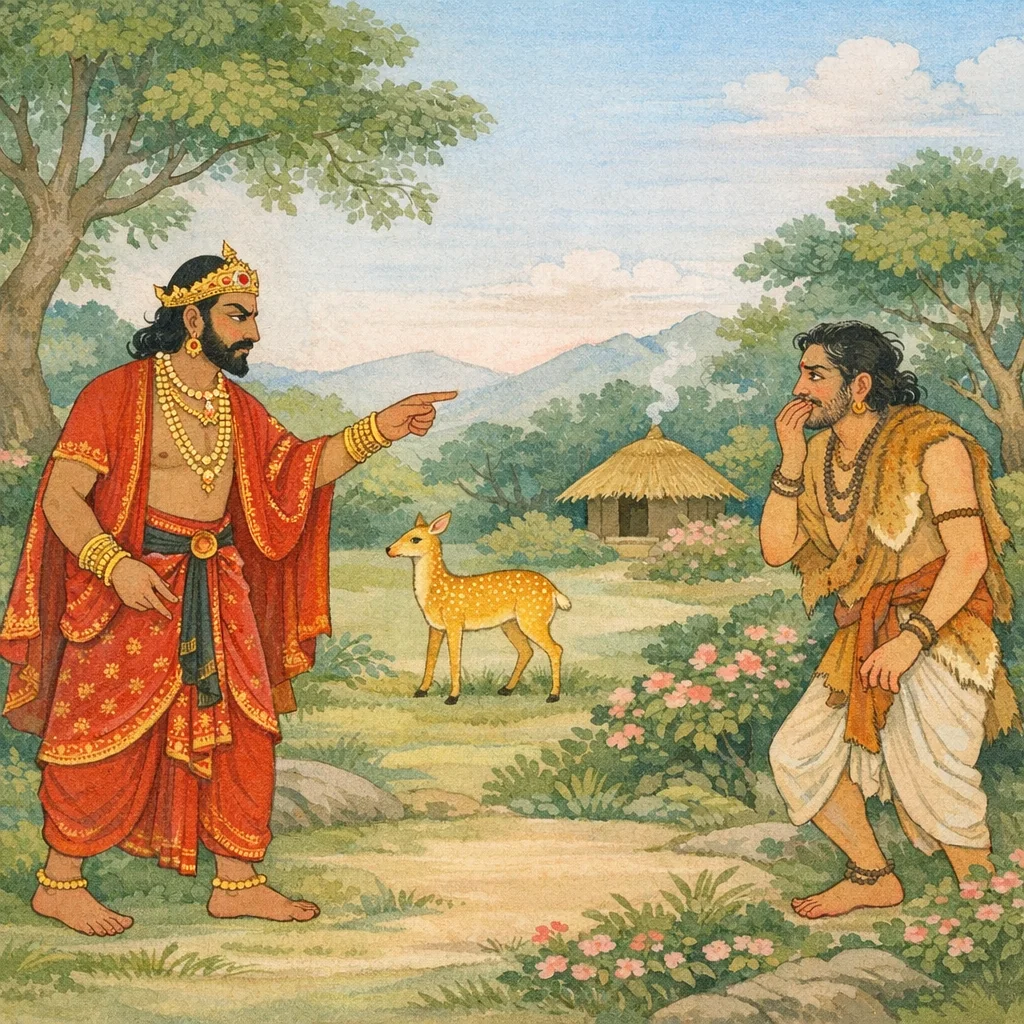
This sarga unfolds as a strategic dialogue in which Rāvaṇa approaches Mārīca as a last-resort agent, presenting himself as “distressed” and seeking refuge in Mārīca’s skill. He recounts the disaster at Janasthāna—Khara, Dūṣaṇa, Triśiras, and fourteen thousand rākṣasas slain by the human Rāma—and then turns to polemical disparagement of Rāma to make vengeance seem natural and the danger seem small. The plan is stated plainly: Mārīca must take the form of a dazzling golden deer, wander before Sītā at Rāma’s āśrama, and awaken her wish to capture it, thereby drawing Rāma and Lakṣmaṇa away from her. In the ensuing isolation, Rāvaṇa intends to abduct Sītā “like Rāhu eclipsing moonlight,” and afterward strike at Rāma, overwhelmed by grief. The chapter closes with Mārīca’s bodily fear at the very mention of Rāma—his mouth dries and his gaze fixes—and with his respectful, truth-guided counsel to Rāvaṇa, revealing his inward knowledge of Rāma’s might and the peril of the scheme.
Shlokas
Verse 1
मारीच श्रूयातां तात वचनं मम भाषतः।आर्तोऽस्मि मम चार्तस्य भवान्हि परमा गतिः।।।।
Mārīca, dear one—listen to the words I speak. I am in distress, and for me in this distress you are indeed the final refuge.
Verse 2
जानीषे त्वं जनस्थाने यथा भ्राता खरो मम।दूषणश्च महाबाहु स्वसा शूर्पणखा च मे।।।।त्रिशिराश्च महातेजा राक्षसः पिशिताशनः।अन्ये च बहवश्शूरा लब्धलक्षा निशाचराः।।।।वसत्नि मन्नियोगेन नित्यवासं च राक्षसाः।बाधमाना महारण्ये मुनीन्वै धर्मचारिणः।।।।
You know how, in Janasthāna, my brother Khara and the mighty-armed Dūṣaṇa, my sister Śūrpaṇakhā, the radiant rākṣasa Triśiras, eater of flesh, and many other brave night-roamers—unfailing in their aim—dwell there at my command as permanent residents, harassing in that great forest the munis who walk in dharma.
Verse 3
जानीषे त्वं जनस्थाने यथा भ्राता खरो मम।दूषणश्च महाबाहु स्वसा शूर्पणखा च मे।।3.36.2।।त्रिशिराश्च महातेजा राक्षसः पिशिताशनः।अन्ये च बहवश्शूरा लब्धलक्षा निशाचराः।।3.36.3।।वसत्नि मन्नियोगेन नित्यवासं च राक्षसाः।बाधमाना महारण्ये मुनीन्वै धर्मचारिणः।।3.36.4।।
You know also Triśiras, the rākṣasa of mighty radiance, a devourer of flesh—and many other brave night-roaming demons besides, whose aim never fails.
Verse 4
जानीषे त्वं जनस्थाने यथा भ्राता खरो मम।दूषणश्च महाबाहु स्वसा शूर्पणखा च मे।।3.36.2।।त्रिशिराश्च महातेजा राक्षसः पिशिताशनः।अन्ये च बहवश्शूरा लब्धलक्षा निशाचराः।।3.36.3।।वसत्नि मन्नियोगेन नित्यवासं च राक्षसाः।बाधमाना महारण्ये मुनीन्वै धर्मचारिणः।।3.36.4।।
At my command those rākṣasas dwell there permanently, and in that vast forest they continually harass the sages who follow the path of dharma.
Verse 5
चतुर्दश सहस्राणि रक्षसां भीमकर्मणाम्।शूराणां लब्धलक्षाणां खरचित्तानुवर्तिनाम्।।।।
Fourteen thousand rākṣasas—heroes of dreadful deeds, brave and sure in their aim—were those who followed the will and intention of Khara.
Verse 6
ते त्विदानीं जनस्थाने वसमाना महाबलाः।सङ्गताः परमायत्ता रामेण सह संयुगे।।।।नानाप्रहरणोपेताः खरप्रमुखराक्षसाः।
Now those very mighty rākṣasas, dwelling at Janasthāna—armed with many kinds of weapons and wholly reliant on Khara’s leadership—joined battle with Rāma.
Verse 7
तेन सञ्जातरोषेण रामेण रणमूर्धनि।अनुक्त्वा परुषं किञ्चिच्छरैर्व्यापारितं धनुः।।।।
Then Rāma—his anger aroused—on the very forefront of battle, without uttering even a harsh word, set his bow to work with arrows.
Verse 8
चतुर्दश सहस्राणि रक्षसामुग्रतेजसाम्।निहतानि शरैस्तीक्ष्णैर्मानुषेण पदातिना।।।।
Fourteen thousand rākṣasas of fierce might were slain by sharp arrows—by a mere human, fighting on foot.
Verse 9
खरश्च निहतस्सङ्ख्ये दूषणश्च निपातितः।हतश्च त्रिशिराश्चापि निर्भया दण्डकाः कृताः।।।।
Khara was slain in battle, and Dūṣaṇa was struck down; Triśiras too was killed—and thus the dwellers of the Daṇḍaka forest were made fearless.
Verse 10
पित्रा निरस्तः क्रुद्धेन सभार्यः क्षीणजीवितः।स हन्ता तस्य सैन्यस्य रामः क्षत्रियपांसनः।।।।
Banished by an angry father, sent away with his wife as though short-lived; yet that Rāma became the slayer of that army—malignly called a disgrace to the kṣatriyas.
Verse 11
दुश्शीलः कर्कशस्तीक्ष्णो मूर्खो लुब्धोऽजितेन्द्रियः।।।।त्यक्तधर्मो ह्यधर्मात्मा भूतानामहिते रतः।
He is ill-conducted, harsh, foolish, greedy, and has no control over his senses; he has abandoned righteousness and delights in harming living beings.
Verse 12
येन वैरं विनाऽरण्ये सत्वमाश्रित्य केवलम्।।।।कर्णनासापहरणाद्भगिनी मे विरूपिता।तस्यभार्यां जनस्थानात्सीतां सुरसुतोपमाम्।।।आनयिष्यामि विक्रम्य सहायस्तत्र मे भव।
Without any enmity, in the forest, relying only on his brute strength, he disfigured my sister by cutting off her ears and nose.
Verse 13
येन वैरं विनाऽरण्ये सत्वमाश्रित्य केवलम्।।3.36.12।।कर्णनासापहरणाद्भगिनी मे विरूपिता।तस्यभार्यां जनस्थानात्सीतां सुरसुतोपमाम्।3.36.13।।आनयिष्यामि विक्रम्य सहायस्तत्र मे भव।
From Janasthana, I will forcibly abduct his wife Sita, who resembles a celestial maiden; be my helper in this endeavor.
Verse 14
त्वया ह्यहं सहायेन पार्श्वस्थेन महाबल।।।।भ्रातृभिश्च सुरान्युद्धे समग्रान्नाभिचिन्तये।तत्सहायो भव त्वं मे समर्थो ह्यसि राक्षस।।।।
With you as my helper by my side, O mighty one, along with my brothers, I do not fear even all the gods in battle. Therefore, assist me, O Rakshasa.
Verse 15
त्वया ह्यहं सहायेन पार्श्वस्थेन महाबल।।3.36.14।।भ्रातृभिश्च सुरान्युद्धे समग्रान्नाभिचिन्तये।तत्सहायो भव त्वं मे समर्थो ह्यसि राक्षस।।3.36.15।।
In valor, in battle, and in pride, there is no one equal to you. You know all strategies, are a great hero, and are skilled in all illusions.
Verse 16
वीर्ये युद्धे च दर्पे च न ह्यस्ति सदृशस्तव।उपायज्ञो महान्शूरस्सर्वमायाविशारदः।।।।
In valor, in battle, and in pride, there is no one equal to you. You know all strategies, are a great hero, and are skilled in all illusions.
Verse 17
एतदर्थमहं प्राप्तस्त्वत्समीपं निशाचर।शृणु तत्कर्म साहाय्ये यत्कार्यं वचनान्मम।।।।
For this very purpose I have come near you, O night-roamer. Listen: in this work of assistance, what must be done is as I say.
Verse 18
सौवर्णस्त्वं मृगो भूत्वा चित्रो रजतबिन्दुभिः।आश्रमे तस्य रामस्य सीतायाः प्रमुखे चर।।।।
Become a wondrous deer—golden and dappled with silver spots—and roam before Sītā in Rāma’s hermitage.
Verse 19
त्वां तु निस्संशयं सीता दृष्ट्वा तु मृगरूपिणम्।गृह्यतामिति भर्तारं लक्ष्मणं चाभिधास्यति।।।।
Seeing you in the form of a deer, Sītā will surely tell her husband—and Lakṣmaṇa as well—“Catch it!”
Verse 20
ततस्तयोरपाये तु शून्ये सीतां यथासुखम्।निराबाधो हरिष्यामि राहुश्चन्द्रप्रभामिव।।।।
Then, when those two are away and the place is left empty, I will abduct Sītā easily and without hindrance—like Rāhu seizing the moon’s radiance.
Verse 21
ततः पश्चात्सुखं रामे भार्याहरणकर्शिते।विस्रब्धः प्रहरिष्यामि कृतार्थेनान्तरात्मना।।।।
After that, when Rāma is tormented by the abduction of his wife, I will strike him down at my ease—confident and inwardly satisfied that my aim has been achieved.
Verse 22
तस्य रामकथां श्रुत्वा मारीचस्य महात्मनः।शुष्कं समभवद्वक्त्रं परितप्ता बभूव ह।।।।
On hearing the mention of Rāma, the great Mārīca’s mouth went dry, and he became deeply distressed.
Verse 23
ओष्ठौ परिलिहञ्चुष्कौ नेत्रैरनिमिषैरिव।मृतभूत इवार्तस्तु रावणं समुदैक्षत।।।।
Licking his parched lips, with eyes as if unblinking, Mārīca—distressed like one already dead—stared at Rāvaṇa.
Verse 24
स रावणं त्रस्तविषण्णचेता महावने रामपराक्रमज्ञः।कृताञ्जलिस्तत्वमुवाच वाक्यं हितं च तस्मै हितमात्मनश्च।।।।
In that great forest, Mārīca—knowing Rāma’s prowess, frightened and downcast—addressed Rāvaṇa with folded hands, speaking truthful and salutary words for Rāvaṇa’s good and for his own as well.
Frequently Asked Questions
The pivotal action is the deliberate adoption of deception as an instrument of abduction: Rāvaṇa proposes a māyā-based stratagem (golden deer) to engineer separation and violate marital and protective dharma by forcibly taking Sītā.
The sarga contrasts informed counsel with compulsive retaliation: Mārīca’s fear and truth-speaking posture implies that knowledge of virtue and power should restrain adharma, while Rāvaṇa’s rhetoric shows how desire and injury can rationalize unethical means.
Janasthāna functions as the rākṣasa stronghold and the site of catastrophic defeat; the forest hermitage (āśrama) setting frames the vulnerability of exile-life; and the Rāhu–moonlight comparison encodes a culturally familiar eclipse image to describe abduction.