Sarga 1
तापसाश्रममण्डलदर्शनम् (Entering Dandaka and Meeting the Sages)
अरण्यकाण्ड
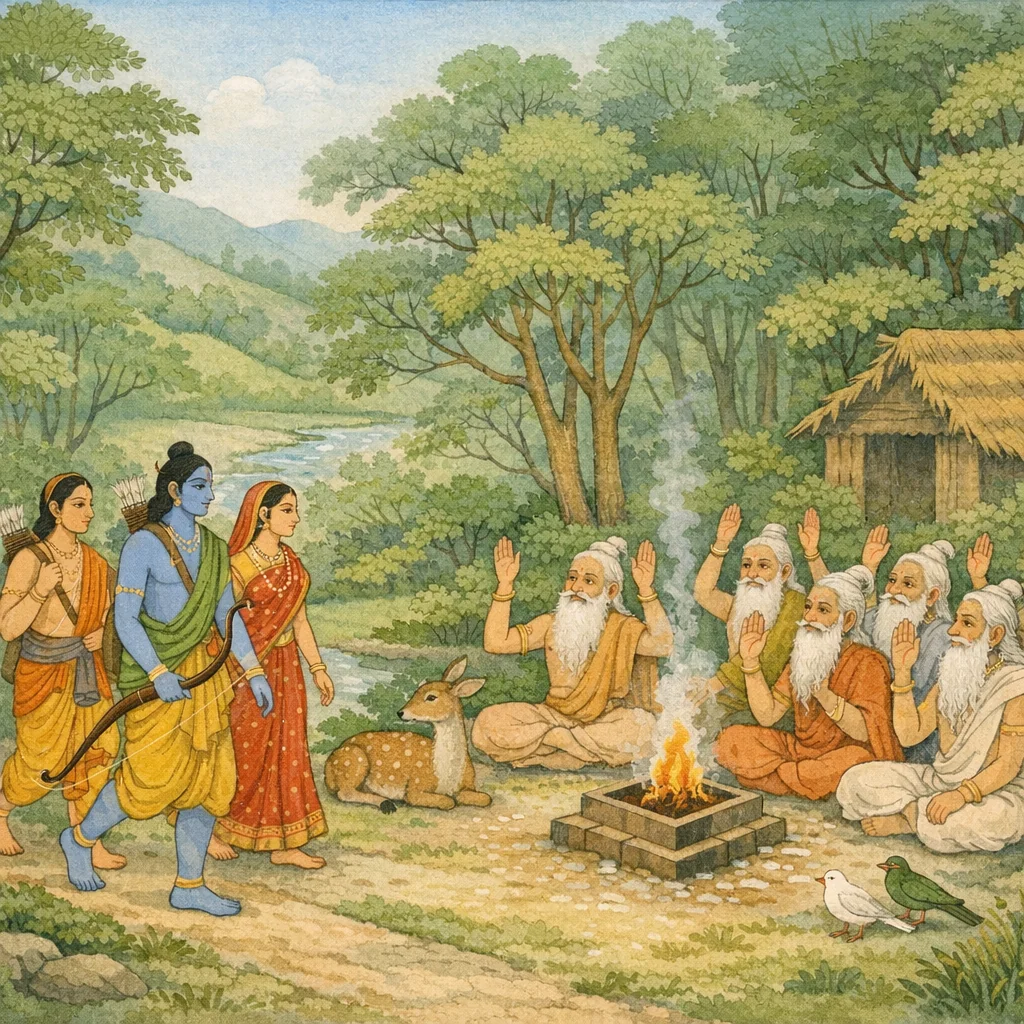
Sarga 1 opens with Rama’s entry into the great Dandaka forest and a sustained portrayal of a network of ascetic hermitages (tāpasāśrama-maṇḍala). The āśramas shine with ritual order: courtyards are cleansed and sprinkled, Vedic recitations resound, offerings and sacred fires are maintained, and the precinct shelters birds and deer—forming a disciplined micro‑community within the wilderness. Rama approaches with the string of his great bow loosened, showing controlled readiness rather than aggression. The sages, endowed with divine insight, greet Rama, Sita, and Lakshmana with auspicious blessings, marvel at them, and liken Rama’s radiance to the rising moon. Hospitality proceeds according to dharma: they are seated in a leaf-hut, offered water, and then forest fare—roots, fruits, and flowers. The sages then articulate the sacred basis of kingship: Rama is declared refuge, protector of dharma, and bearer of daṇḍa, the authority of punishment and protection. A king is called “a fourth part of Indra” because of his duty to guard. They conclude by petitioning protection for ascetics who have renounced coercive power, presenting themselves as dependents “like children,” and thus extending Rama’s sovereign responsibility into the depths of the forest.
Shlokas
Verse 1
प्रविश्य तु महारण्यं दण्डकारण्यमात्मवान्।ददर्श रामो दुर्धर्षस्तापसाश्रममण्डलम्।।।।
Having entered the great wilderness of Daṇḍakāraṇya, the self-possessed and invincible Rāma beheld a wide expanse of ascetics’ hermitages.
Verse 2
कुशचीरपरिक्षिप्तं ब्राह्म्या लक्ष्म्या समावृतम्।यथा प्रदीप्तं दुर्दर्शं गगने सूर्यमण्डलम्।।।।
The precincts of the hermitage were strewn with kuśa-grass and bark-cloth, and encompassed by an auspicious, brahmanical splendor; they shone—hard to gaze upon—like the blazing orb of the sun in the sky.
Verse 3
शरण्यं सर्वभूतानां सुसम्मृष्टाजिरं सदा।मृगैर्बहुभिराकीर्णं पक्षिसङ्घैस्समावृतम्।।।।
With courtyards always well swept, the hermitages were a refuge for all beings—filled with many deer and covered with flocks of birds.
Verse 4
पूजितं च प्रनृत्तं च नित्यमप्सरसां गणैः।विशालैरग्निशरणैः स्रुग्भाण्डैरजिनैः कुशैः।।।।समिद्भिस्तोयकलशैः फलमूलैश्च शोभितम्।आरण्यैश्च महावृक्षैः पुण्यैस्स्वादुफलैर्वृतम्।।।।
It was ever honored and, as it were, graced with dance by companies of apsarases; it was furnished with spacious fire-altars, ladles and ritual vessels, deer-skins, and kuśa-grass.
Verse 5
पूजितं च प्रनृत्तं च नित्यमप्सरसां गणैः।विशालैरग्निशरणैः स्रुग्भाण्डैरजिनैः कुशैः।।3.1.4।।समिद्भिस्तोयकलशैः फलमूलैश्च शोभितम्।आरण्यैश्च महावृक्षैः पुण्यैस्स्वादुफलैर्वृतम्।।3.1.5।।
It was adorned with sacrificial firewood, water-pots, fruits and roots, and encircled by great forest trees—sacred and laden with sweet fruits.
Verse 6
बलिहोमार्चितं पुण्यं ब्रह्मघोषनिनादितम्।पुष्पैश्चान्यैः परिक्षिप्तं पद्मिन्या च सपद्मया।।।।फलमूलाशनैर्दान्तैश्चीरकृष्णाजिनाम्बरैः।सूर्यवैश्वानराभैश्च पुराणैर्मुनिभिर्वुतम्।।।।
Sacred and worshipped with offerings and fire-sacrifices, it resounded with Vedic recitation; it was strewn with various flowers and adorned with a lotus-pond full of lotuses.
Verse 7
बलिहोमार्चितं पुण्यं ब्रह्मघोषनिनादितम्।पुष्पैश्चान्यैः परिक्षिप्तं पद्मिन्या च सपद्मया।।3.1.6।।फलमूलाशनैर्दान्तैश्चीरकृष्णाजिनाम्बरैः।सूर्यवैश्वानराभैश्च पुराणैर्मुनिभिर्वुतम्।।3.1.7।।
It was surrounded by aged sages—self-restrained, living on fruits and roots, clad in bark and black antelope-skins—radiant like the sun and like fire.
Verse 8
पुण्यैश्च नियताहारैः शोभितं परमर्षिभिः।तद्ब्रह्मभवनप्रख्यं ब्रह्मघोषनिनादितम्।।।।
That hermitage-settlement, resounding with Vedic chants and seeming like Brahmā’s own abode, shone with great sages—holy men disciplined in their measured way of life and food.
Verse 9
ब्रह्मविद्भिर्महाभागैर्ब्राह्मणैरुपशोभितम्।तद्दृष्ट्वा राघवः श्रीमांस्तापसाश्रममण्डलम्।।।।अभ्यगच्छन्महातेजा विज्यं कृत्वा महद्धनुः।
Seeing that circle of ascetics’ hermitages, adorned by venerable brāhmaṇas who knew Brahman, the illustrious and radiant Rāghava approached—first loosening the string of his great bow.
Verse 10
दिव्यज्ञानोपपन्नास्ते रामं दृष्ट्वा महर्षयः।।।।अभ्यगच्छन्स्तदा प्रीता वैदेहीं च यशस्विनीम्।
Seeing Rāma together with the illustrious Vaidehī (Sītā), the great seers—endowed with divine insight—were pleased and approached to welcome him.
Verse 11
ते तं सोममिवोद्यन्तं दृष्ट्वा वै धर्मचारिणम्।।।।लक्ष्मणं चैव दृष्ट्वा तु वैदेहीं च यशस्विनीम्।मङ्गलानि प्रयुञ्जानाः प्रत्यगृह्णन्दृढव्रताः।।।।
Those sages, steadfast in their vows, seeing righteous Rāma shining like the rising moon—and also seeing Lakṣmaṇa and the famed Vaidehī—came forward to receive them, uttering auspicious blessings.
Verse 12
ते तं सोममिवोद्यन्तं दृष्ट्वा वै धर्मचारिणम्।।3.1.11।।लक्ष्मणं चैव दृष्ट्वा तु वैदेहीं च यशस्विनीम्।मङ्गलानि प्रयुञ्जानाः प्रत्यगृह्णन्दृढव्रताः।।3.1.12।।
This verse repeats the preceding: the vow-steady sages, seeing righteous Rāma radiant like the rising moon—together with Lakṣmaṇa and the renowned Vaidehī—welcomed them with auspicious blessings.
Verse 13
रूपसंहननं लक्ष्मीं सौकुमार्यं सुवेषताम्।ददृशुर्विस्मिताकारा रामस्य वनवासिनः।।।।
The forest-dwelling sages, astonished, beheld in Rāma the beauty and symmetry of his form, his radiance, his gentle delicacy, and his fitting attire—even in the wilderness.
Verse 14
वैदेहीं लक्ष्मणं रामं नेत्रैरनिमिषैरिव।आश्चर्यभूतान्ददृशुः सर्वे ते वनचारिणः।।।।
All those forest-dwellers gazed, as if without blinking, upon Vaidehī, Lakṣmaṇa, and Rāma—wondrous figures in their eyes.
Verse 15
अत्रैनं हि महाभागा स्सर्वभूतहिते रताः।अतिथिं पर्णशालायां राघवं संन्यवेशयन्।।।।
There, those blessed sages—devoted to the welfare of all beings—seated Rāghava in their leaf-hut, honoring him as a guest.
Verse 16
ततो रामस्य सत्कृत्य विधिना पावकोपमाः।आजह्रुस्ते महाभागाः सलिलं धर्मचारिणः।।।।
Thereafter, those noble sages—pure as fire—having honored Rāma according to proper custom, brought him water, acting in accordance with dharma.
Verse 17
पुष्पं मूलं फलं सर्वमाश्रमं च महात्मनः।निवेदयित्वा धर्मज्ञास्ते ततः प्राञ्जलयोऽब्रुवन्।।।।
Having offered to the noble one flowers, roots, and fruits—all that the hermitage could provide—the sages, knowers of dharma, then spoke with folded hands.
Verse 18
धर्मपालो जनस्यास्य शरण्यस्त्वं महायशाः।पूजनीयश्च मान्यश्च राजा दण्डधरो गुरुः।।।।
O greatly renowned king, you are this people’s refuge and the protector of dharma—worthy of worship and honor; as ruler you bear the staff of punishment and stand as a guiding authority.
Verse 19
इन्द्रस्येह चतुर्भागः प्रजा रक्षति राघव।राजा तस्माद्वरान्भोगान्रम्यान् भुङक्तेलोकनमस्कृतः।।।।
O Rāghava, in this world the king is said to hold a fourth share of Indra’s power, because he protects the people; therefore he is honored by the world and enjoys the finest, delightful rewards.
Verse 20
ते वयं भवता रक्ष्या भवद्विषयवासिनः।नगरस्थो वनस्थो वा त्वं नो राजा जनेश्वरः।।।।
We are inhabitants of your realm; therefore we are to be protected by you. Whether you dwell in the city or in the forest, you are our king—the lord of the people.
Verse 21
न्यस्तदण्डा वयं राजञ्जितक्रोधा जितेन्द्रियाः।रक्षणीयास्त्वया शश्वदगर्भभूतास्तपोधनाः।।।।
O King, we have laid aside the rod of coercion; we have conquered anger and mastered the senses. We ascetics—whose wealth is austerity—are ever to be protected by you, as though we were your own children.
Verse 22
एवमुक्त्वा फलैर्मूलैः पुष्पैर्वन्यैश्च राघवम्।अन्यैश्च विविधाहारैः सलक्ष्मणमपूजयन्।।।।
Having spoken thus, they reverently honored Rāghava—together with Lakṣmaṇa—with fruits, roots, wild flowers, and many kinds of forest-gathered foods.
Verse 23
तथान्ये तापसास्सिद्धा रामं वैश्वानरोपमाः।न्यायवृत्ता यथान्यायं तर्पयामासुरीश्वरम्।।।।
So too, other accomplished ascetics—likened to Vaiśvānara, the sacred fire—upright in conduct, satisfied Lord Rāma in a manner befitting righteousness.
Frequently Asked Questions
The central action is the sages’ petition that Rama, though living in the forest, must still function as king—protector and daṇḍadhara—thereby extending sovereign duty to ascetics who have renounced coercion and depend on righteous protection.
Dharma is portrayed as role-bound and continuous: kingship is defined by safeguarding beings and upholding justice, not merely by residence in a capital; hospitality and ritual order in the āśrama complement, rather than replace, the need for protective governance.
The Dandaka wilderness is mapped through āśrama culture: leaf-huts, fire-sanctuaries, Vedic recitation spaces, lotus-ponds, and provision of forest foods—depicting the hermitage-circle as a structured cultural landscape within the forest.