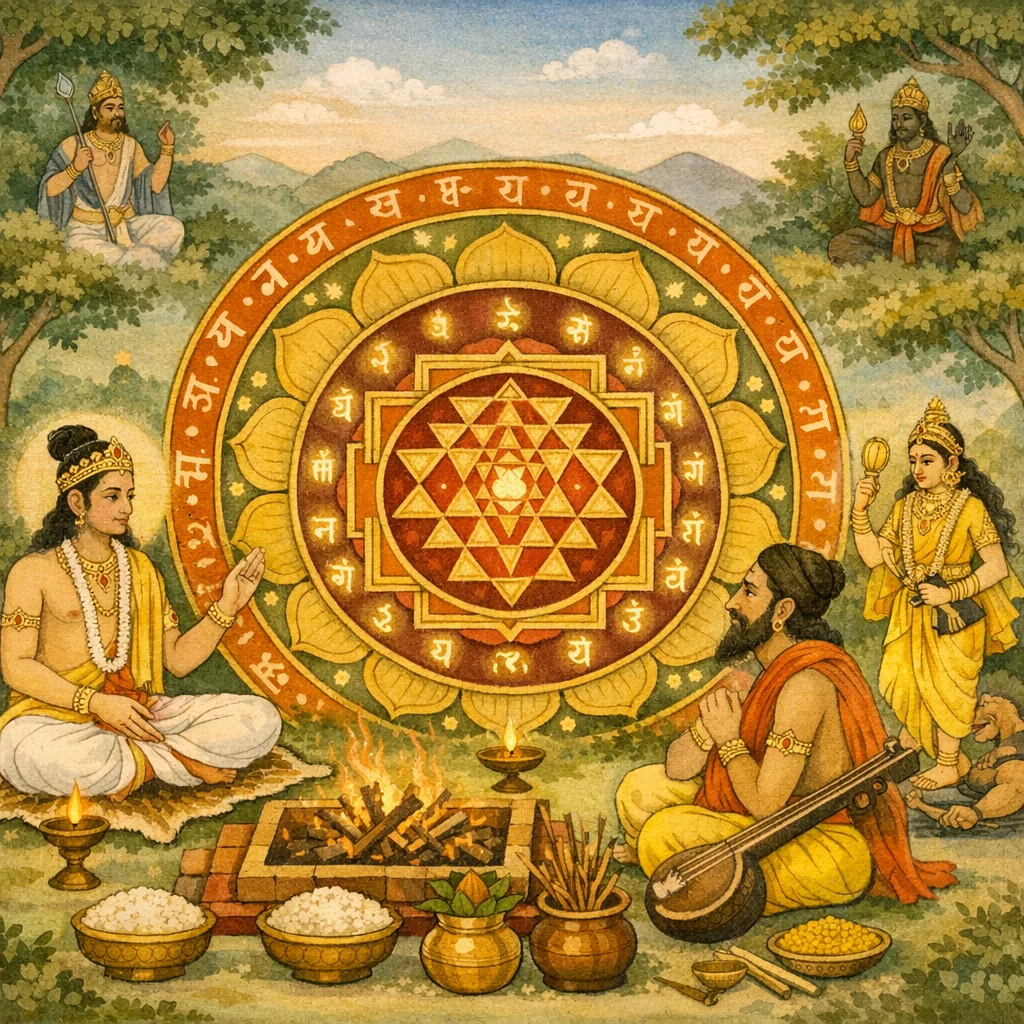
Yakṣiṇī-Mantra-Sādhana Nirūpaṇa (Lakṣmī-avatāra-vidyāḥ: Bālā, Annapūrṇā, Bagalā)
Sanatkumāra continues teaching Nārada, turning from Sarasvatī’s forms to Lakṣmī’s mantra-descents that fulfill human aims. It begins with three bīja-mantras and the mantra’s credentials (ṛṣi Dakṣiṇāmūrti, chandas Paṅkti, devatā Tripurā Bālā), then sets out layered nyāsa (body, hands, nava-yonīpa repetition), installation epithets, and a five-bīja Kāmeśī scheme with Kāma’s names and arrow-deities. A detailed yantra sequence follows (nava-yoni core, eight-petalled enclosure, Mātr̥kā perimeter, pīṭha-śaktis/pīṭhas, bhairavas, dikpālas), with japa–homa counts and fruit-bearing prayogas (mastery of speech, prosperity, longevity, relief from disease, attraction/control), including curse-removal (utkīlana), dīpinī/kindling rules, and guru-line veneration. The latter half introduces Annapūrṇā’s twenty-syllable vidyā with its ritual diagram and śakti arrays, then moves to Bagalāmukhī’s stambhana system—mantra framing, visualization, yantra types, homa materials, and specialized rites (immobilization, expulsion, protection, antidote, swift travel, invisibility)—ending with the colophon.
Shlokas
Verse 1
सनत्कुमार उवाच । सरस्वत्यवतारास्ते कथिताः सिद्धिदा नृणाम् । अथ लक्ष्म्यवतारांस्ते वक्ष्ये सर्वार्थसिद्धिदान् ॥ १ ॥
Sanatkumāra said: The incarnations of Sarasvatī, bestowers of success (siddhi) for human beings, have been described to you. Now I shall speak of the incarnations of Lakṣmī, which grant the accomplishment of all aims.
Verse 2
वाणीमन्मथशक्त्याख्यं बीजत्रितयमीरितम् । ऋषिः स्याद्दक्षिणामूर्तिः पंक्तिश्छंदः प्रकीर्तितम् ॥ २ ॥
The triad of seed-mantras (bīja) is declared as those named Vāṇī, Manmatha, and Śakti. The seer (ṛṣi) of this mantra-set is Dakṣiṇāmūrti, and its meter (chandas) is proclaimed to be Paṅkti.
Verse 3
देवता त्रिपुरा बाला मध्यांते शक्तिबीजके । नाभेरापादमाद्यं तु नाभ्यंतं हृदयात्परम् ॥ ३ ॥
The presiding deity is Tripurā Bālā. The Śakti-bīja is to be placed in the middle and at the end. The “first” placement extends from the navel down to the feet, while the placement ending at the navel is to be made above—from the heart onward.
Verse 4
मृर्ध्नो ह्रदंतं तर्तीयं क्रमाद्देहेषु विन्यसेत् । आद्यं वामकरे दक्षकरे तदुभयोः परम् ॥ ४ ॥
One should place the third mantric installation in due order upon the body, from the crown of the head down to the end-point at the heart. The first is to be placed on the left hand, the second on the right hand, and then the next upon both together.
Verse 5
पुनर्बीजत्रयं न्यस्य मूर्ध्नि गुह्ये च वक्षसि । नव योन्पाभिधं न्यासे नवकृत्वो मनुं न्यसेत् ॥ ५ ॥
Then, placing again the three seed-syllables (bīja-traya), one should perform nyāsa on the head, the secret region, and the chest; and in the nyāsa called “nava-yonīpa,” one should place the mantra nine times.
Verse 6
कर्णयोश्चिबुके न्यस्येच्छंखयोर्मुखपंकजे । नेत्रयोर्नासिकायां च स्कंधयोरुदरे तथा ॥ ६ ॥
One should perform nyāsa by placing the mantra-energies upon the ears and the chin, upon the temples and the lotus-like face, upon the eyes and the nose, and likewise upon the shoulders and the abdomen.
Verse 7
न्यसेत्कूर्परयोर्नाभौ जानुनोर्लिंगमस्तके । पादयोरपि गुह्ये च पार्श्वयोर्हृदये पुनः ॥ ७ ॥
One should perform nyāsa by placing the mantra’s parts at the elbows and at the navel; at the knees, upon the crown of the head; also at the feet, at the secret region, on the sides of the torso, and again at the heart.
Verse 8
स्तनयोः कंठदेशे च वामांगादिषु विन्यसेत् । वाग्भवाद्यां रतिं गुह्ये प्रीतिमत्यादिकां हृदि ॥ ८ ॥
One should perform nyāsa (ritual placement) upon the breasts, the region of the throat, and the limbs on the left side. One should place the śakti called “Rati,” beginning with “Vāgbhavā,” in the secret region, and place “Prītimatī” and the others in the heart.
Verse 9
कामबीजादिकान्पश्येद्भूमध्ये तु मनोभवाम् । पुनर्वागकात्ममाद्यास्तिस्रएव च विन्यसेत् ॥ ९ ॥
One should visualize the seed-mantras beginning with the Kāma-bīja in the center of the ground (within the maṇḍala) as the power called Manobhavā. Then again one should perform nyāsa, placing only the three primordial powers—Vāk, Kā, and Ātman.
Verse 10
अमृतेशीं च योगेशीं विश्वयोनिं तृतीयकाम् । मूर्ध्निं वक्त्रे हृदि न्यस्येद्गुह्ये चरणयोरपि ॥ १० ॥
One should perform nyāsa by placing the names/mantras “Amṛteśī,” “Yogeśī,” “Viśvayonī,” and “Tṛtīyakāma” upon the head, the face, and the heart; and also upon the secret region and upon the feet.
Verse 11
कामेशी पंचबीजाढ्यां स्मरात्पञ्चन्यसेत्क्रमात् । मायाकामौ च वाग्लक्ष्मी कामेशी पंचबीजकम् ॥ ११ ॥
Meditating on Kāmeśī, who is endowed with the five seed-syllables, one should in due order perform the fivefold nyāsa. (The seeds are:) Māyā and Kāma, then Vāk and Lakṣmī—thus is the five-bīja formula of Kāmeśī.
Verse 12
मनोभवश्च मकरध्वजकंदर्पमन्मथाः । कामदेवः स्मरः पंच कीर्तितान्याससिद्धिदाः ॥ १२ ॥
Manobhava, Makaradhvaja, Kandarpa, Manmatha, Kāmadeva, and Smara—these five principal epithets are proclaimed; when employed in nyāsa, they bestow success in that rite.
Verse 13
शिरःपन्मुखागुह्येषु हृदये बाणदेवताः । द्राविण्याद्याः क्रमान्न्यस्येद्वाणेशीबीजपूर्वकः ॥ १३ ॥
Performing nyāsa in proper sequence, one should install the deities of the (five) arrows in the head, the two soles, the face, the secret region, and in the heart—beginning with Drāviṇī and the others—preceded by the seed-syllable (bīja) of Vāṇeśī.
Verse 14
द्रांद्रीं क्लींजूंस इति वैबाणेशबीजकं च कम् । द्राविणी क्षोभिणी वशीकरण्यांकर्षणी तथा ॥ १४ ॥
“Drāṃ,” “drīṃ,” and “klīṃ-jūṃ-sa”—these are said to be the seed-syllables (bīja) belonging to Vaibāṇeśa; and “kam” as well. These mantric powers are named: Drāviṇī (bestower of wealth), Kṣobhiṇī (agitator), Vaśīkaraṇī (enchantress/controller), and Āṃkarṣaṇī (attractor).
Verse 15
संमोहनी च बाणानां देवताः पञ्च कीर्तिताः । तार्तीयवाग्मध्यगेन कामेन स्यात्षडंगकम् ॥ १५ ॥
The presiding deities of (Kāma’s) arrows are declared to be five—among them is Saṁmohanī, the power of delusion and enchantment. And when Kāma is placed as the one “moving within the middle speech,” the third level of speech, this teaching becomes six-limbed.
Verse 16
षड्दीर्घस्वरयुक्तेन ततो देवीं विचिंतयेत् । ध्यायेद्रक्तसरोजस्थां रक्तवस्त्रां त्रिलोचनम् ॥ १६ ॥
Then, with the mantra endowed with six long vowels, one should contemplate the Goddess; one should meditate on Her as seated upon a red lotus, clad in red garments, and three-eyed.
Verse 17
उद्यदर्कनिभां विद्यां मालाभयवरोद्वहाम् । लक्षत्रयं जपेन्मंत्रं दशांशं किंशुकोद्भवैः ॥ १७ ॥
One should meditate upon the Vidyā as radiant like the rising sun, bearing a rosary, granting fearlessness, and bestowing boons; then one should repeat the mantra three lakhs (300,000) of times, and perform one-tenth of that as a fire-offering using blossoms of the kiṃśuka tree.
Verse 18
पुष्पैर्हयारिजैर्वापि जुहुयान्मधुरान्वितैः । नवयोन्यात्मकं यंत्रं बहिरष्टदलावृतम् ॥ १८ ॥
He should also offer oblations into the sacred fire with flowers (or with hayārīja-flowers), together with sweet offerings. This yantra is of the nature of the nine wombs (navayoni) and is outwardly enclosed by an eight-petalled lotus enclosure.
Verse 19
केसरेषु स्वरान्न्यस्येद्वर्गानष्टौदलेष्वपि । दलाग्रेषु त्रिशूलानि पद्म तु मातृकावृतम् ॥ १९ ॥
One should perform nyāsa by placing the vowels upon the filaments of the lotus, and likewise placing the eight consonant-groups upon its eight petals. Upon the tips of the petals one should place tridents; thus the lotus is encircled by the Mātr̥kā, the mother-letters of the alphabet.
Verse 20
एवं विलिखिते यंत्रे पीठशक्तीः प्रपूजयेत् । इच्छा ज्ञाना क्रिया चैव कामिनी कामदायिनी ॥ २० ॥
When the yantra has been drawn in this manner, one should duly worship the Pīṭha-Śaktis—Icchā (Will), Jñānā (Knowledge), Kriyā (Action), as well as Kāminī and Kāmadāyinī, the power that fulfills desire.
Verse 21
रती रतिप्रिया नंदा मनोन्मन्यपि चोदिताः । पीठशक्तीरिमा इष्ट्वा पीठं तन्मनुना दिशेत् ॥ २१ ॥
Having duly worshipped these Pīṭha-Śaktis—Ratī, Ratipriyā, Nandā, and Manonmanī, as enjoined—one should then install the Pīṭha by means of their respective manu, their own mantra.
Verse 22
व्योमपूर्वे तु तार्तीयं सदाशिवमहापदम् । प्रेतपद्मासनं ङेंतं नमोंतः पीठमन्त्रकः ॥ २२ ॥
Then, in the eastern quarter associated with Vyoma (the Sky), the third placement is declared: the great seat of Sadāśiva. It is the lotus-seat (padmāsana) for the ‘Preta’ form; with the syllable “ṅeṃ” and ending with “namo”, this is the pīṭha-mantra, the mantra of the sacred seat.
Verse 23
षोडशार्णस्ततो मूर्तौ क्लृप्तायां मूलमंत्रतः । आवाह्य प्रजपेद्देवीमुपचारैः पृथग्विधैः ॥ २३ ॥
Then, with the sixteen-syllabled mantra, one should invoke the Goddess into the image duly prepared according to the root-mantra, and worship Her by japa-recitation, offering the various distinct ritual services (upacāras).
Verse 24
देवीमिष्ट्वा मध्ययोनौ त्रिकोणे रतिपूर्विकाम् । वामकोणे रतिं दक्षे प्रीतिमग्रे मनोभवाम् ॥ २४ ॥
Having worshipped the Goddess in the central yoni-shaped triangle, one should place (and worship) Ratipūrvikā there; in the left corner (place) Rati, on the right (place) Prīti, and at the front apex (place) Manobhavā.
Verse 25
योन्यन्तर्वह्निकोणादवंगान्यग्नेर्विदिक्ष्वपि । मध्ययोमेर्हहिः पूर्वादिषु चाग्रे स्मरानपि ॥ २५ ॥
From the fiery angle within the yoni, one should also contemplate Agni’s subsidiary limbs in the intermediate directions. In the central region, remember Hari; and in the eastern and other directions, first recollect Smara (Kāma) as well.
Verse 26
वाणदेवीस्तद्वदेव शक्तीरष्टसु योनिषु । सुभगाख्या भागा पश्चात्तृतीया भगसर्पिणी ॥ २६ ॥
Likewise, the śaktis connected with speech (Vāṇī) are to be understood as present within the eight yoni-categories. Among them, the one called Subhagā is the “Bhāgā”; and after her, the third is Bhagasarpiṇī.
Verse 27
भगमाला तथानंगा नगाद्या कुसुमापरा । अनंगमेखलानंगमदनेत्यष्टशक्तयः ॥ २७ ॥
Bhagamālā and Anaṅgā; Nagādyā and Kusumāparā; Anaṅgamekhalā and Anaṅgamadanā—these are the eight śaktis (powers).
Verse 28
पद्मकेशरगा ब्राह्मी मुखाः पत्रेषु भैरवाः । दीर्घाद्या मातरः पूज्या ह्रस्वाद्याश्चाष्टभैरवाः ॥ २८ ॥
Upon the lotus’ pericarp one should install and worship Brahmī; upon the petals, the faces of Bhairava. The Mothers beginning with the long vowels are to be revered, and likewise the eight Bhairavas beginning with the short vowels.
Verse 29
दलाग्रेष्वष्टपीठानि कामरूपाख्यमादिमम् । मलयं कोल्लगिर्य्याख्यं चौहाराख्यं कुलांतकम् ॥ २९ ॥
On the tips of the petals are eight sacred pīṭhas: first the one called Kāmarūpa; then Malaya; the seat known as Kolla-giri; Cauhāra; and Kulāntaka.
Verse 30
जालंधरं तथोन्नासं कोटपीठमथाष्टमम् । भूगृहे दशदिक्ष्वर्चेद्धेतुकं त्रिपुरांतकम् ॥ ३० ॥
Likewise one should install and worship Jālandhara and Unnāsa, and Koṭapīṭha as the eighth seat. In the subterranean shrine (bhūgṛha), one should worship Hetuka and Tripurāntaka in the ten directions.
Verse 31
वैतालमग्नि जिह्वं च कमलांतकालिनौ । एकपादं भीमरूपं विमलं हाटकेश्वरम् ॥ ३१ ॥
Also mentioned are Vaitāla, Agni-jihva, and Kamalānta-kālin; as well as Ekapāda, Bhīmarūpa, Vimala, and Hāṭakeśvara.
Verse 32
शक्राद्यानायुधैः सार्द्धं स्वस्वदिक्षु समर्चयेत् । तद्बहिर्दिक्षु बटुकं योगिनीं क्षेत्रनायकम् ॥ ३२ ॥
One should duly worship Indra (Śakra) and the other deities of the directions, together with their respective weapons, each in their own quarter. Outside those directions, one should worship Baṭuka, the Yoginīs, and Kṣetranāyaka, the Lord of the sacred precinct.
Verse 33
गणेशं विदिशास्वर्चेद्वसून्सूर्याच्छिवांस्तथा । भूतांश्चेत्थं भजन्बालामीशः स्याद्धनविद्ययोः ॥ ३३ ॥
At Vidiśā one should worship Gaṇeśa; at Sūryā, the Vasus; and likewise Śiva. Worshipping the Bhūtas in this prescribed manner, the sādhaka becomes master of the Bālā-vidyā (mantra) and attains both wealth and learning.
Verse 34
रक्तांभोजैर्हुतेर्नार्योवश्याः स्युः सर्षपैर्नृपाः । नंद्यावर्तै राजवृक्षैः कुंदैः पाटलचंपकैः ॥ ३४ ॥
By offering red lotuses into the homa fire, women become amenable (brought under one’s influence). By offering mustard seeds, kings and rulers are brought under control. Likewise, offerings of nandyāvarta flowers, rājavṛkṣa blossoms, kunda (jasmine), pāṭala, and campaka produce similar effects.
Verse 35
पुष्पैर्बिल्वफलैर्वापि होमाल्लक्ष्मीः स्थिरा भवेत् । अपमृत्युं जयेन्मन्त्री गुडूच्या दुग्धयुक्तया ॥ ३५ ॥
By performing homa with flowers or with bilva fruits, Lakṣmī—prosperity—becomes steady. And the mantra-practitioner can conquer apamṛtyu (untimely death) by using guḍūcī prepared together with milk.
Verse 36
यथोक्तदूर्वाहोमेन नीरोगायुः समश्नुते । ज्ञानं कवित्वं लभते चन्द्रागुरुसुरैर्हुतैः ॥ ३६ ॥
By performing the dūrvā-grass homa exactly as prescribed, one attains a long life free from disease. And by offering oblations to the Moon, to the Guru (Bṛhaspati), and to the gods, one gains knowledge and poetic skill.
Verse 37
पलाशपुष्पैर्वाक्सिद्धिरन्नाप्तिश्चान्नहोमतः । सुरभिक्षीरदध्यक्ताँल्लाजान्हुत्वा रुजो जयेत् ॥ ३७ ॥
By offering palāśa blossoms, one gains vāk-siddhi—mastery and efficacy of speech; and by performing an oblation of cooked food, one obtains abundance of food. By offering lājā (parched grains) anointed with cow’s milk and curd, one overcomes illnesses.
Verse 38
रक्तचन्दनकर्पूरकर्चूरागुरुरोचनाः । चन्दनं केशरं मांसीं क्रमाद्भागैनिंयोजयेत् ॥ ३८ ॥
Red sandalwood, camphor, turmeric, agaru, and gorocanā—then sandalwood, saffron, and māṁsī (spikenard): these are to be blended in proper sequence, each in measured proportion.
Verse 39
भूमिचंद्रैकनन्दाब्धिदिक्सप्तनिगमोन्मितैः । श्मशाने कृष्मभूतस्य निशि नीहारपाथसा ॥ ३९ ॥
By measures conveyed through coded numeric terms—earth (1), moon (1), one, Nandā (9), ocean (4), the ten directions (10), seven, and the Vedas (4)—in the cremation ground, for one who has become a dark spirit, at night, along a path of mist.
Verse 40
कुमार्या पेषयेत्तानि मंत्रेणाथाभिमंत्र्य च । विदद्ध्यात्तिलकं तेन दर्शनाद्वशयेज्जनान् ॥ ४० ॥
He should have those ingredients ground by an unmarried maiden; then, after consecrating them with the mantra, he should apply a forehead-mark (tilaka) with that. By merely being seen, he would bring people under his influence.
Verse 41
गजसिंहादिभूतानि राक्षसाञ्छाकिनीरपि । प्रयोजनानां सिद्ध्यै तु देव्याः शापं निवर्त्य च ॥ ४१ ॥
Elephant- and lion-like spirits, as well as rākṣasas and even chākinīs, are (invoked/propitiated) for the accomplishment of one’s intended aims—and also for removing the Goddess’s curse.
Verse 42
विधायोत्कीलितां पश्चाज्जपमस्य समाचरेत् । यो जपेदादिमे बीजे वराहभृगुपावकान् ॥ ४२ ॥
After performing the “unlocking” (utkīlana) rite, one should then properly undertake the japa of this (mantra). Whoever repeats the primal seed-syllable while invoking Varāha, Bhṛgu, and Pāvaka (Agni)…
Verse 43
मध्यमादौ नभोहंसौ मध्यमांते तु पावकम् । आदावंते च तार्तूयक्रमात्स्वं धूम्रकेतनम् ॥ ४३ ॥
At the beginning of the middle section stands the “sky-swan” (nābho-haṃsa); at the end of the middle stands Fire (pāvaka). And at the beginning and at the end, in the tārtūya order, one should place—or inwardly recognize—one’s own “smoke-bannered” principle (dhūmraketu).
Verse 44
एवं जप्त्वा शतं विद्या शापहीना फलप्रदा । यद्वाद्ये चरमे बीजे नैव रेफं वियोजयेत् ॥ ४४ ॥
Thus, when it is japa-recited a hundred times, the vidyā becomes free of any curse and becomes a bestower of fruits. And in the opening sound and in the final seed-syllable, one should never separate the letter “ra” (repha).
Verse 45
शापोद्धारप्रकारोऽन्यो यद्वायं कीर्तितो बुधैः । आद्यमाद्यं हि तार्तीयं कामः कामोऽथ वाग्भवम् ॥ ४५ ॥
Another method for removing a curse, taught by the learned, is this: employ the first seed, again the first, then the third; then “kāma”, again “kāma”, and thereafter “vāgbhava”.
Verse 46
अंत्यमंत्थमनंगश्च नवार्णः कीर्तितो मनुः । जप्तोऽयं शतधा शापं बालाया विनिवर्तयेत् ॥ ४६ ॥
The nine-syllabled mantra—beginning with “antya,” “manttha,” and “anaṅga”—has been declared. When this is recited a hundred times, it turns back the curse afflicting the young girl.
Verse 47
चैतन्याह्लादिनूमन्त्रौ जप्तौ निष्कीलताकरौ । त्रिस्वराश्चेतनं मन्त्री धरः शांतिरनुग्रहः ॥ ४७ ॥
When the mantras known as “Caitanya” and “Āhlādinū” are recited, they loosen all obstructions. The three tonal accents are the mantra’s living power; the chanter is its bearer; and its fruit is peace and divine grace.
Verse 48
तारादिहृदयांतः स्यात्काम आह्लादिनीमनुः । तथा त्रयाणां बीजानां दीपनैर्मनुभिस्त्रिभिः ॥ ४८ ॥
Within the heart of the mantra, beginning with the syllable Tāra (Oṁ), there should be the Kāma-mantra, the delight-bestowing formula. Likewise, for the three seed-syllables there are three “kindling” mantras by which they are awakened and made radiant.
Verse 49
सुदीप्तानि विधायादौ जपेत्तानीष्टसिद्धये । वदयुग्मं सदीर्घांबु स्मृतिवालावनंगतौ ॥ ४९ ॥
Having first kindled them into a bright blaze, one should recite them in japa for the attainment of the desired siddhi. Utter the paired syllables with the long vowel “ā”, following the remembered sequence, without deviating from the prescribed order.
Verse 50
सत्यः सनेत्रो नस्तादृग्वा वाग्वर्णाद्यदीपिनी । क्लिन्ने क्लेदिनि वैकुंठो दीर्घं स्वं सद्यगोंतिमः ॥ ५० ॥
“He is Truth; the One with eyes; the One whose vision is not confined by ordinary perception; the Illuminator of speech and of the classes of sounds and letters. In what is wet—indeed in the moistening principle—He is Vaikuṇṭha; the Enduring One; His own essential nature; and the One whose going is immediate and final.”
Verse 51
निद्रा सचंद्रा कुर्वीत शिवार्णा मध्यदीपिनी । तारो मोक्षं च कुरुते नायं वर्णास्यदीपिनी ॥ ५१ ॥
“Nidrā” is to be formed together with “candra” (the moon), and the Śiva-syllable is the one that shines in the middle. The “tāra” syllable bestows mokṣa (liberation); it is not merely a letter that illuminates the mouth—no mere phonetic sound.
Verse 52
दीपिनीमंतरा बाला साधितापि न सिद्ध्यति । वागंत्यकामान् प्रजयेदरीणा क्षोभहेतवे ॥ ५२ ॥
Without the (auxiliary) Dīpinī, the Bālā-mantra does not attain success even when practiced. Moreover, if uttered at an improper time or in an improper manner, it can stir up enemies and bring about disturbances.
Verse 53
कामवागंत्यबीजानि त्रैलोक्यस्य वशीकृतौ । कामांत्यवाणीबीजानि मुक्तये नियतो जपेत् ॥ ५३ ॥
To bring the three worlds under one’s sway, one should employ the seed-mantras ending in “kāma” and “vāk”; but for liberation (mokṣa), the disciplined sādhaka should repeat in japa the seed-mantras ending in “kāma” and “vāṇī”.
Verse 54
पूजारंभे तु बालायास्त्रिविधानर्चयेद्गुरून् । दिव्यौघश्चैव सिद्धौघो मानवौघ इति त्रिधा ॥ ५४ ॥
At the commencement of worship, the young disciple should venerate the gurus in a threefold way: as the Divine Stream (Divyaugha), the Stream of the Siddhas (Siddhaugha), and the Human Stream (Mānavaugha)—thus in three divisions.
Verse 55
परप्रकाशः परमे शानः परशिवस्तथा । कामेश्वरस्ततो मोक्षः षष्ठः कामोऽमृतोंऽतिमः ॥ ५५ ॥
He is the Supreme Light, the Supreme Lord, and likewise the Transcendent Śiva (Paraśiva). He is Kāmeśvara; then (He is) Mokṣa. The sixth is Kāma, and the final is Amṛta—the nectar of immortality.
Verse 56
एते दप्तैव दिव्यौघा आनन्दपदपश्चिमाः । ईशानाख्यस्तत्पुरुषोऽघोराख्योवामदेवकः ॥ ५६ ॥
These are indeed the five Divine Streams, culminating in the station of ānanda (bliss): Īśāna, Tatpuruṣa, Aghora, and Vāmadeva—together with the fifth, Sadyojāta.
Verse 57
सद्योजात इमे पंच सिद्धौधाख्याः स्मृता मुने । मानवौघाः परिज्ञेयाः स्वगुरोः सम्प्रदायतः ॥ ५७ ॥
O sage, these five are remembered as the Siddhaugha groups and are spoken of as “Sadyojāta,” newly manifested. The Human Streams (Mānavaugha) are to be understood through the living sampradāya handed down from one’s own guru.
Verse 58
नवयोन्यात्मके यन्त्रे विलिखेन्मध्ययोनितः । प्रादक्षिण्येन बीजानि त्रिवारं साधकोत्तमः ॥ ५८ ॥
On a yantra made of nine “yonis” (petal-like compartments), the foremost sādhaka should inscribe the seed-syllables (bīja) three times, beginning from the central yoni and proceeding clockwise.
Verse 59
त्रींस्त्रीन्वर्णांस्तु गायत्र्या अष्टपत्रेषु संलिखेत् । बहिर्मातृकयाऽवेष्ट्य तद्बहिर्भूपुरद्वयम् ॥ ५९ ॥
On the eight petals he should inscribe, three by three, the syllables of the Gāyatrī; enclosing it outwardly with the Mātṛkā (the alphabet), and beyond that drawing a double bhūpura, the twin outer square enclosure.
Verse 60
कामबीजलसत्कोण व्यतिभिन्नं परस्परम् । पत्रे त्रैपुरमाख्यातं जपसंपातसाधितम् ॥ ६० ॥
A radiant triangle formed with the seed-mantra “kāma,” mutually intersecting one another—when set within the lotus-petal diagram—is called “Traipura,” and it is to be empowered by mantra-repetition (japa) and ritual infusions (saṃpāta).
Verse 61
बाहुना विधृते दद्याद्धनं कीर्तिं सुखं सुतान् । कामांते त्रिपुरा देवी विद्महे कविषं भहिम् ॥ ६१ ॥
When upheld by the arm—meaning firmly supported in steady practice—it bestows wealth, fame, happiness, and children. At the end of desire, when craving is brought to rest, we know Tripurā Devī; we contemplate the radiant power of the kavi, the seer-poet.
Verse 62
बकः खङ्गी समारूढः सनेत्रोऽग्निश्च धीमहि । तत्र क्लिन्ने प्रचोदांते यादित्येषा प्रकीर्तिता ॥ ६२ ॥
“We meditate (dhīmahi) upon the baka, the crane; upon the sword-bearing one who is mounted (samārūḍha); and upon the fire endowed with an eye. In that mantric application—when it is ‘moistened/softened’—the impulse to act is brought forth; this is proclaimed as pertaining to Āditya, the solar principle.”
Verse 63
गायत्री त्रैपुरा सर्सिद्धिदा सुरसेविता । अथ लक्ष्म्यवतारोऽन्यः कीर्त्यते सिद्धिदो नृणाम् ॥ ६३ ॥
Gāyatrī—also revered as Tripurā—bestows every attainment and is worshipped by the gods. Now is described another manifestation of Lakṣmī, the giver of success to human beings.
Verse 64
वेदादिर्गिरिजा पद्मा मन्यथो हृदयं भृगुः । भगवति माहेश्वरी ङेन्तेऽन्नपूर्णे दहनांगना ॥ ६४ ॥
The Vedas are her beginning; Girijā and Padmā are her forms; Bṛghu is regarded as her heart. O Bhagavatī, Mahēśvarī—O Annapūrṇā, beloved consort of Agni—be ever present in our speech and rites.
Verse 65
प्रोक्ता विंशतिवर्णेयं विद्या स्याद्द्रुहिणो मुनिः । धृतिश्छंदोऽन्नपूर्णेशी देवता परिकीर्तिता ॥ ६५ ॥
This Vidyā is declared to be of twenty syllables. Its sage (ṛṣi) is Druhiṇa (Brahmā); its metre (chandas) is Dhṛti; and its presiding deity is Annapūrṇeśī (Annapūrṇā), as tradition states.
Verse 66
षड्दीर्घाढ्येन हृल्लेखाबीऽजेन स्यात्षडंगकम् । मुखनासाक्षिकर्णांसगुदेषु नवसु न्यसेत् ॥ ६६ ॥
Using the seed-syllable (bīja) marked with the heart-sign and endowed with six long vowels, one should form the sixfold ancillary mantras (ṣaḍaṅga). Then one should perform nyāsa upon the nine locations—mouth, nose, eyes, ears, shoulders, and the anus.
Verse 67
पदानि नव तद्वर्णसंख्येदानीमुदीर्यते । भूमिचंद्रधरैकाक्षिवेदाब्धियुगबाहुभिः ॥ ६७ ॥
There are nine words; now its count of syllables/letters is stated through the mnemonic numerals: earth, moon, mountain, one, eye, Veda, ocean, yuga, and arms.
Verse 68
पदसंख्यामिता वर्णैस्ततो ध्यायेत्सुरेश्वरीम् । स्वर्णाभांगां त्रिनयनां वस्त्रालंकारशोभिताम् ॥ ६८ ॥
Then, with syllables measured according to the count of metrical feet, one should meditate upon the Goddess, Sureśvarī, Sovereign of the gods—golden-limbed, three-eyed, and radiant with garments and ornaments.
Verse 69
भूरमासं युतां देवीं स्वर्णामत्रकरांबुजाम् । लक्षं जपोऽयुतं होमो घृताक्तचरुणा तथा ॥ ६९ ॥
One should worship the Goddess for a full month, visualizing her lotus-like hands holding a golden vessel; perform one lakh (100,000) mantra recitations and ten thousand fire oblations, using rice-offerings anointed with ghee.
Verse 70
जयादिनवशक्तयाढ्ये पीठे पूजा समीरिता । त्रिकोणा वेदपत्राष्टपत्रषोडशपत्रके ॥ ७० ॥
The worship is prescribed upon a pedestal (pīṭha) endowed with the nine powers beginning with Jayā, fashioned as a triangle and formed with lotus-like sets of petals—the so-called Veda-petals, the eight-petalled, and the sixteen-petalled arrangements.
Verse 71
भूपुरेण युते यंत्रे प्रदद्यान्मायया मनुम् । अग्न्यादिकोणत्रितये शिववाराहमाधवान् ॥ ७१ ॥
On a yantra furnished with a bhūpura (the enclosing square), one should, by the prescribed māyā ritual procedure, place the mantra; and in the triad of triangles beginning with the Agni-corner, one should install Śiva, Vārāha, and Mādhava.
Verse 72
अचर्ययेत्स्वस्वमंत्रैस्तु प्रोच्यंते मनवस्तु ते । प्रणवो मनुचन्द्राढ्यं गगनं हृदयं शिवा ॥ ७२ ॥
One should be instructed by the teacher through one’s own respective mantras; thus those ‘manus’ are declared. The Praṇava (Oṁ) is the mantra; Śiva adorned with the moon is the Manu; the sky is his seat; and the heart is his abode—therein Śivā, the auspicious power, is to be contemplated.
Verse 73
मारुतः शिवमंत्रोऽयं सप्तार्णः शिवपूजने । वाराहनारायणयोर्मंत्रौ पूर्वमुदीरयेत् ॥ ७३ ॥
In Śiva-worship, this seven-syllabled Śiva-mantra is called the “Māruta” (Wind) mantra. Before it, one should first recite the mantras of Varāha and Nārāyaṇa.
Verse 74
षडंगानि ततोऽभ्यर्च्य वामे दक्षे धरां रमाम् । यजेत्स्वस्वमनुभ्यां तु तावुच्येते मुनीश्वर ॥ ७४ ॥
Then, having duly worshipped the six subsidiary parts of the rite, one should worship Dharā on the left and Ramā on the right with their respective mantras. These two are thus prescribed, O lord among sages.
Verse 75
अन्नं मह्यन्नमित्युक्त्वा मे देह्यन्नाधिपोर्णकाः । नयेममन्नं प्राणांते दापयानलसुंदरी ॥ ७५ ॥
Saying, “Food—grant me food,” O attendants of the Lord of Food, bring this food to me at life’s final moment; and let the fair one of fire—the digestive flame—receive and consume it.
Verse 76
द्वाविंशत्यक्षरो मंत्रो भूमीष्टौ भूमिसंपुटः । लक्ष्मीष्टौ श्रीपुटो विप्र स्नृतिर्लभनुचंद्रयुक् ॥ ७६ ॥
O brāhmaṇa, the mantra is of twenty-two syllables. It is called “Bhūmīṣṭā”, enclosed in the “Bhūmi-saṃpuṭa”; it is also “Lakṣmīṣṭā”, enclosed in the “Śrī-puṭa”. It is remembered as being joined with “Labhanu” and “Candra”.
Verse 77
भुवो बीजमिति प्रोक्तं श्रीबीजं प्रागुदाहृतम् । मंत्रादिस्थचतुर्बीजपूर्विकाः परिपूजयेत् ॥ ७७ ॥
“Bhuvaḥ” is declared to be the bīja (seed-syllable), and the Śrī-bīja has already been stated earlier. One should then perform worship in full, beginning with the four bījas placed at the start of the mantra and the other components.
Verse 78
शक्तीश्चतस्रो वेदास्रे परा च भुवनेश्वरी । कमला सुभगा चति ब्राह्म्याद्या अष्टपत्रगाः ॥ ७८ ॥
At the “Veda-point” there are four Śaktis: Parā and Bhuvaneśvarī, and also Kamalā and Subhagā. These, beginning with Brāhmī, abide upon the eight-petalled lotus.
Verse 79
षोडशारे स्मृते चव मानदातुष्टिपुष्टयः । प्रीती रतिर्ह्नीः श्रीश्चापि स्वधा स्वाहा दशम्यथ ॥ ७९ ॥
When the sixteen-spoked wheel (mandala) is contemplated, the presiding powers are Mānadā, Tuṣṭi, Puṣṭi, Prīti, Rati, Hrī, and Śrī; and also Svadhā and Svāhā.
Verse 80
ज्योत्स्ना हैमवती छाया पूर्णिमा संहतिस्तथा । अमावास्येति संपूज्या मंत्रेशे प्राणपूर्विका ॥ ८० ॥
‘Jyotsnā’, ‘Haimavatī’, ‘Chāyā’, ‘Pūrṇimā’, ‘Saṃhati’, and likewise ‘Amāvāsyā’—these are to be duly worshipped in the Lord of Mantras, with prāṇa (the vital breath) offered first.
Verse 81
भूपुरे लोकपालाः स्युस्तदस्त्राणि तदग्रतः । इत्थं जपादिभिः सिद्धे मंत्रेऽस्मिन्धनसंचयैः ॥ ८१ ॥
In the bhūpura (the outer square enclosure of the ritual diagram), the Lokapālas—the guardians of the directions—should be placed, with their weapons set before them. Thus, by japa and allied disciplines, when this mantra is perfected, it becomes a means for the accumulation of wealth.
Verse 82
कुबेरसदृशो मंत्री जायते जनवंदितः । अथ लक्ष्म्यवतारोऽन्यः कीर्त्यते मुनिसत्तम ॥ ८२ ॥
A minister is born, comparable to Kubera and revered by the people. Now, O best of sages, another manifestation of Lakṣmī is being described.
Verse 83
प्रणवः शांतिररुणाक्रियाढ्याचन्द्रभूषिताः । बगलामुखसर्वांते इंधिकाह्रादिनीयुता ॥ ८३ ॥
“Praṇava” and “Śānti”; “Aruṇā,” abounding in ritual action; “Candrabhūṣitā,” adorned with the moon; and the power that brings all to completion with “Bagalāmukhī”—together with “Indhikā” and “Hrādinī”—these are the named forms enumerated here.
Verse 84
पीताजरायुक्प्रतिष्ठा पुनर्दीर्धोदसंयुता । वाचं मुखं पदं स्तंभयांते जिह्वापदं वदेत् ॥ ८४ ॥
Established upon a yellowish, membrane-like support, and again furnished with a long flow of moisture, speech—having the mouth as its seat—becomes checked; then one should utter the tongue-based sound/step (jihvā-pada).
Verse 85
कीलयेति च बुद्धिं विनाशयांते स्वबीजकम् । तारोऽग्निसुंदरी मंत्रो बगलायाः प्रकीर्तितः ॥ ८५ ॥
“It includes the utterance ‘kīlaya’ and the phrase ‘destroy the intellect,’ together with its own seed-syllable. This is proclaimed as the mantra of Bagalā, known as Tāro’gnisundarī.”
Verse 86
मुनिस्तु नारदश्छदो बृहती बगलामुखी । देवता नेत्रपंचेषुनवपंचदिगर्णकैः ॥ ८६ ॥
The seer (ṛṣi) is Nārada; the metre (chandas) is Bṛhatī; the deity is Bagalāmukhī. (The mantra) is to be arranged/recited with the five “eyes,” the nine, the five, the directions, and the syllables (arṇa).
Verse 87
अंगानि कल्पयित्वा च ध्यायेत्पीताम्बरां ततः । स्वर्णासनस्थां हेमाभां स्तंभिनीमिंदुशेखराम् ॥ ८७ ॥
Having first arranged (mentally) the limbs and their placements, one should then meditate upon the goddess clad in yellow garments—seated upon a golden throne, radiant like gold, the power who causes immobilization (Stambhinī), and who bears the moon as her crest.
Verse 88
दधतीं मुद्गरं पाशं वज्रं च रसनां करैः । एवं ध्यात्वाजपेल्लक्षमयुतं चंपकोद्भवैः ॥ ८८ ॥
Meditating thus on (the Goddess) who bears in her hands a mallet (mudgara), a noose (pāśa), a thunderbolt (vajra), and a tongue (rasanā), one should then perform japa—one hundred thousand and ten thousand repetitions—using blossoms of the campaka tree.
Verse 89
कुसुमैर्जुहुयात्पीठे बालायाः पूजयेदिमाम् । चंदनागुरुचंद्राद्यैः पूजार्थं यंत्रमालिखेत् ॥ ८९ ॥
On the altar-seat (pīṭha), one should offer oblations with flowers and worship this Goddess Bālā. For the sake of worship, one should draw a yantra using sandalwood, agaru, camphor, and other fragrant substances.
Verse 90
त्रिकोणषड्दलाष्टास्रषोडशारे यजेदिमाम् । मंगला स्तंभिनी चैव जृंभिणी मोहिनी तथा ॥ ९० ॥
One should worship her on a yantra marked with a triangle, a six-petalled lotus, an eight-cornered figure, and a sixteen-spoked wheel. (She is invoked as) Maṅgalā, and also Stambhinī, Jṛmbhiṇī, and Mohinī.
Verse 91
वश्या चला बलाका च भूधरा कल्मषाभिधा । धात्री च कलना कालकर्षिणी भ्रामिकापि च ॥ ९१ ॥
“(She is called) Vashyā, Chalā, Balākā, Bhūdharā, and also Kalmaṣābhidhā; likewise Dhātrī, Kalanā, Kālakārṣiṇī, and also Bhrāmikā.”
Verse 92
मंदगापि च भोगस्था भाविका षोडशी स्मृता । भूगृहस्य चतुर्दिक्षु पूर्वादिषु यजेत्क्रमात् ॥ ९२ ॥
Mandagā, Bhogasthā, Bhāvikā, and Ṣoḍaśī are also remembered (as designated forms). In the bhūgṛha (ritual ground/earth-temple), one should worship them in the four directions—beginning with the East—in due order.
Verse 93
गणेशं बटुकं चापि योगिनीः क्षेत्रपालकम् । इंद्रादींश्च ततो बाह्ये निजायुधसमन्वितान् ॥ ९३ ॥
He should ritually place Gaṇeśa, Baṭuka, the Yoginīs, and the Kṣetrapālaka; and then, on the outer side, Indra and the other deities, each furnished with their own weapons.
Verse 94
इत्थं सिद्धे मनौ मंत्री स्तंभयेद्देवतादिकान् । पीतवस्त्रपदासीनः पीतमाल्यानुलेपनः ॥ ९४ ॥
Thus, when the mantra has been perfected, the practitioner should perform stambhana (the rite of immobilization) upon deities and other beings, seated upon a yellow cloth, clad in yellow garments, and adorned with yellow garlands and yellow unguents.
Verse 95
पीतपुष्पैर्यजेद्देवीं हरिद्रोत्थस्रजा जपेत् । पीतां ध्यायन्भगवतीं पयोमध्येऽयुतं जपेत् ॥ ९५ ॥
One should worship the Goddess with yellow flowers and perform japa with a garland of beads made from turmeric. Meditating on the Blessed Bhagavatī in her yellow form, one should repeat the mantra ten thousand times while seated in the midst of milk.
Verse 96
त्रिमध्वा ज्यतिलैर्होमो नॄणां वश्यकरो मतः । मधुरत्रितयाक्तैः स्यादाकर्षो लवर्णैर्ध्रुवम् ॥ ९६ ॥
A homa offered with the three sweet substances together with ghee and sesame is held to bring people under one’s influence; when performed with the three sweets blended together it produces attraction, and when done with salt its effect is certainly firm and unfailing.
Verse 97
तैलाभ्यक्तैर्निम्बपत्रैर्होमो विद्वेषकारकः । ताललोणहरिद्राभिर्द्विषां संस्तंभनं भवेत् ॥ ९७ ॥
A homa performed with neem leaves anointed with oil produces enmity; and by using palmyra-salt and turmeric, one brings about stambhana of enemies—their immobilization and obstruction.
Verse 98
आगारधूमं राजीश्च माहिषं गुग्गुलं निशि । श्मशाने पावके हुत्वा नाशयेदचिरादरीन् ॥ ९८ ॥
At night one should offer into the fire at the cremation-ground the soot of household smoke, rājī (mustard), a buffalo product, and guggulu resin; by this oblation in the fire, enemies are swiftly destroyed.
Verse 99
गरुतो गृध्रकाकानां कटुतैलं विभीतकम् । गृहधूमं चितावह्नौ हुत्वा प्रोच्चाटयेद्रिपून् ॥ ९९ ॥
Offering into the funeral-pyre fire the feathers of vultures and crows, pungent oil, bibhītaka (bahedā fruit), and household soot, one drives away enemies by the proccāṭana rite.
Verse 100
दूवार्गुडूचीलाजान्यो मधुरत्रितयान्वितान् । जुहोति सोऽखिलान् रोगान् शमयेद्दर्शनादपि ॥ १०० ॥
One who offers into the sacred fire dūrvā grass, jaggery, guḍūcī, and parched grain, together with the three sweet substances, pacifies all diseases; indeed, even by merely seeing him, ailments are calmed.
Verse 101
पर्वताग्रे महारण्ये नदीसंगे शिवालये । ब्रह्मचर्यरतो लक्षं जपेदखिलसिद्धये ॥ १०१ ॥
On a mountain peak, in a great forest, at the confluence of rivers, or in a temple of Śiva—devoted to brahmacarya—one should repeat the mantra one hundred thousand times for the attainment of all accomplishments.
Verse 102
एक वर्णगवीदुग्धं शर्करामधुसंयुतम् । त्रिशतं मंत्रितं पीतं हन्याद्विषपराभवम् ॥ १०२ ॥
Cow’s milk from a single-colored cow, mixed with sugar and honey—when consecrated with mantra three hundred times and then drunk—destroys the harmful effects and overpowering force of poison.
Verse 103
श्वेतपालशकाष्ठेन रचिते रम्यपादके । अलक्तरंजिते लक्षं मन्त्रयेन्मनुनामुना ॥ १०३ ॥
Upon a lovely footstool fashioned from śvetapālaśa wood and reddened with lac, one should, by that sacred manu, recite and empower the mantra one hundred thousand times.
Verse 104
तदारूढः पुमान् गच्छत्क्षणेन शतयोजनम् । पारदं च शिलां तालं पिष्टं मधुसमन्वितम् ॥ १०४ ॥
Mounted upon it, a man may traverse a hundred yojanas in an instant. Mercury, stone, and tāla are prescribed—ground fine and blended with honey.
Verse 105
मनुना मन्त्रयेल्लक्षं लिंपेत्तेनाखिलां तनुम् । अदृश्यः स्यान्नृणामेष आश्चर्य्यं दृश्यतामिदम् ॥ १०५ ॥
Having empowered the lac by reciting the manu one hundred thousand times, one should anoint the entire body with it; then this person becomes invisible to men—behold this wondrous marvel.
Verse 106
षट्कोणं विलिखद्बीजं साध्यनामान्वितं मनोः । हरितालनिशाचूर्णैरुन्मत्तुरससंयुतैः ॥ १०६ ॥
One should draw a hexagonal figure and inscribe the seed-syllable (bīja), together with the mantra bearing the name of the intended target, using a powder of yellow orpiment (haritāla) and turmeric mixed with the juice of dattūra (thorn-apple).
Verse 107
शेषाक्षरैः समानीतं धरागेहविराजितम् । तद्यंत्रं स्थापितप्राणं पीतसूत्रेण वेष्टयेत् ॥ १०७ ॥
Having arranged it with the remaining syllables so that it shines upon the earth and within the house, one should then—after installing its prāṇa, its life-breath—wrap that yantra with a yellow thread.
Verse 108
भ्राम्यत्कुलालचक्रस्थां गृहीत्वा मृत्तिकां तथा । रचयेदृषभं रम्यं यंत्रं तन्मध्यतः क्षिपेत् ॥ १०८ ॥
Taking the clay set upon the potter’s wheel as it spins, one should fashion a beautiful bull (ṛṣabha) and then place the yantra into its very center.
Verse 109
हरितालेन संलिप्य वृषं प्रत्यहमर्चयेत् । स्तंभयेद्विद्विषां वाचं गतिं कार्यपरंपराम् ॥ १०९ ॥
Having anointed the bull with haritāla (orpiment), one should worship it each day; thereby the speech of enemies is brought to a halt, and their movement and the succession of their undertakings are obstructed.
Verse 110
आदाय वामहस्तेन प्रेतभूस्थितकर्परम् । अंगारेण चितास्थेन तत्र यंत्रं समालिखेत् ॥ ११० ॥
Taking with the left hand a skull lying upon the ground in association with a corpse, one should then carefully draw the yantra upon it using a coal taken from the funeral pyre.
Verse 111
मंत्रितं निहितं भूमौ रिपूणां स्तंभयेद्गतिम् । प्रेतवस्त्रे लिखेद्यंत्रं अंगारेणैव तत्पुनः ॥ १११ ॥
Consecrated with mantra and buried in the earth, it arrests the movement of enemies. Again, one should draw the yantra upon a corpse-cloth, using charcoal alone.
Verse 112
मंडूकवदने न्यस्येत्पीतसूत्रेण वेष्टितम् । पूजितं पीतपुष्पैस्तद्वाचं संस्तंभयेद्द्विषाम् ॥ ११२ ॥
One should place it in the mouth of a frog and wrap it with a yellow thread. When worshipped with yellow flowers, it is said to immobilize the speech of enemies.
Verse 113
यद्भूमौ भविता दिव्यं तत्र यंत्रं समालिखेत् । मार्जितं तद्द्विषां पात्रैर्दिव्यस्तम्भनकृद्भवेत् ॥ ११३ ॥
On the ground where the divine rite is to be performed, one should carefully draw the yantra. When it is wiped and cleansed with the vessels of one’s adversaries, it becomes a divine means of stambhana—restraining and paralysing hostile forces.
Verse 114
इन्द्रवारुणिकामूलं सप्तशो मनुमंत्रितम् । क्षिप्तं जले दिव्यकृतं जलस्तंभनकारकम् ॥ ११४ ॥
The root of indravāruṇikā, enchanted seven times with the Manu-mantra and then cast into water, becomes divinely efficacious—bringing about water-stambhana, the power to arrest and immobilize the waters.
Verse 115
किं बहूक्त्या साधकेन मन्त्रः सम्यगुपासितः । शत्रूणां गतिबुद्ध्यादेः स्तंभनो नात्र संशयः ॥ ११५ ॥
What need is there to say more? When a sādhaka has properly worshipped and mastered the mantra, it surely brings about stambhana of enemies—the stopping of their movement, intelligence, and the like; of this there is no doubt.
Verse 116
इति श्रीबृहन्नारदीयपुराणे पूर्वभागे बृहदुपाख्याने तृतीयपादे यक्षिणीमन्त्रसाधननिरूपणं नाम षडशीतितमोऽध्यायः ॥ ८६ ॥
Thus ends, in the Śrī Bṛhan-Nāradīya Purāṇa—within the Pūrva-bhāga, in the Great Narrative (Bṛhad-upākhyāna), in the Third Pada—the eighty-sixth chapter entitled “An Exposition of the Practice of Yakṣiṇī-Mantras.”
Frequently Asked Questions
Nyāsa is treated as the operative bridge between mantra and embodied worship: by installing bījas, epithets, and śaktis onto specific body loci and diagrammatic loci, the sādhaka aligns speech-power (vāk), desire-power (kāma), and śakti into a ritually “activated” circuit that the text says yields siddhi and stability of results.
The nava-yoni structure functions as the central generative maṇḍala for Tripurā/Bālā worship: it hosts repeated mantra placement, is surrounded by lotus enclosures and Mātr̥kā letters, and becomes the spatial template for installing pīṭha-śaktis, guardians, and ancillary deities so that japa and homa are performed within a fully articulated ritual cosmos.
It indicates different bīja-endings for different aims: seed-mantras ending with ‘kāma’ + ‘vāk’ are prescribed for influence over the worlds (siddhi/vaśya), while ‘kāma’ + ‘vāṇī’ is recommended for liberation-oriented practice by a disciplined practitioner.
Bagalāmukhī is framed around stambhana (immobilization): yellow visualization, specific yantras (triangle/lotus/wheels), turmeric-based japa and homa, and targeted rites (speech-arrest, movement-obstruction, enemy-expulsion), presented as a complete operational toolkit once the mantra is ‘perfected’ (siddha).