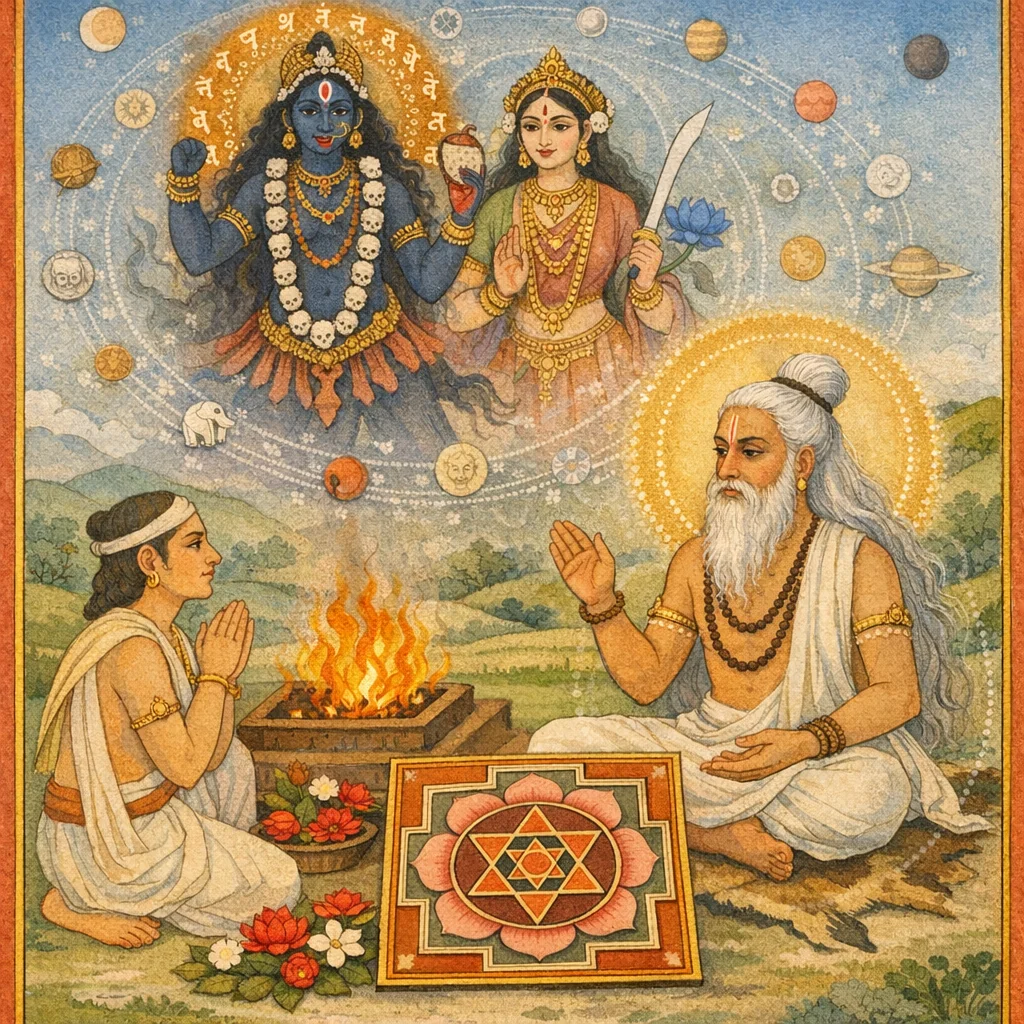
The Classification and Explanation of Yakṣiṇī Mantras (Kālī and Tārā Vidyās)
Sanatkumāra teaches a mantra system centered on Śakti as Vāk (sacred Speech): first Kālī as the Goddess of Speech’s manifestation, then a Tārā-focused vidyā. The chapter defines mantra elements (ṛṣi, chandas, devatā, bīja, śakti), prescribes aṅga-nyāsa and mātṛkā placements, protective rites, and dhyāna on Kālī’s form. It explains yantra construction (hexagon, interlaced triangles, lotus, bhūpura), lists attendant śaktis/mātṛkās, and gives siddhi-oriented japa/homa counts and offerings such as red lotuses, bilva, and karavīra. A major portion details Tārā’s sixteenfold nyāsa, including planetary, lokapāla, Śiva–Śakti, and cakra installations, with digbandha and kavaca-like protections. Ethical cautions—avoid harming others and harsh speech—appear alongside cremation-ground motifs found in some Tantric registers. The chapter ends with amulet/yantra uses for protection, learning, victory, and prosperity.
Shlokas
Verse 1
सनत्कुमार उवाच । वाग्देवता वतारोऽन्यः कालिकेति प्रकीर्तिता । तस्या मन्त्रं प्रवक्ष्यामि भुक्तिमुक्तिप्रदं नृणाम् ॥ १ ॥
Sanatkumāra said: Another manifestation of the Goddess of Speech is celebrated as Kālī. I shall now declare her mantra, which bestows upon people both worldly enjoyment and liberation.
Verse 2
सृष्टिक्रियान्विता शांतिर्बिद्वाढ्या च त्रिधा पुनः । अरुणाक्ष्यादीपिका च बिंदुयुक्ता द्विधा ततः ॥ २ ॥
Śānti (the pacificatory mode) is of the type “accompanied by the act of creation”; and the form called Bidvāḍhyā is again threefold. Likewise, Aruṇākṣī and Dīpikā are recognized, and then the Binduyuktā type is twofold.
Verse 3
मायाद्वयं ततः पश्चाद्दक्षिणे कालिके पदम् । पुनश्च सप्तबीजानि स्वाहांतोऽयं मनूत्तमः ॥ ३ ॥
Next, place the two “māyā” syllables; after that, on the right, set the word “Kālikā.” Then again add the seven seed-syllables—this excellent mantra ends with “svāhā.”
Verse 4
भैरवोऽस्य ऋषिश्छन्द उष्णिक्काली तु देवता । बीजं मायादीर्घवर्त्म शक्तिरुक्ता मुनीश्वर ॥ ४ ॥
For this mantra, Bhairava is declared to be the seer (ṛṣi); the metre is Uṣṇik; the presiding deity is Kālī. The seed-syllable (bīja) is “Māyā”, and the śakti is said to be “Dīrghavartma”, O best of sages.
Verse 5
षड्दीर्धाढ्ये बीजेन विद्याया अंगमीरितम् । मातृकार्णान्दश दश हृदये भुजयोः पदोः ॥ ५ ॥
With the seed-mantra endowed with the six long vowels, the limb-placements (aṅga-nyāsa) of the Vidyā are prescribed. The letters of the Mātṛkā are to be placed—ten and ten—upon the heart, the arms, and the feet.
Verse 6
विन्यस्य व्यापकं कुर्यान्मूलमंत्रेण साधकः । शिरः कृपाणमभयं वरं हस्तैश्च बिभ्रतीम् ॥ ६ ॥
Having performed the nyāsa, the practitioner should, by the root-mantra, undertake the all-pervading (protective) rite and meditate upon the Goddess bearing a severed head, a sword, the gesture of fearlessness, and the boon-giving gesture in her hands.
Verse 7
मुंडस्रङ्मस्तकां मुक्तकेशां पितृवनस्तिताम् । सर्वालंकृतवर्णां च श्यामांगीं कालिकां स्मरेत् ॥ ७ ॥
One should meditate on Kālikā: her head adorned with a garland of skulls, her hair unbound, abiding in the Pitṛ-forest (the realm associated with the ancestors), richly ornamented, and dark-limbed in form.
Verse 8
एवं ध्यात्वा जपेल्लक्षं जुहुयादयुतं ततः । प्रसूनैः करवीरोत्थैः पूजायंत्रमथोच्यते ॥ ८ ॥
Thus having meditated, one should recite the mantra one hundred thousand times; thereafter one should offer ten thousand oblations into the sacred fire. Then, with flowers of karavīra (oleander), the method of worship of the yantra is taught.
Verse 9
विलिख्य पूर्वं षट्कोणं त्रिकोणत्रितयं ततः । पद्ममष्टदलं बाह्ये भूपुरं तत्र पूजयेत् ॥ ९ ॥
First draw a hexagon; then draw the triad of triangles. Outside that, draw an eight-petalled lotus, and beyond it the bhūpura, the surrounding square enclosure. In that diagram one should perform the worship.
Verse 10
जया च विजया चापि अजिता चापराजिता । नित्या विलासिनी वापि दोग्ध्यघोरा च मंगला ॥ १० ॥
Jaya and Vijaya, Ajitā and Aparājitā; Nityā and also Vilāsinī; Dogdhrī, Aghorā, and Maṅgalā—these are the divine names and forms being enumerated.
Verse 11
पीठस्य शक्तयो मायात्मने हृत्पीठमंत्रकः । शिवरूपशवश्थां च शिवाभिर्दिक्षु वेष्टिताम् ॥ ११ ॥
The Śaktis of the pīṭha are for the one whose essence is Māyā; the heart-seat (hṛt-pīṭha) has its own mantra. And one should contemplate the corpse-form that appears as Śiva, enclosed on all sides by the Śivās in the directions.
Verse 12
महाकालरतासक्तां ध्यात्वांगान्यर्चयेत्पुरा । कालीं कपालिनीं कुल्लां कुरुकुल्लां विरोधिनीम् ॥ १२ ॥
Having first meditated on the Goddess who is passionately devoted to Mahākāla, one should then worship her aṅgas (auxiliary limbs/aspects). One should worship her as Kālī, Kapālinī, Kullā, Kurukullā, and Virodhinī.
Verse 13
विप्रचित्तां च षट्कोणे नवकोणे ततोऽर्चयेत् । उग्रामुष्णप्रभां दीप्तां नीलाधानां बलाकिकाम् ॥ १३ ॥
In the hexagonal compartment one should worship Vipracittā; then, in the nine-angled compartment, one should worship Balākikā—fierce, blazing with hot radiance, brilliant, and bearing a blue hue.
Verse 14
मात्रां मुद्रां तथा मित्रां पूज्याः पत्रेषु मातरः । पद्मस्यास्य सुयत्नेन ब्राह्मी नारायणीत्यपि ॥ १४ ॥
Upon the lotus-leaves the Mother-goddesses are to be worshipped as Mātrā, Mudrā, and Mitrā; and, with careful attention, also Brāhmī and Nārāyaṇī in connection with this lotus.
Verse 15
माहेश्वरी च चामुंडा कौमारी चापराजिता । वाराही नारसिंहा च पुनरेतास्तु भूपुरे ॥ १५ ॥
Māheśvarī, Cāmuṇḍā, Kaumārī, Aparājitā, Vārāhī, and Nārasiṃhī—these again are to be installed in the bhūpura, the outer earthly enclosure of the sacred diagram.
Verse 16
भैरवीं महदाद्यां तां सिंहाद्यां धूम्रपूर्विकाम् । भीमोन्मत्तादिकां चापि वशीकरणभैरवीम् ॥ १६ ॥
He also spoke of Bhairavī in her many forms—Mahadādyā, Siṁhādyā, Dhūmrapūrvikā, and those such as Bhīmā and Unmattā—along with Vaśīkaraṇa-bhairavī, the Bhairavī associated with rites of subjugation.
Verse 17
मोहनाद्यां समाराध्य शक्रादीन्यायुधान्यपि । एवमाराधिता काली सिद्धा भवति मंत्रिणाम् ॥ १७ ॥
Having duly propitiated Mohanā and also the weapons beginning with those of Indra (Śakra), thus worshipped, Kālī becomes fully accomplished and grants mantra-siddhi to practitioners of mantras.
Verse 18
ततः प्रयोगान्कुर्वीत महाभैरवभाषितान् । आत्मनो वा परस्यार्थं क्षिप्रसिद्धिप्रदायकान् ॥ १८ ॥
Thereafter, one should perform the ritual applications (prayogas) taught by Mahābhairava, which grant swift success—whether for one’s own purpose or for the sake of another.
Verse 19
स्त्रीणां प्रहारं निंदां च कौटिल्यं वाप्रियं वचः । आत्मनो हितमन्विच्छन् कालीभक्तो विवर्जयेत् ॥ १९ ॥
Seeking his own true welfare, a devotee in the Kali age should avoid striking women, slandering them, acting with deceit, and speaking harsh or unpleasant words.
Verse 20
सुदृशो मदनावासं पश्यन्यः प्रजपेन्मनुम् । अयुतं सोऽचिरादेव वाक्पपतेः समतामियात् ॥ २० ॥
Gazing upon a beautiful woman—an abode of Cupid—one should repeat the mantra. By reciting it ten thousand times, he quickly attains equality with Vākpati, the Lord of Speech.
Verse 21
दिगम्बरो मुक्तकेशः श्मशानस्थोऽधियामिनि । जपेद्योऽयुतमेतस्य भवेयुः सर्वसिद्धयः ॥ २१ ॥
Naked (sky-clad), with hair unbound, stationed in a cremation ground in the stillness of night—whoever repeats this mantra ten thousand times attains all siddhis.
Verse 22
शवस्य हृदये स्थित्वा निर्वासाः प्रेतभूमिगः । अर्कपुष्पसहस्रेणाभ्यक्तेन स्वीयरेतसा ॥ २२ ॥
Staying upon the heart of a corpse—naked, in a cremation-ground—he anoints it with a thousand arka-flowers smeared with his own semen.
Verse 23
देवीं यः पूजयेद्भक्त्या जपन्नेकैकशो मनुम् । सोऽचरेणैव कालेन धरणीप्रभुतां व्रजेत् ॥ २३ ॥
Whoever worships the Goddess with devotion, reciting the mantra one syllable at a time, attains—before long—sovereignty over the earth.
Verse 24
रजः कीर्णं भगं नार्या ध्यायन्यो ह्ययुतं जपेत् । सकवित्वेन रम्येण जनान्मोहयति ध्रुवम् ॥ २४ ॥
Whoever meditates on a woman’s vulva smeared with menstrual blood and repeats (the mantra) ten thousand times surely deludes people through charming, poetic speech.
Verse 25
त्रिपञ्चारे महापीठे शिवस्य हृदि संस्थिताम् । महाकालेन देवेन मारयुद्धं प्रकुर्वतीम् ॥ २५ ॥
At Tripañcāra, that great sacred seat, She was established in the heart of Śiva and was waging a deadly battle with the god Mahākāla.
Verse 26
तां ध्यायन्स्मेरवदनां विदधत्सुरतं स्वयम् । जपेत्सहस्रमपि यः स शंकरसमो भवेत् ॥ २६ ॥
Meditating on Her—whose face bears a gentle smile—and oneself enacting the rite of intimate union, whoever repeats the mantra even a thousand times becomes equal to Śaṅkara (Śiva).
Verse 27
अस्थिलोमत्वचायुक्तं मांसं मार्जारमेषयोः । उष्ट्रस्य महिषस्यापि बलिं यस्तु समर्पयेत् ॥ २७ ॥
Whoever offers as a sacrificial bali the flesh of a cat or a sheep—flesh accompanied by bone, hair, and skin—or likewise offers the bali of a camel or a buffalo, acts contrary to proper ritual rule.
Verse 28
भूताष्टम्योर्मध्यरात्रे वश्याः स्युस्तस्य जन्तवः । विद्यालक्ष्मीयशःपुत्रैः स चिरं सुखमेधते ॥ २८ ॥
At midnight on Bhūtāṣṭamī, living beings fall under his control; and he prospers long in happiness, endowed with learning, prosperity, fame, and sons.
Verse 29
यो हविष्याशनरतो दिवा देवीं स्मरन् जपेत् । नक्तं निधुवनासक्तो लक्षं स स्याद्धरापतिः ॥ २९ ॥
He who lives on havis-offerings, and by day remembers the Goddess and recites her mantra, and by night is intent on love-play—such a man becomes a lord of the earth, possessing vast wealth and power, a “lakh” in measure.
Verse 30
रक्तांभोजैर्हुनेन्मंत्री धनैर्जयति वित्तपम् । बिल्वपत्रैर्भवेद्राज्यं रक्तपुष्पैर्वशीकृतिः ॥ ३० ॥
A mantra-knowing practitioner should offer oblations with red lotuses; by offering wealth he conquers the lord of riches. By offering bilva leaves he gains sovereignty, and by offering red flowers he brings about vaśīkaraṇa, subjugation.
Verse 31
असृजी महिषादीनां कालिकां यस्तु तर्पयेत् । तस्य स्युरचिरादेव करस्थाः सर्वसिद्धयः ॥ ३१ ॥
Whoever offers tarpaṇa to Kālikā with the blood of a buffalo and the like—for him, indeed, all siddhis soon come to rest in his very hand.
Verse 32
यो लक्षं प्रजपेन्मन्त्रं शवमारुह्य मन्त्रवित् । तस्य सिद्धो मनुः सद्यः सर्वेप्सितफलप्रदः ॥ ३२ ॥
A knower of mantras who recites a mantra one hundred thousand times while seated upon a corpse—his mantra becomes immediately accomplished, granting all desired results.
Verse 33
तेनाश्वमेधप्रमुखैर्यागौरिष्टं सुजन्मना । दत्तं दानं तपस्तप्तं उपास्ते यस्तु कालिकाम् ॥ ३३ ॥
By that noble-born person, sacrifices beginning with the Aśvamedha are duly performed; gifts are bestowed and austerities are undertaken—yet whoever worships Mother Kālikā attains the fruit of all these.
Verse 34
ब्रह्मा विष्णुः शिवो गौरी लक्ष्मीर्गणपती रविः । पूजिताः सकला देवा यः कालीं पूजयेत्सदा ॥ ३४ ॥
Brahmā, Viṣṇu, Śiva, Gaurī, Lakṣmī, Gaṇapati, and the Sun—indeed all the gods—are deemed worshipped by the one who worships Kālī always.
Verse 35
अथापरः सरस्वत्या ह्यवतारो निगद्यते । यां निषेव्य नरा लोके कृतार्थाः स्युर्न संशयः ॥ ३५ ॥
Now another manifestation of Sarasvatī is described; by resorting to her, people in this world become fulfilled—of this there is no doubt.
Verse 36
आप्यायिनी चन्द्रयुक्ता माया च वदनांतरे । सकामिका क्रुधा शांतिश्चन्द्रालंकृतमस्तका ॥ ३६ ॥
Āpyāyinī, joined with the Moon; Māyā, present within the mouth; Sakāmikā, Krudhā, and Śānti—these are described as having their heads adorned with the Moon.
Verse 37
दीपिका सासना चन्द्रयुगस्त्रं मनुरीरितः । मुनिरक्षोभ्य उद्दिष्टश्छन्दस्तु बृहती मतम् ॥ ३७ ॥
For the vidyā/mantra called Dīpikā, the prescribed application is “Candrayugāstra”; the seer (ṛṣi) is said to be Manu, the indicated sage (muni) is Akṣobhya, and the metre (chandas) is understood to be Bṛhatī.
Verse 38
ताराख्या देवता बीजं द्वितीयञ्च चतुर्थकम् । शक्तिः षड्दीर्घयुक्तेन द्वितीयेनांगकल्पनम् ॥ ३८ ॥
The presiding deity is She who is called Tārā. The bīja (seed-syllable) is formed by joining the second vowel with the fourth consonantal element. The śakti (power-syllable) is obtained by uniting the second with the sixth long vowel; and the aṅgas (auxiliary limbs for nyāsa) are to be arranged again with the second as the basis.
Verse 39
षोढा न्यासं ततः कुर्यात्तारायाः सर्वसिद्धिम् । श्रीकण्ठादीन्न्यसेद्रुद्रान्मातृकावर्णपूर्वकान् ॥ ३९ ॥
Then one should perform the sixteenfold nyāsa for Tārā, which bestows complete siddhi. One should install (invoke) the Rudras beginning with Śrīkaṇṭha, preceded by the letters of the Mātṛkā, the sacred matrix of sounds.
Verse 40
मातृकोक्तस्थले माया तृतीयक्रोधपूर्वकान् । चतुर्थीनमसायुक्तान्प्रथमो न्यास ईरितः ॥ ४० ॥
In the place indicated by the Mātṛkā, one should install in nyāsa the syllable “māyā”. And the syllables beginning with “krodha”, as the third set, should be joined with the dative ending (caturthī) and the word “namaḥ”. This is declared to be the first nyāsa.
Verse 41
शवपीठसमासीनां नीलकांतिं त्रिलोचनाम् । अर्द्धेन्दुशेखरां नानाभूषणाढ्यां स्मरन्न्यसेत् ॥ ४१ ॥
While performing nyāsa, one should meditate upon Her—seated upon a corpse-seat, dark-blue in radiance, three-eyed, crowned with the crescent moon, and richly adorned with many ornaments—and then install the mantras accordingly.
Verse 42
द्वितीये तु ग्रहन्यासं कुर्यात्तां समनुस्मरन् । त्रिबीजस्वरपूर्वं तु रक्तसूर्यं हृदि न्यसेत् ॥ ४२ ॥
In the second step, one should perform the nyāsa of the planets, remembering Her without interruption. Then, preceded by the three bījas and their proper intonations, one should install the red Sun within the heart.
Verse 43
तथा पवर्गपूर्वं तु शुक्लं सोमं भ्रुवोर्द्वये । कवर्गपूर्वं रक्ताभं मंगलं लोचनत्रयम् ॥ ४३ ॥
Likewise, the syllables beginning with the pa-varga are to be placed by nyāsa as the white Moon upon the pair of eyebrows; and the syllables beginning with the ka-varga, reddish in hue, are to be placed as Mars in the three eyes.
Verse 44
चवर्गाद्यं बुधं श्यामं न्यसेद्वक्षस्थले बुधः । ढवर्गाद्यं पीतवर्णं कण्ठकूपे बृहस्पतिम् ॥ ४४ ॥
A wise practitioner should place by nyāsa Mercury (Budha)—dark-hued and linked with the syllable-group beginning with ‘ca’—upon the region of the chest. And Jupiter (Bṛhaspati)—yellow in color and linked with the group beginning with ‘ḍha’—at the hollow of the throat (the suprasternal pit).
Verse 45
तवर्गाद्यं श्वेतवर्णं घटिकायां तु भार्गवम् । नीलवर्णं पवर्गाद्यं नाभिदेशे शनैश्चरम् ॥ ४५ ॥
The ‘ta’-group, white in color, should be placed at the ghaṭikā (the wrist-joint), and it is presided over by Bhārgava (Venus). The ‘pa’-group, blue in color, should be placed in the region of the navel, and it is presided over by Śanaiścara (Saturn).
Verse 46
शवर्गाद्यं धूम्रवर्णं ध्यात्वा राहुं मुखे न्यसेत् । त्रिबीजपूर्वकश्चैवं ग्रहन्यासः समीरितः ॥ ४६ ॥
Meditating on Rāhu as smoke-hued and linked with the letters of the ‘śa’-group, one should place (his mantra) by nyāsa upon the mouth. Thus, preceded by the three seed-syllables (bīja), the rite of planetary nyāsa has been explained.
Verse 47
तृतीयं लोकपालानां न्यासं कुर्यात्प्रयत्नतः । मायादिबीजत्रितयपूर्वकं सर्वसिद्धये ॥ ४७ ॥
Third, with careful effort, one should perform the nyāsa of the Lokapālas (Guardians of the Directions), preceded by the triad of seed-mantras (bīja) beginning with Māyā, so that all attainments (siddhi) may be accomplished.
Verse 48
स्वमस्तके ललाटादि दिक्ष्वष्टस्वधउर्द्ध्वतः । ह्रस्वदीर्घकादिकाष्टवर्गपूर्वान्दिशाधिपान् ॥ ४८ ॥
Upon one’s own head—beginning with the forehead—one should mentally install, in the eight directions and also above, the presiding deities of the directions, arranged in order: first the short and long vowels, then the consonant groups beginning with “ka” (the eight vargas).
Verse 49
शिवशक्त्यभिधे न्यासं चतुर्थे तु समाचरेत् । त्रिबीजपूर्वकान्न्यस्येत्षट्शिवाञ्छक्तिसंयुतान् ॥ ४९ ॥
In the fourth procedure, one should perform the nyāsa called “Śiva–Śakti.” One should place the mantras beginning with the three seed-syllables, and then install the six Śivas conjoined with Śakti.
Verse 50
आधारादिषु चक्रेषु स्वचक्रवर्णपूर्वकान् । ब्रह्माणं डाकिनीयुक्तं वादिसांतार्णपूर्वकम् ॥ ५० ॥
In the cakras beginning with the Ādhāra, one should first place the letters belonging to each chakra in their proper order; then one should contemplate Brahmā united with Ḍākinī, preceded by the series of seed-syllables from “va” to “sa”.
Verse 51
मूलाधारे विन्यसेच्च चतुर्द्दलसमन्वितम् । श्रीविष्णुं राकिणीयुक्तबादिलांतार्णपूर्वकम् ॥ ५१ ॥
In the Mūlādhāra, one should perform nyāsa of Śrī Viṣṇu in the four-petalled lotus, together with Rākiṇī, preceded by the seed-syllables from “ba” to “la” along with the inner (esoteric) sound.
Verse 52
स्वाधिष्ठनाभिधे चक्रे लिंगस्थे षड्दले न्यसेत् । रुद्रं तु डाकिनीयुक्तं डादिफांतार्णपूर्वकम् ॥ ५२ ॥
In the Svādhiṣṭhāna chakra, in the six-petalled lotus situated at the liṅga, one should perform nyāsa. There one should install Rudra together with Ḍākinī, preceded by the syllables beginning with “ḍa” and ending with “pha”.
Verse 53
चक्रे दशदले न्यस्येन्नाभिस्थे मणिपूरके । ईश्वरं कादिठान्तार्णपूर्वकं शाकिनीयुतम् ॥ ५३ ॥
One should perform nyāsa in the ten‑petalled wheel at the navel—the Maṇipūraka—and there contemplate Īśvara, preceded by the syllables from Ka to Ṭha, accompanied by Śākinī.
Verse 54
विन्यसेद्द्वादशदलेहृदयस्थे त्वनाहते । सदाशिवं शाकिनीं च षोडशस्वरपूर्वकम् ॥ ५४ ॥
One should perform nyāsa in the heart‑lotus, the twelve‑petalled Anāhata, installing Sadāśiva and also Śākinī, preceded by the sixteen vowels.
Verse 55
कण्ठस्थे षोडशदले विशुद्धाख्ये प्रविन्यसेत् । आज्ञाचक्रे परशिवं हाकिनीसंयुतं न्यसेत् ॥ ५५ ॥
One should firmly place one’s contemplation in the sixteen‑petalled lotus at the throat, called Viśuddhā; and in the Ājñā‑cakra one should install Paraśiva, united with Hākinī.
Verse 56
लक्षार्णपूवं भ्रूमध्यसंस्थितेऽतिमनोहरे । तारादिपंचमं न्यासं कुर्यात्सर्वेष्टसिद्धये ॥ ५६ ॥
Placing the mantra that begins with the syllable “lakṣa” in the exceedingly enchanting space between the eyebrows, one should perform nyāsa up to the fifth part beginning with “Tārā”; thereby all desired attainments are accomplished.
Verse 57
अष्टौ वर्गान्स्वरद्वंद्वपूर्वकान् बीजसंयुतान् । ताराद्या न्यासपूर्वाश्च प्रयोज्या अष्टशक्तयः ॥ ५७ ॥
The eight groups of letters are to be employed, each preceded by a pair of vowels and joined with the seed‑syllables (bīja). Beginning with “Tārā” (Oṃ), after first performing nyāsa, the eight Śaktis are to be applied in practice.
Verse 58
ताराथोग्रा महोग्रापि वज्रा काली सरस्वती । कामेश्वरी च चामुंडा इत्यष्टौ तारिकाः स्मृताः ॥ ५८ ॥
Tārā, Athogrā, Mahogrā, Vajrā, Kālī, Sarasvatī, Kāmeśvarī, and Cāmuṇḍā—these eight are remembered in tradition as the Tārikās.
Verse 59
ब्रह्मरंध्रे ललाटे च भ्रूमध्ये कण्ठदेशतः । हृदि नाभौ फले मूलाधारे चेताः क्रमान्न्यसेत् ॥ ५९ ॥
One should place the mind (conscious awareness) step by step—at the brahma-randhra (crown aperture), at the forehead, at the space between the eyebrows, at the region of the throat, in the heart, at the navel, at the genital region, and at the mūlādhāra (root support).
Verse 60
अङ्गन्यासं ततः कुर्यात्पीठाख्यं सर्वसिद्धिदम् । आधारे कामरूपाख्यं बीजं ह्रस्वार्णपूर्वकम् ॥ ६० ॥
Then one should perform the limb-nyāsa called “Pīṭha,” which bestows all attainments. At the foundation (ādhāra), one should place the seed-mantra known as “Kāmarūpa,” preceded by a short vowel.
Verse 61
हृदि जालंधरं बीजं दीर्घपूर्वं प्रविन्यसेत् । ललाटे पूर्णगिर्याख्यं कवर्गाद्यं न्यसेत्सुधीः ॥ ६१ ॥
In the heart, one should carefully place the Jālandhara bīja, preceded by a long vowel. On the forehead, the wise should place the bīja known as Pūrṇagiri, beginning with the consonants of the ka-group.
Verse 62
उड्डीयानं चवर्गाद्यं केशसन्धौ प्रविन्यसेत् । कण्ठे तु मथुरापीठं दशम यादिकं न्यसेत् ॥ ६२ ॥
One should carefully place (nyāsa) ‘Uḍḍiyāna’, beginning with the consonant-group ‘ca’, at the junction of the hairline. And at the throat one should place the Mathurā seat (pīṭha), and the tenth (placement) beginning with ‘ya’.
Verse 63
षोढा न्यासस्तु तारायाः प्रोक्तोऽभीष्टप्रदायकः । हृदि श्रीमदेकजटां तारिणीं शिरसि न्यसेत् ॥ ६३ ॥
The sixteenfold nyāsa of Tārā is taught as the giver of desired fruits. One should install the auspicious Ekajaṭā in the heart, and place Tāriṇī upon the head.
Verse 64
वज्रोदके शिखां पातु उग्रतारां तु वर्मणि । महोग्रा वत्सरे नेत्रे पिंगाग्रैकजटास्त्रके ॥ ६४ ॥
May Vajrodakā protect my śikhā (crown‑tuft); may Ugratārā protect my varman (armor). May Mahogrā guard my calves, and may Piṅgāgrā‑Ekajaṭā protect my eyes and my astra (mantric weapon).
Verse 65
षड्रदीर्गयुक्तमायाया एतान्यष्टौ षडंगके । अंगुष्ठादिष्वंगुलीषु पूर्वं विन्यस्य यत्नतः ॥ ६५ ॥
In the sixfold ancillary rite (ṣaḍaṅga), one should first, with care, place these eight syllables of the Māyā mantra—endowed with six long vowels—upon the fingers beginning with the thumb.
Verse 66
तर्जनीमध्यमाभ्यां तु कृत्वा तालत्रयं ततः । छोटिकामुद्राया कुर्याद्दिग्बन्धं देवतां स्मरन् ॥ ६६ ॥
Then, using the index and middle fingers, one should perform three claps; thereafter, forming the Choṭikā‑mudrā, one should establish the digbandha (directional seal) while remembering the deity.
Verse 67
विद्यया तारपुटया व्यापकं सप्तधा चरेत् । उग्रतारां ततो ध्यायेत्सद्यो वादेऽतिसिद्धिदाम् ॥ ६७ ॥
By the mantra‑vidyā of the Tāra‑puṭa, one should perform the all‑pervading coverage (nyāsa/protection) in sevenfold manner; thereafter one should meditate on Ugratārā, who immediately bestows extraordinary siddhi in debate (vāda).
Verse 68
लयाब्धावंबुजन्मस्थां नीलाभां दिव्यभूषणाम् । कम्बुं खङ्गं कपालं च नीलाब्जं दधतीं करैः ॥ ६८ ॥
She stands upon a lotus born from the ocean of dissolution, dark-hued and adorned with divine ornaments, holding in her hands a conch, a sword, a skull-bowl, and a blue lotus.
Verse 69
नागश्रेष्ठालंकृतांगीं रक्तनेत्रत्रयां स्मरेत् । जपेल्लक्षचतुष्कं हि दशांशं रक्तपद्मकैः ॥ ६९ ॥
One should meditate upon the Goddess whose limbs are adorned with the noblest serpents and who has three red eyes. Then one should perform japa of four lakhs of the mantra; and as a tenth part, offer red lotuses in oblation.
Verse 70
हुनेत्क्षीराज्यसंमिश्रैः शंखं संस्थाप्य संजपेत् । नारीं पश्यन्स्पृशन्गच्छन्महानिशि बलिं चरेत् ॥ ७० ॥
He should offer oblations with a mixture of milk and ghee; having installed a conch, he should perform mantra-recitation. At the Great Night (the midnight rite), while looking at a woman, touching her, and going to her, he should also perform the bali-offering.
Verse 71
श्मशाने शून्यसदने देवागारेऽथ निर्जने । पर्वते वनमध्ये वा शवमारुह्य मंत्रवित् ॥ ७१ ॥
In a cremation-ground, in an empty house, in a temple, or in a solitary place—on a mountain, or in the midst of a forest—the knower of mantras may even mount a corpse as a ritual seat and perform the mantra-practice.
Verse 72
समरे शत्रुनिहतं यद्वा षाण्यासिकं शिशुम् । विद्यां साधयतः शीघ्रं साधितैवं प्रसिद्ध्यति ॥ ७२ ॥
If, while one is engaged in mastering a vidyā (esoteric discipline), one sees either an enemy slain in battle or a child belonging to a renunciant order, then that vidyā is quickly accomplished—thus is it traditionally known.
Verse 73
मेधा प्रज्ञा प्रभा विद्या धीवृत्तिस्मृतिबुद्धयः । विश्वेश्वरीति संप्रोक्ताः पीठस्य नव शक्तयः ॥ ७३ ॥
Medhā (retentive intellect), Prajñā (discernment), Prabhā (radiance), Vidyā (knowledge), Dhī (understanding), Vṛtti (mental function), Smṛti (memory), and Buddhi (intellect)—these are proclaimed as the nine śaktis of the sacred Pīṭha, collectively called Viśveśvarī.
Verse 74
भृगुमन्विंदुसंयुक्तं मेघवर्त्म सरस्वती । योगपीठात्मने हार्द्दं पीठस्य मनुरीरितः ॥ ७४ ॥
The mantra of the Pīṭha is declared thus: it is joined with Bhṛgu, Manu, and the Moon; it moves along the path of the clouds; and it is Sarasvatī—an inward, heart-born offering to the Self of the Yoga-Pīṭha.
Verse 75
दत्त्वानेनासनं मूर्तिं मूलमंत्रेण कल्पयेत् । पूजयेद्विधिवद्देवीं तद्विधानमथोच्यते ॥ ७५ ॥
Having offered her a seat, one should install—by conceiving and establishing—the Goddess’s image with the root-mantra. Then one should worship Devī according to the prescribed rite; now that procedure is set forth.
Verse 76
तारो माया भगं ब्रह्मा जटे सूर्यः सदीर्घकम् । यक्षाधिपतये तंद्रीसोपनीतं बलिं ततः ॥ ७६ ॥
Then, with the mantra-words “Tāra,” “Māyā,” “Bhagaṃ,” “Brahmā,” and “Sūryaḥ” uttered in a long-drawn manner, and with the hair arranged in matted locks (jaṭā), he should thereafter present the bali-offering—brought forward with the rite, step by step—to the Lord of the Yakṣas.
Verse 77
गृहयुग्मं शिवा स्वाहा बलिमंत्रोऽयमीरितः । दद्यान्नित्यं बलिं तेन मध्यरात्रे चतुष्पथे ॥ ७७ ॥
“Pair of houses; O Śivā, svāhā”—this is the declared bali-mantra. With it one should offer the bali daily, at midnight, at a four-way crossroads.
Verse 78
जलदानादिकं मंत्रैर्विदध्याद्दशभिस्ततः । ध्रुवो वज्रोदके वर्म फट्सप्तार्णो जलग्रहे ॥ ७८ ॥
Thereafter one should perform the gifting of water and the allied rites by means of ten mantras: the Dhruva mantra, the Vajrodaka mantra, the Varma (protective) mantra; and, when taking up the water, the seven‑syllabled mantra ending in “phaṭ”.
Verse 79
ताराद्या वह्निजायांता माया हि क्षालने मता । तारो मायाः भृगुः कर्णोविशुद्धं धर्मवर्मतः ॥ ७९ ॥
Beginning with Tārā and ending with Vahnijāyā, this set is regarded as “Māyā” for the act of cleansing. Tārā is the (mantra/measure) called Māyā; Bhṛgu is called Karṇa; and the pure form is known as Dharmavarma.
Verse 80
सर्वपापानि शाम्यंते छेतो नेत्रयुतं जलम् । कल्पान्तनयनस्वाहा मंत्र आचमने मतः ॥ ८० ॥
All sins are pacified by water taken with mindful awareness and with the eyes properly directed. For ācamana (ritual sipping), the mantra “kalpānta-nayana-svāhā” is prescribed.
Verse 81
ध्रुवो मणिधरीत्यंते वज्रिण्यक्षियुता मृतिः । खरिविद्यायुग्रिजश्व सर्ववांते बकोऽब्जवान् ॥ ८१ ॥
“Dhruva” is called “Maṇidhara”; “Mṛti” is said to be “Vajrīṇī, endowed with imperishable eyes”; “Kharī‑vidyā” is known as “Ugrijāśva”; and at the end of all enumerations stands “Baka”, the lotus‑born.
Verse 82
कारिण्यंते दीर्घवर्म अस्त्रं वह्निप्रियांतिमः । त्रयोविंशतिवर्णात्मा शिखाया बंधने मनुः ॥ ८२ ॥
“Kāriṇyaṃte” and “Dīrghavarma”—this is the Astra‑mantra; its concluding portion is “Vahnipriyāntimaḥ”. Composed of twenty‑three syllables, this is the Manu (sacred formula) used for binding and securing the śikhā (crest‑lock/topknot).
Verse 83
प्रणवो रक्षयुगलं दीर्घवर्मास्त्रठद्वयम् । नवार्णेनामुना मंत्री कुर्याद्भूमिविशोधनम् ॥ ८३ ॥
With the Praṇava (Oṃ), together with the pair of protective formulas, the long armor-mantra, and the two ‘astra’ syllables ending in ‘ṭha’, the officiant should purify the ground by means of this nine-syllabled mantra.
Verse 84
नारांते सर्वविघ्नानुत्सारयेति पदं ततः । हुं फट् स्वाहा गुणेंद्वर्णो मनुर्विघ्ननिवारणम् ॥ ८४ ॥
At the end of the name “Nārāyaṇa,” one should add the phrase “drive away all obstacles.” After that, the mantra formed of “huṃ,” “phaṭ,” and “svāhā,” containing the guṇa and indu sounds, is for the removal of obstacles.
Verse 85
मायाबीजं जपापुष्पनिभं नाभौ विचिंयेत् । तदुत्थेनाग्निना देहं दहेत्साद्धस्वपाप्मना ॥ ८५ ॥
One should meditate upon the Māyā-bīja, the seed-syllable resembling a hibiscus blossom, in the navel. With the fire that arises from it, one should burn the body together with one’s own sins.
Verse 86
ताराबीजं सुवर्णाभं चिंतयेद्धृदि मंत्रवित् । पवनेन तदुत्थेन पापभस्म क्षिपेद्भुवि ॥ ८६ ॥
The knower of mantra should meditate within the heart on the Tārā seed-syllable, radiant like gold; and, by the breath that arises from that contemplation, he should cast the ashes of sin down upon the earth.
Verse 87
तुरीयं चंद्रकुंदाभं बीजं ध्यात्वाललाटतः । तदुत्थसुधयादे हं स्वयं वै देवतानिभम् ॥ ८७ ॥
Meditating from the forehead on the fourth seed-syllable, radiant like the moon and jasmine, by the nectar that arises from it one’s very body becomes, of itself, godlike in splendor.
Verse 88
अनया भूतशुद्ध्या तु देवीसादृश्यमाप्नुयात् । तारोऽनंतो भगुः कर्णो पद्मनाभयुतो बली ॥ ८८ ॥
By this practice of elemental purification (bhūtaśuddhi), one truly attains likeness to the Goddess. One becomes Tāra, Ananta, Bhagu, Karṇa, and the mighty one endowed with Padmanābha.
Verse 89
खे वज्ररेखे क्रोधाख्यं बीजं पावकल्लभा । अमुना द्वादशार्णेन रचयेन्मंडलं शुभम् ॥ ८९ ॥
O beloved of Agni, in the sky-like expanse and along thunderbolt-shaped lines, one should place the seed-syllable called “Krodha.” With this twelve-syllabled formula, one should fashion an auspicious maṇḍala.
Verse 90
तारो यथागता निद्रा सदृक्षेकभृगुर्विषम् । सदीर्घस्मृतिरौ साक्षौ महाकालो भगान्वितः ॥ ९० ॥
These names are listed: Tāra; Yathāgatā (“as it has come to be”); Nidrā (Sleep); Sadṛkṣa; Ekabhṛgu; Viṣa (Poison); Sadīrghasmṛti; Rau; Sākṣa (the Witness); Mahākāla (Great Time); and Bhagānvita (endowed with lordly power).
Verse 91
क्रोधोऽस्त्रं मनुवर्णोऽयं मनुः पुष्पादिशोधने । तारः पाशः परा स्वाहा पंचार्णस्चित्तशोधने ॥ ९१ ॥
“Krodha” is the astra-mantra. This mantra, formed from the prescribed syllables, is to be used for purifying flowers and other ritual articles. “Tāra”, “Pāśa”, “Parā”, and “Svāhā”—and the five-syllabled mantra—are for the purification of the mind.
Verse 92
मनवो दश संप्रोक्ता अर्ध्यस्थापनमुच्यते । सेंदुभ्यां मासतो माया भुवं संसृज्य भूगृहम् ॥ ९२ ॥
Ten Manus are declared; this is called the establishment of the arghya-offering. Through the two lunar markers, month by month, Māyā fashions the worlds, creating the earthly realm as a dwelling-place.
Verse 93
वृतं त्रिकोणसंयुक्तं कुर्यान्मंडलमंत्रतः । यजेत्तत्राधारशक्तिं वह्निमंडलमध्यगाम् । वह्निमंडलमभ्यर्च्य महाशंखं निधापयेत् ॥ ९३ ॥
By mantra one should draw a circular maṇḍala joined with a triangle. There one should worship Ādhāra-Śakti, abiding in the midst of the fire-maṇḍala. Having duly adored the fire-maṇḍala, one should then place the Great Conch (Mahāśaṅkha) there.
Verse 94
वामकर्णेन्दुयुक्तेन फडंतेन विहायसा । प्रक्षालितं भृगुर्दंडी त्रिमूर्तींतुयुतं पठेत् ॥ ९४ ॥
With the syllable joined to the prescribed sign of the “moon on the left ear,” and ending with the protective exclamation “phaṭ,” one should recite it together with the element of “sky/ether.” Thus purified, the Bhṛgu-daṇḍī formula is to be read in conjunction with the Three Forms (Trimūrti).
Verse 95
ततोऽर्चयेन्महाशंखं जपन्मंत्रचतुष्टयम् । दीर्घत्रयान्विता माया काली सृष्टिः सदीर्घसः ॥ ९५ ॥
Then one should worship the Great Conch while reciting the set of four mantras: “Māyā” endowed with three long vowels, “Kālī,” “Sṛṣṭi,” and “Sā” (Sa with a long vowel).
Verse 96
प्रतिमासंयुतं मासं यवनं हृदयं ततः । एकाधशार्णः प्रथमो महाशंखार्चने मनुः ॥ ९६ ॥
Then one should employ the sequence “māsa” joined with “pratimāsa”, followed by “yavana”, and then “hṛdaya”. This is the first eleven-syllabled mantra prescribed for the worship of the Great Conch (Mahāśaṅkha).
Verse 97
हंसो हरिभुजंगेशयुक्तो दीर्घंत्रयेंदुयुक् । तारिण्यंते कपालाय नमोंतो द्वादशाक्षरः ॥ ९७ ॥
The twelve-syllabled mantra ends with “namo”; it is formed by combining “haṁsa” with “haribhujaṅgeśa”, joined with the long vowel and the “three moons” as prescribed, and it concludes with “tāriṇī” and “kapālāya”.
Verse 98
स्वं दीर्घत्रयमन्वाढ्यमेषो वामदगन्वितः । लोकपालाय हृदयं तृतीयोऽयं शिवाक्षरः ॥ ९८ ॥
The syllable “svaṃ”, endowed with three long vowels and joined with the “left-side” element, is the heart-mantra for the Lokapāla; this is the third Śiva-syllable.
Verse 99
मायास्त्रीबीजमर्द्धैदुयुतं स्वं स्वर्गखादिमः । पालाय सर्वाधाराय सर्वः सर्वोद्भवस्तथा ॥ ९९ ॥
He is the seed of Māyā, the generative principle of the feminine power; His own sign is joined with the half-moon. He is the Devourer of heaven and the rest—Protector, support of all, the All, and likewise the source from which all arises.
Verse 100
सर्वशुद्धिमयश्चेति ङेंताः सर्वासुरांतिकम् । रुधिरा रतिदीर्घा च वायुः शुभ्रानिलः सुरा ॥ १०० ॥
“These are the ṅeṃtā-words”: “consisting of complete purity”; “the destroyer of all Asuras”; “blood-red”; “of long delight”; “wind”; “bright, white breeze”; and “sura” (the divine/nectar).
Verse 101
भाजनाय भगी सत्या विकपालाय हृन्मनुः । तुर्यो रसेषु वर्णोऽयं महाशंखप्रपूजने ॥ १०१ ॥
For the consecrated vessel (bhājana), the syllabic form is taught as “bhagī satyā”; for the skull-bowl (kapāla) it is “hṛnmanuḥ”. This is the fourth (turyā) ritual “colour/syllabic class”, to be applied with liquids/essences (rasa) in the great worship of the Mahāśaṅkha (Great Conch).
Verse 102
नवार्कमंडलं चेष्ट्वा सलिलं मूलमंत्रतः । प्रपूरयेत्सुधाबुद्ध्या गंधपुष्पाक्षतादिभिः ॥ १०२ ॥
Having prepared a fresh sun-disc (arka-maṇḍala), one should, with the root mantra, consecrate the water, and then complete the offering with the understanding that it is amṛta, nectar—using fragrance, flowers, unbroken rice (akṣata), and the like.
Verse 103
मुद्रां त्रिखंडां संदर्श्य पूजयेच्चंद्रमंडलम् । वाक्सत्यपद्मागगने रेफानुग्रहबिंदुयुक् ॥ १०३ ॥
Having displayed the tri-part mudrā (trikhaṇḍā), one should worship the lunar orb. The worship is to be performed with the mantra “vāk–satya–padmā–gagane,” endowed with the letter “ra” (repha), with the added “anugraha” (grace-bestowing) augment, and with the bindu (nasal dot).
Verse 104
मूलमंत्रो विपद्ध्वंसमनुसर्गसमन्वितम् । अष्टकृत्वोऽमुना मंत्री मंत्रयेत्प्रयतो जलम् ॥ १०४ ॥
The disciplined practitioner should consecrate water by reciting, eight times, the root-mantra (mūla-mantra) together with the “vipad-dhvaṁsa” (calamity-destroying) adjunct and the prescribed “anusarga” additions.
Verse 105
मायया मदिशं क्षिप्त्वा खं योनिं च प्रदर्शयेत् । तत्र वृत्ताष्टषट्कोणं ध्यात्वा देवीं विचिंतयेत् ॥ १०५ ॥
By the power of māyā, having placed the seed-syllable “ma” in the prescribed direction, one should then draw “kha” and the yoni. There, meditating on a circular form together with the eight- and six-angled figures, one should contemplate the Goddess.
Verse 106
पूर्वोक्तां पूजयेत्त्वेनां मूलेनाथ प्रतर्पयेत् । तर्जनूमध्यमानामाकनिष्ठाभिर्महेश्वरीम् ॥ १०६ ॥
In the manner stated earlier, one should worship that form; then, with the root-mantra, one should make offerings to satisfy Her. One should worship Maheśvarī with the fingers—index, middle, ring, and little—according to the prescribed nyāsa.
Verse 107
सांगुष्ठानिश्चुतुर्वारं महाशंखस्थिते जले । खंरेफमनुबिंद्वाढ्यां भृगुमन्विंदुयुक्तया ॥ १०७ ॥
Four times, with the thumb, one should sprinkle (or touch to sanctify) the water kept in a great conch. Then one should employ the syllable “kha” together with “repha” (ra), furnished with anusvāra and bindu; and the syllable “bhṛgu” (bha) joined with a bindu.
Verse 108
ध्रुवाद्येन नमोंतेन तर्प्यादानंदभैरवम् । ततस्तेनार्धतोयेन प्रोक्षेत्पूजनसाधनम् ॥ १०८ ॥
With the mantra beginning with “Dhruva” and ending with “namaḥ,” one should offer tarpana—libations of water—to Ānandabhairava. Then, with the remaining half of that water, one should sprinkle and thereby purify the articles and implements used for worship.
Verse 109
योमिमुद्रां प्रदर्श्यापि प्रणमेद्भवतारिणीम् । विधानमर्घे संप्रोक्तं सर्वसिद्धिप्रदायकम् ॥ १०९ ॥
Having displayed the Yoni-mudrā, one should bow to Bhavatāriṇī. This procedure, taught in connection with the arghya-offering, is declared to bestow every attainment.
Verse 110
पूर्वोक्ते पूजयेत्पीठे पद्मे षट्कोणकर्णिके । धरागृहावृते रम्ये देवीं रम्योपचारकैः ॥ ११० ॥
On the previously described seat—namely, a lotus whose pericarp is a six-angled karnikā, beautifully enclosed by the bhūpura (earth-enclosure)—one should worship the Goddess with pleasing offerings and devotional services.
Verse 111
महीगृहे चतुर्दिक्षु गणेशादीन्प्रपूजयेत् । पाशांकुशौ कपालं च त्रिशूलं दधतं करैः ॥ १११ ॥
In the mahīgṛha (ritual-house), one should duly worship Gaṇeśa and the other deities in the four directions—those who hold in their hands a noose and a goad, a skull-bowl (kapāla), and a trident (triśūla).
Verse 112
अलंकारचयोपेतं गणेशं प्राक्तमर्चयेत् । कपालशूले हस्ताभ्यां दधतं सर्पभूषणम् ॥ ११२ ॥
First, one should worship Gaṇeśa, adorned with a multitude of ornaments—holding a skull and a trident in his two hands, and wearing serpents as sacred adornments.
Verse 113
स्वयूथवेष्टितं रम्यं बटुकं दक्षिणेऽर्चयेत् । असिशूलकपालानि डमरुं दधतं करैः ॥ ११३ ॥
On the southern side, one should worship the charming Baṭuka, surrounded by his own retinue, holding in his hands a sword, a trident, skull-cups (kapāla), and a ḍamaru drum.
Verse 114
कृष्णं दिगंबरं क्रूरं क्षेत्रपालं च पश्चिमे । कपालं डमरुं पाशं लिंगं शंबिभ्रतीं करैः ॥ ११४ ॥
In the western direction, one should place and meditate upon Kṣetrapāla: dark-hued, digambara (sky-clad), fierce—bearing in his hands a skull, a ḍamaru drum, a noose (pāśa), and a liṅga.
Verse 115
अध्याकन्या रक्तवस्त्रा योगिनीरुत्तरे यजेत् । अक्षोभ्यं प्रयजेन्मूर्ध्नि देव्या मंत्रऋषिं शुभम् ॥ ११५ ॥
On the northern side, one should worship the Yoginī—visualized as a maiden clad in red garments. And upon the head (in the rite of nyāsa), one should duly invoke Akṣobhya, the auspicious ṛṣi of the Goddess’s mantra.
Verse 116
अक्षोभ्यं वस्त्रपुष्पं च प्रतीच्छानवल्लभा । अक्षोभ्यपूजने मंत्रः षट्कोगकम् ॥ ११६ ॥
One should accept (and offer) cloth and flowers with unshaken steadiness, dear to the receiver. In the worship of Akṣobhya, the mantra is the six-syllabled formula.
Verse 117
वैराचनं चामिताभं पद्मनाभिभिधं तथा । शंखं पांडुरसंज्ञं च दिग्दलेषु प्रपूजयेत् ॥ ११७ ॥
In the divisions of the directions, one should duly worship Vairācana, Amitābha, Padmanābha, and also Śaṅkha, who is known as Pāṇḍura.
Verse 118
लाभकां मानकां चैव पांडुरां तारकां तथा । विदिग्गताब्जपत्रेषु पूजयेदिष्टसिद्धये ॥ ११८ ॥
For the attainment of the desired fruit, one should worship Lābhakā, Mānakā, Pāṇḍurā, and likewise Tārakā upon lotus-petals arranged according to the directions.
Verse 119
बिंदुनामादिवर्णाद्याः संबुद्ध्यंतास्तथाभिधाः । व्रजपुष्पं प्रतीच्छाग्निप्रियांताः प्रणवादिकाः ॥ ११९ ॥
Beginning with the syllable called “Bindu” and the initial letters (varṇas), these mantras are to be understood and addressed according to their very names; they include forms such as “Vraja”, “Puṣpa”, “Pratīccha”, “Agni”, and those ending in “Priyā”, and they commence with the praṇava “Oṃ” and the like.
Verse 120
वैराचनादि पूजायां मनवः परिकीर्तिताः । भूधरश्च चतुर्द्वार्षु पद्मांतकयमांतकौ ॥ १२० ॥
In the worship that begins with Vairācana, the appropriate Manus are declared; and at the four gates are stationed Bhūdhara, as well as Padmāntaka and Yamāntaka.
Verse 121
विद्यांतकाभिधः पश्चान्नरांतक इमान्यजेत् । शक्रादींश्चैव वज्रादीन्प्रजपेत्तदनंतरम् ॥ १२१ ॥
Afterwards, the one called Vidyāntaka should perform these rites; then Narāntaka should do so as well. Following that, one should recite and invoke Indra and the other deities, and likewise the Vajra and the other divine weapons, in proper sequence.
Verse 122
एवं संपूजयन्देवीं पांडित्यं धनमद्भुतम् । पुत्रान्पौत्राञ्छुभां कीर्तिं लभते जनवश्यताम् ॥ १२२ ॥
Thus, by duly worshipping the Goddess, one attains scholarship, wondrous wealth, sons and grandsons, auspicious fame, and the power to win people’s goodwill and bring hearts under one’s sway.
Verse 123
तारो माया श्रीमदकजटे नीलसरस्वती । महोप्रतारे देवासः सनेत्रो गदियुग्मकम् ॥ १२३ ॥
Tārā; Māyā; the Auspicious One with matted locks; Nīla-Sarasvatī; the Great Pratārā; the divine beings; “Sa-netra” (endowed with eyes); and the pair of mace-bearers—these are the names and forms being enumerated.
Verse 124
सर्वदेवपिशाकर्मो दीर्घोग्रिर्मरुसान्मस । अभ्रगुमम जाड्यं च छेदयद्वितयं रमा ॥ १२४ ॥
Rāmā (Lakṣmī) severs the pair of afflictions—dullness (jāḍya) and the other obstructive defect—arising from harsh, long-burning, spirit-haunted acts and from the desiccating influences of the Maruts.
Verse 125
मायास्त्राग्निप्रियांतोऽयं द्विपंचाशल्लिपिर्मनुः । अनेन नित्यं पूजतिऽन्वहं देव्यै बलिं हरेत् ॥ १२५ ॥
This mantra—beginning with “māyā” and ending with “agnipriyā”—is called the “fifty-letter” (dvipaṃcāśal-lipi) mantra. By it one should worship the Devī daily, and each day offer her a bali, a ritual oblation.
Verse 126
एवं सिद्धे मनौ मंत्री प्रयोगान्विदधाति च । जातमात्रस्य बालस्य दिवसत्रितयादधः ॥ १२६ ॥
When the mantra has thus been duly accomplished and made effective, the officiating priest then performs its ritual applications—beginning within three days after the child’s birth.
Verse 127
जिह्वायां विलिखेन्मंत्रं मध्वाज्याभ्यां शलाकया । सुवर्ण कृतया यद्वा मंत्री धवलदूर्वया ॥ १२७ ॥
He should inscribe the mantra upon the tongue with a small rod dipped in honey and ghee; or the mantra-practitioner may do so with a stylus made of gold, or with white dūrvā grass.
Verse 128
गतेऽष्टमेऽब्दे बालोऽपि जायते कविरद्बुतम् । तथापरैरजेयोऽपि भूपसंघैर्द्धनार्चितः ॥ १२८ ॥
When the eighth year has passed, even a child becomes a wondrous poet; likewise, one who is otherwise unconquerable is subdued by others when faced with hosts of kings and honored—or enticed—with wealth.
Verse 129
उपरागे दतानीव नरदारुसरोजले । निर्माय कीलकं तेन तैलमध्वमृतैर्लिखेत् ॥ १२९ ॥
At the time of an eclipse, in water infused with lotus and the nara-dāru plant, one should fashion a small peg (kīlaka); then, using it, one should write the prescribed characters/yantra with oil, honey, and ghee.
Verse 130
सरोजिनीदले मंत्रं वेष्टयेन्मातृकाक्षरैः । निखाय तदलं कुंडे चतुरस्रे समेखले ॥ १३० ॥
On a lotus-leaf, one should encircle the mantra with the ‘mātṛkā’ (alphabet) syllables; then, placing that prepared leaf within a square fire-pit furnished with a surrounding boundary-line, one should bury/set it in place.
Verse 131
संस्थाप्य पावकं तत्र जुहुयान्मनुनामुना । सहस्रं रक्तपद्मानां धेनुदुग्धजलाप्लुतम् ॥ १३१ ॥
Having established the sacred fire there, one should perform oblations with this prescribed mantra, offering a thousand red lotuses that have been moistened with a mixture of cow’s milk and water.
Verse 132
होमांते विवधै रत्नैः पलैरपि बलिं हरेत् । बलिं मंत्रेण विधिवद्बलिमंत्रः प्रकाश्यते ॥ १३२ ॥
At the conclusion of the homa, one should present the bali-offering—using various jewels or, at least, fruit. The bali is to be offered according to rule, accompanied by a mantra; therefore the bali-mantra is now being set forth.
Verse 133
तारः पद्मे युग तंद्री वियद्दीर्घं च लोहितः । अत्रिर्विषभगारूढो वदत्पद्मावतीपदम् ॥ १३३ ॥
“Tāra” (Bṛhaspati) abides in Padma; there are also (the period) Yuga and (the state) Taṃdrī, as well as Viyad-dīrgha and Lohita. Atri, mounted upon the Bull, proclaims the station called Padmāvatī.
Verse 134
झिंटीशाढ्योनिलस्वाहा षोडशार्णो बलेर्मनुः । ततो निशीथे च बलिं पूर्वोक्तमनुना हरेत् ॥ १३४ ॥
“jhiṃṭīśāḍhya-onila-svāhā”—this sixteen-syllabled mantra is prescribed for the bali (ritual offering). Then, at midnight, one should present the bali using the previously stated mantra.
Verse 135
एवं कृते पंडितानां स जयी कविराड् भवेत् । निवासो भारतीलक्ष्म्योर्जनतारञ्जनक्षमः ॥ १३५ ॥
Acting in this way, one becomes victorious—an eminent poet among the learned; a dwelling-place of eloquence (Bhāratī) and prosperity (Lakṣmī), able to delight the people.
Verse 136
शताभिजप्त्या यो मंत्री रोचनां मस्ताके धरेत् । यं यं पश्यति तस्यासौ दासवज्जायते क्षणात् ॥ १३६ ॥
A mantra-practitioner who, after reciting the mantra one hundred times, places rocanā (a yellow ritual pigment) upon his head—whomever he looks upon, that person instantly becomes like a servant to him.
Verse 137
श्मशानांगारमाश्रित्य पूर्वायां कुजवासरे । तेन मत्रेण संवेष्ट्य निबद्धं रक्ततंतुभिः ॥ १३७ ॥
Taking charcoal from the cremation-ground at dawn on a Tuesday, one should wrap it while reciting that mantra, and bind it fast with red threads.
Verse 138
शताभिजप्तं मूलेन निक्षिपेद्वैरिवेश्मनि । उच्चाटयति सप्ताहात्सकुंटुबान्विरोधिनः ॥ १३८ ॥
Having recited the mantra one hundred times over a root, one should place it in the enemy’s house; within seven days it drives away the hostile person—together with his family.
Verse 139
क्षीराढ्यया निशामंत्रं लिखित्वा पौरुषेऽस्थनि । रविवारे निशीथिन्यां सहस्रमभिमंत्रयेत् ॥ १३९ ॥
Having written the Niśā-mantra with milk-rich ink on a human bone, one should, on a Sunday at midnight, consecrate it by reciting it a thousand times.
Verse 140
तत्क्षिप्तं शत्रुसदने मंडलाद्भ्रंशकं भवेत् । क्षेत्रे क्षिप्तं सस्यहान्योजवहृत्तुरमालयेत् ॥ १४० ॥
If that is cast into an enemy’s dwelling, it becomes a cause for the enemy’s downfall from position and authority. If it is cast into a field, it brings loss of crops and swiftly removes the field’s vigor (productivity).
Verse 141
षट्कोणांतर्लिखेन्मूलं साध्यार्णं केशरे स्वरैः । बाह्येऽष्टवर्गयुक्पत्रं पद्मभूमिपरावृतम् ॥ १४१ ॥
Inside the six-pointed figure one should inscribe the root-mantra; upon the filaments (keśara) place the syllables of the intended mantra together with the vowels. On the outside, the lotus-petals should be written with the syllables belonging to the eight groups (aṣṭa-varga), and the whole should be enclosed by the lotus-base (padma-bhūmi).
Verse 142
यंत्रं भूर्जे जहुरसैर्लिखेत्पूताम्बरावृतम् । पट्टसूत्रेण सन्नद्धं शिशुकंठगतं ध्रुवम् ॥ १४२ ॥
One should inscribe the yantra on birch-bark with the essences of the Juhu sacrificial offerings; wrap it in a purified cloth, bind it with a silk or thread cord, and place it firmly upon the child’s neck as a protective amulet.
Verse 143
भूतभीतिहरं वामवाहौ स्त्रीणां च पुत्रदम् । नृणां दक्षिणबाहुस्थं निर्धनानां धनप्रदम् ॥ १४३ ॥
(This) dispels fear of all beings; worn upon the left arm it grants women a son, and worn upon the right arm for men it bestows wealth upon the poor.
Verse 144
ज्ञानदं ज्ञानमिच्छूनां राज्ञां तु विजयप्रदम् ॥ १४४ ॥
It bestows knowledge upon those who seek knowledge, and to kings it grants victory.
Verse 145
इति श्रीबृहन्नारदीयपुराणे पूर्वभागे बृहदुपाख्याने तृतीयपादे यक्षिणीमन्त्रभेदनिरूपणं नाम पञ्चाशीतितमोऽध्यायः ॥ ८५ ॥
Thus ends the eighty-fifth chapter, entitled “The Classification and Explanation of Yakṣiṇī Mantras,” in the Third Section (Third Pāda) of the Great Narrative (Bṛhad-upākhyāna) within the Pūrva-bhāga of the Śrī Bṛhannāradīya Purāṇa.
Frequently Asked Questions
It explicitly assigns Bhairava as ṛṣi (seer), Uṣṇik as chandas (metre), Kālī as devatā, identifies ‘Māyā’ as the bīja, and names the śakti as ‘Dīrghavartma’, then proceeds into nyāsa and protective procedures based on these assignments.
It prescribes a layered diagram: a central hexagon, then a set of three triangles, surrounded by an eight-petalled lotus, and finally an outer square enclosure (bhūpura), within which the deity and attendant powers are worshipped in their designated compartments.
It is expanded into a sixteenfold nyāsa that includes mātṛkā-based placements, navagraha (planetary) nyāsa, lokapāla (directional) nyāsa, Śiva–Śakti nyāsa, cakra installations from Ādhāra/Mūlādhāra upward, and protective kavaca/digbandha components—presented as a complete siddhi-yielding framework.
Yes. Alongside siddhi claims (vāk-siddhi, influence, protection, victory) and cremation-ground imagery, it also instructs a Kali-yuga devotee to avoid harming or slandering women, deceit, and harsh speech—embedding conduct restraints within a technical ritual chapter.