Kṛṣṇādi-mantra-varga-varṇana (Classification of Krishna and Related Mantras)
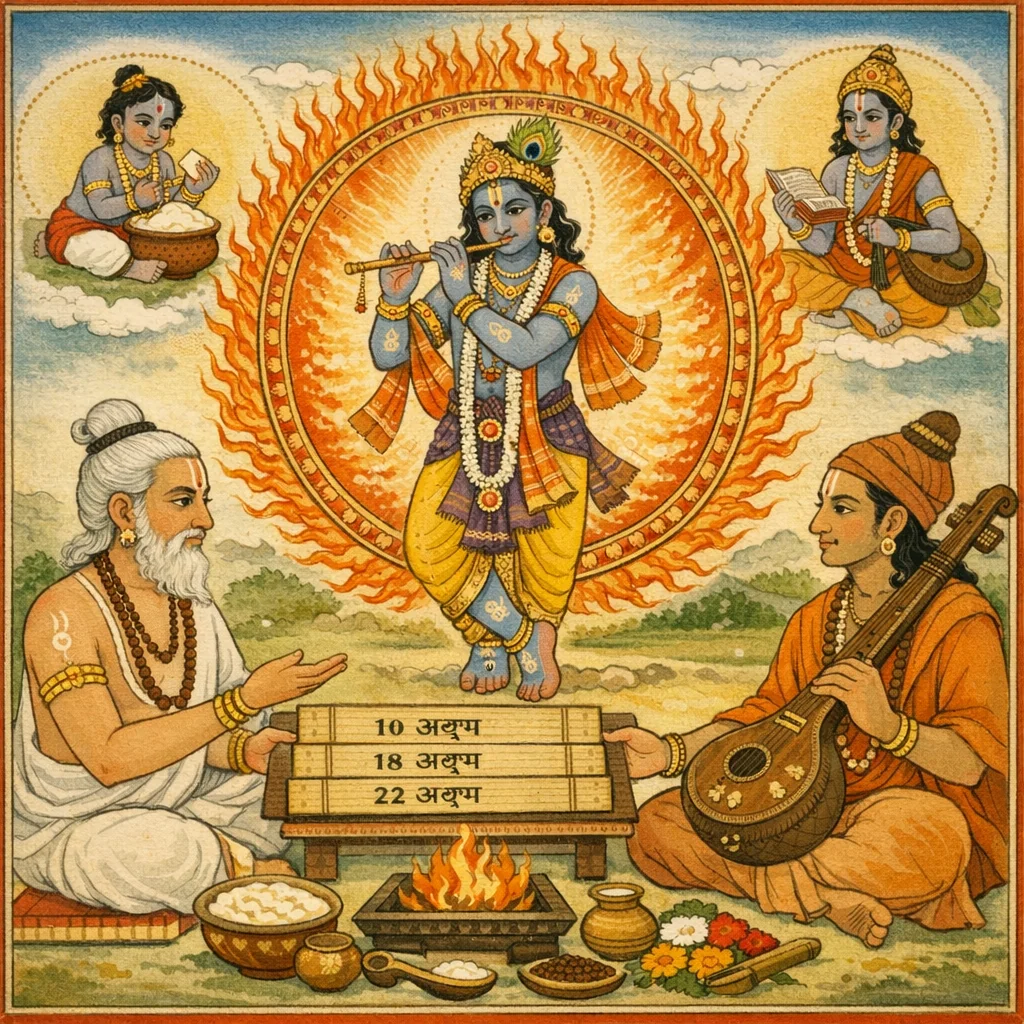
Sanatkumāra instructs Nārada in a carefully ordered hierarchy of Kṛṣṇa/Govinda mantra-systems. The chapter begins by naming three Daśārṇā-linked Manus and fixing the standard mantra-lakṣaṇa: ṛṣi Nārada, Gāyatrī chandas, and devatā Kṛṣṇa/Govinda. It then details ritual construction—limb-nyāsa with cakra emblems, crown measurement, dig-bandhana through Sudarśana, and staged discipline through Daśārṇā observance and Hari-dhyāna. Multiple dhyānas portray Kṛṣṇa in varied, intricate forms: armed yet flute-bearing; Bāla-Kṛṣṇa with dairy offerings; teacher-Kṛṣṇa holding a book and mātṛkā-rosary; Līlā-daṇḍa-hari; and Govallama. Each mantra cluster is paired with japa quotas (100k, 800k, 3.2M), homa at one-tenth, specified oblations (pāyasa, sweetened milk, sesame, flowers), and tarpaṇa for sons, wealth, eloquence, and disease-removal. The teaching extends to protective and therapeutic uses (fever, marriage, poison-removal via Garuḍa rites) and concludes by affirming siddhi and even Upaniṣadic, non-conceptual knowledge as fruits of perfected practice.
Shlokas
Verse 1
श्रीसनत्कुमार उवाच । अथ कृष्णस्य मंत्राणां वक्ष्ये भेदान् मुनीश्वर । यान्समाराध्य मनुजाः साधयंतीष्टमात्मनः ॥ १ ॥
Śrī Sanatkumāra said: Now, O lord among sages, I shall explain the various classifications of Kṛṣṇa’s mantras—by worshipping them, people accomplish the goal they desire for themselves.
Verse 2
शक्तिश्रीमारपूर्वश्च श्रीशक्तिस्मरपूर्वकः । मारशक्तिरमापूर्वो दशार्णा मनवस्त्रयः ॥ २ ॥
Three Manus are enumerated: one preceded by the names Śakti, Śrī, and Māra; another preceded by Śrī, Śakti, and Smara; and a third preceded by Māra, Śakti, and Ramā—these are the three Manus associated with Daśārṇā.
Verse 3
मुनिः स्यान्ना रदच्छन्दो गायत्री देवता पुनः । कृष्णो गोविंदनामात्र सर्वकामप्रदो नृणाम् ॥ ३ ॥
The ṛṣi is the sage Nārada; the chandas is Gāyatrī; and the presiding deity is Kṛṣṇa—Govinda by the Name alone—who grants all desired aims to people.
Verse 4
चक्रैः पूर्ववदंगानि त्रयाणामपि कल्पयेत् । ततः किरीटमनुनाव्यापकं हि समाचरेत् ॥ ४ ॥
With the discus-emblems, one should arrange the limbs of all the three forms just as described earlier. Then one should duly fashion the crown, according to the prescribed measure, making it broad and all-pervading in proper proportion.
Verse 5
सुदर्शनस्य मनुना कुर्याद्दिग्बंधनं तथा । विंशत्यर्णोक्तवत्कुर्यादाद्ये ध्यानार्चनादिकम् ॥ ५ ॥
Using the Sudarśana mantra, one should also perform the rite of ‘binding the quarters’ (dig-bandhana). And just as stated for the twenty-syllabled mantra, one should carry out the preliminary acts—meditation, worship, and the rest.
Verse 6
द्वितीये तु दशार्णोक्तं ध्यानपूजादिकं चरेत् । तृतीये तु हरिं ध्यायेत्समाहितमनाः सुधीः ॥ ६ ॥
In the second stage, one should perform the meditation, worship, and related observances as prescribed in the Daśārṇa tradition. In the third stage, the wise person—his mind well-collected—should meditate upon Hari (Viṣṇu).
Verse 7
शखचक्रधनुर्बाणपाशांकुशधरारुणम् । दोर्भ्यां धृतं धमंतं च वेणुं कृष्णदिवाकरम् ॥ ७ ॥
Reddish-hued, bearing the conch, discus, bow, arrows, noose, and goad; and holding in his arms a flute that he is blowing—he appears as the wondrous ‘dark Sun’, Kṛṣṇa-divākara.
Verse 8
एवं ध्यात्वा जपेन्मंत्रान्पञ्चलक्षं पृथक् सुधीः । जुहुयात्तद्दशांशेन पायसेन ससर्पिषा ॥ ८ ॥
Thus, having meditated, the wise practitioner should separately repeat the mantras five lakhs (five hundred thousand times). Then, offering pāyasa (rice-milk) prepared with ghee, he should perform the fire-offering in the amount of one-tenth of that count.
Verse 9
एवं सिद्धे मनौ मंत्री कुर्यात्काम्यानि पूर्ववत् । श्रीशक्तिकामः कृष्णाय गोविंदायाग्निसुन्दरी ॥ ९ ॥
Thus, when the mantra has been perfected, the mantra-practitioner should perform desire-motivated rites as prescribed earlier. One who seeks prosperity and divine power should invoke Kṛṣṇa—Govinda together with Agnisundarī, the beautiful śakti of fire.
Verse 10
रव्यर्णो ब्रह्मगायत्रीकृष्णा ऋष्यादयोऽस्य तु । बीजैरमाब्धियुग्मार्णैः षडंगानि प्रकल्पयेत् ॥ १० ॥
Its syllable is “ra” (the solar syllable); its metre is Brahma-gāyatrī; and its presiding deity is Kṛṣṇa. As for the ṛṣi and the other mantra-components, one should arrange the sixfold aṅga-nyāsa using seed-syllables formed from the letters indicated by the code-words “amā”, “abdhi”, and “yugma”.
Verse 11
विंशत्यर्णोदितजपध्यानहोमार्चनादिकम् । किं बहूक्तेन मंत्रोऽयं सर्वाभीष्टफलप्रदः ॥ ११ ॥
This twenty-syllabled formula enjoins japa, meditation, homa, worship, and the like. What need is there to say more? This mantra bestows every desired result.
Verse 12
श्रीशक्तिस्मरपूर्वोगजन्मा शक्तिरमांतिकः । दशाक्षरः स एवादौ प्रोक्तः शक्तिरमायुतः ॥ १२ ॥
That mantra is born from the prior union of remembrance (smaraṇa) and Śrī-Śakti; it is the śakti that abides close to Ramā (Lakṣmī). It is indeed the very ten-syllabled mantra first taught—Śakti conjoined with Ramā.
Verse 13
मन्त्रौ षोडशरव्यार्णौ चक्रैरंगानि कल्पयेत् । वरदाभयहस्ताभ्यां श्लिष्यँतं स्वांगके प्रिये ॥ १३ ॥
With the two mantras—each made of sixteen seed-syllables—one should arrange the limbs (of the Deity) by the prescribed chakra-diagrams. O beloved, one should visualize the Lord embracing one’s own body, His hands showing the mudrās of boon-giving and fearlessness.
Verse 14
पद्मोत्पलकरे ताभ्यां श्लिष्टं चक्रदरोज्वलम् । ध्यात्वैवं प्रजपेल्लक्षदशकं तद्दशांशतः ॥ १४ ॥
Meditating thus on (the Lord) whose two hands hold a lotus and a blue water-lily, and who shines with the discus and the conch, one should then perform japa of one hundred and ten thousand repetitions; thereafter one should offer one-tenth of that as the prescribed concluding rite.
Verse 15
आज्यैर्हुत्वा ततः सिद्धौ भवेतां मन्त्रनायकौ । सर्वकामप्रदौ सर्वसंपत्सौभगाग्यदौ नृणाम् ॥ १५ ॥
Having then offered oblations with ghee, those two become perfected, leaders among mantras. For people they grant all desired aims, bestow every kind of prosperity, and confer good fortune and auspicious destiny.
Verse 16
अष्टादशार्णः कामांतो मनुः सुतधनप्रदः । नारदोऽस्य मुनिश्छंदो गायत्री देवता मनोः ॥ १६ ॥
This mantra is of eighteen syllables; it is the “Kāmānta” mantra, a Manu that grants sons and wealth. For this mantra, the sage is Nārada, the metre is Gāyatrī, and the presiding deity is the Deity of the mantra itself.
Verse 17
कृष्णः कामो बीजमुक्तं शक्तिर्वह्निप्रिया मता । षड्वीर्याढ्येन बीजेन षडंगानि समाचरेत् ॥ १७ ॥
“Kṛṣṇa” is the kāma-bīja, taught as the seed-mantra. “Śakti” is regarded as dear to Agni. With the seed endowed with the six powers, one should duly perform the six aṅgas (auxiliary limbs) of the mantra.
Verse 18
पाणौ पायसपक्वं च दक्षे हैयंगवीनकम् । वामे दधद्दिव्यदिगंबरो गोपीसुतोऽवतु ॥ १८ ॥
May Śrī Kṛṣṇa, the son of the gopī, clad in divine, sky-like raiment, protect us—holding payasa (sweet milk-rice) in His hand, fresh morning butter (haiyaṅgavīna) in His right, and curd (dadhi) in His left.
Verse 19
ध्यात्वैवं प्रजपेन्मंत्रं द्वात्रिंशल्लक्षमानतः । दशांशं जुहुयादग्नौ सिताढ्येन पयोंऽधसा ॥ १९ ॥
Having thus meditated, one should recite the mantra in japa to the measure of thirty-two lakṣas (3.2 million repetitions). One should then offer into the sacred fire one-tenth of that number, using milk mixed with sugar as the āhuti.
Verse 20
पूर्वोक्तवैष्णवे पीठे यजेदष्टादशार्णवत् । पद्मस्थं कृष्णमभ्यर्च्य तर्पयेत्तन्मुखांबुजे ॥ २० ॥
On the previously described Vaiṣṇava pīṭha, one should worship according to the rite of the Eighteen-Syllabled Mantra. Having duly adored Kṛṣṇa seated upon a lotus, one should perform tarpaṇa, offering sanctified water to His lotus-like mouth.
Verse 21
क्षीरेण कदलीपक्कैर्दध्ना हैयंगवेन च । पुत्रार्थी तर्पयेदेवं वत्सराल्लभते सुतम् ॥ २१ ॥
With milk, ripe bananas, curd (dadhi), and fresh morning butter (haiyaṅgavīna), one who longs for a son should perform tarpaṇa in this manner; within a year he obtains a son.
Verse 22
यद्यदिच्छति तत्सर्वं तर्पणादेव सिद्ध्यति । वाक्कामो ङेयुतं कृष्णपदं माया ततः पगरम् ॥ २२ ॥
Whatever a person desires—everything—can be accomplished through tarpaṇa. From it arise mastery of speech and the fulfillment of wishes; and by taking devotional refuge at Kṛṣṇa’s feet, Māyā is thereafter overcome.
Verse 23
गोविंदाय रमा पश्चाद्दशार्णं च समुद्धरेत् । मनुस्वरयुतौ सर्गयुक्तौ भृगुतदूर्द्धूगौ ॥ २३ ॥
After uttering “govindāya”, one should next utter “ramā”, and then add the ten-syllabled formula. These syllables are to be pronounced with anusvāra, joined with the syllable “sa”, and set with the ‘bhṛgu’ sound above, according to the taught vowel and intonation.
Verse 24
द्वाविंशत्यक्षरो मन्त्रो वागीशत्वप्रदायकः । ऋषिः स्यान्नारदश्छन्दो गायत्री देवता पुनः ॥ २४ ॥
This is a mantra of twenty-two syllables, bestowing mastery of speech and eloquence. Its seer is said to be Nārada; its metre is Gāyatrī; and its presiding deity is again as stated.
Verse 25
विद्याप्रदश्च गोपालः कामो बीजं प्रकीर्तितम् । शक्तिस्तु वाग्भवं विद्याप्राप्तये विनियोजना ॥ २५ ॥
“Gopāla” is proclaimed as the giver of knowledge; “Kāma” is declared to be the seed (bīja). The śakti is “Vāgbhava”; this is the prescribed application (viniyoga) for attaining learning (vidyā).
Verse 26
वामोर्द्ध्वहस्ते दधतं विद्यापुस्तकमुत्तमम् । अक्षमालां च दक्षोर्द्ध्वस्फाटिकीं मातृकामयीम् ॥ २६ ॥
In the raised left hand he holds an excellent book of sacred knowledge; and in the raised right hand he holds a crystal rosary, formed of the divine letters (mātṛkās).
Verse 27
शब्दब्रह्म मयं वेणुमधः पाणिद्वये पुनः । गायत्रीगीतवसनं श्यामलं कोमलच्छविम् ॥ २७ ॥
Again, (I beheld) the flute—formed of the Brahman that is sound (śabda-brahman)—held below in both hands; clad in the song of the Gāyatrī, dark-hued (śyāma), and of tender radiance.
Verse 28
बर्हावतंसं सर्वज्ञं सेवितं मुनिपुंगवैः । ध्यात्वैवं प्रमदावेशविलासं भुवनेश्वरम् ॥ २८ ॥
Thus one should meditate upon the Lord of the worlds—omniscient, crowned with a peacock-feather crest, served by the foremost sages, and delighting in divine līlā amid the rapture of lovely maidens—and proceed in devotion.
Verse 29
वेदलक्षं जपेन्मंत्रं किंशुकैस्तद्दशांशतः । हुत्वा तु पूजयेन्मन्त्री विंशत्यर्णविधानतः ॥ २९ ॥
One should japa the mantra one hundred thousand times; then perform fire-offerings (homa) with kiṃśuka (palāśa) blossoms in one-tenth of that count; thereafter the practitioner should worship according to the prescribed rite of the twenty-syllabled (viṃśaty-arṇa) mantra.
Verse 30
एवं यो भजते मन्त्रं भवेद्वागीश्वरस्तु सः । अदृष्टान्यपि शास्त्राणि तस्य गंगातरंगवत् ॥ ३० ॥
Thus, whoever worshipfully practices this mantra becomes a lord of speech. Even śāstras never studied arise within him effortlessly—like the waves of the Gaṅgā.
Verse 31
तारः कृष्णयुगं पश्चान्महाकृष्ण इतीरयेत् । सर्वज्ञ त्वंप्रशंशब्दांते सीदमेऽग्निश्च मारम् ॥ ३१ ॥
Next one should utter “Tāra,” then “Kṛṣṇa-yuga,” and thereafter pronounce “Mahā-kṛṣṇa.” At the end, add words of praise—“O Omniscient One, You…”—and also utter “Sīdama,” “Agni,” and “Māra.”
Verse 32
णांति विद्येश विद्यामाशु प्रयच्छ ततश्च मे । त्रयस्त्रिंशदक्षरोऽयं महाविद्याप्रदोमनुः ॥ ३२ ॥
“O Lord of Knowledge, grant me sacred knowledge swiftly.” Thereafter, this thirty-three-syllabled mantra is the bestower of the Great Knowledge (Mahāvidyā).
Verse 33
नारदोऽस्य मुनिश्छन्दोऽनुष्टुम् कृष्णोऽस्य देवता । पादैः सर्वेण पंचांगं कृत्वा ध्यायेत्ततो हरिम् ॥ ३३ ॥
For this mantra/hymn, the seer is Sage Nārada; the metre is Anuṣṭubh; and the presiding deity is Kṛṣṇa. Having fully performed the fivefold ancillary observances, one should then meditate upon Hari.
Verse 34
दिव्योद्याने विवस्वत्प्रतिममणिमये मण्डपे योगपीठे मध्ये यः सर्ववेदांतमयसुरतरोः संनिविष्टो मुकुन्दः । वेदैः कल्पद्रुरूपैः शिखरिशतसमालंबिकोशैश्चतुर्भिर्न्यायैस्तर्कैपुराणैः स्मृतिभिरभिवृतस्तादृशैश्चामराद्यैः ॥ ३४ ॥
In a divine garden, within a jewel-built pavilion radiant like the Sun, upon a yogic throne, Mukunda is seated at the center—within the wish-fulfilling tree that is the very essence of all Vedānta. He is surrounded and fanned, as with royal chāmaras, by the Vedas as wish-granting trees, by the fourfold Nyāya and Tarka, and by the Purāṇas and Smṛtis as attendant insignia.
Verse 35
दद्याद्बिभ्रत्कराग्रैरपि दरमुरलीपुष्पबाणेक्षुचापानक्षस्पृक्पूर्णकुंभौ स्मरललितवपुर्दिव्यभूषांगरागः । व्याख्यां वामे वितन्वन् स्फुटरुचिरपदो वेणुना विश्वमात्रे शब्दब्रह्मोद्भवेन श्रियमरुणरुचिर्बल्लवीवल्लभो नः ॥ ३५ ॥
May the Beloved of the cowherd maidens, Bāllavī-vallabha, radiant with a rosy splendor, grant us Śrī and prosperity. With the very tips of His fingers He bears the softly sounding flute, the flower-arrows and sugarcane-bow of Kāma, and two brimming jars that brush near His eyes; His form is enchanting like Love itself, adorned with divine ornaments and fragrant unguents. With His left hand He unfolds the teaching, and through the flute born of Śabda-Brahman, with clear and charming notes, He instructs the Universal Mother.
Verse 36
एवं ध्यात्वा जपेल्लक्षं दशांशं पायसैर्हुनेत् । अष्टादशार्णवत्कुर्याद्यजनं चास्य मन्त्रवित् ॥ ३६ ॥
Having thus meditated, one should repeat the mantra one lakh (100,000) times; then offer one tenth of that number as oblations into the fire using milk-rice (pāyasa). A knower of mantras should also perform its worship according to the rite prescribed for an eighteen-syllabled (aṣṭādaśārṇa) mantra.
Verse 37
तारो नमो भगवते नन्दपुत्राय संवदेत् । आनन्दवपुषे दद्यादृशार्णं तदनंतरम् ॥ ३७ ॥
One should utter the Tāraka (praṇava) first, and then recite: “Obeisance to Bhagavān, the son of Nanda.” Immediately after that, one should add the Ṛśa syllable, addressed to Him whose very form is Ānanda, divine bliss.
Verse 38
अष्टाविंशतिवर्णोऽयं मंत्रः सर्वेष्टदायकः । नंदपुत्रपदं ङेंतं श्यामलांगपदं तथा ॥ ३८ ॥
This mantra, made of twenty-eight syllables, bestows all desired aims. It contains the word “son of Nanda,” and likewise the word “whose limbs are dark-hued (Śyāma).”
Verse 39
तथा बालवपुःकृष्णं गोविंदं च तथा पुनः । दशार्णोऽतो भवेन्मंत्रो द्वात्रिंशदक्षरान्वितः ॥ ३९ ॥
Likewise, by adding “dark-hued Kṛṣṇa in the form of a child,” and again adding “Govinda,” the mantra becomes a ten-syllabled formula (daśārṇa), furnished with thirty-two letters in its full phonetic form.
Verse 40
अनयोर्नारदऋषिश्छंदस्तूष्णिगनुष्टुभौ । देवता नन्दपुत्रस्तु विनियोगोऽखिलाप्तये ॥ ४० ॥
For these two mantras, the seer (Ṛṣi) is Sage Nārada; the metres (Chandas) are Tūṣṇik and Anuṣṭubh. The presiding deity is the son of Nanda, Śrī Kṛṣṇa, and their ritual application (Viniyoga) is for the attainment of all desired aims.
Verse 41
चक्रैः पंचांगमर्चास्यादंगदिक्पालहेतिभिः । दक्षिणे रत्नचषकं वामे सौवर्णनेत्रकम् ॥ ४१ ॥
The sacred icon (arcā) should be worshipped as having five limbs, marked with discus (cakra) emblems; its limbs are adorned with armlets and equipped with the weapons of the guardians of the directions. In its right hand there should be a jeweled cup, and in its left a golden, eye-like emblem.
Verse 42
करे दधानं देवीभ्यां श्लिष्टं संचिंतयेद्विभुम् । लक्षं जपो दशांशेन जुहुयात्पायसेन तु ॥ ४२ ॥
One should meditate upon the all-pervading Lord as holding the intended emblem in His hand and as embraced by the two Goddesses. One should perform one lakh repetitions of the mantra, and then offer one-tenth of that number as oblations in the fire, using pāyasa (rice cooked in milk).
Verse 43
एताभ्यां सिद्धमंत्राभ्यां मंत्री कुर्याद्यथेप्सितम् । प्रणवः कमला माया नमो भगवते ततः ॥ ४३ ॥
With these two perfected mantras, the mantra-practitioner should accomplish whatever is desired. First is the Praṇava (Oṁ), then the words “Kamalā” and “Māyā”, and thereafter the formula “namo bhagavate”.
Verse 44
नंदपुत्राय तत्पश्चाद्बालान्ते वपुषे पदम् । ऊनविंशतिवर्णोऽयं मुनिर्ब्रह्मा समीरितः ॥ ४४ ॥
Thereafter, the next sacred designation is assigned to Nanda’s son, in the form that appears at the end of the word “bāla.” This mantra-form consists of nineteen syllables—so has the sage Brahmā declared.
Verse 45
छंदोऽनुष्टुप् देवता च कृष्णो बालवपुः स्वयम् । मन्त्रोऽयं सर्वसंपत्तिसिद्धये सेव्यते बुधैः ॥ ४५ ॥
Its metre is Anuṣṭubh; its presiding deity is Kṛṣṇa Himself in the form of a divine child. This mantra is practiced by the wise for the attainment of every kind of prosperity and accomplishment.
Verse 46
तारो ह्यद्भगवानङेंतो रुक्मिणीवल्लभाय च । वह्निजायावधिः प्रोक्तो मंत्रः षोडशवर्णवान् ॥ ४६ ॥
Indeed, beginning with the syllable “tāra” and ending with “vahnijāyā,” this sixteen-syllabled mantra is taught as addressed to the Blessed Lord, the beloved of Rukmiṇī.
Verse 47
नारदोऽस्य मुनिश्छन्दोऽनुष्टुप् च देवता मनोः । रुक्मिणीवल्लभश्चंद्रदृग्वेदांगाक्षिवर्णकैः । पञ्चांगानि प्रकुर्वीत ततो ध्यायेत्सुरेश्वरम् ॥ ४७ ॥
For this (mantra/rite), the seer is Nārada; the metre is Anuṣṭubh; and the presiding deity is Manoḥ. Using the syllables/letters indicated by “Rukmiṇī’s Beloved,” “the Moon,” “the seer,” “the Vedāṅga,” “the eye,” and “the colour,” one should construct the fivefold limbs (of the mantra/nyāsa); thereafter one should meditate upon the Lord of the gods.
Verse 48
तापिच्छच्छविरंकगां प्रियतमां स्वर्णप्रभामंबुजप्रोद्यद्दामभुजां स्ववामभुजयाश्लिष्यन्स्वचित्ताशया । श्लिष्यंतीं स्वयमन्यहस्तविलत्सौवर्णवेत्रश्चिरं पायान्नः सुविशुद्धपीतवसनो नानाविभूषो हरिः ॥ ४८ ॥
May Hari protect us for a long time—He who wears spotless yellow garments and many ornaments, and with His left arm lovingly embraces His beloved Lakṣmī, dark as a tamāla shoot yet radiant like gold, lotus-like, her arms encircled by shining garlands; and who, as she clings to Him, holds in His other hand a gleaming golden staff.
Verse 49
ध्यात्वैवं प्रजपेल्लक्षं रक्तैः पद्मैर्दशांशतः ॥ ४९ ॥
Having thus meditated, one should perform mantra-repetition (japa) for one lakh (100,000) counts, and offer red lotuses as an oblation amounting to one-tenth of that japa.
Verse 50
त्रिमध्वक्तैर्हुनेत्पीठे पूर्वोक्ते पूजयेद्धरिम् । अंगैर्नारदमुख्यैश्च लोकेशैश्च तदायुधैः ॥ ५० ॥
On the altar-seat (pīṭha) described earlier, one should offer oblations in the homa using the three sweet substances, and then worship Hari—together with His subsidiary aṅgas, with Nārada and the foremost devotees, and also with the Lokapālas (world-guardians) and their respective weapons.
Verse 51
एवं सिद्धो मनुर्दद्यात्सर्वान्कामांश्च मंत्रिणे । लीलादंडपदाब्जोऽपि जनसंसक्तदोः पदम् ॥ ५१ ॥
Thus, when the ruler is fully accomplished, he should grant his minister every legitimate desire; for even the lotus-like feet that sportively bear the rod of punishment must take their stand upon arms engaged in the service of the people.
Verse 52
दंडांते वा धरावह्निरधीशाढ्योऽथ लोहितः । मेघश्यामपदं पश्चाद्भगवान् सलिलंसदृक् ॥ ५२ ॥
At the end of the staff (daṇḍa) is the fire that bears the earth; then comes a reddish hue, endowed with sovereignty. After that, the Lord assumes a cloud-dark (blue-black) position/step, and then He appears with a color resembling water.
Verse 53
विष्णो इत्युक्त्वा ठद्वयं स्यादेकोनत्रिंशदर्णवान् । नारदोऽस्य मुनिश्छंदोऽनुष्टुप् च देवता मनोः ॥ ५३ ॥
After uttering “Viṣṇu,” one should add the pair of syllables “ṭha” twice; thus the mantra consists of twenty‑nine syllables. For this mantra, Nārada is the seer (ṛṣi), Anuṣṭubh is the metre (chandas), and Manu is the presiding deity (devatā).
Verse 54
लीलादंडहरिः प्रोक्तो मन्वब्धधियुगवह्निभिः । वेदैः पंचां गकं भागैर्मंत्रवर्णोत्थितैः क्रमात् ॥ ५४ ॥
Thus the name “Līlā-daṇḍa-hari” is declared—formed in due order from the mantra-syllables that arise through the Vedas, by means of the components (a fivefold division) and by the numerical markers denoted as manvantara, ocean, intellect, yuga, and fire.
Verse 55
संमोहयंश्च निजवामकरस्थलीलादंडेन गोपयुवतीः परसुंदरीश्च । दिश्यन्निजप्रियसखांसगंदक्षहस्तो देवश्रियं निहतकंस उरुक्रमो नः ॥ ५५ ॥
May Urukrama—who, with the playful staff resting on the palm of his left hand, bewilders the cowherd maidens and other supremely beautiful women, and who, with his right hand upon his cheek, grants the splendor of divine fortune—he who slew Kaṃsa—bestow grace upon us.
Verse 56
लक्षं जपो दशांशेन जुहुयात्तिलतण्डुलैः । त्रिमध्वक्तैस्ततोऽभ्यर्चेदंगं दिक्पालहेतिभिः ॥ ५६ ॥
One should perform one lakh (100,000) mantra-repetitions; then, as one-tenth of that count, offer oblations into the fire with sesame and rice-grains. Thereafter, having anointed with the three honeys, one should worship the mantra’s auxiliary limbs, together with the guardian-deities of the directions and their weapons.
Verse 57
लीलादंड हरिं यो वै भजते नित्यमादरात् । स सर्वैः पूज्यते लोकैस्तस्य गेहे स्थिरा रमा ॥ ५७ ॥
Whoever worships Hari, the bearer of the playful staff, every day with reverent care—he is honored by all people, and in his home Ramā (Lakṣmī) remains steadfast.
Verse 58
सद्यारूढा स्मृतिस्तोयं केशवाढ्यधरायुगम् । भयाग्निवल्लभामंत्रः सप्तार्णः सर्वसिद्धिदः ॥ ५८ ॥
Instantly arising remembrance is its “water”; its pair of lips is enriched with the name of Keśava. The seven-syllabled mantra called “Bhayāgni-vallabhā” bestows every accomplishment.
Verse 59
ऋषिः स्यान्नारदश्छंदो उष्णिग्गोवल्लमस्य तु । देवतापूर्ववच्चक्रैः पञ्चांगानि तु कल्पयेत् ॥ ५९ ॥
For the Govallama mantra/hymn, the seer (ṛṣi) is Nārada and the metre (chandas) is Uṣṇik. The deity is as stated earlier; and one should also arrange its five limbs (pañcāṅga) together with the cakras (ritual placements).
Verse 60
ध्येयो हरिः सकपिलागणमध्यसंस्थस्ता आह्वयन्दधद्दक्षिणदोस्थवेणुम् । पाशं सयष्टिमपरत्र पयोदनीलः पीताम्बराहिरिपुपिच्छकृतावतंसः ॥ ६० ॥
Hari is to be meditated upon—dark-blue like a rain-cloud, standing amid Kapila and his attendants; calling the devotee and holding a flute in his right hand; and in the other hand bearing a noose along with a staff; clad in yellow garments, with a peacock-feather as his crest-ornament.
Verse 61
सप्तलक्षं जपेन्मंत्रं दशांशं जुहुयात्ततः । गोदुग्धैः पूजयेत्पीठे स्यादंगैः प्रथमावृतिः ॥ ६१ ॥
One should repeat the mantra seven lakh times; thereafter, one should offer homa oblations equal to one-tenth of that count. Then, using cow’s milk, one should worship upon the pīṭha (ritual seat). By these subsidiary rites (aṅgas), the first cycle (prathamāvṛti) is accomplished.
Verse 62
सुवर्णपिंगलां गौरपिंगलां रक्तपिंगलाम् । गुडपिंगां बभ्रुवर्णां चोत्तमां कपिलां तथा ॥ ६२ ॥
Golden-tawny, pale-tawny, red-tawny; tawny like jaggery, brown-hued; the excellent, and likewise the “kapilā” (light-brown) variety—these are the named types.
Verse 63
चतुष्कपिङ्गलां पीतपिङ्गलां चोत्तमां शुभाम् । गोगणाष्टकमभ्यर्च्य लोकेशानुयुधैर्युतान् ॥ ६३ ॥
Having duly worshipped the «gogaṇa-aṣṭaka», the eight sacred cows—four tawny ones, the yellow‑tawny ones, and those most excellent and auspicious—one should then worship the Lokapālas, the Lords of the worlds, together with their attendant warrior-retinues.
Verse 64
संपूज्यैवं मनौ सिद्धे कुर्यात्काम्यानि मंत्रवित् । अष्टोत्तरसहस्रं यः पयोभिर्दिनशो हुनेत् ॥ ६४ ॥
Having thus worshipped, when the mantra has become perfected in siddhi, the knower of mantra should perform the kāmya rites for desired aims. Whoever, day after day, offers milk‑oblations numbering one thousand and eight will attain the intended result.
Verse 65
पक्षात्सगोगणो मुक्तो दशार्णे चाप्ययं विधिः । तारो हृद्भगवान् ङेंतः श्रीगोविंदस्तथा भवेत् ॥ ६५ ॥
When the mantric cluster is released from the «pakṣa» arrangement, this same procedure applies in the ten‑syllabled (daśārṇa) form as well: the syllable «tāra» is placed in the heart as Bhagavān, and the concluding nasal sound is fixed—thus it becomes the venerable mantra of Śrī Govinda.
Verse 66
द्वादशार्णो मनुः प्रोक्तो नारदोऽस्य मुनिर्मतः । छंदः प्रोक्तं च गायत्री श्रीगोविन्दोऽस्य देवता । चन्द्राक्षियुगभूतार्णैः सर्वैः पंचांगकल्पनम् ॥ ६६ ॥
The mantra is declared to be of twelve syllables; its seer (ṛṣi) is held to be Nārada. Its metre (chandas) is proclaimed as Gāyatrī, and its presiding deity is Śrī Govinda. By all the syllables—reckoned according to candra (moon), akṣi (eyes), yuga, and bhūta (elements)—the fivefold (pañcāṅga) ritual configuration is to be constructed.
Verse 67
ध्यायेत्कल्पद्रुमूलाश्रितमणिविलसद्दिव्यसिंहासनस्थं मेघश्यामं पिशंगांशुकमतिसुभगं शंखरेत्रे कराभ्याम् ॥ ६७ ॥
One should meditate upon Him who sits upon a radiant, jewel‑bright divine lion‑throne beneath the roots of the wish‑fulfilling kalpadruma tree—dark as a rain‑cloud, supremely beautiful, clad in tawny garments, and holding the conch (śaṅkha) and the discus (cakra) in His two hands.
Verse 68
बिभ्राणं गोसहस्रैर्वृतममरपतिं प्रौढहस्तैककुंभप्रश्चोतत्सौधधारास्नपितमभिनवांभोजपत्राभनेत्रम् ॥ ६८ ॥
He beheld the Lord of the gods, encircled by thousands of cows—bathed by streams of water pouring down from a lofty mansion as a strong-handed one tipped a single pot—His eyes like the fresh petals of a newly opened lotus.
Verse 69
रविलक्षं जपेन्मंत्रं दुग्धैर्हुत्वा दशांशतः । यजेच्च पूर्ववद्गोष्ठस्थितं वा प्रतिमादिषु ॥ ६९ ॥
One should repeat the mantra one hundred thousand times, then offer oblations with milk equal to one-tenth of that number. Thereafter, one should worship as taught earlier—either the deity established in a cow-shed (goṣṭha) or an image and other duly consecrated forms.
Verse 70
पूर्वोक्ते वैष्णवे पीठे मूर्तिं संकल्प्य मूलतः । तत्रावाह्य यजेत्कृष्णं गुरुपूजनपूर्वकम् ॥ ७० ॥
On the previously described Vaiṣṇava altar-seat, one should first, from the very foundation, establish the deity-form in sacred resolve within the mind. Then, having invoked (āvāhana) Kṛṣṇa there, one should worship Him—beginning with the worship of one’s Guru.
Verse 71
रुक्मिणीं सत्यभामां च पार्श्वयोरिंद्रमग्रतः । पृष्ठतः सुरभिं चेष्ट्वा केसरेष्वंगपूजनम् ॥ ७१ ॥
Placing Rukmiṇī and Satyabhāmā on the two sides, Indra in the front, and Surabhī behind, one should then perform aṅga-pūjā—the worship of the limbs—using filaments of saffron (kesar).
Verse 72
कालिं द्याद्या महिष्योऽष्टौ वसुपत्रेषु संस्थिताः । पीठकोणेषु बद्ध्वादिकिंकणीं च तथा पुनः ॥ ७२ ॥
One should place Kāli first, then set the eight mahīṣyaḥ (buffalo-cows) upon the lotus of the Vasus; and, having tied small bells (kiṅkiṇī) at the corners of the pedestal, one should proceed again to the next step of the rite.
Verse 73
दामानि पृष्ठयोर्वेणुं पुरः श्रीवत्सकौस्तुभौ । अग्रतो वनमासादिर्दिक्ष्वष्टसु तथा स्थिताः ॥ ७३ ॥
Garlands hang upon His back, and there too rests the flute (veṇu). Before Him shine the Śrīvatsa mark and the Kaustubha jewel; and in front, the forest-garland and other ornaments are likewise arranged, established in all eight directions.
Verse 74
पांचजन्यं गदा चक्रं वसुदेवश्च देवकी । नंदगोपो यशोदा च सगोगोपालगोपिकाः ॥ ७४ ॥
Pāñcajanya (the conch), the mace, and the discus; Vasudeva and Devakī; Nanda the cowherd and Yaśodā—together with the cows, the cowherd boys, and the cowherd maidens—are all to be remembered in contemplation as the Lord’s divine retinue.
Verse 75
इंद्राद्याश्च स्थिता बाह्ये वज्राद्याश्च ततः परम् । कुमुदः कुमुदाक्षश्च पुंडरीकोऽथ वामनः ॥ ७५ ॥
Indra and the other deities are stationed on the outer side; beyond them are Vajra and the others. Then come Kumuda, Kumudākṣa, Puṇḍarīka, and thereafter Vāmana.
Verse 76
शंकुकर्णः सर्वनेत्रः सुमुखः सुप्रतिष्टितः । विष्वक्सेनश्च संपूज्यः स्वात्मा चार्च्यस्ततः परम् ॥ ७६ ॥
Śaṅkukarṇa, Sarvanetra, Sumukha, and Supratiṣṭhita—and also Viṣvaksena—should be duly worshipped; thereafter, one should worship one’s own Ātman as the supreme.
Verse 77
एककालं त्रिकालं वा यो गोविंदं यजेन्नरः । स चिरायुर्निरातंको धनधान्यपतिर्भवेत् ॥ ७७ ॥
A man who worships Govinda once a day or three times a day becomes long-lived, free from disease and affliction, and a lord of wealth and grain.
Verse 78
स्मृतिः सद्यान्विता चक्री दक्षकर्णयुतोधरा । नाथाय हृदयांतोऽयं वसुवर्णो महामनुः ॥ ७८ ॥
Smṛti—the remembered doctrine—takes effect at once; wheel-bearing, endowed with a capable “right ear,” it upholds what is to be borne. This great Manu, named Vasuvarṇa, is inwardly devoted in heart to the Lord (Nātha).
Verse 79
मुनिर्ब्रह्मास्य गायत्री छंदः कृष्णोऽस्य देवता । वर्णद्वंद्वैश्च सर्वेण पंचांगान्यस्य कल्पयेत् ॥ ७९ ॥
For this mantra, the seer (ṛṣi) is Brahmā, the metre is Gāyatrī, and the presiding deity is Kṛṣṇa. And by all the paired syllables (varṇa-dvandvas), one should also determine its five limbs (pañcāṅga).
Verse 80
पंचवर्षमतिलोलमंगणे धावमानमतिचंचलेक्षणम् । किंकिणीवलयहारनूपुरै रंजितं नमत गोपबालकम् ॥ ८० ॥
Bow to the cowherd boy—about five years of age—who runs about the courtyard in playful restlessness, his eyes darting with lively mischief, delighting all with the jingling of his bells, bracelets, garland, and anklets.
Verse 81
एवं ध्यात्वा जपेदष्टलक्षं मंत्री दशांशतः । ब्रह्मवृक्षसमिद्भिश्च जुहुयात्पायसेन वा ॥ ८१ ॥
Having thus meditated, the practitioner of the mantra should repeat it eight lakhs (800,000 times). Then, as one tenth of that count, he should perform a fire-offering (homa), making oblations with twigs of the brahma-tree, or else with pāyasa (rice-milk).
Verse 82
प्रागुक्ते वैष्णवे पीठे मूर्तिं संकल्प्य मूलतः । तत्रावाह्यार्चयेत्कृष्णं मंत्री वै स्थिरमानसः ॥ ८२ ॥
Upon the previously described Vaiṣṇava pedestal, first conceiving the icon in sacred resolve (saṅkalpa) from its very foundation, the mantra-knowing officiant—steady in mind—should invoke Kṛṣṇa there and worship Him.
Verse 83
केसरेषु चतुर्दिक्षु विदिक्ष्वंगानि पूजयेत् । वासुदेवं बलं दिक्षु प्रद्युम्नमनिरुद्धकम् ॥ ८३ ॥
Upon the lotus-petals of the worship-diagram, one should adore the attendant limbs (aṅgas) in the four cardinal and the intermediate directions—placing Vāsudeva and Bala in the directions, and likewise Pradyumna and Aniruddha in their proper quarters.
Verse 84
विदिक्षु रुक्मिणीसत्यभामे वै लक्ष्यणर्क्षजे । लोकेशान्सायुधान्बाह्ये एवं सिद्धो भवेन्मनुः ॥ ८४ ॥
In the intermediate quarters one should place Rukmiṇī and Satyabhāmā, and also Lakṣaṇā and Arkṣajā; and on the outer perimeter one should set the Lokapālas, the world-guardians, bearing their weapons. Thus the practitioner becomes accomplished and attains siddhi.
Verse 85
तारः श्रीभुवनाकामो ङेंतं श्रीकृष्णमीरयेत् । श्रीगोविंदं ततः प्रोच्य गोपीजनपदं ततः ॥ ८५ ॥
One should utter first the Tāraka syllable, the deliverer; then pronounce “Śrī-bhuvanakāma”; thereafter recite “Śrī-Kṛṣṇa”. Next, having spoken “Śrī-Govinda”, one should then say “Gopī-janapada”.
Verse 86
वल्लभाय ततः पद्मात्रयं तत्वाक्षरो मनुः । मुन्यादिकं च पूर्वोक्तं सिद्धगोपालकं स्मरेत् ॥ ८६ ॥
Then, for the Lord Vallabha, one should meditate upon the triad of lotuses, upon the mantra formed of the “tattva” syllable and the prescribed manu; and one should also recall the sages and other attendant deities as stated earlier—thus should one remember Siddha-Gopāla, the perfected Gopāla.
Verse 87
माधवीमंडपासीनौ गरुडेनाभिपालितौ । दिव्यक्रीडासु निरतौ रामकृष्णौ स्मरन् जपेत् ॥ ८७ ॥
Let one chant japa while remembering Rāma and Kṛṣṇa—seated in a bower-pavilion of mādhavī creepers, protected by Garuḍa, and delighting in divine play (līlā).
Verse 88
पूजनं पूर्ववच्चास्य कर्तव्यं वैष्णवोत्तमैः । चक्री मुनिस्वरोपेतः सर्गी चैकाक्षरो मनुः ॥ ८८ ॥
His worship should be performed exactly as taught earlier by the foremost Vaiṣṇavas. The emblem is the discus (cakra); the accompanying tone is the sage’s intonation; one should contemplate the “sargī,” the Creator; and the mantra is a single syllable.
Verse 89
कृष्णेति द्व्यक्षरः प्रोक्तः कामादिः स्यात्त्रिवर्णकः । सैव ङेंतो युगार्णः स्यात्कृष्णाय नम इत्यपि ॥ ८९ ॥
“Kṛṣṇa” is declared to be a two-syllabled name. The bīja beginning with “kāma” is of three phonemes. That same formula, when ending in the dative (ṅe-ending), also becomes the two-word mantra: “kṛṣṇāya namaḥ” (“obeisance to Kṛṣṇa”).
Verse 90
पंचाक्षरश्च कृष्णाय कामरुद्धस्तथा परः । गोपालायाग्निजायांतो रसवर्णः प्रकीर्तितः ॥ ९० ॥
The five-syllabled mantra is “kṛṣṇāya.” Another, held to restrain desire, is proclaimed supreme. And the formula ending with “gopālāya” and concluding with “agnijāyānta” is taught as the tradition of the “rasa-letter,” a coded mystical phoneme.
Verse 91
कामः कृष्णपदं ङेंतं वह्निजायांतकः परः । कृष्णगोविंदकौ ङेंतौ सप्तार्णः सर्वसिद्धिदः ॥ ९१ ॥
“Kāma” is the syllable “kṛṣṇa”; the supreme sound is “vahnijāyāntaka.” “Kṛṣṇa” and “Govinda” are to be known together as the syllables; this seven-syllabled mantra bestows all attainments.
Verse 92
श्रीशक्तिकामाः कृष्णाय कामः सप्ताक्षरः परः । कृष्णगोविंदकौ ङेंतौ हृदंतोऽन्यो नवाक्षरः ॥ ९२ ॥
For those who desire Śrī (prosperity), Śakti (power), and Kāma (fulfilment of wishes), the supreme seven-syllabled mantra is: “kṛṣṇāya kāmaḥ.” Another mantra, nine-syllabled, is: “kṛṣṇa govinda,” preceded by the seed “ṅeṃ” and ending with “hṛd”.
Verse 93
ङेंतौ च कृष्णगोविंदौ तथा कामः पुटः परः । कामः शार्ङ्गी धरासंस्थो मन्विंद्वाढ्यश्च मन्मथः ॥ ९३ ॥
He is also known as Ṅeṃtau; as Kṛṣṇa and Govinda; likewise as Kāma, Puṭa, and Para. He is Kāma; the bearer of the Śārṅga bow; established upon the earth; Manvindvāḍhya; and Manmatha, the enchanter of hearts.
Verse 94
श्यामलांगाय हृदयं दशार्णः सर्वसिद्धिदः । बालांते वपुषे कृष्णायाग्निजायांतिमोऽपरः ॥ ९४ ॥
For the dark-limbed Lord, the Heart-mantra (hṛdaya) is the ten-syllabled formula (daśārṇa), bestowing all attainments. For the youthful form, the final additional mantra is for Kṛṣṇā, the daughter of Agni.
Verse 95
द्विठांते बालवपुषे कामः कृष्णाय संवदेत् । ततो ध्यायन्स्वहृदये गोपीजनमनोहरम् ॥ ९५ ॥
At the conclusion of the prescribed twofold rite, Kāma should address Kṛṣṇa in the form of a young boy; then, meditating within his own heart, he should contemplate the One who captivates the minds of the gopīs.
Verse 96
श्रीवृन्दाविपिनप्रतोलिषु नमत्संफुल्लवल्लीततिष्वंतर्जालविघट्टैनः सुरभिणा वातेन संसेविते । कालिंदीपुलिने विहारिणमथो राधैकजीवातुकं वंदे नन्दकिशोरमिंदुवदनं स्निग्धांबुदाडंबरम् ॥ ९६ ॥
I bow to Nandakishora, Nanda’s youthful son—moon-faced, radiant as dark rain-laden clouds—who sports upon the banks of the Kāliṇḍī, whose very life is Rādhā, and who is served by the fragrant breeze that stirs the inner bowers of fully blossoming creepers along the lanes of Vṛndā’s sacred forest.
Verse 97
पूर्वाक्तवर्त्मना पूजा ज्ञेया ह्येषां मुनीश्वर । देवकीसुतवर्णांते गोविंदपदमुच्चरेत् ॥ ९७ ॥
O lord among sages, their worship is to be understood as performed according to the procedure stated earlier; and at the end of pronouncing the name “Devakī’s son,” one should utter the word “Govinda.”
Verse 98
वासुदेवपदं प्रोच्य संबृद्ध्यंतं जगत्पतिंम् । देहि मे तनयं पश्चात्कृष्ण त्वामहमीरयेत् ॥ ९८ ॥
Having uttered the sacred Name of Vāsudeva—the Lord of the universe who makes all flourish—grant me a son; thereafter, O Kṛṣṇa, I shall proclaim and praise You.
Verse 99
शरणं गत इत्यंतो मन्त्रो द्वात्रिंशदक्षरः । नारदोऽस्य मुनिश्छंदो गायत्री चाप्यनुष्टुभम् । देवः सुतप्रदः कृष्णः पादैः सर्वेण चांगकम् ॥ ९९ ॥
The mantra that ends with the words “śaraṇaṃ gata” consists of thirty-two syllables. Its seer (ṛṣi) is the sage Nārada; its metre (chandas) is Gāyatrī and also Anuṣṭubh. Its presiding deity is Kṛṣṇa, the giver of sons; and all its quarters (pādas) together constitute its ancillary limbs (aṅga).
Verse 100
विजयेन युतो रथस्थितः प्रसमानीय समुद्रमध्यतः । प्रददत्तनयान् द्विजन्मने स्मरणीयो वसुदेवनन्दनः ॥ १०० ॥
Seated on his chariot and endowed with victory, Vasudeva’s son—ever worthy of remembrance—brought them safely from the midst of the ocean and bestowed right guidance upon the Brahmin.
Verse 101
लक्षं जपोऽयुतं होमस्तलैर्मधुरसंप्लुतैः । अर्चा पूर्वोदिते पीठे अंगलोकेश्वरायुधैः ॥ १०१ ॥
One should perform one lakh recitations (japa) and ten thousand fire-offerings (homa) using ladles moistened with sweet substances. Worship (arcā) is to be done on the previously described altar-seat (pīṭha), together with the attendant deities (aṅgas), the Lokapālas (lords of the directions), and the divine weapons.
Verse 102
एवं सिद्धे मनौ मंत्री वंध्यायामपि पुत्रवान् । तारो माया ततः सांतसेंदुष्वांतश्च सर्ववान् ॥ १०२ ॥
Thus, when the mantra becomes perfected, the practitioner gains mastery: even from a barren woman he obtains a son. Thereafter he acquires the powers called Tāra and Māyā, and then the attainments named Sānta and Senduṣvānta, and finally becomes possessed of all desired excellences.
Verse 103
सोऽहं वह्निप्रियांतोऽयं मंत्रो वस्वक्षरः परः । पंचब्रह्मात्मकस्यास्य मंत्रस्य मुनि सत्तमः ॥ १०३ ॥
This supreme mantra, beginning with “so’ham” and ending with “vahnipriyā,” is of eight syllables. For this mantra, whose nature is the fivefold Brahman (pañcabrahma), the most excellent sage is the seer (ṛṣi).
Verse 104
ऋषिर्ब्रह्मा च परमा गायत्रीछंद ईरितम् । परंज्योतिः परं ब्रह्म देवता परिकीर्तितम् ॥ १०४ ॥
The seer (ṛṣi) is said to be Brahmā, and the supreme metre is declared to be Gāyatrī; the deity is proclaimed as the Supreme Light—the Supreme Brahman.
Verse 105
प्रणवो बीजमाख्यातं स्वाहा शक्तिरुदाहृता । स्वाहेति हृदयं प्रोक्तं सोऽहं वेति शिरो मतम् ॥ १०५ ॥
The Praṇava (Oṃ) is declared to be the seed-syllable (bīja). “Svāhā” is taught as the power (śakti). “Svāhā” is also stated to be the heart (hṛdaya), and “So’ham” (“I am He”) is regarded as the head (śiras).
Verse 106
हंसश्चेति शिखा प्रोक्ता हृल्लेखा कवचं स्मृतम् । प्रणवो नेत्रमाख्यातमस्त्रं हरिहरेति च ॥ १०६ ॥
“Haṃsaḥ” is declared to be the śikhā (crown-lock) in nyāsa; “Hṛllekhā” is remembered as the kavaca (protective armor). The Praṇava (Oṃ) is taught as the netra (eye-protection), and “Hari-Hara” is also the astra (weapon-mantra).
Verse 107
स ब्रह्मा स शिवो विप्र स हरिः सैव देवराट् । स सर्वरूपः सर्वाख्यः सोऽक्षरः परमः स्वराट् ॥ १०७ ॥
O brāhmaṇa, He is Brahmā; He is Śiva; He is Hari; and He alone is the sovereign Lord of the gods. He is of every form and known by every name; He is the imperishable One—the supreme, self-ruling Lord.
Verse 108
एवं ध्यात्वा जपेदष्टलक्षहोमो दशांशतः । पूजाप्रणवपीठेऽस्य सांगावरणकैर्मता ॥ १०८ ॥
Thus having meditated, one should perform japa totaling eight hundred thousand recitations, and the homa should be one-tenth of that. For this deity/mantra, worship is prescribed upon the praṇava-seat (oṃ-pīṭha), together with its ritual limbs and the enclosing attendant deities (āvaraṇas).
Verse 109
एवं सिद्धे मनौ ज्ञानं साधकेंद्रस्य नारद । जायते तत्त्वमस्यादिवाक्योक्तं निर्विकल्पकम् ॥ १०९ ॥
O Nārada, when the mind has thus been perfected, there arises in the foremost of practitioners the non-conceptual knowledge (nirvikalpa) taught by the great Upaniṣadic sayings such as “That thou art.”
Verse 110
कामो ङेंतो हृषीकेशो हृदयांतो गजाक्षरः । ऋषिर्ब्रह्मास्य गायत्री छंदो गायत्रमीरितम् ॥ ११० ॥
Its beginning (seed, bīja) is “Kāma” and its ending is “Hṛṣīkeśa”; in the heart it contains the “gaja” syllable. For this mantra, Brahmā is declared the seer (ṛṣi), and the metre (chandas) is said to be Gāyatrī.
Verse 111
देवता तु हृषीकेशो विनियोगोऽखिलाप्तये । कामो बीजं तथायेति शक्तिरस्य ह्युदाहृता ॥ १११ ॥
The presiding deity is Hṛṣīkeśa (Viṣṇu); its viniyoga is for the attainment of all aims. “Kāma” is declared its seed (bīja), and “Tathā” is stated as its power (śakti).
Verse 112
बीजेनैव षडंगानि कृत्वा ध्यानं समाचरेत् । पुरुषोत्तममंत्रोक्तं सर्वं वास्य प्रकीर्तितम् ॥ ११२ ॥
Having performed the six auxiliaries (ṣaḍaṅga) by the seed-syllable (bīja) itself, one should then properly undertake meditation. All of this has been declared in accordance with what is taught in the Puruṣottama-mantra.
Verse 113
लक्षं जपोऽयुतं होमो घृतेनैव प्रकीर्तितः । तर्पणं सर्वकामाप्त्यै प्रोक्तं संमोहिनीसुमैः ॥ ११३ ॥
A japa of one lakh (100,000 repetitions) is prescribed; likewise a homa of ten thousand oblations is declared, performed with ghee alone. And tarpaṇa, by means of the Saṃmohinī-flowers, is taught for the attainment of all desired aims.
Verse 114
श्रीबीजं शक्तिरापेति बीजेनैव षडंकस्तथा । त्रैलोक्यमोहनः शब्दो नमोंऽतो मनुरीरितः ॥ ११४ ॥
The bīja “śrī” is said to invoke Śakti; and by that very bīja the sixfold aṅga (ṣaḍaṅga), the mantra-body, is also formed. Then the word that enchants the three worlds is taught as a mantra ending with “namaḥ”.
Verse 115
ऋषिर्ब्रह्मा च गायत्री छन्दः श्रीधरदेवता । श्रीबीजं शक्तिरापेति बीजेनैव षडंगकम् ॥ ११५ ॥
For this (mantra/rite), Brahmā is the seer (ṛṣi), the metre is Gāyatrī, and the presiding deity is Śrīdhara (Viṣṇu). The power (śakti) is the Śrī-bīja; and by that very bīja the sixfold ancillary limbs (ṣaḍaṅga) are established.
Verse 116
पुरुषोत्तमवद्ध्यानपूजादिकमिहोदितः । लक्षं जपस्तथा होम आज्येनैव दशांशतः ॥ ११६ ॥
Here, meditation, worship, and related observances are prescribed in the manner of (the worship of) Puruṣottama. One should perform one lakh repetitions (japa); and then offer a homa with ghee amounting to one-tenth of that number.
Verse 117
सुगंधश्वेतपुष्पैस्तु पूजां होमादिकं चरेत् । एवं कृते तु विप्रेन्द्र साक्षात्स्याच्छ्रीधरः स्वयम् ॥ ११७ ॥
One should perform worship and the rites beginning with oblations (homa), using fragrant white flowers. When this is done, O best of brāhmaṇas, Śrīdhara (Lord Viṣṇu) Himself becomes manifest in person.
Verse 118
अच्युतानन्तगोविंदपदं ङेंतं नमोंतिमम् । मंत्रोऽस्य शौनकऋषिर्विराट् छंदः प्रकीर्तितम् ॥ ११८ ॥
One should know the supreme “namo” formula, grounded in the sacred feet of Acyuta, Ananta, and Govinda. For this mantra, Śaunaka is declared the seer (ṛṣi), and Virāṭ is proclaimed as the metre (chandas).
Verse 119
एषां पराशरव्यासनारदा ऋषयः स्मृताः । विराट् छन्दः समाख्यातं परब्रह्मात्मको हरिः ॥ ११९ ॥
For these teachings, Parāśara, Vyāsa, and Nārada are remembered as the seers (ṛṣi); the metre is declared to be Virāṭ, and Hari—whose very nature is the Supreme Brahman—is stated as the presiding deity.
Verse 120
देवताबीजशक्ती तु पूर्वोक्ते साधकैर्मते । शंखचक्रधरं देवं चतुर्बाहुं किरीटिनम् ॥ १२० ॥
But the deity’s seed-power (devatā-bīja-śakti), according to the doctrine of practitioners already stated, is to be contemplated as the God who bears the conch and discus—four-armed and crowned.
Verse 121
सर्वैरप्यायुधैर्युक्तं गरुडोपरि संस्थितम् । सनकादिमुनींद्रैस्तु सर्वदेवैरुपासितम् ॥ १२१ ॥
Endowed with all divine weapons and seated upon Garuḍa, He is worshipped by the great sages beginning with Sanaka, and by all the gods.
Verse 122
श्रीभूमिसहितं देवमुदयादित्यसन्निभम् । प्रातरुद्यत्सहस्रांशुमंडलोपमकुंडलम् ॥ १२२ ॥
One should worship the Lord accompanied by Śrī (Lakṣmī) and Bhū (the Earth-goddess), radiant like the rising sun, whose earrings resemble the orb of the morning sun with its thousand rays.
Verse 123
सर्वलोकस्य रक्षार्थमनन्तं नित्यमेव हि । अभयं वरदं देवं प्रयच्छंतं मुदान्वितम् ॥ १२३ ॥
Truly, for the protection of all worlds, one should contemplate Ananta—the Eternal— the divine Lord who, rejoicing, bestows fearlessness and grants boons.
Verse 124
एवं ध्यात्वा र्चयेत्पीठे वैष्णवे सुसमाहितः । आद्यावरणसंगैः स्याच्चक्रशंखगदासिभिः ॥ १२४ ॥
Having thus meditated, with steady concentration one should worship upon the Vaiṣṇava pīṭha. Let the first āvaraṇa be attended by the emblems—discus, conch, mace, and sword.
Verse 125
मुशलाढ्यधनुः पाशांकुशैः प्रोक्तं द्वितीयकम् । सनकादिकशाक्तेयव्यासनारदशौनकैः ॥ १२५ ॥
The second is declared as bearing a pestle (muśala), a bow, a noose (pāśa), and a goad (aṅkuśa); thus it is taught by Sanaka and the other sages, by Śākteya, Vyāsa, Nārada, and Śaunaka.
Verse 126
तृतीयं लोकपालैस्तु चतुर्थं परिकीर्तितम् । लक्षं जपो दशांशेन घृतेन हवनं स्मृतम् ॥ १२६ ॥
The third is said to be performed with the Lokapālas, and the fourth is likewise described. One should do one lakh (100,000) japa, and as one-tenth of that, a homa with ghee is enjoined.
Verse 127
एवं सिद्धे मनौ मंत्री प्रयोगानप्युपाचरेत् । श्रीवृक्षमूले देवेशं ध्यायन्वैरोगिणं स्मरन् ॥ १२७ ॥
Thus, when the mantra has been perfected, the practitioner should also undertake its applications—meditating upon the Lord of the gods at the root of the sacred Śrī-tree, and remembering Him as the remover of disease.
Verse 128
स्पृष्ट्वा जप्त्वायुतं साध्यं स्मृत्वा वा मनसा द्विज । रोगिणां रोगनिर्मुक्तिं कुर्यान्मंत्री तु मंडलात् ॥ १२८ ॥
O twice-born one, having touched the patient and recited in japa the prescribed mantra ten thousand times—or even merely remembered it within the mind—the mantra-practitioner, from within the ritual maṇḍala, should bring about the sick person’s release from disease.
Verse 129
कन्यार्थी जुहुयाल्लाजैर्बिल्वैश्चापि धनाप्तये । वस्त्रार्थी गन्धकुसुमैरारोग्याय तिलैर्हुनेत् ॥ १२९ ॥
One who seeks a maiden for marriage should offer parched rice into the sacred fire; for the gaining of wealth, bilva fruits too should be offered. One who desires garments should offer fragrant flowers, and for health one should make the oblation with sesame seeds.
Verse 130
रविवारे जले स्थित्वा नाभिमात्रे जपेत्तु यः । अष्टोत्तरसहस्रं वै स ज्वरं नाशयेद् ध्रुवम् ॥ १३० ॥
Whoever, on a Sunday, stands in water up to the navel and performs japa—reciting one thousand and eight times—will certainly destroy fever.
Verse 131
विवाहार्थं जपेन्मासं शशिमण्डलमध्यगम् । ध्यात्वा कृष्णं लभेत्कन्यां वांछितां चापि नारद ॥ १३१ ॥
O Nārada, for the sake of marriage one should repeat this mantra for a month, visualizing the Lord seated in the midst of the lunar orb. Meditating on Kṛṣṇa, one obtains the maiden one desires as well.
Verse 132
वसुदेवपदं प्रोच्य निगडच्छेदशब्दतः । वासुदेवाय वर्मास्त्रे स्वाहांतो मनुरीरितः ॥ १३२ ॥
After uttering the word “Vasudeva,” derived from the expression meaning “the cutter of fetters,” the mantra is taught for the protective ‘varmāstra’—the armor-weapon: it is addressed to “Vāsudevāya” and ends with the exclamation “svāhā.”
Verse 133
नारदोऽस्य ऋषिश्छन्दो गायत्री कृष्णदेवता । वर्म बीजं शिरः शक्तिरन्यत्सर्वं दशार्णवत् ॥ १३३ ॥
For this mantra, Nārada is the ṛṣi (seer), the metre is Gāyatrī, and Śrī Kṛṣṇa is the presiding Deity. The bīja is “varma,” the śakti is “śiraḥ,” and all remaining particulars are as stated for the Daśārṇa (ten-syllabled) mantra.
Verse 134
बालः पवनदीर्घैदुयुक्तो झिंटीशयुर्जलम् । अत्रिर्व्यासाय हृदयं मनुरष्टाक्षरोऽवतु ॥ १३४ ॥
May the eight-syllabled mantra protect us: the Lord, childlike in nature, joined with the wind’s long breath; the water upon which the jhiṃṭī plant rests; the ṛṣi Atri; and the heart offered to Vyāsa—may that eight-syllabled mantra be our safeguard.
Verse 135
ब्राह्मानुष्टुप् मुनिश्छन्दो देवः सत्यवतीसुतः । आद्यं बीजं नमः शक्तिदीर्घाढ्यो नादिनांगकम् ॥ १३५ ॥
The metre is Brāhmānuṣṭubh, and the ṛṣi of this mantra is the Muni; the presiding Deity is the son of Satyavatī, Vyāsa. The bīja is the primordial syllable; the śakti is expressed by “namaḥ,” enriched with a lengthened vowel, and its aṅga is linked with nāda, the mystic sound.
Verse 136
व्याख्यामुद्रिकया लसत्करतलं सद्योगपीठस्थितं वामे जानुतले दधानमपरं हस्तं सुविद्यानिधिम् । विप्रव्रातवृतं प्रसन्नमनसं पाथोरुहांगद्युतिं पाराशर्यमतीव पुण्यचरितं व्यासं स्मरेत्सिद्धये ॥ १३६ ॥
For the attainment of siddhi, one should meditate upon Vyāsa, the son of Parāśara: his palm shining with the mudrā of exposition, seated upon the excellent yogic pīṭha; his other hand resting on the left knee, a treasury of true knowledge; surrounded by hosts of brāhmaṇas; serene in mind; radiant like a lotus; and of deeds supremely holy.
Verse 137
जपेदष्टसहस्राणि पायसैर्होममाचरेत् । पूर्वोक्तपीठे व्यासस्य पूर्वमंगानि पूजयेत् ॥ १३७ ॥
One should perform japa eight thousand times and carry out a homa with pāyasa (milk-rice). Upon the previously described pīṭha of Vyāsa, one should first worship Vyāsa’s preliminary aṅgas (auxiliary limbs).
Verse 138
प्राच्यादिषु यजेत्पैलं वैशंपायनजैमिनी । सुमंप्तुं कोणभागेषु श्रीशुकं रोमहर्षणम् ॥ १३८ ॥
In the eastern quarter and in the other directions, one should perform worship with Paila, and likewise with Vaiśampāyana and Jaimini. In the intermediate corner-regions one should worship Sumantu, and in the same way Śrī Śuka and Romaharṣaṇa.
Verse 139
उग्रश्रवसमन्यांश्च मुनीन्सेंद्रादिकाययुधान् । एवं सिद्धमनुर्मंत्री कवित्वं शोभनाः प्रजाः ॥ १३९ ॥
Thus, by this accomplishment, he becomes endowed with perfected mantras (siddha-mantras); he gains eloquence and poetic power, and wins over excellent people—together with sages such as Ugraśravas and others, and even hosts of warriors led by Indra and the like.
Verse 140
व्याख्यानशक्तिं कीर्तिं च लभते संपदां चयम् । नृसिंहो माधवो दृष्टो लोहितो निगमादिमः ॥ १४० ॥
He gains the power of exposition (vyākhyāna-śakti), fame, and an accumulation of prosperity. In this manner Nṛsiṃha—Mādhava is beheld as the red-hued Divine, the primordial source of the Nigamas (the Vedas).
Verse 141
कृशानुजाया पञ्चार्णो मनुर्विषहरः परः । अनंतपंक्तिपक्षीन्द्रा मुनिश्छन्दः सुरा मताः ॥ १४१ ॥
For Kṛśānu’s daughter, the supreme five-syllabled mantra (pañcārṇa) is taught as “Viṣahara,” the remover of poison. Its seer (ṛṣi) is Anantapaṅkti, its metre (chandas) is Pakṣīndrā, and its presiding deities are understood to be the Suras (the gods).
Verse 142
तारवह्निप्रिये बीजशक्ती मन्त्रस्य कीर्तिते । ज्वलज्वल महामंत्री स्वाहा हृदयमीरितम् ॥ १४२ ॥
“Tārā,” “Vahni,” and “Priyā” are declared to be the bīja and śakti of this mantra. The heart-formula (hṛdaya) is taught as: “Jvala jvala, O great mantra-power, svāhā.”
Verse 143
गरुडेति पदस्यांते चूडाननशुचिप्रिया । शिरोमन्त्रो गरुडतः शिखे स्वाहा शिखा मनुः ॥ १४३ ॥
At the end of the formula, add the word “garuḍa.” The mantra “cūḍānana-śuci-priyā” is to be placed upon the head as the head-mantra. From “garuḍa” onward—ending with “svāhā”—is the śikhā-mantra, to be applied in nyāsa to the topknot (śikhā).
Verse 144
गरुडेति पदं प्रोच्य प्रभंजययुगं वदेत् । प्रभेदययुगं पश्चाद्वित्रासय विमर्दय ॥ १४४ ॥
Having uttered the word “Garuḍa,” one should recite “prabhaṃjaya” twice; thereafter recite “prabhedaya” twice, and then say “vitrāsaya” and “vimardaya.”
Verse 145
प्रत्येकं द्विस्ततः स्वाहा कवचस्य मनुर्मतः । उग्ररूपधरांते तु सर्वविषहरेति च ॥ १४५ ॥
For each formula, the protective kavaca-mantra is prescribed to be recited two hundred times, ending with “svāhā.” And at the conclusion of the mantra to the Deity who bears a fierce form, one should add: “sarva-viṣa-harā” (“remover of all poison”).
Verse 146
भीषयद्वितयं प्रोच्य सर्वं दहदहेति च । भस्मीकुरु ततः स्वाहा नेत्रमन्त्रोऽयमीरितः ॥ १४६ ॥
After uttering the two words beginning with “bhīṣaya” (to terrify), one should also say, “Burn, burn everything”; then add, “Reduce to ashes,” and finally “svāhā.” This is declared to be the Netra-mantra.
Verse 147
अप्रतिहतवर्णांते बलाय प्रहतेति च । शासनांते तथा हुं फट् स्वाहास्त्रमनुरीरितः ॥ १४७ ॥
At the end of the mantra’s syllables, add “apratihata” (“unobstructed”), and also the words “balāya” (“for strength”) and “prahata” (“strike!”). At the end of the command, likewise utter “huṃ,” “phaṭ,” and “svāhā”—thus is the weapon-mantra (astramantra) declared.
Verse 148
पादे कटौ हृदि मुखे मूर्ध्निं वर्णान्प्रविन्यसेत् ॥ १४८ ॥
One should carefully place (nyāsa) the syllables upon the feet, the waist, the heart, the mouth, and the crown of the head.
Verse 149
तप्तस्वर्णनिभं फणींद्रनिकरैःक्लृप्तांग भूषंप्रभुं स्तर्तॄणां शमयन्तमुग्रमखिलं नॄणां विषं तत्क्षणात् । चंच्वग्रप्रचलद्भुजंगमभयं पाण्योर्वरं बिभ्रतं पक्षोच्चारितसामगीतममलं श्रीपक्षिराजं भजे ॥ १४९ ॥
I worship the stainless, glorious King of Birds, Śrī Pakṣirāja Garuḍa—the Lord whose body shines like heated gold, adorned with hosts of serpent-kings as ornaments; who in an instant pacifies and destroys the fierce poison that afflicts all people; who in his two hands bears the boon of fearlessness against the moving serpents; and whose pure chant is the Sāma-melody uttered by his wings.
Verse 150
पञ्चलक्षं जपेन्मंत्रं दशांशं जुहुयात्तिलैः । पूजयेन्मातृकापीठे गरुडं वेदविग्रहम् ॥ १५० ॥
One should repeat the mantra five hundred thousand times; then offer one-tenth of that number into the fire as oblations with sesame seeds. At the Mātṛkā seat (Mātṛkā-pīṭha), one should worship Garuḍa—whose very form is the Veda.
Verse 151
चतुर्थ्यन्तः पक्षिराजः स्वाहा पीठमनुः स्मृतः । दृष्ट्वांगं कर्णिकामध्ये नागान्यंत्रेषु पूजयेत् ॥ १५१ ॥
The pīṭha-mantra is said to be: “Pakṣirājāya” (in the dative, the fourth case), followed by “svāhā.” Having visualized the aṅga in the middle of the karṇikā (lotus-pericarp), one should worship the Nāgas in the yantras.
Verse 152
तद्बिहिर्लोकपालांश्च वज्राद्यैर्विलसत्करान् । एवं सिद्धमनुर्मंत्री नाशयेद्गरलद्वयम् । देहांते लभते चापिश्रीविष्णोः परमं पदम् ॥ १५२ ॥
By those mantras and rites, the mantra-practitioner should also propitiate the world-guardians (Lokapālas), whose hands shine with the vajra and other weapons. Thus, when the sacred formula (manu) is perfected, the adept destroys the twofold poison; and at the end of the body (at death) he also attains the supreme abode of Śrī Viṣṇu.
Verse 153
इति श्रीबृहन्नारदीयपुराणे पूर्वभागे बृहदुपाख्याने तृतीयपादे कृष्णादिमन्त्रभेदनिरूपणं नामैकाशीतितमोऽध्यायः ॥ ८१ ॥
Thus ends the eighty-first chapter, entitled “The Explanation of the Classification of Kṛṣṇa and Related Mantras,” in the Pūrva-bhāga of the Śrī Bṛhannāradīya Purāṇa, within the Great Narrative (Bṛhad-upākhyāna), in the Third Section (Tṛtīya-pāda).
Frequently Asked Questions
The chapter repeatedly prescribes homa at one-tenth of the japa count, reflecting a standard tantric-purāṇic siddhi protocol: japa stabilizes mantra-śakti internally, while homa externalizes and seals the mantra’s efficacy through Agni, making the practice ritually complete (pūrṇatā) for viniyoga (practical application).
Beyond praise and theology, it provides a reference-style grid—mantra syllable-classes, ṛṣi/chandas/devatā, bīja/śakti, nyāsa construction by coded letter-groups, precise japa totals, homa substances, pīṭha layouts, āvaraṇa deities (Lokapālas, weapons), and specialized outcomes (sons, eloquence, fever, poison)—typical of a technical compendium.
Sanatkumāra is the principal teacher and Nārada the recipient; this preserves the Nāradiya Purāṇa’s characteristic Sanakādi-to-Nārada transmission model for mantra-vidhi sections.