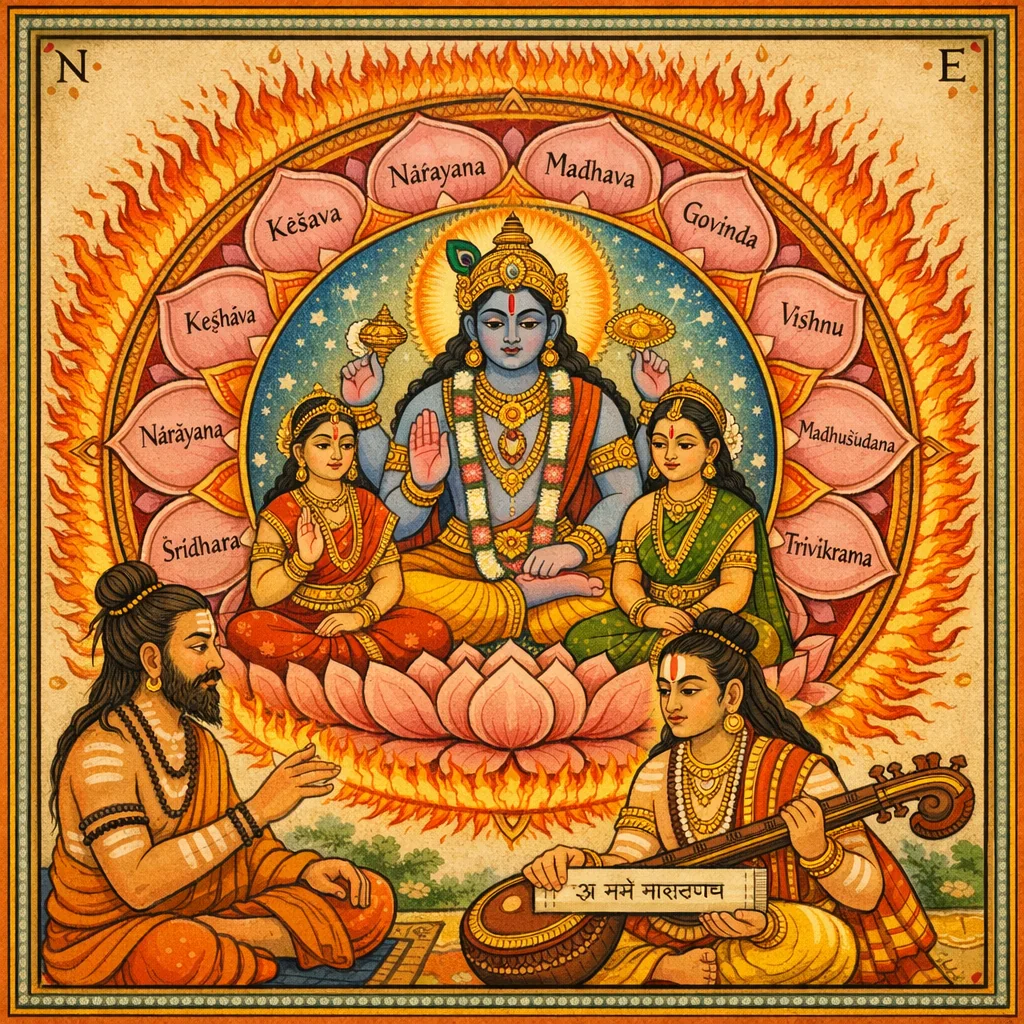
Mahāviṣṇu-Mantras: Aṣṭākṣarī, Sudarśana-Astra, Nyāsa Systems, Āvaraṇa-Pūjā, and Prayogas
Sanatkumāra instructs Nārada in rare Mahāviṣṇu mantras said to empower creation itself. The chapter defines the aṣṭākṣarī “Nārāyaṇa” mantra with its ṛṣi–chandas–devatā–bīja–śakti–viniyoga, then unfolds protective, embodied practice: pañcāṅga/ṣaḍaṅga arrangements, the twelve-syllabled Sudarśana astra-mantra, and binding of the directions. It explains Vibhūti-pañjara nyāsa (multi-cycle placements), tattvābhidha/tattva-nyāsa (eight prakṛtis and twelve tattvas), and the installation of twelve mūrtis paired with the twelve Ādityas (Keśava–Padmanābha, etc.). Meditation on Nārāyaṇa with Śrī and Bhū leads to graded japa-fruits (from lakhs to mokṣa) and to homa and seat-mantras with lotus-diagram worship (Vāsudeva–Saṅkarṣaṇa–Pradyumna–Aniruddha; Śaktis such as Śānti/Śrī). The latter half compiles applied prayogas: anti-poison and serpent-bite rites (Garuḍa/Nṛsiṃha), healing and longevity, prosperity and land-acquisition, and specialized mantras for Puruṣottama, Śrīkara, Ādi-Varāha, Dharaṇī, and Jagannātha (including attraction/delusion formulae), concluding that a perfected mantra grants all aims up to Viṣṇu-sāmya.
Shlokas
Verse 1
सनत्कुमार उवाच । अथ वक्ष्ये महाविष्णोर्मन्त्रान्लोकेषु दुर्लभान् । यान्प्राप्य मानवास्तूर्णं प्राप्नुवंति निजेप्सितम् ॥ १ ॥
Sanatkumāra said: Now I shall declare the mantras of Mahāviṣṇu—rare in all the worlds—by obtaining which people swiftly attain what they truly desire.
Verse 2
ऽ । ब्रह्मादयोऽपि याञ्ज्ञात्वा समर्थाः स्युर्जगत्कृतौ ॥ २ ॥
Even Brahmā and the other cosmic beings, only after knowing that, become capable of bringing about the creation of the universe.
Verse 3
तारहृत्पूर्वकं ङेंतं नारायणपदं भवेत् । अष्टाक्षरो मनुश्चास्य साध्यो नारायणो मुनिः ॥ ३ ॥
When the syllable ‘tāra’ is placed first and joined with the remaining syllables, it becomes the word ‘Nārāyaṇa’. This is the eight-syllabled mantra; its presiding sage (ṛṣi) is Nārāyaṇa.
Verse 4
छन्दः प्रोक्तं च गायत्री देवता विष्णुख्ययः । ॐ बीजं यं च तथा शक्तिर्विनियोगोऽखिलाप्तये ॥ ४ ॥
The metre is declared to be Gāyatrī; the presiding deity is the one renowned as Viṣṇu. The seed-syllable is Oṁ; “yaṁ” is likewise stated as the Śakti; and its application (viniyoga) is for the attainment of all desired ends.
Verse 5
क्रुद्धोल्काय हृदाख्यातं महोल्काय शिरः स्मृतम् । वीरोल्काय शिखा प्रोक्ता द्युल्काय कवचं मतम् ॥ ५ ॥
“The heart is declared to belong to Kruddholkā; the head is remembered as belonging to Maholkā. The topknot (śikhā) is said to belong to Vīrolkā; and the protective armour (kavaca) is regarded as belonging to Dyulkā.”
Verse 6
महोल्कायेति चास्रं स्यादित्थं पंचांगकल्पना । पुनः षडंगमंत्रोत्थैः षड्वर्णैश्च समाचरेत् ॥ ६ ॥
The (mantra/weapon-formula) is ‘Maholkāya’; thus is the construction of the fivefold (pañcāṅga) arrangement. Thereafter, one should again perform it by means of the six syllables that arise from the six auxiliary-limbed (ṣaḍaṅga) mantras.
Verse 7
अवशिष्टौ न्यसेत्कुक्षिपृष्टयोर्मंत्रवर्णकौ । सुदर्शनस्य मंत्रेण कुर्याद्दिग्बन्धनं ततः ॥ ७ ॥
He should place the remaining two mantra-syllables upon the belly and the back. Then, with the Sudarśana mantra, he should perform the binding of the directions, sealing all quarters in protection.
Verse 8
तारो नमश्चतुर्थ्यंतं सुदर्शनपदं वदेत् । अस्त्रायफडिति प्रोक्तो मंत्रो द्वादशवर्णवान् ॥ ८ ॥
One should utter the Tāraka—the praṇava “Oṁ”—then say “namaḥ” with the dative ending, and pronounce the word “Sudarśana”; followed by “astrāya phaḍ”. Thus is declared the twelve-syllabled Astra-mantra.
Verse 9
दशावृत्तिमय न्यासं वक्ष्ये विभूतिपञ्चरम् । मूलार्णान्स्वतनौ न्यस्येदाधारे हृदये मुखे ॥ ९ ॥
I shall explain the Vibhūti-Pañjara—the nyāsa arranged in ten cycles. One should place the root seed-syllables upon one’s own body: at the base (ādhāra), at the heart, and at the mouth.
Verse 10
दोःपन्मूलेषु नासायां प्रथमावृत्तिरीरिता । गले नाभौ हृदि कुचपार्श्वपृष्टेषु तत्पराः ॥ १० ॥
The first cycle (āvṛtti) is declared at the roots of the arms and at the nose. Those intent on this placement apply it at the throat, the navel, the heart, and also at the sides of the breasts, the flanks, and the back.
Verse 11
मूर्द्धास्यनेत्रश्रवणघ्राणेषु च तृतीयकाः । दोःपादसंध्यंगुलिषु वेदावृत्त्या च विन्यसेत् ॥ ११ ॥
One should place the third set upon the crown of the head, the mouth, the eyes, the ears, and the nose; and, in accordance with the Vedic mode of repetition (veda-āvṛtti), also upon the joints and fingers of the arms and legs.
Verse 12
धातुप्राणेषु हृदये विन्यसेत्तदनंतरम् । शिरोनेत्रा स्यहृत्कुक्षिसोरुजंघापदद्वये ॥ १२ ॥
Thereafter one should perform nyāsa, placing the mantras upon the bodily elements and the vital airs, with the heart as the center; then place them upon the head, the eyes, the mouth/face, the heart, the belly, the thighs, the shanks, and both feet.
Verse 13
एकैकशो न्यसेद्वर्णान्मंत्रस्य क्रमतः सुधीः । न्यसेद्धृदंसोरुपदेष्वर्णान्वेदमितान्मनोः ॥ १३ ॥
The wise practitioner should perform nyāsa by placing the mantra’s syllables one by one in proper sequence. Then, upon the heart, the shoulders, the thighs, and the feet, he should place the syllables of the sacred formula as measured and prescribed by the Veda.
Verse 14
चक्रशं खगदांभोजपदेषु स्वस्वमुद्रया । शेषांश्च न्यासवर्योऽयं विभूतिपञ्जराभिधः ॥ १४ ॥
Upon the bodily places assigned to the discus, conch, sword/mace, lotus, and the feet, one should perform nyāsa using each emblem’s own mudrā. This excellent remaining sequence of placements is called “Vibhūti-pañjara,” the protective cage of divine powers.
Verse 15
न्यसेन्मूलार्णमेकैकं सचंद्रं तारसम्पुटम् । अथवा वै नमोंतेन न्यसेदित्यपरे जगुः ॥ १५ ॥
One should perform nyāsa by placing each root syllable one by one, joined with the ‘candra’ (ṃ/anusvāra) and enclosed by the sacred ‘tārā’, Oṁ. Alternatively, others say the nyāsa is to be done with ‘namaḥ’ added at the end.
Verse 16
तत्त्वन्यासं ततः कुर्याद्धिष्णुभावप्रसिद्धये । अष्टार्णोऽष्टप्रकृत्यात्मा गदितः पूर्वसूरिभिः ॥ १६ ॥
Then one should perform tattva-nyāsa, the placement of the principles, to firmly establish absorption in Viṣṇu. The eight-syllabled mantra (aṣṭārṇa), of the nature of the eightfold prakṛti, has been taught by the sages of old.
Verse 17
पृथिव्यादीनि भूतानि ततोऽहंकारमेव च । महांश्च प्रकृतिश्चैवेत्यष्टौ प्रकृतयो मताः ॥ १७ ॥
Earth and the other elements, then ahaṅkāra (egoity), and also Mahat (the Great Principle) and Prakṛti—these are held to be the eight fundamental natures (prakṛtis).
Verse 18
पादे लिंगे हृदि मुखे मूर्ध्नि वक्षसि हृत्स्थले । सर्वांगे व्यापकं कुर्यादेकेन साधकोत्तमः ॥ १८ ॥
Placing (the mantra’s power) in the feet, the generative organ, the heart, the mouth, the crown of the head, the chest, and the heart-region, the best practitioner should, by a single mantra, make it pervade the entire body.
Verse 19
मंत्रार्णहृत्परायाद्यमात्मने हृदयांतिमम् । तत्तन्नाम समुच्चार्य्य न्यसेत्तत्तत्स्थले बुधः ॥ १९ ॥
Beginning with the mantra’s syllables and proceeding up to the heart, and then placing the final syllable at the end of the heart-region for the Self—uttering each corresponding name, the wise practitioner should perform nyāsa by placing them in their respective locations.
Verse 20
अयं तत्त्वाभिधो न्यासः सर्वन्यासोत्तमोत्तमः । मूर्तीर्न्यसेद्द्वादश वै द्वादशादित्यसंयुताः ॥ २० ॥
This is the nyāsa called ‘tattvābhidha’ (the placement that names the principles); it is the most excellent of all forms of nyāsa. One should indeed install twelve forms (mūrtis), joined with the twelve Ādityas.
Verse 21
द्वादशाक्षरवर्णाद्या द्वादशादित्यसंयुताः । अष्टार्णोऽयं मनुश्चाष्टप्रकृत्यात्मा समीरितः ॥ २१ ॥
Beginning with the twelve-syllabled mantra and connected with the Twelve Ādityas, this eight-syllabled mantra is also declared—its very nature being the eightfold Prakṛti.
Verse 22
तासामात्मचतुष्कस्य योगादर्काक्षरो भवेत् । ललाटकुक्षिहृत्कंठदक्षपार्श्वांसकेषु च ॥ २२ ॥
By the yogic union of those elements with the fourfold inner principle (ātma-catuṣka), the syllable “arka” arises; and by nyāsa it is to be placed on the forehead, the belly, the heart, the throat, and on the right side and shoulder.
Verse 23
गले च वामपार्श्वांसगलपृष्टेष्वनंतरम् । ककुद्यपि न्यसेन्मंत्री मूर्तीर्द्वादश वै क्रमात् ॥ २३ ॥
Then, on the throat, on the left side, on the shoulder, and thereafter on the back of the throat; and also on the kakudya (upper back). The mantra-knowing practitioner should perform nyāsa of the twelve divine forms (mūrti) in due order.
Verse 24
धात्रा तु केशवं न्यस्यार्यम्ण नारायणं पुनः । मित्रेण माधवं न्यस्य गोविंदं वरुणेन च ॥ २४ ॥
One should perform nyāsa: place Keśava with Dhātṛ; again place Nārāyaṇa with Aryaman; place Mādhava with Mitra, and also Govinda with Varuṇa.
Verse 25
विष्णुं चैवांशुना युक्तं भगेन मधुसूदनम् । न्यसेद्विवस्वता युक्तं त्रिविक्रममतः परम् ॥ २५ ॥
One should place (by nyāsa) Viṣṇu together with Aṃśu, and Madhusūdana together with Bhaga. Thereafter one should place Trivikrama together with Vivasvat (the Sun).
Verse 26
वामनं च तथाद्रण पूष्णा श्रीधरमेव च । हृषीकेशं न्यसेत्पश्चात्पर्जन्येन समन्वितम् ॥ २६ ॥
One should then place (by nyāsa) Vāmana, and likewise Draṇa; then Pūṣan and Śrīdhara as well. After that, one should place Hṛṣīkeśa together with Parjanya.
Verse 27
त्वष्ट्रा युतं पद्मनाभं दामोदरं च विष्णुना । द्वादसार्णं ततो मंत्रं समस्ते शिरसि न्यसेत् ॥ २७ ॥
Then one should perform nyāsa, placing upon the head the twelve-syllabled mantra, invoking Padmanābha together with Tvaṣṭṛ, and Dāmodara together with Viṣṇu.
Verse 28
व्यापकं विन्यसेत्पश्चात्किरीटमनुना सुधीः । ध्रुवःकिरीटकेयूरहारांते मकरेतिच ॥ २८ ॥
Afterwards, the wise practitioner should perform the all-pervading (vyāpaka) nyāsa; then, with the crown-mantra, he should place the crown. He should also fix the mantras for Dhruva, the crown, the armlets, and at the end of the necklace, the ‘Makara’ as well.
Verse 29
कुंडलांते चक्रशंखगदांतेंऽभोजहस्ततः । पीतांबरांते श्रीवत्सां कितवक्षः स्थलेति च ॥ २९ ॥
He is described as wearing earrings; bearing the discus, conch, and mace; holding a lotus in his hand; clad in yellow garments; and marked with the Śrīvatsa—the sacred sign upon His chest.
Verse 30
श्रीभूमिसहितस्वात्मज्योतिर्द्वयमतः परम् । वदेद्दीप्तिकरायांति सहस्रादित्यतेजसे ॥ ३० ॥
One should declare the supreme reality as the twofold inner radiance, together with Śrī and Bhūmi. By that utterance, the giver of brilliance attains the splendor of a thousand suns.
Verse 31
नमोंतो बाणषङ्वर्णैः किरीटमनुरीरितः । एवं न्यासविधिं कृत्वा ध्यायेन्नारायणं विभुम् ॥ ३१ ॥
The crown-mantra is taught as a sequence of syllables beginning with “namo”, together with the set of “bāṇa” and “ṣaṅ” letters. Having thus completed the method of nyāsa, one should meditate upon Nārāyaṇa, the all-pervading Lord.
Verse 32
उद्यत्कोट्यर्कसदृशं शंखं चक्रं गदांबुजम् । दधतं च करैर्भूमिश्रीभ्यां पार्श्वद्वयांचितम् ॥ ३२ ॥
Holding in His hands the conch, discus, mace, and lotus—radiant like the rising light of ten million suns—He stands, adorned on both sides by Bhūmi (Earth) and Śrī (Lakṣmī).
Verse 33
श्रीवत्सवक्षसं भ्राजत्कौस्तुभामुक्तकन्धरम् । हारकेयूरवलयांगदं पीतांबरं स्मरेत् ॥ ३३ ॥
One should meditate upon the Lord whose chest bears the Śrīvatsa mark, whose neck is adorned with the radiant Kaustubha jewel, who is decorated with necklace, armlets, bracelets, and arm-ornaments, and who is clad in a yellow garment (pītāmbara).
Verse 34
वर्णलक्षं जपेन्मंत्रं विधिवन्नियतेंद्रियः । प्रथमेन तु लक्षेण स्वात्मशुद्धिर्भवेद् ध्रुवम् ॥ ३४ ॥
With senses restrained and according to proper procedure, one should repeat the mantra for one lakh (100,000) syllables; and by that first lakh, purification of one’s own inner self certainly arises.
Verse 35
लक्षद्वयजपेनाथ मंत्रशुद्धिमवाप्नुयात् । लक्षत्रयेण जप्तेन स्वर्लोकमधिगच्छति ॥ ३५ ॥
By repeating two lakhs (200,000) of the mantra, one attains the purification of the mantra; and by repeating three lakhs (300,000), one reaches Svarga-loka, the heavenly world.
Verse 36
विष्णोः समीपमाप्नोति वेदलक्षजपान्नरः । तथा च निर्मलं ज्ञानं पंचलक्षजपाद्भवेत् ॥ ३६ ॥
By repeating the Veda one lakh (100,000) times, a person attains proximity to Viṣṇu; likewise, through five lakhs (500,000) repetitions, spotless, pure knowledge arises.
Verse 37
लक्षषष्टेन चाप्नोति मंत्री विष्णौ स्थिरा मतिम् । सप्तलक्षजपान्मंत्री विष्णोः सारूप्यमाप्नुयात् ॥ ३७ ॥
By one lakh and sixty thousand repetitions, the mantra-practitioner attains steadfast understanding, firmly fixed in Viṣṇu; and by seven lakh repetitions, the practitioner attains sārūpya—resemblance to Viṣṇu.
Verse 38
अष्टलक्षं जपेन्मंत्री निर्वाणमधिगच्छति । एवं जप्त्वा ततः प्राज्ञो दशांशं सरसीरुहैः ॥ ३८ ॥
A mantra-practitioner who repeats the mantra eight lakh times attains liberation (nirvāṇa). Having thus completed the japa, the wise person should then offer a tenth part as a concluding rite, with lotus-flowers.
Verse 39
मधुराक्तैः प्रजुहुयात्संस्कृते हव्यवाहने । मंडूकात्परतत्वांतं पीठे संपूज्य यत्नतः ॥ ३९ ॥
Let him offer oblations mixed with sweet substances into the duly consecrated fire (Agni). Then, upon the ritual seat (pīṭha), he should carefully worship—beginning from the Maṇḍūka (support) and proceeding up to the Supreme Principle (paratattva).
Verse 40
विमलोत्कर्षिणी ज्ञाना क्रिया योगा ततः परा । प्रह्वी सत्या तथेशाननुग्रहा नवमी मता ॥ ४० ॥
The ninth power (śakti) is held to be: Vimalotkarṣiṇī, Jñānā, Kriyā, Yogā, and then the Supreme, Parā; also Prahvī, Satyā, and likewise Īśāna-anugrahā—the Lord’s gracious favor.
Verse 41
तारो नमनो भगवते विष्णवे सर्वभू ततः । तात्मने वासुदेवाय सर्वात्मेति पदं वदेत् ॥ ४१ ॥
One should utter the syllable “tāra” (Oṁ), then “namanaḥ”; thereafter: “to the Blessed Lord Viṣṇu”; then “sarvabhū” (the all-becoming); then “tātmane” (to that Self); “to Vāsudeva”; and finally the word “Sarvātmā”—“the Self of all.”
Verse 42
संयोगयोगपद्मांते पीठाय हृदयांतिमः । षड्विंशदक्षरः पीठमंत्रोऽनेनासनं दिशेत् ॥ ४२ ॥
At the close of the Saṃyoga‑yoga Padma formula, one should add the final syllable of the Hṛdaya‑mantra for the pīṭha. This pīṭha‑mantra, of twenty‑six syllables, is used to assign and consecrate the ritual seat (āsana).
Verse 43
मूर्तिं संकल्प्य मूलेन तस्यामावाह्य पूजयेत् । आदौ चांगानि संपूज्य मंत्राणां केशरेषु च ॥ ४३ ॥
Having envisioned the Deity’s form by the root‑mantra (mūla‑mantra), one should invoke (āvāhana) the Lord into that form and worship. First, duly worship the auxiliary limbs (aṅgas), and also the mantras in their “petals,” the assigned places of the ritual lotus.
Verse 44
प्रागादिदिग्दले वासुदेवं संकर्षणं तथा । प्रद्युम्नमनिरुद्धं च शक्तीः कोणेष्वथार्चयेत् ॥ ४४ ॥
On the petals aligned with the directions beginning from the east, worship Vāsudeva, and likewise Saṅkarṣaṇa, Pradyumna, and Aniruddha; then worship their Śaktis in the intermediate corners.
Verse 45
शांतिं श्रियं सरस्वत्या रतिं संपूजयेत्क्रमात् । हेमपीततमालेंद्रनीलाभाः पीतवाससः ॥ ४५ ॥
In proper sequence, worship Śānti (Peace), Śrī (Prosperity), Sarasvatī (Learning), and Rati (Delight). Their hues are like gold, yellow, the dark blue of the tamāla tree, and indigo, and they are clad in yellow garments.
Verse 46
चतुर्भुजाः शंखचक्रगदांभघोजधरा इमे । सितकांचनगोदुग्धदूर्वावर्णाश्च शक्तयः ॥ ४६ ॥
These Śaktis are four‑armed, bearing the conch (śaṅkha), discus (cakra), mace (gadā), and lotus (padma). Their hues are like white, gold, cow’s milk, and dūrvā grass.
Verse 47
दलाग्रेषु चक्रशंखगदापंकजकौस्तुभान् । पूजयेन्मुसलं खङ्गं वनमालां यथाक्रमात् ॥ ४७ ॥
On the tips of the petals, one should worship in due order the discus, conch, mace, lotus, and the Kaustubha jewel; and likewise, sequentially, the plough, the sword, and the forest-garland (Vanamālā).
Verse 48
रक्ताजपीतकनकश्यामकृष्णासितार्जुनान् । कुंकुमाभं समभ्यर्च्येद्वहिरग्रे खगेश्वरम् ॥ ४८ ॥
Having duly worshipped, before the sacrificial fire, the Lord of birds—radiant like saffron (kuṅkuma)—one should then offer (or employ) the varieties: red, tawny, golden, dark, black, bluish, and the Arjuna-type, in accordance with the rite.
Verse 49
पार्श्वयोः पूजयेत्पश्चांखपद्मनिधी क्रमात् । मुक्तामाणिक्यसंकाशौ पश्चिमे ध्वजमपर्चयेत् ॥ ४९ ॥
Then, on the two sides, one should worship successively the two treasures (Nidhis), Śaṅkha and Padma. On the western side, radiant like pearls and rubies, one should worship the banner (Dhvaja).
Verse 50
रक्तं विघ्नं तथाग्नेये श्याममार्यं च राक्षसे । दुर्गां श्यामां वायुकोणे सेनान्यं पीतमैश्वरे ॥ ५० ॥
In the south-east (Agni corner) one should place the red form called Vighna. In the south-west (Rākṣasa corner) one should place Śyāma and Ārya. In the north-west (Vāyu corner) one should place Durgā and Śyāmā. In the north-east (Īśāna corner) one should place the yellow form called Senānī.
Verse 51
लोकेशा नायुधैर्युक्तान्बहिः संपूजयेत्सुधीः । एवमावरणैर्युक्तं योऽर्चजयेद्विष्णुमव्ययम् ॥ ५१ ॥
A wise person should duly worship the Lords of the Worlds outside the main shrine, without depicting them with weapons. Thus, whoever worships the imperishable Viṣṇu together with these surrounding enclosures (āvaraṇas) performs the worship in a proper and complete manner.
Verse 52
भुक्त्वेहसकलान्भोगानंते विष्णुपदं व्रजेत् । क्षेत्रधान्यसुवर्णानां प्राप्तये धारणीं स्मरेत् ॥ ५२ ॥
Having enjoyed here all desirable worldly pleasures, in the end one goes to Viṣṇupada, the abode of Lord Viṣṇu. For obtaining fields, grain, and gold, one should remember and recite the dhāraṇī.
Verse 53
देवीं दूर्वादलश्यामां दधानां शालिमंजरीम् । चिंतयेद्भारतीं देवीं वीणापुस्तकधारिणीम् ॥ ५३ ॥
One should meditate on the Goddess Bhāratī: dark-hued like the blades of dūrvā grass, holding a cluster of rice-ears, and bearing a vīṇā and a book.
Verse 54
दक्षिणे देवदेवस्य पूर्णचंद्रनिभाननाम् । क्षीराब्धिफेनपुंजाभे वसानां श्वेतवाससी ॥ ५४ ॥
On the right side of the God of gods stands a lady whose face resembles the full moon; she is radiant like a mass of foam from the Milk Ocean and is clad in white garments.
Verse 55
भारत्या सहितं यो वै ध्यायेद्द्वेवं परात्परम् । वेदवेदार्थतत्त्वज्ञो जायते सर्ववित्तमः ॥ ५५ ॥
Whoever truly meditates on that Supreme Reality together with Bhāratī becomes a knower of the essential truth of the Veda and its meaning—and is born as the foremost among the all-knowing.
Verse 56
नारसिंहमिवात्मानं देवं ध्यात्वातिभैरवम् । शश्त्रं संमंत्र्य मंत्रेण शब्रून्हत्वा निवर्तते ॥ ५६ ॥
Meditating upon the supremely terrifying Deity as manifest like Narasiṃha, and consecrating the weapon with a mantra, one strikes down hostile foes and then withdraws.
Verse 57
नारसिंहेन बीजेन मंत्रं संयोज्य साधकः । शतमष्टोत्तरं जपत्वा वामहस्ताभिमंत्रिताः ॥ ५७ ॥
Having joined the mantra with the Nṛsiṃha seed-syllable (bīja), the practitioner should repeat it one hundred and eight times; then the items consecrated by the left hand become duly empowered.
Verse 58
पुनः पुनरपः सिंचेत्सर्पदष्टोऽपि जीवति । गारुडेन च संयोज्य पंचार्णेन जपेत्तदा ॥ ५८ ॥
Again and again one should sprinkle water; even one bitten by a serpent may survive. Then, combining it with the protective Garuḍa mantra, one should at that time recite the five-syllabled mantra.
Verse 59
निर्विषीकरणे ध्यायेद्विष्णुं गरुडवाहनम् । अशोकफलके तार्क्ष्यमालिख्याशोकसंहतौ ॥ ५९ ॥
For neutralizing poison, one should meditate on Viṣṇu, the Lord who rides upon Garuḍa; and on a tablet of aśoka wood one should draw Tārkṣya (Garuḍa) and bind it with a cluster or garland of aśoka (flowers or leaves).
Verse 60
अशोकपुष्पैः संपूज्य भगवंतं तदग्रतः । जुहुयात्तानि पुष्पाणि त्रिसंध्यं सप्तपत्रकम् ॥ ६० ॥
After duly worshipping Bhagavān with aśoka flowers, one should, in His very presence, offer those flowers into the ritual fire—three times a day at the three sandhyās—using the saptapatraka (seven-leaved offering).
Verse 61
प्रत्यक्षो जायते पक्षी वरमिष्टं प्रयच्छति । गाणपत्येन संयोज्य जपेल्लक्षं पयोव्रतः ॥ ६१ ॥
A bird manifests directly and grants the desired boon. Joining the rite with the Gaṇapatya practice, one who observes the milk-vow (payo-vrata) should perform one lakh—one hundred thousand—repetitions of the mantra.
Verse 62
महागणपतिं देवं प्रत्यक्षमिह पश्यति । वाणिबीजेन संयुक्तं षण्मासं योजयेन्नरः ॥ ६२ ॥
Here, in this very life, he beholds the god Mahāgaṇapati directly. A man should practice it for six months, conjoined with the seed-mantra (bīja) of Vāṇī—Speech, Sarasvatī.
Verse 63
महाकविवरो भूत्वा मोहयेत्सकलं जगत् । हुत्वा गुङ्चीशकलान्यर्द्धागुलमितानि च ॥ ६३ ॥
Having become an excellent great poet, he can enchant the whole world—by offering into the sacred fire (homa) pieces of guñcī seeds, each measured to half a finger-breadth.
Verse 64
दधिमध्वाज्ययुक्तानि मृत्युं जयति साधकः । शनैश्वर दिने सम्यक् स्पृष्ट्वा श्वत्थं च पाणिना ॥ ६४ ॥
With offerings prepared with curd, honey, and ghee, the practitioner conquers death; and on Śanaiśvara’s day (Saturday), by properly touching with the hand the sacred aśvattha (pipal) tree, he attains that victory.
Verse 65
जप्त्वा चाष्टशतं युद्धे ह्यपमृत्युं जयत्यसौ । पञ्चविंशतिधा जप्त्वा नित्यं प्रातः पिबेज्जलम् ॥ ६५ ॥
By reciting it one hundred and eight times in battle, he indeed conquers untimely death (apamṛtyu). And having recited it twenty-five times, one should daily drink water in the morning.
Verse 66
सर्वपापविनिर्मुक्तो ज्ञानवान् रोगवर्जितः । कुंभं संस्थाप्य विधिवदापूर्य शुद्धवारिणा ॥ ६६ ॥
Freed from all sins—wise and untouched by disease—one should duly install the ritual water-pot (kumbha) and fill it, according to prescription, with purified water.
Verse 67
जप्त्वायुतं ततस्तेनाभिषेकः सर्वरोगनुत् । चंद्रसूर्योपरागे तु ह्युपोष्याष्टसहस्रकम् ॥ ६७ ॥
After reciting it ten thousand times, one should perform abhiṣeka with that consecrated means; it removes all diseases. And at the time of a lunar or solar eclipse, having fasted, one should recite it eight thousand times.
Verse 68
स्पृष्ट्वा ब्राह्मीधृतं जप्त्वा पिबेत्साधकसत्तमः । मेधां कवित्वं वाक्सिद्धिं लभते नात्र संशयः ॥ ६८ ॥
After touching ghee infused with brāhmī and reciting the mantra, the best of practitioners should drink it; he attains intellect, poetic brilliance, and vāk-siddhi—mastery of speech—without doubt.
Verse 69
जुहुयादयुतं विल्वैर्महाधनपतिर्भवेत् । नारायणस्य मन्त्रोऽयं सर्वमंत्रोत्तमोत्तमः ॥ ६९ ॥
If one offers ten thousand oblations in the homa with bilva leaves, one becomes a great lord of wealth. This mantra of Nārāyaṇa is the most excellent of all mantras—supremely the best.
Verse 70
आलयः सर्वसिद्धीनां कथितस्तव नारद । नारायणाय शब्दांते विद्महे पदमीरयेत् ॥ ७० ॥
O Nārada, you have declared that sacred formula to be the abode of all attainments. At the end of the utterance, one should pronounce the word “vidmahe” and then recite the pada—the concluding phrase—for Nārāyaṇa.
Verse 71
वासुदेवपदं ङेंतं धीमहीति ततो वदेत् । तन्नो विष्णुः प्रचोवर्णान्संवदेञ्चोदयादिति ॥ ७१ ॥
Then one should utter the expression “the pada of Vāsudeva,” and thereafter recite “dhīmahi”—“we meditate.” May that Viṣṇu impel and illumine our syllables and their proper utterance; may He inspire our speech.
Verse 72
एषोक्ता विष्णुगायत्री सर्वपापप्रणाशिनी । तारो हृद्भगवान् ङेंतो वासुदेवाय कीर्तितः ॥ ७२ ॥
Thus has the Viṣṇu-Gāyatrī been taught—she destroys all sins. The sacred syllable ‘tāra’ (Oṁ) is the Lord in the heart, and it is proclaimed for Vāsudeva.
Verse 73
द्वादशार्णो महामन्त्रो भुक्तिमुक्तिप्रदायकः । स्त्रीशूद्राणां वितारोऽयं सतारस्तु द्विजन्मनाम् ॥ ७३ ॥
The great twelve-syllabled mantra bestows both worldly enjoyment and liberation. For women and Śūdras it is to be imparted without the praṇava (the ‘tāra’), while for the twice-born it is to be taught together with the tāra.
Verse 74
प्रजापतिर्मुनिश्चास्य गायत्री छन्द ईरितः । देवता वासुदेवस्तु बीजं शक्तिर्ध्रुवश्च हृत् ॥ ७४ ॥
For this mantra, Prajāpati is declared to be the seer (ṛṣi), Gāyatrī the metre (chandas), and Vāsudeva the presiding deity (devatā). Its seed-syllable (bīja) and power (śakti) are stated, and Dhruva is to be placed in the heart (hṛd) as the supporting key.
Verse 75
चन्द्राक्षिवेदपञ्चर्णैः समस्तेनांगकल्पनम् । मूर्ध्नि भाले दृशोरास्ये गले दोर्हृदये पुनः ॥ ७५ ॥
With the complete five-syllabled formula—“candra, akṣi, veda” (the pañcārṇa mantra)—one should perform aṅga-kalpanā/nyāsa upon the limbs: on the head, the forehead, the eyes, the mouth, the throat, the arms, and again on the heart.
Verse 76
कुक्षौ नाभौ ध्वजे जानुद्वये पादद्वये तथा । न्यासेत्क्रमान् मन्त्रवर्णान्सृष्टिन्यासोऽयमीरितः ॥ ७६ ॥
One should place, in due sequence, the syllables of the mantra upon the belly, the navel, the genital region, both knees, and both feet. This is declared to be the ‘sṛṣṭi-nyāsa’—the installation in the order of creation.
Verse 77
हृदादिमस्तकांतं तु स्थितिन्यासं प्रचक्षते । पादादारभ्य मूर्द्धानं न्यासं संहारकं विदुः ॥ ७७ ॥
They declare that the nyāsa, the sacred placement performed from the heart up to the crown of the head, is the nyāsa of sustaining (sthiti). But the nyāsa done beginning from the feet and rising to the head is known as the nyāsa of withdrawal and dissolution (saṃhāra).
Verse 78
तत्त्वन्यासं ततः कुर्यात्सर्वतंत्रेषु गोपितम् । बीवं प्राणं तथा चित्तं हृत्पद्मं सूर्यमण्डलम् ॥ ७८ ॥
Then one should perform the tattva-nyāsa—kept secret in all Tantras—placing inwardly the seed-syllable (bīja), the vital breath (prāṇa), the mind (citta), the heart-lotus, and the solar orb (sūrya-maṇḍala).
Verse 79
चन्द्राग्निमण्डले चैव वासुदेवं ततः परम् । संकर्षणं च प्रद्युम्नमनिरुद्धं ततः परम् ॥ ७९ ॥
In the lunar and solar spheres as well, one should contemplate Vāsudeva as the Supreme. Beyond that are Saṅkarṣaṇa and Pradyumna, and beyond them again is Aniruddha as the Supreme.
Verse 80
नारायणं चक्रमतस्तत्त्वानि द्वादशैव तु । मूलार्णहृत्परायाद्यमात्मने हृदयांतिमम् ॥ ८० ॥
For Nārāyaṇa—the Lord who bears the discus (cakra)—there are indeed twelve principles (tattvas). Beginning from the root syllable (mūla-arṇa) and culminating in the heart’s innermost essence, they are directed to the Self (Ātman).
Verse 81
तत्त्वे नाम समुञ्चर्य्य न्यसेन्मूर्द्धादिषु क्रमात् । पूर्वोक्तं ध्यानमत्रापि भानुलक्षजपो मनोः ॥ ८१ ॥
Having gathered the divine Name into its essential principle (tattva), one should perform nyāsa upon the head and the other limbs in due sequence. Here too, one should practice the previously described meditation and repeat the mantra one hundred thousand times (japa).
Verse 82
तदृशांशं तिलैराज्यलोलितैर्हवनं चरेत् । पीठे पूर्वोदिते मन्त्री मूर्ति संकल्प्य मूलतः ॥ ८२ ॥
He should perform the havana (fire-oblation) with the prescribed portion, using sesame seeds moistened with ghee. Then, upon the altar previously described, the knower of mantra should, from the very foundation, form the saṅkalpa and mentally establish the Deity’s sacred form.
Verse 83
तस्यामावाह्य देवेशं वासुदेवं प्रपूजयेत् । अङ्गानि पूर्वमभ्यर्च्य वासुदेवादिकास्ततः ॥ ८३ ॥
Having invoked (āvāhana) into that seat the Lord of gods, Vāsudeva, one should worship Him with complete reverence. First, one should duly honor His limbs (aṅgas/nyāsa), and thereafter worship Vāsudeva and the other associated forms.
Verse 84
शांत्यादिशक्तयः पूज्याः प्राग्वद्दिक्षु विदिक्षु च । तृतीयावरणे पूज्याः प्रोक्ता द्वादश मूर्तयः ॥ ८४ ॥
The Śaktis beginning with Śānti are to be worshipped, as before, in the cardinal and intermediate directions. In the third enclosure (āvaraṇa), the twelve mūrtis that have been taught are to be adored.
Verse 85
इंद्राद्यानायुधैर्युक्तान् पूजयेद्धरणीगृहे । एवमावरणैरिष्ट्वा पञ्चभिर्विष्णुमव्ययम् ॥ ८५ ॥
In the sanctified ground-enclosure (dharaṇī-gṛha), one should worship Indra and the other deities together with their weapons. Thus, having duly honored the five āvaraṇas, one worships Viṣṇu, the imperishable (avyaya).
Verse 86
प्राप्नुयात्सकलानर्थानन्ते विष्णुपदे व्रजेत् । पुरुषोत्तमसंज्ञस्य विष्णोर्भेदचतुष्टयम् ॥ ८६ ॥
He attains all desired aims, and in the end proceeds to Viṣṇu’s abode (Viṣṇu-pada). This is the fourfold distinction of Viṣṇu, who is known as Puruṣottama.
Verse 87
त्रैलोक्यमोहनस्तेषां प्रथमः परिकीर्तितः । श्रीकरश्च हृषीकेशः कृषअणश्चात्र चतुर्थकः ॥ ८७ ॥
Among these, the first is proclaimed as “Trailokya-mohana,” the Enchanter of the three worlds. Then come Śrīkara and Hṛṣīkeśa; and here Kṛṣṇa is mentioned as the fourth.
Verse 88
तारः कामो रमा पश्चान् ङेंतः स्यात्पुरुषोत्तमः । वर्मास्त्राण्यग्निप्रियांतो मन्त्रो वह्नीन्दुवर्णवान् ॥ ८८ ॥
Then one should utter Tāra, Kāma, and Ramā; thereafter, ending with the nasal “ṅeṃta”, it becomes a mantra of Puruṣottama. This mantra is armored with protective formulae and weapon-mantras, concludes with “Agni-priyā”, and is described as bearing the hue of fire and the moon.
Verse 89
ब्रह्मा मुनिः स्याद्गायत्री छन्दः प्रोक्तोऽथ देवता । पुरुषोत्तमसंज्ञोऽत्र बीजशक्तीस्मरंदिरे ॥ ८९ ॥
Here, Brahmā is said to be the seer (ṛṣi); the metre is declared to be Gāyatrī; and the presiding deity is spoken of as Puruṣottama. In this mantra, the bīja, the śakti, and the smara (kīlaka/locking principle) are also to be understood as established in their proper places.
Verse 90
भूचंद्रैकरसाक्ष्यक्षिमंत्रवर्णोर्विभागतः । कृत्वांगानि ततो ध्यायेद्विधिवत्पुरुषोत्तमम् ॥ ९० ॥
Having assigned the letters of the mantra to the body-limbs in their proper divisions (nyāsa), one should then, according to the prescribed rite, meditate upon Puruṣottama.
Verse 91
समुद्यदादित्यनिभं शंखचक्रगदांबुजैः । लसत्करं पीतवस्रं स्मरेच्छ्रीपुरुषोत्तमम् ॥ ९१ ॥
One should meditate on Śrī Puruṣottama—radiant like the rising sun—whose shining hands bear the conch, discus, mace, and lotus, and who is clad in yellow garments.
Verse 92
महारत्नौघखचितस्फुरत्तोरणमंडपे । मौक्तिकौघशमदमविराजितवितानके ॥ ९२ ॥
In that pavilion, the shining gateway-arches were inlaid with masses of great jewels, and the canopy was splendidly adorned with heaps of pearls, so that it appeared resplendent.
Verse 93
नृत्यद्देवांगनावृंदक्वणात्किंकिणिनूपुरे । लसन्माणिक्यवेद्यां तु दीत्पार्कायुततेजसि ॥ ९३ ॥
There it was filled with the jingling of the tiny bells on the anklets of hosts of dancing celestial maidens; and upon a radiant platform inlaid with gleaming rubies, it shone with the brilliance of ten million suns.
Verse 94
वृंदारकव्रातकिरीटाग्ररत्नाभिचर्चिते । नवलक्षं जपेन्मंत्रं जुहुयात्तद्दशांशतः ॥ ९४ ॥
In that form, adored even by the jewel at the crest of the crowns of hosts of celestial beings, one should repeat the mantra nine lakhs (900,000) times, and then offer oblations into the fire amounting to one-tenth of that count.
Verse 95
उत्फुल्लैः कमलैः पीठे पूर्वोक्ते वैष्णवेऽर्चयेत् । एवमाराध्य देवेशं प्राप्नोति महतीं श्रियम् ॥ ९५ ॥
On the previously described Vaiṣṇava altar-seat (pīṭha), one should worship with fully blossomed lotuses. By thus propitiating Deveśa, the Lord of the gods, one attains great śrī—abundant prosperity and grace.
Verse 96
पुत्रान्पौत्रान्यशः कांतिं भुक्तिं मुक्तिं च विंदति । उत्तिष्टेति पदं पश्चाच्छ्रीकराग्निप्रियांतिमः ॥ ९६ ॥
He attains sons and grandsons, fame, radiance, worldly enjoyment, and even liberation (mukti). Thereafter, the concluding utterance is the word “uttiṣṭha” (“Arise!”), which is especially dear to Śrīkara and Agnipriya.
Verse 97
अष्टार्णोऽस्य मुनिर्व्यासः पंक्तिश्छंद उदाहृतम् । श्रीकाराख्यो हरिः प्रोक्तो देवता सकलेष्टदः ॥ ९७ ॥
This is an eight-syllabled mantra: its seer is Sage Vyāsa, its metre is declared to be Paṅkti, and its presiding deity is Hari known as “Śrī-kāra” (the Lord associated with Śrī). He bestows all desired attainments.
Verse 98
भीषयद्वितयं हृत्स्यात् त्रासयद्वितयं शिरः । शिखा प्रमर्द्दयद्वंद्वं वर्म प्रध्वंसयद्वयम् ॥ ९८ ॥
The pair called “bhīṣayat” is to be applied at the heart; the pair called “trāsayat” at the head. The double mark termed “śikhā-pramarddya” is to be applied at the topknot (crown), and the pair called “varma-pradhvaṃsaya” is to be applied as well.
Verse 99
अस्रं रक्षद्वयं सर्वे हुमंताः समुदीरिताः । मस्तके नेत्रयोः कंठहृदये नाभिदेशके ॥ ९९ ॥
All the protective ‘astra’ formulas—together with the twofold protection—are to be uttered with the exclamation “hum”; they are to be applied (as a protective placement) on the head, the eyes, the throat, the heart, and the region of the navel.
Verse 100
ऊरूजंघांयुग्मेषु मंत्रवर्णान्क्रमान्न्यतसेत् । ततः पुरुषसूक्तोक्तमंत्रैर्न्यासं समाचरेत् ॥ १०० ॥
On the paired thighs and shanks, one should place (nyāsa) the syllables of the mantra in their proper sequence. Thereafter, one should duly perform nyāsa using the mantras stated in the Puruṣa Sūkta.
Verse 101
मुखे न्यसेद्ब्राह्मणोऽस्य मुखमासीदिमं मनुम् । बाहुयुग्मे तथा बाहूंराजन्य इति विन्यसेत् ॥ १०१ ॥
He should perform nyāsa upon the mouth with the mantra “brāhmaṇaḥ asya mukham āsīt”; and likewise, upon the pair of arms he should place (nyāsa) with the mantra “bāhū rājanyaḥ”.
Verse 102
ऊरू तदस्य यद्वैश्य इममूरुद्वये न्यसेत् । न्यसेत्पादद्वये मंत्री पद्भ्यां शूद्रो अजायत ॥ १०२ ॥
Let the Vaiśya be placed upon His two thighs—indeed upon those very thighs. Let the mantrī be placed upon His two feet; from the feet the Śūdra was born.
Verse 103
चक्रं शंखं गदां पद्मं कराग्रेष्वथ विन्यसेत् । एवं न्यासविधिं कृत्वा ध्यायेत्पूर्वोक्तमण्डपे ॥ १०३ ॥
Then, by nyāsa, one should place the discus, conch, mace, and lotus upon the fingertips. Having thus performed the prescribed nyāsa, one should meditate within the maṇḍapa described earlier.
Verse 104
अरुणाब्जासनस्थस्य तार्क्ष्यस्योपरि संस्थितम् । पूर्वोक्तरूपिणं देवं श्रीकरं लोकमोहनम् ॥ १०४ ॥
Seated upon a reddish lotus-throne, positioned above Tārkṣya (Garuḍa), is that Deity whose form was described earlier—bestower of auspiciousness and prosperity, and the Enchanter of the worlds.
Verse 105
ध्यात्वैवं पूजयेदष्टलक्षं मंत्री दशांशतः । रक्तांबुजैः समिद्भिश्च विल्वक्षीरिद्रुमोद्भवैः ॥ १०५ ॥
Having thus meditated, the mantra-practitioner should perform worship up to eight lakhs, and then offer a tenth part as oblations—using red lotuses and fuel-sticks obtained from bilva and other milk-bearing trees.
Verse 106
पयोऽन्नैः सर्पिषा हुत्वा प्रत्येकं सुसमाहितः । अश्वत्थोदुंबरप्लक्षवटाः क्षीरिद्रुमाः स्मृता ॥ १०६ ॥
With steady concentration, offer into the fire—at each rite—milk, cooked rice, and ghee. Know that the aśvattha, udumbara, plakṣa, and vaṭa are remembered as the ‘milk-bearing’ (kṣīrī) trees.
Verse 107
पूजयेद्वैष्णवे पीठे मूर्तिं संकल्प्य मूलतः । अंगावरणदिक्पालहेतिभिः सहितं विभुम् ॥ १०७ ॥
One should worship the Lord upon a Vaiṣṇava pedestal, first resolving to install the deity-form from the very foundation; then worship that all-pervading Lord together with His limbs, attendant enclosures, the guardians of the directions, and His divine weapons.
Verse 108
इत्थं सिद्धे मनौ मत्री प्रयोगान्पूर्ववञ्चरेत् । तारो हृद्भगवान् ङेंतो वराहेति ततः परम् ॥ १०८ ॥
Thus, when the mantra has been perfected, the practitioner should proceed with its applications in the previously prescribed order: first the ‘tāra’ syllable (Oṃ), then the ‘hṛt’ (heart) formula, then ‘bhagavān’, then the terminal element ‘ṅeṃta’, and thereafter ‘varāha’ (the Varāha name/form).
Verse 109
रूपाय भूर्भुवः स्वः स्याल्लोहितकामिका च ये । भूपतित्वं च मे देहि ददापय शुचिप्रिया ॥ १०९ ॥
For attaining beauty and form, let the vyāhṛtis ‘bhūḥ, bhuvaḥ, svaḥ’ be recited, along with the rite/mantra called Lohitakāmikā. Grant me sovereignty as a king; O Śucipriyā, cause it to be bestowed upon me.
Verse 110
रामाग्निवर्णो मंत्रोऽयं भार्गवोऽस्य मुनिर्मतः । छन्दोऽनुष्टुब्देवतादिवराहः समुदीरितः ॥ ११० ॥
This mantra is of the colour (or syllabic class) ‘rāma’ and ‘agni’; its seer is held to be Bhārgava. Its metre is Anuṣṭubh, and its deity is Ādi-Varāha, the Primeval Boar—thus it is declared.
Verse 111
एकदंष्ट्राय हृदयं व्योमोल्कायग शिरः स्मृतम् । शिखा तेजोऽधिपतये विश्वरूपाय वर्म च ॥ १११ ॥
Let the ‘hṛdaya’ (heart) be assigned to Ekadaṃṣṭra; the ‘śiras’ (head) is declared to belong to Vyomolkāyaga. Let the ‘śikhā’ (topknot) be assigned to Tejo’dhipati, and the ‘varma’ (protective armour) to Viśvarūpa.
Verse 112
महादंष्ट्राय चास्त्रं स्यात्पञ्चांगमिति कल्पयेत् । अथवा गिरिषट्सप्तबाणैर्वसुभिरक्षरैः ॥ ११२ ॥
For (the deity) Mahādaṃṣṭrā, the astra—the weapon-mantra—should be fashioned as a five-limbed formula. Or else it may be arranged through the syllables indicated by the numeric code-words: giri (7), ṣaṭ (6), sapta (7), bāṇa (5), and vasu (8).
Verse 113
विभक्तैर्मंत्रवर्यस्य पञ्चागांनि प्रकल्पयेत् । ततौ ध्यायेदनेकार्कनिभमादिवराहकम् ॥ ११३ ॥
Having divided the excellent mantra into its parts, one should assign its five limbs; thereafter one should meditate upon Ādi-Varāha, the Primordial Boar, radiant like many suns.
Verse 114
आं ह्रीं स्वर्णनिभं जान्वोरधो नाभेः सितप्रभम् । इष्टाभीतिगदाशंखचक्रशक्त्यसिखेटकान् ॥ ११४ ॥
With the seed-syllables “āṃ” and “hrīṃ”, meditate thus: below the knees He shines with a golden hue; from the navel downward He gleams with a white radiance. Behold Him as the giver of desired boons and fearlessness, bearing the mace, conch, discus, spear (śakti), sword, and shield.
Verse 115
दधतं च करैर्दंष्ट्राग्रलसद्धरणिं स्मरेत् । एवं ध्यात्वा जपेल्लक्षं दशांशं सरसीरुहैः ॥ ११५ ॥
One should meditate on Him holding the earth in His hands, the earth shining at the tips of His tusks. Having thus contemplated, one should perform one lakh (100,000) japa repetitions, and offer a tenth part thereof as an oblation with lotus-flowers.
Verse 116
मध्वक्तैर्जुहयात्पीठे पूर्वोक्ते वैष्णवे यजेत् । मूलेन मूर्तिं सङ्कल्प्य तस्यां सम्पूजयेद्विभुम् ॥ ११६ ॥
On the previously described Vaiṣṇava altar (pīṭha), one should offer oblations with honey and ghee and perform the worship. Having mentally established the Lord’s form through the root-mantra (mūla-mantra), one should then fully adore Vibhu, the all-pervading Supreme, in that very form.
Verse 117
अङ्गावरणदिक्पालहेतियंत्रप्रसिद्धये । जपादेवावर्नि दद्याद्धनं धान्यं महीं श्रियम् ॥ ११७ ॥
For the success and renowned efficacy of the rites of the Deity’s limbs, protective enclosures, the guardians of the directions, sacred weapons, and yantras—by japa alone, the invoked Deity bestows wealth, grain, land, and prosperity.
Verse 118
सिंहार्के सितपक्षस्याष्टम्यां गव्येषु पञ्चसु । शिलां शुद्धां विनिक्षिप्य स्पृष्ट्वा तामयुतं जपेत् ॥ ११८ ॥
When the Sun is in Leo, on the eighth lunar day of the bright fortnight, place a purified stone into the five products of the cow; then touch it and recite the mantra ten thousand times.
Verse 119
उदङ्मुखस्वतो मंत्री तां शिलां लिखनेद्भुवि । भूतप्रेताहिचौरादिकृतां बाधां निवारयेत् ॥ ११९ ॥
Facing north, the mantra-practitioner should inscribe that stone upon the ground; it will ward off afflictions caused by bhūtas, pretas, snakes, thieves, and the like.
Verse 120
प्रातर्भृगुदिने साध्यभूतलान्मृदमाहरेत् । मंत्रितां मूलमंत्रेण विभजेत्तां त्रिधा पुनः ॥ १२० ॥
On the day of Bhṛgu (Friday), in the morning, one should collect earth (clay) from a purified spot on the ground. Having consecrated it with the root-mantra, one should then divide that earth again into three portions.
Verse 121
चुल्ल्यामेकं समालिप्याप्यपरं पाकभाजने । गोदुग्धे परमालोड्य शोधितांस्तंदुलान् क्षिपेत् ॥ १२१ ॥
After smearing and preparing the hearth, and also setting another vessel for cooking, one should thoroughly churn cow’s milk and then put in the cleansed rice-grains.
Verse 122
सम्यक् शुद्धे शुचिः केशे जपन्मंत्रं पचेञ्चरुम् । अवतार्य चरुं पश्चाद्वह्नौ देयं यथाविधि ॥ १२२ ॥
Having properly purified oneself and kept the hair clean, one should cook the ritual porridge (caru) while reciting the mantra. Then, after taking it down, one should offer that caru into the sacred fire in the prescribed manner.
Verse 123
सम्पूज्य धूपदीपाद्यैः पश्चादाज्यप्लुतं चरुम् । जुहुयात्संस्कृते वह्नौ अष्टोत्तरशतं सुधीः ॥ १२३ ॥
After duly worshipping with incense, lamps, and the like, the wise person should then offer into the consecrated fire the cooked caru moistened with ghee—making one hundred and eight offerings.
Verse 124
एवं प्रजुहुयान्मंत्री कविवारेषु सप्तसु । विरोधो नश्यति क्षेत्रे शत्रुचौराद्युपद्रवाः ॥ १२४ ॥
Thus, the one who knows the mantra should duly perform the oblation on seven Thursdays; then discord in the land is destroyed, and disturbances such as enemies, thieves, and the like come to an end.
Verse 125
भानूदयेप्यारवारे साध्यक्षेत्रान्मृदं पुनः । आदाय पूर्वविधिना हविरापाद्य पूर्ववत् ॥ १२५ ॥
Even at sunrise on the day of Āravāra, one should again take sacred earth from the Sādhya-kṣetra; then, following the former procedure, prepare the oblation and perform it just as before.
Verse 126
जुहुयादेधिते वह्नौ पूर्वसंख्याकमादरात् । एवं स सप्तारवारेषु जुहुयात्क्षेत्रसिद्धये ॥ १२६ ॥
He should offer oblations into the well-kindled fire, reverently, in the prescribed earlier number. In this manner, on seven successive days of Āravāra, he should perform the oblations for the accomplishment of the kṣetra (the intended rite and its aim).
Verse 127
जुहुयाल्लक्षसंख्याकं गव्यै श्चैव सपायसैः । अभीष्टभूम्याधिपत्यं लभते नात्र संशयः ॥ १२७ ॥
If one performs a hundred thousand homa oblations with offerings derived from the cow, together with milk-rice (payasa), one attains sovereignty over the desired land—of this there is no doubt.
Verse 128
उद्यद्दोः परिधं दिव्यं सितदंष्ट्राग्रभूधरम् । स्वर्णाभं पार्थिवे पीते मंडले सुसमाहितः ॥ १२८ ॥
With perfect concentration, one should contemplate the radiant, divine orb: its circumference resplendent, its white tusks tipped like mountains, golden in hue, set within the earthly yellow maṇḍala.
Verse 129
ध्यात्वाप्नोति महीं रम्यां वराहस्य प्रसादतः । वारुणे मण्डले ध्यायेद्वाराहं हिमसन्निभघम् ॥ १२९ ॥
By meditation one attains a delightful realm through the grace of Varāha. In the Varuṇa-maṇḍala, one should contemplate Lord Varāha, radiant like a mass of snow.
Verse 130
महोपद्रवशांतिः स्यात्साधकस्य न संशयः । वश्यार्थं च सदा ध्यायेद्वह्र्याभं वह्निमण्डे ॥ १३० ॥
For the practitioner, the pacification of great calamities will surely occur—there is no doubt. And for the purpose of bringing others under control, one should always meditate upon the fire-like form within the circle of fire.
Verse 131
ध्यायेदेवं रिपूञ्चाटे कृष्णाभं वायुमण्डले । ह्यमण्डलगतं स्वच्छं वाराहं सर्वसिद्धिदम् ॥ १३१ ॥
Thus, for the pacification and driving away of enemies, one should meditate upon Varāha, the Boar-incarnation, dark-hued, within the vāyu-maṇḍala (circle of air): radiant and pure, abiding in the subtle sphere, bestowing every siddhi.
Verse 132
शत्रुभूतग्रहक्ष्वेडामयपीडादिशांतये । भग्वर्धीशयुतं व्योमबिंदुभूषितमस्तकम् ॥ १३२ ॥
For the pacification of afflictions—enemies, spirits, planetary seizures, malignant influences, diseases, and torment—one should worship and meditate upon the Deity united with Bhaga, Vṛddhi, and Īśa, whose head is adorned with the celestial dot (vyoma-bindu).
Verse 133
एकाक्षरो वराहस्य मन्त्रः कल्पद्रुमोऽपरः । पूजाद्यार्ध्यादिकं सर्वमस्यां पूर्वोक्तवञ्चरेत् ॥ १३३ ॥
The one-syllabled mantra of Varāha is, in another sense, a wish-fulfilling tree (kalpadruma). In this practice, one should perform all rites—beginning with worship and including offerings such as arghya—exactly as previously prescribed.
Verse 134
सवामकर्णानिद्रास्याद्वराहाय हृदंतिमः । ताराद्यो वसुवर्णोऽयं सर्वैश्वर्यप्रदायकः ॥ १३४ ॥
For Varāha, this is said to be the heart’s final and most intimate formula—beginning with “tārā” and shining with the splendor of wealth and gold; it bestows every kind of prosperity and lordly fortune.
Verse 135
ब्रह्मा मुनिः स्याद्गायत्री छन्दो वाराहसंज्ञकः । देवश्चंद्रेंद्वब्धिनेत्रैः सवेणांगक्रिया मता ॥ १३५ ॥
Brahmā is said to be the seer (ṛṣi); the metre is Gāyatrī; and it is known by the name “Vārāha.” The presiding deity is determined through the encoded count “moon–Indra–moon–ocean–eyes,” and the rite is held to be performed together with the auxiliary limbs (aṅgas).
Verse 136
ध्यानपूजाप्रयोगादि प्राग्वदस्यापि कल्पयेत् । प्रणवादौ च ङेन्तं च भगवतीति पदं ततः । धरणिद्वितयं पश्चाद्धरेर्द्वयमुदीरयेत् ॥ १३६ ॥
For this mantra too, one should arrange the procedure of meditation, worship, and related ritual applications just as stated earlier. Beginning with the praṇava (Oṁ), add the dative ending (ṅe), then the word “bhagavatī”; after that utter the two syllables of “dharaṇi,” and finally pronounce the two syllables of “hare.”
Verse 137
एकोनविंशत्यर्णाढ्यो मन्त्रो वह्निप्रियांतिमः । वराहोऽस्य मुनिश्छन्दो गायत्री निवृदादिका ॥ १३७ ॥
This mantra is endowed with nineteen syllables; its concluding portion is dear to Agni. For this mantra, Varāha is the ṛṣi (seer); its metre (chandas) is Gāyatrī, beginning with the nivṛt-type arrangement and related forms.
Verse 138
देवता धरणी बीजं तारःशक्तिर्वसुप्रिया । रामवेदाग्निबाणाक्षिनेत्रार्णैरंगरकल्पनम् ॥ १३८ ॥
The deity is Dharaṇī, the Earth-Goddess; the seed-syllable is the bīja; the śakti is Tāra; and (this mantra) is dear to the Vasus. The aṅga-nyāsa (assignment of the limbs) is to be performed with the syllables: ‘rā, ma, ve, da, a, gni, bā, ṇa, a, kṣi, ne, tra’.
Verse 139
श्यामां चित्रविभूषाढ्यां पद्मस्थां तुंगसुस्तनीम् । नीलांबुजद्वयं शालिमंजरीं च शुक्रं करैः ॥ १३९ ॥
Meditate upon Her as dark-hued, richly adorned with splendid ornaments, seated upon a lotus, with lofty and beautiful breasts—holding in Her hands two blue lotuses, an ear of ripened rice, and a bright, pure white object.
Verse 140
दधतीं चित्रवसनां धरां भगवतीं स्मरेत् । एवं ध्यात्वा जपेल्लक्षं दशांशं पायसेन तु ॥ १४० ॥
One should meditate upon Dhārā, the Blessed Goddess who bears all beings, clad in variegated garments. Having thus contemplated Her, one should repeat the mantra one lakh (100,000) times, and then offer a tenth part as oblation with pāyasa (rice-milk pudding).
Verse 141
साज्येन जुहुयान्मन्त्री विष्णोः पीठे समर्चयेत् । मूर्तिं संकल्प्य मूलेन तस्यां वसुमतीं यजेत् ॥ १४१ ॥
The mantra-reciter should offer oblations with ghee and duly worship at Viṣṇu’s pīṭha (altar-seat). Having, by the root-mantra, resolved upon and mentally installed the deity’s form, he should then worship Vasumatī, the Earth-Goddess, in that very form.
Verse 142
अङ्गानि पूर्वमाराध्य भूवह्निजलमारुतान् । दिक्पात्रेषु च सम्पूज्य कोणपत्रेषु तत्कलाः ॥ १४२ ॥
First one should propitiate the sacred limbs (aṅgas); then worship Earth, Fire, Water, and Wind. Having duly worshipped them in the vessels assigned to the directions, one should also worship their respective kalās (subtle portions of power) upon the corner-leaves of the ritual diagram.
Verse 143
निवृत्तिश्च प्रतिष्टा च विद्यानां तैश्च तत्कलाः । इंद्राद्यानपि वञ्चादीन्पूजयेत्तदनंतरम् ॥ १४३ ॥
Then one should worship Nivṛtti and Pratiṣṭhā—the presiding powers of the sciences (vidyās)—and with them the subsidiary kalās, the attendant arts of those sciences. Thereafter one should also worship Indra and the other deities, together with Vaṅca and the remaining attendant powers.
Verse 144
एवं सिद्धे मनौ मंत्री साधयेदिष्टमात्मनः । धरणी प्रभजन्नेवं पशुरत्नांबरादिभिः ॥ १४४ ॥
When the mantra has thus become perfected, the mantrin (practitioner) should accomplish his own desired aim. In this manner he gains the favor of Dharanī, the Earth, and becomes endowed with cattle, jewels, garments, and the like.
Verse 145
धरम्या वल्लभः स स्यात्सुखी जीवेच्छतं समा । त्रैलोक्यमोहनो मंत्रो जगन्नाथस्य कीर्त्यते ॥ १४५ ॥
He becomes dear to the righteous, lives in happiness, and may live for a hundred years. This is proclaimed as the mantra of Jagannātha, the “bewilderer of the three worlds.”
Verse 146
तारः कामो रमा बीजं हृदंते पुरुषोत्तमः । श्रीकंठः प्रतिरूपांते लक्ष्मीति च निवासि च ॥ १४६ ॥
“Tāra” and “Kāma”; “Ramā” is the seed-syllable (bīja). In the heart is Puruṣottama. At the end is “Śrīkaṇṭha”; at the end of the pratirūpa (counter-form) is the word “Lakṣmī”; and He is also Nivāsī, the Indweller.
Verse 147
सकलांते जगत्पश्चात्क्षोभणेति पदं वदेत् । सर्वस्त्रीहृदयांते तु विदारणपदं वदेत् ॥ १४७ ॥
At the end of the complete mantra, after the word “jagat,” one should utter the term “kṣobhaṇa,” the rousing, agitating word. And at the end of “sarva-strī-hṛdaya,” one should utter the term “vidāraṇa,” the piercing, splitting word.
Verse 148
ततस्त्रिभुवनांतं तु मदोन्मादकरेति च । सुरासुरांते मनुजसुंदरीजनवर्णतः ॥ १४८ ॥
Then it is spoken of as reaching to the very end of the three worlds, and as bringing about intoxication and frenzy; and at the meeting-place of devas and asuras, it is portrayed in the forms of human maidens and people of beautiful appearance.
Verse 149
मनांसि तापयद्वंद्वं दीपयद्वितयं ततः । शोषयद्वितयं पश्चान्मारयद्वितयं ततः ॥ १४९ ॥
First, the pair of opposites scorches the minds; then it kindles the twofold, like two fires. Thereafter it dries up the twofold supports of life, and finally it destroys the twofold life-forces.
Verse 150
स्तंभयद्वितयं भूयो मोहयद्वितय ततः । द्रावयद्वितयं तावदाकर्षययुगं ततः ॥ १५० ॥
Again, perform the pair of rites of immobilization; then perform the pair of rites of delusion. Next, perform the pair of rites of softening and liquefying; and after that, perform the pair of rites of attraction.
Verse 151
समस्तपरमो येन सुभगेन च संयुतम् । सर्वसौभाग्यशब्दांते करसर्वपदं वदेत् ॥ १५१ ॥
Then, at the end of the word “sarva-saubhāgya,” one should utter the expression “kara-sarva,” together with the auspicious term “subhaga.” By this, the formula becomes the supreme totality—fully complete and most efficacious.
Verse 152
कामप्रदादमुन्ब्रह्मासेंदुर्हनुयुगं ततः । चक्रेण गदया पश्चात्खङ्गेन तदनंतरम् ॥ १५२ ॥
Then Brahmā bestowed the boon that fulfills desires; thereafter he also granted him a pair of mighty jaws. Next he struck the foe with the discus and the mace, and immediately after, with the sword.
Verse 153
सर्वबाणैर्भेदियुगं पाशेनांते कटद्वयम् । अंकुशेनेति संप्रोच्य ताडयद्वितयं पुनः ॥ १५३ ॥
Reciting, “with all arrows—pierce the pair,” he should strike the pair. Then, with “with the noose—at the end, the two mats,” he should strike the two mats at the end; and again, reciting “with the goad,” he should strike the pair once more.
Verse 154
कुरुशब्दद्वयमथो किं तिष्टसि पदं वदेत् । तावद्यावत्पदस्यांते समाहितमनंतरम् । ततो मे सिद्धिराभास्य भवमन्ते च वर्म फट् ॥ १५४ ॥
Then one should utter the two-syllabled word “kuru”; why stand still? Speak the mantra-word, remaining focused until its final syllable. Immediately after that, my siddhi will become manifest; and at the end say: “bhava”—“varma (protective armour)”—“phaṭ”.
Verse 155
हृदंतोऽयं महामंत्रो द्विशतार्णः समीरितः । जैमिनिर्मुनिरस्योक्तश्छंदश्चामितमीरितम् ॥ १५५ ॥
This great mantra is said to end with the syllable “hṛt” (hṛd-anta) and is proclaimed to consist of two hundred syllables. For it, the sage Jaimini is declared the seer (ṛṣi), and its metre (chandas) is stated to be immeasurable.
Verse 156
देवता जगतां मोहे जगन्नाथः प्रकीर्तितः । कामो बीजं रमा शक्तिर्विनियोगो।़खिलाप्तये ॥ १५६ ॥
For the rite concerning the delusion and infatuation of beings, the presiding deity is proclaimed to be Jagannātha, the Lord of the universe. Kāma is the seed-mantra (bīja); Ramā (Lakṣmī) is the power (śakti); and its application (viniyoga) is for the attainment of all desired results.
Verse 157
पुरुषोत्तमत्रिभुवनोन्मादकांतेऽग्निवर्म च । हृदयं कीर्तितं पश्चाज्जगत्क्षोभणशब्दतः ॥ १५७ ॥
Then, after uttering “Puruṣottama” and “O beloved who bewilders the three worlds,” and also “Agnivarman,” the heart-mantra is proclaimed; thereafter one utters “Jagat-kṣobhaṇa,” “the stirrer of the universe.”
Verse 158
लक्ष्मीदयितवर्मान्तः शिरः प्रोक्तं शिखा पुनः । मन्मथो तमशब्दांते मंगजे पदमीरयेत् ॥ १५८ ॥
The ‘head’ syllable (śiras) is declared to be the ending of the formula “lakṣmī-dayita-varman”; and likewise the ‘topknot’ (śikhā) is taught. After the word “tamas,” one should utter “maṅgaja,” and place the term “manmatha” in its proper position.
Verse 159
कामदायेति हुं प्रोच्य न्यसेद्वम ततः परम् । परमांते भृगुकर्णाभ्यां च सर्वपदं ततः ॥ १५९ ॥
Uttering the mantra “kāmadāya” together with “huṃ,” one should then perform nyāsa on the left side. Thereafter, at the extreme end, one places (the mantra) with the syllables “bhṛgu” and “karṇa,” and then applies the “sarvapada” formula.
Verse 160
सौभाग्यकरवर्मांते कवचं पारिकीर्तितम् । सुरासुरांते मनुजसुंदरीति पदं वदेत् ॥ १६० ॥
At the end of the “Saubhāgyakara-varman” protective formula, the kavaca (sacred armor) is duly proclaimed. At the conclusion of the (mantra ending with) “surāsura,” one should utter the phrase “manuja-sundarī.”
Verse 161
हृदयांते विदा पश्चाद्रणसर्वपदं वदेत् । ततः प्रहरणधरसर्वकामुकतत्पदम् ॥ १६१ ॥
At the end of the heart-nyāsa, one should next utter the mantra-segment that begins with “vidā” and ends with “raṇa-sarva”. Thereafter, one should recite the following mantra-segment that begins with “praharaṇa-dhara” and ends with “sarva-kāmuka-tat”.
Verse 162
हनयुग्मं च हृदयं बंधनानि ततो वदेत् । आकर्षयद्वयं पश्चान्महाबलपदं ततः ॥ १६२ ॥
Next, one should utter the pair of syllables “hana,” then the hṛdaya (Heart) formula; thereafter the bandhana (Bond) formulas. After that, one should recite “ākarṣaya” twice, and then the word-formula “mahābala” (Great Power).
Verse 163
वर्म चास्त्रं समाख्यातं नेत्रं स्यात्तदनंतरम् । वदेत्रिभुवनं पश्चाच्चर सर्वजनेति च ॥ १६३ ॥
“Varma” is declared to be the astra (weapon-formula); immediately after that comes “Netra.” Then one should utter “Tribhuvana,” and thereafter also say “Cara” and “Sarvajana.”
Verse 164
मनांसि हरयुग्मांते दारयद्वितयं च मे । वशमानय वर्मांते नेत्रमंत्रः समीरितः ॥ १६४ ॥
At the end of the pair “hara,” place “manāṁsi,” and also place my “dārayad” twice. At the end of “varman,” add “vaśamānaya.” Thus the Netra-mantra is declared.
Verse 165
षडंगमंत्रास्ताराद्याः फट्नमोंताः प्रकीर्तिताः । तारस्त्रैलोक्यशब्दांते मोहनेति पदं वदेत् ॥ १६५ ॥
The six-limbed (ṣaḍaṅga) auxiliary mantras are taught as beginning with the sacred syllable Oṁ (tārā) and ending with “phaṭ” and “namaḥ.” After uttering Oṁ, and at the end of the word “trailokya,” one should pronounce the term “mohane.”
Verse 166
हृषीकेशेति संप्रोच्याप्रतिरूपादिशब्दतः । मम्नथानंतरं सर्वस्त्रीणां हृदयमीरयेत् ॥ १६६ ॥
After uttering the word “Hṛṣīkeśa” (Lord of the senses), and then pronouncing the syllables beginning with “pratirūpa” as prescribed, one should next stir the hearts of all women—i.e., effect attraction—through the subsequent mantra-procedure.
Verse 167
आकर्षणपदा गच्छदागच्छहृदयांतिमः । अनेन व्यापकं कृत्वा जगन्नाथं स्मरेत् सुधीः ॥ १६७ ॥
Having placed (the mantra) in the station of “attraction,” and then in the stations of “going and returning,” ending in the heart, the wise should by this means pervade the whole body and remember Jagannātha, Lord of the universe.
Verse 168
क्षीराब्धेस्तु तटे रम्यं सुरद्रुमलतांचितम् । उद्यदर्काभुजालाभं स्वधाम्नोज्वालदिङ्मुखम् ॥ १६८ ॥
On the lovely shore of the Ocean of Milk stands a delightful realm, adorned with creepers upon celestial wish-fulfilling trees—radiant like the spreading net of the rising sun’s rays, and making all quarters blaze with the brilliance of its own effulgence.
Verse 169
प्रसूनावलिसौरभ्यमाद्यन्मधुकरारवम् । दिव्यवातोञ्चलत्कंजपरागोद्धूलितांबरम् ॥ १६९ ॥
Fragrant with rows of blossoms, resonant with the humming of bees drinking the first honey, and with garments dusted by the pollen of lotuses stirred by a divine breeze.
Verse 170
स्वर्वधूगीतमाधुर्याभिराम चिंतयेद्वनम् । तदंतर्मणिसम्पत्तिस्फुरत्तोरणमण्डपे ॥ १७० ॥
One should contemplate a forest made delightful by the sweetness of the songs sung by celestial maidens, and within it a pavilion whose gateways and canopies shine with the splendor of jeweled riches.
Verse 171
विलसन्मौक्तिकोद्दामदामराजद्वितानके । मणिवेद्यादि वियत्किरीटाग्रसमर्चिते ॥ १७१ ॥
It was adorned with a splendid royal canopy, resplendent with strings of large pearls; and it was further honored by jewel-studded altars and the like, whose lofty, sky-touching pinnacles seemed to worship it from above.
Verse 172
दिव्यसिंहासने विप्र समासीनं स्मरेद्विभुम् । शंखपाशेषु चापानि मुसलं नंदकं गदाम् ॥ १७२ ॥
O brāhmaṇa, one should meditate on the all-pervading Lord seated upon a divine throne, bearing the conch and the noose, the bows, the pestle, Nandaka—His sword—and the mace.
Verse 173
अंकुशं दधतं दोर्भिः श्लिष्टे कमलयोरसि । पश्यत्यंकस्थयांभोजश्रिया रागोल्लसदृशा ॥ १७३ ॥
Holding the aṅkuśa (goad) in His arms, with Śrī Lakṣmī clasped to His lotus-like chest, He gazes—His eyes radiant with ardent love—upon the lotus-like beauty seated upon His lap.
Verse 174
ध्यात्वैवं प्रजपेल्लक्षचतुष्कं तद्दशांशतः । कुंडेऽर्द्धचंद्रे पद्मैर्वा जातीपुष्पैश्च होमयेत् ॥ १७४ ॥
Having thus meditated, one should perform japa of the mantra four lakhs of times; then, as one-tenth of that count, one should offer homa oblations in a half-moon-shaped fire-pit, using lotus flowers or jasmine blossoms.
Verse 175
यागभूमिं तथात्मानं यागोपकरणं तथा । पूजयिष्यन् जगन्नाथं गायत्र्या प्रोक्षयेद्वुधः ॥ १७५ ॥
A wise practitioner, intending to worship Jagannātha, should sprinkle and consecrate with the Gāyatrī mantra the sacrificial ground, himself, and the implements of the rite as well.
Verse 176
त्रैलोक्यमोहनायांते विद्महे पदमीरयेत् । स्मराय धीमहीत्युक्त्वा तन्नो विष्णुः प्रचोदयात् ॥ १७६ ॥
One should utter the formula: “We know You as the Enchantress of the three worlds (vidmahe); we meditate upon Kāma, Desire (dhīmahi). May that Viṣṇu impel and inspire us (pracodayāt).”
Verse 177
गायत्र्येषा समाख्याता सर्वशुद्धिकरी परा । कल्पयेदासनं पीठे पूर्वोक्ते वैष्णवे सुधीः ॥ १७७ ॥
Thus this Gāyatrī is proclaimed—the supreme purifier that bestows complete purity. The wise practitioner should arrange his seat upon the previously described Vaiṣṇava pīṭha.
Verse 178
पक्षिराजाय ठद्वंद्वं पीठमंत्रोऽयमीरितः । मूर्तिं संकल्पमूलेन तस्यामावाहयेदतः ॥ १७८ ॥
For Garuḍa, king of birds, this is declared as the pīṭha-mantra. Thereafter, grounded in the formal saṅkalpa, one should perform āvāhana, invoking the deity’s form into that seat.
Verse 179
व्यापकन्यासमंत्रेण ततः सम्पूज्य भक्तितः । श्रीवत्सहृदयं तेन श्रीवत्सं स्तनयोर्यजेत् ॥ १७९ ॥
Then, with the mantra of all-pervading nyāsa (vyāpaka-nyāsa), one should worship in devotion. By that same rite, one should venerate the Śrīvatsa-Hṛdaya and worship the Śrīvatsa mark upon the deity’s two breasts.
Verse 180
कौस्तुभाय हृदंतेन यजेद्वक्षसि कौस्तुभम् । पूजयेद्वनमालायै हृदंतेन गले च ताम् ॥ १८० ॥
With the mantra ending in “hṛdanta”, one should worship the Kaustubha jewel upon the chest; and with that same “hṛdanta”, one should honor the Vanamālā garland upon the neck.
Verse 181
कर्णिकायां ततोऽभ्यर्चयेद्विधिवञ्चांगदेवताः । दलेषु पूजयेत्पश्चाल्लक्ष्म्याद्यावृत्तचामराः ॥ १८१ ॥
Then, in the lotus’s central pericarp (karnikā), one should duly worship the deities presiding over the Lord’s limbs. Thereafter, upon the petals, one should worship Lakṣmī and the others, portrayed as holding and waving cāmara fly-whisks.
Verse 182
बन्धूककुसुमाभासाःमुक्ताहारलसत्कुचाः । उत्फुल्लांभघोजनयना मदविभ्रममंथराः ॥ १८२ ॥
They shone like bandhūka blossoms; their breasts gleamed with pearl necklaces. Their lotus-like eyes were wide and fully open, and, intoxicated by amorous play, they moved with a languid, swaying grace.
Verse 183
लक्ष्मी सरस्वती चैव धृतिः प्रीतिस्ततः परम् । कांतिः शांतिस्तुष्टिपुष्टिबीजाद्या ङेनमोंतिकाः ॥ १८३ ॥
Lakṣmī and Sarasvatī, and also Dhṛti (steadfastness) and Prīti (affection); further, Kānti (radiance) and Śānti (peace), together with Tuṣṭi (contentment), Puṣṭi (nourishment), and the bīja seed-syllables and related mantric elements—these are the names and forms connected with the nasal-letter group beginning with “ṅ”.
Verse 184
भृगुः खड्राशचन्द्राढ्यो देव्या बीजमुदाहृतम् । ह्रस्वत्रयक्लीबसर्वरहितस्वरसंयुतम् ॥ १८४ ॥
The Goddess’s seed-mantra (bīja) is declared to be: “bhṛgu”, together with the syllables denoted by the “khad” sound and the lunar element (candra), joined with the vowel-sound. It is to be formed with three short vowels, free from all klība (neuter) additions.
Verse 185
देव्या बीजं क्रमादासामादौ च विनियोजयेत् । दलाग्रेषु यजेच्छंखं शार्ङ्गं चक्रमसिं गदाम् ॥ १८५ ॥
He should first, in due order, apply the Goddess’s seed-mantra (bīja) to these placements. Then, upon the tips of the petals, he should worship the conch (śaṅkha), Śārṅga the bow, the discus (cakra), the sword, and the mace (gadā).
Verse 186
अंकुशं मुसलं पाशं स्वमुद्रामनुभिः पृथक् । महाजलचरा यांते वर्मास्त्रं वह्निवल्लभा ॥ १८६ ॥
Separately, with their own accompanying mudrās, they bear the goad (aṅkuśa), the pestle (musala), and the noose (pāśa). They move amid the great creatures of the waters, and they wield the protective armour-weapon, the varmāstra. They are beloved of Agni, the Fire.
Verse 187
पांचजन्या प्रताराद्यो नमोंतः शंखपूजने । शार्ङ्गाय सशयांते च वर्मास्त्रं वह्निवल्लभा ॥ १८७ ॥
In the worship of the conch, one should employ the mantras beginning with “Pāñcajanyā …” and ending with “namo’ntaḥ.” Likewise, in the worship of Śārṅga, Viṣṇu’s bow, the mantras ending with “saśayānta” are to be used; and for the protective armor-weapon (varmāstra), the mantra is “Vahnivallabhā.”
Verse 188
शार्ङ्गाय हृदयं मन्त्रो महाद्यः शार्ङ्गपूजने । सुदर्शनमहांते तु चक्रराजपदं वदेत् ॥ १८८ ॥
In the worship of Śārṅga, Viṣṇu’s bow, the heart-mantra begins with “mahā…”. And at the conclusion of the Sudarśana mantra, one should utter the epithet “cakrarāja,” “king of discs.”
Verse 189
हययुग्मं सर्वदुष्टभयमन्ते कुरुद्वयम् । छिंधिद्वयं ततः पश्चाद्विदारययुगं ततः ॥ १८९ ॥
At the end, place the pair called “Hayayugma,” meant to instill fear in all wicked beings. Then place the pair “Kurudvaya”; after that, the pair “Chiṃdhidvaya”; and thereafter the pair “Vidārayayuga.”
Verse 190
परमन्त्रान् ग्रसद्वन्द्वं भक्षयद्वितयं पुनः । भूकानि त्रासयद्वंद्वं वर्मफड्वह्निसुंदरी ॥ १९० ॥
This mantra-form “devours” hostile mantras and overcomes the pairs of opposites; again it “consumes” the twofold obstacles. It terrifies the bhūtas; it is a kavaca (armor of protection), the repelling “phaṭ” force, fire, and an auspicious power of safeguarding.
Verse 191
सुदर्शनाय हृदयं प्रोक्तश्चक्रर्चने मनुः । महाखङ्गतीक्ष्णपदाच्छिवियुग्मं समीरयेत् ॥ १९१ ॥
For the worship of the Sudarśana Cakra, the Hṛdaya (heart-mantra) of Sudarśana is taught. From the segment beginning with “mahākhaṅga” and “tīkṣṇapada,” one should utter the paired syllables “śivi.”
Verse 192
हुं फट् स्वाहा च खङ्गाय नमः खङ्गार्चने मनुः । महाकौमोदकीत्यन्ते वदेञ्चैव महाबले ॥ १९२ ॥
“Huṁ,” “Phaṭ,” and “Svāhā”—together with “Namaḥ to the Sword”—this is the mantra for the arcana-worship of the sword. And at the end one should also utter the name “Mahākaumodakī,” O mighty one.
Verse 193
सर्वासुरांतके पश्चात्प्रसीदयुगलेति च । वर्मास्त्रवह्निजायांतकौमोदकि हृक्षतिमः ॥ १९३ ॥
After uttering “Sarvāsurāntaka,” one should then say “Prasīda‑yugala.” It also includes the expressions “Varmāstra,” “Vahni,” “Jāyānta,” “Kaumodakī,” “Hṛkṣati,” and “Timaḥ.”
Verse 194
कौमोदक्यर्चने प्रोक्तो मन्त्रः सर्वार्थसाधकः । महांकुशपदात्कुट्चयुग्मं हुंफट्वसुप्रिया ॥ १९४ ॥
In the arcana-worship of Kaumodakī, a mantra is taught that accomplishes all aims. From the word “Mahāṅkuśa” one should take the pair of syllables “kuṭ‑ca”, and add “huṃ”, “phaṭ”, and “Vasupriyā”.
Verse 195
अंकुशाय नमः प्रोक्तो मन्त्रग्रौवाकुशर्चने । संवर्तकमहांते तु मुसलेति पदं वदेत् ॥ १९५ ॥
For the worship of the goad (aṅkuśa) in the mantra-sequence, one should utter: “Namaḥ to the Aṅkuśa.” And at the conclusion of the great Saṃvartaka section, one should pronounce the word “musala” (pestle/club).
Verse 196
योधयद्वितयं वर्म फडंते वह्निसुंदरी । मुसलाय नमः प्रोक्तो मन्त्रो सुसलपूजने ॥ १९६ ॥
The mantra for the arcana-worship of Susalā is declared as: “yodhayad‑dvitayaṃ, varma, phaḍ‑ante, vahni‑sundarī”; and “namaḥ to the musala (pestle/club).”
Verse 197
महापाश हदादघटयमाकर्षयद्वयम् । हुं फटे स्वाहा च पाशाय नमः पाशार्चने मनुः ॥ १९७ ॥
(Recite:) “O Great Noose (pāśa), seize, strike down, render powerless, and draw (the target) toward me—huṁ, phaṭ; svāhā. Salutations to the Noose.” This is the mantra for the worship of the noose (pāśārcana).
Verse 198
ताराद्या मनवो ह्येते ततः शक्रादिकान्यजेत् ॥ १९८ ॥
These mantras begin with Tārā and the rest; thereafter one should omit the subsequent items beginning with Śakra (Indra).
Verse 199
वज्राद्यानपि संपूज्य सर्वसिद्धीश्वरो भवेत् । मासमात्रं तु कुसुमैः पूजयित्वा हयारिजैः ॥ १९९ ॥
By duly worshipping even the powers beginning with Vajra, one becomes a lord of all siddhis (spiritual attainments). Indeed, by worshipping for only one month with flowers born of (or offered to) Hayāri (Viṣṇu), this result is obtained.
Verse 200
कुमुदैर्वा प्रजुहुयादष्टोत्तरसहस्रकम् । मासमात्रेण वश्यास्स्युस्तस्य सर्वे नृपोत्तमाः ॥ २०० ॥
Or, offering oblations with kumuda flowers one thousand and eight times (1008), within merely a month all excellent kings become compliant to him.
Frequently Asked Questions
It is presented as the foundational Vaiṣṇava mantra whose full efficacy arises only when its mantra-lakṣaṇa (ṛṣi/chandas/devatā/bīja/śakti/viniyoga) and embodied installations (nyāsa, protection, meditation) are correctly performed, culminating in graded fruits up to mokṣa.
It functions as a protective ‘weapon-formula’ used for dik-bandhana (sealing the quarters), repelling obstacles, and safeguarding the practitioner and the rite; it is integrated after bodily placements to complete a protective perimeter around the sādhaka.
It explicitly assigns japa thresholds for purification, mantra-śuddhi, svarga, knowledge, sārūpya, and mokṣa, while also embedding Vrata-kalpa-like prayogas (health, poison, victory, wealth, land) to show a single mantra-stream supporting bhukti and mukti.