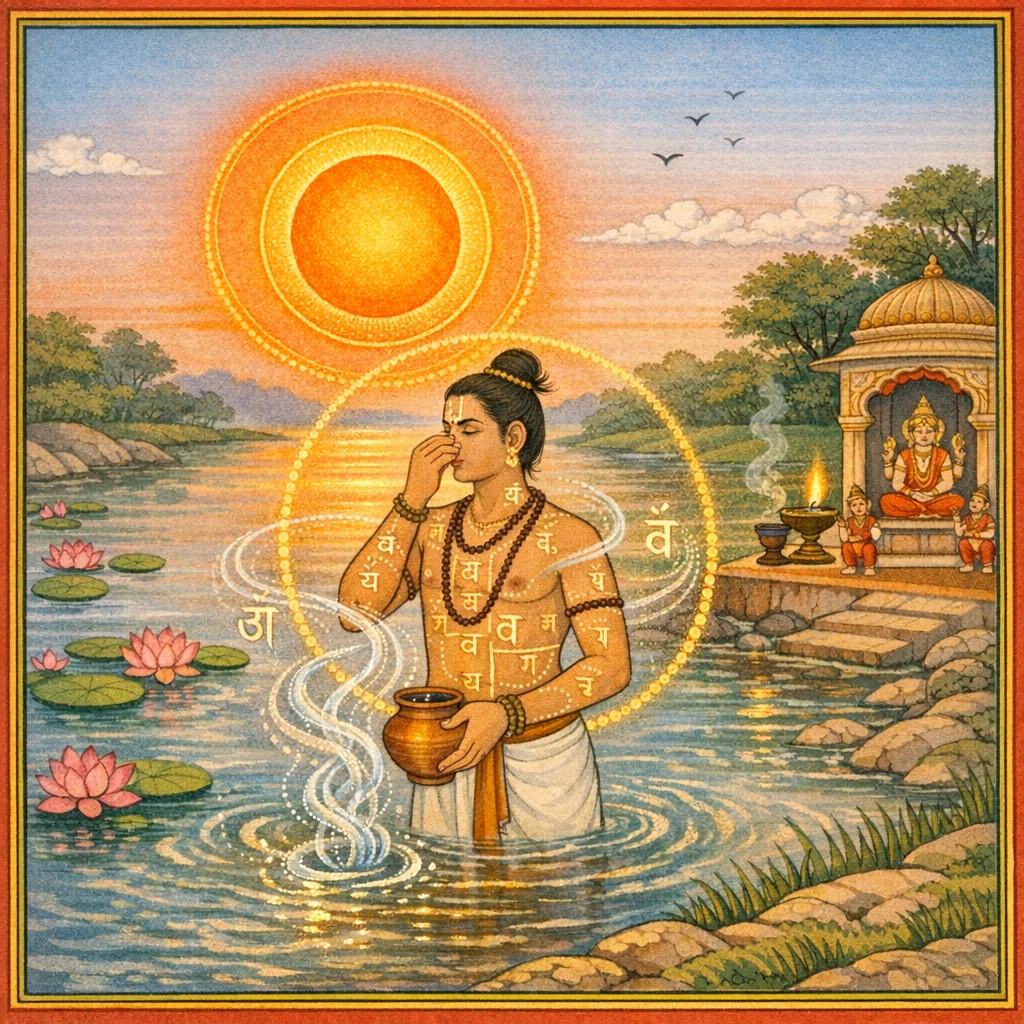
The Explanation of Sandhyā and Related Daily Observances (Saṅdhyā-ādi Nitya-karma-Vidhi)
Sanatkumāra teaches the proper daily nitya-karmas: reverence to Earth before stepping; etiquette for relieving oneself and post-śauca cleansing with earth and water; mouth-rinsing and the Vanaspati prayer in the tooth-stick rite; preparing the shrine and performing ārati with astra/mūla mantras. He explains river-bathing with mantra-consecrated clay, inner-bath visualization through the brahma-randhra, and śrauta-like composure. Mantra-snāna includes time/place saṅkalpa, prāṇāyāma, tīrtha-invocation (Gaṅgā, Yamunā, etc.), sudhā-bīja, kavaca/astra protections, and consecration cycles. When ill, Aghamarṣaṇa is prescribed as expiation; Sandhyā is performed with Keśava–Nārāyaṇa–Mādhava invocations; detailed Vaiṣṇava ācamana/nyāsa is given along with Śaiva/Śākta variants; rules for tilaka and tripuṇḍra; doorway worship with deity placements and lists of gatekeepers; extensive mātṛkā and śakti-nyāsa correspondences and bīja/śakti doctrine, concluding that worship should begin only after ṣaḍaṅga-nyāsa.
Shlokas
Verse 1
सनत्कुमार उवाच । ततः श्वासानुसारेण दत्वा पादं महीतले । समुद्र मेखले देवि पर्वतस्तनमण्डले 1. ॥ १ ॥
Sanatkumāra said: Then, keeping time with the rhythm of the breath, placing the feet upon the ground—O Goddess—one should meditate upon the Earth, girdled by the oceans and adorned with mountains like breasts.
Verse 2
विष्णुपत्नि नमस्तुभ्यं पादस्पर्शं क्षमस्व मे । इति भूमिं तु सम्प्रार्थ्य विहरेच्च यथाविधि ॥ २ ॥
“O Earth, consort of Viṣṇu, salutations to you. Forgive me for the touch of my feet.” Thus, after respectfully entreating the ground, one should then proceed to move about in the proper, prescribed manner.
Verse 3
रक्षः कोणे ततो ग्रामाद्गत्वा मन्त्रमुदीरयेत् । गच्छन्तु ऋषयो देवाः पिशाचा ये च गुह्यकाः ॥ ३ ॥
Then, going from the village to the quarter associated with rākṣasas, one should recite the mantra: “Let the sages (ṛṣis) and the gods depart; and let the piśācas and those who are called guhyakas also depart.”
Verse 4
पितृभूतगणाः सर्वे करिष्ये मलमोचनम् । इति तालत्रयं दत्वा शिरः प्रावृत्य वाससा ॥ ४ ॥
“O all hosts of the Pitṛs and Bhūtas, I shall now cast off impurity.” Saying so, he claps three times and, covering his head with a cloth, proceeds.
Verse 5
दक्षिणाभिमुखं रात्रौ दिवा स्थित्वा ह्युदङ्मुखः । मलं विसृज्य शौचं तु मृदाद्भिः समुपाचरेत् ॥ ५ ॥
At night one should face south, and by day stand facing north. After evacuating, one should duly perform purification (śauca) with earth (clay) and water.
Verse 6
एका लिङ्गे गुदे तिस्रो दश वामकरे मृदः । करयोः सप्त वै दद्यात्त्रित्रिवारं च पादयोः ॥ ६ ॥
Of cleansing earth: one application for the genital organ; three for the anus; ten for the left hand. For both hands one should apply seven, and for the feet three-and-three times.
Verse 7
एवं शौचं विधायाथ गण्डूषान्द्वादशैव तु । कृत्वा वनस्पतिं चाथ प्रार्थयेन्मनुनामुना ॥ ७ ॥
Having thus performed purification, one should then do twelve mouth-rinsings (gaṇḍūṣa). Thereafter, invoking the sacred Vanaspati, lord of vegetation, one should pray with this prescribed mantra.
Verse 8
आयुर्बलं यशो वर्चः प्रजाः पशुवसूनि च । श्रियं प्रज्ञां च मेधां च त्वं नो देहि वनस्पते ॥ ८ ॥
O Vanaspati, Lord of the forest, grant us longevity and strength, fame and radiance; offspring, cattle, and wealth; and bestow upon us prosperity (Śrī), wisdom, and keen intelligence (medhā).
Verse 9
संप्रार्थ्यैवं दन्तकाष्ठं द्वादशाङ्गुलसंमितम् । गृहीत्वा काममंत्रेण कुर्यान्मन्त्री समाहितः ॥ ९ ॥
Having thus reverently sought permission and blessing, the practitioner should take a tooth-stick measuring twelve finger-breadths; then, with a collected mind, he should perform the rite while reciting the Kāma-mantra.
Verse 10
कामदेवपदं ङेन्तं तथा सर्वजनप्रियम् । हृदन्तः कामबीजाढ्यं दन्तांश्चानेन शोधयेत् ॥ १० ॥
One should employ the syllable (pada) connected with Kāmadeva, ending in the nasal ‘ṅ’, which is dear to all people. Ending with the heart-sound (hṛd-anta) and filled with the seed of desire (kāma-bīja), by means of this one should purify the dental sounds (dantya letters) as well.
Verse 11
जिह्वोल्लेखो वाग्भवेन मूलेन क्षालयेन्मुखम् । देवागारं ततो गत्वा निर्माल्यमपसार्य च ॥ ११ ॥
After scraping and cleaning the tongue, one should rinse the mouth using the root-mantra of Vāgbhava; then, going to the deity’s shrine, one should remove the previous offerings (withered flowers and the like).
Verse 12
परिधायाम्बरं शुद्धं मङ्गलारार्तिकं चरेत् । अस्त्रेण पात्रं संप्रोक्ष्य मूलेन ज्वालयेच्च तम् ॥ १२ ॥
Having put on clean garments, one should perform the auspicious ārati. Sprinkling (purifying) the vessel with the Astra-mantra, one should then kindle (light) it with the Mūla-mantra.
Verse 13
संपूज्य पात्र्रमादायोत्थाय घन्टां च वादयेत् । सुगोघृतप्रदीपेन भ्रामितेन समन्ततः ॥ १३ ॥
Having duly worshipped, one should take up the vessel, stand up, and ring the bell; then, with a well-prepared lamp fueled by cow’s ghee, one should circle it all around (the sacred place/deity) in āratī.
Verse 14
वाद्यैर्गींतैर्मनोज्ञैश्च देवस्यारार्तिकं भवेत् । इति नीराजनं कृत्वा प्रार्थयित्वा निजेश्वरम् ॥ १४ ॥
With pleasing songs and musical instruments, one should perform the deity’s ārārtika (ārati). Having thus completed the nīrājana (waving of lights), one should then pray to one’s own Lord.
Verse 15
स्नातुं यायान्निम्नगादौ कीर्तयन्देवतागुणान् । गत्वा तीर्थं नमस्कृत्य स्नानीयं च निधाय वै ॥ १५ ॥
For bathing, one should go to a river or other low-lying watercourse while reciting the virtues of the deities. Having reached the sacred ford (tīrtha), one should offer reverence, and then duly place down the articles meant for bathing.
Verse 16
मूलाभिमन्त्रितमृदमादाय कटिदेशतः । विलिप्य पादपर्यन्तं क्षालयेत्तीर्थवारिणा ॥ १६ ॥
Taking earth (clay) that has been consecrated by the root-mantra, one should smear it on the body from the waist down to the feet, and then wash it off with water from a sacred ford (tīrtha).
Verse 17
ततश्च पञ्चभिः पादौ प्रक्षाल्यान्तर्जले पुनः । प्रविश्य नाभिमात्रे तु मृदं वामकरस्य च ॥ १७ ॥
Then, washing the feet with five handfuls (of water), one should again enter the water; standing with the water up to the navel, one should take a lump of earth (clay) with the left hand as well.
Verse 18
मणिबन्धे हस्ततले तदग्रे च तथा पुनः । कृत्वाङ्गुल्या गाङ्गमृदमादायास्त्रेण तत्पुनः ॥ १८ ॥
At the wrist, on the palm, and again at its forepart, one should use the finger to take sacred Ganges-clay (Ganga-mṛd) and apply it once more, accompanied by the Astra-mantra.
Verse 19
निजोपरि च मन्त्रज्ञो भ्रामयित्वा त्यजेत्सुधी । तलस्थां च षडङ्गेषु तन्मन्त्रैः प्रविलेपयेत् ॥ १९ ॥
The wise knower of mantras should rotate it over himself and then set it aside. Then, with those very mantras, he should anoint the six limbs with the substance placed in the palm of the hand.
Verse 20
निमज्य क्षालयेत्सम्यग् मलस्नानमितीरितम् । विभाव्येष्टमयं सर्वमान्तरं स्नानमाचरेत् ॥ २० ॥
After immersing, one should wash oneself thoroughly—this is called “bathing that removes impurity.” Then, contemplating everything as filled with the presence of the Beloved, the chosen Deity, one should perform the inner bath, the purification of the mind.
Verse 21
अनन्तादित्यसङ्काशं निजभूषायुधैर्युतम् । मन्त्रमूर्तिं प्रभुं स्मृत्वा तत्पादोदकसंभवाम् ॥ २१ ॥
Remembering the Lord—whose radiance is like the boundless sun, adorned with His own ornaments and weapons, and who is the very embodiment of mantra—one should then take up the sacred water/substance that has arisen from the water that washed His feet.
Verse 22
धारां च ब्रह्मरन्ध्रेण प्रविशन्तीं निजां तनुम् । तया संक्षालयेत्सर्वमन्तर्द्देहगतं मलम् ॥ २२ ॥
And one should contemplate a stream entering one’s own body through the brahma-randhra, the cranial aperture; by that inner stream one should thoroughly wash away all impurity lodged within the body.
Verse 23
तत्क्षणाद्विरजा मन्त्री जायते स्फटिकोपमः । ततः श्रौतोक्तविधिना स्नात्वा मन्त्री समाहितः ॥ २३ ॥
In that very moment the mantra-practitioner becomes free from impurity, crystal-like in clarity. Then, having bathed according to the procedure taught in the Śrauta tradition, the practitioner remains composed, recollected, and steady.
Verse 24
मन्त्रस्नानं ततः कुर्यात्तद्विधानमथोच्यते । देशकालौ च सङ्कीर्त्य प्राणायामषडङ्गकैः ॥ २४ ॥
Thereafter one should perform the “mantra-bath” (mantra-snāna). Now its rite is taught: having duly proclaimed the place and the time, one should practice prāṇāyāma together with the six auxiliary limbs (ṣaḍ-aṅga).
Verse 25
कृत्वार्कमन्दलात्तीर्थान्याह्वयेन्मुष्टिमुद्र या । ब्रह्माण्डोदरतीर्थानि करैः स्पृष्टानि ते रवेः ॥ २५ ॥
Having formed the Sun-disc (arka-maṇḍala), one should invoke the tīrthas by means of the fist-seal (muṣṭi-mudrā). O Ravi, the tīrthas abiding within the womb of the cosmic egg (brahmāṇḍa) are touched by your rays, as by hands.
Verse 26
तेन सत्येन मे देव देहि तीर्थं दिवाकर ॥ २६ ॥
By this truth of mine, O Deva—O Divākara, the Sun—grant me a tīrtha.
Verse 27
गङ्गे च यमुने चैव गोदावरि सरस्वति । नर्मदे सिन्धुकावेरि जलेऽस्मिन्सन्निधिं कुरु ॥ २७ ॥
O Gaṅgā, O Yamunā, and also O Godāvarī, O Sarasvatī; O Narmadā, O Sindhu, O Kāverī—be present in this water.
Verse 28
इत्यावाह्य जले तानि सुधाबीजेन योजयेत् । गोमुद्र यामृतीकृत्य कवचेनावगुण्ठ्य च ॥ २८ ॥
Thus, having invoked them into the water, one should unite and empower them with the “Sudhā-bīja” mantra. Then, by the Go-mudrā, one should make it nectar-like, and also cover and protect it with the Kavaca.
Verse 29
संरक्ष्यास्त्रेण तत्पश्चाच्चक्रमुद्रां प्रदर्शयेत् । वह्न्यर्केन्दुमण्डलानि तत्र सन्चितयेद्बुधः ॥ २९ ॥
After safeguarding the rite/space with the protective astra-mantra, one should then display the Cakra-mudrā; and the wise practitioner should arrange there the circular emblems of Fire, the Sun, and the Moon.
Verse 30
मन्त्रयेदर्कमन्त्रेण सुधाबीजेन तज्जलम् । मूलेन चैकादशधा तत्र सम्मन्त्र्य भावयेत् ॥ ३० ॥
One should consecrate that water by reciting the Arka-mantra and the Sudhā seed-syllable; and then, with the root-mantra, having duly empowered it eleven times, one should contemplate and infuse it with the intended sacred potency.
Verse 31
पूजायन्त्रं च तन्मध्ये स्वान्तादावाह्य देवताम् । स्नापयित्वार्चयेत्तां च मानसैरुपचारकैः ॥ ३१ ॥
One should prepare the diagram of worship (pūjā-yantra) and, drawing the deity forth from one’s own inner heart, invoke the deity into its center. Having then bathed the deity, one should worship that deity with the offerings performed mentally (mānasa-upacāras).
Verse 32
सिंहासनस्थां तां नत्वा तज्जलं प्रणमेत्सुधीः । आधारः सर्वभूतानां विष्णोरतुलतेजसः ॥ ३२ ॥
Having bowed to Her who is seated upon a throne, the wise person should also bow to that water; for it is the support of all beings, belonging to Vishnu of incomparable splendor.
Verse 33
तद्रू पाश्च ततो जाता आपस्ताः प्रणमाम्यहम् । इति नत्वा समारुन्ध्य सप्तच्छिद्राणि साधकः ॥ ३३ ॥
Then (he contemplates): “From that (principle) the waters, of that very form, came into being; I bow to those waters.” Having thus bowed, the practitioner closes up the seven apertures (of the head) and restrains them.
Verse 34
निमज्य सलिले तस्मिन्मूलं देवाकृतिं स्मरेत् । निमज्ज्योन्मज्ज्य त्रिश्चैवं सिंचेत्कं कुंभमुद्रया ॥ ३४ ॥
Having immersed it in that water, one should remember the Root-Mantra together with the divine form. Then, dipping and lifting it out in this way three times, one should sprinkle the water with the kumbha-mudrā.
Verse 35
त्रिर्मूलेन चतुर्मन्त्रैरभिर्षिञ्चेन्निजां तनुम् । चत्वारो मनवस्तेऽत्र कथ्यन्ते तान्त्रिका मुने ॥ ३५ ॥
With the Mūla(-mantra) recited threefold and with four additional mantras, one should ritually sprinkle (consecrate) one’s own body. Here too, O sage, four “Manus” are taught according to the Tantric tradition.
Verse 36
सिसृक्षोर्निखिलं विश्वं मुहुः शुक्रं प्रजापतेः । मातरः सर्वभूतानामापो देव्यः पुनन्तु माम् ॥ ३६ ॥
May the divine Waters—mothers of all beings—purify me: those waters that arise again and again from the seed of Prajāpati whenever he wills to create this entire universe.
Verse 37
अलक्ष्मीर्मलरूपा या सर्वभूतेषु संस्थिता । क्षालयन्ति च तां स्पर्शादापो देव्यः पुनन्तु माम् ॥ ३७ ॥
May the divine Waters purify me: for Alakṣmī—misfortune in the form of impurity—dwells in all beings, and by their very touch the Waters wash her away.
Verse 38
यन्मे केशेषु दौर्भाग्यं सीमन्ते यच्च मूर्द्धनि । ललाटे कर्णयोरक्ष्णोरापस्तद्धन्तु वो नमः ॥ ३८ ॥
Whatever misfortune may be upon my hair, upon the parting of my hair, and upon my head—upon my forehead, ears, and eyes—may the sacred waters remove it. Salutations to you, O Waters.
Verse 39
आयुरारोग्यमैश्वर्यमरिपक्षक्षयं शुभम् । सन्तोषः क्षान्तिरास्तिक्यं विद्या भवतु वो नमः ॥ ३९ ॥
May you be blessed with long life, good health, prosperity and lordly fortune, the destruction of hostile forces, and auspiciousness; may contentment, forbearance, faith in the Vedas, and true knowledge arise in you—salutations to you.
Verse 40
विप्रपादोदकं पीत्वा शालग्रामशिलाजलम् । पिबेद्विरुद्धं नो कुर्यादेषां तु नियतो विधिः ॥ ४० ॥
Having first drunk the water that has washed a brāhmaṇa’s feet, one should then drink the water associated with the Śālagrāma stone. One should not treat these as mutually incompatible, for in their case a fixed and specific rule of procedure is prescribed.
Verse 41
पृथिव्यां यानि तीर्थानि दक्षाङ्घ्रौ तानि भूसुरे । स्वेष्टदेवं समुद्वास्य मन्त्री मार्तण्डमण्डले ॥ ४१ ॥
O brāhmaṇa (bhūsura), all the sacred tīrthas upon the earth are present in the right foot. Having duly invoked one’s chosen deity (iṣṭa-devatā), the knower of mantra should contemplate and worship within the orb of Mārtaṇḍa, the Sun.
Verse 42
ततस्तीरं समागत्य वस्त्रं संक्षाल्य यत्नतः । वाससी परिधायाथ कुर्यात्सन्ध्यादिकं सुधीः ॥ ४२ ॥
Then, coming to the riverbank, one should carefully wash one’s cloth; after putting on clean garments, the wise person should perform the Sandhyā rites and the other daily observances.
Verse 43
रोगाद्यशक्तो मनुजः कुर्यात्तत्राघमर्षणम् । अथवा भस्मना स्नातो रजोभिश्चैव वाऽक्षमः ॥ ४३ ॥
If a person is unable due to illness and the like, he should there perform the expiation called Āghamarṣaṇa. Or else, being unable, he should bathe with ashes and also with dust.
Verse 44
अथ सन्ध्यादिकं कुर्यात् स्थित्वा चैवासने शुभे । केशवेन तथा नारायणेन माधवेन च ॥ ४४ ॥
Then, seated steadily upon an auspicious seat, one should perform the Sandhyā and the related daily rites, invoking the Lord as Keśava, and also as Nārāyaṇa and Mādhava.
Verse 45
संप्राश्य तोयं गोविन्दविष्णुभ्यां क्षालेत्करौ । मधुसूदनत्रिविक्रमाभ्यामोष्ठौ च मार्जयेत् ॥ ४५ ॥
After sipping water (ācaman), one should wash the hands while uttering the names Govinda and Viṣṇu; and one should wipe the lips while uttering the names Madhusūdana and Trivikrama.
Verse 46
वामनश्रीधराभ्यां च मुखं हस्तौ स्पृशेत्ततः । हृषीकेशपद्मनाभाभ्यां स्पृशेच्चरणौ ततः ॥ ४६ ॥
Then, invoking the Lord as Vāmana and Śrīdhara, one should touch the face and the hands. Thereafter, invoking Him as Hṛṣīkeśa and Padmanābha, one should touch the feet.
Verse 47
दामोदरेण मूर्द्धानं मुखं सङ्कर्षणेन च । वासुदेवेन प्रद्युम्नेन स्पृशेन्नासिके ततः ॥ ४७ ॥
With the mantra of Dāmodara one should touch the crown of the head; with Saṅkarṣaṇa, the face; then with Vāsudeva and Pradyumna one should touch the nostrils.
Verse 48
अनिरुद्धपुरुषोत्तमाभ्यां नेत्रे स्मृशेत्ततः । अधोक्षजनृसिंहाभ्यां श्रवणे संस्पृशेत्तथा ॥ ४८ ॥
Then one should touch (consecrate) the eyes while remembering Aniruddha and Puruṣottama; likewise, one should touch (consecrate) the ears while remembering Adhokṣaja and Nṛsiṃha.
Verse 49
नाभिं स्पृशेदच्युतेन जनार्दनेन वक्षसि । हरिणा विष्णुनांसौ च वैष्णावाचमनं त्विदम् ॥ ४९ ॥
Touch the navel while uttering “Acyuta”; touch the chest while uttering “Janārdana”; touch the shoulders with “Hari” and “Viṣṇu”. This is the Vaiṣṇava manner of ācamana, the rite of sipping for purification.
Verse 50
प्रणवाद्यैर्ङेतमोन्तैः केशवादिकनामभिः । मुखे नसोः प्रदेशिन्याऽनामया नेत्रकर्णयोः 1. ॥ ५० ॥
With mantras beginning with Oṁ and ending in “netra”, and with the divine Names starting from Keśava, one should perform nyāsa upon the mouth and the nose; then, using the index finger (pradeśinī) with “Anāmaya”, place it upon the eyes and the ears.
Verse 51
कनिष्ठया नाभिदेशं सर्वत्राङ्गुष्ठयोजनम् । आत्मविद्याशिवैस्तत्त्वैस्वाहान्तैः शैवमीरितम् ॥ ५१ ॥
With the little finger (kaniṣṭhā) one should touch the region of the navel and mark it everywhere by the measure of a thumb’s breadth; in nyāsa one places the Śaiva principles, beginning with “Ātma-vidyā” and ending with the mantra-formula “svāhā”. This is the Śaiva procedure as taught.
Verse 52
दीर्घत्रयेन्दुयुग्व्योमपूर्वकैश्च पिबेज्जलम् । आत्मविद्याशिवैरेव शैवं स्वाहावसानिकैः ॥ ५२ ॥
After first uttering the syllables “dīrgha, traya, indu, yuga, vyoma”, one should drink water; likewise, with the Śaiva mantras consisting of “ātma, vidyā, śiva” and ending with “svāhā”, one performs the Śaiva rite.
Verse 53
वालज्जाश्रीमुखैः प्रोक्तं शाक्तं स्वाहावसानिकैः । वाग्लज्जाश्रीमुखैः प्रोक्तं द्विजाचमनमर्थदम् ॥ ५३ ॥
The Śākta formula is taught as beginning with “vā, la, ljjā, śrī” and ending with “svāhā”. The efficacious dvija’s ācamana (dvijācamanam) is taught as beginning with “vāk, ljjā, śrī”.
Verse 54
तिलकं च ततः कुर्याद्भाले सुष्ठु गदाकृति । नन्दकं हृदये शखचक्रे चैव भुजद्वये ॥ ५४ ॥
Then one should apply the tilaka upon the forehead, well formed in the shape of a mace; one should place the mark of Nandaka in the region of the heart, and the marks of the conch and the discus upon the two arms.
Verse 55
शार्ङ्गबाणं मस्तके च विन्यसेत्क्रमशः सुधीः । कर्णमूले पार्श्वयोश्च पृष्ठे नाभौ ककुद्यपि ॥ ५५ ॥
The wise practitioner should then, in due sequence, place the mark of Śārṅga and the arrow upon the head; and likewise at the roots of the ears, on both sides, on the back, at the navel, and also upon the hump (upper back).
Verse 56
एवं तु वैष्णवः कुर्यान्मृद्भिस्तीर्थोद्भवादिभिः । अग्निहोत्रोद्भवं भस्म गृहीत्वा त्र्यम्बकेण तु ॥ ५६ ॥
Thus should a Vaiṣṇava act, using earth (clay) and the like that arise from sacred pilgrimage-places; and having taken ash produced from the Agnihotra, he should apply it while reciting the Tryambaka-mantra.
Verse 57
किवाग्निरिति मंत्रैणाभिमन्त्र्य पञ्चमन्त्रकैः । क्रमात्तत्पुरुषाघोरसद्योजातादिनामभिः ॥ ५७ ॥
Having consecrated with the mantra beginning “kivāgnir…”, one should then, in due order, perform the sanctification with the five mantras—named Tatpuruṣa, Aghora, Sadyojāta, and the others.
Verse 58
पञ्च कुर्यात्त्रिपुन्ड्राणि भालांसोदरहृत्सु च । शैवः शाक्तत्त्रिकोणाभं नारीवद्वा समाचरेत् ॥ ५८ ॥
One should make five tripuṇḍra marks—on the forehead, the shoulders, the belly, and the heart. A Śaiva or a Śākta should apply a triangular-shaped mark, or else follow the practice prescribed for women.
Verse 59
कृत्वा तु वैदिकीं सन्ध्यां तान्त्रिकीं च समाचरेत् । आचम्य विधिवन्मन्त्री तीर्थान्यावाह्य पूर्ववत् ॥ ५९ ॥
Having performed the Vedic Sandhyā, one should then duly observe the Tantric rite as well. After ācamana—sipping water for purification—performed according to rule, the knower of mantras should invoke the sacred tīrthas as before.
Verse 60
ततस्त्रिवारं दर्भेण भूमौ तोयं विनिःक्षिपेत् । सप्तधा तज्जलेनाथ मूर्द्धानमभिषेचयेत् ॥ ६० ॥
Then, using a blade of darbha grass, one should pour water onto the ground three times; thereafter, with that very water, one should sprinkle (anoint) the head seven times.
Verse 61
ततश्च प्राणानायम्य कृत्वा न्यासं षडङ्गकम् । आदाय वामहस्तेऽम्बु दक्षेणाच्छाद्य पाणिना ॥ ६१ ॥
Then, having regulated the breath by prāṇāyāma and performed the sixfold-limb nyāsa, one should take water into the left hand and cover it with the right palm.
Verse 62
वियद्वाय्वग्नितोयक्ष्माबीजैः सन्मन्त्र्य मन्त्रवित् । मूलेन तस्मात् श्चोतद्भिर्बिन्दुभिस्तत्त्वमुद्रया ॥ ६२ ॥
A knower of mantras should duly consecrate with the seed-mantras of ether, air, fire, water, and earth; then, with the root (mūla) mantra, using the dripping drops (bindus) that issue forth, he should seal it by the ‘tattva-mudrā’.
Verse 63
स्वशिरः सप्तधा प्रोक्ष्यावशिष्टं तत्पुनर्जलम् । कृत्वा तदक्षरं मन्त्री नासिकान्तिकमानयेत् ॥ ६३ ॥
Sprinkling his own head seven times, the mantra-practitioner should then take up the remaining water again; having formed and empowered that syllable (akṣara), he should bring it near the nostril.
Verse 64
जलं तेजोमयं तच्चाकृष्यान्तश्चेडया पुनः । प्रक्षाल्यान्तर्गतं तेन कलमषं तज्जलं पुनः ॥ ६४ ॥
Then, drawing in that water—radiant like fire—again through iḍā (the left channel), one should wash away the impurity that has entered within; and that very water should be expelled again.
Verse 65
कृष्णवर्णं पिङ्गलया रचयेत्स्वाग्रतस्तथा । क्षिपेदस्त्रेण तत्पश्चात्कल्पिते कुलिशोपले ॥ ६५ ॥
Using piṅgalā (yellow substance), one should draw the black-colored mark before oneself. Thereafter, with the ‘Astra’ (weapon-mantra), one should cast it upon the prepared thunderbolt-like stone (kuliśa-upala).
Verse 66
एतद्धि सर्वपापघ्नं प्रोक्तं चैवाघमर्षणम् । ततश्च हस्तौ प्रक्षाल्य प्राग्वदाचम्य मन्त्रवित् ॥ ६६ ॥
This indeed is declared to be the ‘Aghamarṣaṇa’, the destroyer of all sins. Thereafter, the knower of mantra should wash his hands and, as before, perform ācamana (ritual sipping of water).
Verse 67
समुत्थाय च मन्त्रज्ञस्ताम्रपात्रे सुमादिकम् । प्रक्षिप्यार्घं प्रदद्याद्वै मूलान्तैर्मन्त्रमुच्चरन् ॥ ६७ ॥
Then, rising, the knower of mantras should place auspicious items (such as flowers and the like) into a copper vessel and offer arghya, reciting the mantra(s) ending with the mūla (root) syllables.
Verse 68
रविमंडलसंस्थाय देवायार्घ्यं प्रकल्पयेत् । दत्वार्घं त्रिरनेनाथ देवं रविगतं स्मरेत् ॥ ६८ ॥
One should prepare and offer arghya (a ritual water-offering) to the deity who abides in the orb of the Sun. Having offered the arghya three times with this procedure, one should meditate upon the Lord as present within the Sun.
Verse 69
स्वल्पोक्तां च गायत्रीं जपेदष्टोत्तरं शतम् । अष्टांविंशतिवारं वा गुह्येतिमनुनार्पयेत् ॥ ६९ ॥
One should also repeat the concise Gāyatrī one hundred and eight times; or else, twenty-eight times, one should make the offering accompanied by the mantra beginning with “guhyeti”.
Verse 70
उद्यदादित्यसंकाशां पुस्तकाक्षकरांबुजाम् । कृष्णाजिनाम्बरां ब्राह्मीं ध्यायेत्ताराङिकतेऽम्बरे ॥ ७० ॥
One should meditate upon Brāhmī, the goddess of sacred knowledge, radiant like the rising sun, whose lotus-hands hold a book and a rosary; clad in a black antelope-skin garment, and seated in the star-marked sky.
Verse 71
मध्याह्ने वरदां देवी पार्वतीं संस्मरेत्पराम् । शुक्लाम्बरां वृषारूढां त्रिनेत्रां रविबिम्बगाम् ॥ ७१ ॥
At midday one should meditate upon the supreme Goddess Pārvatī, the bestower of boons—clad in white, mounted upon a bull, three-eyed, and radiant like the orb of the Sun.
Verse 72
वरं पाशं च शूलं च दधानां नृकरोटिकाम् । सायाह्ने रत्नभूषाढ्यां पीतकौशेयवाससाम् ॥ ७२ ॥
Holding the boon-granting gesture, a noose and a trident, and bearing a human skull-bowl, she is seen at evening—adorned with jeweled ornaments and clothed in yellow silk.
Verse 73
श्यामरङ्गां चतुर्हस्तां शङ्खचक्रलसत्कराम् । गदापद्मधारां देवीं सूर्यासनकृताश्रयाम् ॥ ७३ ॥
One should meditate upon the Goddess, dark-hued and four-armed, whose hands shine with the conch and discus, who bears the mace and lotus, and who is seated upon a solar throne.
Verse 74
ततो देवानृषींश्चैव पितॄश्चापि विधानवित् । तर्पयित्वा स्वेष्टदेवं तर्पयेत्कल्पमार्गतः ॥ ७४ ॥
Thereafter, one who knows the proper ritual procedure should offer tarpaṇa (libations) to the gods, the ṛṣis, and the ancestors; and then, in accordance with the ritual path laid down in the Kalpa tradition, he should honor and satisfy his own chosen deity (iṣṭa-devatā).
Verse 75
गुरुपङिक्तं च सन्तर्प्य साङ्गं सावरणं तथा । सायुधं वैनतेयं सन्तर्पयामीति तर्पयेत् ॥ ७५ ॥
Having also satisfied, by the rite of tarpaṇa, the line of teachers (guru-paṅkti)—together with their associated parts, their retinue, and even their weapons—one should offer the libation, saying: “I satisfy Vainateya (Garuḍa).”
Verse 76
नारदं पर्वतं जिष्णुं निशठोद्धवदारुकान् । विष्वक्सेनं च शैलेयं वैष्णवः परितर्पयेत् ॥ ७६ ॥
A devotee of Viṣṇu (a Vaiṣṇava) should offer tarpaṇa to Nārada, Parvata, Jiṣṇu, Niśaṭha, Uddhava, Dāruka, as well as to Viṣvaksena and Śaileya.
Verse 77
एवं सन्तर्प्य विप्रेन्द्र दत्त्वार्घ्यं च विवस्वते । पूजागारं समागत्य प्रक्षाल्यान्घ्री उपस्पृशेत् ॥ ७७ ॥
Thus, O best of brāhmaṇas, having duly performed the rite and offered arghya to Vivasvān (the Sun), one should come to the place of worship; washing the feet, one should perform ācamana (ritual sipping for purification).
Verse 78
अग्निहोत्रस्थितानग्नीन् हुत्वोपस्थाय यत्नतः । पूजास्थलं समागत्य द्वारपूजां समाचरेत् ॥ ७८ ॥
Having offered oblations (āhuti) into the fires maintained for the Agnihotra, and having attended upon them with careful reverence, one should then come to the place of worship and duly perform the worship of the doorway (dvāra-pūjā).
Verse 79
गणेशं चोर्द्धशाखायां महालक्ष्मीं च दक्षिणे । सरस्वतीं वामभागे दक्षे विघ्नेश्वरं पुनः ॥ ७९ ॥
Place Gaṇeśa upon the upper branch; Mahālakṣmī on the southern side; Sarasvatī on the left; and again place Vighneśvara on the right.
Verse 80
क्षेत्रपालं तथा वामे दक्षे गङ्गां प्रपूजयेत् । वामे च यमुनां दक्षे धातारं वामतस्तथा ॥ ८० ॥
Worship Kṣetrapāla on the left and Gaṅgā on the right; likewise, Yamunā on the left and Dhātā on the right, arranging them according to the prescribed sides.
Verse 81
विधातारं शङ्खपद्मनिधींश्च वामदक्षयोः । द्वारपालांस्ततोऽभ्यर्चेत्तत्तत्कल्पोदितान्सुधीः ॥ ८१ ॥
The wise practitioner should worship Vidhātā, the divine ordainer, and the treasure-deities Śaṅkha and Padma on the left and right; thereafter he should worship the gatekeepers as taught in the respective Kalpa ritual manuals.
Verse 82
नन्दः सुनन्दश्चंडण्श्च प्रचण्डः प्रचलोबलः । भद्र ः सुभद्र श्चेत्याद्या वैष्णवा द्वारपालकाः ॥ ८२ ॥
Nanda, Sunanda, Caṇḍaṇa, Pracaṇḍa, Pracalobala, Bhadra, Subhadra, and others—these are the Vaiṣṇava gatekeepers.
Verse 83
नन्दी भृङ्गी रिटीस्कन्दो गणेशोमामहेश्वराः । वृषभश्च महाकालः शैवा वै द्वारपालकाः ॥ ८३ ॥
Nandī, Bhṛṅgī, Riṭī, Skanda, Gaṇeśa, Umā, and Maheśvara, as well as Vṛṣabha and Mahākāla—these indeed are the Śaiva gatekeepers.
Verse 84
ब्राह्मयाद्य्रा मातरोऽष्टौ तु शक्तयो द्वाःस्थिताः स्वयम् । सेन्दुः स्वनामाघर्णाद्या ङेनमोन्ता इमे स्मृताः ॥ ८४ ॥
Beginning with Brāhmī, there are eight Mother-powers (Mātṛ-śaktis), standing of themselves at the two doorways. They are remembered as: (Sa-)Indu, Svanāmā, Agharṇā, and the rest—ending with Ṅenamontā.
Verse 85
ततः स्थित्वासने धीमानाचम्य प्रयतः शुचिः । दिव्यान्तरिक्षभौमांश्च विघ्नानुत्सार्य यत्नतः ॥ ८५ ॥
Then, seated firmly on his seat, the wise practitioner—having performed ācamana and become disciplined and pure—should diligently drive away all obstacles, whether celestial, atmospheric, or earthly.
Verse 86
केशवाद्यां मातृकां तु न्यसेद्वैष्णवसत्तमः । केशवः कीर्तिसंयुक्तः कांत्या नारायणस्तथा ॥ ८६ ॥
The foremost Vaiṣṇava should perform the nyāsa of the Mātṛkā beginning with “Keśava.” “Keśava” is associated with fame (kīrti), and likewise “Nārāyaṇa” is associated with radiance (kānti).
Verse 87
माधवस्तुष्टिसहितो गोविन्दः पुष्टिसंयुतः । विष्णुस्तु धृतिसंयुक्तः शान्तियुङ्मधुसूदनः ॥ ८७ ॥
Mādhava is accompanied by contentment; Govinda is endowed with nourishment and prosperity. Viṣṇu is joined with steadfastness, and Madhusūdana is united with peace.
Verse 88
त्रिविक्रमः क्रियायुक्तो वामनो दयितायुतः । श्रीधरो मेधया युक्तो हृषीकेशश्च हर्षया ॥ ८८ ॥
Trivikrama is endowed with sacred action; Vāmana is accompanied by the beloved (consort). Śrīdhara is joined with discerning intelligence, and Hṛṣīkeśa is joined with joy.
Verse 89
पद्मनाभयुता श्रद्धा लज्जा दामोदरान्विता । वासुदेवश्च लक्ष्मीयुक् सङ्कर्षण सरस्वती ॥ ८९ ॥
Śraddhā (faith) is united with Padmanābha; Lajjā (modesty) is united with Dāmodara. Vāsudeva is accompanied by Lakṣmī, and Saṅkarṣaṇa is accompanied by Sarasvatī.
Verse 90
प्रद्युम्नः प्रीतिसंयुक्तोऽनिरुद्धो रतिसंयुतः । चक्री जयायुतः पश्चाद्गदी दुर्गासमन्वितः ॥ ९० ॥
Pradyumna is joined with Prīti (affection), and Aniruddha is joined with Rati (delight). Thereafter the Discus-bearer (Viṣṇu) is accompanied by Jayā (victory), and then the Mace-bearer is accompanied by Durgā (protective power).
Verse 91
शार्ङ्गी तु प्रभया युक्तः खड्गी युक्तस्तु सत्यया । शङ्खी चण्डासमायुक्तो हली वाणीसमायुतः ॥ ९१ ॥
He who bears the Śārṅga bow is joined with Radiance; he who bears the sword is joined with Truth. He who bears the conch is joined with Fierce Power; and he who bears the plough is joined with Sacred Speech.
Verse 92
मुसली च विलासिन्या शूली विजययान्वितः । पाशी विरजया युक्तो कुशी विश्वासमन्वितः ॥ ९२ ॥
The wielder of the musala mace is accompanied by Vilāsinī; the trident-bearer is endowed with Vijayā. The noose-bearer is joined with Virajā; and the wielder of the kuśa-grass is possessed of Viśvāsa (trust/faith).
Verse 93
मुकुन्दो विनतायुक्तो नन्दजश्च सुनन्दया । निन्दी स्मृत्या समायुक्तो नरो वृद्ध्या समन्वितः ॥ ९३ ॥
Mukunda is united with Vinatā; and Nandaja is united with Sunandā. Nindī is joined with Smṛti (memory), and Nara is endowed with Vṛddhi (increase, prosperity).
Verse 94
समृद्धियुङ्नरकजिच्छुद्धियुक्च हरिः स्मृतः । कृष्णो बुद्ध्या युतः सत्यो भुक्त्या मुक्त्याथ सात्वतः ॥ ९४ ॥
He is remembered as Hari—endowed with prosperity, the conqueror of Naraka, and possessed of purity. He is called Kṛṣṇa when joined with discerning intelligence; Satya when associated with righteous enjoyment; and Sātvata when linked with liberation.
Verse 95
सौरिक्षमे सूररमे उमायुक्तो जनार्दनः । भूधरः क्लेदिनीयुक्तो विश्वमूर्तिश्च क्लिन्नया ॥ ९५ ॥
With the power called Saurikṣamā he is “Sūrarama”; united with Umā he is Janārdana. As “Bhūdhara” he is joined with the potency called Kledinī, and with the potency called Klinnā he becomes “Viśvamūrti”, the One whose form is the entire universe.
Verse 96
वैकुण्ठो वसुधायुक्तो वसुदः पुरुषोत्तमः । बली तु परया युक्तो बलानुजपरायणे ॥ ९६ ॥
He is Vaikuṇṭha; united with Vasudhā, the Earth, he is Vasuda—the giver of riches—and Puruṣottama, the Supreme Person. He is Bali; joined with the Supreme Parā, he is devoted to the younger brother of Bala (that is, Viṣṇu).
Verse 97
बालसूक्ष्मे बृषघ्नस्तु सन्ध्यायुक्प्रज्ञया वृषः । हंसःप्रभासमायुक्तो वराहो निशया युतः ॥ ९७ ॥
In the condition of childhood and subtlety, he is Bṛṣaghna; when joined with twilight (sandhyā) and awakened discernment, he is Vṛṣa. The Haṃsa is associated with radiance (prabhāsā), while the Varāha is joined with the night (niśā).
Verse 98
विमलो धारया युक्तो नृसिंहो विद्युता युतः । केशवादिमातृकाया मुनिर्नारायणो मतः ॥ ९८ ॥
Vimala is united with the sustaining stream (dhārā); Nṛsiṃha is joined with lightning (vidyutā). In the Mātr̥kā that begins with Keśava (Keśava-ādi Mātr̥kā), the sage is understood to be Nārāyaṇa.
Verse 99
अनृताद्या च गायत्री छन्दो विष्णुश्च देवता । चक्राद्यायुधसंयुक्तं कुम्भादर्शधरं हरिम् ॥ ९९ ॥
For the mantra-portion beginning with “anṛtā…,” the meter is Gāyatrī and the presiding deity is Viṣṇu. One should meditate on Hari as bearing the discus and other weapons, and as holding a water-pot and a mirror.
Verse 100
लक्ष्मीयुतं विद्युदाभं बहुभूषायुतं भजेत् । एवं ध्यात्वा न्यसेच्छक्तिं श्रीकामपुटिताक्षरम् 1. ॥ १०० ॥
One should worship (meditate upon) the deity as accompanied by Lakṣmī, radiant like lightning, and adorned with many ornaments. Having thus contemplated, one should perform the nyāsa of Śakti with the syllable/letters enclosed (sealed) by the mantras of Śrī and Kāma.
Verse 101
वदेत्तद्विष्णुशक्तिभ्यां हृदयं प्रणवादिकम् । त्वगसृङ्मांसमेदोऽस्थिमज्जाशुक्राण्यसून्वदेत् ॥ १०१ ॥
He should utter the Heart-mantra, beginning with the Praṇava (Oṃ), assigning it to Viṣṇu together with His Śaktis. He should also recite the corresponding formulae for the skin, blood, flesh, fat, bone, marrow, semen, and the vital breaths.
Verse 102
प्राणं क्रोधं तथा मभ्यामन्तान्यादिदशस्वपि । एक मौलौ मुखे चैक द्विक नेत्रे द्विकं श्रुतौ ॥ १०२ ॥
Prāṇa and krodha, and the other inner factors beginning with them—ten in all—have their respective seats: one in the crown of the head, one in the mouth, two in the eyes, and two in the ears.
Verse 103
नसोर्द्वयं कपोले च द्वयं द्वे द्विरदच्छदे । एकं तु रसनामूले ग्रीवायामेकमेव च ॥ १०३ ॥
There are two points at the nostrils, and two on the cheeks; two and two on the ‘elephant’s covering’ (the temples); one at the root of the tongue, and one indeed in the neck.
Verse 104
कवर्गं दक्षिणे बाहौ चवर्गं वामबाहुके । टतवर्गौ पादयोस्तु पफौ कुक्षिद्वये न्यसेत् ॥ १०४ ॥
One should perform nyāsa by placing the ka-group on the right arm, the ca-group on the left arm; the ṭa- and ta-groups upon the feet; and the pa- and pha-sounds upon both flanks of the waist.
Verse 105
पृष्ठवंशे वमित्युक्तं नाभौ भं हृदये तु मम् । यादिसप्तापि धातुस्था हं प्राणे लं तथात्मनि ॥ १०५ ॥
“Vaṃ” is said to be placed in the spinal column; “bhaṃ” in the navel; and “maṃ” in the heart. Likewise, the seven letters beginning with “ya” abide in the bodily constituents (dhātus); “haṃ” is in the vital breath (prāṇa), and “laṃ” is in the Self (ātman).
Verse 106
क्षं क्रोधे क्रमतो न्यस्य विष्णुपूजाक्षमो भवेत् । पूर्णोदर्या तु श्रीकण्ठो ह्यनन्तो विजरान्वितः ॥ १०६ ॥
By placing, step by step, the syllable “kṣaṃ” upon the seat of anger, one becomes fit for the worship of Viṣṇu. Thereby Śrīkaṇṭha becomes “Pūrṇodaryā”; indeed, he is Ananta, endowed with freedom from old age (vijarā).
Verse 107
सूक्ष्मेशः शाल्मलीयुक्तो लोलाक्षीयुक्त्रिमूर्तिकः । महेश्वरो वर्तुलाक्ष्याधीशो वै दीर्घघोणया ॥ १०७ ॥
Sūkṣmeśa is associated with the śālmalī (silk-cotton) tree; Lolākṣī is joined with the three-formed principle of the Trimūrti. Maheśvara is the lord presiding over Vartulākṣī, and likewise over Dīrghaghoṇā.
Verse 108
दीर्घमुख्या भारभूतिस्तिथीशो गोमुखीयुतः । स्थावरेशो दीर्घजिह्वायुग्धरः कुडोदरीयुतः ॥ १०८ ॥
There are forms/beings with long faces; one named Bhārabhūti; one called Tithīśa, endowed with a cow-like face; one who is lord of the immovables (sthāvara); one with a long tongue; one bearing a yoke; and one endowed with a pot-belly.
Verse 109
उर्द्ध्वकेश्या तु झिण्टीशो भौतिको विकृतास्यया । सद्यो ज्वालामुखीयुक्तोल्कामुख्यानुग्रहो युतः ॥ १०९ ॥
Then appears Jhiṇṭīśa, his hair standing upright—material in nature, with a distorted face; instantly he is endowed with a flaming mouth, attended by Ulkā and other chief attendants who bestow boons.
Verse 110
अक्रूर आस्यया युक्तो महासेनो विद्यया युतः । क्रोधीशश्च महाकाल्या चण्डेशेन सरस्वती ॥ ११० ॥
Akrūra is joined with Āsyā; Mahāsena is endowed with Vidyā, sacred knowledge. Krodhīśa is linked with Mahākālī, and Sarasvatī is linked with Caṇḍeśa.
Verse 111
पञ्चान्तकः सिद्धगौर्या युक्तश्चाथ शिरोत्तमः । त्रैलोक्यविद्यया युक्तो मन्त्रशक्त्यैकरुद्रकः ॥ १११ ॥
Then there is Pañcāntaka, joined with the perfected Gaurī; also Śirottama, endowed with the knowledge of the three worlds; and Ekarudraka, possessed of the single, concentrated power of mantra.
Verse 112
कूर्मेशः कमठीयुक्तो भूतमात्रैकनेत्रकः । लम्बोदर्या चतुर्वक्त्रो ह्यजेशो द्राविणीयुतः ॥ ११२ ॥
He is Kūrmeśa, the Lord in the Tortoise-form—endowed with the power of that form; the One-eyed among all beings; pot-bellied; four-faced; indeed the Lord of Ajā, the Unborn Brahmā; and accompanied by Drāviṇī, the goddess of wealth and abundance.
Verse 113
सर्वेशो नागरीयुक्तः सोमेशः खेचरीयुतः । मर्यादया लाङ्गलीशो दारुकेशेन रूपिणी ॥ ११३ ॥
Sarveśa is joined with Nāgarī; Someśa is joined with Khecarī. By the principle of maryādā, rightful order, he is Lāṅgalīśa; and through Dārukeśa is indicated Rūpiṇī, the Form-endowed One.
Verse 114
वारुण्या त्वर्द्धनारीशो उमाकान्तो मुनीश्वरः । काकोदर्या तथाषाढी पूतनासंयुतो मतः ॥ ११४ ॥
For Vāruṇī he is regarded as Ardhanārīśvara; for Umākāntā, as Munīśvara. Likewise, for Kākodarī and for Āṣāḍhī, he is held to be associated with Pūtanā.
Verse 115
दण्डीशो भद्रकालीयुगत्रीशो योगिनीयुतः । मीनेशः शङिखनीयुक्तो मेषेशस्तर्जनीयुतः ॥ ११५ ॥
Daṇḍīśa is attended by Bhadrakālī; Yugatrīśa is accompanied by the Yoginīs. The lord of Pisces bears Śaṅkhinī, the conch-bearer, and the lord of Aries is associated with Tarjanī, the admonishing gesture.
Verse 116
लोहितः कालरात्र्या च शिखीशः कुजनीयुतः । छलगण्डः कपर्दिन्या द्विरण्डेशश्च वज्रया ॥ ११६ ॥
Lohita, the red-hued one, is associated with Kālarātrī; Śikhīśa is joined with Kujarṇī; Chalagaṇḍa with Kapardinī; and Dviraṇḍeśa with Vajrā.
Verse 117
महाबलो जयायुक्तो बलीशः सुमुखेश्वरी । भुजङ्गो रेवतीयुक्तः पिनाकी माधवीयुतः ॥ ११७ ॥
“Of great strength, endowed with victory; the mighty Lord with Sumukheśvarī, the fair-faced sovereign power. As the Serpent, united with Revatī; as the bearer of the Pināka bow, joined with Mādhavī.”
Verse 118
खड्गीशो वारुणीयुक्तो बकेशो वायवीयुतः । श्वेतोरस्को विदारिण्या भृगुः सहजया युतः ॥ ११८ ॥
Khaḍgīśa is associated with the Vāruṇī power; Bakeśa is joined with the Vāyavī power. Śvetoraska is joined with Vidāriṇī; and Bhṛgu is joined with Sahajā.
Verse 119
लकुलीशश्च लक्ष्मीयुक् शिवेशो व्यापिनीयुतः । संवर्तके महामाया प्रोक्ता श्रीकण्ठमातृका ॥ ११९ ॥
At the time of saṃvartaka, the cosmic dissolution, He is proclaimed as Lakulīśa, endowed with Lakṣmī; as Śiveśa, united with Vyāpinī; and as Mahāmāyā, spoken of as Śrīkaṇṭha-mātṛkā.
Verse 120
यत्र स्वीशपदं नोक्तं तत्र सर्वत्र योजयेत् । मुनिस्स्याद्दक्षिणामूर्तिर्गायत्रीछन्द ईरितम् ॥ १२० ॥
Where the word “Svīśa” is not explicitly stated, it should be supplied everywhere as understood. The ṛṣi is said to be Dakṣiṇāmūrti, and the metre is declared to be Gāyatrī.
Verse 121
देवता चार्द्धनारीशो विनियोगोऽखिलाप्तये । हलो वीजानि चोक्तानि स्वराः शक्तय ईरिताः ॥ १२१ ॥
The presiding deity is Ardhanārīśvara, and its viniyoga is for the attainment of all. The consonants are declared to be seed-syllables (bījas), and the vowels are taught as the powers (śaktis).
Verse 122
कुर्याद्भृगुस्थाकाशेन षड्दीर्घाढ्येन चाङ्गकम् । बन्धूकस्वर्णवर्णागं वराक्षाङ्कुशपाशिनम् ॥ १२२ ॥
One should fashion the form by placing the syllable “kā” in the Bhṛgu-sthā asterism, endowed with six long vowels; with a body-hue like the bandhūka flower and like gold; and bearing an excellent rosary, a goad (aṅkuśa), and a noose (pāśa).
Verse 123
अर्द्धेन्दुशेखरं त्र्यक्षं देववन्द्यं विचिन्तयेत् । ध्यात्वैवं शिवशक्तीश्च चतुर्थी हृदयान्तिमे ॥ १२३ ॥
One should contemplate Śiva, who bears the crescent moon as his crest, who is three-eyed, and who is revered by the gods. Having thus meditated on Śiva together with Śakti, one should place/utter the fourth part at the end of the heart (in the heart-lotus as the concluding placement).
Verse 124
सौबीजमातृकापूर्वे विन्यसेन्मातृका स्थले । विघ्नेशश्च ह्रिया युक्तो विघ्नराजः श्रिया युतः ॥ १२४ ॥
Having first performed the nyāsa of the seed-syllabled Mātr̥kā (the sacred alphabet), one should then place the Mātr̥kās in their proper loci. Vighneśa is to be installed together with Hrī, and Vighnarāja together with Śrī.
Verse 125
विनायकस्तथा पुष्ट्या शान्तियुक्तः शिवोत्तमः । विघ्नकृत्स्वस्तिसंयुक्तो विघ्नहर्ता सरस्वती ॥ १२५ ॥
Invoke Vināyaka together with Puṣṭi; Śānti united with Śivottama; Vighnakṛt joined with Svasti; and Vighnahartā with Sarasvatī—paired divine powers for auspiciousness and the removal of obstacles.
Verse 126
स्वाहया गणनाथश्च एकदन्तः सुमेधया । कान्त्या युक्तो द्विदन्तस्तु कामिन्या गजवक्रकः ॥ १२६ ॥
United with Svāhā, He is Gaṇanātha; united with Sumedhā, He is Ekadanta. Joined with Kānti, He becomes Dvidanta; and with Kāminī, He is Gajavakra, the elephant-faced Lord.
Verse 127
निरञ्जनो मोहिनीयुक्कपर्द्दी तु नटीयुतः । दीर्घजिह्वः पार्वतीयुग्ज्वालिन्या शङ्कुकर्णकः ॥ १२७ ॥
Nirañjana is accompanied by Mohinī; Kapardī is joined with Naṭī. Dīrghajihva is linked with Pārvatī, and Śaṅkukarṇaka with Jvālinī.
Verse 128
वृषध्वजो नन्दया च सुरेश्या गणनायकः । गजेन्द्रः कामरूपिण्या शूर्पकर्णस्तथोमया ॥ १२८ ॥
Vṛṣadhvaja (Śiva) is accompanied by Nandā and by Sureśī; Gaṇanāyaka (Gaṇeśa) likewise is attended. Gajendra is with Kāmarūpiṇī, and Śūrpakarṇa too is with Umā.
Verse 129
विरोचनस्तेजोवत्या सत्या लम्बोदरेण च । महानन्दश्च विघ्नेश्या चतुर्मूर्तिस्वरूपिणी ॥ १२९ ॥
Along with Virocana, Tejovatī, Satyā, and Lambodara—and also Mahānanda—she is Vighneśī, whose very nature is the fourfold form.
Verse 130
सदाशिवः कामदया ह्यामोदो मदजिह्वया । दुर्मुखो भूतिसंयुक्तः सुमुखो भौतिकीयुतः ॥ १३० ॥
Sadāśiva is associated with Kāmadayā; Āmoda with Madajihvā. Durmukha is connected with Bhūti, while Sumukha is joined with Bhautikī.
Verse 131
प्रमोदः सितया युक्त एकपादो रमायुतः । द्विजिह्वो महिषीयुक्तो जभिन्याशूरनामकः ॥ १३१ ॥
Pramoda is joined with Sitā; Ekapāda is accompanied by Ramā; Dvijihva is joined with Mahiṣī; and another is called Jabhinyāśūra.
Verse 132
वीरो विकर्णया युक्तः षण्मुखो भृकुटीयुतः । वरदो लज्जया वामदेवेशो दीर्घघोणया ॥ १३२ ॥
He is heroic, joined with Vikarṇayā; six-faced and marked by the knit brow. He is the bestower of boons, accompanied by Lajjā (Modesty); and as Vāmadeveśa he is associated with Dīrghaghoṇā.
Verse 133
धनुर्द्धर्या वक्रतुण्डो द्विरण्डो यामिनीयुतः । सेनानी रात्रिसंयुक्तः कामान्धो ग्रामणीयुतः ॥ १३३ ॥
“She who bears the bow; the one with the curved trunk; the two-tusked one; the one accompanied by the night; the commander; the one joined with the night; the desire-blinded one; and the one attended by the village-leader”—these are declared as recognized epithets and technical appellations.
Verse 134
मत्तः शशिप्रभायुक्तो विमत्तो लोलनेत्रया । मत्तवाहश्चञ्चलया जटी दीप्तिसमन्वितः ॥ १३४ ॥
Intoxicated, he shines with moonlike radiance; yet, because of the woman with restless eyes, he appears as though un-intoxicated. With a headlong, drunken mount and a fickle companion, he is the matted-haired ascetic, possessed of blazing splendor.
Verse 135
मुण्डी सुभगया युक्तः खड्गी दुर्भगया युतः । वरेण्यश्च शिवायुक्तो भगया वृषकेतनः ॥ १३५ ॥
He is Muṇḍī, the shaven-headed ascetic, united with Subhagā; he is Khaḍgī, the sword-bearer, united with Durbhagā; he is Vareṇya, the most excellent and choice-worthy, united with Śivā; and he is Vṛṣaketana, whose emblem is the bull, united with Bhagā.
Verse 136
भक्ष्यप्रियो भगिन्या च गणेशो भगिनीयुतः । मेघनादः सुभगया व्यापी स्यात्कालरात्रियुक् ॥ १३६ ॥
Bhakṣyapriya will attain success together with his sister; Gaṇeśa likewise will be accompanied by his sister. Meghanāda will be with Subhagā; and Vyāpī will be joined with Kālarātri.
Verse 137
गणेश्वरः कालिकया प्रोक्ता विघ्नेशमातृकाः । गणेशमातृकायास्तु गणो मुनिभिरीरितः ॥ १३७ ॥
Kālikā has declared Gaṇeśvara to be the presiding deity of the Vighneśa-mātṛkās; and the sages have stated that the gaṇa, the attendant host, belongs to the Gaṇeśa-mātṛkā.
Verse 138
त्रिवृद्गायत्रिकाछन्दो देवः शक्तिगणेश्वरः । षड्दीर्घाढ्येन बीजेन कृत्वाङ्गानि ततः स्मरेत् ॥ १३८ ॥
Its metre is Trivṛt-Gāyatrī, and its presiding deity is Śakti Gaṇeśvara. Having performed the aṅga-nyāsa with the seed-mantra endowed with six long vowels, one should then meditate upon that deity and mantra.
Verse 139
पांशांकुशाभयवरान्दधानं कज्जहस्तया । पत्न्याश्लिष्टं रक्ततनुं त्रिनेत्रं गणपे भवेत् ॥ १३९ ॥
Gaṇeśa should be depicted holding the noose and the goad, showing the gestures of fearlessness and boon‑giving, and with one hand bearing the sweet modaka. He is to be embraced by his consort, with a reddish body and three eyes.
Verse 140
एवं ध्यात्वा न्यसेत्स्वीयबीजपूर्वाक्षरान्वितम् । निवृत्तिश्च प्रतिष्ठा च विद्या शान्तिस्तथेधिका ॥ १४० ॥
Having thus meditated, one should perform nyāsa, placing the mantra joined with one’s own bīja and the preceding syllables. From this arise withdrawal from worldly tendencies, firm establishment, true knowledge, peace, and further spiritual increase.
Verse 141
दीपिका रेचिका चापि मोचिका च पराभिधा । सूक्ष्मासूक्ष्मामृता ज्ञानामृता चाप्यायिनी तथा ॥ १४१ ॥
She is also called Dīpikā (the Illuminator), Recikā (the Purifier/Emptier), Mocikā (the Liberator), and Parā (the Supreme). Likewise she is known as Sūkṣmā (the Subtle), Asūkṣmāmṛtā (the Nectar beyond the subtle), Jñānāmṛtā (the Nectar of Knowledge), and also Āpyāyinī (the Nourisher).
Verse 142
व्यापिनी व्योमरूपा चानन्ता सृष्टिः समृद्धिका । स्मृतिर्मेधा ततः कान्तिर्लक्ष्मीर्द्धृतिः स्थिरा स्थितिः ॥ १४२ ॥
She is all‑pervading and of the nature of the sky—endless. She is Creation and Prosperity; she is Memory and Intelligence. Then she is Splendour; she is Lakṣmī, Fortitude, Steadfastness, and stable Abidance.
Verse 143
सिद्धिर्जरा पालिनी च क्षान्तिरीश्वरिका रतिः । कामिका वरदावाथ ह्लादिनी प्रीतिसंयुता ॥ १४३ ॥
She is Siddhi, Jarā, Pālinī, and Kṣānti; Īśvarikā and Rati; Kāmikā and Varadā; and also Hlādinī—endowed with prīti, loving delight.
Verse 144
दीर्घा तीक्ष्णा तथा रौद्रा प्रोक्ता निद्रा च तन्द्रि का । क्षुधा च क्रोधिनी पश्चात्क्रियाकारी समृत्युका ॥ १४४ ॥
Sleep is taught as threefold—prolonged, sharp (overpowering), and fierce; and drowsiness is likewise. Hunger is called “wrathful”; and thereafter arises the force that drives one into action—akin to death itself.
Verse 145
पीता श्वेतारुणा पश्चादसितानन्तया युता । उक्ता कलामातृकैवं तत्तद्भक्तः समाचरेत् ॥ १४५ ॥
First it is yellow, then white and reddish; thereafter it is joined with the dark (black) and with the Endless, Ananta. Thus the Kalā-mātṛkā has been described; the devotee of that principle should practise accordingly.
Verse 146
कलायुङ्मातृकायास्तु मुनिः प्रोक्तः प्रजापतिः । गायत्रीछन्द आख्यातं देवता शारदाभिधा ॥ १४६ ॥
For the (mantra/vidyā) called Kalāyuṅmātṛkā, the seer (ṛṣi) is said to be Prajāpati; its metre is declared to be Gāyatrī, and its presiding deity is Śāradā (Sarasvatī).
Verse 147
ह्रस्वदीर्घांतरस्थैश्च तारैः कुर्यात्षडङ्गकम् । पद्मचक्रगुणैणांश्च दधतीं च त्रिलोचनाम् ॥ १४७ ॥
Using the tonal markers (tāra) that indicate short, long, and intermediate sounds, one should construct the sixfold (ṣaḍaṅga) arrangement; and one should contemplate the three-eyed Goddess, bearing the qualities of the lotus and the wheel (cakra), and also holding the guṇa and the aṃśa (constituent measures).
Verse 148
पञ्चवक्त्रां भारतीं तां मुक्ताभूषां भजेत्सुधीः । ध्यात्वैवं तारपूर्वां तां न्यसेन्ङन्तकलान्विताम् ॥ १४८ ॥
The wise seeker should worship that Bhāratī (Sarasvatī) who is five-faced and adorned with pearls. Having thus meditated on her—preceded by the syllable Tāra (Oṃ)—he should perform nyāsa of the letters together with the kalās, ending with the nasal ṅ.
Verse 149
ततश्च मूलमन्त्रस्य षडङ्गानि समाचरेत् । हृदयादिचतुर्थ्यन्ते जातीः संयोज्य विन्यसेत् ॥ १४९ ॥
Then one should perform the ṣaḍaṅga, the six-limbed rite of the root mantra; and, beginning with the hṛdaya (Heart) and ending with the fourth limb, one should join the jātis (syllables/seed-sounds) and place them by nyāsa in the proper manner.
Verse 150
नमः स्वाहा वषट् हुं वौषट् फट् जातय ईरिताः । ततो ध्यात्वेष्टदेवं तं भूषायुधसमन्वितम् 1. ॥ १५० ॥
The mantra-syllables—“namaḥ,” “svāhā,” “vaṣaṭ,” “huṃ,” “vauṣaṭ,” and “phaṭ”—are declared as the respective jātis. Thereafter one should meditate upon one’s chosen deity (iṣṭa-devatā), adorned with ornaments and furnished with divine weapons and emblems.
Verse 151
न्यस्याङ्गषट्कं तन्मूर्तौ ततः पूजनमारभेत् ॥ १५१ ॥
Having performed the sixfold limb-nyāsa (aṅga-ṣaṭka) upon that divine form, one should then begin the worship (pūjā).
Verse 152
इति श्री बृहन्नारदीयपुराणे पूर्वभागे बृहदुपाख्याने तृतीयपादे सन्ध्यादिनिरूपणंनाम षट्षष्टिन्तमोऽध्यायः ॥ ६६ ॥
Thus ends the sixty-sixth chapter, called “The Explanation of Sandhyā and related daily observances,” in the Third Pāda of the Great Narrative within the Pūrva-bhāga of the sacred Bṛhannāradīya Purāṇa.
Frequently Asked Questions
It is presented as a sin-destroying expiation (pāpa-nāśaka) usable when standard Sandhyā/bathing is obstructed by illness; the rite is framed in mantra-technical terms (astra deployment and ritual casting), preserving nitya-karma continuity under constraint.
It layers external cleansing (earth/water), mantra-consecrated tīrtha water (tīrtha-āhvāna with bīja, mudrā, kavaca/astra), and an inner visualization bath that imagines the Lord’s pādodaka entering via brahma-randhra to wash internal impurity—integrating śrauta decorum with tantric sādhanā.
It gives a normative Vaiṣṇava ācamana/tilaka/nyāsa while explicitly documenting Śaiva and Śākta ācamana and marking conventions (tripuṇḍra/triangular marks), indicating a cataloging intent rather than exclusivist polemic.