Mantraśodhana, Dīkṣā-krama, Guru-Pādukā, Ajapā-Haṃsa, and Ṣaṭcakra-Kuṇḍalinī Sādhana
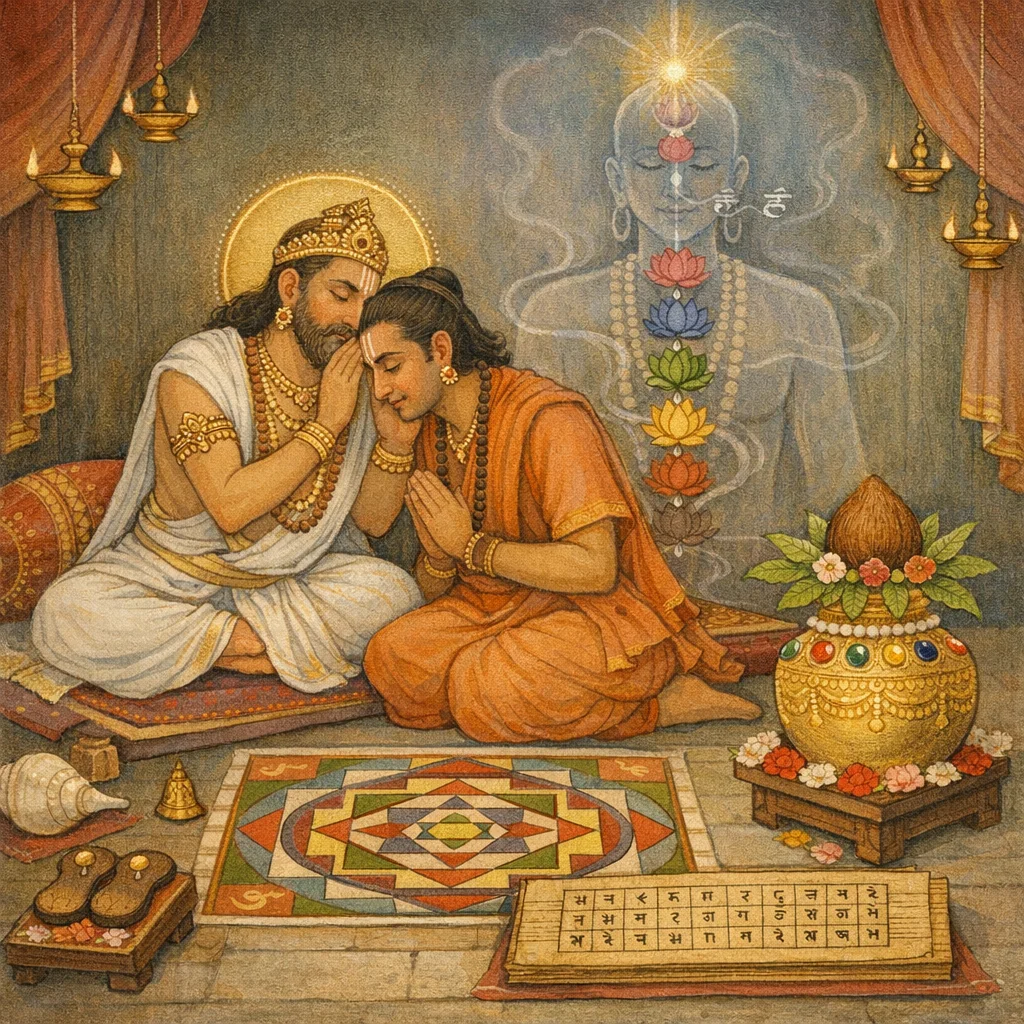
Sanatkumāra presents a layered sādhana manual. First the guru tests the disciple and performs mantraśodhana, arranging the mantra’s letters in a directional grid (nṛpa-koṣṭhaka) and confirming syllabic order. The chapter classifies outcomes—siddha, sādhya, su-siddha, ari, and mixed states—as a diagnosis of mantra power and obstacles. It then details dīkṣā: svasti rites, the Sarvatobhadra maṇḍala, entry into the hall, obstacle-removal, preparing the kumbha with herbs, navaratna and pañcapallava, and purifying the disciple (bhūtaśuddhi, nyāsa, sprinkling). The guru transmits the mantra (108 recitations; eight ear-recitals), blesses the disciple, and enjoins guru-sevā and dakṣiṇā. Daily pañcadevatā worship is mapped with central and outer placements. The chapter culminates in the Guru-pādukā mantra and stotra, then Kuṇḍalinī’s ascent through the six cakras to brahmarandhra, and Ajapā/Haṃsa-Gāyatrī breath-japa with ṛṣi, chandas, devatā, ṣaḍaṅga and cakra-offerings, ending in nondual mokṣa-dharma affirmations.
Shlokas
Verse 1
सनत्कुमार उवाच । परीक्ष्य शिष्यं तु गुरुर्मंत्रशोधनमाचरेत् । प्राक्प्रत्यग्दक्षिणोदक्चपंचसूत्राणि पातयेत् ॥ १ ॥
Sanatkumāra said: Having first examined the disciple, the guru should perform the purification of the mantra; and he should have the five sacred threads arranged toward the directions—east, west, south, and north.
Verse 2
चतुष्टयं चतुष्कानां स्यादेवं नृपकोष्ठके । तत्राद्यप्रथमे त्वाद्यं द्वितीयाद्ये द्वितीयकम् ॥ २ ॥
Thus, in the royal grid (nṛpa-koṣṭhaka), a set of four is formed from the groups of four: in the first primary position the first is placed; in the second primary position, the second is placed.
Verse 3
तृतीयाद्ये तृतीयं स्याञ्चतुर्थाद्ये तुरीयकम् । तत्तदाग्नेयकोष्ठेषु तत्तत्पंचममक्षरम् ॥ ३ ॥
In the set beginning with the third, the third is taken; in the set beginning with the fourth, the fourth. And in each corresponding ‘Agni’ (southeast) cell, the fifth letter of that set is to be placed.
Verse 4
विलिख्य क्रमतो धीमान्मनुं संशोधयेत्ततः । नामाद्यक्षरमारभ्य यावन्मन्त्रादि वर्णकम् ॥ ४ ॥
Having written the mantra in proper sequence, the wise should then examine and correct it—starting from the first letter of the Holy Name and continuing through every syllable that makes up the mantra and its opening portions.
Verse 5
चतुष्के यत्र नामार्णस्तत्स्यात्सिद्धिचतुष्ककम् । प्रादक्षिण्यात्तद्द्वितीयं साध्याख्यं परिकीर्तितम् ॥ ५ ॥
That set of four in which the syllables of the Holy Name are placed is called the ‘fourfold of siddhis’. Taking them in rightward (clockwise) order, the second set is declared to be known as ‘Sādhya’.
Verse 6
तृतीयं पुंसि सिद्धाख्यं तुरीयमरिसंज्ञकम् । द्वयोर्वर्णावेककोष्ठे सिद्धसिद्धेति तन्मतम् ॥ ६ ॥
The third category in the masculine is called “Siddha,” and the fourth is termed “Ari.” When two letters share a single compartment (koṣṭha), their accepted designation is “Siddha–Siddha.”
Verse 7
तद्द्वितीये तु मंत्रार्णे सिद्धसाध्यः प्रकीर्तितः । तृतीये तत्सुसिद्धः स्यात्सिद्धारिस्तञ्चतुर्थके ॥ ७ ॥
But when it is in the second mantra-syllable (mantrārṇa), it is declared “siddha-sādhya” (success attainable). In the third, it becomes “su-siddha” (very successful); and in the fourth, it is termed “siddhāri” (an obstructor to success).
Verse 8
नामार्णान्यचतुष्कात्तु द्वितीये मंत्रवर्णके । चतुष्के चेत्तदा पूर्वं यत्र नामाक्षरं स्थितम् ॥ ८ ॥
If the name-syllables (letters forming the name) are not in a group of four, then in the second quartet of the mantra-letters—if a quartet is to be applied—one should place them earlier, at the position where the name-letter is found.
Verse 9
तत्र तत्कोष्ठमारभ्य गणयेत्पूर्ववत्क्रमात् । साध्यसिद्धः साध्यसाध्यस्तत्सुसिद्धश्च तद्रिप्रुः ॥ ९ ॥
There, beginning from that particular compartment (koṣṭha), one should compute as before, in due order. From that reckoning arise: “sādhya-siddha,” “sādhya-sādhya,” “tat-su-siddha,” and “tad-ripru” (the adversary/obstructor).
Verse 10
तृतीये चेञ्चतुष्के तु यदि स्यान्मंत्रवर्णकः । तदा पूर्वोक्तरीत्या तु क्रमाद्देयं मनीषिभिः ॥ १० ॥
If, in the third set of four, there occurs a mantra-syllable (a mantra-bearing unit), then the wise should impart it in due sequence, following the method stated earlier.
Verse 11
सुसिद्धसिद्धस्तत्साध्यस्तत्सुसिद्धश्च तदृषिः । तुरीये चेञ्चतुष्के तु तदैवं गणयेत्सुधीः ॥ ११ ॥
“Su-siddha-siddha,” “Tat-sādhya,” “Tat-su-siddha”—and that very ṛṣi: in the fourth section, within the fourfold set, the wise should enumerate it exactly in this manner.
Verse 12
अरिसिद्धोऽरिसाध्यश्च तत्सुसिद्धश्च तद्रिपुः । रिद्धसिद्धो यथोक्तेन द्विगुणात्सिद्धिसाध्यकः ॥ १२ ॥
One is called “ari-siddha” and another “ari-sādhya”; likewise there is “tat-su-siddha” and its corresponding “enemy.” Further, as stated before, the “ṛddha-siddha” is the one who attains success by a twofold, intensified measure.
Verse 13
सिद्धः सुसिद्धोर्द्धतयात्सिद्धारिर्हंति गोत्रजान् । द्विगुणात्साध्यसिद्धस्तु साध्यसाध्यो विलंबतः ॥ १३ ॥
A “Siddha,” through the heightened power of being “Su-siddha,” becomes such that the “siddha-ari” destroys even those born of his own gotra. With twice that intensity one becomes “Sādhya-siddha”; but the “Sādhya-sādhya” attains its fruit only after delay.
Verse 14
साध्यः सुसिद्धो द्विगुणात्साध्यारिर्हंति बांधवान् । सुसिद्धसिद्धोर्द्धतया तत्साध्यो द्विगुणाज्जपात् ॥ १४ ॥
A sādhya becomes a susiddha by twice the effort; the enemy of the sādhya harms his kinsmen. Yet by the heightened power of one who is both susiddha and siddha, that very sādhya is attained again through japa performed in double measure.
Verse 15
तत्सुसिद्धप्राप्तिमात्रात्सुसिद्धारिः कुटुंबहृत् । अरिसिद्धस्तु पुत्रघ्नोऽरिसाध्यः कन्यकापहः ॥ १५ ॥
By merely attaining “tat-su-siddha,” the “susiddha-ari” becomes a destroyer of one’s household. The “ari-siddha” is said to slay sons, and the “ari-sādhya” becomes a stealer of a maiden (daughter/young woman).
Verse 16
तत्सुसिद्धः कलत्रघ्नः साधकघ्नोरेऽप्यरिः स्मृतः । अन्येऽप्यत्र प्रकारा हि संति वै बहवो मुने ॥ १६ ॥
That configuration is said to be fully effective: it destroys one’s spouse and is hostile even to the practitioner (sādhaka). O sage, there are indeed many other varieties of such cases here as well.
Verse 17
सर्वेषु मुख्योऽयं तेऽत्र कथितो कथहाभिधः । एवं संशोध्य मंत्रं तु शुद्धे काले स्थले तथा ॥ १७ ॥
Among all the methods, this one is the foremost; it has been explained to you here, known by the name “Kathahā.” Thus, having purified and verified the mantra, one should employ it at a pure time and in a pure place as well.
Verse 18
दीक्षयेञ्च गुरुः शिष्यं तद्विधानमुदीर्यते । नित्यकृत्यं विधायाथ प्रणम्य गुरुपादुकाम् ॥ १८ ॥
The teacher should initiate the disciple with dīkṣā, after first declaring the proper procedure for that initiation. Then, having the disciple perform the prescribed daily duties, one should bow in reverence to the Guru’s pādukās (sacred sandals).
Verse 19
प्रार्थयेत्सद्गुरुं भक्त्याभीष्टार्थमादृतः । संपूज्य वस्त्रालंकारगोहिरण्यधरादिभिः ॥ १९ ॥
With devotion and due reverence, one should petition the sadguru, the true guru, for the desired aim, having first worshipped him fully with garments, ornaments, cows, gold, land, and the like.
Verse 20
कृत्वा स्वस्ति विधानं तु मंडलादि च तुष्टिमान् । गुरुः शिष्येण सहितः शुचिर्यागगृहं विशेत् ॥ २० ॥
After performing the rite of auspicious benedictions (svasti-vidhāna) and completing the maṇḍala and related preliminaries, the guru—content and purified—should enter the sacrificial hall (yāga-gṛha) together with the disciple.
Verse 21
सामान्यार्घोदकेनाथ संप्रोक्ष्य द्वारमस्त्रतः । दिव्यानुत्सारयेद्विघ्नान्नभस्थानर्च्य वारिणा ॥ २१ ॥
O Lord, having sprinkled the doorway with the water of a simple arghya and safeguarded it with the Astra-mantra, one should drive away the divine obstacles; and by worship with water one should also propitiate the beings stationed in the sky.
Verse 22
पार्ष्णिघातैस्त्रिभिर्भौमांस्ततः कर्म समाचरेत् । वर्णकैः सर्वतोभद्रे यथोक्तपरिकल्पिते ॥ २२ ॥
Then, striking the ground three times with the heel, one should proceed with the rite within the ‘Sarvatobhadra’ (all-auspicious) diagram, prepared exactly as prescribed with the designated letters (varṇas).
Verse 23
वह्निमण्डलमभ्यर्च्य तत्कलाः परिपूज्य च । अस्त्रप्रक्षालितं कुंभं यथाशक्ति विनिर्मितम् ॥ २३ ॥
Having worshipped the fire-maṇḍala and duly honoured its attendant powers (kalā-s), one should prepare—according to one’s capacity—a kumbha, a water-pot, ritually purified by the Astra-mantra.
Verse 24
तत्र संस्थाप्य विधिवत्तत्र भानोः कलां यजेत् । विलोममातृकामूलमुच्चरन् शुद्धवारिणा ॥ २४ ॥
Having duly installed it there according to the prescribed rite, one should worship the divine ray/portion of the Sun. While doing so, one should recite the root of the Matṛkā (seed of the alphabet) in reverse order, using purified water.
Verse 25
आपूर्य कुंभं तत्रार्चेत्सोमस्य विधिवत्कलाः । धूम्रार्चिरूष्मा ज्वलिनी ज्वालिनी विस्फुलिंगिनी ॥ २५ ॥
Having filled the water-pot, one should there worship, according to the prescribed rite, the kalā-s of Soma: Dhūmrārci (smoke-flamed), Ūṣmā (heat), Jvalinī (blazing), Jvālinī (flaming), and Visphuliṅginī (spark-emitting).
Verse 26
सुश्रीः सुरूपा कपिला हव्यकव्यवहा तथा । वह्नेर्दश कलाः प्रोक्ताः प्रोच्यंतेऽथ रवेः कलाः ॥ २६ ॥
Suśrī, Surūpā, Kapilā, and Havyakavyavahā—these are declared to be the ten kalās (powers/rays) of Agni, the sacred Fire. Now, next, the kalās of Ravi, the Sun, are described.
Verse 27
तपिनी तापिनी धूम्रा मरीचिज्वालिनी रुचिः । सुषुम्णा भोगदा विश्वा बोधिनी धारिणी क्षमा ॥ २७ ॥
She is Tapinī, Tāpinī, Dhūmrā, Marīci-jvālinī, and Ruci; she is Suṣumṇā, the giver of enjoyment, the All-pervading, Bodhinī who awakens knowledge, Dhāriṇī who sustains, and Kṣamā—forbearance itself.
Verse 28
अथेंदोश्च कला ज्ञेया ह्यमृता मानदा पुनः । पूषा तुष्टिश्च पुष्टिश्च रतिश्च धृतिसंज्ञिकाः ॥ २८ ॥
Next, the lunar kalās (digits) of the Moon are to be known: Amṛtā, Mānadā, and again Pūṣā, Tuṣṭi, Puṣṭi, Rati, and those known as Dhṛti.
Verse 29
शशिनी चंद्रिका कांतिर्ज्योत्स्ना श्रीः प्रीतिरंगदा । पूर्णापूर्णामृता चेति प्रोक्ताश्चंद्रमसः कलाः ॥ २९ ॥
Śaśinī, Candrikā, Kānti, Jyotsnā, Śrī, Prīti, Aṅgadā, Pūrṇā, Apūrṇā, and Amṛtā—these are declared to be the named kalās (digits/phases) of Candramas, the Moon.
Verse 30
वस्त्रयुग्मेन संवेष्ट्य तस्मिन्सर्वैषधीः क्षिपेत् । नवरत्नानि निक्षिप्य विन्यसेत्पञ्चपल्लवान् ॥ ३० ॥
Wrapping it with a pair of cloths, one should place within it all medicinal herbs. Then, having put in the nine gems (navaratna), one should arrange the five sacred fresh leaf-sprigs.
Verse 31
पनसाम्रवटाश्वत्थबकुलेति च तान् विदुः । मुक्तामाणिक्यवैडूर्यगोमेदान्वज्रविद्रुमौ ॥ ३१ ॥
They are known by the names jackfruit, mango, banyan, aśvattha (the sacred fig), and bakula; and likewise as pearl, ruby, vaidūrya (cat’s-eye), gomeda (hessonite), diamond, and coral.
Verse 32
पद्मरागं मरकतं नीलं चेति यथाक्रम् । एवं रत्नानि निक्षिप्य तत्रावाह्येष्टदेवताम् ॥ ३२ ॥
In proper order, place the padmarāga (ruby), the marakata (emerald), and the nīla (sapphire). Having thus set down the gems, one should invoke there, by āvāhana, the Iṣṭa-devatā—the chosen Deity of one’s devotion.
Verse 33
संपूज्य विधिवन्मंत्री ततः शिष्यं स्वलंकृतम् । वेद्यां संवेश्य संप्रोक्ष्य प्रोक्षणीस्थेन वारिणा ॥ ३३ ॥
After duly offering worship according to rule, the mantra-officiant then seats the well-adorned disciple upon the ritual altar and sprinkles him for purification with water kept in the sprinkling vessel (prokṣaṇī).
Verse 34
भूतशुद्ध्यादिकं कृत्वा तच्छरीरे विधानतः । न्यासजालेन संशोध्य मूर्ध्नि विन्यस्य पल्लवान् ॥ ३४ ॥
Having performed bhūtaśuddhi and the other preliminary purifications according to rule, one should cleanse that body by the network of nyāsa, and then place fresh sprigs (pallava) upon the crown of the head.
Verse 35
अष्टोत्तरशतेनाथ मूलमंत्रेण मंत्रितैः । अभिषिंचेत्प्रियं शिष्यं जपन्मूलमनुं हृदि ॥ ३५ ॥
O Lord, with water empowered by repeating the root-mantra one hundred and eight times, the teacher should anoint—by sacred sprinkling—the beloved disciple, while inwardly reciting the root seed-syllable (bīja) within the heart.
Verse 36
शिष्टोदकेन वाचम्य परिधायांबरं शिशुः । गुरुं प्रणम्य विधिवत्संविशेत्पुरतः शुचिः ॥ ३६ ॥
Having rinsed his mouth with purified water as prescribed and having donned his garment, the student—clean and disciplined—should bow to the Guru according to rule and then sit before him.
Verse 37
अथ शिष्यस्य शिरसि हस्तं दत्वा गुरुस्ततः । जपेदष्टोत्तरशतं देयमन्त्रं विधानतः ॥ ३७ ॥
Then the Guru, placing his hand upon the disciple’s head, should duly recite—according to the prescribed rite—the mantra to be bestowed one hundred and eight times.
Verse 38
समोऽस्त्वित्यक्षरान्दद्यात्ततः शिष्योऽर्चयेद्गुरुम् । ततः सचन्दनं हस्तं दत्वा शिष्यस्य मस्तके ॥ ३८ ॥
He should impart the syllables beginning with “samo’stu” (“May there be equanimity/peace”). Then the disciple should worship the Guru. After that, the Guru places his hand, anointed with sandal paste, upon the disciple’s head to complete the rite.
Verse 39
तत्कर्णे प्रवदेद्विद्यामष्टवारं समाहितः । संप्राप्तविद्यः शिष्योऽपि निपतेद्गुरुपादयोः ॥ ३९ ॥
With focused attention, the teacher should recite the sacred knowledge into the disciple’s ear eight times. Having received that knowledge, the disciple too should bow down at the Guru’s feet.
Verse 40
उत्तिष्ठ वत्स मुक्तोऽसि सम्यगाचारवान्भव । कीर्तिश्रीकांतिपुत्रायुर्बलारोग्य सदास्तु ते ॥ ४० ॥
“Rise up, dear child—you are liberated. Be established in right conduct. May fame, prosperity, radiance, sons, long life, strength, and freedom from disease always be yours.”
Verse 41
ततः शिष्यः समुत्थाय गन्धाद्यैर्गुरुमर्चयेत् । दद्याञ्च दक्षिणां तस्मै वित्तशाठ्यविवर्जितः ॥ ४१ ॥
Then the disciple should rise and worship the guru with sandal paste and other offerings, and also present the prescribed dakṣiṇā—free from any deceit concerning wealth.
Verse 42
संप्राप्यैवं गुरोर्मंत्रं तदारभ्य धनादिभिः । देहपुत्रकलत्रैश्च गुरुसेवापरो भवेत् ॥ ४२ ॥
Having thus received the mantra from one’s guru, from that time onward one should be devoted to serving the guru—through one’s wealth and resources, and also through one’s own person, one’s children, and one’s spouse.
Verse 43
स्वेष्टदेवं यजेन्मध्ये दत्वा पुष्पांजलिं ततः । अग्निनैर्ऋतिवागीशान् क्रमेण परिपूजयेत् ॥ ४३ ॥
In the center one should worship one’s chosen deity; then, having offered a handful of flowers in añjali, one should thereafter worship in order—Agni, Nairṛti, and Vāgīśa, the Lord of speech.
Verse 44
यदा मध्ये यजेद्विष्णुं बाह्यादिषु विनायकम् । रविं शिवां शिवं चैव यदा मध्ये तु शङ्करम् ॥ ४४ ॥
When one worships Viṣṇu in the central position, one should worship Vināyaka on the outer sides; likewise one should worship the Sun, Śivā the Goddess, and Śiva as well. But when Śaṅkara is worshipped in the center, the arrangement should be made accordingly, with the proper complementary deities placed around.
Verse 45
रविं गणेशमंबां च हरिं चाथ यदा शिवाम् । ईशं विघ्नार्कगोविंदान्मध्ये चेद्गणनायकम् ॥ ४५ ॥
When reciting the names—Sūrya (Ravi), Gaṇeśa, Ambā, Hari, and then Śivā—if Īśa (Śiva) is mentioned between “Vighna” (the remover of obstacles), “Arka” (the Sun), and “Govinda” (Viṣṇu), then Gaṇanāyaka (Gaṇeśa, Lord of the Gaṇas) should be placed in the middle.
Verse 46
शिवं शिवां रविं विष्णुं रवौ मध्यगते पुनः । गणेषं विष्णुमंबां च शिवं चेति यथाक्रमम् ॥ ४६ ॥
Invoke Śiva, Śivā, the Sun, and Viṣṇu; and again, when the Sun is placed at the center, invoke Gaṇeśa, Viṣṇu, Ambā, and Śiva—thus, in the proper sequence.
Verse 47
एवं नित्य समभ्यर्च्य देवपञ्चकमादृतः । ब्राह्मे मुहूर्त्ते ह्युत्थाय कृत्वाचावश्यकं बुधः ॥ ४७ ॥
Thus, having reverently worshipped the five deities each day, the wise should rise in the brāhma-muhūrta and then perform the obligatory daily rites.
Verse 48
अशंकितो वा शय्यायां स्वकीयशिरसि स्मरेत् । सहस्रदलशुक्लाब्जकणिकास्थेंदुमण्डले ॥ ४८ ॥
Or, lying on his bed without fear, he should meditate upon the lunar orb situated in his own head—resting upon the filaments at the center of a thousand‑petalled white lotus.
Verse 49
अकथादित्रिकोणस्थं वराभयकरं गुरुम् । द्विनेत्रं द्विभुजं शुक्लगंधमाल्यानुलेपनम् ॥ ४९ ॥
He should meditate upon the Guru stationed in the triangular diagram beginning with “Aka-thā”—showing the gestures of boon-giving and fearlessness; two-eyed and two-armed; adorned with white fragrance, garlands, and unguents.
Verse 50
वामे शक्त्या युतं ध्यात्वा मानसैरुपचारकैः । आराध्य पादुकामन्त्रं दशधा प्रजपेत्सुधीः ॥ ५० ॥
Having meditated on (the deity) as united with Śakti on the left side, and having worshipped with mental offerings, the wise practitioner should then recite the Pādukā-mantra tenfold.
Verse 51
वा माया श्रीर्भगेंद्वाढ्या वियद्धंसखकाग्नयः । हसक्षमलवार्यग्निवामकर्णेंदुयुग्मरुत् ॥ ५१ ॥
“These are the groupings of seed-syllables (bīja): ‘vā’, ‘māyā’, ‘śrīḥ’, and ‘bhaga’ (endowed with the lunar sound); then the series ‘viyat’, ‘haṃsa’, ‘kha’, ‘kā’, and ‘agni’. Further: ‘ha-sa’, ‘kṣa’, ‘mala’, ‘vāri’, ‘agni’, the sound of the ‘left ear’, together with the paired ‘moon’-sounds and ‘marut’ (wind-breath).”
Verse 52
ततो भृग्वाकाशखाग्निभगेंद्वाढ्याः परंतिमः । सहक्षमलतोयाग्निचंद्रशांतियुतो मरुत् ॥ ५२ ॥
“Then the Wind-principle (Marut) is described as enriched with Bhṛgu, ether (ākāśa), space (kha), fire (agni), Bhaga, and the Moon (indu); and as endowed with forbearance, purity, water, fire, lunar calmness, and pacification.”
Verse 53
ततः श्रीश्चामुकांते तु नन्दनाथामुकी पुनः । देव्यंबांते श्रीपांदुकां पूजयामि हृदंतिमे ॥ ५३ ॥
“Thereafter, I worship Śrī (Lakṣmī) at Cāmukānta; again, Nandanātha at Āmukī; at Devyambānta I worship Śrīpāṇḍukā—these are the innermost, dearest to my heart.”
Verse 54
अयं श्रीपादुकामंत्रः सर्वसिद्धिप्रदो नृणाम् । गुह्येति च समर्प्याथ मन्त्रैरेतैर्नमेत्सुधीः ॥ ५४ ॥
“This is the Śrīpādukā mantra, which bestows all attainments (siddhis) upon people. Having offered (the pādukā) with the utterance ‘guhya’ (‘secret, most confidential’), the wise person should then bow in reverence with these mantras.”
Verse 55
अखण्डमंडलाकारं व्याप्तं येन चराचरम् । तत्पदं दर्शितं येन तस्मै श्रीगुरवे नमः ॥ ५५ ॥
“Salutations to that revered Śrī Guru by whom the moving and the unmoving universe is known as pervaded by the One—of unbroken, all-encompassing form—and by whom the supreme state, that Reality, is revealed.”
Verse 56
अज्ञानतिमिरांधस्य ज्ञानाञ्जनशलाकया । चक्षुरुन्मीलितं येन तस्मै श्रीगुरवे नमः ॥ ५६ ॥
Salutations to that revered Guru who, with the collyrium-stick of knowledge, opens the eyes of one blinded by the darkness of ignorance.
Verse 57
नमोऽस्तु गुरवे तस्मा इष्टदेवस्वरूपिणे । यस्य वागमृतं हंति विषं संसारसंज्ञकम् ॥ ५७ ॥
Salutations to that Guru who is the very embodiment of one’s chosen deity; whose nectar-like speech destroys the poison known as worldly existence (saṃsāra).
Verse 58
इति नत्वा पठेत्स्तोत्रं सद्यः प्रत्ययकारकम् । ॐ नमस्ते नाथ भगवान् शिवाय गुरुरूपिणे ॥ ५८ ॥
Having thus bowed, one should recite this hymn, which produces immediate assurance: “Oṁ, salutations to You, O Lord—O Blessed Śiva—who appear in the form of the Guru.”
Verse 59
विद्यावतारसंसिद्ध्यै स्वीकृतानेकविग्रह । नवाय तनरूपाय परमार्थैकरूपिणे ॥ ५९ ॥
Salutations to the One who, for the fulfillment of the descent of knowledge, assumes many forms; to the ever-new One whose body is subtle, and whose true nature is the single reality of the highest truth.
Verse 60
सर्वाज्ञानतमोभेदभानवे चिद्धनाय ते । स्वतंत्राय दयाक्लृप्तविग्रहाय शिवात्मने ॥ ६० ॥
Salutations to You—the sun that dispels the darkness of all ignorance; the very wealth of consciousness; the fully independent Lord; He whose form is assumed out of compassion; whose very essence is auspiciousness (Śiva).
Verse 61
परत्र त्राय भक्तानां भव्यानां भावरूपिणे । विवेकिनां विवेकाय विमर्शाय विमर्शिनाम् ॥ ६१ ॥
In the hereafter, may He protect the devotees; may He, whose very nature is sacred auspicious Being, protect the virtuous. May He grant discernment to the discerning, and deep reflective insight to those devoted to inquiry.
Verse 62
प्रकाशानां प्रकाशाय ज्ञानिनां ज्ञानरूपिणे । पुरस्तात्पार्श्वयोः पृष्टे नमस्तुभ्यमुपर्यधः ॥ ६२ ॥
Salutations to You—the Light of all lights, the very form of knowledge for the wise—present before, at the sides, behind, above, and below.
Verse 63
सदा सञ्चित्स्वरूपेण विधेहि भवदासनम् । त्वत्प्रसादादहं देव कृताकृत्योऽस्मि सर्वतः ॥ ६३ ॥
Ever establish me in Your seat, in the form of pure Being-Consciousness; by Your grace, O Lord, I am fulfilled in every way—nothing remains to be done or left undone.
Verse 64
मायामृत्युमहापाशाद्विमुक्तोऽस्मि शिवोऽस्मि वः । इति स्तुत्वा ततः सर्व गुरवे विनिवेदयेत् ॥ ६४ ॥
“I am freed from the great noose of illusion and death; I am auspicious (Śiva) for you.” Having thus offered praise, one should then submit everything to the Guru.
Verse 65
प्रातः प्रभृति सायांतं सांयादिप्रातरंततः । यत्करोमि जगन्नाथ तदस्तु तव पूजनम् ॥ ६५ ॥
From morning until evening, and from evening again until morning—whatever I do, O Jagannātha, Lord of the universe, may that become Your worship.
Verse 66
ततश्च गुरुपादाब्जगलितामृतधारया । क्षालितं निजमात्मानं निर्मलं भावयेत्सुधीः ॥ ६६ ॥
Then, with the stream of nectar flowing from the lotus-feet of the Guru, the wise should contemplate one’s own self as washed clean and made perfectly pure.
Verse 67
मूलादिब्रह्मरंध्रांतं मूलविद्यां विभावयेत् । मूलाधारादधो भागे वर्तुलं वायुमंडलम् ॥ ६७ ॥
One should contemplate the root-knowledge (mūla-vidyā) from the Mūlādi (root center) up to the Brahma-randhra (the aperture at the crown). Below the Mūlādhāra, in the lower region, one should visualize a circular sphere—the maṇḍala of Vāyu (the wind element).
Verse 68
तत्रस्थवायुबीजोत्थवायुना च तदूर्द्ध्वकम् । त्रिकोणं मंडलं वह्नेस्तत्रस्थवह्निबीजतः ॥ ६८ ॥
Then, by the wind that arises from the seed-syllable (bīja) of Vāyu placed there, that (form/region) is lifted upward. From the seed-syllable of Agni situated there, the triangular maṇḍala of fire is produced.
Verse 69
उत्पन्नेनाग्निना मूलाधारावस्थितविग्रहाम् । प्रसुप्तभुजगाकारां स्वयंभूलिंगवेष्टिनीम् ॥ ६९ ॥
By the fire that has arisen, one should contemplate her form stationed in the Mūlādhāra—shaped like a sleeping serpent—coiled around the self-manifest liṅga (svayambhū).
Verse 70
विसतंतुनिभां कोटिविद्युदाभां तनीयसीम् । कुलकुंडलिनीं ध्यात्वा कूर्चेनोत्थापयेञ्च ताम् ॥ ७० ॥
Meditating on the Kula-Kuṇḍalinī—subtle as a lotus-fibre, radiant like a crore of lightning flashes, and exceedingly fine—one should raise her upward by means of the kūrca (the yogic lock/impulse).
Verse 71
सुषुम्णावर्त्मनातां च षट्चक्रक्रमभेदिनीम् । गुरुपदिष्टविधिना ब्रह्मरंध्रं नयेत्सुधीः ॥ ७१ ॥
Following the path of the suṣumṇā and piercing the succession of the six cakras, the wise—by the method taught by the guru—should lead it to the brahma-randhra, the Brahman aperture at the crown.
Verse 72
तत्रस्थामृतसंमग्नीकृत्यात्मानं विभावयेत् । तत्प्रभापटलव्याप्तैविमलं चिन्मयं परम् ॥ ७२ ॥
Fixing the mind there, one should contemplate the Self as immersed in amṛta, the nectar of bliss. Pervaded by a canopy of That Supreme radiance, one realizes the stainless, consciousness-natured, transcendent Reality.
Verse 73
पुनस्तां स्वस्थलं नीत्वा हृदिदेवं विचिंतयन् । दृष्ट्वा च मानसैर्द्रव्यैः प्रार्थयेन्मनुनामुना ॥ ७३ ॥
Then, leading her back to a proper, steady place, meditating upon the deity within the heart, and mentally presenting imagined offerings, one should pray using this mantra.
Verse 74
त्रैलोक्यचैत न्यमयादिदेव श्रीनाथ विष्णो भवदाज्ञयैव । प्रातः समुत्थाय तव प्रियार्थं संसारयात्रां त्वनुवर्तयिष्ये ॥ ७४ ॥
O primal Lord, embodiment of the consciousness of the three worlds—O Śrīnātha Viṣṇu—by Your command alone, rising early each morning for what is dear to You, I shall continue and follow the course of worldly life.
Verse 75
विष्णोरिति स्थले विप्र कार्य ऊहोऽन्यदैवते । ततः कुर्यात्सर्वसिद्ध्यै त्वजपाया निवेदनम् ॥ ७५ ॥
O brāhmaṇa, where the rite is prescribed with the formula “of Viṣṇu,” if it is to be applied to another deity one should make the proper substitution. Then, for the attainment of all siddhis, one should perform the nivedana (offering) to Ajapā—the unuttered japa, the subtle current of mantra.
Verse 76
षट्शतानि दिवा रात्रौ सहस्राण्येकविंशतिः । अजपाख्यां तु गायत्रीं जीवो जपति सर्वदा ॥ ७६ ॥
By day there are six hundred, and by night twenty-one thousand (breaths); thus the embodied being continually repeats the Gāyatrī known as Ajapā—without deliberate effort, at all times.
Verse 77
ऋषिर्हंसस्तथाव्यक्तगायत्रीछंद ईरितम् । देवता परमो हंसश्चाद्यंते बीजशक्तिकम् ॥ ७७ ॥
The seer (ṛṣi) is Haṃsa, and the metre is declared to be the unmanifest Gāyatrī. The presiding deity is the Supreme Haṃsa; and its seed (bīja) and power (śakti) are placed at the beginning and the end (of the mantra/rite).
Verse 78
ततः षडंगं कुर्वीत सूर्यः सोमोनिरंजनः । निराभासश्च धर्मश्च ज्ञानं चेति तथा पुनः ॥ ७८ ॥
Then one should set forth the sixfold division: Sūrya, Soma, Niranjana, Nirābhāsa, Dharma, and again Jñāna.
Verse 79
क्रमादेतान्हंसपूर्वानात्मनेपदपश्चिमान् । जातयुक्तान्साधकेंद्र षडंगेषु नियोजयेत् ॥ ७९ ॥
In due sequence, O foremost of practitioners, one should apply these—beginning with the ‘haṃsa’ series and ending with the ātmanepada set—together with their proper jāti (class/derivative forms), to the six auxiliaries (ṣaḍ-aṅgas) of Vedic practice.
Verse 80
हकारः सूर्यसंकाशतेजाः संगच्छते बहिः । सकारस्तादृशश्चैव प्रवेशे ध्यानमीरितम् ॥ ८० ॥
The sound “ha” is a brilliance like the sun and moves outward. The sound “sa” is likewise of the same nature; it is declared to be the meditation at the time of inward entry (of the breath).
Verse 81
एवं ध्यात्वार्पयेद्धीमान्वह्न्यर्केषु विभागशः । मूलाधारे वादिसांतबीजयुक्ते चतुर्दले ॥ ८१ ॥
Thus having meditated, the wise practitioner should, in proper divisions, place the invoked energies and mantras into Agni and into the Sun. He should also place them in the Mūlādhāra—the four‑petalled lotus endowed with seed‑syllables from “va” to “sa”.
Verse 82
बंधूकाभे स्वशक्त्या तु सहितापास्वगाय च । पाशांकुशसुधापात्रमोदकोल्लासपाणये ॥ ८२ ॥
Salutations to the One radiant like the bandhūka flower, accompanied by his own divine Śakti and attended by those at his side; whose hands shine, bearing the noose and the goad, the vessel of nectar, and the sweet modaka.
Verse 83
षट्शतं तु गणेशाय वागधीशाय चार्पयेत् । स्वाधिष्ठाने विद्रुमाभे वादिलांतार्णसंयुते ॥ ८३ ॥
One should offer six hundred (oblations or recitations) to Gaṇeśa, the Lord of Speech, meditating on him in the Svādhiṣṭhāna center, coral-hued, and linked with the inner syllabic sequence from “va” to “la”.
Verse 84
वामांगशक्तियुक्ताय विद्याधिपतये तथा । स्रुवाक्षमालालसितबाहवे पद्मजन्मने ॥ ८४ ॥
Salutations to him who is united with the Śakti on his left side, the Lord of sacred knowledge; whose arms are adorned with the ritual ladle and the rosary; and who is lotus-born.
Verse 85
ब्रह्मणे षट्सहस्रं तु हंसारूढाय चार्पयेत् । विद्युल्लसितमेघाभे डादिफांतार्णपत्रके ॥ ८५ ॥
One should offer six thousand (oblations or recitations) to Brahmā, the one mounted on the swan, using a leaf inscribed with the syllables from “ḍa” to “pha”, whose appearance is like a cloud lit up by lightning.
Verse 86
मणिपूरे शंखचक्रगदापंकजधारिणे । सश्रिये षट्सहस्रं च विष्णवे विनिवेदयेत् ॥ ८६ ॥
At the Maṇipūra (navel) center, one should offer six thousand (recitations/oblations) to Lord Viṣṇu—bearer of conch, discus, mace, and lotus—together with Śrī (Lakṣmī).
Verse 87
अनाहतेऽर्कपत्रे च कादिठांतार्णसंयुते । शुक्ले शूलाभयवरसधाकलशधारिणे ॥ ८७ ॥
In the Anāhata (heart-lotus), upon a sun-like lotus-leaf, joined with the seed-syllables from “ka” to “ṭha,” meditate on the radiant white deity—bearing a trident, showing the gestures of fearlessness and boon-giving, and holding a vessel of amṛta (nectar).
Verse 88
वामांगे शक्तियुक्ताय विद्याधिपतये सुधीः । वृषारूढाय रुद्राय षट्सहस्रं निवेदयेत् ॥ ८८ ॥
The wise practitioner should offer six thousand (as the prescribed count) to Rudra—who bears Śakti on his left side, who is the lord of sacred knowledge, and who rides the bull.
Verse 89
विशुद्धे षोडशदले स्वराढ्ये शुक्लवर्णके । महाज्योतिप्रकाशायेन्द्रियाधिपतये ततः ॥ ८९ ॥
Then, in the Viśuddha (throat) lotus of sixteen petals—resonant with sacred sounds, white in hue—one should meditate on the great radiance, the lord who presides over the senses.
Verse 90
सहस्रमर्पयेत्प्राणशक्त्या युक्तेश्चराय च । आज्ञाचक्रे हक्षयुक्ते द्विदिलेऽब्जे सहस्रकम् ॥ ९० ॥
With the power of prāṇa-śakti (life-breath energy), one should offer a thousand (repetitions/oblations) to Yukteśvara. Likewise, at the Ājñā-cakra—joined with the syllables “ha” and “kṣa,” in the two-petalled lotus—one should perform a thousand (recitations).
Verse 91
सदाशिवाय गुरवे पराशक्तियुताय वै । सहस्रारे महापद्मे नादबिन्दुद्वयान्विते ॥ ९१ ॥
Salutations to the Guru who is Sadāśiva, united with the Supreme Śakti—abiding in the thousand-petalled great lotus (Sahasrāra), endowed with the twin principles of Nāda and Bindu.
Verse 92
विलसन्मातृकावर्णे वराभयकराय च । प्ररमाद्ये च गुरवे सहस्रं विनिवेदयेत् ॥ ९२ ॥
To the Guru—shining with the letters of the Mātṛkā and with hands that grant boons and fearlessness, the foremost and the original—one should offer a thousand (repetitions/oblations) as prescribed.
Verse 93
चुलुकेंऽबु पुनर्द्धृत्वा स्वभावादेव सिध्यतः । एकविंशतिसाहस्रप्रमितस्य जपस्य च ॥ ९३ ॥
Taking a palmful of water again, the rite is accomplished by its very nature; and so too is the japa that is measured as twenty-one thousand (repetitions).
Verse 94
षट्शताधिकसंख्या स्यादजपाया विभागशः । संकल्पेन मोक्षदाता विष्णुर्मे प्रीयतामिति ॥ ९४ ॥
The Ajapā (natural, unuttered japa) is, in its divisions, said to number a little more than six hundred. With this resolve—“May Viṣṇu, the giver of liberation, be pleased with me”—one should practice it.
Verse 95
अस्याः संकल्पमात्रेण महापापैः प्रमुच्यते । ब्रह्मैवाहं न संसारी नित्यमुक्तो न शोकभाक् ॥ ९५ ॥
By the mere resolve (saṅkalpa) of this realization, one is freed from great sins. (One knows:) “I am Brahman alone; I am not a transmigrating being; I am eternally liberated and not a partaker of sorrow.”
Verse 96
सञ्चिदानंदरूपोऽहमात्मानमिति भावयेत् । ततः समाचरेद्देहकृत्यं देवार्चनं तथा ॥ ९६ ॥
One should contemplate: “I am the Ātman whose very nature is Existence, Consciousness, and Bliss (Sat–Cit–Ānanda).” Thereafter, one should duly perform the duties of the body, and likewise the worship of the Deity.
Verse 97
तद्धिधानं प्रवक्ष्यामि सदाचारस्य लक्षणम् ॥ ९७ ॥
Now I shall explain that ordinance—the defining characteristics of good conduct (sadācāra).
Frequently Asked Questions
It functions as a formalized hermeneutic tool for mantra-letters—placing name-syllables and mantra-syllables into compartments to classify outcomes (siddha/sādhya/ari, etc.). In śāstric terms, it is a diagnostic overlay that links phonemic arrangement with predicted siddhi or obstruction, thereby guiding correction (śodhana) before dīkṣā and japa.
It anchors the ritual and yogic program in guru-tattva: the pādukā-mantra and hymns sacralize transmission, cultivate devotion and surrender (samarpana), and frame later inner practices (Ajapā and Kuṇḍalinī) as empowered by lineage rather than mere technique.
Ajapā interprets the natural breath current as continuous mantra-japa (Haṃsa/Gāyatrī), complete with ṛṣi-chandas-devatā and ṣaḍaṅga mapping. The practice culminates in nondual resolve—‘I am Brahman’—showing a bridge from counted ritual performance to internalized realization.