गङ्गामाहात्म्य — The Greatness of the Gaṅgā
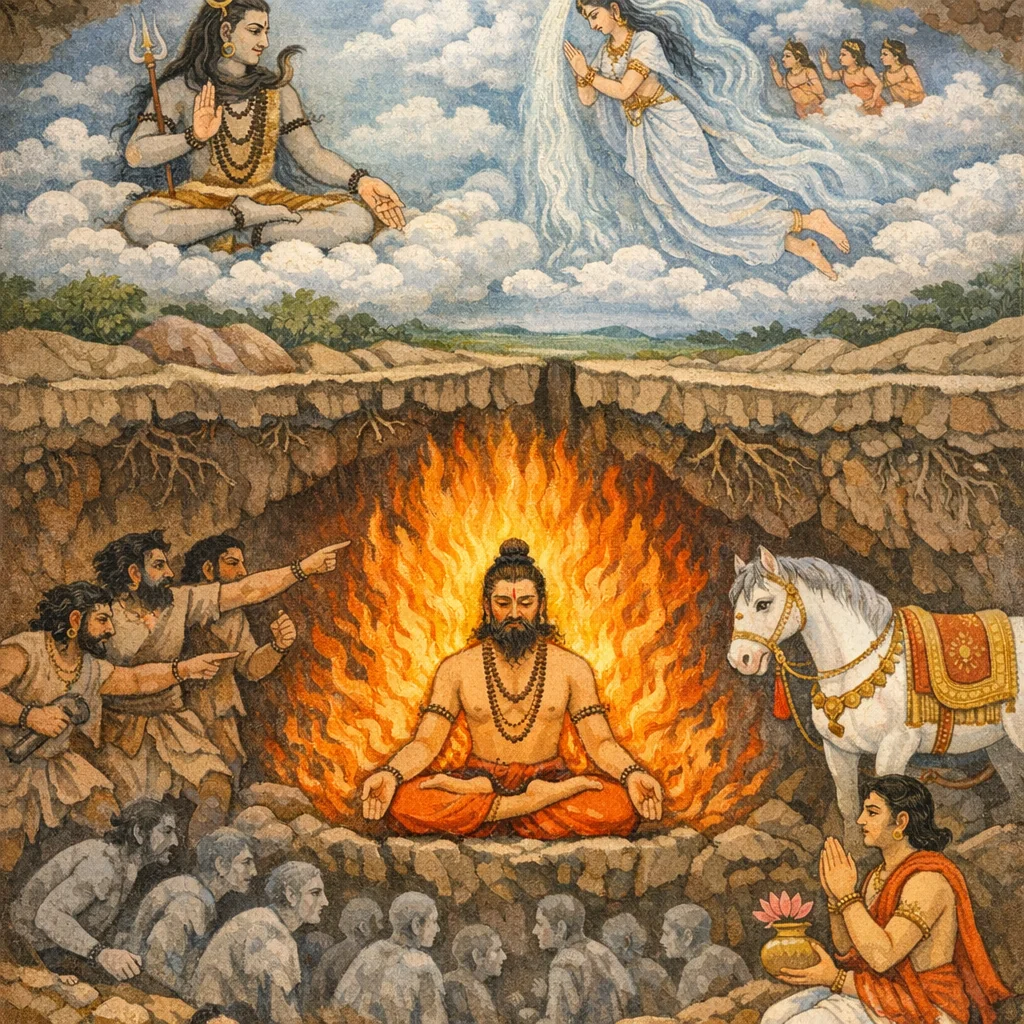
Sanaka tells Nārada how Bāhu’s queens served Sage Aurva: the elder tried to poison the younger, yet the merit of sādhu-sevā protected her and she bore Sagara, named for the digested poison (gara). Aurva performed the saṁskāras and trained Sagara in rāja-dharma and mantra-empowered weapons. Seeking his lineage, Sagara vowed to defeat usurpers and approached Vasiṣṭha, who subdued hostile tribes and taught him karmic determinism and the inviolability of the Ātman, cooling his wrath. As king, Sagara performed the Aśvamedha; Indra stole the horse and hid it near Kapila in Pātāla. Sagara’s sons dug through the earth, confronted Kapila, and were burned to ashes by his fiery gaze. Aṁśumān, through humility and praise, received the boon that Bhagīratha would bring down Gaṅgā, whose waters would purify and liberate the ancestors. The chapter ends by tracing the line to Bhagīratha and noting Gaṅgā’s power to undo even curses (Saudāsa).
Shlokas
Verse 1
सनक उवाच । एवमौर्वाश्रमे ते द्वे बाहुभार्ये मुनीश्वर । चक्राते भक्तिभावेन शुश्रूषां प्रतिवासरम् 1. ॥ १ ॥
Sanaka said: “Thus, O lord among sages, in the hermitage of Aurva, those two wives of Bāhu rendered daily service with a spirit of bhakti, devotional love.”}]}
Verse 2
गते वर्षार्द्धके काले ज्येष्ठा राज्ञी तु या द्विज । तस्याः पापमतिर्जाता सपत्न्याः सम्पदं प्रति ॥ २ ॥
When half of the rainy season had passed, O brāhmaṇa, the senior queen conceived a wicked intention toward the prosperity of her co-wife.
Verse 3
ततस्तया गरो दत्तः कनिष्ठायै तु पापया । न स्वप्रभावं चक्रे वै गरो मुनिनिषेवया ॥ ३ ॥
Then that sinful woman gave the poison to the youngest. Yet the poison did not produce its own effect, for she was under the protective influence of service and association with a sage.
Verse 4
भूलेपनादिभिः सम्यग्यतः सानुदिनं मुनेः । चकार सेवां तेनासौ जीर्णपुण्येन कर्मणा ॥ ४ ॥
Because of his simplicity and other humble traits, he became well-disciplined; and day after day he served the sage. By that act—born of his former, time-worn merit—he rendered devoted service.
Verse 5
ततो मासत्रयेऽतीते गरेण सहितं सुतम् । सुषाव सुशुभे काले शुश्रूषानष्टकिल्बिषा ॥ ५ ॥
Then, when three months had passed, she gave birth—at an auspicious time—to a son together with the placenta; she, being devoted to service and freed from sin.
Verse 6
अहो सत्सङ्गतिर्लोके किं पापं न विनाशयेत् । न तदातिसुखं किं वा नराणां पुण्यकर्मणाम् ॥ ६ ॥
Ah! In this world, what sin is there that holy association does not destroy? And what greater happiness can there be for people than the merit born of righteous deeds?
Verse 7
ज्ञानाज्ञानकृतं पापं यच्चान्यत्कारितं परैः । तत्सर्वं नाशयत्याशु परिचर्या महात्मनाम् ॥ ७ ॥
Sin committed knowingly or unknowingly—and even other wrongs brought about through the agency of others—are all swiftly destroyed by devoted service to great-souled saints.
Verse 8
जडोऽपि याति पूज्यत्वं सत्सङ्गाज्जगतीतले । कलामात्रोऽपि शीतांशुः शम्भुना स्वीकृतो यथा ॥ ८ ॥
Even a dull-witted person becomes worthy of reverence on this earth through the company of the virtuous (satsanga)—just as the moon, though only a single digit (kalā), was accepted by Śambhu (Śiva).
Verse 9
सत्सङ्गतिः परामृद्धिं ददाति हि नृणां सदा । इहामुत्र च विप्रेन्द्र सन्तः पूज्यतमास्ततः ॥ ९ ॥
Indeed, the company of the virtuous (satsanga) always grants people supreme prosperity—both in this world and in the next. Therefore, O best of brāhmaṇas, the righteous are the most worthy of reverence.
Verse 10
अहो महद्गुणान्वक्तुं कः समर्थो मुनीश्वर । गर्भं प्राप्तो गरो जीर्णो मासत्रयमहोऽदभुतम् ॥ १० ॥
Ah! O lord of sages, who could fully describe such great virtues? A deadly poison, once it entered the womb, was digested there for three months—how truly astonishing!
Verse 11
गरेण सहितं पुत्रं दृष्ट्वा तेजोनिधिर्मुनिः । जातकर्म चकारासौ तन्नाम सगरेति च ॥ ११ ॥
Seeing the son together with the poison (gara), the sage—an abode of spiritual splendor—performed the birth-rite (jātakarma) and gave him the name “Sagara.”
Verse 12
पुपोष सगरं बालं तन्माता प्रीतिपूर्वकम् । चौलोपवीतकर्माणि तथा चक्रे मुनीश्वरः ॥ १२ ॥
With deep affection, his mother lovingly nurtured the child Sagara; and the lordly sage likewise performed for him the rites of tonsure (cūḍā/caula) and the upanayana, the investiture with the sacred thread.
Verse 13
शास्त्राण्यध्यापयामास राजयोग्यानि मन्त्रवित् । समर्थं सगरं दृष्ट्वा किंचिदुद्भिन्नशैशवम् ॥ १३ ॥
The knower of sacred mantras then taught him the treatises suited to kingship; seeing Sagara capable, with his childhood just beginning to blossom, he instructed him accordingly.
Verse 14
मन्त्रवत्सर्वशस्त्रास्त्रं दत्तवान्स मुनीश्वरः । सगरः शिक्षितस्तेन सम्यगौर्वर्षिणा मुने ॥ १४ ॥
That lordly sage bestowed upon him all weapons and missiles, empowered with mantras. Thus Sagara was properly trained by the sage Aurva, O sage.
Verse 15
बभूव बलवान्धर्मी कृतज्ञो गुणवान्सुधीः । धर्मज्ञः सोऽपि सगरो मुनेरमिततेजसः । समित्कुशाम्बुपुष्पादि प्रत्यहं समुपानयत् ॥ १५ ॥
Sagara too became strong, righteous, grateful, virtuous, and wise—one who understood dharma. And every day he brought to the sage of immeasurable splendor offerings such as fuel-sticks, kuśa grass, water, flowers, and the like.
Verse 16
स कदाचिद्गुणनिधिः प्रणिपत्य स्वमातरम् । उवाच प्राञ्जलिर्भूत्वा सगरो विनयान्वितः ॥ १६ ॥
Once, Sagara—an ocean of virtues—bowed down to his own mother; then, standing with folded hands and filled with humility, he addressed her.
Verse 17
सगर उवाच । मातर्गतः पिता कुत्र किं नामा कस्य वंशजः । तत्सर्वं मे समाचक्ष्व श्रोतुं कौतूहलं मम ॥ १७ ॥
Sagara said: “Where has my father gone? What is his name, and of what lineage is he? Tell me all of this in full, for my heart is eager to hear.”
Verse 18
पित्रा विहीना ये लोके जीवन्तोऽपि मृतोपमाः ॥ १८ ॥
Those in this world who are bereft of a father are, though alive, comparable to the dead.
Verse 19
दरिद्रो ऽपि पिता यस्य ह्यास्ते स धनदोपमः । यस्य माता पिता नास्ति सुखं तस्य न विद्यते ॥ १९ ॥
Even if a man’s father is poor, if his father is still living, that man is like one who possesses wealth. But for one who has neither mother nor father, happiness is not to be found.
Verse 20
धर्महीनो यथा मूर्खः परत्रेह च निन्दितः । मातापितृविहीनस्य अज्ञस्याप्यविवेकिनः । अपुत्रस्य वृथा जन्म ऋणग्रस्तस्य चैव हि ॥ २० ॥
One who is without dharma is like a fool—condemned both here and hereafter. So too is one who is without mother and father, ignorant and lacking discernment. Likewise, the birth of one without a son is futile; and so is the life of one crushed by debt.
Verse 21
चन्द्र हीना यथा रात्रिः पद्महीनं यथा सरः । पतिहीना यथा नारी पितृहीनस्तथा शिशुः ॥ २१ ॥
As a night is without the moon, as a lake is without lotuses, as a woman is without her husband, so too is a child without a father.
Verse 22
धर्महीनो यथा जन्तुः कर्महीनो यथा गृही । पशुहीनो यथा वैश्यस्तथा पित्रा विनार्भकः ॥ २२ ॥
As a creature without dharma is of no worth, as a householder without prescribed duties is hollow, and as a Vaiśya without cattle is bereft of livelihood—so too a child without a father is left without support.
Verse 23
सत्यहीनं यथा वाक्यं साधुहीना यथा सभा । तपो यथा दयाहीनं तथा पित्रा विनार्भकः ॥ २३ ॥
A word without truth is worthless; an assembly without the virtuous is hollow. Austerity without compassion is barren—so too a child without a father is left without support.
Verse 24
वृक्षहीनं यथारण्यं जलहीना यथा नदी । वेगहीनो यथा वाजी तथा पित्रा विनार्भकः ॥ २४ ॥
As a forest without trees, as a river without water, and as a horse without speed—so is a child without a father, bereft of refuge.
Verse 25
यथा लघुतरो लोके मातर्याच्ञापरो नरः । तथा पित्रा विहीनस्तु बहुदुःखान्वितःसुतः ॥ २५ ॥
Just as, in this world, a man who disobeys his mother is deemed base, so too a son bereft of his father becomes afflicted with many kinds of sorrow.
Verse 26
इतीरितं सुतेनैषा श्रुत्वा निःश्वस्य दुःखिता । संपृष्टं तद्यथावृत्तं सर्वं तस्मै न्यवेदयत् ॥ २६ ॥
Hearing what her son had thus spoken, she sighed in grief; and when asked, she related to him everything, exactly as it had occurred.
Verse 27
तच्छ्रुत्वा सगरः क्रुद्धः कोपसंरक्तलोचनः । हनिष्यामीत्यरातीन्स प्रतिज्ञामकरोत्तदा ॥ २७ ॥
Hearing this, Sagara blazed with wrath, his eyes reddened by anger; and then he made a vow: “I shall slay the enemies.”
Verse 28
प्रदक्षिणीकृत्य मुनिं जननीं च प्रणम्य सः । प्रस्थापितः प्रतस्थे च तेनैव मुनिना तदा ॥ २८ ॥
Having circumambulated the sage in pradakṣiṇā and bowed to him and to his mother, he set out—formally dispatched at that very time by the same muni.
Verse 29
और्वाश्रमाद्विनिष्क्रान्तः सगरः सत्यवाक् शुचिः । वसिष्ठं स्वकुलाचार्यं प्राप्तः प्रीतिसमन्वितः ॥ २९ ॥
Having departed from Aurva’s hermitage, Sagara—truthful in speech and pure—approached Vasiṣṭha, the preceptor of his royal lineage, filled with affection and reverence.
Verse 30
प्रणम्य गुरवे तस्मै वशिष्ठाय महात्मने । सर्वं विज्ञापयामास ज्ञानदृष्ट्या विजानते ॥ ३० ॥
Having bowed to that great-souled guru Vasiṣṭha, he reported everything in full to him—who knew all through the vision of spiritual knowledge.
Verse 31
एन्द्रा स्त्रं वारुणं ब्राह्ममाग्नेयं सगरो नृपः । तेनैव मुनिनाऽवाप खड्गं वज्रोपमं धनुः ॥ ३१ ॥
King Sagara obtained the Indra-weapon, the Varuṇa-weapon, the Brahmā-weapon, and the Agni-weapon; and from that very sage he also received a sword and a thunderbolt-like bow.
Verse 32
ततस्तेनाभ्यनुज्ञातः सगरः सौमनस्यवान् । आशीर्भिरर्चितः सद्यः प्रतस्थे प्रणिपत्य तम् ॥ ३२ ॥
Then, having received his permission, Sagara—his heart brimming with gladness—at once set forth, honoring him with blessings and bowing down in reverent obeisance.
Verse 33
एकेनैव तु चापेन स शूरः परिपन्थिनः । सपुत्रपौत्रान्सगणानकरोत्स्वर्गवासिनः ॥ ३३ ॥
But that hero, with only a single bow, sent the highwaymen—together with their sons, grandsons, and all their followers—to become dwellers of heaven.
Verse 34
तच्चापमुक्तबाणाग्निसंतप्तास्तदरातयः । केचिद्विनष्टा संत्रस्तास्तथा चान्ये प्रदुद्रुवुः ॥ ३४ ॥
Scorched by the fiery arrows loosed from that bow, those foes were thrown into turmoil—some were destroyed, some were seized by terror, and others fled in every direction.
Verse 35
केचिद्विशीर्णकेशाश्च वल्मीकोपरि संस्थिताः । तृणान्यभक्षयन्केचिन्नग्नाश्च विविशुर्जलम् ॥ ३५ ॥
Some, with hair dishevelled, sat upon anthills; some ate only grass; and some, naked, entered into the water.
Verse 36
शकाश्च यवनाश्चैव तथा चान्ये महीभृतः । सत्वरं शरणं जग्मुर्वशिष्ठं प्राणलोलुपाः ॥ ३६ ॥
The Śakas and the Yavanas, and other rulers of the earth as well, eager to preserve their very lives, swiftly went to Vasiṣṭha for refuge.
Verse 37
जितक्षितिर्बाहुपुत्रो रिपून्गुरुसमीपगान् । चारैर्विज्ञातवान्सद्यः प्राप्तश्चाचार्यसन्निधिम् ॥ ३७ ॥
Jitakṣiti, son of Bāhu, at once learned through his spies that the enemies had drawn near his preceptor, and he immediately came into the teacher’s presence.
Verse 38
तमागतं बाहुसुतं निशम्य मुनिर्वशिष्ठः शरणागतांस्तान् । त्रातुं च शिष्याभिहितं च कर्तुं विचारयामास तदा क्षणेन ॥ ३८ ॥
Hearing that the son of Bāhu had arrived, the sage Vasiṣṭha, seeing those who had come to him for refuge, reflected at once—how to protect them and how to fulfill what his disciple had requested.
Verse 39
चकार मुण्डाञ्शबरान्यवनांल्लम्बमूर्द्धजान् । अन्धांश्च श्मश्रुलान्सर्वान्मुण्डान्वेदबहिष्कृतान् ॥ ३९ ॥
He made the Śabaras and Yavanas shaven-headed, leaving long hair upon the crown; and all the rest he made blind, bearded, and shaven—cast out from the authority of the Veda.
Verse 40
वसिष्ठमुनिना तेन हतप्रायान्निरीक्ष्य सः । प्रहसन्प्राह सगरः स्वगुरुं तपसो निधिम् ॥ ४० ॥
Seeing them nearly destroyed by that sage Vasiṣṭha, King Sagara smiled and addressed his own guru—Vasiṣṭha, a veritable treasury of austerity.
Verse 41
सगर उवाच । भो भो गुरो दुराचारानेतान्ररक्षसि तान्वृथा । सर्वथाहं हनिष्यामि मत्पितुर्देशहारकान् ॥ ४१ ॥
Sagara said: “O revered guru, you protect these wicked men in vain. In any case, I shall surely slay these usurpers who have seized my father’s kingdom.”
Verse 42
उपेक्षेत समर्थः सन्धर्मस्य परिपन्थिनः । स एव सर्वनाशाय हेतुभूतो न संशयः ॥ ४२ ॥
If a capable person ignores those who obstruct true dharma, he himself becomes the cause of total ruin—of this there is no doubt.
Verse 43
बान्धवं प्रथमं मत्वा दुर्जनाः सकलं जगत् । त एव बलहीनाश्चेद्भजन्तेऽत्यन्तसाधुताम् ॥ ४३ ॥
Having first regarded their own kinsman as primary, wicked people then treat the entire world accordingly; and when those very people are without strength, they adopt an extreme show of saintliness.
Verse 44
अहो मायाकृतं कर्म खलाः कश्मलचेतसः । तावत्कुर्वन्ति कार्याणि यावत्स्यात्प्रबलं बलम् ॥ ४४ ॥
Ah! Such is the māyā-driven conduct of the wicked, whose minds are stained: they carry out their schemes only so long as their power remains strong.
Verse 45
दासभावं च शत्रूणां वारस्त्रीणां च सौहृदम् । साधुभावं च सर्पाणां श्रेयस्कामो न विश्वसेत् ॥ ४५ ॥
One who seeks true welfare should not place trust in an enemy’s show of servility, a courtesan’s affection, or a serpent’s display of gentleness.
Verse 46
प्रहासं कुर्वते नित्यं यान्दन्तान्दर्शयन्खलाः । तानेव दर्शयन्त्याशु स्वसामर्थ्यविपर्यये ॥ ४६ ॥
Wicked people constantly mock others, baring their teeth in laughter; but when their own power turns against them, they are quickly made to show those very same teeth in helplessness.
Verse 47
पिशुना जिह्वया पूर्वं परुषं प्रवदन्ति च । अतीव करुणं वाक्यं वदन्त्येव तथाबलाः ॥ ४७ ॥
With a slanderous tongue they first speak harshly; then, weak in character, they utter words that sound exceedingly compassionate as well.
Verse 48
श्रेयस्कामो भवेद्यस्तु नीतिशास्त्रार्थकोविदः । साधुत्वं समभावं च खलानां नैव विश्वसेत् ॥ ४८ ॥
One who seeks true welfare should be skilled in grasping the meaning of ethical and political treatises; and he should never trust the “goodness” or “even-mindedness” displayed by the wicked.
Verse 49
दुर्जनं प्रणतिं यान्तं मित्रं कैतवशीलिनम् । दुष्टां भार्यां च विश्वस्तो मृत एव न संशयः ॥ ४९ ॥
One who trusts a wicked man even when he comes bowing in submission, a friend whose nature is deceitful, and a corrupt wife—such a person is as good as dead; of this there is no doubt.
Verse 50
मा रक्ष तस्मादेतान्वै गोरूपव्याघ्रकर्मिणः । हत्वैतानखिलान् दुष्टांस्त्वत्प्रसादान्महीं भजे ॥ ५० ॥
Therefore, do not protect these men—cow-like in appearance, they act like tigers. Slay all these wicked ones; by your grace, I shall enjoy and rule the earth.
Verse 51
वशिष्ठस्तद्वचः श्रुत्वा सुप्रीतो मुनिसत्तमः । कराभ्यां सगरस्याङ्गं स्पृशन्निदमुवाच ह ॥ ५१ ॥
Hearing those words, Vasiṣṭha—the foremost of sages—was greatly pleased. Touching Sagara’s body with both hands, he then spoke as follows.
Verse 52
वसिष्ठ उवाच । साधु साधु महाभाग सत्यं वदसि सुव्रत । तथापि मद्वचः श्रुत्वा परां शान्तिं लभिष्यसि ॥ ५२ ॥
Vasiṣṭha said: “Well said, well said, O fortunate one; you speak the truth, O steadfast in vows. Even so, upon hearing my words, you will attain the supreme peace.”
Verse 53
मयैते निहताः पूर्वं त्वत्प्रतिज्ञाविरोधिनः । हतानां हनने कीर्तिः का समुत्पद्यते वद ॥ ५३ ॥
I have already slain these opponents who stood against your vow. Tell me—what fame can possibly arise from killing those who are already slain?
Verse 54
भूमीश जन्तवः सर्वे कर्मपाशेन यन्त्रिताः । तथापि पापैर्निहताः किमर्थं हंसि तान्पुनः ॥ ५४ ॥
O Lord of the earth, all living beings are bound and driven by the fetters of their own karma. Even so, when they are already struck down by their sins, why do you slay them again?
Verse 55
देहस्तु पापजनितः पूर्वमेवैनसा हतः । आत्मा ह्यभेद्यः पूर्णत्वाच्छास्त्राणामेष निश्चयः ॥ ५५ ॥
The body is born of sin and is, indeed, already struck down by that very demerit. But the Self is truly unbreakable; because it is complete, this is the settled conclusion of the scriptures.
Verse 56
स्वकर्मफलभोगानां हेतुमात्रा हि जन्तवः । कर्माणि दैवमूलानि दैवाधीनमिदं जगत् ॥ ५६ ॥
Living beings are only the instrumental causes for experiencing the fruits of their own actions. Actions themselves are rooted in destiny, and this entire world is governed by destiny.
Verse 57
यस्माद् दैवं हि साधुनां रक्षिता दुष्टशिक्षिता । ततो नरैरस्वतन्त्रैः किं कार्यं साध्यते वद ॥ ५७ ॥
Since Divine Providence (daiva) alone protects the virtuous and disciplines the wicked, tell me: what deed can be accomplished by human beings who are not truly independent?
Verse 58
शरीरं पापसंभूतं पापेनैव प्रवर्तते । पापमूलमिदं ज्ञात्वा कथं हन्तुं समुद्यतः ॥ ५८ ॥
The body is born of sin and is driven only by sin. Knowing that this body-bound life has sin as its root, how can one set out to kill another?
Verse 59
आत्मा शुद्धोऽपि देहस्थो देहीति प्रोच्यते बुधैः । तस्मादिदं वपुर्भूप पापमूलं न संशयः ॥ ५९ ॥
Though the Self (Ātman) is pure, when it abides within the body the wise call it the embodied being. Therefore, O king, this body is indeed the root of sin—of this there is no doubt.
Verse 60
पापमूलवपुर्हन्तुः का कीर्तिस्तव बाहुज । भविष्यतीति निश्चित्य नैतान्हिंसीस्ततः सुत ॥ ६० ॥
O mighty-armed one, what renown will be yours as a slayer of creatures whose very bodily nature is rooted in sin? Knowing for certain that such a name would follow, therefore, my son, do not harm them.
Verse 61
इति श्रुत्वा गुरोर्वाक्यं विरराम स कोपतः । स्पृशन्करेण सगरं नन्दनं मुनयस्तदा ॥ ६१ ॥
Having thus heard the words of the guru, he ceased from his anger. Then the sages touched Nandana’s pot with their hand.
Verse 62
अथाथर्वनिधिस्तस्य सगरस्य महात्मनः । राज्याभिषेकं कृतवान्मुनिभिः सह सुव्रतैः ॥ ६२ ॥
Then Atharvanidhi, together with sages of noble vows, performed the royal abhiṣeka (consecration and coronation) of that great-souled King Sagara.
Verse 63
भार्याद्वयं च तस्यासीत्केशिनी सुमतिस्तथा । काश्यपस्य विदर्भस्य तनये मुनिसत्तम ॥ ६३ ॥
O best of sages, he had two queens—Keśinī and Sumati—both daughters of Kāśyapa of Vidarbha.
Verse 64
राज्ये प्रतिष्ठिते दृष्ट्वा मुनिरौर्वस्तपोनिधिः । वनादागत्य राजानं संभाष्य स्वाश्रमं ययौ ॥ ६४ ॥
Seeing the kingdom firmly established, the sage Aurva—an ocean of ascetic power—came from the forest, spoke with the king, and then returned to his own hermitage.
Verse 65
कदाचित्तस्य भूपस्य भार्याभ्यां प्रार्थितो मुनिः । वरं ददावपत्यार्थमौर्वो भार्गवमन्त्रवित् ॥ ६५ ॥
Once, at the request of that king’s two queens, the sage Aurva—knower of the Bhārgava mantras—granted them a boon for the sake of offspring.
Verse 66
क्षणं ध्यानस्थितो भूत्वा त्रिकालज्ञो मुनीश्वरः । केशिनीं सुमतिं चैव इदमाह प्रहर्षयन् ॥ ६६ ॥
Absorbed for a moment in meditation, the lordly sage—knower of the three times—then joyfully addressed Keśinī and Sumati with these words.
Verse 67
और्व उवाच । एका वंशधरं चैकमन्या षडयुतानि च । अपत्यार्थं महाभागे वृणुतां च यथेप्सितम् ॥ ६७ ॥
Aurva said: “O blessed lady, one (cow) will grant you a single heir to uphold the lineage, while another will grant you six thousand sons. For the sake of offspring, choose as you desire.”
Verse 68
अथ श्रुत्वा वचस्तस्य मुनेरौर्वस्य नारद । केशिन्येकं सुतं वव्रे वंशसन्तानकारणम् ॥ ६८ ॥
O Nārada, having heard the words of the sage Aurva, Keśinī requested a single son, so that the lineage might continue.
Verse 69
तथा षष्टिसहस्राणि सुमत्या ह्यभवन्सुताः । नाम्नासमंजाः केशिन्यास्तनयो मुनिसत्तम ॥ ६९ ॥
Likewise, from Sumati there were born sixty thousand sons; and Keśinī’s son was named Samaṃja—O best of sages.
Verse 70
असमंजास्तु कर्माणि चकारोन्मत्तचेष्टितः । तं दृष्ट्वा सागराः सर्वे ह्यासन्दुर्वृत्तचेतसः ॥ ७० ॥
But Asamañjas performed disgraceful deeds, behaving like one deranged. Seeing him, all of Sagara’s sons became of wicked disposition.
Verse 71
तद्बालभावं संदुष्टं ज्ञात्वा बाहुसुतो नृपः । चिन्तयामास विधिवत्पुत्रकर्म विगर्हितम् ॥ ७१ ॥
Knowing that the child’s disposition had become corrupted, the king, the son of Bāhu, duly reflected—according to dharma—on the proper course regarding his son, though it was a blameworthy matter.
Verse 72
अहो कष्टतरा लोके दुर्जनानां हि संगतिः । कारुकैस्ताड्यते वह्निरयः संयोगमात्रतः ॥ ७२ ॥
Alas! In this world, the company of the wicked is most grievous; for even fire is struck by craftsmen merely because it has come into contact with iron.
Verse 73
अंशुमान्नाम तनयो बभूव ह्यसमंजसः । शास्त्रज्ञो गुणवान्धर्मी पितामहहिते रतः ॥ ७३ ॥
Asamañjasa had a son named Aṃśumān—learned in the śāstras, endowed with virtues, righteous in dharma, and devoted to the welfare of his grandfather.
Verse 74
दुर्वृत्ताः सागराः सर्वे लोकोपद्र वकारिणः । अनुष्ठानवतां नित्यमन्तराया भवन्ति ते ॥ ७४ ॥
All the oceans are of unruly nature and bring disturbance to the world; for those devoted to dharmic observances, they ever become obstacles on the path of practice.
Verse 75
हुतानि यानि यज्ञेषु हवींषि विधिवद् द्विजैः । बुभुजे तानि सर्वाणि निराकृत्य दिवौकसः ॥ ७५ ॥
Whatever oblations were duly offered in sacrifices by the twice-born, he consumed them all, pushing aside the gods who dwell in heaven.
Verse 76
स्वर्गादाहृत्य सततं रम्भाद्या देवयोषितः । भजन्ति सागरास्ता वै कचग्रहबलात्कृताः ॥ ७६ ॥
Continually bringing them down from heaven, the oceans indeed keep company with the celestial women—Rambhā and the rest—who have been made to do so by the force of Kacagraha.
Verse 77
पारिजातादिवृक्षाणां पुष्पाण्याहृत्य ते खलाः । भूषयन्ति स्वदेहानि मद्यपानपरायणाः ॥ ७७ ॥
Those wicked men, devoted to drinking liquor, pluck the blossoms of wish-fulfilling trees such as the Pārijāta and use them only to adorn their own bodies.
Verse 78
साधुवृत्तीः समाजह्रुः सदाचाराननाशयन् । मित्रैश्च योद्धुमारब्धा बलिनोऽत्यन्तपापिनः ॥ ७८ ॥
Those exceedingly sinful and powerful men seized the livelihoods of the virtuous, destroyed righteous conduct, and, together with their allies, set about waging war.
Verse 79
एतद् दृष्ट्वातितुःखार्ता देवा इन्द्र पुरोगमाः । विचारं परमं चक्रुरेतेषां नाशहेतवे ॥ ७९ ॥
Seeing this, the gods—overwhelmed with extreme sorrow, with Indra at their head—undertook the highest deliberation, seeking the means to bring about the destruction of those adversaries.
Verse 80
निश्चित्य विबुधाः सर्वे पातालान्तरगोचरम् । कपिलं देवदेवेशं ययुः प्रच्छन्नरूपिणः ॥ ८० ॥
Having ascertained that Kapila—the Lord of the gods—was moving within the inner regions of Pātāla, all the gods went to Him, assuming concealed forms.
Verse 81
ध्यायन्तमात्मनात्मानं परानन्दैकविग्रहम् । प्रणम्य दण्डवद् भूमौ तुष्टुवुस्त्रिदशास्ततः ॥ ८१ ॥
Then the gods, seeing Him absorbed in meditation upon His own Self—His very form being pure, supreme bliss—bowed down upon the earth like a staff and began to hymn His praise.
Verse 82
देवा ऊचुः । नमस्ते योगिने तुभ्यं सांख्ययोगरताय च । नररूपप्रतिच्छन्नजिष्णवे विष्णवे नमः ॥ ८२ ॥
The Devas said: Salutations to You, the supreme Yogi; salutations to You who delight in Sāṅkhya and Yoga. Salutations to Vishnu, the ever-victorious Lord, concealed beneath a human form.
Verse 83
नमः परेशभक्ताय लोकानुग्रहहेतवे । संसारारण्यदावाग्ने धर्मपालनसेतवे ॥ ८३ ॥
Salutations to the devotee of the Supreme Lord, who acts for the welfare of the worlds—like a forest-fire in the wilderness of saṃsāra—and who is a bridge for the protection and upholding of dharma.
Verse 84
महते वीतरागाय तुभ्यं भूयो नमो नमः । सागरैः पीडितानस्मांस्त्रायस्व शरणागतान् ॥ ८४ ॥
Again and again we bow to You—the great One, free from all attachment. We, tormented by the oceans, have come to You for refuge; protect and deliver us.
Verse 85
कपिल उवाच । ये तु नाशमिहेच्छंतिं यशोबलधनायुषाम् । त एव लोकान्बाधन्ते नात्राश्चर्यं सुरोत्तमाः ॥ ८५ ॥
Kapila said: Those who, in this world, desire the ruin of fame, strength, wealth, and longevity—such people alone harass and afflict the worlds. In this there is nothing surprising, O best of the gods.
Verse 86
यस्तु बाधितुमिच्छेत जनान्निरपराधिनः । तं विद्यात्सर्वलोकेषु पापभोगरतं सुराः ॥ ८६ ॥
But whoever wishes to harass people who are innocent—know that person, in all worlds, to be one who delights in the “enjoyment” (experience) of sin, O gods.
Verse 87
कर्मणा मनसा वाचा यस्त्वन्यान्बाधते सदा । तं हन्ति दैवमेवाशु नात्र कार्या विचारणा ॥ ८७ ॥
Whoever continually harms others by deed, by mind, or by speech—fate itself swiftly strikes him down; no further deliberation is needed.
Verse 88
अल्पैरहोभिरेवैते नाशमेष्यन्ति सागराः । इत्युक्ते मुनिना तेन कपिलेन महात्मना । प्रणम्य तं यथान्यायं गता नाकं दिवौकसः ॥ ८८ ॥
When the great-souled sage Kapila declared, “In only a few days these oceans will meet destruction,” the denizens of heaven bowed to him in proper reverence and departed for Svarga.
Verse 89
अत्रान्तरे तु सगरो वसिष्ठाद्यैर्महर्षिभिः । आरेभे हयमेधाख्यं यज्ञं कर्त्तुमनुत्तमम् ॥ ८९ ॥
Meanwhile, King Sagara, together with the great sages led by Vasiṣṭha, began to perform the unsurpassed sacrifice known as the Aśvamedha.
Verse 90
तद्यज्ञे योजितं सप्तिमपहृत्य सुरेश्वरः । पाताले स्थापयामास कपिलो यत्र तिष्ठति ॥ ९० ॥
Having stolen the sacrificial horse appointed for that rite, the Lord of the gods placed it in Pātāla, where Kapila dwells.
Verse 91
गूढविग्रहशक्रेण हृतमश्वं तु सागराः । अन्वेष्टुं बभ्रमुर्लोकान् भूरादींश्च सुविस्मिताः ॥ ९१ ॥
When Indra, in a concealed form, stole the sacrificial horse, the sons of Sagara—utterly astonished—wandered in search of it through the worlds, beginning with Bhū (the earthly realm) and onward.
Verse 92
अदृष्टसप्तयस्ते च पातालं गन्तुमुद्यताः । चख्नुर्महीतलं सर्वमेकैको योजनं पृथक् ॥ ९२ ॥
And those seven, now beyond sight and intent on reaching Pātāla, dug through the whole face of the earth, each one separately excavating the measure of one yojana.
Verse 93
मृत्तिकां खनितां ते चोदधितीरे समाकिरन् । तद्द्वारेण गताः सर्वे पातालं सगरात्मजाः ॥ ९३ ॥
They heaped the excavated earth upon the seashore; and through that very opening, all the sons of Sagara entered Pātāla, the netherworld.
Verse 94
विचिन्वन्ति हयं तत्र मदोन्मत्ता विचेतसः ॥ ९४ ॥
There they search for the horse; but, intoxicated by pride, their minds are bewildered and they have lost all discernment.
Verse 95
तत्रापश्यन्महात्मानं कोटिसूर्यसमप्रभम् । कपिलं ध्याननिरतं वाजिनं च तदन्तिके ॥ ९५ ॥
There he beheld the great-souled Kapila, radiant like ten million suns, absorbed in meditation; and near him he also saw a horse.
Verse 96
ततः सर्वे तु संरब्धा मुनिं दृष्ट्वाऽतिवेगतः । हन्तुमुद्युक्तमनसो विद्र वन्तः समासदन् ॥ ९६ ॥
Then all of them, enraged on seeing the sage, rushed forward at great speed; their minds set on killing him, they ran up and closed in around him.
Verse 97
हन्यतां हन्यतामेष वध्यतां वध्यतामयम् । गृह्यतां गृह्यतामाशु इत्यूचुस्ते परस्परम् ॥ ९७ ॥
“Kill him! Kill him! Let this one be slain! Let him be executed! Seize him quickly!” thus they cried out to one another.
Verse 98
हृताश्वं साधुभावेन बकवद्ध्य्नातत्परम् । सन्ति चाहो खला लोके कुर्वन्त्याडम्बरं महत् ॥ ९८ ॥
By putting on a saintly demeanor like a crane, he deceived Hṛtāśva. Alas, in this world there are wicked men who create a great show of piety.
Verse 99
इत्युच्चरन्तो जहसुः कपिलं ते मुनीश्वरम् । समस्तेन्द्रि यसन्दोहं नियम्यात्मानमात्मनि ॥ ९९ ॥
Saying thus, those sages laughed at Kapila, the lord among munis. Then, restraining the entire multitude of his senses, he composed his self within the Self.
Verse 100
आस्थितः कपिलस्तेषां तत्कर्म ज्ञातवान्नहि ॥ १०० ॥
Kapila remained present among them, yet he did not come to know of that deed.
Verse 101
आसन्नमृत्यवस्ते तु विनष्टमतयो मुनिम् । पद्भिः संताडयामासुर्बाहूं च जगृहुः परे ॥ १०१ ॥
But those whose minds were ruined, finding the sage in a condition close to death, began to kick him with their feet; others seized him by the arms.
Verse 102
ततस्त्यक्तसमाधिस्तु स मुनिर्विस्मितस्तदा । उवाच भावगम्भीरं लोकोपद्र वकारिणः ॥ १०२ ॥
Then, withdrawing from his samādhi, that sage—astonished in that moment—spoke words of profound inner feeling, meant to remove the afflictions of the world.
Verse 103
एश्वर्यमदमत्तानां क्षुधितानां च कामिनाम् । अहंकारविमूढानां विवेको नैव जायते ॥ १०३ ॥
In those intoxicated by power and prosperity, in those driven by hunger, and in those ruled by lust—bewildered by ego—true discernment does not arise.
Verse 104
निधेराधारमात्रेण मही ज्वलति सर्वदा । तदेव मानवा भुक्त्वा ज्वलन्तीति किमद्भुतम् ॥ १०४ ॥
By merely resting upon a fiery subterranean treasure of heat, the earth ever burns; so if human beings consume that very thing and then burn, what is astonishing in that?
Verse 105
किमत्र चित्रं सुजनं बाधन्ते यदि दुर्जनाः । महीरुहांश्चानुतटे पातयन्ति नदीरयाः ॥ १०५ ॥
What is so surprising if wicked people trouble the virtuous? Even the currents of a river, flowing along the bank, cause great trees to fall.
Verse 106
यत्र श्रीर्यौवनं वापि शारदा वापि तिष्ठति । तत्राश्रीर्वृद्धता नित्यं मूर्खत्वं चापि जायते ॥ १०६ ॥
Wherever Śrī (prosperity), youthfulness, and Śāradā (the goddess of learning) abide, there—when these are absent—misfortune, perpetual decrepitude, and even foolishness are born.
Verse 107
अहो कनकमाहात्म्यमाख्यातुं केन शक्यते । नामसाम्यदहो चित्रं धत्तूरोऽपि मदप्रदः ॥ १०७ ॥
Ah! Who can fully proclaim the greatness of gold? Wondrous indeed is the sameness of name—even dhattūra, too, bestows intoxication.
Verse 108
भवेद्यदि खलस्य श्रीः सैव लोकविनाशिनी । यथा सखाग्नेः पवनः पन्नगस्य यथा विषम् ॥ १०८ ॥
If prosperity comes to a wicked person, that very prosperity becomes the destroyer of the world—just as wind is the ally of fire, and just as poison belongs to a serpent.
Verse 109
अहो धनमदान्धस्तु पश्यन्नपि न पश्यति । यदि पश्यत्यात्महितं स पश्यति न संशयः ॥ १०९ ॥
Alas! One blinded by the arrogance of wealth does not truly see, even while looking. But the one who perceives what is beneficial for the Self—he alone truly sees, without any doubt.
Verse 110
इत्युक्त्वा कपिलः क्रुद्धो नेत्राभ्यां ससृजेऽनलम् । स वह्निः सागरान्सर्वान्भस्मसादकरोत्क्षणात् ॥ ११० ॥
Having spoken thus, Kapila—angered—sent forth fire from his two eyes; and that fire, in an instant, reduced all the sons of Sagara to ashes.
Verse 111
यन्नेत्रजानलं दृष्ट्वा पातालतलवासिनः । अकालप्रलयं मत्वा च्रुकुशुः शोकलालसाः ॥ १११ ॥
Seeing that fire born from his eyes, the dwellers of Pātāla cried out, thinking that an untimely cosmic dissolution had arrived, overwhelmed by grief and panic.
Verse 112
तदग्नितापिताः सर्वे दन्दशूकाश्च राक्षसाः । सागरं विविशुः शीघ्रं सतां कोपो हि दुःसहः ॥ ११२ ॥
Scorched by that fire, all the serpents and the rākṣasas swiftly entered the ocean—for the anger of the righteous is indeed hard to endure.
Verse 113
अथ तस्य महीपस्य समागम्याध्वरं तदा । देवदूत उवाचेदं सर्वं वृत्तं हि यक्षते ॥ ११३ ॥
Then, at that time, a divine messenger came to the king’s sacrificial rite and said, “I shall relate to you the entire account of what has happened.”
Verse 114
एतत्समाकर्ण्य वचः सगरःसर्ववित्प्रभुः । दैवेन शिक्षिता दुष्टा इत्युवाचातिहर्षितः ॥ ११४ ॥
Hearing these words, King Sagara—the all-knowing, mighty lord—spoke in great delight: “This wicked one has been chastened by fate itself.”
Verse 115
माता वा जनको वापि भ्राता वा तनयोऽपि वा । अधर्मं कुरुते यस्तु स एव रिपुरिष्यते ॥ ११५ ॥
Whether it be one’s mother or father, brother or even son—whoever commits unrighteousness, that very person is to be regarded as an enemy.
Verse 116
यस्त्वधर्मेषु निरतः सर्वलोकविरोधकृत् । तं रिपुं परमं विद्याच्छास्त्राणामेष निर्णयः ॥ ११६ ॥
But one who is devoted to unrighteous acts and who acts in opposition to all people—know that person to be the supreme enemy; this is the determination of the treatises.
Verse 117
सगरः पुत्रनाशेऽपि न शुशोच मुनीश्वरः । दुर्वृत्तनिधनं यस्मात्सतामुत्साहकारणम् ॥ ११७ ॥
Even upon the loss of his sons, the sage-like King Sagara did not grieve; for the destruction of the wicked is indeed a cause of renewed zeal and encouragement for the righteous.
Verse 118
यज्ञेष्वनधिकारत्वादपुत्राणामिति स्मृतेः । पौत्रं तमंशुमन्तं हि पुत्रत्वे कृतवान्प्रभुः ॥ ११८ ॥
Because the Smṛti declares that the childless have no entitlement in sacrificial rites, the Lord therefore accepted that grandson, Aṁśumān, as a son.
Verse 119
असमञ्जस्सुतं तं तु सुधियं वाग्विदां वरम् । युयोज सारविद् भूयो ह्यश्वानयनकर्मणि ॥ ११९ ॥
But that son of Asamañjas—intelligent and foremost among masters of speech—was again appointed by the knower of charioteering to the task of bringing back and managing the horses.
Verse 120
स गतस्तद्बिलद्वारे दृष्ट्वा तं मुनिपुङ्गवम् । कपिलं तेजसां राशिं साष्टाङ्गं प्रणनाम ह ॥ १२० ॥
Having gone to the entrance of that cave and seeing Kapila, foremost of sages—a veritable heap of radiant spiritual power—he bowed down to him with the eightfold prostration.
Verse 121
कृताञ्जलिपुटो भूत्वा विनयेनाग्रतः स्थितः । उवाच शान्तमनसं देवदेवं सनातनम् ॥ १२१ ॥
With hands folded in reverence and standing before Him in humility, he addressed the eternal Deva of devas, the ancient Lord whose mind was perfectly tranquil.
Verse 122
अंशुमानुवाच । दौःशील्यं यत्कृतं ब्रह्मन्मत्पितृव्यैः क्षमस्व तत् । परोपकारनिरताः क्षमासारा हि साधवः ॥ १२२ ॥
Aṁśumān said: “O Brahmin, please forgive the misconduct committed by my paternal uncles. For the virtuous are ever devoted to the welfare of others, and forgiveness is truly their very essence.”
Verse 123
दुर्जनेष्वपि सत्वेषु दयां कुर्वन्ति साधवः । नहि संहरते ज्योत्स्नां चन्द्र श्चाण्डालवेश्मनः ॥ १२३ ॥
Even toward wicked beings, the virtuous show compassion; for the moon does not withhold its moonlight even from the house of a caṇḍāla.
Verse 124
बाध्यमानोऽपि सुजनः सर्वेषां सुखकृद् भवेत् । ददाति परमां तुष्टिं भक्ष्यमाणोऽमरैः शशी ॥ १२४ ॥
Even when oppressed, a good person should remain a maker of happiness for all. Just as the moon, though being “eaten” by the immortals during an eclipse, still grants supreme delight.
Verse 125
दारितश्छिन्न एवापि ह्यामोदेनैव चन्दनः । सौरभं कुरुते सर्वं तथैव सुजनो जनः ॥ १२५ ॥
Even when split and cut, sandalwood still spreads fragrance by its very nature; in the same way, a good person, even amid harm or hardship, brings goodness to all.
Verse 126
क्षान्त्या च तपसाचारैस्तद्गुणज्ञा मुनीश्वराः । सञ्जातं शासितुं लोकांस्त्वां विदुः पुरुषोत्तम ॥ १२६ ॥
Through your forbearance and through the disciplines of austerity and right conduct, the lordly sages—knowers of your divine qualities—recognize you, O Puruṣottama, as the one who has manifested to govern and uphold the worlds.
Verse 127
नमो ब्रह्मन्मुने तुभ्यं नमस्ते ब्रह्ममूर्त्तये । नमो ब्रह्मण्यशीलाय ब्रह्मध्यानपराय च ॥ १२७ ॥
Salutations to you, O muni established in Brahman; salutations to you whose very form is Brahman. Salutations to you whose conduct is devoted to Brahman, and who are wholly intent on meditation upon Brahman.
Verse 128
इति स्तुतो मुनिस्तेन प्रसन्नवदनस्तदा । वरं वरय चेत्याह प्रसन्नोऽस्मि तवानघ ॥ १२८ ॥
Thus praised by him, the sage became serene in countenance and said, “Choose a boon, for I am pleased with you, O sinless one.”
Verse 129
एवमुक्ते तु मुनिना ह्यंशुमान्प्रणिपत्य तम् । प्रापयास्मत्पितॄन्ब्राह्मं लोकमित्यभ्यभाषत ॥ १२९ ॥
When the sage had spoken thus, Aṁśumān bowed down to him and said: “Please lead our forefathers to the Brahma-world (Brahmaloka).”
Verse 130
ततस्तस्यातिसंतुष्टो मुनिः प्रोवाच सादरम् । गङ्गामानीय पौत्रस्ते नयिष्यति पितॄन्दिवम् ॥ १३० ॥
Then the sage, greatly pleased with him, spoke respectfully: “By bringing the Gaṅgā, your grandson will lead your forefathers to heaven.”
Verse 131
त्वत्पौत्रेण समानीता गङ्गा पुण्यजला नदी । कृत्वैतान्धूतपापान्वै नयिष्यति परं पदम् ॥ १३१ ॥
Brought down by your grandson, the Gaṅgā—this river of holy waters—will indeed wash away their sins and lead these ancestors to the supreme state.
Verse 132
प्रापयैनं हयं वत्स यतः स्यात्पूर्णमध्वरम् । पितामहान्तिकं प्राप्य साश्वं वृत्तं न्यवेदयत् ॥ १३२ ॥
“My child, send this sacrificial horse onward, so that the adhvara (sacred rite) may be brought to full completion.” Reaching the presence of the Grandfather, Brahmā, he reported the entire course of events—together with the horse.
Verse 133
सगरस्तेन पशुना तं यज्ञं ब्राह्मणैः सह । विधाय तपसा विष्णुमाराध्याप पदं हरेः ॥ १३३ ॥
With that very sacrificial animal, Sagara—together with the brāhmaṇas—completed the yajña; and by tapas (austerity) he worshipped Viṣṇu and attained the blessed state of Hari.
Verse 134
जज्ञे ह्यंशुमतः पुत्रो दिलीप इति विश्रुतः । तस्माद्भगीरथो जातो यो गङ्गामानयद्दिवः ॥ १३४ ॥
Indeed, from Aṁśumat was born a son famed as Dilīpa. From him was born Bhagīratha—the one who brought the river Gaṅgā down from heaven.
Verse 135
भगीरथस्य तपसा तुष्टो ब्रह्मा ददौ मुने । गङ्गां भगीरथायाथ चिन्तयामास धारणे ॥ १३५ ॥
Pleased by Bhagīratha’s austerities, Brahmā granted him Gaṅgā, O sage; and then Bhagīratha began to contemplate how she might be borne and restrained upon the earth.
Verse 136
ततश्च शिवमाराध्य तद्द्वारा स्वर्णदीं भुवम् । आनीय तज्जलैः स्पृष्ट्वा पूतान्निन्ये दिवं पितॄन् ॥ १३६ ॥
Then, having propitiated Lord Śiva, through Śiva’s grace he brought Svarṇadī down to the earth; and by touching the forefathers with its waters, he purified the Pitṛs and led them to heaven.
Verse 137
भगीरथान्वये जातः सुदासो नाम भूपतिः । तस्य पुत्रो मित्रसहः सर्वलोकेषु विश्रुतः ॥ १३७ ॥
In the lineage of Bhagiratha was born a king named Sudāsa. His son was Mitrasaha, renowned throughout all the worlds.
Verse 138
वसिष्ठशापात्प्राप्तः स सौदासौ राक्षसीं तनुम् । गङ्गाबिन्दुनिषेकेण पुनर्मुक्तो नृपोऽभवत् ॥ १३८ ॥
By the curse of Vasiṣṭha, King Saudāsa assumed a rākṣasa form; but by the sprinkling of a single drop of Gaṅgā water, he was released and became a king once more.
Verse 139
इति श्रीबृहन्नारदीयपुराणे पूर्वभागे प्रथमपादे गङ्गामाहात्म्यं नाम अष्टमोऽध्यायः ॥ ८ ॥
Thus ends the Eighth Chapter, entitled “The Greatness of the Gaṅgā,” in the First Pada of the Pūrva-bhāga of the Śrī Bṛhan-Nāradīya Purāṇa.
Frequently Asked Questions
It establishes a core dharma-axiom: devoted service (sevā) and association with a saint (sādhu-saṅga) can neutralize even extreme pāpa and physical danger. The narrative uses ‘poison digested in the womb’ as a theological proof-text for the purifying efficacy of holy association.
Vasiṣṭha reframes vengeance through karma and daiva: beings experience the fruits of their own actions, the body is already ‘struck down’ by demerit, while the Self is unbreakable. Therefore, renown from killing the already-doomed is empty, and kingship must be governed by discernment rather than rage.
Gaṅgā is presented as a tīrtha that washes sin and elevates pitṛs to the supreme state; however, her descent requires tapas (Bhagīratha) and cosmic regulation (Śiva bearing/containing her force), integrating devotion, austerity, and divine cooperation.
It triggers the descent-to-Pātāla motif that reveals the danger of pride and misrecognition of sanctity (Kapila in meditation). The theft also reframes sacrificial success as dependent on dharma and humility, not merely royal power.