Bhakti-Śraddhā-Ācāra-Māhātmya and the Commencement of the Mārkaṇḍeya Narrative
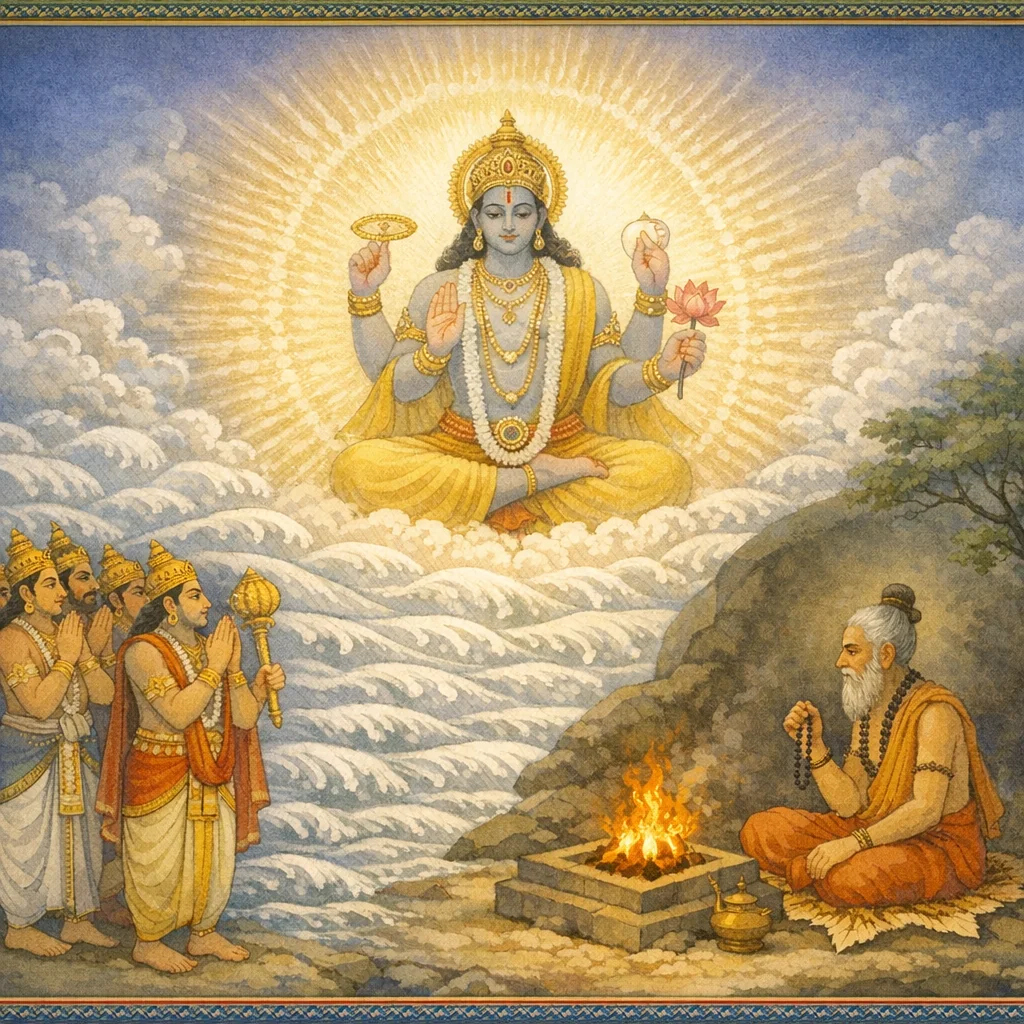
Sanaka teaches Nārada that śraddhā is the root of all dharma and bhakti the life-force of every siddhi: without devotion, dāna, tapas, and even Aśvamedha-like yajñas are fruitless, while with faith even small acts yield lasting puṇya and fame. He weds bhakti to varṇāśrama-ācāra, declaring that one who abandons prescribed conduct becomes patita, and that neither Vedānta learning, pilgrimage, nor sacrifice can save a forsaker of ācāra. Bhakti arises from sat-saṅga, gained through prior merit; the virtuous dispel inner darkness through well-spoken instruction. When Nārada asks the marks and destiny of Bhagavān’s devotees, Sanaka introduces Mārkaṇḍeya’s secret teaching. The chapter then turns cosmological and theistic: Viṣṇu as the supreme Light at pralaya, the gods’ hymn at the Kṣīra-sāgara, and Viṣṇu’s gracious assurance. Mṛkaṇḍu’s tapas and stotra culminate in Viṣṇu’s boon—His promise to be born as the sage’s son—setting forth bhakti’s saving power in narrative form.
Shlokas
Verse 1
सनक उवाच । श्रद्धापूर्वाः सर्वधर्मा मनोरथफलप्रदाः । श्रद्धयासाध्यते सर्वं श्रद्धया तुष्यते हरिः ॥ १ ॥
Sanaka said: All forms of dharma are rooted in śraddhā (faith) and bestow the fruits one longs for. By faith everything is accomplished, and by faith Hari is pleased.
Verse 2
भक्तिर्भक्त्यैव कर्त्तव्यातथा कर्माणि भक्तितः । कर्मश्चद्धाविहीनानि न सिध्यन्तिं द्विजोत्तमाः ॥ २ ॥
Bhakti is to be performed through bhakti itself; likewise, ritual actions (karma) should be undertaken from devotion. Deeds devoid of śraddhā do not succeed, O dvijottama, best of the twice-born.
Verse 3
यथाऽलोको हि जन्तूनां चेष्टाकारणतां गतः । तथैव सर्वसिद्धीनां भक्तिः परमकारणम् ॥ ३ ॥
Just as light becomes the very cause that enables living beings to act, so too bhakti is the supreme cause of all attainments and perfections (siddhi).
Verse 4
यथा समस्त लोकानां जीवनं सलिलं स्मृतम् । तथा समस्तसिद्धीनां जीवनं भक्तिरिष्यते ॥ ४ ॥
Just as water is remembered as the very life of all worlds, so bhakti—devotional love—is held to be the very life of all siddhis, the spiritual attainments.
Verse 5
यथा भूमिं समाश्रित्य सर्वे जीवन्ति जन्तवः । तथा भक्तिं समाश्रित्य सर्वकार्य्याणि साधयेत् ॥ ५ ॥
Just as all beings live by taking refuge in the earth, so by taking refuge in bhakti one brings every work and every aim to fulfillment.
Verse 6
श्रद्धाबँल्लभते धर्म्मं श्रद्धावानर्थमाप्नुयात् । श्रद्धया साध्यते कामः श्रद्धावान्मोक्षमान्पुयात् ॥ ६ ॥
Through śraddhā—faith—one attains dharma; the faithful gain prosperity. By faith desire is fulfilled; and the faithful reach moksha, liberation.
Verse 7
न दानैर्न तपोभिर्वा यज्ञैर्वा बहुदक्षिणैः । भक्तिहीनेर्मुनिश्चेष्ठ तुष्यते भगवान्हरिः ॥ ७ ॥
Not by gifts, nor by austerities, nor even by sacrifices laden with abundant dakṣiṇā—O best of sages—does the Blessed Lord Hari take pleasure in one who is without bhakti.
Verse 8
मेरुमात्रसुवर्णानां कोटिकोटिसहस्रशः । दत्ता चाप्यर्थनाशाय यतोभक्तिविवर्जिता ॥ ८ ॥
Even if one were to give gifts of gold as vast as Mount Meru, in tens of thousands of crores, they still lead only to ruin when they are devoid of bhakti.
Verse 9
अभक्त्या यत्तपस्तप्तैः केवलं कायशोषणम् । अभक्त्या यद्धुतं हव्यं भस्मनि न्यस्तहव्यवत् ॥ ९ ॥
Austerities performed without bhakti are merely the wasting of the body; and oblations offered without bhakti are like sacrificial offerings placed upon ashes.
Verse 10
यत्किञ्चित्कुरुते कर्म्मश्रद्धयाऽप्यणुमात्रकम् । तन्नाम जायते पुंसां शाश्वतं प्रतीदायकम् ॥ १० ॥
Even the smallest act a person performs with śraddhā (faith) becomes for that person a lasting source of recognized merit and renown.
Verse 11
अश्वमेघसहस्त्रं वा कर्म्म वेदोदितं कृतम् । तत्सर्वं निष्फलं ब्रह्मन्यदि भक्तिविवर्जितम् ॥ ११ ॥
Even if one performs a thousand Aśvamedha sacrifices, or any action enjoined by the Vedas, all of it becomes fruitless, O Brahman, if it is devoid of bhakti.
Verse 12
हरिभक्तिः परा नॄणां कामधेनूपमा स्मृता । तस्यां सत्यां पिबन्त्यज्ञाः संसारगरलं ह्यहो ॥ १२ ॥
Supreme devotion to Hari is remembered as being like Kāmadhenu, the wish-fulfilling cow, for human beings. Yet even when that true bhakti is present, the ignorant—alas—still drink the poison of saṃsāra.
Verse 13
असारभूते संसारे सारमेतदजात्मज । भगवद्भक्तसङ्गश्च हरिभक्तिस्तितिक्षुता ॥ १३ ॥
O son of Aja (Brahmā), in this world that is essentially without substance, this alone is the true essence: association with devotees of the Lord, devotion to Hari, and steadfast forbearance.
Verse 14
असूयोपेतमनसां भक्तिदानादिकर्म्म यत् । अवेहि निष्फलं ब्रहंस्तेषां दूरतरो हरिः ॥ १४ ॥
O Brāhmaṇa, know that whatever acts such people perform—bhakti, charity (dāna), and the like—when their minds are filled with fault-finding envy, become fruitless; for to them Hari remains very far away.
Verse 15
परिश्रियाभितत्पानां दम्भाचाररतात्मनाम् । मृषा तु कुर्वतां कर्म तेषां दूरतरो हरिः ॥ १५ ॥
For those who are scorched by worldly hardship yet remain devoted to hypocritical conduct, and who perform actions with deceit, Hari (Vishnu) stays far away from them.
Verse 16
पृच्छतां च महाधर्म्मान्वदतां वै मृषा च तान् । धर्मेष्वभक्तिमनसां तेषां दूरतरो हरिः ॥ १६ ॥
Even for those who ask about the highest dharmas, and even for those who speak of them yet speak falsely, and for those whose minds are devoid of devotion while engaged in religious acts—Hari remains far away from them.
Verse 17
वेदप्रणिहितो धर्म्मो धर्म्मो वेदो नारायणः परः । तत्राश्रद्धापरा ये तु तेषां दूरतरो हरिः ॥ १७ ॥
Dharma is established by the Veda; and the Veda itself is Dharma—supreme is Nārāyaṇa. But for those who remain devoted to disbelief, lacking śraddhā in that, Hari stands far away.
Verse 18
यस्य धर्म्मविहीनानि दिनान्यायान्ति यान्ति च । स लोहकारभस्त्रेव श्वसन्नपि न जीवति ॥ १८ ॥
A person whose days come and go devoid of dharma is like a blacksmith’s bellows: though breathing in and out, he does not truly live.
Verse 19
धर्मार्थकाममोक्षाख्याः पुरुषार्थाः सनातनाः । श्रद्धावतां हि सिध्यन्ति नान्यथा ब्रह्मनन्दन ॥ १९ ॥
Dharma, Artha, Kama, and Moksha—these are the eternal aims of human life. They are truly fulfilled only by those endowed with śraddhā (faith); not otherwise, O son of Brahma.
Verse 20
स्वाचारमनतिक्रम्य हरिभक्तिपरो हि यः । स याति विष्णुभवनं यद्वै पश्यन्ति सूरयः ॥ २० ॥
One who does not transgress his own proper conduct (svācāra) and is devoted to Hari in bhakti indeed goes to the abode of Viṣṇu—that realm beheld by the wise seers.
Verse 21
कुर्वन्वेदोदितान्धर्म्मान्मुनीन्द्र स्वाश्रमोचितान् । हरिध्यानपरोयस्तु स याति परमं पदम् ॥ २१ ॥
O best of sages, one who performs the Veda-enjoined duties appropriate to one’s own āśrama, while remaining devoted to meditation on Hari, attains the supreme state.
Verse 22
आचारप्रभवो धर्मः धर्म्मस्य प्रभुरच्युतः । आश्रमाचारयुक्तेन पूजितः सर्वदा हरिः ॥ २२ ॥
Dharma arises from proper conduct (ācāra), and the Lord Acyuta is the supreme authority over dharma. Therefore, one established in the right disciplines of the āśramas should ever worship Hari.
Verse 23
यः स्वाचारपरिभ्रष्टः साङ्गवेदान्तगोऽपि वा । स एव पतितो ज्ञेयो यतः कर्मबहिष्कृतः ॥ २३ ॥
Even if one has mastered Vedānta along with its auxiliary disciplines, if he has fallen away from right conduct (svācāra), he alone should be known as ‘fallen’—for he is excluded from Vedic duties and rites.
Verse 24
हरिभक्तिपरि वाऽपि हरिध्यानपरोऽपि वा । भ्रष्टो यः स्वाश्रमाचारात्पतितः सोऽभिधीयते ॥ २४ ॥
Even if one is devoted to Hari, or intent on meditating upon Hari, if one has fallen away from the conduct prescribed for one’s own āśrama, one is called a “patita” (fallen person).
Verse 25
वेदो वा हरिभक्तिर्वा भक्तिर्वापि महेश्वरे । आचारात्पतितं मूढं न पुनाति द्विजोत्तम ॥ २५ ॥
Whether it be the Veda, devotion to Hari, or even devotion to Maheśvara—none of these purify a deluded person who has fallen away from right conduct (ācāra), O best of the twice-born.
Verse 26
पुण्यक्षेत्राभिगमनं पुण्यतीर्थनिषेवणम् । यज्ञो वा विविधो ब्रह्मंस्त्यक्ताचारंन रक्षति ॥ २६ ॥
Visiting sacred regions, resorting to holy pilgrimage-fords (tīrtha), or even performing various sacrifices (yajña)—O Brāhmaṇa—do not protect one who has abandoned right conduct (ācāra).
Verse 27
आचारात्प्राप्यते स्वर्ग आचारात्प्राप्यते सुखम् । आचारात्प्राप्यते मोक्ष आचारात्किं न लभ्यते ॥ २७ ॥
Through right conduct (ācāra) one attains heaven; through right conduct one attains happiness. Through right conduct one attains liberation (mokṣa)—what indeed is not obtained through right conduct?
Verse 28
आचाराणांतु सर्वेषां योगानां चैव सत्तम् । हरिभक्तेपरि तथा निदानं भक्तिरिष्यते ॥ २८ ॥
Among all codes of conduct and among all yogic disciplines, O best of the virtuous, devotion (bhakti) is declared to be the decisive cause—especially when it is devotion to Hari.
Verse 29
भक्त्यैव पूज्यते विष्णुर्वाञ्छितार्थफलप्रदः । तस्मात्समस्तलोकानां भक्तिर्मातेति गीयते ॥ २९ ॥
Vishnu, the bestower of the fruits of one’s desired aims, is worshipped solely through bhakti (devotion). Therefore, in all the worlds, devotion is praised as a mother.
Verse 30
जीवन्ति जन्तवः सर्वे यथा मातराश्रिताः । तथा भक्तिं समाश्रित्य सर्वे जीवन्ति धार्म्मिकाः ॥ ३० ॥
Just as all creatures live by depending on their mother, so too do all the righteous live by taking refuge in bhakti (devotion).
Verse 31
स्वाश्रमाचारयुक्तस्य हरिभक्तिर्यदा भवेत् । न तस्य त्रिषु लोकेषु सदृशोऽस्त्यजनन्दन ॥ ३१ ॥
O descendant of Aja (Brahmā), when devotion to Hari arises in one who is established in the conduct of one’s own āśrama, there is none equal to him in the three worlds.
Verse 32
भक्त्या सिध्यन्ति कर्म्माणि कर्म्माणि कर्म्माभिस्तुष्यते हरिः । तस्मिंस्तुष्टे भवेज्ज्ञानं ज्ञानान्मोक्षमवाप्यते ॥ ३२ ॥
Through bhakti, ritual duties are perfected; by those very duties Hari is pleased. When He is pleased, true knowledge arises, and from that knowledge one attains mokṣa (liberation).
Verse 33
भक्तिस्तु भगवद्भक्तसङ्गेन खलु जायते । सत्सङ्गं प्राप्यते पुम्भिः सुकृतैः पूर्वसञ्चितैः ॥ ३३ ॥
Devotion truly arises through association with the Lord’s devotees. And one attains such holy company (satsaṅga) by the merit of virtuous deeds accumulated in the past.
Verse 34
वर्णाश्रमाचाररता भगवद्भक्तिलालसाः । कामादिदोष्नि र्मुक्तास्ते सन्तो लोकशिक्षकाः ॥ ३४ ॥
Those devoted to the duties of varṇa and āśrama, yearning for bhakti to the Bhagavān, and freed from faults such as desire—such are the true saints, the teachers of the world.
Verse 35
सत्ङ्गः परमो ब्रह्मन्न लभ्येताकृतात्मनाम् । यदि लभ्येत विज्ञेयं पुण्यं जन्मान्तरार्जितम् ॥ ३५ ॥
O Brahmin, the highest good is sat-saṅga, holy company, yet it is not attained by those who have not disciplined the inner self. If one does obtain it, know it to be the fruit of merit earned in previous births.
Verse 36
पूर्वार्जितानि पापानि नाशमायान्ति यस्य वै । सत्सङ्गतिर्भवेत्तस्य नान्यथा घटते हि सा ॥ ३६ ॥
For one who attains sat-saṅga, the company of the virtuous, sins accumulated from the past surely come to destruction. Such holy association arises for him—indeed, it does not occur otherwise.
Verse 37
रविर्हि रशिमजालेन दिवा हन्तिबहिस्तमः । सन्तः सूक्तिमरीच्योश्चान्तर्ध्वान्तं हि सर्वदा ॥ ३७ ॥
Just as the sun, by its network of rays, destroys the outer darkness by day, so do the virtuous—through the rays of well-spoken words—always dispel the inner darkness of ignorance.
Verse 38
दुर्लभाः पुरुषा लोके भगवद्भक्तिलालसाः । तेषां सङ्गो भवेद्यस्य तस्य शान्तिर्हि शाश्वती ॥ ३८ ॥
Rare indeed in this world are those who long for bhakti to the Bhagavān. One who gains the company of such devotees attains truly everlasting peace.
Verse 39
नारद उपाच । किंलक्षणा भागवतास्ते च किं कर्म्म कुर्वते । तेषां लोको भवेत्कीदृक्तत्सर्वं ब्रूहि तत्त्वतः ॥ ३९ ॥
Nārada said: “What are the marks of the Bhāgavatas, the devotees of Bhagavān, and what deeds do they perform? What world (destiny) do they attain? Tell me all this, in accordance with the truth.”
Verse 40
त्वं हि भक्तो रमेशस्य देवदेवस्य चक्रिणः । एतान्निगदितुं शक्तस्त्वतो नास्त्यधिकोऽपरः ॥ ४० ॥
For you are a devotee of Rameśa—the God of gods, the bearer of the discus. You are able to proclaim these matters; in this there is none superior to you, nor any equal.
Verse 41
सनक उवाच । श्रृणु ब्रह्मन्परं गुह्यं मार्कण्डेयस्य धीमनः । यमुवाच जगन्नाथो योगनिद्राविमोचितः ॥ ४१ ॥
Sanaka said: “O Brahmin, listen to the supreme and most secret teaching of the wise Mārkaṇḍeya—what Jagannātha, the Lord of the universe, spoke to him after being released from yogic sleep.”
Verse 42
योऽसौ विष्णुः परं ज्योतिर्देवदेवः सनातनः । जगदूपी जगत्कर्त्ता शिवब्रह्म स्वरुपवान् ॥ ४२ ॥
That very Viṣṇu is the supreme Light—the God of gods, eternal. He is the very form of the universe and the maker of the universe, possessing the nature of Śiva and Brahmā as well.
Verse 43
युगान्ते रौद्ररुपेण ब्रह्माण्डलसबृंहितः । जगत्येकार्णवीभूते नष्टे स्थावरजङ्गमे ॥ ४३ ॥
At the end of the age, assuming a fierce, Rudra-like form and filling the whole cosmic sphere, when the world becomes a single ocean and all beings—both the unmoving and the moving—are destroyed—
Verse 44
भगवानेव शेषात्मा शेते वटदले हरिः । असंख्याताब्जजन्माद्यैराभूषिततनूरूहः ॥ ४४ ॥
Hari Himself—whose inner essence is Śeṣa—reclines upon a banyan leaf, His form adorned with countless wondrous signs, such as lotus-births and other sacred marks.
Verse 45
पादाङ्गुष्टाग्रनिर्यातगङ्गाशीताम्बुपावनः । सूक्ष्मात्सूक्ष्मतरो देवो ब्रह्माण्डग्रासंबृंहितः ॥ ४५ ॥
From the tip of His great toe the Gaṅgā springs forth—her cool waters purifying all. He, the Divine, is subtler than the subtlest, yet vast enough to encompass even the swallowing of the entire brahmāṇḍa, the cosmic egg.
Verse 46
वटच्छदे शयानोऽभूत्सर्वशक्तिसमन्वितः । तस्मिन्स्थाने महाभागो नारायणपरायणः । मार्कंडेयः स्थिनस्तस्य लीलाः पश्यन्महेशितुः ॥ ४६ ॥
Lying beneath the banyan’s canopy, he became endowed with all powers. In that very place the greatly fortunate sage Mārkaṇḍeya—wholly devoted to Nārāyaṇa—remained, beholding the Supreme Lord’s divine līlā.
Verse 47
ऋषय ऊचुः । तस्मिन्काले महाघोरे नष्टे स्थावरजङ्गमे । हरिरेकः स्थित इति मुने पूर्वं हि शुश्रुम ॥ ४७ ॥
The sages said: “O sage, we have indeed heard before that, at that most dreadful time—when all that is immovable and movable has perished—Hari alone remains.”
Verse 48
जगत्येकार्णवीभूते नष्टे स्थावरंजगमे । सर्वग्रस्तेन हरिणा किमर्थं सोऽवशेषितः ॥ ४८ ॥
When the world had become a single ocean and all moving and unmoving beings were destroyed, why was he left remaining by Hari, who had swallowed everything?
Verse 49
परं कौतूहलं ह्यत्रं वर्त्ततेऽतीव सूत नः । हरिकीर्तिसुधापाने कस्यालस्यं प्रजायते ॥ ४९ ॥
O Sūta, we are filled here with the highest eagerness indeed. For who could ever feel laziness when drinking the nectar of Hari’s glorification?
Verse 50
सूत उवाच । आसीन्मुनिर्महाभागो मृकण्डुरिति विश्रुतः । शालग्रामे महातीर्थे सोऽतप्यत महातपाः ॥ ५० ॥
Sūta said: There once was a greatly fortunate sage, renowned by the name Mṛkaṇḍu. That great ascetic performed austere penance at the great sacred ford (tīrtha) of Śālagrāma.
Verse 51
युगानाम युतं ब्रह्मन्गृणन्ब्रह्म सनातनम् ॥ट । निराहारः क्षमायुक्तः सत्यसन्धो जितेन्द्रियः ॥ ५१ ॥
O Brahmin, for ten thousand yugas he praised the eternal Brahman; living without food, endowed with forbearance, firm in truth, and having conquered the senses.
Verse 52
आत्मवत्सर्वभूतानि पश्यन्विषयनिःस्पृहः । सर्वभूतहितो दान्त स्तताप सुमहत्तपः ॥ ५२ ॥
Seeing all beings as his own self, free from craving for sense-objects, benevolent toward all creatures, and self-controlled, he performed exceedingly great austerity.
Verse 53
तत्तापःशङ्किताः सर्वे देवा इन्द्रादयस्तदा । परेशं शरणं जग्मुर्नारायणमनामयम् ॥ ५३ ॥
Then all the gods—Indra and the rest—alarmed by that burning affliction, went for refuge to the Supreme Lord, Nārāyaṇa, who is free from all disease and distress.
Verse 54
क्षीराब्धेरुत्तरं तीरं संप्राप्यत्रिदिवौकसः । तुष्टुवुर्देवदेवेशं पह्मनाभं जगद्गुरुम् ॥ ५४ ॥
Having reached the northern shore of the Ocean of Milk, the dwellers of heaven praised the Lord of lords, Padmanābha (Viṣṇu), the Guru of the universe.
Verse 55
देवा ऊचुः । नारायणाक्षरानन्त शरणागतपालक । मृकण्डुतपसा त्रस्तान्पाहि नः शरणागतान् ॥ ५५ ॥
The gods said: “O Nārāyaṇa—imperishable Akṣara, endless Ananta, protector of those who seek refuge! Terrified by Mṛkaṇḍu’s austerity, protect us who have come to You for shelter.”
Verse 56
जय देवाधिदेवेश जय शङ्खगदाधर । जयो लोकस्वरुपाय जयो ब्रह्माण्डहेतवे ॥ ५६ ॥
Victory to You, O Lord over the gods, Supreme Divine! Victory to You, bearer of the conch and mace. Victory to You who are the very form of the worlds; victory to You, the very cause of the cosmic egg (the universe).
Verse 57
नमस्ते देवदेवेश नमस्ते लोकपावन । नमस्ते लोकनाथाय नमस्ते लोकसाक्षिणे ॥ ५७ ॥
Salutations to You, Lord of the gods; salutations to You, purifier of the worlds. Salutations to You, Lord of the worlds; salutations to You, the Witness of the worlds.
Verse 58
नमस्ते ध्यानगम्याय नमस्ते ध्यानहेतवे । नमस्ते ध्यानरुपाय नमस्ते ध्यानपाक्षिणे ॥ ५८ ॥
Salutations to You who are attainable through meditation; salutations to You who are the very cause of meditation. Salutations to You whose form is meditation itself; salutations to You who are the supporting wing of meditation.
Verse 59
केशिहन्त्रे नमस्तुभ्यं मधुहन्त्रे परात्मने । नमो भूम्यादिरूपाय नमश्चैतन्यरुपिणे ॥ ५९ ॥
Salutations to You, slayer of Keśī; salutations to You, slayer of Madhu, the Supreme Self. Salutations to You whose form is the earth and the other elements; salutations to You whose very nature is pure consciousness.
Verse 60
नमो ज्येष्टाय शुद्धाय निर्गुणाय गुणात्मने । अरुपाय स्वरुपाय बहुरुपाय ते नमः ॥ ६० ॥
Salutations to You—the Most Ancient, the Pure; beyond all qualities yet the very essence within qualities; formless yet of true form; one and yet appearing in many forms—salutations to You.
Verse 61
नमो ब्रह्मण्यदेवाय गोब्राह्मणहिताय च । जगद्धिताय कृष्णाय गोविन्दाय नम्नोमः ॥ ६१ ॥
Salutations again and again to Kṛṣṇa—Govinda, the divine protector of the virtuous—who seeks the welfare of cows and Brāhmaṇas, and who works for the good of the entire world.
Verse 62
नमो हिरण्यगर्भाय नमो ब्रह्मादिरुपिणे । नमः सूर्य्यादिरुपाय हव्यकव्यभुजे नमः ॥ ६२ ॥
Salutations to Hiraṇyagarbha; salutations to the One who assumes the form of Brahmā and the other deities. Salutations to the One whose form is the Sun and the rest; salutations to the eater of the oblations offered to gods and to ancestors.
Verse 63
नमो नित्याय वन्द्याय सदानन्दैकरुपिणे । नमः स्मृतार्तिनाशाय भूयो भूयो नमो नमः ॥ ६३ ॥
Salutations to the Eternal One, worthy of reverence, whose very form is ever-bliss. Salutations to Him who destroys the distress of those who remember Him; again and again, my salutations—salutations.
Verse 64
एवं देवस्तुतिं श्रुत्वा भगवान्कमलापतिः । प्रत्यक्षतामगात्तेषां शङ्कचत्रगदाधरः ॥ ६४ ॥
Thus, having heard their hymn of praise to the devas, the Blessed Lord—Kamalāpati, consort of Lakṣmī—became manifest before them, bearing the conch, the discus, and the mace.
Verse 65
विकचाम्बुजपत्राक्षं सूर्य्यकोटिसमप्रभम् । सर्वालङ्कारसंयुक्तं श्रीवत्साङ्कितवक्षसम् ॥ ६५ ॥
His eyes were like fully blossomed lotus petals; His radiance equaled that of tens of millions of suns. Adorned with every ornament, His chest bore the sacred mark of Śrīvatsa.
Verse 66
पीताम्बरधरं सौम्यं स्वर्णयज्ञोपवीतिनम् । स्तृयमानं मुनिवरैः पार्षदप्रवरावृत्तम् ॥ ६६ ॥
Wearing yellow garments, gentle and auspicious in appearance, and bearing a golden sacred thread (yajñopavīta), He was being praised by the foremost sages, surrounded on all sides by His best attendants.
Verse 67
तं दृष्य्वा देवसंघास्ते तत्तेजोहततेजसः । नमश्चक्रुर्मुदा युक्ता अष्टांगौरवनिं गताः ॥ ६७ ॥
Seeing Him, those assemblies of devas—whose own radiance was outshone by His splendor—joyfully offered salutations and, with reverence, prostrated themselves in the eight-limbed obeisance (aṣṭāṅga).
Verse 68
ततः प्रसन्नो भगवान्मेघगंभीरनिस्वनः । उवाच प्रीणयन्देवान्नतानिन्द्रपुरोगमान् ॥ ६८ ॥
Then the Blessed Lord—whose voice was deep like the rumbling of clouds—became gracious and spoke, pleasing the bowed-down devas, led by Indra.
Verse 69
श्रीभगवानुवाच । जाने वो मानसं दुःखं मृकण्डुतपसोद्गम् । युष्मान्न बाधते देवाः स ऋषिः सज्जनाग्राणीः ॥ ६९ ॥
The Blessed Lord said: “I know the sorrow in your minds that has arisen from Mṛkaṇḍu’s austerities. The gods do not trouble you; that sage is foremost among the virtuous.”
Verse 70
संपद्भिः संयुता वापि विपद्भिश्चापि सज्जनाः । सर्वथान्यं न बाधन्ते स्वप्नेऽपि सुरसत्तमाः ॥ ७० ॥
Whether endowed with prosperity or confronted by adversity, the noble do not harm others in any way—indeed, not even in a dream, O best of the gods.
Verse 71
सततं बाध्यमानोऽपि विषयाख्यैररातिभिः । अविधायात्मनो रक्षामन्यान्द्वेष्टि कथं सुधीः ॥ ७१ ॥
Even though one is constantly assailed by enemies called sense-objects, how can a wise person, without first securing his own protection, come to hate others?
Verse 72
तापत्रयाभिधानेन बाध्यमानो हि मानवः । अन्यं क्रीडयितुं शक्तः कथं भवति सत्तमः ॥ ७२ ॥
For a human being, indeed, when afflicted by what is called the threefold misery, how can he—O best of the good—have the capacity to toy with or trifle with another?
Verse 73
कर्मणा मनसा वाचा बाधते यः सदा परान् । नित्यं कामादिभिर्युक्तो मूढधीः प्रोच्यते तु सः ॥ ७३ ॥
He who constantly harms others by deed, by thought, and by speech, and who is ever bound up with desire and the like—such a person is indeed called “deluded in intellect.”
Verse 74
यो लोकहितकृन्मर्त्यो गतासुर्यो विमत्सरः । निःशङ्गः प्रोच्यते सद्भिरिहामात्र च सत्तमाः ॥ ७४ ॥
That mortal who works for the welfare of the world, free from envy and without attachment—such a one is declared by the good to be a true “sattama” (best among the virtuous) here in this very life.
Verse 75
सशङ्कः सर्वदा दुःखी निःशङ्कः सुखमाप्नुयात् । गच्छध्वं स्वालयं स्वस्थाः क्रीडयिष्यति वो न सः ॥ ७५ ॥
One who is full of suspicion is always miserable; one who is free from suspicion attains happiness. Go now to your own homes in peace—he will not trouble you or play tricks on you anymore.
Verse 76
भवतां रक्षकश्चाहं विहरध्वं यथासुखम् । इति दत्वा वरं तेषामतसीकुसुमप्रभः ॥ ७६ ॥
“I too shall be your protector; dwell and move about as you please, in comfort.” Having thus granted them this boon, He—radiant like the blossom of the flax (atasī)—continued onward.
Verse 77
पश्यतामेव देवानां तत्रैवान्तरधीयत । तुष्टात्मानः सुरगणां ययुर्नाकं यथागतम् ॥ ७७ ॥
Even as the gods were watching, he vanished right there. Pleased at heart, the hosts of devas then returned to heaven, just as they had come.
Verse 78
मृकण्डोरपि तुष्टात्मा हरिः प्रत्यक्षतामगात् । अरुपं परमं ब्रह्मस्वप्रकाशं निरञ्जनम् ॥ ७८ ॥
Pleased at heart even with Mṛkaṇḍu, Hari became directly manifest—He who is the formless, supreme Brahman, self-luminous and stainless.
Verse 79
अतसीपुष्पसंकाशं पीतवाससमच्युतम् । दिव्यायुधधरं दृष्ट्वा मृकण्डुर्विस्मितोऽभवत् ॥ ७९ ॥
Seeing the Imperishable Lord Acyuta—radiant like the atasi blossom, clad in yellow garments and bearing divine weapons—Mṛkaṇḍu was filled with wonder.
Verse 80
ध्यानादुन्मील्य नयनं अपश्यद्धरिमग्रतः । प्रसन्नवदनं शान्तं धातारं विश्वतेजसम् ॥ ८० ॥
Opening his eyes from meditation, he beheld Hari before him—gracious of face, serene and tranquil, the Sustainer, radiant with the splendor of the whole universe.
Verse 81
रोमाञ्चितशरीरोऽसावानन्दाश्रुविलोचनः । ननाम दण्डवद्भूमौ देवदेव सनातनम् ॥ ८१ ॥
His body thrilled with rapture and his eyes brimmed with tears of joy; he bowed to the ground like a staff, in reverence to the eternal God of gods.
Verse 82
अश्रुभिः क्षालयंस्तस्य चरणौ हर्षसंभवैः । शिरस्यञ्चलिमाधाय स्तोतुं समुपचक्रमे ॥ ८२ ॥
Washing His feet with tears born of joy, and placing his folded hands upon his head, he then began to offer praise.
Verse 83
मृकण्डुरुवाच । नमः परेशाय परात्मरुपिणे परात्परस्प्रात्परतः पराय । अपारपाराय परानुकर्त्रे नमः परेभ्यः परपारणाय ॥ ८३ ॥
Mṛkaṇḍu said: Salutations to the Supreme Lord, whose very form is the Paramātman—higher than the highest, beyond all beyond; the ultimate Transcendent. Salutations to Him whose farther shore is unreachable, who guides beings toward the Supreme; salutations to the One beyond every transcendent state, who carries all across to the further shore.
Verse 84
यो नामजात्यादिविकल्पहीनः शब्दादिदोषव्यतिरेकरुपः । बहुस्वरुपोऽपि निरञ्जनो यस्तमीशमीढ्यं परमं भजामि ॥ ८४ ॥
I worship that Supreme Lord, worthy of praise—free from all conceptual distinctions such as name and class; whose very nature negates the faults bound up with word and speech; and who, though appearing in many forms, remains stainless and untouched.
Verse 85
वेदान्तवेद्यं पुरुषं पुराणं हिरण्यगर्भादिजगत्स्वरुपम् । अनूपमं भक्ति जनानुकम्पिनं भजामि सर्वेश्वरमादिमीड्यम् ॥ ८५ ॥
I worship the Primeval, praise-worthy Lord of all—known through Vedānta—the eternal Supreme Person whose very nature is the universe beginning with Hiraṇyagarbha, incomparable, and compassionate to devotees.
Verse 86
पश्यन्ति यं वीतसमस्तदोषा ध्यानैकनिष्ठा विगतस्पृहाश्च । निवृत्तमोहाः परमं पवित्रं नतोऽस्मि संसारनिर्वर्त्तकं तम् ॥ ८६ ॥
I bow to Him—the Supreme Purifier, the One who sets the cycle of saṃsāra in motion—whom the faultless, steadfast in meditation alone, free from craving, and rid of delusion, truly behold.
Verse 87
स्मृतार्तिनाशनं विष्णुं शरणागतपालकम् । जगत्सेव्यं जगाद्धाम परेशं करुणाकरम् ॥ ८७ ॥
I take refuge in Viṣṇu—He who destroys distress when remembered in times of fear, who protects those who surrender, who is worthy of worship by the whole world, the abode of the universe, the Supreme Lord, and the ocean of compassion.
Verse 88
एवं स्तुतः स भगवान्विष्णुस्तेन महर्षिणा । अवाप परमां तुष्टिं शङ्खचक्रगदाधरः ॥ ८८ ॥
Thus praised by that great sage, the Blessed Lord Viṣṇu—bearer of the conch, discus, and mace—attained supreme satisfaction.
Verse 89
अयालिङ्ग्य मुनिं देवश्चतुर्भिर्दीर्घबाहुभिः । उवाच परमं प्रीत्या वरं वरय सुव्रत ॥ ८९ ॥
Embracing the sage with His four long arms, the Lord spoke with the highest affection: “O you of noble vows, choose a boon—ask for whatever gift you desire.”
Verse 90
प्रीतोऽस्मि तपसा तेन स्तोत्रेण च तवानघ । मनसा यदभिप्रेतं वरं वरय सुव्रत ॥ ९० ॥
“O blameless one, I am pleased by your austerity and by your hymn of praise. O steadfast in sacred vows, choose a boon—whatever your heart truly desires.”
Verse 91
मृकण्डुरूवाच । देवदेव जगन्नाथ कृतार्थोऽस्मि न संशयः । त्वद्दर्शनमपुण्यानां दुर्लभं च यतः स्मृतम् ॥ ९१ ॥
Mṛkaṇḍu said: “O God of gods, O Lord of the universe, I am fulfilled—without doubt. For it is remembered that the vision of You is hard to attain for those who lack merit.”
Verse 92
ब्रह्माद्या यं न पश्यन्ति योगिनः संशितव्रताः । धर्मिष्टा दीक्षिताश्वापि वीतरागा विमत्सराः ॥ ९२ ॥
Even Brahmā and the other gods do not behold Him—nor do the yogins of firm vows, the most righteous, the initiated, those free from attachment, and those without envy.
Verse 93
तं पश्यामि परं धाम किमतोऽन्यं वरं वृणे । एतेनैव कृतार्थोऽस्मि जनार्दन जगद्गुरो ॥ ९३ ॥
I behold that supreme abode—what other boon could I choose beyond this? By this alone I am fulfilled, O Janārdana, O Guru of the world.
Verse 94
यत्रामस्मृतिमात्रेण महापातकिनोऽपि ये । तत्पदे परमं यान्नि ते दृष्ट्वा किमुनाच्युत ॥ ९४ ॥
In that realm, even those stained by the gravest sins, by mere remembrance of You, attain the supreme state at Your feet. O Acyuta, having beheld You, what could they not attain?
Verse 95
श्रीभगवानुवाच । सत्यत्प्रुक्तं त्वया ब्रह्मान्प्रीतीऽस्मि तव पण्डित । मद्दर्शनं हि विफलं न कदाचिद्भविष्यति ॥ ९५ ॥
The Blessed Lord said: “O Brahman, you have spoken the truth. O learned one, I am pleased with you. Indeed, the vision of Me is never fruitless—never at any time will it be in vain.”
Verse 96
विष्णिर्भक्तकुटुम्बीति वदन्ति विवुधाः सदा । तदेव पालयिष्यामि मज्जनो नानृतं वदेत् ॥ ९६ ॥
The wise always say, “Vishnu is the kinsman of His devotees.” That very truth I shall uphold—let none who belong to Me ever speak falsehood.
Verse 97
तस्मात्त्वत्तपसातुष्टो यास्यामि तव पुत्रताम् । समस्तगुणसंयुक्तो दीर्घजीवी स्वरुपवान् ॥ ९७ ॥
Therefore, pleased by your austerities, I shall be born as your son—endowed with all virtues, long-lived, and possessed of a radiant and proper form.
Verse 98
मम जन्म कुले यस्य तत्कुलं मोक्षगामि वै । मयि तुष्टे मुनिश्रेष्ट किमसाध्यं जगत्रये ॥ ९८ ॥
In whatever family I take birth, that entire lineage surely becomes bound for liberation. O best of sages, when I am pleased, what is there that cannot be accomplished in the three worlds?
Verse 99
इत्युक्त्वा देवदेवशो मुनेरतस्य समीक्षतः । अंतर्दधे मृकण्डुश्च तपसः समवर्तत ॥ ९९ ॥
Having spoken thus, the Lord of lords, while the sage looked on, vanished from sight; and Mṛkaṇḍu too then devoted himself wholly to ascetic practice (tapas).
Verse 100
इति श्रीबृहन्नारदीयपुराणे पूर्वभागे प्रथमपादे भक्तिवर्णनप्रसङ्गेन मार्कण्डेयचरितारम्भो नाम चतुर्थोऽध्यायः ॥ ४ ॥
Thus, in the Śrī Bṛhannāradīya Purāṇa, in the Pūrva-bhāga (Earlier Section), First Pāda, the fourth chapter—called “The Commencement of the Narrative of Mārkaṇḍeya,” arising in the course of describing bhakti (devotion)—is concluded.
Frequently Asked Questions
Because the chapter frames bhakti/śraddhā as the enabling cause (kāraṇa) that makes karma spiritually efficacious: without it, actions remain external and fail to please Hari, who is presented as the ultimate adhikārin (authority) and phala-dātā (giver of results).
It presents them as mutually necessary supports: bhakti is the decisive inner cause, while ācāra and āśrama-dharma are the stabilizing outer disciplines; abandoning prescribed conduct makes one ‘patita,’ and even learning, pilgrimage, or worship cannot purify one who rejects ācāra.
The chapter states a clear chain: bhakti perfects Veda-enjoined duties; those duties please Hari; from Hari’s pleasure arises true knowledge (jñāna); from jñāna comes mokṣa.
It concretizes the teaching by showing tapas and stotra culminating in Viṣṇu’s direct grace, and it opens the Mārkaṇḍeya narrative stream, linking encyclopedic instruction (dharma/bhakti/ācāra) with purāṇic theology and exemplary lives.