The Greatness of Viṣṇu (Viṣṇor Māhātmya)
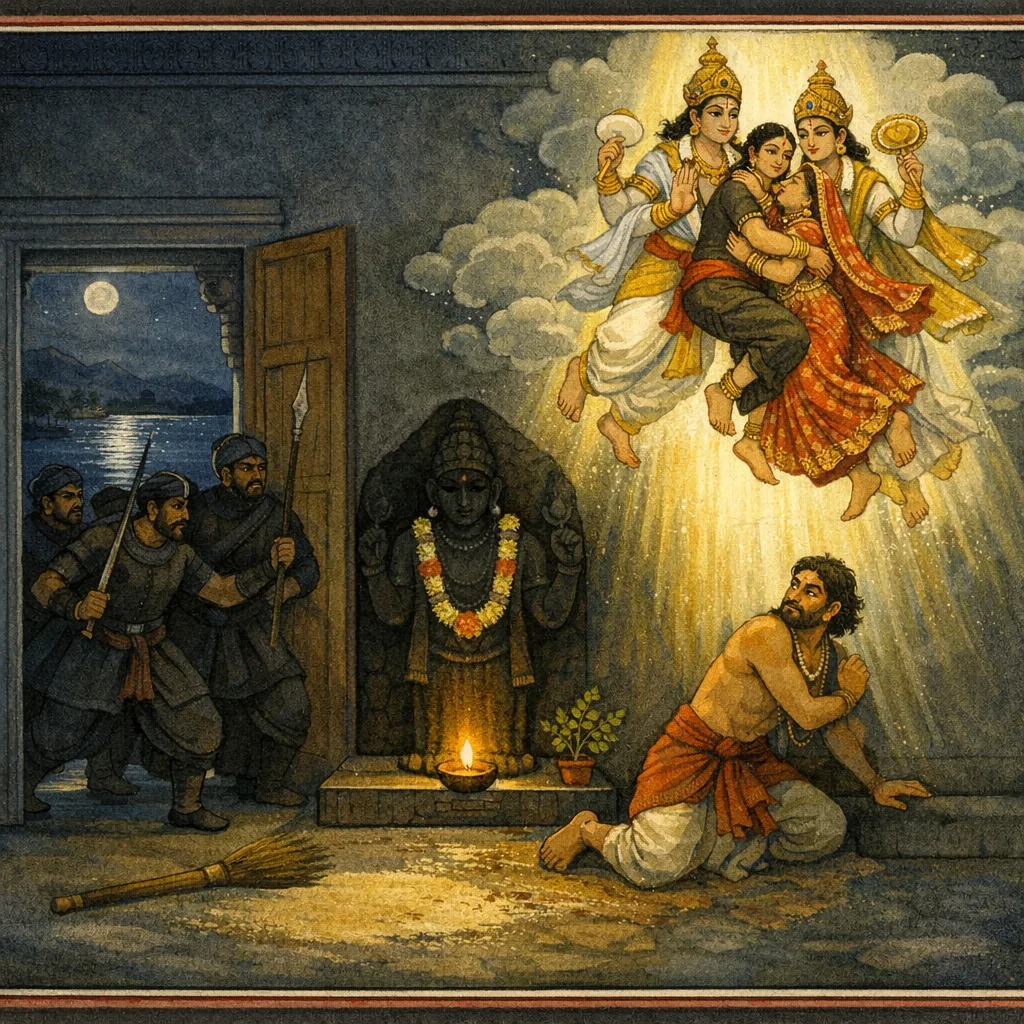
Sanaka teaches a brāhmaṇa assembly the saving power of Hari-kathā, Hari-nāma, and fellowship with devotees (satsaṅga). He praises devotees regardless of outward conduct when they are steady in nāma-kīrtana, and declares that merely seeing, remembering, worshipping, meditating on, or bowing to Govinda carries one across saṃsāra. An “ancient history” follows: King Jayadhvaja of the Lunar line, devoted to cleaning Viṣṇu’s temple and offering lamps on the bank of the Revā/Narmadā, is asked by his purohita Vītihotra about the special fruit of these two acts. Jayadhvaja recounts a chain of past lives: the learned brāhmaṇa Raivata falls into forbidden livelihoods and dies miserably; reborn as the sinful caṇḍāla Daṇḍaketu, he enters an empty Viṣṇu temple at night with a woman. Through incidental contact with temple-cleaning and the setting up of a lamp (even without pure intent), accumulated sin is destroyed; though slain by guards, they are borne by Viṣṇu’s messengers to Viṣṇuloka for vast ages, later returning to earthly prosperity. He concludes that intentional devotion has immeasurable merit, urging worship of Jagannātha/Nārāyaṇa, esteem for satsaṅga, tulasī-sevā and śālagrāma worship, and honor for devotees whose service uplifts many generations.
Shlokas
Verse 1
सनक उवाच । भूयः शृणुष्व विप्रेन्द्र माहात्म्यं परमेष्ठिनः । सर्वपापहरं पुण्यं भुक्तिमुक्तिप्रदं नृणाम् 1. ॥ १ ॥
Sanaka said: O best of brāhmaṇas, listen again to the greatness of Parameṣṭhin; it is holy, it destroys all sins, and it grants people both worldly enjoyment and liberation.
Verse 2
अहो हरिकथालोके पापघ्न पुण्यदायिनी । शृण्वतां वदतां चैव तद्भक्तानां विशेषतः ॥ २ ॥
Ah! In this world, the sacred narration of Hari’s stories (Harikathā) destroys sin and bestows merit—especially for His devotees who listen to it and also speak it.
Verse 3
हरिभक्तिरसास्वादमुदिता ये नरोत्तमाः । नमस्करोम्यहं तेभ्यो यत्सङ्गान्मुक्तिभाग्नरः ॥ ३ ॥
I bow to those best of men who rejoice in tasting the nectar-like rasa of devotion (bhakti) to Hari; for by their company a person becomes a sharer in liberation (mukti).
Verse 4
हरिभक्तिपरा ये तु हरिनामपरायणाः । दुर्वृत्ता वा सुवृत्ता वा तेभ्यो नित्यं नमो नमः ॥ ४ ॥
But those who are devoted to Hari and wholly devoted to Hari’s Name—whether their conduct is bad or good—to them I bow again and again, always.
Verse 5
संसारसागरं तर्तुं य इच्छेन्मुनिपुङ्गव । स भजेद्धरिभक्तानां भक्तान्वै पापहारिणः ॥ ५ ॥
O best of sages, whoever wishes to cross the ocean of saṃsāra should honor and serve the devotees of Hari—those devotees who indeed remove sin.
Verse 6
दृष्टः स्मृतः पूजितो वा ध्यातः प्रणमितोऽपि वा । समुद्धरति गोविन्दो दुस्तराद्भवसागरात् ॥ ६ ॥
Whether He is merely seen, remembered, worshipped, meditated upon, or even bowed to—Govinda lifts one up and delivers one from the hard-to-cross ocean of worldly becoming (bhava-sāgara).
Verse 7
स्वपन् भुञ्जन् व्रजंस्तिष्ठन्नतिष्ठंश्च वदंस्तथा । चिन्तयेद्यो हरेर्नाम तस्मै नित्यं नमो नमः ॥ ७ ॥
Whether sleeping or eating, walking or standing, resting or speaking—whoever continually contemplates the Name of Hari, to that one I bow again and again, forever.
Verse 8
अहो भाग्यमहो भाग्यं विष्णुभक्तिरतात्मनाम् । येषां मुक्तिः करस्थैव योगिनामपि दुर्लभा ॥ ८ ॥
Oh, how blessed—how truly blessed—are those whose whole being delights in bhakti to Viṣṇu; for liberation seems to rest in the palm of their hand, though it is hard to attain even for yogins.
Verse 9
अत्राप्युदाहरन्तीममितिहासं पुरातनम् । वदतां शृण्वतां चैव सर्वपापप्रणाशनम् ॥ ९ ॥
Here too they cite this ancient sacred history; for those who recite it and those who listen, it brings about the destruction of all sins.
Verse 10
आसीत् पुरा महीपालः सोमवंशसमुद्भवः । जयध्वज इति ख्यातो नारायणपरायणः ॥ १० ॥
Long ago there was a protector of the earth, born in the Lunar dynasty (Somavaṃśa), renowned as Jayadhvaja—one wholly devoted to Nārāyaṇa.
Verse 11
विष्णोर्देवालये नित्यं सम्मार्जनपरायणः । दीपदानरतश्चैव सर्वभूतदयापरः ॥ ११ ॥
Ever devoted to cleaning the temple of Viṣṇu, delighting in the offering of lamps, and intent on compassion toward all beings—such a one is established in righteous devotion.
Verse 12
स कदाचिन्महीपालो रेवातीरे मनोरमे । विचित्रकुसुमोपेतं कृतवान्विष्णुमन्दिरम् ॥ १२ ॥
Once, that king built a temple of Lord Viṣṇu on the lovely bank of the Revā, adorning it with flowers of many kinds.
Verse 13
स तत्र नृपशार्दूलः सदा सम्मार्जने रतः । दीपदानपरश्चैव विशेषेण हरिप्रियः ॥ १३ ॥
There, that tiger among kings was always engaged in cleaning the sacred place, devoted to the offering of lamps; and in a special way he became dear to Hari (Viṣṇu).
Verse 14
हरिनामपरो नित्यं हरिसंसक्तमानसः । हरिप्रणामनिरतो हरिभक्तजनप्रियः ॥ १४ ॥
Ever devoted to the Name of Hari, with the mind continually absorbed in Hari; constantly engaged in bowing to Hari, and dear to the community of Hari’s devotees.
Verse 15
वीतिहोत्र इति ख्यातो ह्यासीत्तस्य पुरोहितः । जयध्वजस्य चरितं दृष्ट्वा विस्मयमागतः ॥ १५ ॥
His family priest was renowned by the name Vītihotra. Seeing the deeds of Jayadhvaja, he was struck with astonishment.
Verse 16
कदाचिदुपविष्टं तं राजानं विष्णुतत्परम् । अपृच्छद्वीतिहोत्रस्तु वेदवेदाङ्गपारगः ॥ १६ ॥
Once, as that king—steadfastly devoted to Lord Viṣṇu—sat seated, Vītihotra, who had mastered the Vedas and their auxiliary disciplines (Vedāṅgas), questioned him.
Verse 17
वीतिहोत्र उवाच । राजन्परमधर्मज्ञ हरिभक्तिपरायण । विष्णुभक्तिमतां पुंसां श्रेष्ठोऽसि भरतर्षभ ॥ १७ ॥
Vītihotra said: O King, supreme knower of dharma, wholly devoted to Hari—O bull among the Bharatas—you are foremost among men who are devoted to Viṣṇu.
Verse 18
सम्मार्जनपरो नित्यं दीपदानरतस्तथा । तन्मे वद महाभाग किं त्वया विदितं फलम् ॥ १८ ॥
Ever devoted to cleansing the sacred place and likewise engaged in the gift of lamps—tell me, O greatly fortunate one, what fruit have you come to know from this?
Verse 19
संपादनेन वर्त्तीनां तैल संपादनेन च । संयुक्तोऽसि सदा भद्र यद्विष्णोर्गृहमार्जने ॥ १९ ॥
O good one, you are always engaged in preparing lamp-wicks and procuring oil, and in cleaning the house of Lord Viṣṇu.
Verse 20
कर्माण्यन्यानि सन्त्येव विष्णोः प्रीतिकराणि च । तथापि किं महाभाग एतयोः सततोद्यतः ॥ २० ॥
There are indeed other actions as well that please Lord Viṣṇu. Even so, O greatly fortunate one, why are you constantly devoted to these two practices alone?
Verse 21
सर्वात्मना महापुण्यं नरेश विदितं च यत् । तद् ब्रूहि मे गुह्यतमं प्रीतिर्मयि तवास्ति चेत् ॥ २१ ॥
O king, whatever supremely meritorious truth you know with your whole being—tell me that most secret teaching, if you indeed have affection for me.
Verse 22
पुरोधसैवमुक्तस्तु प्रहसन्स जयध्वजः । विनयावनतो भूत्वा प्रोवाचेदं कृताञ्जलि ॥ २२ ॥
Thus addressed by his royal priest, Jayadhvaja smiled; then, bowing modestly and joining his palms in reverence, he spoke these words.
Verse 23
जयध्वज उवाच । शृणुष्व विप्रशार्दूल मयैवाचरितं पुरा । जातिस्मरत्वाज्जानामि श्रोतॄणां विस्मयप्रदम् ॥ २३ ॥
Jayadhvaja said: “Listen, O tiger among Brahmins, to what I did long ago. Because I remember former births, I know it—something that will astonish the listeners.”
Verse 24
आसीत्पुरा कृतयुगे ब्रह्मन्स्वारोचिषेऽन्तरे । रैवतो नाम विप्रेन्द्रो वेदवेदाङ्गपारगः ॥ २४ ॥
O Brahmin, in ancient times—during the Kṛta Yuga, in the Svārociṣa Manvantara—there lived a foremost Brahmin named Raivata, who had mastered the Vedas and all the Vedāṅgas.
Verse 25
अयाज्ययाजकश्चैव सदैव ग्रामयाजकः । पिशुनो निष्ठुरश्चैव ह्यपण्यानां च विक्रयी ॥ २५ ॥
Blameworthy too is one who performs sacrifices for those unfit to receive them, who habitually serves as a village-priest for hire, who is a slanderer and cruel, and who sells what ought not to be sold.
Verse 26
निषिद्धकर्माचरणात्परित्यक्तः स बन्धुभिः । दरिद्रो दुःखितश्चैव शीर्णाङ्गो व्याधितोऽभवत् ॥ २६ ॥
Because he engaged in forbidden actions, he was abandoned by his kinsmen; he became poor and sorrowful, and his body grew wasted and diseased.
Verse 27
स कदाचिद्धनार्थं तु पृथिव्यां पर्यटन् द्विजः । ममार नर्मदातीरे श्वासकासप्रपीडितः ॥ २७ ॥
Once, that twice-born man, wandering the earth in search of wealth, died on the bank of the Narmadā, tormented by breathlessness and coughing.
Verse 28
तस्मिन्मृते तस्य भार्या नाम्ना बन्धुमती मुने । कामचारपरा सा तु परित्यक्ता च बन्धुभिः ॥ २८ ॥
When he had died, O sage, his wife—named Bandhumatī—became devoted to living as she pleased, and she was cast off by her own relatives.
Verse 29
तस्यां जातोऽस्मि चण्डालो दण्डकेतुरिति श्रुतः । महापापरतो नित्यं ब्रह्मद्वेषपरायणः ॥ २९ ॥
In that womb I was born as a caṇḍāla, known by the name Daṇḍaketu. Ever devoted to great sin, I was constantly intent on hatred toward the Brāhmaṇas and the sacred order.
Verse 30
परदारपरद्र व्यलोलुपो जन्तुहिंसकः । गावश्च विप्रा बहवो निहता मृगपक्षिणः ॥ ३० ॥
Greedy for another man’s wife and another’s wealth, he becomes a killer of living beings; many cows and many Brāhmaṇas are slain, and so too countless deer and birds.
Verse 31
मेरुतुल्यसुवर्णानि बहून्यपहृतानि च । मद्यपानरतो नित्यं बहुशो मार्गरोधकृत् ॥ ३१ ॥
He has stolen much gold—gold as massive as Mount Meru—and is ever addicted to drinking liquor; again and again he blocks the public roads.
Verse 32
पशुपक्षिमृगादीनां जन्तूनामन्तकोपमः । कदाचित्कामसन्तप्तो गन्तुकामो रतिं स्त्रियः ॥ ३२ ॥
He was like Death itself to living creatures—cattle, birds, deer, and the rest. Yet once, scorched by desire, he set out, longing to seek sensual pleasure with women.
Verse 33
शून्यं विष्णुगृहं दृष्ट्वा प्रविष्टश्च स्त्रिया सह । निशि रामोपभोगार्थं शयितं तत्र कामिना ॥ ३३ ॥
Seeing the temple of Viṣṇu to be empty, the lustful man entered it together with a woman; and at night, intending sensual enjoyment, he lay down there.
Verse 34
ब्रह्मन्स्ववस्त्रप्रान्तेन कियद्देशः प्रमार्जितः । यावन्त्यः पांशुकणिकास्तत्र सम्मार्जिता द्विज ॥ ३४ ॥
O Brāhmaṇa, with the edge of your own garment, how much ground have you wiped clean? And how many tiny grains of dust have been swept up there, O twice-born one?
Verse 35
तावज्जन्मकृतं पापं तदैव क्षयमागतम् । प्रदीपः स्थापितस्तत्र सुरतार्थं द्विजोत्तम ॥ ३५ ॥
All the sin accumulated since birth was destroyed at that very moment, O best of the twice-born, when a lamp was set up there for the worship of the Deity.
Verse 36
तेनापि मम दुष्कर्म निःशेषं क्षयमागतम् । एवं स्थिते विष्णुगृहे ह्यागताः पुरपालकाः ॥ ३६ ॥
By that very act my evil karma too was completely destroyed. While things stood thus in the house of Viṣṇu, the city-guards arrived.
Verse 37
जारोऽयमिति मां तां च हतवन्तः प्रसह्य वै । आवां निहत्य ते सर्वे निवृत्ताः पुररक्षकाः ॥ ३७ ॥
Crying, “He is a paramour!”, the city-guards violently slew both her and me. After killing us, all those protectors of the city withdrew.
Verse 38
यदा तदैव सम्प्राप्ता विष्णुदूताश्चतुर्भुजाः । किरीटकुण्डलधरा वनमालाविभूषिताः ॥ ३८ ॥
At that very moment, the messengers of Viṣṇu arrived—four-armed, wearing crowns and earrings, and adorned with garlands of forest flowers.
Verse 39
तैस्तु स्रंपेरितावावां विष्णुदूतैरकल्मषैः । दिव्यं विमानमारुह्य सर्वभोगसमन्वितम् ॥ ३९ ॥
Urged on by those stainless messengers of Viṣṇu, the two of us mounted a divine aerial chariot, endowed with every celestial enjoyment.
Verse 40
दिव्यदेहधरौ भूत्वा विष्णुलोकमुपागतौ । तत्र स्थित्वा ब्रह्मकल्पशतं साग्रं द्विजोत्तम ॥ ४० ॥
Having assumed divine bodies, the two attained Viṣṇu’s world. Remaining there, O best of twice-born, they stayed for a little more than a hundred Brahmā-kalpas.
Verse 41
दिव्यभोगसमायुक्तौ तावत्कालं दिवि स्थितौ । ततश्च भूभिभागेषु देवयोगेषु वै क्रमात् ॥ ४१ ॥
Endowed with celestial enjoyments, they remained in heaven for that length of time; thereafter, in due order, they passed into the divisions of the earth through the ordained connections (yogas) with the gods.
Verse 42
तेन पुण्यप्रभावेण यदूनां वंशसंभवः । तेनैव मेऽच्युता संपत्तथा राज्यमकण्टकम् ॥ ४२ ॥
By the power of that merit, the lineage of the Yadus came into being; and by that same merit, O Acyuta, I obtained unfailing prosperity and a kingdom without thorns—free from obstacles and enemies.
Verse 43
ब्रह्मन्कृत्वोपभोगार्थमेवं श्रेयो ह्यवाप्तवान् । भक्त्या कुर्वन्ति ये सन्तस्तेषां पुण्यं न वेद्म्यहम् ॥ ४३ ॥
O Brahmin, by acting thus for the sake of worldly enjoyment one indeed attains a certain measure of well-being. But as for the virtuous who act with devotion (bhakti), I do not know the limit of their merit.
Verse 44
तस्मात्संमार्जने नित्यं दीपदाने च सत्तम । यतिष्ये परया भक्त्या ह्यहं जातिस्मरो यतः ॥ ४४ ॥
Therefore, O best of the virtuous, I shall always strive—with supreme devotion—in the regular cleansing of the sacred place and in the offering of lamps; for through these practices I have become one who remembers former births.
Verse 45
यः पूजयेज्जगन्नाथमेकाकी विगतस्पृहः । सर्वपापविनिर्मुक्तः प्रयाति परमं पदम् ॥ ४५ ॥
Whoever worships Jagannātha in solitude, free from craving, is released from all sins and attains the supreme abode.
Verse 46
अवशेनापि यत्कर्म कृत्वेमां श्रियमागतः । भक्तिमद्भिः प्रशान्तैश्च किं पुनः सम्यगर्चनात् ॥ ४६ ॥
If even by performing some act unintentionally one attains this prosperity, then what need be said of the fruit of proper worship, rightly offered by devotees who are tranquil and full of faith?
Verse 47
इति भूपवचः श्रुत्वा वीतिहोत्रो द्विजोत्तमः । अनन्ततुष्टिमापन्नो हरिपूजापरोऽभवत् ॥ ४७ ॥
Hearing the king’s words, Vītihotra—the foremost among the twice-born—was filled with boundless joy and became wholly devoted to the worship of Hari (Vishnu).
Verse 48
तस्माच्छृणुष्व विप्रेन्द्र देवो नारायणोऽव्ययः । ज्ञानतोऽज्ञानतो वापि पूजकानां विमुक्तिदः ॥ ४८ ॥
Therefore, O best of Brahmins, listen: the imperishable Lord Nārāyaṇa grants liberation to His worshippers—whether they worship with understanding or even without understanding.
Verse 49
अनित्या बान्धवाः सर्वे विभवो नैव शाश्वतः । नित्यं सन्निहितो मृत्युः कर्तव्यो धर्मसङ्ग्रहः ॥ ४९ ॥
All relatives are impermanent, and prosperity is not everlasting. Death stands ever near; therefore one must steadily gather and practice Dharma.
Verse 50
अज्ञो लोको वृथा गर्वं करिष्यति महोद्धतः । कायः सन्निहितापायो धनादीनां किमुच्यते ॥ ५० ॥
The ignorant world, swollen with arrogance, indulges in pride in vain. When the body itself is ever on the verge of perishing, what need is there to speak of wealth and the rest?
Verse 51
जन्मकोटिसहस्रेषु पुण्यं यैः समुपार्जितम् । तेषां भक्तिर्भवेच्छुद्धा देवदेवे जनार्दने ॥ ५१ ॥
For those who have amassed merit across thousands of crores of births, pure devotion arises toward Janārdana—the God of gods.
Verse 52
सुलभं जाह्नवीस्नानं तथैवातिथिपूजनम् । सुलभाः सर्वयज्ञाश्च विष्णुभक्तिः सुदुर्लभा ॥ ५२ ॥
Bathing in the Jāhnavī (Gaṅgā) is easy to obtain, and so is honoring guests; even the performance of all sacrifices is attainable—yet devotion (bhakti) to Lord Viṣṇu is exceedingly rare.
Verse 53
दुर्लभा तुलसीसेवा दुर्लभः सङ्गमः सताम् । सर्वभूतदया वापि सुलभा यस्य कस्यचित् ॥ ५३ ॥
Service to Tulasī is rare; rare too is the company of the virtuous. Yet compassion toward all beings is, for some person or other, comparatively easy to practice.
Verse 54
सत्सङ्गस्तुलसीसेवा हरिभक्तिश्च दुर्लभा ॥ ५४ ॥
Holy company (satsaṅga), service to Tulasī, and devotion (bhakti) to Lord Hari are all rare to obtain.
Verse 55
दुर्लभं प्राप्य मानुष्यं न तथा गमयेद् बुधः । अर्चयेद्धि जगन्नाथं सारमेतद् द्विजोत्तम ॥ ५५ ॥
Having attained the rare human birth, a wise person should not let it pass in vain. Rather, he should worship Jagannātha, the Lord of the universe. This indeed is the very essence, O best of the twice-born.
Verse 56
तर्त्तुं यदीच्छति जनो दुस्तरं भवसागरम् । हरिभक्तिपरो भूयादेतदेव रसायनम् ॥ ५६ ॥
If a person wishes to cross the hard-to-cross ocean of worldly existence (saṃsāra), let him become devoted to Hari; this alone is the true rasāyana, the sacred elixir.
Verse 57
भ्रातराश्रय गोविन्दं मा विलम्बं कुरु प्रिय । आसन्नमेव नगरं कृतान्तस्य हि दृश्यते ॥ ५७ ॥
Brother, take refuge in Govinda—do not delay, dear one. For the city of Kṛtānta (Death) is indeed seen to be very near.
Verse 58
नारायणं जगद्योनिं सर्वकारणकारणम् । समर्चयस्व विप्रेन्द्र यदि मुक्तिमभीप्ससि ॥ ५८ ॥
O best of Brahmins, worship Narayana—the womb of the universe, the cause of all causes—if you desire liberation.
Verse 59
सर्वाधारं सर्वयोनिं सर्वान्तर्यामिणं विभुम् । ये प्रपन्ना महात्मानस्ते कृतार्था न संशयः ॥ ५९ ॥
Those great souls who have taken refuge in the all-supporting Lord—the source of all, the inner ruler dwelling within all, the all-pervading Supreme—have truly fulfilled the purpose of life; of this there is no doubt.
Verse 60
ते वन्द्यास्ते प्रपूज्याश्च नमस्कार्या विशेषतः । येऽचयन्ति महाविष्णुं प्रणतार्तिप्रणाशनम् ॥ ६० ॥
They are worthy of reverence; they are to be honored and worshipped, and most especially to be saluted—those who worship Mahāviṣṇu, the destroyer of the afflictions of all who bow to Him.
Verse 61
ये विष्णुभक्ता निष्कामा यजन्ति परमेश्वरम् । त्रिःसप्तकुलसंयुक्तास्ते यान्ति हरिमन्दिरम् ॥ ६१ ॥
Those devotees of Viṣṇu who, free from selfish desire, worship the Supreme Lord—together with their thrice-seven (i.e., twenty-one) generations of family—attain the abode of Hari.
Verse 62
विष्णुभक्ताय यो दद्यान्निष्कामाय महात्मने । पानीयं वा फलं वापि स एव भगवत्प्रियः ॥ ६२ ॥
Whoever offers—even water or a fruit—to a great soul, a devotee of Viṣṇu and free from selfish desire, that person alone is truly dear to the Bhagavān.
Verse 63
विष्णुभक्तिपराणां तु शुश्रूषां कुर्वते तु ये । ते यान्ति विष्णुभुवनं यावदाभूतसंप्लवम् ॥ ६३ ॥
But those who render devoted service (śuśrūṣā) to persons wholly dedicated to bhakti for Viṣṇu attain Viṣṇu’s abode and remain there until the cosmic dissolution of the elements.
Verse 64
ये यजन्ति स्पृहाशून्या हरिभक्तान् हरिं तथा । त एव भुवनं सर्वं पुनन्ति स्वाङिघ्रपांशुना ॥ ६४ ॥
Those who, free from craving, worship the devotees of Hari as well as Hari Himself—such people alone purify the entire world with the dust of their own feet.
Verse 65
देवपूजापरो यस्य गृहे वसति सर्वदा । तत्रैव सर्वदेवाश्च तिष्ठन्ति श्रीहरिस्तथा ॥ ६५ ॥
In the house of one who is always devoted to the worship of the Deity, all the gods dwell right there—and Śrī Hari as well abides there.
Verse 66
पूज्यमाना च तुलसी यस्य तिष्ठति वेश्मनि । तत्र सर्वाणि श्रेयांसि वर्द्धन्त्यहरहर्द्विज ॥ ६६ ॥
O twice-born one, in the home where Tulasī resides and is duly worshipped, all auspicious blessings and true prosperities increase day after day.
Verse 67
शालग्रामशिलारूपी यत्र तिष्ठति केशवः । न बाधन्ते ग्रहास्तत्र भूतवेतालकादयः ॥ ६७ ॥
Where Keśava abides in the form of the sacred Śālagrāma stone, there malefic planetary influences do not afflict; nor can spirits, vetālas, and the like cause harm.
Verse 68
शालग्रामशिला यत्र तत्तीर्थं तत्तपोवनम् । यतः सन्निहितस्तत्र भगवान्मधुसूदनः ॥ ६८ ॥
Wherever the sacred Śālagrāma stone is present, that place is truly a tīrtha and a tapovana, for there the Blessed Lord Madhusūdana (Viṣṇu) abides in close presence.
Verse 69
यद् गृहे नास्ति देवर्षे शालग्रामशिलार्चनम् । श्मशानसदृशं विद्यात्तद् गृहं शुभवर्जितम् ॥ ६९ ॥
O divine sage, the house in which there is no worship of the Śālagrāma-śilā should be known as like a cremation-ground; that home is devoid of auspiciousness.
Verse 70
पुराणन्यायमीमांसाधर्मशास्राणि च द्विज । साङ्गा वेदास्तथा सर्वे विष्णो रूपं प्रकीर्तितम् ॥ ७० ॥
O twice-born one, the Purāṇas, Nyāya, Mīmāṃsā, and the Dharmaśāstras—and likewise all the Vedas together with their auxiliary limbs—are proclaimed to be manifestations of Viṣṇu.
Verse 71
भक्त्या कुर्वन्ति ये विष्णोः प्रदक्षिणचतुष्टयम् । तेऽपि यान्ति परं स्थानं सर्वकर्मनिबर्हणम् ॥ ७१ ॥
Those who, with devotion, perform four circumambulations (pradakṣiṇā) of Lord Viṣṇu—even they attain the supreme abode, which destroys all karmic residues.
Verse 72
इति श्रीबृहन्नारदीयपुराणे पूर्वभागे प्रथमपादे विष्णुमाहात्म्यंनामैकोनचत्वारिंशोऽध्यायः ॥ ३९ ॥
Thus ends the thirty-ninth chapter, called “The Greatness of Viṣṇu,” in the First Pāda of the Pūrva-bhāga of the Śrī Bṛhannāradīya Purāṇa.
Frequently Asked Questions
They are presented as highly accessible, repeatable acts of Viṣṇu-sevā (vrata-kalpa in miniature) that generate powerful merit even when performed with imperfect understanding. The Jayadhvaja/Daṇḍaketu narrative illustrates ajñāta-sukṛti: incidental participation in mandira-mārjana and establishing a lamp for worship burns accumulated pāpa and becomes the karmic cause for ascent to Viṣṇuloka and later prosperity—thereby validating these practices as direct instruments of mokṣa-dharma.
It explicitly states that the imperishable Nārāyaṇa grants liberation to worshippers whether they worship with understanding or without understanding, emphasizing the Lord’s grace and the intrinsic potency of devotion-oriented acts (nāma, pūjā, service to devotees).
They are affirmed as ‘forms of Viṣṇu,’ a theological move that subsumes technical disciplines under bhakti: learning and hermeneutics are not rejected but reinterpreted as participating in the divine body of knowledge, consistent with the Purāṇa’s encyclopedic self-presentation.