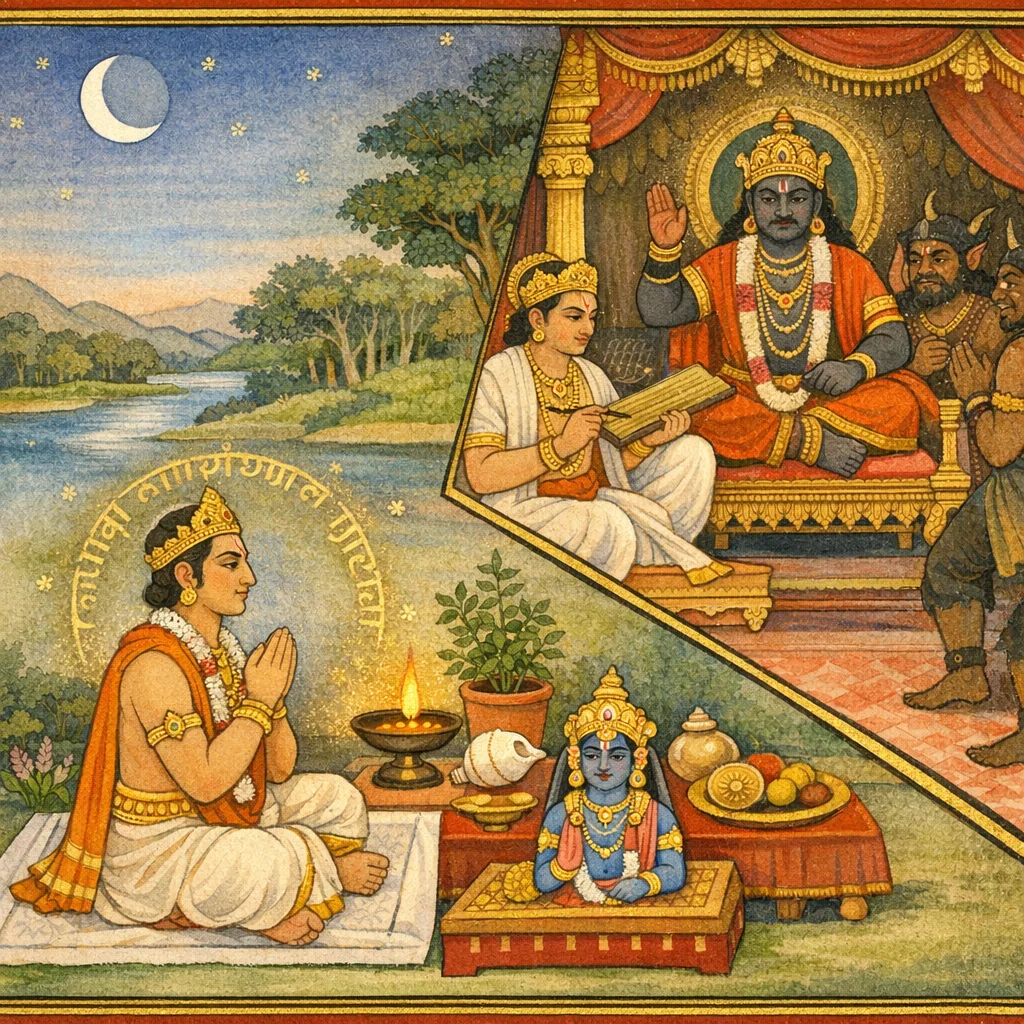
Ekādaśī Vrata-Vidhi and the Galava–Bhadrashīla Itihāsa (Dharmakīrti before Yama)
Sanaka teaches a universally applicable vow of devotion to Viṣṇu: Ekādaśī. He declares it the most meritorious tithi, insists on complete fasting on the eleventh day, and sets a three-day discipline—single meals on Daśamī and Dvādaśī, with strict upavāsa on Ekādaśī. The observance includes bathing, worship of Viṣṇu with mantra and saṅkalpa, night vigil with kīrtana, hearing the Purāṇas, and on Dvādaśī renewed worship followed by feeding brāhmaṇas and giving dakṣiṇā, then eating with restrained speech. Ethical safeguards are added: avoid corrupting company and hypocrisy, stressing inner purity along with austerity. The chapter then relates an itihāsa: Bhadrashīla, child of the sage Gālava, recalls a former birth as King Dharmakīrti, whose accidental Ekādaśī fast and vigil on the Reva lead Citragupta to declare him freed from sins; Yama orders his messengers to keep away from devotees of Nārāyaṇa, revealing the saving power of Ekādaśī and nāma-smaraṇa.
Shlokas
Verse 1
सनक उवाच । इदमन्यत्प्रवक्ष्यामि व्रतं त्रैलोक्यविश्रुतम् । सर्वपापप्रशमनं सर्वकामफलप्रदम् ॥ १ ॥
Sanaka said: I shall now declare another vow, renowned throughout the three worlds—one that pacifies all sins and grants the fruits of all rightful desires.
Verse 2
ब्राह्मणक्षत्रियविशां शूद्राणां चैव योषिताम् । मोक्षदं कुर्वतां भक्त्या विष्णोः प्रियतरं द्विज ॥ २ ॥
O twice-born one, for Brahmins, Kshatriyas, Vaishyas, Shudras, and women alike, nothing is dearer to Vishnu than devotional practice (bhakti) that bestows liberation.
Verse 3
एकादशीव्रतं नाम सर्वाभीष्टप्रदं नृणाम् । कर्त्तव्यं सर्वथा विप्रविष्णुप्रीतिकरं यतः ॥ ३ ॥
The vow called Ekādaśī bestows upon human beings the fulfillment of all desired aims. Therefore, O brāhmaṇa, it should be observed in every way, for it brings delight to Viṣṇu.
Verse 4
एकादश्यां न भुञ्जीत पक्षयोरुभयोपरि । यो भुंक्ते सोऽत्र पापीयान्परत्र नरकं व्रजेत् ॥ ४ ॥
On Ekādaśī one should not eat, whether in the waxing or the waning fortnight. Whoever eats on that day becomes sinful here, and hereafter goes to hell.
Verse 5
उपवासफलं लिप्सुर्जह्याद्भुक्तिचतुष्टयम् । पूर्वापरदिने गत्रावहोरात्रं तु मध्यमे ॥ ५ ॥
One who seeks the fruit of fasting should abandon the fourfold indulgence in eating: on the day before and the day after, renounce rich foods; and on the middle day observe a complete day-and-night fast.
Verse 6
एकादशीदिने यस्तु भोक्तुमिच्छति मानवः । स भोक्तुं सर्वपापानि स्पृहयालुर्नसंशयः ॥ ६ ॥
A person who desires to eat on the day of Ekādaśī is, without doubt, one who is craving to ‘consume’—to take upon himself—all sins.
Verse 7
भवेद्दशम्यामेकाशीद्वादश्यां च मुनीश्वर । एकादश्यां निराहारो यदि मुक्तिमभीप्सति ॥ ७ ॥
O lord among sages, on the tenth day and on the twelfth day one should take only a single meal; and on the eleventh (Ekādaśī) one should remain without food, if one seeks liberation.
Verse 8
यानि कानि च पापानि ब्रह्महत्यादिकानि च । अन्नमाश्रित्य तिष्ठन्ति तानि विप्र हरेश्वर । एकादश्यां निराहारो यदि मुक्तिमभीप्सति ॥ ८ ॥
Whatever sins there are—even grave ones such as brahmahatyā—remain clinging to food. Therefore, O brāhmaṇa, O Lord Hari, if one longs for liberation, one should observe complete fasting on Ekādaśī.
Verse 9
यानि कानि च पापानि ब्रह्महत्यादिकानि च । अन्नमाश्रित्य तिष्ठन्ति तानि च मुनीश्वर । एकादश्यां निराहारो यदि मुक्तिमभीप्सति ॥ ९ ॥
Whatever sins there are—even grave ones such as brahmahatyā—they abide by taking refuge in food. Therefore, O lord among sages, if one seeks liberation, one should remain without food on Ekādaśī.
Verse 10
महापातकयुक्तो वायुक्तो वा सर्व पातकैः । एकादश्यां निराहारः स्थित्वा याति परां गतिम् ॥ १० ॥
Whether burdened with great sins or not, even one tainted by all faults—by remaining without food on Ekādaśī, one attains the supreme state.
Verse 11
एकादशी महापुण्या विष्णोः प्रियतमा तिथिः । संसेव्या सर्वथा विप्रैः संसारच्छेदलिप्सुभिः ॥ ११ ॥
Ekādaśī is supremely meritorious—the dearest lunar day to Viṣṇu. It should always be observed by brāhmaṇas and by all who seek to cut through the bondage of worldly existence.
Verse 12
दशम्यां प्रातरुत्थाय दन्तधावनपूर्वकम् । स्नापयेद्विधिवद्विष्णुं पूजयेत्प्रयतेन्द्रियः ॥ १२ ॥
On the tenth lunar day (Daśamī), rising early in the morning and first performing the cleansing of the teeth, one should bathe Lord Viṣṇu according to the prescribed rite and worship Him with well-controlled senses.
Verse 13
एकादश्यां निराहारो निगृहीतेन्द्रियो भवेत् । शयीत सन्निधौ विष्णोर्नारायणपरायणः ॥ १३ ॥
On Ekādaśī one should fast, restrain the senses, and—wholly devoted to Nārāyaṇa—spend the night in the presence of Lord Viṣṇu.
Verse 14
एकादश्यां तथा स्नात्वा संपूज्य च जनार्दनम् । गन्धपुष्पादिभिः सम्यक् ततस्त्वे वसुदीरयेत् ॥ १४ ॥
On Ekādaśī, after bathing, one should duly worship Janārdana with fragrances, flowers, and the like; thereafter one should recite the utterance beginning with “Vasu…”.
Verse 15
एकादश्यां निराहारः स्थित्वाद्याहं परेऽहनि । भोक्ष्यामि पुण्डरीकाक्ष शरणं मे भवाच्युत ॥ १५ ॥
“Having remained without food on Ekādaśī, today I shall eat on the following day. O lotus-eyed Lord, O Acyuta—be my refuge.”
Verse 16
इमं मन्त्रं समुच्चाय देव देवस्य चक्रिणः । भक्तिभावेन तुष्टात्मा उपवासं समर्पयेत् ॥ १६ ॥
Having duly recited this mantra of the Discus-bearing Lord—the God of gods—one whose heart is satisfied through devotion should offer the fast as an act of worship.
Verse 17
देवस्य पुरतः कुर्याज्जागरं नियतो व्रती । गीतैर्वाद्यैश्च नृत्यैश्च पुराणश्रवणादिभिः ॥ १७ ॥
A disciplined observer of vows should keep a night-vigil in front of the Deity—engaging in devotional singing, instrumental music, dancing, and practices such as listening to the Purāṇas.
Verse 18
ततः प्रातः समुत्थाय द्वादशीदिवसे व्रती । स्नात्वा च विधिवद्विष्णुं पूजयत्प्रयतेन्द्रियः ॥ १८ ॥
Then, rising early on the morning of Dvādaśī, the keeper of the vow—having bathed—should worship Viṣṇu according to the proper rite, with the senses disciplined and restrained.
Verse 19
पञ्चामृतेन संस्नाप्य एकादश्यां जनार्द्दनम् । द्वादश्यां पयसा विप्र हरिसारुपप्यमश्नुते ॥ १९ ॥
O brāhmaṇa, having bathed Janārdana (Lord Viṣṇu) with the five nectars on Ekādaśī, and then with milk on Dvādaśī, one attains a form resembling Hari.
Verse 20
अज्ञानतिमिरान्धस्य व्रतेनानेन केशव । प्रसीद सुमुखो भूत्वा ज्ञानदृष्टिप्रदो भव ॥ २० ॥
O Keśava, I am blinded by the darkness of ignorance. By this vow, be gracious—be kindly disposed, and grant me the vision of true knowledge.
Verse 21
एवं विज्ञाप्य विप्रेन्द्र माधवं सुसमाहितः । ब्रह्मणान्भोजयेच्छक्त्या दद्याद्वै दक्षिणां तथा ॥ २१ ॥
Thus, O best of brāhmins, having duly invoked Mādhava with a well-collected mind, one should feed the brāhmins according to one’s capacity, and likewise give the proper dakṣiṇā.
Verse 22
ततः स्वबन्धुभिः सार्द्धं नारायणपरायणः । कृतपञ्चमहायज्ञः स्वयं भुञ्जीत वाग्यतः ॥ २२ ॥
Thereafter, wholly devoted to Nārāyaṇa, having performed the five great daily sacrifices, one should take one’s meal together with one’s relatives, with speech restrained.
Verse 23
एवं यः प्रयतः कुर्यात्पुण्यमेकादशीव्रतम् । स याति विष्णुभवनं पुनरावृत्तिदुर्लभम् ॥ २३ ॥
Thus, whoever—disciplined and self-restrained—observes the meritorious vow of Ekādaśī attains the abode of Viṣṇu, from which return to rebirth is exceedingly difficult.
Verse 24
उपवासव्रतपरो धर्मकार्यपरायणः । चाण्डालान्पतितांश्चैव नेक्षेदपि कदाचन ॥ २४ ॥
Devoted to fasting-vows and intent on works of dharma, he should never, at any time, even look upon chāṇḍālas and those fallen from right conduct.
Verse 25
नास्तिकान्भिन्नमर्योदान्निन्दकान्पिशुनांस्तथा । उपवास व्रतपरो नालपेच्च कदाचन ॥ २५ ॥
He should not speak with atheists (nāstikas), with those who transgress proper bounds, with slanderers, or with malicious informers. Devoted to fasting and sacred vows, he should never indulge in idle talk.
Verse 26
वृषलीसूतिपोष्टारं वृषलीपतिमेव च । अयाज्ययाजकं चैव नालपेत्सर्वदा व्रती ॥ २६ ॥
A vow-observer should never converse with one who maintains the children of a Śūdra woman (vṛṣalī), nor with the husband of a Śūdra woman, nor with a priest who performs sacrifices for those unfit to receive them.
Verse 27
कुण्डाशिनं गायकं च तथा देवलकाशिनम् । भिषजं काव्यकर्त्तारं देवद्विजविरोधिनम् ॥ २७ ॥
One should avoid one who eats from a kuṇḍa (an improper or unauthorized ritual fire), a professional singer, one who lives by temple-service as a devalaka, a physician as a livelihood (in this context), a mercenary maker of poetry, and one hostile to the gods and the dvijas (the twice-born).
Verse 28
परान्नलोलुपं चैव परस्त्रीनिरतं तथा । व्रतोपवासनिरतो वाङ्मात्रेणापि नार्चयेत् ॥ २८ ॥
One should not worship the Lord, not even by mere speech, if one is greedy for another’s food, addicted to another man’s wife, or absorbed only in vows and fasting without inner purity.
Verse 29
इत्येवमादिभिः शुद्धो वशी सर्वहिते रतः । उपवासपरो भूत्वा परां सिद्धिमवान्पुयात् ॥ २९ ॥
Thus, purified by such disciplines, self-controlled and devoted to the welfare of all beings, one who is steadfast in fasting attains the highest spiritual perfection.
Verse 30
नास्ति गङ्गासमं तीर्थं नास्ति मातृसमोगुरुः । नास्तु विष्णुसमं दैवं तपो नानशनात्परम् ॥ ३० ॥
There is no sacred ford (tīrtha) equal to the Gaṅgā, no teacher equal to one’s mother. There is no deity equal to Viṣṇu, and no austerity higher than fasting.
Verse 31
नास्ति क्षमासमा माता नास्ति कीर्तिसमं धनम् । नास्ति ज्ञानसमो लाभो न च धर्म समः पिता ॥ ३१ ॥
There is no mother equal to forgiveness; there is no wealth equal to good fame. There is no gain equal to knowledge; and there is no father equal to dharma.
Verse 32
न विवेकसमो बन्धुनैकादश्याः परं व्रतम् । अत्राप्युदाहरंतीममितिहासं पुरातनम् ॥ ३२ ॥
There is no friend equal to discernment (viveka), and no vow superior to the observance of Ekādaśī. In this very connection, I shall also cite an ancient traditional account (itihāsa).
Verse 33
संवादं भद्रशीलस्य तत्पितुर्गालवस्य च । पुरा हिगालवो नाम मुनिः सत्यपरायणः ॥ ३३ ॥
In ancient times there was a sage named Gālava, wholly devoted to truth; this is the dialogue of Bhadrashīla and his father, Gālava.
Verse 34
उवास नर्मदातीरे शान्तो दान्तस्तपोनिधिः । बहुवृक्षसमाकीर्णे गजभल्लुनिषेविते ॥ ३४ ॥
He dwelt on the bank of the Narmadā—peaceful, self-restrained, a very treasury of austerity—in a place thick with many trees, frequented by elephants and bears.
Verse 35
सिद्धचारणगन्धर्व यक्षविद्याधरान्विते । कन्दमूलफलैः पूर्णे मुनिवृन्दनिषेदिते ॥ ३५ ॥
It was inhabited by Siddhas, Cāraṇas, Gandharvas, Yakṣas, and Vidyādharas—abounding in bulbs, roots, and fruits—and frequented as a resting-place by multitudes of sages.
Verse 36
गालवो नाम विप्रेन्द्रो निवासमकरोच्चिरम् । तस्याभवद्भद्रशील इति ख्यातः सुतो वशी ॥ ३६ ॥
A foremost Brāhmaṇa named Gālava established a long-standing residence there. To him was born a self-controlled son, renowned by the name Bhadraśīla.
Verse 37
जांतिस्मरो महाभागो नारायणपरायणः । बालक्रीडनकालेऽपि भद्रशीलो महामतिः ॥ ३७ ॥
He remembered his previous births, a greatly fortunate soul, wholly devoted to Nārāyaṇa; even during the playful days of childhood, Bhadrashīla was of noble conduct and lofty understanding.
Verse 38
मृदा च विष्णोः प्रतिमां कृत्वा पूजयते क्षणम् । वयस्यान्बोधयेच्चापि विष्णुः पूज्यो नरैः सदा ॥ ३८ ॥
Even if one fashions an image of Viṣṇu from clay and worships Him only for a moment—and also instructs one’s companions—this teaches that Viṣṇu is ever to be worshiped by human beings.
Verse 39
एकादशीव्रतं चैव कर्त्तव्यमपि पण्डितैः । एवं ते बोधितास्तेन शिशवोऽपि मुनीश्वर ॥ ३९ ॥
“The Ekādaśī vow should certainly be observed—even by the learned. Thus instructed by him, O lord of sages, even mere children became enlightened.”
Verse 40
हरिं मृदैव निर्माय पृथक्संभूय वा मुदा । अर्चयन्ति महाभागा विष्णुभक्तिपरायणाः ॥ ४० ॥
The greatly fortunate, wholly devoted to bhakti for Viṣṇu, fashion an image of Hari from clay; or else, gathering separately with joy, they worship Him.
Verse 41
नमस्कुर्वन्भद्रमतिर्विष्णवे सर्वविष्णवे । सर्वेषां जगतां स्वस्ति भूयादित्यब्रवीदिदम् ॥ ४१ ॥
With auspicious intent, he bowed in reverence to Viṣṇu—the all-pervading Viṣṇu—and said: “May well-being and prosperity arise for all the worlds.”
Verse 42
क्रीडाकाले मुहूर्तं वा मुहूर्तार्द्धमथापि वा । एकादशीति संकल्प्यव्रतं यच्छति केशवे ॥ ४२ ॥
Even during a time of play, whether for a full muhūrta or even for half a muhūrta, if one resolves, “This is Ekādaśī,” and offers that vow to Keśava, it becomes an observance dedicated to Him.
Verse 43
एवं सुचरितं दृष्ट्वा तनयं गालवो मुनिः । अपृच्छद्विस्मयाविष्टः समालिंग्य तपोनिधिः ॥ ४३ ॥
Seeing thus the excellent conduct of his son, the sage Gālava—treasure-house of austerity—embraced him and, overcome with wonder, questioned him.
Verse 44
गालव उवाच । भद्रशील महाभाग भद्रशीलोऽसि सुव्रत । चरितं मंगलं यत्ते योगिनामपि दुर्लभम् ॥ ४४ ॥
Gālava said: O noble-minded, illustrious one—truly you are of auspicious conduct and firm vows. The sacred and blessed course of life that is yours is difficult to attain even for yogins.
Verse 45
हरिपूजापरो नित्यं सर्वभूतहितेरतः । एकादशीव्रतपरो निषिद्धाचारवर्जितः । निर्द्धन्द्वो निर्ममः शान्तो हरिध्यानपरायाणः ॥ ४५ ॥
Always devoted to the worship of Hari, engaged in the welfare of all beings, steadfast in the Ekādaśī vow, avoiding forbidden conduct—free from the pairs of opposites, without possessiveness, tranquil, and wholly dedicated to meditation on Hari.
Verse 46
एवमेतादृशी बुद्धिः कथं जातार्भकस्यते । विनापि महतां सेवां हरिभक्तिर्हि दुर्लभा ॥ ४६ ॥
How has such a noble understanding arisen in you, who are still a mere child? For devotion to Hari is indeed rare—rare even with the service and association of great souls.
Verse 47
स्वभावतो जनस्यास्य ह्यविद्याकामकर्मसु । प्रवर्त्तते मतिर्वत्स कथं तेऽलौकिकी कृतिः ॥ ४७ ॥
By nature, dear child, the mind of people turns toward ignorance, desire, and action. How, then, is your conduct and accomplishment so extraordinary—beyond the worldly?
Verse 48
सत्सङ्गेऽपि मनुष्याणां पूर्वपुण्यातिरेकतः । जायते भगवद्भक्तिस्तदहं विस्मयं गतः ॥ ४८ ॥
Even amid sat-saṅga, the company of the virtuous, devotion (bhakti) to the Bhagavān arises only when the merit of former lives overflows. Seeing this, I am filled with wonder.
Verse 49
पृच्छामि प्रीतिमापन्नस्तद्भवान्वक्तुमर्हति । भद्रशीलो मुनिश्रेष्टः पित्रैवं सुविकल्पितैः ॥ ४९ ॥
Filled with affection, I ask; may you be pleased to explain it. O best of sages, of auspicious conduct—this has been thoughtfully and well conceived by my father.
Verse 50
जातिस्मरः सुकृतात्मा हृष्टप्रहसिताननः । स्वानभ्रुतं यथाव्रतं सर्वं पित्रे न्यवेदयत् ॥ ५० ॥
Remembering his former births, virtuous at heart, with a face bright with joy and gentle laughter, he reported everything to his father—exactly as it had occurred and in keeping with the vow (vrata) he had undertaken.
Verse 51
भद्रशील उवाच । श्रृणु तात मुनिश्रेष्ट ह्यनुभूतं मया पुरा । जातिस्मरत्वाज्जानामि यमेन परिभाषितम् ॥ ५१ ॥
Bhadraśīla said: “Listen, my child—O best of sages—to what I myself experienced long ago. Because I remember my former birth, I know the words spoken by Yama.”
Verse 52
एतच्छ्रत्वा महाभागो गालवो विस्मयोन्वितः । उवाच प्रीतिमापन्नो भद्रशीलं महामतिम् ॥ ५२ ॥
Hearing this, the fortunate Gālava, filled with wonder, spoke with joy to the noble and great-minded Bhadrashīla.
Verse 53
गालव उवाच । कस्त्वं पूर्वं महाभाग किमुक्तं च यमेन ते । कस्य वा केन वा हेतोस्तत्सर्वं वक्तुमर्हसि ॥ ५३ ॥
Gālava said: “O greatly fortunate one, who were you in former times? And what did Yama speak to you? For whose sake—or for what cause—did all this come to pass? Please tell me everything.”
Verse 54
भद्रशील उवाच । अहमासं पुरा तात राजा सोमकुलोद्भवः । धर्मकीर्तिरिति ख्यातो दत्तात्रेयेण शासितः ॥ ५४ ॥
Bhadraśīla said: “Dear one, formerly I was a king born in the Lunar dynasty. I was renowned as Dharmakīrti, and I was instructed and disciplined by Dattātreya.”
Verse 55
नव वर्षसहस्त्राणि महीं कृत्स्त्रमपालयम् । अधर्माश्च तथा धर्मा मया तु बहवः कृताः ॥ ५५ ॥
For nine thousand years I ruled and protected the whole earth; and by me many deeds were done—both adharma and dharma—indeed.
Verse 56
ततः श्रिया प्रमत्तोऽहं बह्वधर्मम कारिषम् । पाषण्डजनसंसर्गात्पाषण्डचरितोऽभवम् ॥ ५६ ॥
Then, intoxicated by prosperity, I committed many acts of adharma; and through association with pāṣaṇḍas (heretics), I myself adopted heretical conduct.
Verse 57
पुरार्जितानि पुण्यानि मया तु सुबहून्यपि । पाषण्डैर्बाधितोऽहं तु वेदमार्गं समत्यजम् ॥ ५७ ॥
Though I had accumulated many merits in the past, harassed and misled by pāṣaṇḍas (heretics), I completely abandoned the path of the Veda.
Verse 58
मखाश्च सर्वे विध्वस्ता कूटयुक्तिविदा मया । अधर्मनिरतं मां तु दृष्ट्वा महेशजाः प्रजाः ॥ ५८ ॥
All the sacrificial rites were ruined by me, skilled in crooked stratagems; and when the creatures born of Maheśa saw me devoted to adharma, they too turned toward adharma.
Verse 59
सदैव दुष्कृतं चक्रुः षष्टांशस्तत्रमेऽभवत् । एवं पापसमाचारो व्यसनाभिरतः सदा ॥ ५९ ॥
They constantly committed evil deeds; and in that matter, a one‑sixtieth share fell to me. Thus, with sinful conduct as his habitual course, he remained ever addicted to vices.
Verse 60
मृगयाभिररतो भूत्वा ह्येकदा प्राविशं वनम् । ससैन्योऽहं वने तत्र हत्वा बहुविधान्मृगान् ॥ ६० ॥
Once, having become engrossed in hunting, I entered the forest; and there in that forest, I—along with my troops—killed many kinds of wild animals.
Verse 61
क्षुत्तृट्परिवृतः श्रांतो रेवातीरमुपागमम् । रवितीक्ष्णातपक्लांतो रेवायां स्नानमाचरम् ॥ ६१ ॥
Afflicted by hunger and thirst and exhausted, he reached the bank of the Revā. Wearied by the sun’s fierce heat, he performed a bath in the Revā river.
Verse 62
अदृष्टसैन्य एकाकी पीड्यमानः क्षुधा भृशम् ॥ ६२ ॥
With his army nowhere in sight, all alone, he was severely afflicted—tormented intensely by hunger.
Verse 63
समेतास्तत्र ये केचिद्रेवातीरनिवासिनः । एकादशीव्रतपरा मया दृष्ट्वा निशामुखे ॥ ६३ ॥
There, as night drew near, I beheld some dwellers on the bank of the Revā gathered together, steadfastly devoted to the vow of Ekādaśī.
Verse 64
निराहारश्च तत्राहमेकाकी तज्जनैः सह । जागरं कृतवांश्वापि सेनया रहितो निशि ॥ ६४ ॥
There I remained without food, alone yet in the company of those people; and even at night, bereft of my army, I kept vigil (jāgara) without sleep.
Verse 65
अध्वश्रमपरिश्रांतः क्षुत्पिपासाप्रपीडितः । तत्रैव जागरान्तेऽहं तातपंचत्वमागतः ॥ ६५ ॥
Worn down by the weariness of the road and tormented by hunger and thirst, there—at the close of the night’s vigil—O dear one, I came to the state of pañcatva, the fivefold affliction.
Verse 66
ततो यमभटैर्बद्धो महादंष्ट्राभयंकरैः । अनेकक्लेशसंपन्नमार्गेणाप्तो यमांतिकम् । दंष्ट्राकरालवदनमपश्यं समवर्तिनम् ॥ ६६ ॥
Then, bound by Yama’s attendants (yama-bhaṭas), terrifying with their huge fangs, I was taken along a path filled with many torments to the presence of Yama; and there I saw Samavartin, the Lord of Death, his face dreadful with protruding fangs.
Verse 67
अथ कालिश्चित्रगुप्तमाहूयेदमभाषत । अस्य शिक्षाविधानं च यथावद्वद पंडित ॥ ६७ ॥
Then Kāli summoned Citragupta and spoke: “O learned one, set forth properly the rules and method of instruction (śikṣā) for him.”
Verse 68
एवमुक्तश्चित्रगुप्तो धर्मराजेन सत्तम । चिरं विचारयामास पुनश्चेदमभाषत ॥ ६८ ॥
Thus addressed by Dharmarāja, Citragupta—O best among the virtuous—pondered for a long time, and then spoke these words again.
Verse 69
असौ पापरतः सत्यं तथापि श्रृणु धर्मप । एकादश्यां निराहारः सर्वपापैः प्रमुच्यते ॥ ६९ ॥
True, this person is devoted to sinful conduct; yet listen, O knower of dharma: by fasting without food on Ekādaśī, one is released from all sins.
Verse 70
एष रेवातटे रम्ये निराहारो हरेर्दिने । जागरं चोपवासं च कृत्वा निष्पापतां गतः ॥ ७० ॥
On the delightful bank of the Revā, he remained without food on Hari’s sacred day; having observed both the night‑vigil and the fast, he attained freedom from sin.
Verse 71
यानि कानि च पापानि कृतानि सुबहूनि च । तानि सर्वाणि नष्टानि ह्युपवासप्रभावतः ॥ ७१ ॥
Whatever sins—however many—have been committed, all of them are destroyed indeed by the power of fasting (upavāsa).
Verse 72
एवमुक्तो धर्मराजश्चित्रगुप्तेन धीमता । ननाम दंडवद्भूमौ ममाग्रे सोऽनुकंपितः ॥ ७२ ॥
Thus addressed by the wise Citragupta, Dharmarāja—moved with compassion—bowed down before me, prostrating like a staff upon the ground.
Verse 73
पूजयामास मां तत्र भक्तिभावेन धर्मराट् । ततश्च स्वभटान्सर्वानाहूयेदमुवाच ह ॥ ७३ ॥
There, the righteous king (Dharmarāṭ) worshipped me with a heart of bhakti. Then, summoning all his attendants, he spoke these words.
Verse 74
धर्मराज उवाच । श्रृणुध्वं मद्वचो दूता हितं वक्ष्याम्यनुत्तममम् । धर्ममार्गरतान्मर्त्यान्मानयध्वं ममान्तिकम् ॥ ७४ ॥
Dharmarāja said: “Hear my words, O messengers; I shall declare what is supremely beneficial. Bring with honor before me those mortals devoted to the path of Dharma.”
Verse 75
ये विष्णुपूजनरताः प्रयताः कृतज्ञाश्चैकादशीव्रतपरा विजितेन्द्रियाश्च । नारायणाच्युतहरे शरणं भवेति शान्ता वदन्ति सततं तरसा त्यजध्वम् ॥ ७५ ॥
Those devoted to the worship of Viṣṇu—disciplined, grateful, steadfast in the Ekādaśī vow, and self-controlled—ever calmly declare: “Let there be refuge in Nārāyaṇa, in Hari Acyuta, the infallible.” Therefore, swiftly abandon all other attachments.
Verse 76
नारायणाच्युत जनार्दन कृष्ण विष्णो पद्मेश पद्मजपितः शिव शंकरेति । नित्यं वदंत्यखिललोक हिताः प्रशान्ता दूरद्भटास्त्यजता तान्न ममैषु शिक्षा ॥ ७६ ॥
“Nārāyaṇa”, “Acyuta”, “Janārdana”, “Kṛṣṇa”, “Viṣṇu”; “Padmeśa”; “Śiva”, “Śaṅkara”—thus the tranquil sages, intent on the welfare of all worlds, constantly utter these divine names. But for one who abandons such noble, fearless men and keeps away from them, in this matter I have no instruction to give.
Verse 77
नारायणार्पितकृतान्हरिभक्तिभजः स्वाचारमार्गनिरतान् गुरुसेवकांश्च । सत्पात्रदान निरतांश्च सुदीनपालान्दूतास्त्यजध्वमनिशं हरिनामसक्तान् ॥ ७७ ॥
O messengers, always leave aside those who dedicate their actions to Nārāyaṇa—devotees of Hari established in right conduct, who serve their guru, who are intent on giving to worthy recipients, who protect the truly helpless, and who are constantly devoted to the Name of Hari.
Verse 78
पाषंडसङ्गरहितान्द्विजभक्तिनिष्ठान्सत्संगलोलुपतरांश्च तथातिथेयान् । शंभौ हरौ च समबुद्धिमतस्तथैव दूतास्त्यजध्वमुपकारपराञ्जनानाम् ॥ ७८ ॥
O messengers, shun those who pursue “good” for selfish ends. Seek instead those free from the company of heretics, steadfast in devotion to the twice-born, eager for the holy fellowship of the virtuous, devoted to honoring guests, and who revere Śambhu (Śiva) and Hari (Viṣṇu) with equal-minded respect.
Verse 79
ये वर्जिता हरिकथामृतसेवनैश्च नारायणस्मृतिपरायणमानसैश्च । विप्रेद्रपादजलसेचनतोऽप्रहृष्टांस्तान्पापिनो मम भटा गृहमानयध्वम् ॥ ७९ ॥
“My attendants, bring to my abode those sinners who are barred from tasting the nectar of Hari’s sacred narrations, whose minds are not devoted to remembrance of Nārāyaṇa, and who feel no joy even when sprinkled with the water that has washed the feet of the foremost brāhmaṇas.”
Verse 80
ये मातृतातपरिभर्त्सनशीलिनश्च लोकद्विषो हितजनाहितकर्मणश्च । देवस्वलोभनिरताञ्जननाशकर्तॄनत्रानयध्वमपराधपरांश्च दूताः ॥ ८० ॥
“Bring here, O messengers, those who habitually revile their mother and father; those who hate the world and act against the welfare of good people; those greedy for the property of the gods; and those who destroy life—indeed, all who are steeped in wrongdoing.”
Verse 81
एकादशीव्रतपराङ्मुखमुग्रशीलं लोकापवादनिरतं परनिंदकं च । ग्रामस्य नाशकरमुत्तमवैरयुक्तं दूताः समानयत विप्रधनेषु लुब्धम् ॥ ८१ ॥
The messengers brought that man who had turned away from the Ekādaśī vow—harsh in nature, absorbed in slandering the world and condemning others—one who ruined his village, was bound to fierce enmity, and was greedy for the wealth of brāhmaṇas.
Verse 82
ये विष्णुभक्तिविमुखाः प्रणमंति नैव नारायणं हि शरणागतपालकं च । विष्ण्वालयं च नहि यांति नराः सुमूर्खास्तानानयध्वमतिपापरतान्प्रसाह्य ॥ ८२ ॥
Those who turn away from devotion to Viṣṇu do not bow to Nārāyaṇa, the protector of those who seek refuge. Such utterly deluded men do not attain the abode of Viṣṇu. Drag here those engrossed in great sin and bring them to be restrained.
Verse 83
एवं श्रुतं यदा तत्र यमेन परिभाषितम् । मयानुतापदग्धेन स्मृतं तत्कर्म निंदितम् ॥ ८३ ॥
When I thus heard Yama speaking there, I—burnt by remorse—remembered that blameworthy deed of mine.
Verse 84
असत्कर्मानुतापेन सद्धर्मश्रवणेन च । तत्रैव सर्वपापानि निःशेषाणि गतानि मे ॥ ८४ ॥
Through remorse for wrongful deeds, and through listening to the true Dharma, right there itself all my sins have departed completely.
Verse 85
पापशेषाद्विनिर्मुक्तं हरिसारुप्यतां गतम् । सहस्रसूर्यसंकाशं प्रणनाम यमश्च तम् ॥ ८५ ॥
Freed from even the last remnant of sin, having attained likeness to Hari, and shining with the splendor of a thousand suns—Yama too bowed down to that liberated one.
Verse 86
एवं दृष्ट्वा विस्मितास्ते यमदूता भयोत्कटाः । विश्वासं परमं चक्रुर्यमेन परिभाषिते ॥ ८६ ॥
Seeing it thus, those messengers of Yama—terrified and astonished—placed their highest confidence in what Yama had declared to them.
Verse 87
ततः संपूज्य मां कालो विमानशतसंकुलम् । सद्यः संप्रेषयामास तद्विष्णोः परमं पदम् ॥ ८७ ॥
Then Time (Kāla), having duly honored me, immediately dispatched me—amid a host of hundreds of celestial chariots—to that supreme abode of Viṣṇu.
Verse 88
विमानकोटिभिः सार्द्धं सर्वभोगसमन्वितैः । कर्मणा तेन विप्रर्षे विष्णुलोके मयोषितम् ॥ ८८ ॥
O best of brāhmaṇa sages, by that very meritorious deed I dwelt in Viṣṇu’s realm, accompanied by crores of celestial vimānas and endowed with every kind of enjoyment.
Verse 89
कल्पकोटिसहस्राणि कल्पकोटिशतानि च । स्थित्वा विष्णुपदं पश्चादिंद्रलोकमुपगमम् ॥ ८९ ॥
Having dwelt in Viṣṇu-pada for thousands of crores of kalpas, and for hundreds of crores of kalpas as well, thereafter I went on to the world of Indra.
Verse 90
तत्रापि सर्वभोगाढ्यः सर्वदेवनमस्कृतः । तावत्कालं दिविस्थित्वा ततो भूमिमुपागतः ॥ ९० ॥
There too I was endowed with every enjoyment and honored by all the devas. After residing in heaven for that full span of time, I then returned again to the earth.
Verse 91
अत्रापि विष्णुभक्तानां जातोऽहं भवतां कुले । जातिस्मरत्वाडज्जानामि सर्वमेतन्मुनीश्वर ॥ ९१ ॥
Here too I have been born in the lineage of devotees of Viṣṇu. Because I possess remembrance of my former births, O lord among sages, I know all this.
Verse 92
तस्माद्विष्ण्वर्चनोद्योगं करोमि सह बालकैः । एकादशीव्रतमिदमिति न ज्ञातवान्पुरा ॥ ९२ ॥
Therefore, together with the children, I undertake the worship of Lord Viṣṇu; for earlier I did not know that this observance is the Ekādaśī vow.
Verse 93
जातिस्मृतिप्रभावेण तज्ज्ञातं सांप्रतं मया । अत्र स्वेनापि यत्कर्म कृतं तस्य फलं त्विदम् ॥ ९३ ॥
By the power of remembering past births, I have now come to know that. And this, here before me, is indeed the fruit of whatever action I myself performed in this life.
Verse 94
एकादशीव्रतं भक्त्या कुर्वतां किमुत प्रभो । तस्माच्चरिष्ये विप्रेंद्र शुभमेकादशीव्रतम् ॥ ९४ ॥
O Lord, what more can be said of those who observe the Ekādaśī vow with devotion? Therefore, O best of brāhmaṇas, I shall undertake the auspicious Ekādaśī vow.
Verse 95
विष्णुपूजां चाहरहः परमस्थानकांक्षया । एकादशीव्रतं यत्तु कुर्वंति श्रद्धया नराः ॥ ९५ ॥
Desiring the supreme abode, people worship Viṣṇu day after day; and with faith they also observe the Ekādaśī vow.
Verse 96
तेषां तु विष्णुभवनं परमानंददायकम् । एवं पुत्रवचः श्रुत्वा संतुष्टो गालवो मुनिः ॥ ९६ ॥
For them indeed, the abode of Viṣṇu is the giver of supreme bliss. Thus, having heard the words of his son, the sage Gālava became satisfied.
Verse 97
अवाप परमां तुष्टिं मनसा चातिहर्षितः । मज्जन्म सफलं जातं मद्धंशः पावनीकृतः ॥ ९७ ॥
He attained supreme contentment and became inwardly overjoyed: “My birth has become fruitful, and my lineage has been purified.”
Verse 98
यतस्त्वं मद्गृहे जातो विष्णुभक्तिपरायणः । इति संतुष्टचित्तस्तु तस्य पुत्रस्य कर्मणा ॥ ९८ ॥
“Since you were born in my house, wholly devoted to bhakti for Viṣṇu,”—thinking thus, he became satisfied at heart because of that son’s conduct.
Verse 99
हरिपूजाविधानं च यथावत्समबोधयत् । इत्येतत्ते मुनिश्रेष्ट यथावत्कथितं मया । संकोचविस्तराभ्यां च किमन्यच्छ्रोतुमिच्छसि ॥ ९९ ॥
Thus the proper procedure for the worship of Hari has been fully explained. In this way, O best of sages, I have correctly told you everything—both in brief and in detail. What else do you wish to hear?
Frequently Asked Questions
The chapter frames food as a locus where sins ‘cling’ (pāpa-āśraya), so abstention on Ekādaśī is presented as a direct method of pāpa-kṣaya. The narrative proof is Dharmakīrti: despite extensive wrongdoing, the single Ekādaśī fast with vigil is accepted by Citragupta as sufficient to nullify accumulated sin, leading to release and ascent.
A three-day discipline is emphasized: (1) Daśamī—rise early, cleanse, bathe and worship Viṣṇu; take only one meal (avoid rich indulgence). (2) Ekādaśī—complete fast, sense-restraint, devotion to Nārāyaṇa, and night vigil before the Deity with devotional practices. (3) Dvādaśī—bathe, worship Viṣṇu again, then complete the vow through brāhmaṇa-feeding/dakṣiṇā and only afterward eat with restraint.
It supplies narrative adjudication: Citragupta’s assessment and Yama’s decree operationalize the doctrine that Ekādaśī observance overrides prior demerit. Yama’s messenger-instructions become a moral taxonomy—who is protected (Hari-bhaktas devoted to nāma, guru-sevā, dāna) and who is liable (revilers of parents, anti-devotional, violent, greedy)—thereby converting ritual teaching into enforceable ethical categories.