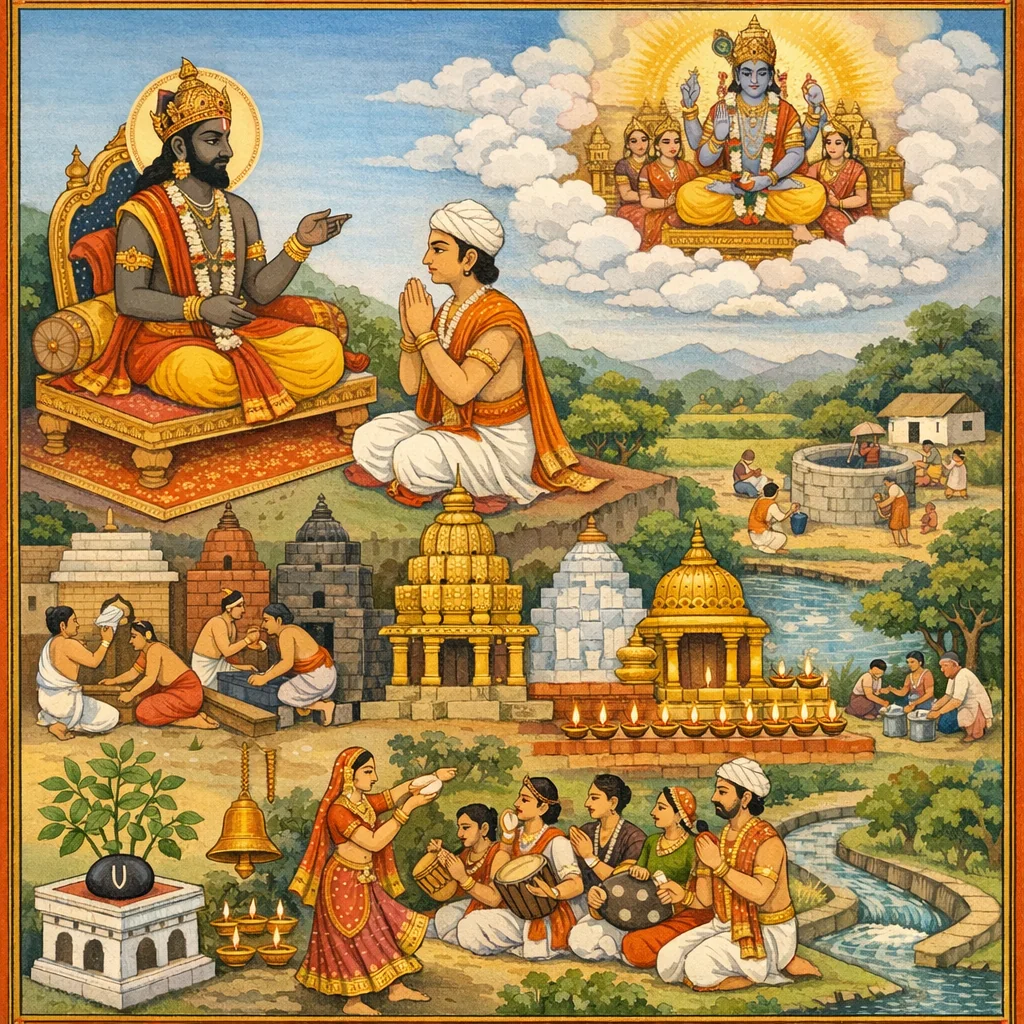
Dharmānukathana (Narration of Dharma)
In a didactic setting attributed to Dharmarāja instructing a king, the chapter lists dharmic deeds whose फल (phala) rises in stages: building temples for Śiva or Hari—even clay shrines—grants residence in Viṣṇu’s abode for many kalpas, ascent through Brahmapura and svarga, and finally yogic rebirth and liberation. Merit is multiplied by the materials used (firewood, brick, stone, crystal, copper, gold) and by protective upkeep (cleaning, plastering, sprinkling, decorating). Public works—ponds, reservoirs, wells, tanks, canals, villages, āśramas, groves—are ranked by social benefit, with an equity principle that poor and rich gain equal fruit when giving according to capacity. A central bhakti arc praises Tulasī (planting, watering, gifting leaves, offering to Śālagrāma) and ūrdhva-puṇḍra, promising destruction of grave sins and long dwelling in Nārāyaṇa’s realm. The chapter catalogs abhiṣeka substances (milk, ghee, pañcāmṛta, coconut water, sugarcane juice, filtered water, fragrant water) and sacred times (Ekādaśī, Dvādaśī, pūrṇimā, eclipses, saṅkrānti, nakṣatra-yogas). It expands into dāna-dharma: food and water as supreme gifts, cows and knowledge as liberative, and graded gifts of gems and vehicles yielding distinct lokas. Temple arts (music, dance, bells, conches, lamps) are framed as mokṣa-oriented service. The conclusion affirms a Viṣṇu-centered metaphysics: dharma, action, instruments, and fruits are all Viṣṇu.
Shlokas
Verse 1
धर्मराज उवाच । देवतायतनं यस्तु कुरुते कारयत्यपि । शिवस्यापि हरेर्वापि तस्य पुण्यफलं शृणु 1. ॥ १ ॥
Dharmarāja said: Whoever builds a temple for a deity—or causes one to be built—whether for Śiva or for Hari (Viṣṇu), hear now the meritorious fruit that comes to him.
Verse 2
मातृतः पितृतश्चैव लक्षकोटिकुलान्वितः । कल्पत्रयं विष्णुपदे तिष्ठत्येव न संशयः ॥ २ ॥
Together with the lineages on the mother’s side and the father’s side—amounting to hundreds of thousands and crores of families—one truly abides in Viṣṇupada, the supreme abode of Viṣṇu, for three kalpas; of this there is no doubt.
Verse 3
मृदैव कुरुते यस्तु देवतायतनं नरः । यावत्पुण्यं भवेत्तस्य तन्मे निगदतः शृणु ॥ ३ ॥
If a man builds a shrine (temple) for the Deity, even using only clay, hear from me as I declare how great the merit of that act becomes.
Verse 4
दिव्यदेहधरो भूत्वा विमानवरमास्थितः । कल्पत्रयं विष्णुपदे तिष्ठत्येव न संशयः ॥ ४ ॥
Assuming a divine body and seated in an excellent celestial chariot (vimāna), he indeed remains in Viṣṇupada, Viṣṇu’s abode, for three kalpas; of this there is no doubt.
Verse 5
मृदैव कुरुते यस्तु देवतायतनं नरः । यावत्पुण्यं भवेत्तस्य तन्मे निगदतः शृणु ॥ ५ ॥
A man who builds a shrine (temple) for a Deity—even using only clay—gains a measure of merit. Listen as I explain how great that merit is.
Verse 6
दिव्यदेहधरो भूत्वा विमानवरमास्थितः । कल्पत्रयं विष्णुपदे स्थित्वा ब्रह्मपुरं व्रजेत् ॥ ६ ॥
Assuming a divine body and seated in an excellent celestial chariot (vimāna), one remains established in Viṣṇupada for three kalpas, and thereafter proceeds to Brahmā’s city (Brahmapura).
Verse 7
कल्पद्वयं स्थितस्तत्र पुनः कल्पं वसेद्दिवि । ततस्तु योगिनामेव कुले जातो दयान्वितः ॥ ७ ॥
Having remained there for two kalpas, he then dwelt in heaven for yet another kalpa. After that, he was born in the very lineage of yogins, endowed with compassion.
Verse 8
वैष्णवं योगमास्थाय मुक्तिं व्रजति शाश्वतीम् । दारुभिः कुरुते यस्तु तस्य स्याद् द्विगुणं फलम् ॥ ८ ॥
One who takes refuge in Vaiṣṇava Yoga attains everlasting liberation. But whoever performs it using sacred firewood obtains a fruit that is double.
Verse 9
त्रिगुणं चेष्टकाभिस्तु शिलाभिस्तच्चतुर्गुणम् । स्फाटिकाभिः शिलाभिस्तु ज्ञेयं दशगुणोत्तरम् ॥ ९ ॥
When it is made with bricks, the result is threefold; when made with stone slabs, it becomes fourfold; and when made with crystal slabs, it should be understood to yield a merit ten times greater.
Verse 10
ताम्रीभिस्तच्छतगुणं हेम्ना कोटिगुणं भवेत् । देवालयं तडागं वा ग्रामं वा पालयेत्तु यः ॥ १० ॥
If it is done with copper, the merit becomes a hundredfold; if done with gold, it becomes a crore-fold. Whoever protects a temple, a pond (reservoir), or even a village (community) thereby gains such multiplied spiritual fruit.
Verse 11
कर्तुःशतगुणं तस्य पुण्यं भवति भूपते । देवालयस्य शुश्रूषां लेपसेचनमण्डनैः ॥ ११ ॥
O king, the merit earned by one who serves a temple of the Deity—by plastering or cleansing, sprinkling with water, and adorning it—becomes a hundredfold compared to that of the mere doer of ordinary pious acts.
Verse 12
कुर्याद्यत्सततं भक्त्या तस्य पुण्यमनन्तकम् । वेतनाद्विष्टितो वापि पुण्यकर्मप्रवर्त्तिताः ॥ १२ ॥
Whatever a person does continually with devotion (bhakti), its spiritual merit becomes endless. Even those compelled by wages or pressed into service are thereby set in motion toward meritorious deeds.
Verse 13
ते गच्छन्ति धराधाराः शाश्वतं वैष्णवं पदम् । तडागार्द्धफलं राजन्कासारे परिकीर्तितम् ॥ १३ ॥
Such supporters of the earth (benefactors) go to the eternal abode of Viṣṇu, the Vaiṣṇava state. O King, it is declared that a mere pond (kāsāra) yields half the merit of constructing a proper reservoir (taḍāga).
Verse 14
कूपे पादफलं ज्ञेयं वाप्यां पद्माकरोन्मितम् । वापीशतगुणं प्रोक्तं कुल्यायां भूपतेः फलम् ॥ १४ ॥
Know that a well yields only a quarter of the merit; a pond yields merit measured by the number of lotus-beds it supports. A large tank (vāpi) is said to give a hundredfold of the pond’s merit; and the merit of an irrigation canal (kulyā) is declared to belong to the king.
Verse 15
दृषद्भिस्तु धनी कुर्यान्मृदा निष्किञ्चनो जनः । तयोः फलं समानं स्यादित्याह कमलोद्भवः ॥ १५ ॥
A wealthy person should perform the pious work with stones, while a penniless person may do it with clay; the fruit of both is the same—so declares Kamalodbhava (Brahmā).
Verse 16
दद्यादाढ्यस्तु नगरं हस्तमात्रमकिञ्चनः । भुवं तयोः समफलं प्राहुर्वेदविदो जनाः ॥ १६ ॥
A wealthy man should give even a town, while a destitute man should give only what fits in his hand; the wise knowers of the Veda declare that the spiritual fruit of those two gifts is equal.
Verse 17
धनाढ्यः कुरुते यस्तु तडागं फलसाधनम् । दरिद्र ः कुरुते कूपं समं पुण्यं प्रकीर्तितम् ॥ १७ ॥
A wealthy person who builds a pond as a fruitful public work, and a poor person who digs a well—both are declared to gain equal spiritual merit.
Verse 18
आश्रमं कारयेद्यस्तु बहुजन्तूपकारकम् । स याति ब्रह्मभुवनं कुलत्रयसमन्वितः ॥ १८ ॥
Whoever causes an āśrama (a shelter or hermitage) to be built for the benefit of many living beings attains Brahmā’s world, accompanied by merit that uplifts three generations of his lineage.
Verse 19
धेनुर्वा ब्राह्मणो वापि यो वा को वापि भूपते । क्षणार्द्धं तस्य छायायां तिष्ठन्स्वर्गं नयत्यमुम् ॥ १९ ॥
O king, whether it be a cow or a brāhmaṇa—or indeed anyone at all—whoever stands for even half a moment in that being’s shade is led to heaven by that merit.
Verse 20
आरामकारका राजन्देवतागृहकारिणः । तडागग्रामकर्त्तारः पूज्यन्ते हरिणा सह ॥ २० ॥
O King, those who create pleasure-groves (public gardens), those who build temples for the deities, and those who construct tanks and establish villages are honored—together with Hari (Vishnu).
Verse 21
सर्वलोकोपकारार्थं पुष्पारामं जनेश्वर । कुर्वते देवतार्थं वा तेषां पुण्यफलं शृणु ॥ २१ ॥
O lord of men, listen to the meritorious fruit of those who create a flower-garden either for the benefit of all people or as an offering meant for the deities.
Verse 22
तत्र यावन्ति पर्णानि कुसुमानि भवन्ति च । तावद्वर्षाणि नाकस्थो मोदते कुलकोटिभिः ॥ २२ ॥
There, for as many years as there are leaves and blossoms, one who attains heaven dwells in the celestial realms, rejoicing together with tens of millions of his lineage.
Verse 23
प्राकारकारिणस्तस्य कण्टकावरणप्रदाः । प्रयान्ति ब्रह्मणः स्थानं युगानामेकसप्ततिम् ॥ २३ ॥
Those who build protective ramparts for it, and those who provide coverings against thorns, attain the abode of Brahmā for seventy-one yugas.
Verse 24
तुलसीरोपणं ये तु कुर्वते मनुजेश्वर । तेषां पुण्यफलं राजन्वदतो मे निशामय ॥ २४ ॥
O lord among men, those who plant Tulasi—O King, listen now as I describe the meritorious fruit that accrues to them.
Verse 25
सप्तकोटिकुलैर्युक्तो मातृतः पितृतस्तथा । वसेत्कल्पशतं साग्रं नारायणपदे नृप ॥ २५ ॥
O king, one who is connected with seven crore lineages—on the mother’s side and likewise on the father’s—dwells for a full hundred kalpas (and more) in the abode of Nārāyaṇa.
Verse 26
ऊर्ध्वपुण्ड्रधरो यस्तु तुलसीमूलमृत्स्नया । गोपिकाचन्दनेनापि चित्रकूटमृदापि वा । गङ्गामृत्तिकया चैव तस्य पुण्यफलं शृणु ॥ २६ ॥
Now hear the meritorious fruit of that person who wears the vertical Vaiṣṇava forehead-mark (ūrdhva-puṇḍra), made with the sacred earth from the root of Tulasī, or with Gopī-candana, or with the earth of Citrakūṭa, or indeed with the clay of the Gaṅgā.
Verse 27
विमानवरमारुढो गन्धर्वाप्सरसां गणैः । सङ्गीयमानचरितो मोदते विष्णुमन्दिरे ॥ २७ ॥
Mounted upon an excellent celestial chariot, attended by hosts of Gandharvas and Apsarases, and with his deeds sung in praise, he rejoices in the temple-abode of Viṣṇu.
Verse 28
पत्राणि तुलसीमूलाद्यावन्ति पतितानि वै । तावन्ति ब्रह्महत्यादिपातकानि हतानि च ॥ २८ ॥
As many leaves as have fallen from the root of Tulasī, so many sins—beginning with brahmahatyā, the grave sin of killing a brāhmaṇa—are destroyed as well.
Verse 29
तुलस्यां सेचयेद्यस्तु जलं चुलुकमात्रकम् । क्षीरोदवासिना सार्द्धं वसेदाचन्द्र तारकम् ॥ २९ ॥
Whoever waters the Tulasī plant with even a palmful of water will dwell together with the Lord who resides in the Milk Ocean, for as long as the moon and stars endure.
Verse 30
ददाति ब्राह्मणानां यः कोमलं तुलसीदलम् । स याति ब्रह्मसदने कुलत्रितयसंयुतः ॥ ३० ॥
Whoever gives a tender leaf of Tulasī to the brāhmaṇas attains the abode of Brahmā, accompanied by the merit that uplifts three generations of his lineage.
Verse 31
शालग्रामेऽपयेद्यस्तु तुलस्यास्तु दलानि च । स वसेद्विष्णुभवने यावदाभूतसम्प्लवम् ॥ ३१ ॥
Whoever offers Tulasī leaves to the Śālagrāma, the stone emblem of Viṣṇu, dwells in the abode of Viṣṇu until the cosmic dissolution of all beings.
Verse 32
कण्टकावरणं यस्तु प्राकारं वापि कारयेत् । सोऽप्येकविंशतिकुलैर्मोदते विष्णुमन्दिरे ॥ ३२ ॥
Whoever causes a protective thorn-fence, or even an enclosing wall, to be built—he too, together with twenty-one generations of his family—rejoices in the temple-abode of Viṣṇu.
Verse 33
योऽच्चयेद्धरिपादाब्जं तुलस्याः कोमलैर्दलैः । न तस्य पुनरावृत्तिर्विष्णुलोकान्नरेश्वर ॥ ३३ ॥
O lord among men, one who worships the lotus-feet of Hari with the tender leaves of Tulasi does not return again to rebirth; for him there is no return from the world of Viṣṇu.
Verse 34
द्वादश्यां पौर्णमास्यां यः क्षीरेण स्नापयेद्धरिम् । कुलायुतयुतः सोऽपि मोदते वैष्णवे पदे ॥ ३४ ॥
Whoever bathes Hari with milk on the Dvādaśī that coincides with the full-moon day—even if burdened with sins accumulated over ten thousand lineages—rejoices in the supreme Vaiṣṇava abode.
Verse 35
प्रस्थमात्रेण पयसा यः स्नापयति केशवम् । कुलायुतायुतयुतः सोऽपि विष्णुपुरे वसेत् ॥ ३५ ॥
Whoever bathes Keśava with milk in the measure of one prastha—even he, with merit multiplied through countless lineages, shall dwell in Viṣṇu’s divine abode.
Verse 36
घृतप्रस्थेन यो विष्णुं द्वादश्यां स्नापयेन्नरः । कुलकोटियुतो राजन्सायुज्यं लभते हरेः ॥ ३६ ॥
O King, the man who bathes Lord Viṣṇu on Dvādaśī with a prastha-measure of ghee becomes endowed with crores of family lines and attains sāyujya (complete union) with Hari.
Verse 37
पञ्चामृतेन यः स्नानमेकादश्यां तु कारयेत् । विष्णोः सायुज्यकं तस्य भवेत्कुलशतायुतैः ॥ ३७ ॥
Whoever, on Ekādaśī, performs the bath with pañcāmṛta attains sāyujya—union with Lord Viṣṇu; and together with hundreds of thousands of his lineage, he is blessed with that attainment.
Verse 38
एकादश्यां पौर्णमास्यां द्वादश्यां वा नृपोत्तम । नालिकेरोदकैर्विष्णुं स्नापयेत्तत्फलं शृणु ॥ ३८ ॥
O best of kings, on Ekādaśī, on the full-moon day (Paurṇamāsī), or on Dvādaśī, one should bathe Lord Viṣṇu with coconut water. Hear now the fruit of doing so.
Verse 39
दशजन्मार्जितैः पापैर्विमुक्तो नृपसत्तम । शतद्वयकुलैर्युक्तो मोदते विष्णुना सह ॥ ३९ ॥
O best of kings, freed from sins accumulated over ten births, and accompanied by two hundred lineages of his family, he rejoices together with Lord Viṣṇu.
Verse 40
इक्षुत्येन देवेशं यः स्नापयति भूपते । केशवं लक्षपितृभिः सार्द्धं विष्णुपदं व्रजेत् ॥ ४० ॥
O king, whoever bathes the Lord of the gods—Keśava—with sugarcane-juice water attains Viṣṇu-pada, the supreme abode of Viṣṇu, together with a hundred thousand of his ancestors.
Verse 41
पुष्पोदकेन गोविन्दं तथा गन्धोदकेन च । स्नापयित्वा हरिं भक्त्या वैष्णवं पदमाप्नुयात् ॥ ४१ ॥
Having bathed Govinda—Hari—with water infused with flowers and likewise with fragrant water, a person, with devotion (bhakti), attains the Vaiṣṇava state—the supreme abode of Lord Viṣṇu.
Verse 42
जलेन वस्त्रपूतेन यः स्नापयति माधवम् । सर्वपापविनिर्मुक्तो विष्णुना सह मोदते ॥ ४२ ॥
Whoever bathes Mādhava with water purified by filtering it through cloth is freed from all sins and rejoices together with Viṣṇu.
Verse 43
क्षीराद्यैः स्नापयेद्यस्तु रविसङ्क्रमणे हरिम् । स वसेद्विष्णुसदने त्रिसप्तपुरुषैः सह ॥ ४३ ॥
Whoever, at the Sun’s transit (saṅkramaṇa), bathes Lord Hari with milk and other auspicious substances will dwell in Viṣṇu’s abode together with twenty-one generations of his line.
Verse 44
शुक्लपक्षे चतुर्द्दश्यामष्टम्यां पूर्णिमादिने ॥ ४४ ॥
In the bright fortnight (śukla-pakṣa): on the fourteenth lunar day, on the eighth, and on the day of the full moon.
Verse 45
एकादश्यां भानुवारे द्वादश्यां पञ्चमीतिथौ । सोमसूर्योपरागे च मन्वादिषु युगादिषु ॥ ४५ ॥
On Ekādaśī when it falls on a Sunday; on Dvādaśī when it coincides with the Pañcamī tithi; during lunar and solar eclipses; and at the beginnings of Manvantaras and Yugas—these times are especially sacred for observances.
Verse 46
अर्द्धोदये च सूर्यस्य पुष्यार्के रोहिणीबुधे । तथैव शनिरोहिण्यां भौमाश्विन्यां तथैव च ॥ ४६ ॥
Likewise, the observance becomes especially efficacious when the Sun is at mid-rise; when the Sun is in Puṣyā; when Mercury is in Rohiṇī; similarly when Saturn is in Rohiṇī; and when Mars is in Aśvinī.
Verse 47
शन्यां भृगुमृगे चैव भृगुरेवतिसङ्गमे । तथा बुधानुराधायां श्रवणार्के तथैव च ॥ ४७ ॥
Likewise, this auspicious result is obtained when Saturn is in Mṛgaśīrṣā and Venus is also in Mṛgaśīrṣā; when Venus is conjoined with Revatī; when Mercury is in Anurādhā; and similarly when the Sun is in Śravaṇā.
Verse 48
तथा च सोमश्रवणे हस्तयुक्ते बृहस्पतौ । बुधाष्टम्यां बुधाषाढे पुण्ये चान्ये दिने तथा ॥ ४८ ॥
Likewise, the rite should be performed when Monday coincides with the Śravaṇa constellation, when Thursday coincides with Hasta, when the eighth lunar day falls on Wednesday, during the auspicious Āṣāḍha period, and similarly on other holy days as well.
Verse 49
स्नापयेत्पयसा विष्णुं शान्तिमान् वाग्यतः शुचिः । घृतेन मधुना वापि दध्ना वा तत्फलं शृणु ॥ ४९ ॥
Calm in mind, restrained in speech, and pure, one should bathe Lord Viṣṇu in abhiṣeka with milk—or with ghee, honey, or curd. Now hear the fruit of that rite.
Verse 50
सर्वयज्ञफलं प्राप्य सर्वपापविवर्जितः । वसेद्विष्णुपुरे सार्द्धं त्रिसप्तपुरुषैर्नृप ॥ ५० ॥
Having obtained the fruit of all sacrifices and being freed from every sin, he dwells in the city of Viṣṇu, O king, together with twenty-one generations of his lineage.
Verse 51
तत्रैव ज्ञानमासाद्य योगिनामपि दुर्लभम् । मोक्षमाप्नोति नृपते पुनरावृत्तिदुर्लभम् ॥ ५१ ॥
There itself, having attained that knowledge—rare even among yogins—one attains liberation (mokṣa), O King, a state in which return to rebirth is impossible.
Verse 52
कृष्णपक्षे चतुर्दश्यां सोमवारे च भूपते । शिवं संस्नाप्य दुग्धेन शिवसायुज्यमाप्नुयात् ॥ ५२ ॥
O king, on the fourteenth lunar day (Caturdaśī) of the dark fortnight, when it falls on a Monday, one should bathe Lord Śiva with milk; by this one attains sāyujya—union with Śiva.
Verse 53
नालिकेरोदकेनापि शिवं संस्नाप्य भक्तितः । अष्टम्यामिन्दुवारे वा शिवसायुज्यमश्नुते ॥ ५३ ॥
Even with coconut water, if one bathes Śiva with devotion, one attains sāyujya with Śiva—especially when performed on Aṣṭamī, the eighth lunar day, or on a Monday.
Verse 54
शुक्लपक्षे चतुर्दश्यामष्टम्यां वापि भूपते । घृतेन मधुना स्नाप्य शिवं तत्साम्यतां व्रजेत् ॥ ५४ ॥
O king, on Caturdaśī of the bright fortnight—or else on Aṣṭamī—one should bathe Lord Śiva with ghee and honey; by this one attains sāmyatā, likeness and nearness to Śiva.
Verse 55
तिलतैलेन संस्नाप्य विष्णुं वा शिवमेव च । स याति तत्तत्सारूप्यं पितृभिः सह सप्तभिः ॥ ५५ ॥
By bathing either Viṣṇu or Śiva with sesame oil, one attains sārūpya—likeness to that very deity—together with one’s seven pitṛs, the ancestral forefathers.
Verse 56
शिवमिक्षुरसेनापि यः स्नापयति भक्तितः । शिवलोके वसेत्कल्पं स सप्तपुरुषैः सह ॥ ५६ ॥
Even one who, with devotion, bathes Śiva with sugarcane juice dwells in Śiva’s world for a kalpa, together with seven generations of his lineage (saptapuruṣa).
Verse 57
घृतेन स्नापयेल्लिङ्गमुत्थाने द्वादशीदिने । क्षीरेण वा महाभाग तत्फलं शृणु मद्गिरा ॥ ५७ ॥
O noble one, on the Dvādaśī day at the time of utthāna (rising), one should bathe the liṅga with ghee—or with milk. Hear from my words the fruit of that act.
Verse 58
जन्मायुतार्जितैः पापैर्विमुक्तो मनुजो नृप । कोटिसङ्ख्यं समुद्धृत्य स्वकुलं शिवतां व्रजेत् ॥ ५८ ॥
O King, a man becomes freed from sins accumulated over tens of thousands of births; and, having uplifted his own lineage—numbering in crores—he attains the auspicious state (śivatā).
Verse 59
सम्पूज्य गन्धकुसुमैर्विष्णुं विष्णुतिथौ नृप । जन्मायुतार्जितैः पापैर्मुक्तो व्रजति तत्पदम् ॥ ५९ ॥
O king, one who duly worships Viṣṇu with fragrances and flowers on Viṣṇu’s sacred lunar day becomes freed from sins accumulated over tens of thousands of births and goes to His supreme abode.
Verse 60
पद्मपुष्पेण यो विष्णुं शिवं वा पूजयन्नेरः । स याति विष्णुभवनं कुलकोटिसमन्वितः ॥ ६० ॥
Whoever—being free from negligence—worships Viṣṇu, or even Śiva, with a lotus flower, attains the abode of Viṣṇu, accompanied by crores of his lineage.
Verse 61
हरिं च केतकीपुष्पैः शिवं धत्तूरजैर्निशि । सम्पूज्य पापनिर्मुक्तो वसेद्विष्णुपुरे युगम् ॥ ६१ ॥
Worshipping Hari with ketakī flowers and Śiva at night with dhattūra blossoms—having duly honored them—one becomes freed from sin and dwells in Viṣṇu’s city for an age (yuga).
Verse 62
हरिं तु चाम्पकैः पुष्पैरर्कपुष्पैश्च शङ्करम् । समभ्यर्च्य महाराज तत्तत्सालोक्यमाप्नुयात् ॥ ६२ ॥
O great king, one who worships Hari (Viṣṇu) with campaka blossoms and worships Śaṅkara (Śiva) with arka flowers attains sālokya—dwelling in communion within the very realm of each deity.
Verse 63
शङ्करस्याथवा विष्णोर्घृतयुक्तं च गुग्गुलुम् । दत्त्वा धूपे नरो भक्त्या सर्वपापैः प्रमुच्यते ॥ ६३ ॥
One who, in devotion, offers as incense guggulu mixed with ghee to Śaṅkara or to Viṣṇu is released from all sins.
Verse 64
तिलतैलान्वितं दीपं विष्णोर्वा शङ्करस्य वा । दत्त्वा नरः सर्वकामान्संप्राप्नोति नृपोत्तम ॥ ६४ ॥
O best of kings, one who offers to Viṣṇu—or to Śaṅkara—a lamp filled with sesame oil attains the fulfillment of all desires.
Verse 65
घृतेन दीपं यो दद्याच्छङ्करायाथ विष्णवे । स मुक्तः सर्वपापेभ्यो गङ्गास्नानफलं लभेत् ॥ ६५ ॥
Whoever offers a ghee-fueled lamp to Śaṅkara and also to Viṣṇu is freed from all sins and gains merit equal to bathing in the Gaṅgā.
Verse 66
ग्राम्येण वापि तैलेन राजन्नन्येन वा पुनः । दीपं दत्त्वा महाविष्णोः शिवस्यापि फलं शृणु ॥ ६६ ॥
O King, whether with common oil or with some other oil, having offered a lamp to Mahāviṣṇu—hear also of the fruit of merit in the case of Śiva.
Verse 67
सर्वपापविनिर्मुक्तः सर्वैश्वर्यसमन्वितः । तत्तत्सालोक्यमाप्नोति त्रिःसप्तपुरुषान्वितः ॥ ६७ ॥
Freed from all sins and endowed with every divine prosperity, he attains sālokya—dwelling in the very same world as that Lord; and this merit extends, together with welfare, to three times seven persons, that is, twenty-one generations.
Verse 68
यद्यदिष्टतमं भोज्यं तत्तदीशाय विष्णवे । दत्वा तत्तत्पदं याति चत्वारिंशत्कुलान्वितः ॥ ६८ ॥
Whatever food one cherishes most—offering that very thing, and that alone, to Lord Viṣṇu—one attains the corresponding divine state, together with forty generations of one’s lineage.
Verse 69
यद्यदिष्टतमं वस्तु तत्तद्विप्राय दापयेत् । स याति विष्णुभवनं पुनरावृत्तिदुर्लभम् ॥ ६९ ॥
Whatever object one loves most, one should have it given to a learned brāhmaṇa; by this, one reaches Viṣṇu-bhavana, the abode of Viṣṇu—a state in which return to worldly rebirth is hard to obtain.
Verse 70
भ्रूणहा स्वर्णदानेन शुद्धो भवति भूपते । अन्नतोयसमं दानं न भूतं न भविष्यति ॥ ७० ॥
O king, even a slayer of a bhrūṇa (embryo) becomes purified by the gift of gold. Yet no gift has ever been, nor will ever be, equal to the giving of food and water.
Verse 71
अन्नदः प्राणदः प्रोक्तः प्राणदश्चापि सर्वदः । सर्वदानफलं यस्मादन्नदस्य नृपोत्तम ॥ ७१ ॥
The giver of food is declared to be the giver of life; and the giver of life is truly the giver of everything. Therefore, O best of kings, the giver of food obtains the fruit of all gifts.
Verse 72
अन्नदो ब्रह्मसदनं याति वंशायुतान्वितः । न तस्य पुनरावृत्तिरिति शास्त्रेषु निश्चितम् ॥ ७२ ॥
The giver of food attains Brahmā’s abode, accompanied by tens of thousands of descendants; for him there is no return to rebirth—so it is firmly established in the śāstras.
Verse 73
सद्यस्तुष्टिकरं ज्ञेयं जलदानं यतोऽधिकम् । अन्नदानान्नृपश्रेष्ठ निर्दिष्टं ब्रह्मवादिभिः ॥ ७३ ॥
Know that the gift of water brings immediate satisfaction; yet, O best of kings, the knowers of Brahman declare the gift of food to be even more superior.
Verse 74
महापातकयुक्तो वा युक्तो वाप्युपपातकैः । जलदो मुच्यते तेभ्य इत्याह कमलोद्भवः ॥ ७४ ॥
Whether tainted by a great sin (mahāpātaka) or even by secondary sins (upapātaka), one who gives water is freed from those faults—so declares the Lotus-born (Brahmā).
Verse 75
शरीरमन्नजं प्राहुः प्राणानप्यन्नजान्विदुः । तस्मादन्नप्रदो ज्ञेयः प्राणदः पृथिवीपते ॥ ७५ ॥
They say the body is born of food, and the vital breaths (prāṇa) too are known to arise from food. Therefore, O lord of the earth, one who gives food should be understood as a giver of life-breath itself.
Verse 76
यद्यत्तुष्टिकरं दानं सर्वकामफलप्रदम् । तस्मादन्नसमं दानं नास्ति भूपाल भूतले ॥ ७६ ॥
Whatever gift brings satisfaction and grants the fruits of all desired aims—yet, O king, on this earth there is no charity equal to the gift of food.
Verse 77
अन्नदस्य कुले जाता आसहस्रं नृपोत्तम । नरकं ते न पश्यन्ति तस्मादन्नप्रदो वरः ॥ ७७ ॥
O best of kings, up to a thousand born in the lineage of one who gives food do not behold hell; therefore the giver of food is the most excellent among donors.
Verse 78
पादाभ्यङ्गं भक्तियुक्तो योऽतिथेः कुरुतेनरः । स स्नातः सर्वतीर्थेषु गङ्गास्नानपुरःसरम् ॥ ७८ ॥
One who, with devotion, massages and anoints the feet of a guest is regarded as having bathed in all sacred tīrthas—foremost, the bath in the Gaṅgā.
Verse 79
तैलाभ्यङ्गं महाराज ब्राह्मणानां करोति यः । स स्नातोऽष्टशतं साग्रं गङ्गायां नात्र संशयः ॥ ७९ ॥
O great king, whoever provides an oil anointing and massage (tailābhyaṅga) for Brāhmaṇas is deemed to have bathed in the Gaṅgā eight hundred times and more; of this there is no doubt.
Verse 80
रोगितान्ब्राह्मणान्यस्तु प्रेम्णा रक्षति रक्षकः । स कोटिकुलसंयुक्तो वसेद् ब्रह्मपुरे युगम् ॥ ८० ॥
But that protector who, with loving care, safeguards Brāhmaṇas afflicted by illness—endowed with the merit of ten million lineages—dwells in Brahmā’s city for a yuga.
Verse 81
यो रक्षेत्पृथिवीपाल रङ्कं वा रोगिणं नरम् । तस्य विष्णुः प्रसन्नात्मा सर्वान्कामान्प्रयच्छति ॥ ८१ ॥
O king, whoever protects a destitute person or one who is ill—upon him Viṣṇu becomes gracious at heart and bestows all desired blessings.
Verse 82
मनसा कर्मणा वाचा यो रक्षेदामयान्वितम् । सर्वान्कामानवाप्नोति सर्वपापविवर्जितः ॥ ८२ ॥
Whoever protects and tends one afflicted by illness—by mind, by deed, and by speech—attains all desired aims and becomes free from every sin.
Verse 83
यो ददाति महीपाल निवासं ब्राह्मणाय वै । तस्य प्रसन्नो देवेशः स्वलोकं सम्प्रयच्छति ॥ ८३ ॥
O king, whoever grants a dwelling-place to a brāhmaṇa—over him the Lord of the gods becomes pleased and bestows His own heavenly realm.
Verse 84
ब्राह्मणाय ब्रह्मविदे यो दद्याद्गां पयस्विनीम् । स याति ब्रह्मसदनमन्येषामतिदुर्लभम् ॥ ८४ ॥
Whoever gives a milk-yielding cow to a brāhmaṇa who knows Brahman attains the abode of Brahmā—an attainment exceedingly difficult for others to reach.
Verse 85
अन्येभ्यः प्रतिगृह्यापि यो दद्याद्गां पयस्विनीम् । तस्य पुण्यफलं वक्तुं नाहं शक्तोऽस्मि पण्डित ॥ ८५ ॥
Even if one has received (wealth) from others, if he then gives away a milk-yielding cow, O learned one, I am not able to describe the full meritorious fruit of that gift.
Verse 86
कपिलां वेदविदुषे यो ददाति पयस्विनीम् । स एव रुद्रो भूपाल सर्वपापविवर्जितः ॥ ८६ ॥
O king, whoever gifts a tawny Kapilā milch-cow, rich in milk, to a knower of the Veda—he indeed becomes like Rudra himself, freed from all sins.
Verse 87
विप्राय वेदविदुषे दद्यादुभयतोमुखीम् । यस्तस्य पुण्यं सङ्ख्यातुं न शक्तोऽब्दशतैरपि ॥ ८७ ॥
One should offer an “ubhayato-mukhī” gift to a brāhmaṇa learned in the Vedas; for none can reckon the merit of that act, even across hundreds of years.
Verse 88
तस्य पुण्यफलं राजञ्श्छृणु वक्ष्यामि तत्त्वतः । एकतः क्रतवः सर्वे समग्रवरदक्षिणाः ॥ ८८ ॥
O King, listen: I shall truthfully declare the fruit of that merit. It is equal, on one side, to all kratu sacrifices performed together, complete with the finest and full dakṣiṇās.
Verse 89
एकतो भयभीतस्य प्राणिनः प्राणरक्षणम् । संरक्षति महीपाल यो विप्रं भयविह्वलम् ॥ ८९ ॥
On one side, it is the saving of the very life of a being terrified by danger; likewise, the king who protects a brāhmaṇa shaken by fear truly safeguards that life itself.
Verse 90
स स्नातः सर्वतीर्थेषु सर्वयज्ञेषु दीक्षितः । वस्त्रदो रुद्र भवनं कन्यादो ब्रह्मणः पदम् ॥ ९० ॥
He is regarded as one who has bathed at all tīrthas and as one initiated (dīkṣā) for all sacrifices. The giver of garments attains Rudra’s abode, and the giver of a maiden in marriage (kanyā-dāna) attains the station of Brahmā.
Verse 91
हेमदो विष्णुभवनं प्रयाति स्वकुलान्वितः । यस्तु कन्यामलङ्कृत्य ददात्यध्यात्मवेदिने ॥ ९१ ॥
One who gifts gold goes to Viṣṇu’s abode together with his family. Yet one who adorns a maiden and gives her in marriage to a knower of the inner Self (adhyātma-vedin) attains that same supreme goal.
Verse 92
शतवंशसमायुक्तः स व्रजेद् ब्रह्मणः पदम् । कार्तिक्यां पौर्णमास्यां वा आषाढ्यां वापि भूपते ॥ ९२ ॥
Endowed with a hundred lineages (a vast, meritorious progeny), he attains the abode of Brahmā—either on the full-moon day of Kārttika or on the full-moon day of Āṣāḍha, O king.
Verse 93
वृषभं शिवतुष्ट्यर्थमुत्सृजेत्तत्फलं शृणु । सप्तजन्मार्जितैः पापैर्विमुक्तो रुद्र रूपभाक् ॥ ९३ ॥
One should set a bull free for the sake of pleasing Śiva—hear the fruit of that act: freed from sins accumulated over seven births, one attains a Rudra-like (Śiva-like) form.
Verse 94
कुलसप्ततिसंयुक्तो रुद्रे ण सह मोदते । शिवलिङ्गाङ्कितं कृत्वा महिषं यः समुत्सृजेत् ॥ ९४ ॥
One who releases a buffalo after marking it with the emblem of Śiva’s liṅga rejoices together with Rudra, accompanied by seventy generations of his lineage.
Verse 95
न तस्य यातनालोको भवेन्नृपतिसत्तम । ताम्बूलदानं यः कुर्याच्छक्तितो नृपसत्तम ॥ ९५ ॥
O best of kings, for one who, according to his ability, gives tāmbūla (a betel-leaf offering), there will be no experience of the world of torment and punishment.
Verse 96
तस्य विष्णुः प्रसन्नात्मा ददात्यायुर्यशः श्रियम् । क्षीदो घृतदश्चैव मधुदो दधिदस्तथा ॥ ९६ ॥
Viṣṇu, pleased at heart with such a person, grants long life, fame, and prosperity. Likewise, one who gives milk, ghee, honey, and curd attains these blessings.
Verse 97
दिव्याब्दायुतपर्यन्तं स्वर्गलोके महीयते । प्रयाति ब्रह्मसदनमिक्षुदाता नृपोत्तम ॥ ९७ ॥
O best of kings, the giver of sugarcane is honored in the heavenly realm for ten thousand divine years, and thereafter attains the abode of Brahmā.
Verse 98
गन्धदः पुण्यफलदः प्रयाति ब्रह्मणः पदम् । गुडेक्षुरसदश्चैव प्रयाति क्षीरसागरम् ॥ ९८ ॥
One who offers fragrance, bestowing meritorious results, attains the realm of Brahmā; likewise, one who offers jaggery and sugarcane-juice attains the Ocean of Milk (Kṣīra-sāgara).
Verse 99
भटानां जलदो याति सूर्यलोकमनुत्तमम् । विद्यादानेन सायुज्यं माधवस्य व्रजेन्नरः ॥ ९९ ॥
By giving water to those in need, one attains the unsurpassed realm of the Sun (Sūrya-loka); but by gifting sacred knowledge, a person goes to sāyujya—union with Mādhava (Viṣṇu).
Verse 100
विद्यादानं महीदानं गोदानं चोत्तमोत्तमम् । नरकादुद्धरन्त्येव जपवाहनदोहनात् ॥ १०० ॥
The gift of knowledge, the gift of land, and—supremely—the gift of a cow: these indeed lift one out of hell, through (the cow’s) use in yajña and worship, as a means of conveyance, and through its milking.
Verse 101
सर्वेषामपि दानानां विद्यादानं विशिष्यते । विद्यादानेन सायुज्यं विष्णोर्याति नृपोत्तम ॥ १०१ ॥
Among all forms of charity, the gift of knowledge is the highest. By granting knowledge, O best of kings, one attains sāyujya—union with Viṣṇu.
Verse 102
नरस्त्विन्धनदानेन मुच्यते ह्युपपातकैः । शालग्रामशिलादानं महादानं प्रकीर्तितम् ॥ १०२ ॥
By gifting firewood, a person is indeed freed from minor sins; and the gifting of a Śālagrāma stone is proclaimed to be the supreme, great gift.
Verse 103
यद् दत्वा मोक्षमाप्नोति लिङ्गदानं तथा स्मृतम् । ब्रह्माण्डकोटिदानेन यत्फलं लभते नरः ॥ १०३ ॥
That gift by giving which one attains liberation is remembered as the gifting of a liṅga. It yields the same merit a man gains by gifting crores of Brahmāṇḍas—entire universes.
Verse 104
तत्फलं समवाप्नोति लिङ्गदानान्न संशयः । शालग्रामशिलादाने ततोऽपि द्विगुणं फलम् ॥ १०४ ॥
One certainly attains that merit through the gift of a liṅga—there is no doubt. And by gifting a Śālagrāma stone, the spiritual merit is even twice as great as that.
Verse 105
शालग्रामशिलारूपी विष्णुरेवेति विश्रुतः । यो ददाति नरो दानं गृहेषु महतां प्रभो ॥ १०५ ॥
O Lord, it is well known that Viṣṇu Himself is present in the form of the Śālagrāma stone. The man who offers this gift in the homes of the noble and great attains vast religious merit.
Verse 106
गङ्गास्नानफलं तस्य निश्चितं नृप जायते । रत्नान्वितसुवर्णस्य प्रदानेन नृपोत्तम ॥ १०६ ॥
O king, by gifting gold adorned with gems, that person surely attains the very fruit of bathing in the Gaṅgā, O best of rulers.
Verse 107
भुक्तिमुक्तिमवाप्नोति महादानं यतः स्मृतम् । नरो माणिक्यदानेन परं मोक्षमवाप्नुयात् ॥ १०७ ॥
Because it is remembered as a “great gift” bestowing both worldly enjoyment and liberation, a person—by offering a māṇikya (ruby) in charity—may attain the supreme state of mokṣa.
Verse 108
ध्रुवलोकमवाप्नोति वज्रदानेन मानवः । स्वर्गं विद्रुमदानेन रुद्र लोकमवाप्नुयात् ॥ १०८ ॥
By gifting a vajra (diamond), a person attains Dhruvaloka; by gifting vidruma (coral), one reaches heaven and may attain Rudraloka.
Verse 109
प्रयाति यानदानेन मुक्तादानेन चैन्दवम् । वैडूर्यदो रुद्र लोकं पुष्परागप्रदस्तथा ॥ १०९ ॥
By gifting a yāna (vehicle), one proceeds upon the celestial path; by gifting muktā (pearls), one reaches the lunar realm. The giver of vaidūrya (cat’s-eye gem) attains Rudra’s world, and likewise the giver of puṣparāga (topaz) attains the corresponding exalted abode.
Verse 110
पुष्परागप्रदानेन सर्वत्र सुखमश्नुते । अश्वदो ह्यश्वसान्निध्यं चिरं व्रजति भूमिप ॥ ११० ॥
By gifting puṣparāga (topaz), one enjoys happiness everywhere. And, O king, the giver of a horse attains the company and nearness of horses for a long time.
Verse 111
गजदानेन महता सर्वान्कामानवाप्नुयात् । प्रयाति यानदानेन स्वर्गं स्वर्यानमास्थितः ॥ १११ ॥
By the great gift of an elephant, one may obtain all desired aims. And by the gift of a vehicle, one departs to heaven, mounted upon a celestial conveyance.
Verse 112
महिषीदो जयत्येव ह्यपमृत्युं न संशयः । गवां तृणप्रदानेन रुद्र लोकमवाप्नुयात् ॥ ११२ ॥
Indeed, the giver of a buffalo-cow surely conquers untimely death—there is no doubt. And by offering grass and fodder to cows, one attains the world of Rudra (Śiva).
Verse 113
वारुणं लोकमाप्नोति महीश लवणप्रदः । स्वाश्रमाचारनिरता सर्वभूतहिते रताः ॥ ११३ ॥
O king, one who gives salt attains the world of Varuṇa. Those devoted to the duties of their own āśrama and engaged in the welfare of all beings also reach auspicious destinies.
Verse 114
अदाम्भिका गतासूयाः प्रयान्ति ब्रह्मणः पदम् । परोपदेशनिरता वीतरागा विमत्सरा ॥ ११४ ॥
Those who are free from pretence, rid of envy, devoted to guiding others, dispassionate, and without jealousy—such people attain the supreme state of Brahman.
Verse 115
हरिपादार्चनरताः प्रयान्ति सदनं हरेः । सत्सङ्गाह्लादनिरताः सत्कर्मसु सदोद्यताः ॥ ११५ ॥
Those devoted to worship at the feet of Hari attain the abode of Hari. Delighting in the joy of holy company (satsaṅga), they remain ever engaged in righteous deeds.
Verse 116
परापवादविमुखाः प्रयान्ति हरिमन्दिरम् । नित्यं हितकरा ये तु ब्राह्मणेषु च गोषु च ॥ ११६ ॥
Those who turn away from slandering others attain the temple-abode of Hari; and so too do those who are ever devoted to the welfare of brāhmaṇas and cows.
Verse 117
परस्त्रीसङ्गविमुखा न पश्यन्ति यमालयम् । जितेन्द्रि या जिताहारा गोषु क्षान्ताः सुशीलिनः ॥ ११७ ॥
Those who turn away from association with others’ wives do not behold Yama’s abode. Self-controlled and moderate in diet, patient and gentle in their dealings with cattle, and endowed with good conduct—such people do not go to the realm of punishment.
Verse 118
ब्राह्मणेषु क्षमाशीलाः प्रयान्ति भवनं हरेः । अग्निशुश्रूषवश्चैव गुरुशुश्रूषकास्तथा ॥ ११८ ॥
Those who are patient and forgiving toward brāhmaṇas attain the abode of Hari; likewise, those devoted to serving the sacred fire, and those devoted to serving their guru, also reach it.
Verse 119
पतिशुश्रूषणरता न वै संसृतिभागिनः । सदा देवार्चनरता हरिनामपरायणाः ॥ ११९ ॥
Those devoted to serving their husband are not, indeed, destined to share in worldly transmigration. Ever devoted to worship of the Deity and wholly devoted to the Name of Hari, they attain freedom from saṃsāra.
Verse 120
प्रतिग्रहनिवृत्ताश्च प्रयान्ति परमं पदम् । अनाथं विप्रकुणपं ये दहेयुर्नृपोत्तम ॥ १२० ॥
Those who refrain from accepting gifts (that compromise dharma) attain the supreme abode. And O best of kings, those who cremate the unclaimed corpse of a brāhmaṇa also reach the highest state.
Verse 121
अश्वमेधसहस्राणां फलमश्नुवते सदा । पत्रैः पुष्पैः फलैर्वापि जलैर्वा मनुजेश्वर ॥ १२१ ॥
O lord among men, one who offers in worship continually—even leaves, flowers, fruits, or water—ever attains merit equal to that of a thousand Aśvamedha sacrifices.
Verse 122
पूजया रहितं लिङ्गमचर्येत्तत्फलं शृणु । अप्सरोगणगन्धर्वैः स्तूयमानो विमानगः ॥ १२२ ॥
Hear the fruit of venerating the liṅga without the prescribed offerings and honors: one becomes a rider of a celestial vimāna, praised by hosts of apsarās and gandharvas.
Verse 123
प्रयाति शिवसान्निध्यमित्याह कमलोद्भवः । चुलुकोदकमात्रेण लिङ्गं संस्नाप्य भूमिप ॥ १२३ ॥
“He attains nearness to Śiva,” thus spoke Kamalodbhava (Brahmā), O king—even by bathing the Śiva-liṅga with merely a palmful of water.
Verse 124
लक्षाश्वमेधजं पुण्यं संप्राप्नोति न संशयः । पूजया रहितं लिङ्गं कुसुमैर्योऽचयेत्सुधीः ॥ १२४ ॥
There is no doubt: the wise who offers flowers to the liṅga—even without formal ritual worship—attains the merit born of a hundred thousand Aśvamedha sacrifices.
Verse 125
अश्वमेधायुतफलं भवेत्तस्य जनेश्वर । भक्ष्यैर्भोज्यैः फलैर्वापि शून्यं लिङ्गं प्रपूज्य च ॥ १२५ ॥
O lord of men, for that person the reward becomes equal to ten thousand Aśvamedha sacrifices, if one duly worships the formless (unmanifest) Liṅga even with simple offerings—edibles, prepared foods, or fruits.
Verse 126
शिवसायुज्यमाप्नोति पुनरावृत्तिवर्जितम् । पूजया रहितं विष्णुं योऽचयेदर्कवंशज ॥ १२६ ॥
O scion of the Solar race, one who duly honors Viṣṇu—even without formal ritual worship—attains Śiva-sāyujya, union with Śiva, a state free from any return (rebirth).
Verse 127
जलेनापि स सालोक्यं विष्णोर्याति नरोत्तम । देवतायतने यस्तु कुर्यात्सम्मार्जनं सुधीः ॥ १२७ ॥
O best of men, even by cleansing with water, the wise one who sweeps and purifies in a deity’s temple attains sālokya—dwelling in the same realm as Lord Viṣṇu.
Verse 128
यावत्पांसु युगावासं वैष्णवे मन्दिरे लभेत् । शीर्णं स्फटिकलिङ्गं तु यः संदध्यान्नृपोत्तम ॥ १२८ ॥
O best of kings, just as gaining residence and service in a Vaiṣṇava temple—even for a fleeting moment—brings merit, so too does merit accrue to one who restores and re-establishes a worn crystal emblem (liṅga).
Verse 129
शतजन्मार्जितैः पापैर्मुच्यते स तु मानवः । यस्तु देवालये राजन्नपि गोचर्ममात्रकम् ॥ १२९ ॥
O King, that person is freed from sins amassed over a hundred births, who, within the temple precinct—even to the measure of a single cowhide—performs a sacred act, such as dedicating or gifting land or space.
Verse 130
जलेन सिञ्चेद् भूभागं सोऽपि स्वर्गं लभेन्नरः । गन्धोदकेन यः सिञ्चेद्देवतायतने भुवम् ॥ १३० ॥
Even one who merely sprinkles a patch of ground with water attains heaven; and one who sprinkles the earth in a deity’s shrine with fragrant water gains still greater merit.
Verse 131
यावत्कणानुकल्पं तु तिष्ठेत देवसन्निधौ । मृदा धातुविकारैर्वा यो लिम्पेद्देवतागृहम् ॥ १३१ ॥
Even if only for a moment—no longer than the time of a single speck—remaining in the Deity’s presence, or plastering and repairing the Lord’s temple with clay or with preparations made from metals, becomes highly meritorious.
Verse 132
स कोटिकुलमुद्धृत्य याति साम्यं मधुद्विषः । शिलाचूर्णेन यो मर्त्यो देवागारं तु लेपयेत् ॥ १३२ ॥
That mortal who plasters the Deity’s temple with stone-powder uplifts a crore of his lineage and attains equality—nearness—with Madhudviṣa (Viṣṇu, slayer of Madhu).
Verse 133
स्वस्तिकादीनि वा कुर्यात्तस्य पुण्यमनन्तकम् । यः कुर्याद्दीपरचनां देवतायतने नृप ॥ १३३ ॥
Or one may make auspicious emblems such as the svastika—his merit becomes endless. O king, whoever arranges and offers lamps in a deity’s temple gains immeasurable religious merit.
Verse 134
तस्य पुण्यं प्रसङ्ख्यातुं नोत्सहेऽब्दशतैरपि । अखण्डदीपं यः कुर्याद्विष्णोर्वा शङ्करस्य च ॥ १३४ ॥
I am not able to enumerate that person’s merit even in hundreds of years—of one who sets up an unbroken lamp for Viṣṇu, or for Śaṅkara as well.
Verse 135
क्षणे क्षणेऽश्वमेधस्य फलं तस्य न दुर्लभम् । अर्चितं शङ्करं दृष्ट्वा विष्णुं वापि नमेत्तु यः ॥ १३५ ॥
For one who, at every moment, beholds the worshipped Śaṅkara and then bows to Viṣṇu as well, the merit of an Aśvamedha sacrifice becomes readily attainable—again and again.
Verse 136
स विष्णुभवनं प्राप्य मोदते च युगायुतम् । देव्याः प्रदक्षिणामेकां सप्त सूर्यस्य भूमिप ॥ १३६ ॥
Having reached the abode of Viṣṇu, he rejoices there for ten thousand yugas. O king, even a single circumambulation of the Goddess yields the merit of seven circumambulations of the Sun.
Verse 137
तिस्रो विनायकस्यापि चतस्रो विष्णुमन्दिरे । कृत्वा तत्तद्गृहं प्राप्य मोदते युगलक्षकम् ॥ १३७ ॥
Having built three such shrines for Vināyaka and four within the temple of Viṣṇu, one reaches the respective divine abode and rejoices there for two hundred thousand yugas.
Verse 138
यो विष्णोर्भक्तिभावेन तथैव गोद्विजस्य च । प्रदक्षिणां चरेत्तस्य ह्यश्वमेधः पदे पदे ॥ १३८ ॥
Whoever, with a devotional heart toward Viṣṇu, likewise performs pradakṣiṇā—circumambulation—of a cow and of a brāhmaṇa, gains at every step the merit of an Aśvamedha sacrifice.
Verse 139
काश्यां माहेश्वरं लिङ्गं संपूज्य प्रणमेत्तु यः । न तस्य विद्यते कृत्यं संसृतिर्नैव जायते ॥ १३९ ॥
Whoever in Kāśī duly worships the Māheśvara Liṅga and then bows in reverence— for that person no further obligatory duty remains; rebirth in saṃsāra does not arise at all.
Verse 140
शिवं प्रदक्षिणं कृत्वा सव्येनैव विधानतः । नरो न च्यवते स्वर्गाच्छङ्करस्य प्रसादतः ॥ १४० ॥
Having circumambulated Śiva in the properly prescribed manner—keeping Him to one’s left—a man does not fall from heaven, by the grace of Śaṅkara.
Verse 141
स्तुत्वा स्तोत्रैर्जगन्नाथं नारायणमनामयम् । सर्वान्कामानवाप्नोति मनसा यद्यदिच्छति ॥ १४१ ॥
Having praised Jagannātha—Nārāyaṇa, the faultless Lord free from disease—through hymns, one attains all desires, whatever one wishes for in the mind.
Verse 142
देवतायतने यस्तु भक्तियुक्तः प्रनृत्यति । गायते वा स भूपाल रुद्र लोके च मुक्तिभाक् ॥ १४२ ॥
O king, whoever—endowed with devotion—dances or sings in a deity’s temple becomes a recipient of liberation and attains Rudra’s world as well.
Verse 143
ये तु वाद्यं प्रकुर्वन्ति देवतायतने नराः । ते हंसयानमारूढा व्रजन्ति ब्रह्मणः पदम् ॥ १४३ ॥
But those who play musical instruments in a temple of the deity—mounted upon a swan-like celestial conveyance—go to the abode of Brahmā.
Verse 144
करतालं प्रकुर्वन्ति देवतायतने तु ये । ते सर्वपापनिर्मुक्ता विमानस्था युगायुतम् ॥ १४४ ॥
Those who clap their hands in a deity’s temple are freed from all sins; seated in a celestial chariot, they dwell in heaven for ten thousand yugas.
Verse 145
देवतायतने ये तु घण्टानादं प्रकुर्वते । तेषां पुण्यं निगदितुं न समर्थः शिवः स्वयम् ॥ १४५ ॥
Those who sound the bell in a deity’s temple—of such people, even Śiva himself is not capable of fully describing the merit they gain.
Verse 146
भेरीमृदङ्गपटहमुरजैश्च सडिण्डिमैः । संप्रीणयन्ति देवेशं तेषां पुण्यफलं शृणु ॥ १४६ ॥
With kettle-drums (bhērī), mṛdaṅgas, paṭahas, murajas, and also ḍiṇḍimas, they delight the Lord of the gods. Hear now the meritorious fruit that comes to them from this.
Verse 147
देवस्त्रीगणसंयुक्ताः सर्वकामैः समर्चिताः । स्वर्गलोकमनुप्राप्य मोदन्ते कल्पपञ्चकम् ॥ १४७ ॥
Accompanied by hosts of celestial maidens and honored with every desired enjoyment, they attain the heavenly realm and rejoice there for five kalpas.
Verse 148
देवतामन्दिरे कुर्वन्नरः शङ्खं नृप । सर्वपापविनिर्मुक्तो विष्णुना सह मोदते ॥ १४८ ॥
O King, one who fashions (or installs) a conch (śaṅkha) in the Deity’s temple is freed from all sins and rejoices together with Viṣṇu.
Verse 149
तालकांस्यादिनिनदं कुर्वन् विष्णुगृहे नरः । सर्वपापविनिर्मुक्तो विष्णुलोकमवाप्नुयात् ॥ १४९ ॥
One who causes the sound of cymbals, bells, bronze instruments, and the like to resound in Viṣṇu’s house-temple is freed from all sins and attains the world of Viṣṇu.
Verse 150
यो देवः सर्वदृग्विष्णुर्ज्ञानरूपी निरञ्जनः । सर्वधर्मफलं पूर्णं संतुष्टः प्रददाति च ॥ १५० ॥
That Deity—Viṣṇu—who sees all, whose very form is knowledge, and who is stainless, when pleased bestows in full the complete fruit of all dharma.
Verse 151
यस्य स्मरणमात्रेण देवदेवस्य चक्रिणः । सफलानि भवन्त्येव सर्वकर्माणि भूपते ॥ १५१ ॥
O King, by the mere remembrance of that discus-bearing Lord of lords, all actions indeed become fruitful.
Verse 152
परमात्मा जगन्नाथः सर्वकर्म्मफलप्रदः । सत्कर्मकर्तृभिर्नित्यं स्मृतः सर्वार्तिनाशनः । तमुद्दिश्य कृतं यच्च तदानन्त्याय कल्पते ॥ १५२ ॥
The Paramātmā, Jagannātha, Lord of the universe, bestows the fruits of all actions. Ever remembered by those who perform righteous deeds, He destroys every affliction. Whatever is done with Him as the intended aim becomes a cause of endless, imperishable merit.
Verse 153
धर्माणि विष्णुश्च फलानि विष्णुः कर्माणि विष्णुश्च फलानि भोक्ता । कार्यं च विष्णुः करणानि विष्णुरस्मान्न किञ्चिद्व्यतिरिक्तमस्ति ॥ १५३ ॥
Dharma is Viṣṇu, and the fruits are Viṣṇu; actions are Viṣṇu, and the enjoyer of their fruits is Viṣṇu. The result is Viṣṇu and the instruments are Viṣṇu—apart from Him, nothing whatsoever exists.
Verse 154
इति श्रीबृहन्नारदीयपुराणे पूर्वभागे प्रथमपादे धर्मानुकथनं नाम त्रयोदशोऽध्यायः ॥ १३ ॥
Thus ends the thirteenth chapter, called “Dharmānukathana” (Narration of Dharma), in the Pūrva-bhāga, First Pāda of the Śrī Bṛhan-Nāradīya Purāṇa.
Frequently Asked Questions
The chapter frames temple-building and temple-service as direct causes of residence in Viṣṇu’s supreme abode and eventual liberation (sāyujya/sālokya motifs). By identifying dharma, action, and fruit with Viṣṇu, it interprets public sacred infrastructure as a vehicle of bhakti that transforms both the doer and extended lineages.
Yes. It explicitly states that the wealthy should build with stone while the penniless may build with clay, yet the fruit is declared equal when actions are performed according to one’s capacity and with devotion—an ethical equalization principle within dāna and public works.
Tulasī functions as a compact bhakti-technology: planting, watering, gifting leaves, wearing tilaka made from sacred clays, and offering Tulasī to Śālagrāma are each assigned large-scale sin-destruction and long-duration residence in Nārāyaṇa’s realm, linking simple acts to high soteriological outcomes.
The text lists tithis (Ekādaśī, Dvādaśī, Caturdaśī, Aṣṭamī, Pūrṇimā), eclipses, saṅkrānti, and cosmological junctions (manvantara/yuga beginnings), plus nakṣatra-planet combinations, implying that correct temporal alignment intensifies the फल of abhiṣeka and worship.