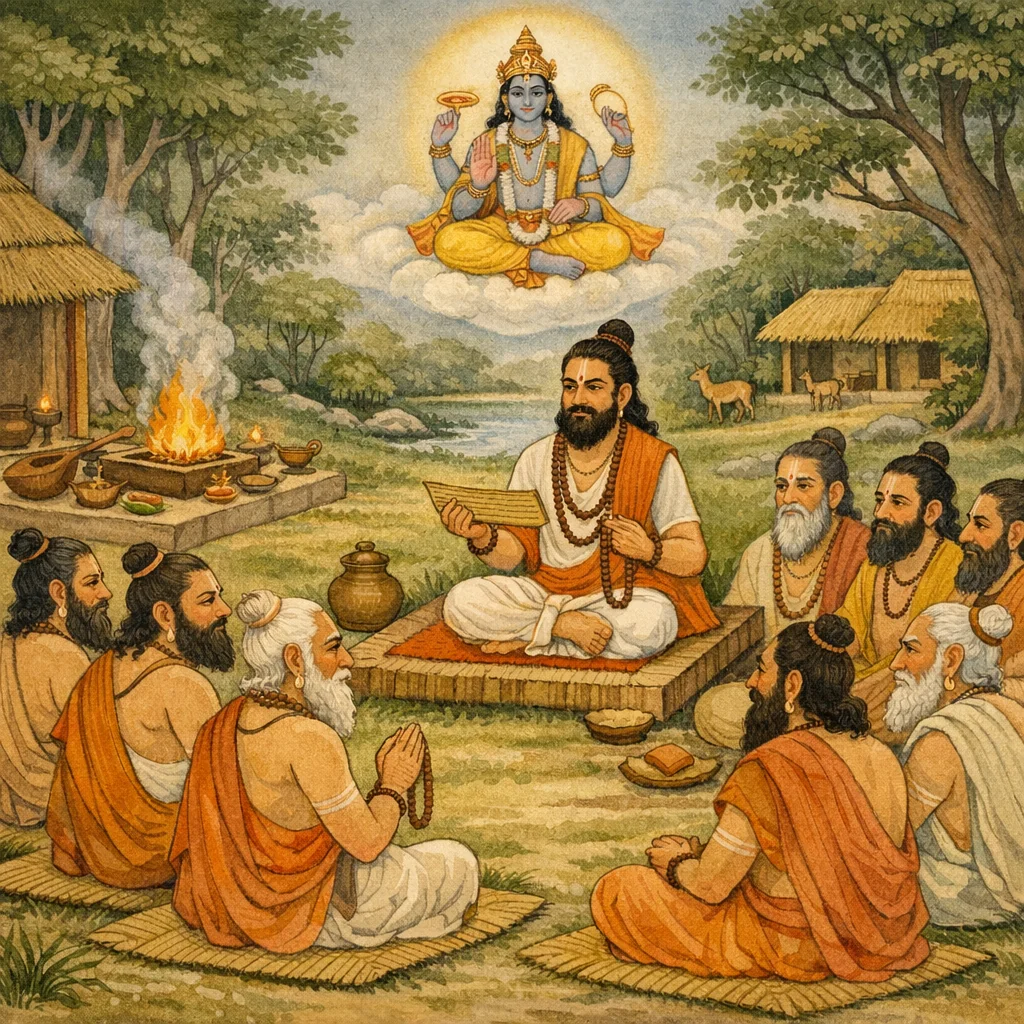
Maṅgalācaraṇa, Naimiṣāraṇya-Sabhā, Sūta-Āhvāna, and Narada Purāṇa-Māhātmya
The chapter opens with auspicious invocations to the gurus, Gaṇeśa, Vāsudeva/Nārāyaṇa, Nara–Narottama, and Sarasvatī, and praises the Primeval Being whose partial manifestations rule as Brahmā–Viṣṇu–Maheśa. In Naimiṣāraṇya, Śaunaka and the sages perform tapas and worship Viṣṇu through sacrifice, knowledge, and bhakti, seeking an integrated path to dharma, artha, kāma, and mokṣa. Learning that Sūta Romaharṣaṇa—Vyāsa’s disciple and authorized Purāṇic reciter—dwells at Siddhāśrama, they go there, behold the setting of Nārāyaṇa’s Agniṣṭoma, and await the avabhṛtha conclusion. They request “knowledge as hospitality,” asking how to please Viṣṇu, the right modes of worship, varṇa–āśrama duties, honoring guests, fruitful karma, and the nature of liberating bhakti. Sūta promises to teach what Sanaka and the foremost sages sang to Nārada, then proclaims the Narada Purāṇa’s harmony with the Vedas, its power to destroy sin, and the graded merits of hearing or reciting its chapters, along with strict discourse etiquette and eligibility. The chapter culminates in mokṣa-dharma: remembrance of Nārāyaṇa and one-pointed listening gives rise to bhakti and fulfills all puruṣārthas.
Shlokas
Verse 1
ॐ श्रीगुरुभ्यो नमः । ॐ श्रीगणेशाय नमः । ॐ नमो भगवते वासुदेवाय । ॐ नारायाणं नमस्कृत्य नरं चैव नरोत्तमम् । देवीं सरस्वतीं चैवततो जयमुदीरयेत् ॥ १ ॥
Om—salutations to the revered Gurus. Om—salutations to Śrī Gaṇeśa. Om—salutations to Bhagavān Vāsudeva. Having bowed to Nārāyaṇa, to Nara and the supreme Nara (Narottama), and to Goddess Sarasvatī, one should then proclaim “Victory” for this sacred discourse.
Verse 2
ॐ वेदव्यासाय नमः । वृन्दे वृन्दावनासीनमिन्दिरानन्दन्दमन्दिरम् । उपेन्द्रं सांद्रकारुण्यं परानन्दं परात्परम् ॥ १॥ १ ॥
Om—salutations to Vedavyāsa. O Vṛndā! I adore Upendra, seated in Vṛndāvana, the very temple-abode of Indirā’s (Lakṣmī’s) bliss; whose compassion is dense and overflowing; who is supreme bliss itself, transcendent beyond the highest.
Verse 3
ब्रह्मविष्णुमहेशाख्यां यस्यांशा लोकसाधकाः । तमादिदेवं चिद्रूपं विशुद्ध परमं भजे ॥ २ ॥
I worship that Primeval Divine Being—supremely pure, of the nature of pure consciousness—whose partial manifestations, known as Brahmā, Viṣṇu, and Maheśa, accomplish the governance of the worlds.
Verse 4
शौनकाद्या महात्मान ऋषयो ब्रह्मवादिनः । नैमिषाख्ये महारण्ये तपस्तेपुर्मुमुक्षवः ॥ ३ ॥
The great-souled sages—Śaunaka and others—expounders of Brahman, performed austerities in the great forest called Naimiṣa, desiring liberation.
Verse 5
जितेन्द्रिया जिताहाराः सन्तः सत्यपराक्रमाः । यजन्तः परया भक्त्या विष्णुमाद्यं सनातनम् ॥ ४ ॥
Self-controlled and moderate in diet, the virtuous—whose valor is grounded in truth—worshiped Viṣṇu, the primordial and eternal Lord, with supreme devotion.
Verse 6
अनीर्ष्याः सर्वधर्म्मज्ञा लोकानुग्रहतत्पराः । निर्म्ममा निरहंकाराः परस्मिन्नतमानसाः ॥ ५ ॥
Free from envy, knowing the essence of all dharmas, intent on the welfare of the world—without possessiveness and without ego—they keep their minds bowed in dedication to the Supreme.
Verse 7
न्यस्तकामा विवृजिनाः शमादिगुणसंयुताः । कृष्णाजिनोत्तरीयास्ते जटिला ब्रह्मचारिणः ॥ ६ ॥
Having laid aside all desires and freed from sin, endowed with virtues beginning with tranquility, they wore black antelope-skins as their upper garments; matted-haired, they lived as celibate brahmacārins.
Verse 8
गृणन्तः परमं ब्रह्म जगच्चक्षुः समौजसः । धर्म्मशास्त्रार्थतत्त्वज्ञास्तेपुर्नैमिषकानने ॥ ७ ॥
Praising the Supreme Brahman—the Lord who is the eye of the universe—those sages, equal in spiritual vigor and truly versed in the essential meaning of the Dharma-śāstras, performed austerities in the Naimiṣa forest.
Verse 9
यज्ञैर्यज्ञपतिं केचिज्ज्ञानैर्ज्ञानात्मकं परे । केचिच्च परया भक्त्या नारायणमपूजयन् ॥ ८ ॥
Some worshipped the Lord of sacrifice through sacrifices; others, through knowledge, worshipped Him who is of the very nature of knowledge. And some, with supreme devotion, worshipped Nārāyaṇa.
Verse 10
एकदा ते महात्मानः समाजं चक्रुरुतमाः । धर्मार्थकाममोक्षाणामुपायाञ्ज्ञातुमिच्छवः ॥ ९ ॥
Once, those exalted great-souled sages convened an assembly, desiring to know the means to attain dharma, artha, kāma, and mokṣa.
Verse 11
षङ्विंशतिसहस्त्राणि मुनीनामूर्द्ध्वरेतसाम् । तेषां शिष्यप्रशिष्याणां संख्या वक्तुं न शक्यते ॥ १० ॥
There are twenty-six thousand sages, steadfast in brahmacarya and spiritually exalted; and the number of their disciples and grand-disciples cannot be spoken.
Verse 12
मुनयो भावितात्मानो मिलितास्ते महौजसः । लोकानुग्रहकर्तारो वीतरागा विमत्सराः ॥ ११ ॥
Those sages—self-cultivated and radiant with great spiritual power—had assembled together. Free from passion and jealousy, they acted for the welfare and upliftment of the worlds.
Verse 13
कानि क्षेत्राणि पुण्यानि कानि तीर्थानि भूतले । कथं वा प्राप्यते मुक्तिर्नृणां तापार्तचेतसाम् ॥ १२ ॥
Which sacred regions are truly meritorious, and which tīrthas—pilgrimage fords—are found upon the earth? And how is moksha, liberation, attained by human beings whose minds are scorched by suffering?
Verse 14
कथं हरौ मनुष्याणां भक्तिरव्यभिचारिणी । केन सिध्येत च फलं कर्मणस्त्रिविधात्मनः ॥ १३ ॥
How does unwavering, undeviating bhakti to Hari (Vishnu) arise in human beings? And by what means is the fruit of karma—of threefold nature—brought to fulfillment?
Verse 15
इत्येवं प्रष्टुमात्मानमुद्यतान्प्रेक्ष्य शौनकः । प्राञ्जलिर्वाक्यमाहेदं विनयावनतः सुधीः ॥ १४ ॥
Seeing them thus ready to question him, the wise Śaunaka—hands joined in añjali and bowed in humility—spoke these words.
Verse 16
शौनक उवाच । आस्ते सिद्धाश्रमे पुण्ये सूतः पौराणिकोत्तमः । यजन्मखैर्बहुविधैर्विश्वरुपं जनार्दनम् ॥ १५ ॥
Śaunaka said: In the holy Siddhāśrama dwells Sūta, foremost among the expounders of the Purāṇas, worshipping Janārdana—the Lord of the Universal Form—through many kinds of sacrificial rites.
Verse 17
स एतदखिलं वेत्ति व्यासशिष्यो महामुनिः । पुराणसंहितावक्ता शान्तो वै रोमहर्षणिः ॥ १६ ॥
He knows all this in its entirety—the great sage Romaharṣaṇa, a disciple of Vyāsa, calm in nature, and the reciter of the Purāṇic compendium.
Verse 18
युगे युगेऽल्पकान्धर्मान्निरीक्ष्य मधुसूदनः । वेदव्यास स्वरूपेण वेदभागं करोति वै ॥ १७ ॥
In every age, Madhusūdana (Lord Viṣṇu), observing that dharma has become diminished, indeed assumes the form of Vedavyāsa and divides the Veda into portions.
Verse 19
वेदव्यासमुनिः साक्षान्नारायण इति द्विजाः । शुश्रुमः सर्वशास्त्रेषु सूतस्तु व्यासशासितः ॥ १८ ॥
O twice-born sages, we have heard in all the scriptures that the sage Vedavyāsa is verily Nārāyaṇa Himself incarnate; and that Sūta is one instructed and appointed by Vyāsa.
Verse 20
तेन संशासितः सूतो वेदव्यासेन धीमता । पुराणानि स वेत्त्येव नान्यो लोके ततः परः ॥ १९ ॥
Instructed by that wise Vedavyāsa, Sūta (Romaharṣaṇa) indeed knows the Purāṇas; in this world there is no one superior to him in that knowledge.
Verse 21
स पुराणार्थविल्लोके स सर्वज्ञः स बुद्धिमान् । स शान्तो मोक्षधर्मज्ञः कर्मभक्तिकलापवित् ॥ २० ॥
In this world, he alone is truly versed in the meaning of the Purāṇas; he is all-knowing, wise, serene, a knower of the dharma that leads to mokṣa, and fully acquainted with the entire range of karma and bhakti.
Verse 22
वेदवेदाङ्गशास्त्राणां सारभूतं मुनीश्वराः । जगद्धितार्थं तत्सर्वं पुराणेषूक्तवान्मुनिः ॥ २१ ॥
O best of sages, the very essence of the Vedas and the Vedāṅga disciplines has been set forth by the muni in the Purāṇas—all of it—for the welfare of the world.
Verse 23
ज्ञानार्णवो वै सूतस्तत्सर्वतत्त्वार्थकोविदः । तस्मात्तमेव पृच्छाम इत्यूचे शौनको मुनीन् ॥ २२ ॥
Sūta is indeed an ocean of knowledge, well-versed in the meaning and purport of all tattvas. Therefore, let us question him alone—thus Śaunaka spoke to the sages.
Verse 24
ततस्ते मुनयः सर्वे शौनकं वाग्विदां वरम् । समाश्लिष्य सुसंप्रीताः साधु साध्विति चाब्रुवन् ॥ २३ ॥
Then all those sages, embracing Śaunaka—the foremost among the masters of sacred speech—being exceedingly pleased, exclaimed, “Well said! Well said!”
Verse 25
अथ ते मुनयो जग्मुः पुण्यं सिद्धाश्रमं वने । मृगव्रजसमाकीर्णं मुनिभिः परिशोभितम् ॥ २४ ॥
Then those sages went to the holy Siddhāśrama in the forest—filled with herds of deer and made splendid by the presence of other ascetics and munis.
Verse 26
मनोज्ञभूरुहलताफलपुष्पविभूषितम् । युक्तं सरोभिरच्छोदैरतिथ्यातिथ्यसंकुलम् ॥ २५ ॥
It was adorned with charming trees and creepers, laden with fruits and flowers; furnished with clear, pure lakes, and filled with the continual reception and hospitality of guests.
Verse 27
ते तु नारायणं देवमनन्तमपराजितम् । यजन्तमग्निष्टोमेन ददृशू रोमहर्षणिम् ॥ २६ ॥
But they beheld the God Nārāyaṇa—endless and unconquered—performing worship through the Agniṣṭoma sacrifice, in a vision that was thrilling and awe-inspiring.
Verse 28
यथार्हमर्चितास्तेन सूतेन प्रथितौजसः । तस्यावभृथमीक्षन्तस्तत्र तस्थुर्मखालये ॥ २७ ॥
Having been duly honored by that Sūta of renowned vigor, they remained there in the sacrificial hall, watching for the concluding ablution-rite (avabhṛtha) of the sacrifice.
Verse 29
अधरावभृथस्नातं सूतं पौराणिकोत्तमम् । पप्रच्छुस्ते सुखासीनां नैमिषारण्यवासिनः ॥ २८ ॥
After Sūta—the foremost among Purāṇic narrators—had bathed following the concluding (avabhṛtha) rite, the residents of Naimiṣāraṇya, while he sat comfortably at ease, questioned him.
Verse 30
ऋषय ऊचुः । वयं त्वतिथयः प्राप्ता आतिथेयास्तु सुव्रत । ज्ञानदानोपचारेण पूजयास्मान्यथाविधिः ॥ २९ ॥
The sages said: “We have arrived here as your guests, O virtuous one. Therefore, as our host, honor and receive us properly—according to the prescribed rule—by the offering of knowledge as a gift and by fitting acts of hospitality.”
Verse 31
दिवौकसो हि जीवन्ति पीत्वा चन्द्रकलामृतम् । ज्ञानामृतं भूसुरास्तु मुने त्वन्मुखनिःसृतम् ॥ ३० ॥
The dwellers of heaven indeed live by drinking the nectar that flows from the Moon’s rays; but the brāhmaṇas, O sage, live by the nectar of knowledge that issues forth from your mouth.
Verse 32
येनेदमखिलं जातं यदाधारं यदात्मकम् । यस्मिन्प्रतिष्ठितं तात यस्मिन्वा लयमेष्यति ॥ ३१ ॥
That by which this entire universe has come into being—whose very support it is, and whose very nature it is; in whom it stands established, dear one, and into whom it will finally dissolve.
Verse 33
केन विष्णुः प्रसन्नः स्यात्स कथं पूज्यते नरैः । कथं वर्णाश्रमाचारश्चातिथेः पूजनं कथम् ॥ ३२ ॥
“By what means does Viṣṇu become pleased, and how is He to be worshipped by people? How is the proper conduct of the varṇas and āśramas to be observed, and how, indeed, is a guest to be honoured?”
Verse 34
सफलं स्याद्यथा कर्म मोक्षोपायः कथं नृणाम् । भक्त्या किं प्राप्यते पुंभिस्तथा भक्तिश्च कीदृशी ॥ ३३ ॥
How may action become truly fruitful, and what is the means to liberation for human beings? What is attained by devotion, and what kind of devotion is it that should be practiced?
Verse 35
वद सूत मुनिश्रेष्ट सर्वमेतदसंशयम् । कस्य नो जायते श्रद्धा श्रोतुं त्वद्वचनामृतम् ॥ ३४ ॥
Speak, O Sūta—best among sages—tell all this without any doubt. For who would not feel faith and eagerness to hear the nectar of your words?
Verse 36
सूत उवाच । श्रृणुध्वमृषयः सर्वे यदिष्टं वो वदामि तत् । गीतं सनकमुख्यैस्तु नारदाय महात्मने ॥ ३५ ॥
Sūta said: “Hear, O sages, all of you. I shall declare exactly what you desire—this sacred teaching that Sanaka and the other foremost seers sang to the great-souled Nārada.”
Verse 37
पुराणं नारदोपाख्यमेतद्वेदार्थसंमितम् । सर्वपापप्रशमनं दुष्टग्रहनिवारणम् ॥ ३६ ॥
This Purāṇa, known as the Nārada Purāṇa, accords fully with the meaning of the Vedas. It pacifies all sins and wards off afflictions born of malevolent planetary influences.
Verse 38
दुःस्वप्ननाशनं धर्म्यं भुक्तिमुक्तिफलप्रदम् । नारायणकथोपेतं सर्वकल्याणकारणम् ॥ ३७ ॥
It destroys evil dreams, is righteous in nature, and grants the fruits of both worldly enjoyment and liberation. Endowed with the sacred narrative of Nārāyaṇa, it becomes the cause of all auspiciousness.
Verse 39
धर्मार्थकाममोक्षाणां हेतुभूतं महाफलम् । अपूर्वपुण्यफलदं श्रृणुध्वं सुसमाहिताः ॥ ३८ ॥
Listen with full attention: this teaching is the cause of dharma, artha, kāma, and mokṣa; it yields great results and grants the fruit of unprecedented merit.
Verse 40
महापातकयुक्तो वा युक्तो वाप्युपपातकैः । श्रृत्वैतदार्षं दिव्यं च पुराणं शुद्धिमाप्नुयात् ॥ ३९ ॥
Even if a person is tainted by great sins, or even by subsidiary sins, by hearing this divine Purāṇa of the seers, one attains purification.
Verse 41
यस्यैकाध्यायपठनाद्वाजिमेधफलं लभेत् । अध्यायद्वयपाठेन राजसूयफलं तथा ॥ ४० ॥
By reciting a single chapter of this Purāṇa, one gains the merit of the Aśvamedha sacrifice; and by reciting two chapters, one likewise gains the merit of the Rājasūya sacrifice.
Verse 42
ज्येष्ठमासे पूर्णिमायां मूलक्षें प्रयतो नरः । स्नात्वा च यमुना तोये मथुरायामुपोषितः ॥ ४१ ॥
On the full-moon day of the month of Jyeṣṭha, under the Mūla asterism, a disciplined person should bathe in the waters of the Yamunā and observe upavāsa (a devotional fast) at Mathurā.
Verse 43
अभ्यर्च्य विधितवत्कृष्णं यत्फलं लभते द्विजाः । तत्फलं समवाप्रोति अध्यायत्रयपाठतः ॥ ४२ ॥
O twice-born ones, whatever fruit is gained by duly worshipping Kṛṣṇa according to the prescribed rites, that very fruit is attained by the recitation of three chapters.
Verse 44
तत्प्रवक्ष्यामि वः सम्यक् शृणुध्वं गदतो मम । जन्मायुतार्जितैः पापैर्मुक्तः कोटिकुलान्वितः ॥ ४३ ॥
I shall explain it to you correctly—listen to me as I speak. By this, one is freed from sins amassed over tens of thousands of births, together with countless generations of one’s lineage.
Verse 45
ब्रह्मणः पदमासाद्य तत्रैव प्रतितिष्ठति । श्रुत्वास्य तु दशाध्यायान्भक्तिभावेन मानवः ॥ ४४ ॥
Having attained the station of Brahmā, one becomes firmly established there. Yet a human being who listens to these ten chapters with bhakti—an attitude of devotion—attains that same state.
Verse 46
निर्वाणमूक्तिं लभते नात्र कार्या विचारणा । श्रेयसां परमं श्रेयः पवित्राणामनुत्तमम् ॥ ४५ ॥
One attains the liberation of nirvāṇa—here there is no need for doubt or further deliberation. This is the highest good among all goods, and the unsurpassed purifier among all that is pure.
Verse 47
दुःखप्रनाशनं पुण्यं श्रोतव्यं यत्नतो द्विजाः । श्रद्धया सहितो मर्त्यः श्लोकं श्लोकार्द्धमेव वा ॥ ४६ ॥
O twice-born ones, this meritorious teaching that destroys sorrow should be listened to with earnest effort. A mortal endowed with faith should hear even a single śloka—or even half a śloka.
Verse 48
पठित्वा मुच्यते सद्यो महापातकराशिभिः । सतामेव प्रवक्तव्यं गुह्याद्गुह्यतरं यतः ॥ ४७ ॥
By reading it, one is immediately freed from heaps of great sins. Therefore it should be taught only to the virtuous, for it is more secret than even the secret.
Verse 49
वावयेत्पुरतो विष्णोः पुण्यक्षेत्रे द्विजान्तिके । ब्रह्यद्रोहपराणां च दंभाचारयुतात्मनाम् ॥ ४८ ॥
One should have this sacred recitation performed before Viṣṇu—at a holy place and in the presence of brāhmaṇas—especially for those intent on hostility toward the sacred (Brahman/brāhmaṇas) and whose minds are joined to hypocrisy and corrupt conduct.
Verse 50
जनानां बकवृतीनां न ब्रूयादिदमुत्तमम् । त्यक्तकामादिदोषाणां विष्णुभक्तिरतात्मनाम् ॥ ४९ ॥
This supreme teaching should not be spoken to people who wear a false, hypocritical guise. It is meant for those who have abandoned faults such as lust and whose minds are devoted to bhakti toward Viṣṇu.
Verse 51
सदाचारपराणां च वक्तव्यं मोक्षयसाधनम् । सर्वदेवमयो विष्णुः स्मरतामार्तिनाशनः ॥ ५० ॥
To those devoted to righteous conduct, the means to mokṣa should indeed be taught. Viṣṇu—who embodies all the gods—destroys the distress of those who remember Him.
Verse 52
सद्भक्तिवत्सलो विप्रा भक्त्या तुष्यति नान्यथा । अश्रद्धयापि यांन्नाच्चि कीर्तितेऽथ स्मूतेऽपि वा ॥ ५१ ॥
O brāhmaṇas, the Lord is affectionate to true devotees; He is pleased only by bhakti and by nothing else. Even without faith, when His Name is uttered, sung in kīrtana, or even remembered, it still bears spiritual effect.
Verse 53
विमुक्तः पातकैर्मर्त्यो लभते पदमव्ययम् । संसारधोरकान्ताग्दावाग्रिर्मधुसुदनः ॥ ५२ ॥
Freed from sins, a mortal attains the imperishable state. For the blazing forest-fire at the far end of the dreadful wilderness of saṃsāra, Madhusūdana (Viṣṇu) is the fire that consumes it away.
Verse 54
स्मरतां सर्वपापानि नाशयत्याशु सत्तमाः । तदर्थद्योतकमिदं पुराणं श्राव्यमुत्तमम् ॥ ५३ ॥
O best of the virtuous, for those who remember it, it quickly destroys all sins. Therefore, this excellent Purāṇa—which illuminates that very meaning—should certainly be heard.
Verse 55
श्रवणात्पठनाद्वापि सर्वपापविनाशकृत् । यस्यास्य श्रवणे बुद्धिर्जायते भक्तिसंयुता ॥ ५४ ॥
By merely hearing it, or even by reciting it, it becomes a destroyer of all sins. For the one in whom, upon hearing this, understanding arises united with bhakti, it bears its highest fruit.
Verse 56
स एव कृतकृत्यस्तु सर्वशास्त्रार्थकोविदः । यदर्जितं तपः पुण्यं तन्मन्ये सफलं द्विजाः ॥ ५५ ॥
He alone is truly fulfilled, and truly skilled in discerning the meaning of all śāstras. Whatever tapas (austerity) and puṇya (merit) he has gained—O twice-born ones—I deem that to be genuinely fruitful.
Verse 57
यदस्य श्रवणे भाक्तिरन्यथा नहि जायते । सत्कथासु प्रर्वतन्ते सज्जना ये जगाद्धिताः ॥ ५६ ॥
By hearing this, bhakti arises—never otherwise. The good who seek the welfare of the world devote themselves to sat-kathā, noble and sacred discourses.
Verse 58
निन्दायां कलहे वापि ह्यसन्तः पाप्तात्पराः । पुराणेष्वर्थवादत्वं ये वदन्ति नराधमाः ॥ ५७ ॥
Those who delight in slander and quarrel are truly wicked—worse than the sinful. And the lowest of men who declare the Purāṇas to be mere arthavāda, empty eulogy, are likewise condemned.
Verse 59
तैरर्जितानि पुण्यानि क्षयं यान्ति द्विजोत्तमाः । समस्तकर्मनिर्मूलसाधनानि नराधमः ॥ ५८ ॥
O best of the twice-born, the merits gained by those means come to an end; but the lowest of men relies on means that uproot action (karma) altogether at its very root.
Verse 60
पुराणान्यर्थवादेन ब्रुवन्नरकमश्नुते । अन्यानि साधयन्त्येव कार्याणि विधिना नराः ॥ ५९ ॥
One who speaks of the Purāṇas as mere arthavāda, exaggerated eulogy, incurs hell; whereas people accomplish other duties only when they are performed according to proper rule and procedure (vidhi).
Verse 61
पुराणानि द्विजश्रेष्टाः साधयन्ति न मोहिताः । अनायासेन यः पुण्यानीच्छतीह द्विजोत्तमाः ॥ ६० ॥
O best of the twice-born, those who are not deluded accomplish their aims through the Purāṇas; and whoever here desires merit without toil—O foremost brāhmaṇas—should rely upon the Purāṇas.
Verse 62
श्रोतव्यानि पुराणानि तेन वै भक्तिभावतः । पुराणश्रवणे बुद्धिर्यस्य पुंसः प्रवर्तते ॥ ६१ ॥
Therefore the Purāṇas should indeed be heard with a devotional spirit; for in that person whose intellect turns toward hearing the Purāṇas, bhakti is awakened and made firm.
Verse 63
पुरार्जितानि पापानि तस्य नश्यन्त्यसंशयम् । पुराणे वर्तमानेऽपि पापपाशेन यन्त्रितः । आदरेणान्यगाथासु सक्तबुद्धिः पतत्यधः ॥ ६२ ॥
His sins amassed from former times are destroyed—without doubt. Yet even while the Purāṇa is being recited, if one is bound by the noose of sin and, with misdirected reverence, fastens the mind upon other worldly songs and tales, one falls downward.
Verse 64
सत्सङ्गदेवार्चनसत्कथासु हितोपदेशे निरतो मनुष्यः । प्रयाति विष्णोः परमं पदं यद्देहावसानेऽच्युततुल्यतेजाः ॥ ६३ ॥
One who is devoted to holy company (sat-saṅga), the worship of the Devas, the hearing of sacred narratives, and beneficial counsel attains the supreme abode of Viṣṇu; and at the body’s end, he shines with splendor comparable to Acyuta (Viṣṇu).
Verse 65
तस्मादिदं नारदनामधेयं पुण्यं पुराणं श्रुणुत द्विजेन्द्राः । यस्मिञ्छ्रुते जन्मजरादिहीनो नरो भवेदच्युतनिष्टचेताः ॥ ६४ ॥
Therefore, O best among the twice-born, listen to this holy and meritorious Purāṇa that bears the name “Nārada”. When it is heard, a person becomes free from birth, old age, and the like, with the mind firmly devoted to Acyuta (Viṣṇu).
Verse 66
वरं वरेण्यं वरदं पुराणं निजप्रभाभावितसर्वलोकम् । संकल्पितार्थप्रदमादिदेवं स्मृत्वाव्रजेन्मुक्तिपदं मनुष्यः ॥ ६५ ॥
A human being who remembers this excellent and most worthy Purāṇa—bestower of boons, illuminating all worlds by its own radiance and granting the desired aims—and who remembers the Primeval Lord, attains the state of liberation.
Verse 67
ब्रह्मेशविष्ण्वादिशरीरभेदैर्विश्वं सृजत्यत्ति च पाति विप्राः । तमादिदेवं परमं परेशमाधाय चेतस्युपयाति मुक्तिम् ॥ ६६ ॥
O brāhmaṇas, by assuming differentiated bodies as Brahmā, Īśa (Śiva), Viṣṇu and others, He creates the universe, sustains it, and also withdraws it. Fixing that Primordial God—the Supreme Lord of lords—in one’s heart, one attains liberation.
Verse 68
यो नाम जात्यादिविकल्पहीनः परः पराणां परमः परस्मात् । वेदान्तवेद्यः स्वजनप्रकाशः समीड्यते सर्वपुराणवेदैः ॥ ६७ ॥
He whose very Name is free from all distinctions such as birth, caste, and the like—who is beyond the beyond, the Supreme of the supreme, higher than the highest—who is knowable through Vedānta and self-luminous to His own devotees: He is praised by all the Purāṇas and the Vedas.
Verse 69
तस्मात्तिमीशं जगतां विमुक्तिमुपासनायालमजं मुरारिम् । परं रहस्यं पुरुषार्थहेतुं स्मृत्वा नरो याति भवाब्धिपारम् ॥ ६८ ॥
Therefore, remembering and worshipping the unborn Murāri—Lord of the worlds, the very liberation of the universe, the supreme secret and the cause of all human aims—a person crosses beyond the ocean of worldly existence.
Verse 70
वक्तव्यं धार्मिकेभ्यस्तु श्रद्दधानेभ्य एव च । मुमुक्षुभ्यो यतिभ्यश्च वीतरागेभ्य एव च ॥ ६९ ॥
This teaching should be spoken only to the righteous, and indeed only to those who have faith—also to seekers of liberation, to ascetics (yatis), and only to those who are free from attachment.
Verse 71
वक्तव्यं पुण्यदेशे च सभायां देवतागृहे । पुण्यक्षेत्रे पुण्यतीर्थे देव ब्राह्मणसन्निधौ ॥ ७० ॥
This sacred teaching should be spoken in a holy place—in an assembly, in a temple; in a meritorious land and at a holy tīrtha, especially in the presence of the gods and of brāhmaṇas.
Verse 72
उच्छिष्टदेशे वक्तार आख्यानमिदमुत्तमम् । पच्यन्ते नरके घोरे यावदाभूतसंप्लवम् ॥ ७१ ॥
Those who recite this supreme sacred narrative in an impure place are cooked in a dreadful hell until the dissolution of all beings.
Verse 73
मृषा श्रृणोति यो मूढो दम्भी भक्तिविवर्जितः । सोऽपि तद्वन्महाघोरे नरके पच्यतेऽक्षये ॥ ७२ ॥
That deluded man who listens with false intent—being hypocritical and devoid of devotion—he too, like such offenders, is cooked in a most dreadful hell that does not end.
Verse 74
नरो यः सत्कथामध्ये संभाषां कुरुतेऽन्यतः । स याति नरकं घोरं तदेकाग्रमना भवेत् ॥ ७३ ॥
He who, in the midst of a sacred discourse (sat-kathā), turns to side-talk with others goes to a dreadful hell; therefore let the mind be one-pointed upon the holy narration.
Verse 75
श्रोता वक्ता चविप्रेन्द्रा एष धर्मः सनातनः । असमाहितचित्तस्तु न जानाति हि किंचना ॥ ७४ ॥
O best of brāhmaṇas, to be a true listener and a true speaker—this is the eternal dharma (sanātana). But one whose mind is not collected and steady understands nothing at all.
Verse 76
तत एकमना भूत्वा पिबेद्धरिकथामृतम् । कथं संभ्रान्तचित्तस्य कथास्वादः प्रजायते ॥ ७५ ॥
Therefore, becoming one-pointed in mind, one should drink the nectar of Hari’s sacred narratives. For how can the taste of such discourse arise in one whose mind is agitated and distracted?
Verse 77
किं सुखं प्राप्यते लोके पुंसा संभ्रान्तचेतसा । तस्मात्सर्वं परित्यज्य कामं दुःखस्य साधनम् ॥ ७६ ॥
What happiness is ever attained in this world by a man whose mind is agitated? Therefore, renouncing everything, abandon kāma—desire—for it is the very instrument that produces sorrow.
Verse 78
समाहितमना भूत्वाकुर्यादच्युतचिन्तनम् । येन केनाप्युपायेन स्मृतो नारायणोऽव्ययः ॥ ७७ ॥
With the mind made steady, one should meditate on Acyuta; by whatever means possible, let the imperishable Nārāyaṇa be remembered.
Verse 79
अपि पातकयुक्तस्य प्रसन्नः स्यान्नसंशयः । यस्य नारायणे भक्तिर्विभौ विश्वेश्वरेऽव्यये । तस्य स्यात्सफलं जन्म मुक्तिश्चैव करे स्थिता ॥ ७८ ॥
Even a person burdened with sin becomes pleasing to the Lord—of this there is no doubt—if they have devotion to Nārāyaṇa, the all-pervading, imperishable Lord of the universe. For such a devotee, life becomes fruitful, and liberation itself stands as though in the palm of the hand.
Verse 80
धर्मार्थकाममोक्षाख्यपुरुषार्था द्विजोत्तमाः । हरिभक्तिपराणां वै संपद्यन्ते न संशयः ॥ ७९ ॥
O best of the twice-born, the human goals known as dharma, artha, kāma, and mokṣa surely come to fruition for those who are devoted to Hari—of this there is no doubt.
Frequently Asked Questions
Śaunaka cites śāstric tradition that Vyāsa is Nārāyaṇa’s incarnation who divides the Veda in each age, and that Sūta is specifically instructed and appointed by Vyāsa. This establishes a recognized Purāṇic pramāṇa chain, making Sūta the proper conduit for dharma, karma, and bhakti teachings leading to mokṣa.
While acknowledging sacrifice and knowledge, the chapter repeatedly centers bhakti—especially hearing sacred narrative, one-pointed attention, and remembrance/uttering of Nārāyaṇa’s name—as the decisive purifier and liberating force, capable of destroying sins and fulfilling the four puruṣārthas.