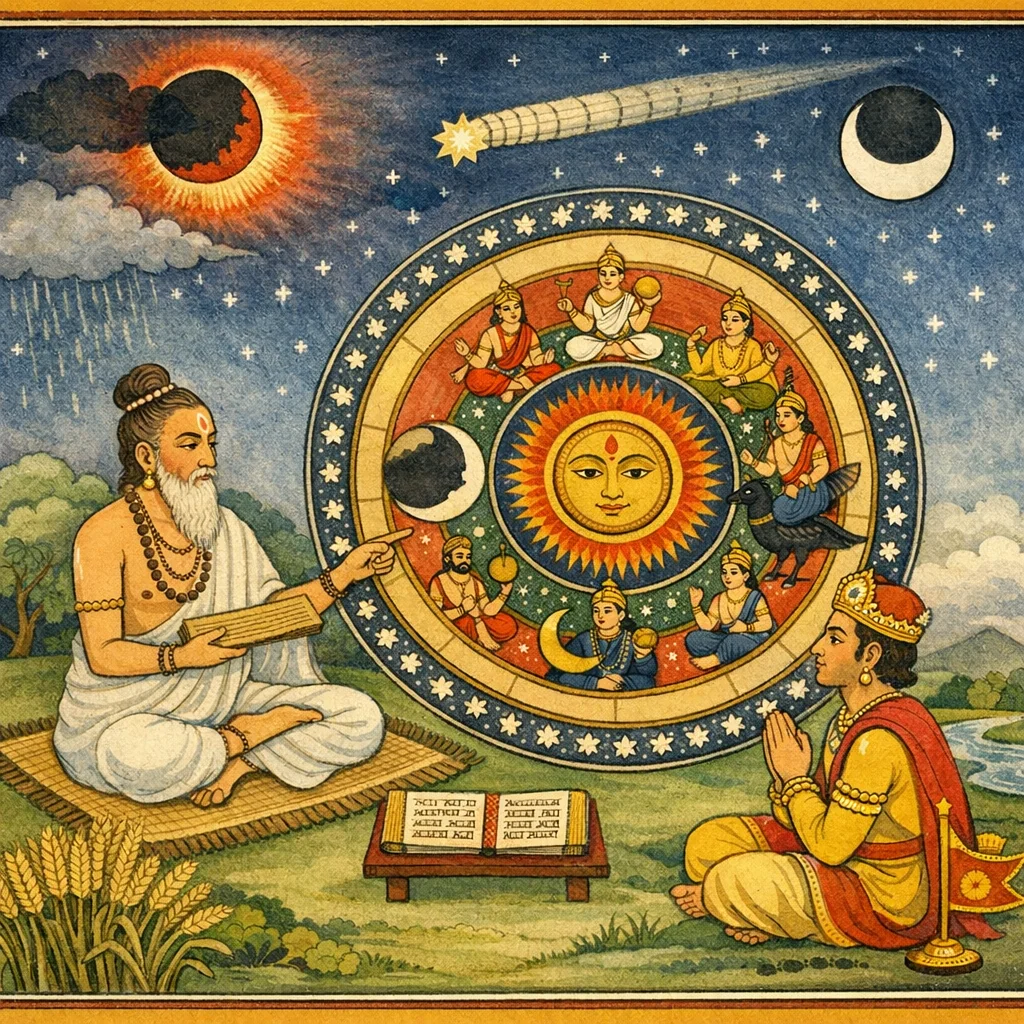
Graha–Ketu–Utpāta Lakṣaṇas: Solar/Lunar Omens, Comets, Eclipses, and Calendar Rules
Sanandana teaches a sage/royal listener how to read time and omens through the Sun, Moon, the planets, and ketus (comets/meteors). It opens with the solar saṅkrānti sequence from Caitra and the primacy of the weekday of Caitra-śukla-pratipadā, then ranks planetary auspiciousness. Solar portents—disk-shapes, smoky masses, halos, and seasonally abnormal colors—are linked to political and ecological outcomes such as war, a king’s death, drought, famine, and epidemics. Lunar omens follow: “horn” positions, inverted risings, dangers in southern-course nakṣatras, and specific “marks” (e.g., ghaṭokṣṇa) correlated with signs and weapons. Mars and Mercury are treated via retrograde/rising conditions across nakṣatras and their effects on rain, crops, professions, and public safety; Jupiter’s retrograde hues and daytime visibility signal crisis. Venus is mapped by celestial tracks (vīthikās) and conjunction rules, while Saturn’s transit through certain nakṣatras is portrayed as beneficent. The text then systematizes ketu types by tail length, color, shape, and direction, with corresponding results. Finally it codifies nine time-measures, practical election rules for rites (journeys, marriage, vows), the 60-year Jovian cycle with yuga-lords, uttarāyaṇa/dakṣiṇāyana ritual suitability, month names, tithi classes (Nandā/Bhadrā/Jayā/Riktā/Pūrṇā), doṣa remedies (dvipuṣkara), and nakṣatra classifications for specific saṃskāras and agriculture.
Shlokas
Verse 1
सनंदन उवाच । क्रमाच्चैत्रादिमासेषु मेषाद्याः संक्रमा मताः । चैत्रशुक्लप्रतिपदि यो वारः स नृपः स्मृतः 1. ॥ १ ॥
Sanandana said: In due order, in the months beginning with Caitra, the Sun’s transitions (saṅkrama) are held to commence with Meṣa (Aries) and the rest in sequence. And the weekday that falls upon the śukla pratipad—the first lunar day of Caitra’s bright fortnight—is remembered as the “king,” the chief among days.
Verse 2
मेषप्रवेशे सेनानीः कर्कटे सस्यपो भवेत् । समोद्यधीश्वरः सूर्यो मध्यमश्चोत्तमो विधुः ॥ २ ॥
When the Sun enters Meṣa (Aries), it signifies a commander of armies; when it enters Karkaṭa (Cancer), there arises a lord of crops, an agrarian ruler. The Sun becomes lord over the ocean, while the Moon is first of middling strength and then becomes excellent, most auspicious.
Verse 3
नेष्टः कुजो बुधो जीवो भृगुस्त्वतिशुभङ्करः । अधमो रविजो वाच्यो ज्ञात्वा चैषां बलाबलम् ॥ ३ ॥
Mars (Kuja) is said to be unfavorable; Mercury (Budha) and Jupiter (Jīva) are favorable; and Venus (Bhṛgu) is exceedingly auspicious. But the Sun is to be called the least favorable—after discerning the relative strength and weakness of these planets.
Verse 4
दण्डाकारे कबंधेवा ध्वांक्षाकारेऽथ कीलके । दृष्टेऽकमण्डले व्याधिर्भ्रांतिश्चोरार्थनाशनम् ॥ ४ ॥
If the ritual peg (kīlaka) is seen in the form of a staff, or like a headless trunk, or like a crow—then, when such a kamaṇḍalu (water-pot) is beheld—it portends illness, delusion and confusion, and the loss of wealth through thieves.
Verse 5
छत्रध्वजपताकाद्यसन्निभस्तिमितैर्ध्वनैः । रविमण्डलगैर्धूम्रैः सस्फुलिंगैर्जगत् क्षयः ॥ ५ ॥
With muffled, stifled sounds resembling umbrellas, banners, and flags, and with smoky masses moving across the Sun’s disk, shot through with sparks, the destruction of the world is foretold.
Verse 6
सितरक्तैः पीतकृष्णैर्वर्णैर्विप्रादिपीडनम् । घ्नंति द्वित्रिचतुर्वर्णैर्भुवि राजजनान्मुने ॥ ६ ॥
O sage, on earth the royal class oppresses and afflicts brāhmaṇas and others; through factions marked “white,” “red,” “yellow,” and “black,” they strike them down by two-, three-, and fourfold divisions.
Verse 7
ऊर्द्ध्वैर्भानुकरैस्ताम्रैर्नाशं याति चमूपतिः । पीतैर्नृपसुतः श्वेतैः पुरोधश्चित्रितैर्जनाः ॥ ७ ॥
When the Sun’s rays rise upward and appear coppery-red, the commander of the army meets destruction. When they appear yellow, the king’s son is afflicted; when white, the royal priest (purohita) is afflicted; and when variegated, the common people suffer.
Verse 8
धूम्रैर्नृपपिशंगैस्तु जलदाधोमुखैर्जगत् । शुभोर्कः शिशिरे ताम्रः कुंकुमाभा वसन्तिके ॥ ८ ॥
With smoke-hued, tawny clouds hanging low, the world appears overcast. The auspicious sun, in winter, looks coppery; and in spring it shines with a saffron-like radiance.
Verse 9
ग्रीष्मश्चापांडुरश्चैव विचित्रो जलदागमे । पद्मोदराभः शरदि हेमंते लोहितच्छविः ॥ ९ ॥
In summer it becomes pale; at the coming of the rainy season it appears variegated; in autumn it shines like the inside of a lotus; and in winter it takes on a reddish hue.
Verse 10
पीतः शीते सिते वृष्टौ ग्रीष्मे लोहितभा रविः । रोगानावृष्टिभयकृत् क्रमादुक्तो मुनीश्वर ॥ १० ॥
O great sage, it is stated in due order that when the Sun appears yellow in winter, pale-white during the rainy season, and reddish in summer, it gives rise to fear—bringing diseases and the dread of scanty rainfall.
Verse 11
इन्द्र चापार्द्धमूर्तिस्तु भानुर्भूपविरोधकृत् । शशरक्तनिभे भानौ संग्रामो न चिराद्भुवि ॥ ११ ॥
If the Sun appears in a form like half of Indra’s bow (a partial rainbow), it stirs hostility among kings. And when the Sun takes on a deep red hue like hare’s blood, battle will arise upon the earth before long.
Verse 12
मयूरपत्रसङ्काशो द्वादशाब्दं न वर्षति । चन्द्रमासदृशो भानुः कुर्याद्भूपांतरं क्षितौ ॥ १२ ॥
If the clouds appear like peacock-feathers, there will be no rainfall for twelve years. If the Sun comes to resemble the Moon, it foretells a change of kingship upon the earth.
Verse 13
अर्के श्यामे कीटभयं भस्माभे राष्ट्रजं तथा । छिद्रे ऽर्कमण्डले दृष्टं महाराजविनाशनम् ॥ १३ ॥
If the Sun appears dark, it foretells fear of insects and pestilence; if it appears ash-colored, it indicates calamity arising within the kingdom. And if a hole is seen in the solar disk, it portends the destruction of a great king.
Verse 14
घटाकृतिः क्षुद्भयकृत्पुरहा तोरणाकृतिः । छत्राकृते देशहतिः खंडभानुनृपांतकृत् ॥ १४ ॥
A portent shaped like a pot brings fear of famine; one appearing over a city brings destruction to the town. A portent shaped like a gateway-arch brings ruin; one shaped like an umbrella brings devastation to the land. If the Sun appears broken or fragmented, it foretells the death of the king.
Verse 15
उदयास्तमये काले विद्युदुल्काशनिर्यदि । तदा नृपवधो ज्ञेयस्त्वथवा राजविग्रहः ॥ १५ ॥
If, at the time of sunrise or sunset, lightning or a meteor is seen, it should be understood as a portent of the king’s death—or else of conflict and hostility among rulers.
Verse 16
पक्षं पक्षार्धमर्केन्दु परिविष्टावहर्निशम् । राजानमन्यं कुरुतो लोहिताम्बुदयास्तगौ ॥ १६ ॥
The Sun and the Moon, moving in their ordained courses, bring forth the measures of time—fortnights and half-fortnights, and day and night. Likewise, by their reddish risings and settings, they cause the succession of rulers, the changing order of dominion.
Verse 17
उदयास्तमये भानुराच्छिन्नः शस्त्रसन्निभैः । घनैर्युद्धं खरोष्ष्ट्राद्यैः पापरूपैर्भयप्रदम् ॥ १७ ॥
At sunrise and at sunset, the Sun appears as though cut off by clouds that resemble weapons—an alarming battle, as if waged by sinful and fearsome forms such as donkeys and camels.
Verse 18
याम्य शृङ्गोन्नतश्चन्द्रः शुभदो मीनमेषयोः । सौम्य शृङ्गोन्नतः श्रेष्ठो नृयुङ्मकरयोस्तथा ॥ १८ ॥
When the Moon is raised at the “southern horn,” it becomes auspicious for Pisces and Aries. Likewise, when the Moon is raised at the “northern horn,” it is regarded as the best for Aquarius and Capricorn as well.
Verse 19
घटोक्ष्णस्तु समः कर्कचापयोः शरसन्निभः । चापवत्कौर्महर्योश्च शूलवत्तुलकर्कयोः ॥ १९ ॥
The mark called ghaṭokṣṇa is the same for Cancer and Sagittarius and resembles an arrow. For Capricorn and Leo it is like a bow, and for Libra and Cancer it is like a spear (a sharp, trident-like weapon).
Verse 20
विपरीतोदितश्चन्द्रो दुर्भिक्षकलहप्रदः । आषाढद्वयमूलेन्द्र धिष्ण्यानां याम्यगः शशी ॥ २० ॥
When the Moon rises in an inverted, inauspicious manner, it becomes a giver of famine and strife. Likewise, when the Moon moves on the southern course among the lunar mansions—especially in the two Āṣāḍhās, Mūla, and Jyeṣṭhā—it brings adverse results.
Verse 21
अग्निप्रदस्तेयचरवनसर्पविनाशकृत् । विशाखा मित्रयोर्याम्यपार्श्वगः पापगः शशी ॥ २१ ॥
When the Moon abides in Viśākhā, it is said to bring destruction to fire, theft, moving creatures, forests, and serpents; then the Moon passes along the southern side of the two Mitras and is deemed inauspicious.
Verse 22
मध्यमः पितृदैवत्ये द्विदैवे सौम्यगः शशी । अप्राप्यपौष्णभाद्रौद्रामदुक्षाविशशी शुभः ॥ २२ ॥
When the Moon is of middling strength, placed in an asterism presided over by the Pitṛs (Ancestors) and in a dual-natured sign, the Moon becomes gentle (saumya) and auspicious. Not reaching the Pauṣṇa, Bhādra, or Raudra groupings, it remains unafflicted and favorable.
Verse 23
मध्यगो द्वारदक्षाणि अतीत्य नववासवात् । यमेंद्रा हीशनोयेशमरुतश्चार्द्धतारकाः ॥ २३ ॥
Passing through the southern gates, the one who moves in the middle course goes beyond the nine Vāsavas; there he encounters Yama and Indra, Īśāna and Yeaśa, the Maruts, and the half-stars.
Verse 24
ध्रुवादिति द्विदैवाः स्युरध्यर्द्धांश्चापराः समाः । याम्यशृंगोन्नतो नेष्टः शुभः शुक्ले पिपीलिका ॥ २४ ॥
From Dhruva onward, some omens are said to be “double-fated,” while others yield their result in a time equal to one-and-a-half parts. One whose right horn is raised is not deemed desirable; but an ant seen in the bright fortnight (śukla pakṣa) is auspicious.
Verse 25
कार्यहानिः कार्यवृद्धिर्हानिर्वृद्धिर्यथाक्रमम् । सुभिक्षकृद्विशालेंदुरविशालोघनाशनः ॥ २५ ॥
In due order, it brings loss of undertakings and growth of undertakings; likewise decline and increase. It produces abundance of provisions (subhikṣa); it makes the Moon appear broad; it makes what is vast seem not vast; and it dispels dense masses, such as heavy clouds.
Verse 26
अधोमुखे शस्त्रभयं कलहो दंडसन्निभे । कुजाद्यैर्निहते शृंगे मंडले वा यथाक्रमम् ॥ २६ ॥
When the mark turns downward, it signifies fear from weapons; when it is like a staff, it signifies quarrel. If the horn or the circular mark is struck by Kuja (Mars) and the other planets in due sequence, the corresponding results arise accordingly.
Verse 27
क्षेमाद्यं वृष्टिभूपालजननाशः प्रजायते । सत्याष्टनवमर्क्षेषु सोदयाद्वक्रिमे कुजे ॥ २७ ॥
When Kuja (Mars) is retrograde and rises in the asterisms beginning with Satyā, it yields results such as welfare and security, rainfall, and also the destruction of kings and of people.
Verse 28
तद्वक्रमुष्णं संज्ञं स्यात्प्रजापीडाग्निसंभवः । दशमैकादशे ऋक्षे द्वादशर्वाग्रतीपयः ॥ २८ ॥
That configuration is designated “vakra-uṣṇa,” “retrograde and hot,” arising from a fire that afflicts living beings. It is noted in the tenth and eleventh lunar mansions; and then the twelve are those whose points turn forward in their course.
Verse 29
कूक्रं वक्रमुखं ज्ञेयं सस्यवृष्टिविनाशकृत् । कुजे त्रयोदशे ऋक्षे वक्रिते वा चतुर्दशे ॥ २९ ॥
Know the portent called Kūkra as “the crooked-faced”; it brings destruction to crops and to rainfall. It is indicated when, on a Tuesday, the Moon is in the thirteenth lunar mansion, or when it is in the fourteenth while the condition called “Vakrita” (crooked/retrograde) prevails.
Verse 30
बालस्यचक्रं तत्तस्मिन्सस्यवृष्टिविनाशनम् । पंचदशे षोडशर्क्षे वक्रे स्याद्रुधिराननम् ॥ ३० ॥
The omen called “the child’s wheel”: when it appears, it brings destruction to crops and to rainfall. When a planet is retrograde in the fifteenth or sixteenth lunar mansion, it is said to become “blood-faced,” an inauspicious sign.
Verse 31
दुर्भिक्षं क्षुद्भयं रोगान्करोति क्षितिनंदनः । अष्टादशे सप्तदशे तद्वक्रं मुशलाह्वयम् ॥ ३१ ॥
O son of the Earth, O king, it brings famine, fear of hunger, and diseases. In the eighteenth cycle, in the seventeenth position, its crooked and inauspicious configuration is called “Muśala.”
Verse 32
दुर्भिक्षं धनधान्यादिनाशने भयकृत् सदा । फाल्गुन्योरुदितो भौमो वैश्वदेवे प्रतीपगः ॥ ३२ ॥
When Mars (Bhauma) rises in the two Phālgunī nakṣatras and moves in an adverse course in Vaiśvadeva, it ever causes fear—bringing famine and the ruin of wealth, grain, and related resources.
Verse 33
अस्तगश्चतुरास्यार्क्षे लोकत्रयविनाशकृत् । उदितः श्रवणे पुष्ये वक्तृगोश्वनहानिदः ॥ ३३ ॥
If (a celestial body) sets during the nakṣatra Caturāsya, it becomes a cause of destruction for the three worlds. If it rises while the Moon is in Śravaṇa or in Puṣya, it brings loss to the speaker and causes harm to cows, horses, and men.
Verse 34
यद्दिग्गोऽभ्युदितो भौमस्तद्दिग्भूपभयप्रदः । मघामध्यगतो भौमस्तत्र चैव प्रतीपगः ॥ ३४ ॥
In whatever direction Mars (Bhauma) rises, fear befalls the king of that very quarter. And when Mars enters the middle of the Maghā nakṣatra, he becomes adverse and inauspicious there as well.
Verse 35
अवृष्टिशस्त्रभयदः पीड्यं देवा नृपांतकृत् । पितृद्विदैवधातॄणां भिद्यन्ते गंडतारकाः ॥ ३५ ॥
When the gods are afflicted, they bring fear through drought and weapons, and they bring about the downfall of kings; and for those who are hostile to the Pitṛs and to the divine ordinances, ominous portents—like tumor-like swellings—burst forth.
Verse 36
दुर्भिक्षं मरणं रोगं करोति क्षितिजस्तदा । त्रिषूत्तरासु रोहिण्यां नैरृते श्रवणे मृगे ॥ ३६ ॥
Then Mars, the Earth-born one, brings famine, death, and disease when he is placed in the three Uttarās (Uttarā‑Phālgunī, Uttarāṣāḍhā, Uttarā‑Bhādrapadā), in Rohiṇī, in the south‑western quarter (Nairṛta), and in the lunar mansions Śravaṇa and Mṛgaśīrṣa.
Verse 37
अवृष्टिदश्चरन्भौमो दक्षिणे रोहिणीस्थितः । भूमिजः सर्वधिष्ण्यानामुदगामी शुभप्रदः ॥ ३७ ॥
When Mars (Bhūma/Bhauma) moves in an irregular course—being in Rohiṇī yet turned to the south—it is a sign of drought. But when that Earth-born planet proceeds northward through all its stations, it bestows auspicious results.
Verse 38
याम्यगोऽनिष्टफलदो भवेद्भेदकरो नृणाम् । विनोत्पातेन शशिनः कदाचिन्नोदयं व्रजेत् ॥ ३८ ॥
When the Moon moves in the southern course, it yields undesirable results and becomes a cause of discord among people. Without some portent (utpāta), the Moon would never rise at all.
Verse 39
अनावृष्टाग्निभयकृदनर्थनृपविग्रहः । वसुवैष्णवविश्वेन्दुधातृभेषु चरन्बुधः ॥ ३९ ॥
Mercury (Budha), when moving through the Vasu, Vaiṣṇava, Viśve, Indu, Dhātṛ, and Bha constellational groups, becomes a cause of calamities—such as drought and fear of fire—and brings misfortune and conflict among kings.
Verse 40
भिनत्ति यदि तत्तारां बाधावृष्टिभयंकरः । आद्रा र्दिपितृभांतेषु दृश्यते यदि चन्द्र जः ॥ ४० ॥
If the fearsome planet that brings affliction and ruinous rains pierces that very star, and if the Moon-born planet is seen in Ārdrā, in the rainy-season asterisms, or among the Pitṛ‑nakṣatras, then such a configuration indicates distress and calamity connected with rain.
Verse 41
तदा दुर्भिक्षकलहरोगानावृष्टिभीतिकृत् । हस्तादिषट्सु तारासु विचरन्निन्दुनंदनः ॥ ४१ ॥
At that time, as Indunandana (Budha, Mercury) moves through the six lunar mansions beginning with Hasta, he becomes a cause of fear arising from famine, strife, disease, and lack of rain.
Verse 42
क्षेमं सुभिक्षमारोग्यं कुरुते रोगनाशनम् । अहिर्बुध्न्यार्यमाग्नेययाम्यभेषु चरन्बुधः ॥ ४२ ॥
Mercury, moving through the lunar mansions Ahi-budhnya, Āryamā, Āgneya, and Yāmya, bestows safety, plentiful food, and health, and brings about the destruction of disease.
Verse 43
भिषक्तरंगवाणिज्यवृत्तीनां नाशकृत्तदा । पूर्वात्रयेचरन्सौम्यो योगतारां भिनत्ति चेत् ॥ ४३ ॥
At that time it becomes destructive for the professions of physicianing, seafaring, and trade—if Saumya (Mercury), while moving through the earlier triad of asterisms, should pierce the Yoga-star.
Verse 44
क्षुच्छस्त्रानलचौरेभ्यो भयदः प्राणिनां तदा । याम्याग्निधातृवायव्यधिष्ण्येषु प्राकृता गतिः ॥ ४४ ॥
Then, for living beings, he becomes the giver of fear from hunger, weapons, fire, and thieves; and the ordinary (worldly) course leads to the abodes presided over by Yama, Agni, Dhātṛ, and Vāyu.
Verse 45
रौद्रे न्दुसार्पपित्र् येषु ज्ञेया मिश्राह्वया गतिः । भाग्यार्यमेज्यादितिषु संक्षिप्ता गतिरुच्यते ॥ ४५ ॥
In the divisions called Raudra, Indu, Sārpa, and Pitṛya, the gati (course) is to be understood as the “mixed” (miśra) course. In the divisions called Bhāgya, Āryama, Ejya, and Āditi, the course is declared to be the “condensed/brief” (saṃkṣiptā) one.
Verse 46
गतिस्तीक्ष्णाजचरणाहिर्बुघ्न्यभाश्रिभेषुया । योमातिकातिविश्वांबुमूलमत्स्यैन्यजस्य च ॥ ४६ ॥
“Gati,” “Tīkṣṇā,” “Aja,” “Caraṇa,” “Ahir,” “Bughnyā,” “Bhā,” “Śrī,” and “Bheṣuyā”—and also “Yo,” “Mātikā,” “Ati,” “Viśvāmbu,” “Mūla,” “Matsya,” and “Enyaja”—these are mystic appellations to be contemplated as sacred designations of the Supreme Lord.
Verse 47
घोरा गतिर्हरित्वाष्ट्रवसुवारुणभेषु च । इंद्रा ग्निमित्रमार्तंडभेषु पापाह्वयागतिः ॥ ४७ ॥
In the designations Harit, Tvāṣṭra, Vasu, and Vāruṇa, the soul’s course is dreadful; and in the designations Indrāgni, Mitra, and Mārtaṇḍa, the destination is known as the “sin-named” (inauspicious) course.
Verse 48
प्राकृताद्यासु गतिषु ह्युदितोऽस्तमियोपिवा । यावंत्येव दिनान्येष दृश्यस्तावत्यदृश्यगः ॥ ४८ ॥
In the various courses of existence beginning with the material (prākṛta) state, this one—whether spoken of as rising or setting—remains visible only for that many days; for the same span he moves in an unseen condition.
Verse 49
चत्वारिंशत्क्रमात्र्त्रिशद्र वींदू भूसुतो नव । पंचदशैकादशभिर्दिवसैः शशिनंदनः ॥ ४९ ॥
In due order: the Sun and the Moon complete their courses in thirty and forty days; Mars (the son of Earth) in nine; and Mercury (the son of the Moon) in fifteen and eleven days.
Verse 50
प्राकृतायां गतः सौम्यः क्षेमारोग्यसुभिक्षकृत् । मिश्रसक्षिप्तयोर्मध्ये फलदोऽन्यासु वृष्टिदः 1. ॥ ५० ॥
When the benefic planet Saumya (Mercury) moves in an ordinary (neutral) condition, it brings security, health, and abundance of food. In mixed or afflicted conditions it yields results only moderately; but in other favourable conditions it becomes a giver of rains.
Verse 51
वैशाखे श्रावणे पौषे आषाढेऽभ्युदितो बुधः । जगतां पापफलदस्त्वितरेषु शुभप्रदः ॥ ५१ ॥
When Budha (Mercury) rises in the months of Vaiśākha, Śrāvaṇa, Pauṣa, or Āṣāḍha, it yields sinful and inauspicious results for the world; but when it rises in the other months, it bestows auspicious results.
Verse 52
इषोर्जमासयोः शस्त्रदुर्भिक्षाग्निभयप्रदः । उदितश्चंद्र जः श्रेष्ठो रजतस्फटिकोपमः ॥ ५२ ॥
In the months of Iṣa and Ūrja, it is said to bring fear from weapons, famine, and fire. But when the Moon-born (Chandra-ja) rises, it is most auspicious, shining like silver or crystal.
Verse 53
द्विभाटजोदिमास्तस्य पंचमैकादशास्त्रिभात् । यन्नक्षत्रोदितो जीवस्तन्नक्षत्राख्यवत्सरः ॥ ५३ ॥
In that cycle, the months are reckoned by divisions of the nakṣatras—two, five, eleven, and three. The year is named after the nakṣatra under which Jīva (Bṛhaspati, Jupiter) rises and becomes visible.
Verse 54
कार्तिको मार्गशीर्षश्च नृणां दुष्टफलप्रदः । शुभप्रदौ पौषमाघौ मध्यमौ फाल्गुनो मधुः ॥ ५४ ॥
For people, the months Kārtika and Mārgaśīrṣa are said to yield adverse results; Pauṣa and Māgha are auspicious and bestow good results; while Phālguna and Madhu (Caitra) are of middling effect.
Verse 55
माधवः शुभदो ज्येष्ठो नृणां मध्यफलप्रदः । शुचिर्मध्यो नभः श्रेष्ठो भाद्र ः श्रेष्ठः क्वचिन्नरः ॥ ५५ ॥
Mādhava is auspicious; Jyeṣṭha is beneficent; and for people, the “middle” period yields middling results. Śuci is the “middle”; Nabhas is excellent; and Bhādra is, for some persons, the best.
Verse 56
अतिश्रेष्ठ इषः प्रोक्तो मासानां फलमीदृशम् । सौम्ये भागे चरन्भानां क्षेमारोग्यसुभिक्षकृत् ॥ ५६ ॥
The month called Iṣa is declared the most excellent among the months; such is the fruit of vows and observances among them. When the Sun moves through the auspicious, gentle division, it bestows welfare, freedom from disease, and abundant prosperity.
Verse 57
विपरीतो गुरुर्याम्ये मध्ये चरति मध्यमम् । पीताग्निश्यामहरितरक्तवणेगिराः क्रमात् ॥ ५७ ॥
When Guru (Jupiter) is in retrograde motion, it moves at a middling pace through the southern region; and, in due order, its hue and radiance appear as yellow, fiery, dark, green, and red.
Verse 58
व्याध्यग्निचौरशस्त्रास्त्रभयदः प्राणिनां भवेत् । अनावृष्टिं भूम्ननिभः करोति सुरपूजितः ॥ ५८ ॥
It becomes a source of fear to living beings through disease, fire, thieves, weapons, and missiles; and that mighty one, revered even by the gods, brings about drought upon the earth (a lack of rain).
Verse 59
दिवादृष्टो नृपवध्यामयंवाराष्ट्रनाशनम् । संवत्सरशरीरं स्यात्कृत्तिका रोहिणी तथा ॥ ५९ ॥
If it is seen in the daytime, it indicates either the death of a king, a grievous epidemic, or the destruction of a kingdom. This time-sign should be understood as having the “body” of a year; likewise, it is connected with the nakṣatras Kṛttikā and Rohiṇī.
Verse 60
नाभिस्त्वापाठयुगलमाद्री हृत्कुसुमं मघा । दुर्भिक्षाग्निमरुद्भीतिः शरीरं क्रूरपीडिते ॥ ६० ॥
For one afflicted by cruel suffering: the navel corresponds to the pair called Āpāṭha; the heart to Ādrī; the “flower” (vital center) to Maghā. Such a person is tormented by fears arising from famine, fire, and violent winds.
Verse 61
नाभ्यां क्षुत्तृड्भयं पुष्ये सम्यङ्मूलफलक्षयः । हृदयेशस्य निधनं शुभं स्यात्संयुतैः शुभैः ॥ ६१ ॥
When an omen arises from the navel, it foretells fear born of hunger and thirst; in the nakṣatra Puṣya it signifies a proper depletion of roots and fruits. If the sign pertains to the region of the heart, it portends the death of the lord of the house; yet, when joined with auspicious indications, it may turn favorable.
Verse 62
शस्यवृद्धिः प्रजारोग्यं युद्धं जीवात्यवर्षणम् । इति द्विजातिमध्यां तु गोनृपस्त्रीसुखं महत् ॥ ६२ ॥
Crops will increase, the people will be healthy; there will be war, and rains sufficient for the sustenance of living beings. Thus, for the woman of the twice-born community (dvija), there shall be great happiness through the blessing of cows, the protection of the king, and the well-being of the household.
Verse 63
निःस्वनावृष्टिफणिभिर्वृष्टिः स्वास्थ्यं महोत्सवः । महार्घमपि संपत्तिर्देशनाशोऽतिवर्षणम् ॥ ६३ ॥
When rain falls amid ominous signs—such as unnatural silence and the appearance of serpents—there may still be health and great festivals; even precious prosperity may arise. Yet excessive rainfall brings the ruin of a region.
Verse 64
अवैरं रोगमभयं रोगभीः सस्यवर्षणे । रोगो धान्यं नभोऽदृष्टिमघाद्यृक्षगते गुरौ ॥ ६४ ॥
When Guru (Jupiter) transits the lunar mansion Maghā and those that follow, the land becomes free from enmity; diseases subside and people grow fearless. Rain comes for the crops and grain is produced—though the sky may appear overcast and the sight of the heavens is diminished.
Verse 65
सौम्यमध्यमयाम्येषु मार्गेषु वीथिकात्रयम् । शुक्रस्य दस्रभाज्ज्ञेयं पर्यायैश्च त्रिभिस्त्रिभिः ॥ ६५ ॥
In the northern, middle, and southern tracks of the heavens there is a triad of avenues (vīthikā). This set is to be understood as pertaining to Śukra (Venus), and each avenue is also known by three synonymous names.
Verse 66
नागेभैरावताश्चैव वृषभोष्ट्र्रखराह्वयाः । मृगांजदहनाख्याः स्युर्याम्यांता वीथयो नव ॥ ६६ ॥
Also, there are nine avenues (vīthīs) that end toward the southern quarter: those called Nāga and Bhairavata; those named for the bull, the camel, and the donkey; and those called Mṛga, Añja, and Dahana.
Verse 67
सौम्यमार्गे च तिसृषु चरन्वीथिषु भार्गवः । धान्यार्थवृष्टिसस्यानां परिपूर्तिं करोति हि ॥ ६७ ॥
When Bhārgava (Venus) moves along the auspicious course and passes through the three celestial tracks, he indeed brings fullness—of grain, of wealth, of rainfall, and of crops.
Verse 68
मध्मार्गे च तिसृषु सर्वमप्यधमं फलम् । पूर्वस्यां दिशि मेघस्तु शुभदः पितृपंचके ॥ ६८ ॥
If (a sign such as a cloud) appears on the middle path and in the three (specified) positions, the outcome is altogether inferior. Yet a cloud in the eastern quarter is auspicious during the five-day period of the Pitṛs (ancestral rites).
Verse 69
स्वातित्रये पश्चिमायां तस्यां शुक्रस्तथाविधः । विपरीते त्वनावृष्टिर्वृष्टिकृद्बुधसंयुतः ॥ ६९ ॥
During the threefold period of Svātī, if it lies in the western quarter, then Śukra (Venus) too is regarded as being in that same condition. If it is the reverse, there is lack of rain (anāvṛṣṭi); but when joined with Budha (Mercury), it becomes a causer of rainfall.
Verse 70
कृष्णाष्टम्यां चतुर्दश्याममायां च यदा सितः । उदयास्तमनं याति तदा जलमयी मही ॥ ७० ॥
When, on Kṛṣṇāṣṭamī, on the fourteenth lunar day, and on the night of Amāvāsyā (new moon), the “white one” (sitaḥ) reaches its rising and its setting, then the earth becomes, as it were, made of water.
Verse 71
मिथः सप्तमराशिस्थौ पश्चात्प्राग्वीथिसंस्थितौ । गुरुशुक्रावनावृष्टिदुर्भिक्षसमरप्रदौ ॥ ७१ ॥
When Jupiter (Guru) and Venus (Śukra) stand mutually in the seventh signs and are set upon the western and eastern paths, they become causes of drought, famine, and war.
Verse 72
कुजज्ञजीवरविजाः शुक्रस्याग्रेसरा यदि । युद्धातिवायुर्दुर्भिक्षजलनाशकरामताः ॥ ७२ ॥
If Mars, Mercury, Jupiter, and the Sun move ahead of Venus (Śukra), they foretell war, violent winds, famine, and the ruin of waters—bringing great affliction.
Verse 73
जलमित्रार्यमाहींद्र नक्षत्रेषु सुभिक्षकृत् । सच्छस्त्रावृष्टिदो मूलेऽहिर्बुध्न्यांत्यभयोर्भयम् ॥ ७३ ॥
In the Nakṣatras Jala, Mitra, Āryamā, and Mahīndra, it brings abundance and prosperity. In Mūla it grants excellent weapons and rainfall; but in Āhirbudhnya and in the last two Nakṣatras, it causes fear.
Verse 74
श्रवणानिलहस्ताद्रा र्भरणीभाग्यभेषु च । चरञ्छनैश्चरो नॄणां सुभिक्षारोग्यसस्यकृत् ॥ ७४ ॥
When Saturn (Śanaiścara) transits the lunar mansions Śravaṇa, Anila, Hasta, Ārdrā, Bharaṇī, Bhāgya, and Bheṣu, he becomes for people a giver of plentiful food, good health, and abundant crops.
Verse 75
मुखे चैकं गुदे द्वे च त्रीणि के नयने द्वयम् । हृदये पञ्च ऋक्षाणि वामहस्ते चतुष्टयम् ॥ ७५ ॥
One (sacred unit) is placed in the mouth; two in the anus; three in the ears; two in the eyes. Five Ṛkṣas are set in the heart, and a group of four in the left hand.
Verse 76
वामपादे तथा त्रीणि दक्षिणे त्रीणि भानि च । चत्वारि दक्षिणे हस्ते जन्मभाद्र विजस्थितिः ॥ ७६ ॥
Likewise, there are three auspicious marks upon the left foot and three upon the right; and four upon the right hand—such an arrangement proclaims an excellent birth and a pre-eminent station, brahmin-like in dignity.
Verse 77
रोगो लाभस्तथा हानिर्लाभः सौख्यं च बंधनम् । आयासः श्रेष्ठयात्रा च धनलाभः क्रमात्फलम् ॥ ७७ ॥
In due sequence, the fruits are: illness; gain; then loss; gain again; happiness; bondage; exertion; an excellent journey; and at last, the gaining of wealth.
Verse 78
बहुधारविजस्त्वेतद्वक्रगः फलमीदृशम् । करोत्येव समः साम्यं शीघ्रगेषूत्क्रमात् फलम् ॥ ७८ ॥
Indeed, such is the result wrought by that which is born of many streams and moves along a crooked course. Yet what is even and steady brings about balance; and among those that move swiftly, the fruit ripens quickly because their progress is rapid.
Verse 79
विष्णुचक्रोत्कृत्तशिराः पङ्गुः पीयूषपानतः । अमृत्युतां गतस्तत्र खेटत्वे परिकल्पितः ॥ ७९ ॥
There, the lame one—whose head had been severed by Viṣṇu’s discus—by drinking the nectar (amṛta) attained deathlessness, and was then appointed to the status of a celestial planet (kheṭa).
Verse 80
वरणधातुरर्केन्दू तुदते सर्वपर्वणि । विक्षेपावनतेर्वंगाद्रा हुर्दूरगतस्तयोः ॥ ८० ॥
The verbal root ‘varaṇa’ (to choose/cover) strikes the compounds ‘arka’ (Sun) and ‘indu’ (Moon) at every joint; and, through ‘vikṣepa’ (casting/throwing) and ‘avanati’ (lowering/inclining), it is said that Vaṅgā and Adrā become far removed from them.
Verse 81
षण्मासवृद्ध्या ग्रहणं शोधयेद्र विचंद्र योः । पर्वेशास्तु तथा सत्यदेवा रव्यादितः क्रमात् ॥ ८१ ॥
By adding a correction of six months, one should compute and verify the eclipses of the Sun and the Moon. Likewise, the lords of the junction-days (parvan-days) are to be determined in proper sequence—beginning with the Sun—together with the associated Satya-devas.
Verse 82
ब्रह्मेन्द्विन्द्र धनाधीशवरुणाग्नियमाह्वयाः । पशुसस्यद्विजातीनां वृद्धिर्ब्राह्मे तु पर्वणि ॥ ८२ ॥
Invocations of Brahmā, the Moon, Indra, Kubera (lord of wealth), Varuṇa, and Agni are to be performed; and on the sacred observance called the Brāhma-parvan there is increase—of cattle, of crops, and of the twice-born.
Verse 83
तद्वदेव फलं सौम्ये श्लेष्मपीडा च पर्वणि । विरोधो भूभुजां दुःखमैंद्रे सस्यविनाशनम् ॥ ८३ ॥
Likewise, O gentle one, when the influence is Saumya, the result is of the same kind; and on the Parvan there is affliction from phlegm. Under Aindra influence there arises conflict and suffering for kings, and the destruction of crops.
Verse 84
धनिनां धनहानिः स्यात्कौबेरं धान्यवर्धनम् । नृपाणामशिवं क्षेममितरेषां च वारुणे ॥ ८४ ॥
In the Kubera quarter, the wealthy may suffer loss of wealth, while grain and provisions increase. In the Varuṇa quarter, kings meet with inauspicious outcomes, whereas for others there is safety and well-being.
Verse 85
प्रवर्षणं सस्यवृद्धिः क्षेमं हौताशपर्वणि । अनावृष्टिः सस्यहानिर्दुर्भिक्षं याम्यपर्वणि ॥ ८५ ॥
At the juncture sacred to Agni (Hautāśa-parvan), there is abundant rainfall, increase of crops, and general well-being. But at the juncture sacred to Yama (Yāmya-parvan), there is lack of rain, loss of crops, and famine.
Verse 86
वेलाहीने सस्यहानिर्नृपाणां दारुणं रणम् । अतिवेले पुष्पहानिर्भयं सस्यविनाशनम् ॥ ८६ ॥
When the season arrives late, crops are lost, and for kings there arises a dreadful outbreak of war. When the season comes excessively early, blossoms are destroyed, and fear arises that the harvest will be ruined.
Verse 87
एकस्मिन्नेव मासे तु चंद्रा र्कग्रहणं यदा । विरोधो धरणीशानामर्थवृष्टिविनाशनम् ॥ ८७ ॥
But when, within the very same month, eclipses of both the Moon and the Sun occur, it foretells conflict among the rulers of the earth and the destruction of prosperity and rainfall.
Verse 88
ग्रस्तोदितावस्तमितौ नृपधान्यविनाशदौ । सर्वग्रस्ताविनेंदू तु क्षुद्व्याध्यग्निभयप्रदौ ॥ ८८ ॥
When the Sun or the Moon rises or sets while eclipsed, it brings destruction to kings and to grain. But when the Moon is completely eclipsed, it gives rise to fears of famine, disease, and fire.
Verse 89
सौम्यायने क्षत्रविप्रानितरां हन्ति दक्षिणे । द्विजातीं श्चक्रमाद्धंति राहुदृष्टोरगादितः ॥ ८९ ॥
In the Sun’s northern course, it strikes down Kṣatriyas and Brāhmaṇas more severely; in the southern course, it especially afflicts the twice-born (dvija). Hostile forces—beginning with serpents and the like, and those under the gaze of Rāhu—assail them in recurring cycles.
Verse 90
तथैव ग्रामभेदाः स्युर्मोक्षभेदास्तथा दश । नो शक्ता लक्षितुं देवाः किं पुनः प्राकृता जनाः ॥ ९० ॥
Likewise, there are said to be distinctions among communities (grāmas), and likewise ten distinct modes of liberation (mokṣa). Even the gods are not able to fully discern them—how much less can ordinary people?
Verse 91
आनीय खेटान्गणितांस्तेषां वारं विचिंतयेत् । शुभाशुभान्यैः कालस्य ग्राहयामो हि लक्षणम् ॥ ९१ ॥
Having consulted the computed motions of the planets, one should reflect upon their influence according to the weekday; for through auspicious and inauspicious indications we indeed discern the marks of time.
Verse 92
तस्मादन्वेषणीयं तत्कालज्ञानाय धीमता । उत्पातरूपाः केतूनामुदयास्तमया नृणाम् ॥ ९२ ॥
Therefore the wise should carefully investigate these, to know the nature of the present time—namely the portent-forms of the ketus: the risings and settings of the ketus (comets/meteors) that bear upon humankind.
Verse 93
दिव्यांतरिक्षा भौमास्ते शुभाशुभफलप्रदाः । यज्ञध्वजास्त्रभवनरक्षवृद्धिंगजोपमाः ॥ ९३ ॥
These signs may be celestial, atmospheric, or terrestrial; they bestow auspicious or inauspicious results. Mighty like elephants, they strengthen the protection and prosperity of yajña, banners, weapons, and dwellings.
Verse 94
स्तम्भशूलांकुशाकारा आंतरिक्षाः प्रकीर्तिताः । नक्षत्रसंस्थिता दिव्या भौमा ये भूमिसंस्थिताः ॥ ९४ ॥
Those in the mid-region are described as having forms like pillars, spears, and goads (ankuśa). Those stationed among the constellations are called divine, while those abiding upon the earth are called terrestrial.
Verse 95
एकोऽपि भिन्नरूपः स्याज्जंतुर्नाम शुभाय वै । यावन्तो दिवसान्केतुर्दृश्यते विविधात्मकः ॥ ९५ ॥
Even a single creature, if seen in an unusual (altered) form, is indeed taken as an auspicious sign. Likewise, for as many days as a ketu is seen—appearing in various forms—its influence is understood to extend for that many days.
Verse 96
तावान्मासैः फलं यच्छत्यष्टौ सारव्यवत्सरैः । ये दिव्याः केतवस्तेपि शश्वज्जीवफलप्रदाः ॥ ९६ ॥
That same merit is bestowed within months—equal to what would otherwise accrue over eight years. And those divine portents, the Ketus, continually grant their fruits to living beings.
Verse 97
ह्रस्वः स्निग्धः सुप्रसन्नः श्वेतकेतुः सुवृष्टिकृत् । क्षिप्रादस्तमयं याति दीर्घकेतुरवृष्टिकृत् ॥ ९७ ॥
A Ketu whose tail is short, glossy, serene and clear, and white brings good rains. It quickly sets and vanishes; whereas a long-tailed Ketu brings drought and lack of rain.
Verse 98
अनिष्टदो धूमकेतुः शक्रचापसमप्रभः । द्वित्रिचतुःशूलरूपः स च राज्यांतकृन्मतः ॥ ९८ ॥
The Dhūmaketu, a comet that brings misfortune, shining like Indra’s rainbow and appearing with two, three, or four spear-like prongs—such a portent is regarded as one that brings a kingdom to its end.
Verse 99
मणिहारस्तु वर्णाभा दीप्तिमंतोऽकसूनवः । केतवश्चोदिताः पूर्वापरयोर्नृपहानिदाः ॥ ९९ ॥
A halo like a jeweled garland, radiant and shining; and the Ketus—called the sons of the Sun—when they appear and move, if seen in the eastern or western quarters, become omens that bring about the decline of kings.
Verse 100
वंसुकबिंबक्षितजच्छुकतुंडादिसन्निभाः । हुताशनोदितास्तेऽपि केतवः फलदाः स्मृताः 1. ॥ १०० ॥
Those Ketus, resembling bamboo shoots, a gourd, a clod of earth, a parrot’s beak, and the like—even when they arise from the direction of fire—are remembered as bestowers of results.
Verse 101
भूसुता जलतैलाभा वर्तुलाः क्षुद्भयप्रदाः । सुभिक्षक्षेमदाः श्वेतकेतवः सोमसूनवः ॥ १०१ ॥
The sons of the Earth—portents born of the ground—appear like water or oil and in circular form, and they awaken fear of famine. Yet the white-bannered ones, the sons of Soma, bestow good harvest and secure well-being.
Verse 102
पितामहात्मजः केतुस्त्रिवर्णस्त्रिदशान्वितः । ब्रह्मदंडाद्धूमकेतुः प्रजानामंतकृन्मतः ॥ १०२ ॥
Ketu, the son of Pitāmaha (Brahmā), is said to bear three hues and to be attended by the gods. Born from Brahmā’s staff, he is called Dhūmaketu, “the smoke-bannered one,” and is regarded as a bringer of endings for living beings.
Verse 103
एशान्यां भार्गवसुताः श्वेतरूपास्त्वनिष्टदाः । अनिष्टदाः पंगुसुता विशिखाः कमकाह्वयाः ॥ १०३ ॥
In the north-eastern quarter are the sons of Bhṛgu, white in appearance yet bestowing misfortune. There too are the sons of Paṅgu—arrowless—known as Kamakā, and they likewise bring inauspicious results.
Verse 104
विकचाख्या गुरुसुता वेष्टा याम्ये स्थिता अपि । सूक्ष्माः शुक्ला बुधसुताश्चौररोगभयप्रदाः ॥ १०४ ॥
Vikacā—said to be the daughter of Guru (Bṛhaspati)—and Veṣṭā, though placed in the southern quarter, are subtle and white-bright. These “sons of Budha” become causes of fear, giving rise to dread of thieves and disease.
Verse 105
कुजात्मजाः कुंकुमाख्या रक्ताः शूलास्त्वनिष्टदाः । अग्निजा विश्वरूपाख्या अग्निवर्णाः सुखप्रदाः ॥ १०५ ॥
The sons of Kuja (Mars) are called Kuṅkuma: red, spear-like, and bring what is undesirable. The offspring of Agni are called Viśvarūpa: fire-hued, they bestow happiness.
Verse 106
अरुणाः श्यामलाकारा अर्कपुत्राश्च पापदाः । शुक्रजा ऋक्षसदृशाः केतवः शुभदायकाः ॥ १०६ ॥
The Aruṇas are dark in form and, as sons of the Sun, bestow harmful results. The Ketus born of Venus resemble bears, and they grant auspicious outcomes.
Verse 107
कृत्तिकासु भवो धूमकेतुर्नूनं प्रजाक्षयः । प्रासादवृक्षशैलेषु जातो राज्ञां विनाशकृत् ॥ १०७ ॥
A comet (Dhūmaketu) appearing in the Kṛttikā constellation surely foretells the destruction of the populace. If it is seen arising over palaces, trees, or mountains, it becomes a cause of the ruin of kings.
Verse 108
सुभिक्षकृत्कौमुदाख्यः केतुः कुमुदसन्निभः । आवर्तकेतुसंध्यायां शशिरो नेष्टदायकः ॥ १०८ ॥
A Ketu called Kaumuda—bringing plentiful harvests—appears, resembling a white water-lily. But when twilight is marked by a whirling (āvarta) Ketu, the Moon (Śaśin) becomes a giver of what is undesired, of inauspicious results.
Verse 109
ब्रह्मदेवमनोर्मानं पित्र्यं सौरं च सावनम् । चांद्रमार्क्षं गुरोर्मानमिति मानानि वै नव ॥ १०९ ॥
The measures (of time) are nine indeed: the measure of Brahmā, the measure of the gods, the measure of Manu, the ancestral (Pitṛ) measure, the solar measure, the civil (sāvana) measure, the lunar measure, the sidereal (nakṣatra-based) measure, and the measure of Jupiter (Guru).
Verse 110
एतेषां नवमानानां व्यवहारोऽत्र पञ्चभिः । तेषां पृथक्पृथक्कार्यं वक्ष्यते व्यवहारतः ॥ ११० ॥
Here, the practical usage of these nine kinds of measures is carried out through five modes. Their distinct functions will be explained separately, in terms of actual practice.
Verse 111
ग्रहाणां निखिलश्चारो गृह्यते सौरमानतः । वृष्टेर्विधानं स्त्रीगर्भः सावनेनैव गृह्यते ॥ १११ ॥
The complete course of the planets is determined by the solar measure of time; but the regulation of rainfall and the reckoning of a woman’s pregnancy are determined only by the sāvana (civil, day-based) measure.
Verse 112
प्रवर्षणां समे गर्भो नाक्षत्रेण प्रगृह्यते । यात्रोद्वाहव्रतक्षौरे तिथिवर्षेशनिर्णयः ॥ ११२ ॥
When the year is reckoned in relation to the rainy season, conception (and its reckoning) is not to be fixed by the lunar mansion (nakṣatra). For journeys, marriages, religious vows, and tonsure rites, the decision is to be made by the lunar day (tithi) and by the presiding lord of the year (varṣeśa).
Verse 113
पर्ववास्तूपवासादि कृत्स्नं चांद्रे ण गृह्यते । गृह्यते गुरुमानेन प्रभवाद्यब्दलक्षणम् ॥ ११३ ॥
All observances—such as festival days (parvan), rites connected with dwellings and sites (vāstu), fasts, and the like—are to be determined by the lunar reckoning. The defining features of the years beginning with Prabhava are determined by the measure of Jupiter (Guru).
Verse 114
तत्तन्मासैर्द्वादशभिस्तत्तदष्टौ भवेत्ततः । गुरुमध्यमचारेण षष्ट्यब्दाः प्रभवादयः ॥ ११४ ॥
From those divisions, twelve make a year; and then, by that same reckoning, eight such (years) are formed thereafter. According to the mean motion of Jupiter (Guru), there are sixty years beginning with Prabhava.
Verse 115
प्रभवो विभवः शुक्लः प्रमोदोऽथ प्रजापतिः । अंगिराः श्रीमुखो भावो युवा धाता तथैव च ॥ ११५ ॥
“(He is) Prabhava, Vibhava, Śukla, Pramoda, and also Prajāpati; (He is) Aṅgirā, Śrīmukha, Bhāva, Yuvā, and likewise Dhātā.”
Verse 116
ईश्वरो बहुधान्यश्च प्रमाथी विक्रमो वृषः । चित्रभानुस्सुभानुश्च तारणः पार्थिवोऽव्ययः ॥ ११६ ॥
He is the Supreme Lord—abundant in nourishment and prosperity; the mighty subduer; valour itself; the righteous Bull (Vṛṣa), upholder of dharma. He shines with variegated splendour and auspicious radiance; He is the saviour who carries beings across; He rules within the earthly realm, and yet remains imperishable.
Verse 117
सर्वजित्सर्वधारी च विरोधी विकृतः खरः । नंदनो विजयश्चैव जयो मन्मथदुर्मुखौ ॥ ११७ ॥
He is the All-Conqueror and the Upholder of all; the Opposer of evil and the Unchanging One; firm and unyielding. He is the Delighter, Victory itself, the Victorious; the subduer of Kāma (desire); and the One of formidable countenance.
Verse 118
हेमलंबो विलंबश्च विकारी शार्वरी लवः । शुभकृच्छोभनः क्रोधी विश्वावसुपराभवौ ॥ ११८ ॥
Hemalamba, Vilamba, Vikārī, Śārvarī, Lava, Śubhakṛt, Śobhana, Krodhī, Viśvāvasu, and Parābhava—these are the names being enumerated.
Verse 119
प्लवंगः कीलकः सौम्यः सामाप्तश्च विरोधकृत् । र्प्भावी प्रमादी च आनन्दो राक्षसोऽनलः ॥ ११९ ॥
He is also named Plavaṅga, Kīlaka, Saumya, Sāmāpta, and Virodhakṛt; likewise Ṛbhāvī, Pramādī, Ānanda, Rākṣasa, and Anala.
Verse 120
पिंगलः कालयुक्तश्च सिद्धार्थो रौद्र दुर्मतीः । दुंदुभी रुधिरोद्गारी रक्ताक्षः क्रोधनः क्षयः ॥ १२० ॥
He is called Piṅgala, united with Time; Siddhārtha, fulfiller of all aims; Raudra, the fierce; and Durmati, of ill intent. He is Dundubhī, roaring like a drum; Rudhirodgārī, spewer of blood; Raktākṣa, red-eyed; Krodhana, wrathful; and Kṣaya, dissolution itself.
Verse 121
नामतुल्यफलाः सर्वे विज्ञेयाः षष्टिवत्सराः । युगं स्थात्पंचभिर्वर्षैर्युगान्येवं तु द्वादश ॥ १२१ ॥
All the sixty years of the Jovian cycle are to be known as yielding fruits in accordance with their very names. A yuga consists of five years; thus, within the sixty-year cycle there are twelve such yugas.
Verse 122
तेषामीशाः क्रमाज्ज्ञेया विष्णुर्देवपुरोहितः । पुरंदरो लोहितश्च त्वष्टाहिर्बुध्न्यसंज्ञकः ॥ १२२ ॥
Their presiding lords are to be known in proper order: Viṣṇu, the priest of the gods; Purandara (Indra); Lohita; Tvaṣṭṛ; and the one renowned as Ahirbudhnya.
Verse 123
पितरश्च ततो विश्वे शशींद्रा ग्न्यश्विनो भगः । तथा युगस्य वर्षेशास्त्वग्निनेंदुविधीश्वराः ॥ १२३ ॥
Then come the Pitṛs and the Viśvedevas; also Soma and Indra, Agni, the twin Aśvins, and Bhaga. Likewise, the presiding lords of the yugas and of the years are Agni, the Moon, and Vidhīśvara, the sovereign Ordainer.
Verse 124
अथाद्वेशचमूनाथसस्यपानां बलाबलम् । तत्कालं ग्रहचारं च सम्यग् ज्ञात्वा फलं वदेत् ॥ १२४ ॥
Then, having rightly understood the strengths and weaknesses of (factors such as) Adveśa, Camūnātha, the crops, and drinking-water, and also the planetary transits at that time, one should declare the result.
Verse 125
सौम्यायनं मासषट्कं मृगाद्यं भानुभुक्तितः । अहः सुराणां तद्रा त्रिः कर्काद्यं दक्षिणायनम् ॥ १२५ ॥
From the Sun’s passage through the zodiacal signs, the six-month period beginning with Makara (Capricorn) and the signs that follow is called saumyāyana, the northern course. This is the day of the gods; its corresponding night is the six-month period beginning with Karka (Cancer), known as dakṣiṇāyana, the southern course.
Verse 126
गृहप्रवेशवैवाहप्रतिष्ठामौंजिबन्धनम् । मघादौ मंगलं कर्म विधेयं चोत्तरायणे ॥ १२६ ॥
House-entering, marriage, consecration/installation (pratiṣṭhā), and the tying of the sacred girdle (upanayana)—these auspicious rites should be performed beginning with the nakṣatra Maghā, and also during the Sun’s northward course (uttarāyaṇa).
Verse 127
याम्यायने गर्हितं च कर्म यत्नात्प्रशस्यते । माघादिमासौ द्वौ द्वौ च ऋतवः शिशिरादयः ॥ १२७ ॥
In the Sun’s southern course (dakṣiṇāyana), even a deed otherwise deemed blameworthy becomes commendable when done with careful effort. From Māgha onward, the months are arranged in pairs; likewise the seasons—beginning with Śiśira—each consist of two months.
Verse 128
मृगाच्छिशिरवसंतश्च ग्रीष्माः स्युश्चोत्तरायणे । वर्षा शरच्च हेमंतः कर्काद्वै दक्षिणायने ॥ १२८ ॥
From Mṛga (Mṛgaśīrṣa) onward, the seasons Śiśira, Vasanta, and Grīṣma belong to the Uttarāyaṇa (the Sun’s northward course). From Karka (Cancer) onward, the seasons Varṣā, Śarad, and Hemanta belong to the Dakṣiṇāyaṇa (the Sun’s southward course).
Verse 129
चांद्रो दर्शावधिः सौरः संक्रात्या सावनो दिनैः । त्रिंशद्भिश्चंद्र भगणो मासो नाक्षत्रसंज्ञकः ॥ १२९ ॥
The lunar month (cāndra) is reckoned up to the boundary of the new moon (amāvāsyā); the solar month (saura) is determined by saṅkrānti, the Sun’s ingress into a new sign. The civil month (sāvana) is counted by days; and the month based on the Moon’s cycle—consisting of thirty tithis—is called the nakṣatra-month.
Verse 130
मधुश्च माधवः शुक्रः शुचिश्चाथ नभस्ततः । नभस्य इषःऊर्जश्च सहाश्चैव सहस्यकः ॥ १३० ॥
Madhu, Mādhava, Śukra, and Śuci; then Nabhas; thereafter Nabhasya; and then Īṣa and Ūrja; also Sahā and Sahasyaka—these are the successive names of the months.
Verse 131
तपास्तपस्य क्रमशश्चैत्रादीनां समाह्वयाः । यस्मिन्मासे पौर्णमासी येन धिष्ण्येन संयुता ॥ १३१ ॥
Tapas and Tapasya are, in due order, names also assigned among the months beginning with Caitra. Each month is identified by the full-moon day (pūrṇimā) that falls within it and by the particular lunar mansion (nakṣatra) with which that full moon is conjoined.
Verse 132
तन्नक्षत्राह्वयो मासः पौर्णमासी तदाह्वया । तत्पक्षौ दैव पित्राख्यौ शुक्लकृष्णौ तथापरे ॥ १३२ ॥
The lunar month is designated by that presiding nakṣatra, and the full-moon day (pūrṇimā) is known by that very name. Its two fortnights are called ‘divine’ and ‘ancestral’—the bright (śukla) and the dark (kṛṣṇa) halves.
Verse 133
शुभाशुभे कर्मणि च प्रशस्तौ भवतः सदा । क्रमात्तिथीनां ब्रह्माग्नी विरिंचिविष्णुशैलजाः ॥ १३३ ॥
In both auspicious and inauspicious rites, you two are always declared commendable. In the ordered sequence of lunar days (tithis), the presiding powers are Brahmā and Agni, and also Viriñci, Viṣṇu, and Śailajā (Pārvatī).
Verse 134
विनायकयमौ नागचंद्रौ स्कंदोऽकवासवौ । महेन्द्र वासवौ नागदुर्गादंडधराह्वयः ॥ १३४ ॥
Vināyaka and Yama; Nāga and Candra; Skanda and the two Vasus; Mahendra and Vāsava; Nāga, Durgā, and the one called Daṇḍadhara—these are the sacred divine names invoked/recited in this context.
Verse 135
शिवविष्णू हरिरवीकामः सर्वः कलीततः । चन्द्र विश्वेदर्शसंज्ञतिथीशाः पितरः स्मृताः ॥ १३५ ॥
Śiva and Viṣṇu, Hari, Ravi (the Sun), and Kāma—indeed all these divine powers—are said to be connected with the Kali group. The Moon, the Viśvedevas, and the deities known as the lords of the tithis (lunar days) are remembered as the Pitṛs, the ancestral deities.
Verse 136
नंदाभद्रा जयारिक्तापूर्णाः स्युस्तिथयः पुनः । त्रिरावृत्त्या क्रमाज्ज्ञेया नेष्टमध्येष्टदाः सिते ॥ १३६ ॥
Again, the lunar days (tithis) are to be understood as Nandā, Bhadrā, Jayā, Riktā, and Pūrṇā. By repeating this sequence three times in due order, they are known throughout the fortnight. In the bright fortnight (śukla-pakṣa), they yield, according to their class, undesirable, middling, and desirable results, respectively.
Verse 137
कृष्णपक्षे त्विष्टमध्यानिष्टदाः क्रमशस्तदा । अष्टमी द्वादशी षष्ठी चतुर्थी च चतुर्दशी ॥ १३७ ॥
In the dark fortnight (kṛṣṇa-pakṣa), these tithis are, in order, regarded as yielding results that move from middling toward undesirable: the eighth, the twelfth, the sixth, the fourth, and the fourteenth.
Verse 138
तिथयः पक्षरंध्राख्या ह्यतिरूक्षा प्रकीर्तिताः । समुद्र मनुरंध्रांकतत्त्वसंख्यास्तुनाडिकाः ॥ १३८ ॥
The tithis are said to be exceedingly subtle, and are therefore designated as the “randhras (apertures) of the pakṣa (fortnight).” And the nāḍikās (time-measures) are to be reckoned according to traditional numerical designations—such as “samudra” (ocean), “Manu,” “randhra” (aperture), “aṅka” (digit), and “tattva”—used for expressing numbers.
Verse 139
त्याज्याः स्युस्तासु तिथिषु क्रमात्पंच च सर्वदा । अमावास्या च नवमी हित्वा विषमसज्ञिका ॥ १३९ ॥
Among those tithis, five in sequence are always to be avoided. And, excluding Amāvāsyā (the new-moon day) and Navamī (the ninth), the remaining ones are known as the “viṣama” (uneven, inauspicious) tithis.
Verse 140
तिथयस्तुप्रशस्तास्युर्मध्यमा प्रतिपत्सिता । षष्ठ्यां तैलं तथाष्टम्यां मासं क्षौरं कलेस्तिथौ ॥ १४० ॥
Among the tithis, the middle ones are considered auspicious, and Pratipat (the first lunar day) is also approved. On Ṣaṣṭhī (the sixth) one should apply oil; on Aṣṭamī (the eighth) one should undertake a monthly observance; and on the tithi of Kāla (Time/Death) one should perform shaving.
Verse 141
पूर्णिमादर्शयोर्नारीसेवनं परिवर्जयेत् । दर्शे षष्ठ्यां प्रतिपदि द्वादश्यां प्रतिपर्वसु ॥ १४१ ॥
One should abstain from sexual union on the days of Pūrṇimā (Full Moon) and Amāvasyā (New Moon), and likewise on the Amāvasyā day itself, on Ṣaṣṭhī (the sixth lunar day), on Pratipad (the first), on Dvādaśī (the twelfth), and on all Parvans—sacred festival and junction days.
Verse 142
नवम्यां च न कुर्वीत कदाचिद्दंतधावनम् । व्यतीपाते च संक्रांतावेकादश्यां च पर्वसु ॥ १४२ ॥
On Navamī (the ninth lunar day) one should never perform tooth-cleaning; likewise on Vyatīpāta, on Saṅkrānti, on Ekādaśī, and on sacred Parva days.
Verse 143
अर्कभौमदिने षष्ठ्यां नाभ्यंगो वैधृतौ तथा । यः करोति दशम्यां च स्नानमामलकैर्नरः ॥ १४३ ॥
On Ṣaṣṭhī (the sixth lunar day) when it falls on a Sunday or a Tuesday, and likewise during the inauspicious Vaidhṛti-yoga, one should not perform oil-massage (abhyanga). But the man who, on Daśamī (the tenth lunar day), bathes using āmalaka (Indian gooseberry) fulfills the prescribed purificatory bath.
Verse 144
पुत्रहानिर्भवेत्तस्य त्रयोदश्यां धनक्षयः । अर्थपुत्रक्षयस्तस्य द्वितीयायां न संशयः ॥ १४४ ॥
For him, on Trayodaśī (the thirteenth lunar day) there arises the loss of a son, and on Dvitīyā (the second lunar day) there is loss of wealth. On that second day, the loss of both wealth and progeny occurs—of this there is no doubt.
Verse 145
अमायां च नवम्यां च सप्तम्यां च कुलक्षयः । या पौर्णिमा दिवा चंद्र मती सानुमती स्मृता ॥ १४५ ॥
On Amāvasyā (the new-moon day), on the ninth, and on the seventh lunar day, there is said to be the ruin of one’s lineage. That Pūrṇimā on which the Moon is present by day is remembered as an inauspicious full-moon, called Candramatī, also known as Sānumatī.
Verse 146
रात्रौ चन्द्र वती राकाप्यमावास्या तथा द्विधा । सिनीवाली चेंदुमती कुहूर्नेंदुमती मता ॥ १४६ ॥
By night the lunar day is called Rākā; likewise the Amāvāsyā, the new‑moon night, is of two kinds: Sinīvālī is held to be “moon‑possessing” (indumatī), while Kuhū is deemed “not moon‑possessing” (not indumatī).
Verse 147
कार्तिके शुक्लनवमी त्वादिः कृतयुगस्य च । त्रेतादिर्माधवे शुक्ले तृतीया पुण्यसंज्ञिता ॥ १४७ ॥
In Kārtika, the bright‑fortnight ninth tithi is said to be the beginning of the Kṛta (Satya) Yuga; and in Mādhava (Vaiśākha), the bright‑fortnight third tithi is famed as the auspicious commencement of the Tretā Yuga.
Verse 148
कृष्णापंचदशी माघे द्वापरादिरुदीरिता । कल्पादिः स्यात्कृष्णपक्षे नभस्यस्य त्रयोदशी ॥ १४८ ॥
It is taught that the beginning of the Dvāpara falls on the Amāvāsyā—Kṛṣṇā Pañcadaśī—in the month of Māgha; and that the commencement of a Kalpa occurs on the dark‑fortnight thirteenth tithi, Trayodaśī, in the month of Nabhasya (Bhādrapada).
Verse 149
द्वादश्यूर्जे शुक्लपक्षे नवम्यच्छेश्वयुज्यपि । चेत्रे भाद्र पदे चैव तृतीया शुक्लसंज्ञिता ॥ १४९ ॥
In the bright fortnight, the twelfth tithi in the month of Ūrja (Kārttika) is observed as auspicious; likewise the ninth tithi in Āśvayuja (Āśvina). In Caitra and also in Bhādrapada, the third tithi is similarly designated “Śuklā,” a blessed observance of the bright lunar phase.
Verse 150
एकादशी सिता पौषे ह्याषाढेर्देशमीसिता । माघे च सप्तमी शुक्ला नभस्ये त्वसिताष्टमी 1. ॥ १५० ॥
In the month of Pauṣa there is the bright (Śukla/Sitā) Ekādaśī; in Āṣāḍha, the bright Daśamī; in Māgha, the bright Saptamī; and in Nabhasya (Bhādrapada), the dark (Kṛṣṇa/Asitā) Aṣṭamī.
Verse 151
श्रावणे मास्यमावास्या फाल्गुने मासि पौर्णिमा । आषाढें कार्तिके मासि ज्यष्ठे चैत्रे च पौर्णिमा ॥ १५१ ॥
In the month of Śrāvaṇa, one should observe the Amāvāsyā (new-moon day); in the month of Phālguna, the Paurṇimā (full-moon day). In the months of Āṣāḍha and Kārtika, and likewise in Jyeṣṭha and Caitra, the Paurṇimā is to be observed.
Verse 152
मन्वादयो मानवानां श्राद्धेष्वत्यंतपुण्यदा । भाद्रे कृष्णत्रयोदश्यां मघामिंदुः करे रविः ॥ १५२ ॥
For human beings, the Manv-ādi observances performed in connection with Śrāddha are exceedingly merit-giving—especially on the dark-fortnight Trayodaśī of Bhādrapada, when the Moon is in Maghā and the Sun is in Hasta.
Verse 153
गजच्छाया तदा ज्ञेया श्राद्धे ह्यत्यंतपुण्यदा । एकस्मिन्वासरे तिस्रस्तिथयः स्यात्तिथिक्षयः ॥ १५३ ॥
At that time one should recognize the auspicious period called “gaja-chāyā” (elephant-shadow); in the performance of śrāddha it is exceedingly meritorious. When, within a single day, three tithis occur, it is known as tithi-kṣaya, the ‘loss of a tithi’.
Verse 154
तिथिर्वारत्रये त्वेका ह्यधिका द्वे च निंदिते । सूर्यास्तमनपर्यंतं यस्मिन्वारे तु या तिथिः ॥ १५४ ॥
Across a span of three weekdays, one tithi may occur as an ‘adhikā’ (extra tithi), and two may be regarded as ‘ninditā’ (censured). A tithi is to be assigned to that weekday on which it continues up to (or beyond) sunset.
Verse 155
विद्यते सा त्वखंडा स्यान्न्यूना चेत्खंडसंज्ञिता । तिथेः पंचदशो भागः क्रमात्प्रतिपदादयः ॥ १५५ ॥
If a tithi is fully present, it is called akhaṇḍā, ‘unbroken’; but if it is deficient, it is known as khaṇḍa, ‘broken’. A tithi is the fifteenth part of the lunar month, beginning in order with Pratipadā and so on.
Verse 156
क्षणसंज्ञास्तदर्द्धानि तासामर्द्धप्रमाणतः । रविः स्थिश्चरश्चन्द्र ः क्रूरोवक्रोखिलो बुधः ॥ १५६ ॥
Half of those divisions of time are called kṣaṇas; and by the measure of their halves it is declared: the Sun is steady, the Moon is moving; and Budha (Mercury) is harsh, retrograde, and irregular in his course.
Verse 157
लघुरीज्यो मृदुः शुक्रस्तीक्ष्णो दिनकरात्मजः । अभ्यक्तो भानुवारे यः स नरः क्लेशवान्भवेत् ॥ १५७ ॥
Jupiter (Bṛhaspati) is light in influence, Venus (Śukra) is gentle, and the Sun’s son Saturn (Śani) is harsh. If a man anoints his body with oil on a Sunday, he becomes one afflicted with troubles.
Verse 158
ऋक्षेशे कांतिभाग्भौमे व्याधिसौभाग्यमिंदुजे । जीवे नैवं सिते हानिर्मन्दे सर्वसमृद्धयः ॥ १५८ ॥
When Mars (Maṅgala) is lord of the lunar mansion (nakṣatra), one gains radiance and charm; when Budha (Mercury) is so placed, both illness and good fortune arise. With Jupiter (Jīva/Bṛhaspati) the result is not of this kind; with Venus (Śukra) there is loss, while with Saturn (Manda/Śani) there is complete prosperity.
Verse 159
लंकोदयात्स्याद्वारादिस्तस्मादूर्ध्वमधोऽपिवा । देशांतरस्वचरार्द्धनाडीभिरपरे भवेत् ॥ १५९ ॥
From the sunrise at Laṅkā, the time at Dvārakā and other places is determined—either ahead (greater) or behind (less). In other regions, the difference is to be computed in half-nāḍīs according to the local longitudinal shift (sva-cara).
Verse 160
बलप्रदस्य खेटस्य कर्म सिद्ध्य्ति यत्कृतम् । तत्कर्म बलहीनस्य दुःखेनापि न सिद्ध्य्ति ॥ १६० ॥
A task undertaken with a protective amulet that bestows strength succeeds; but that very task does not succeed for one who lacks strength, even if he struggles in pain.
Verse 161
इंदुज्ञजीवशुक्राणां वासराः सर्वकर्मसु । फलदास्त्वितरे क्रूरे कर्मस्वभिमतप्रदाः ॥ १६१ ॥
The weekdays of the Moon, Mercury, Jupiter, and Venus are fruitful for all undertakings. The other days, being harsh, grant the desired result only in harsh or forceful deeds.
Verse 162
रक्तवर्णो रविश्चंद्रो गौरो भौमस्तु लोहितः । दूर्वावर्णो बुधो जीवः पीतः श्वेतस्तु भार्गवः ॥ १६२ ॥
The Sun and the Moon are of a red hue; Mars is fair, yet also spoken of as reddish. Mercury is the color of dūrvā grass; Jupiter is yellow; and Venus is white.
Verse 163
कृष्णः सौरिः स्ववारेषु स्वस्ववर्णक्रिया हिताः । अद्रि बाणाश्च यस्तर्कपातालवसुधाधाः ॥ १६३ ॥
Kṛṣṇa and Sauri (Śani) are auspicious when worshipped on their own respective weekdays, and the rites prescribed for each varṇa then conduce to welfare. (The verse also recalls traditional symbolic epithets such as “mountain” and “arrow” used in such correspondences.)
Verse 164
बाणाग्निलोचनानिह्यवेदवाहुशिलीमुखाः । त्र् येकाहयो नेत्रगोत्ररामाश्चंद्र रसर्तवः ॥ १६४ ॥
Arrows, fire, eyes, the sacred utterance, the Vedas, arms, and sharp missiles; the triad, the single day, horses; eyes, lineages, the Rāmas; the Moon, essences (rasas), and the seasons—these are recalled as interconnected sacred correspondences.
Verse 165
कुलिकाश्चोपकुलिका वारवेलास्तथा क्रमात् । प्रहरार्द्धप्रमाणास्ते विज्ञेयाः सूर्यवासरात् ॥ १६५ ॥
In due order, the time-divisions called Kulikā, Upakulikā, and Vāravelā are each to be understood as measuring half a prahara, reckoned from the solar day beginning at sunrise.
Verse 166
यस्मिन्वारे क्षणो वारदृष्टस्तद्वासराधिपः । आद्यः षष्ठो द्वितीयोऽस्मात्तत्षष्ठस्तु तृतीयकः ॥ १६६ ॥
Whatever weekday (vāra) is seen at that moment, the lord of that day is the ruler of the day. From that day-lord, the first is counted as the sixth; the second is the sixth from it; and the third is the sixth from that.
Verse 167
षष्ठः षष्ठश्चेतरेषां कालहोराधिपाः स्मृताः । सार्द्धनाडीद्वयेनैव दिवा रात्रौ यथाक्रमात् ॥ १६७ ॥
The sixth lord, and again the sixth among the remaining ones, are remembered as the rulers of the time-hours (kāla-horā). Each such hour consists of two and a half nāḍīs, unfolding in due order by day and by night.
Verse 168
वारप्रोक्ते कर्मकार्ये तद्ग्रहस्य क्षणेऽपि सन् । नक्षत्रेशाः क्रमाद्दस्रयमवह्निपितामहाः ॥ १६८ ॥
When a rite is enjoined for a particular weekday, even if that planet is present only for a moment, the lords of the Nakṣatras (lunar mansions) are, in due order: the Aśvins (Dasras), Yama, Agni, and Pitāmaha (Brahmā).
Verse 169
चंद्रे शादितिजीवाहिपितरो भगसंज्ञकः । अर्यमार्कत्वष्टृमरुच्छक्राग्निमित्रवासवः ॥ १६९ ॥
In the sphere of the Moon are deities such as Śa, the Ādityas, Jīva, the Nāgas, and the Pitṛs; and there is also one known as Bhaga. There too are Aryaman, Arka (the Sun), Tvaṣṭṛ, Marut, Chakra (Indra’s power/discus), Agnimitra, and Vāsava (Indra).
Verse 170
नैरृत्युदकविश्वेजगोविंदवसुतोयपाः । अजैकपादहिर्बुध्न्या पूषा चेति प्रकीर्तिताः ॥ १७० ॥
Nairṛta, Udaka, Viśveja, Govinda, Vasu, Toyapā, Ajaikapād, Ahirbudhnya, and Pūṣan—these are declared as the names to be recited.
Verse 171
पूर्वात्रयं मघाह्यग्निविशाखायममूलभम् । अधोमुखं तु नवकं भानौ तत्रविधीयते ॥ १७१ ॥
The three “Pūrva” asterisms, along with Maghā, (Kṛttikā) the Fire-star, Viśākhā, Āyama, and Mūla, are declared “rootless,” and thus unfit for establishing beginnings. Likewise, the ninefold set called “downward-facing” is prescribed there in relation to the Sun (Sūrya).
Verse 172
बिलप्रवेशगणितभूतसाधनलेखनम् । शिल्पकर्मकलाकूपनिक्षेपोद्धरणादि यत् ॥ १७२ ॥
This includes technical knowledge of entering subterranean passages, computation, rites and methods connected with spirits, the art of writing, craftsmanship and applied arts, and also works such as retrieving deposits hidden in wells and the like.
Verse 173
मित्रेन्दुत्वाष्ट्रहस्तेन्द्रा दितिभांत्याश्विवायुभम् । तिर्यङ्मुखाख्यं नवकं भानौ तत्र विधीयते ॥ १७३ ॥
Mitra, the Moon, Tvaṣṭṛ, Hasta, Indra, Diti, Bhānti, the Aśvins, and Vāyu—this group of nine, known as the “Tiryaṅmukha” Navaka, is prescribed there in relation to the Sun (Sūrya).
Verse 174
हलप्रवाहगमन गंत्रीपत्रगजोष्ट्रकम् । खरगोरथनौयानालुलायहयकर्म च ॥ १७४ ॥
Ploughing and the management of irrigation flow; the craft of making and using carriages and leaf-made implements; the handling of elephants and camels; and also work involving donkeys and cattle, chariots and boats, together with various swinging and horse-related occupations.
Verse 175
ब्रह्मविष्णुमहेशार्यशततारावसूत्तराः । ऊद्ध्वास्यं नवकं भानां प्रोक्तमत्र विधीयते ॥ १७५ ॥
Here it is set forth that the ninefold “upper series” of the luminaries is declared—namely: Brahmā, Viṣṇu, Maheśa, the Āryas, the Śatatārās, the Vasus, and the Uttarās.
Verse 176
नृपाभिषेकमांगल्यवारणध्वजकर्म च । प्रासादतोरणारामप्राकाराद्यं च सिद्ध्य्ति ॥ १७६ ॥
Royal consecrations, auspicious ceremonies, rites connected with elephants and victory-banners, and the successful completion of works such as palaces, ceremonial gateways (toraṇa), gardens, boundary-walls, and the like—all these are brought to fulfillment through the prescribed auspicious observances.
Verse 177
स्थिरं रोहिण्युत्तराख्यं क्षिप्रं सूर्याश्विपुष्यभम् । साधारणं द्विदैवत्यं वह्निभं च प्रकीर्तितम् ॥ १७७ ॥
Rohiṇī and the three Uttara-nakṣatras are declared “fixed”; Sūrya (the Sūrya-nakṣatra), Aśvinī, and Puṣya are said to be “swift.” Dvidaivatya is taught as “common/ordinary,” and Vahnibha too is proclaimed as a distinct class.
Verse 178
वस्वदित्यंवुपुष्याणि विष्णुभं चरसंज्ञितम् । मृद्विंदुमित्रचित्रांत्यमुग्रं पूर्वामघात्रिकम् ॥ १७८ ॥
The groups are declared thus: the Vasus, the Ādityas, and the Puṣya set; Viṣṇubha is known as “Cara” (moving); then the sets called Mṛd, Vindu, Mitra, and those ending with Citrā; also Ugra; and the triad beginning with Pūrvā and Maghā.
Verse 179
मूलाद्रा र्हींद्र भं तीक्ष्णं स्वनामसदृशं फलम् । चित्रादित्यंबुविष्ण्वंबांत्याधिमित्रवसूडुषु ॥ १७९ ॥
For Mūlā and Ārdrā, and likewise for Rhīṃdra, Bhaṃ, and Tīkṣṇa, the fruit of the rite/mantra is said to accord with the very meaning of their names. So too, in the asterisms called Citrā, Āditya, Ambu, Viṣṇu, Ambā, Āntya, Ādhi, Mitra, and Vasūḍu, the fruit is obtained in a manner consistent with their respective designations.
Verse 180
समृगेज्येषु बालानां कर्णवेधक्रिया हिता । दस्रेन्द्वदितितिष्येषु करादित्रितये तथा ॥ १८० ॥
For children, the ear-piercing rite (karṇavedha) is beneficial when performed under the asterisms Mṛgaśīrṣa and Jyeṣṭhā. Likewise, it is recommended under Dhaniṣṭhā, Śravaṇa, Aditi (Punarvasu), and Tiṣyā (Puṣyā), and also during the three lunar days beginning with the “Hand” day (Hastā) and the following two.
Verse 181
गजकर्माखिलं यत्तद्विधेयं स्थिरभेषु च । वाजिकर्माखिलं कार्यं सूर्यवारे विशेषतः ॥ १८१ ॥
All undertakings connected with elephants should be performed when the Moon is in the fixed signs; and all undertakings connected with horses should be done especially on Sunday.
Verse 182
चित्रावरुणवैरिंचत्र् युत्तरासु गमागमम् । दर्शाष्टम्यां चतुर्दश्यां पशूनां न कदाचन ॥ १८२ ॥
On the days (or under the yogas/nakṣatras) named Citrā, Varuṇa, and Vairiñca, and also during the northern course (uttarāyaṇa), one should avoid setting out and returning on journeys. Likewise, on the new-moon day, the eighth lunar day, and the fourteenth lunar day, one should never undertake the moving or handling of animals.
Verse 183
मृदुध्रुवक्षिप्रचरविशाखापितृभेषु च । हलप्रवाहं प्रथमं विदध्यान्मूलभे वृषैः ॥ १८३ ॥
In the gentle, fixed, swift, and moving asterisms—and also in Viśākhā and the Pitṛ-nakṣatras—one should first undertake the rite called “hala-pravāha,” the sacred beginning of ploughing and furrowing. In the Mūla asterism, it should be performed with bulls.
Verse 184
हलादौ वृषनाशाय भत्रयं सूर्यमुक्तभात् । अग्रे वृद्ध्यै त्रयं लक्ष्म्यै सौम्यपार्श्वे च पंचकम् ॥ १८४ ॥
Beginning with the syllable “ha,” three (units/letters) are prescribed for the destruction of the bull (vṛṣa). From the solar, liberated radiance, a further arrangement is stated: at the front, three for increase; for Lakṣmī, and on the gentle side, five.
Verse 185
शूलत्रयेपि नवकं मरणाय च पंचकम् । श्रियै पुष्ट्यै त्रयं श्रेष्ठं स्याच्चक्रे लांगलाह्वये ॥ १८५ ॥
Even among the three kinds of tridents (śūla), the set of nine is prescribed for bringing death; the set of five is also used for that. But for Śrī (prosperity) and Puṣṭi (nourishment and strength), the set of three is best—especially in the discus (cakra) known as “Lāṅgala.”
Verse 186
मृदुध्रुवक्षिप्रभेषु पितृवायुवसूडुषु । समूलभेषु बीजोप्तिरत्युत्कृष्टफलप्रदा ॥ १८६ ॥
When seed is sown under the lunar mansions classed as Mṛdu, Dhruva, or Kṣipra, and also under those allied to the Pitṛs, to Vāyu, and to the Vasus—especially when the asterism is “with root” (sa-mūla)—the planting yields fruits of surpassing excellence.
Verse 187
भवेद्भत्रितयं मूर्ध्नि धान्यनाशाय राहुभात् । गले त्रयं कज्जलाय वृद्ध्यै च द्वादशोदरे ॥ १८७ ॥
If, through the affliction of Rāhu, three marks appear upon the head, it signifies the loss of grain. If three appear upon the throat, it foretells a soot-like blackening; and if twelve appear upon the belly, it indicates increase and growth.
Verse 188
निस्तंडुलत्वं लांगूले भवतु ष्टयभीतिदम् । नाभौ वह्निः पचकं यद्बजोप्ताविति चिंतयेत् ॥ १८८ ॥
One should contemplate thus: “Let there be, at the tail, the condition of being without grain—this becomes a cause of fear for the wicked; and in the navel abides the digestive fire, the cooker—thus it is established.”
Verse 189
स्थिरेष्वदितिसार्पांत्यपितृमारुतभेषु च । न कुर्याद्रो गमुक्तस्य स्नानमाहींदुशुक्रयोः ॥ १८९ ॥
On the fixed tithis, and on those tithis connected with Aditi, the serpents, the final tithi, the Pitṛs, and Vāyu, one should not perform the prescribed ritual bath for a person freed from illness; likewise it should not be done on the days of the Moon and of Venus (Śukra).
Verse 190
उत्तरात्रयमैतेन्द्र वसुवारुणभेषु च । पुष्यार्कपौष्णधिष्ण्येषु नृत्यारंभः प्रशस्यते ॥ १९० ॥
To begin the practice or performance of dance is praised as especially auspicious during the three Uttara (later) days, and also under the constellations Aitendra, Vasu, Vāruṇa, and Bheṣa; likewise under the asterisms Puṣya, Arka, and Pauṣṇa.
Verse 191
पूर्वार्द्धयुंजि षड्भानि पौष्णभादुदभात्ततः । मध्ययुंजि द्वादशर्क्षाणीन्द्र भान्नवभानि च ॥ १९१ ॥
From Puṣya onward, six lunar mansions are assigned to the first division; to the middle division are assigned twelve nakṣatras; and to the Indra-division, nine constellations are likewise assigned.
Verse 192
परार्द्धयुंजि क्रमशः संप्रीतिर्दम्पतेर्मिथः । जघन्यास्तोयपाद्रा र्हिपवनांतकनाकपाः ॥ १९२ ॥
In due sequence, the measure called “parārdha” is applied; and the mutual affection between husband and wife proceeds accordingly. The lowest (classes/measures) are: water, footstep, “drā”, “arhi”, wind, the end (death), gold, and “kāpa”.
Verse 193
क्रमादितिद्विदैवत्या बृहत्ताराः पराः समाः । तासां प्रमाणघटिकास्त्रिंशन्नवतिद्यष्टयः ॥ १९३ ॥
In due order, reckoning by the two deities of the tithi, the “Bṛhat-tārā” years are the superior years; and their standard measure in ghaṭikās is thirty, ninety, and eight.
Verse 194
क्रमादभ्युदिते चंद्रे नयत्यर्घसमानि च । अश्वग्रींद्वीज्यनैरृत्यत्वाष्ट्रजत्त्युराभवाः ॥ १९४ ॥
As the Moon rises in due sequence, one should also perform the arghya-offerings in the same order. In this sequence are counted divisions such as Aśvagrī, Dvījya, Nairṛtya, Tvāṣṭra, Jattyu, and Rābhava.
Verse 195
पितृद्विदैववस्वाख्यास्ताराः स्युः कुलसंज्ञिकाः । धातृज्येष्ठादितिस्वातीपौष्णार्कहरिदेवताः ॥ १९५ ॥
The lunar mansions (tārās) known as Pitṛ, Dvi-daiva, and Vasu are to be understood as bearing clan-designations (kula-saṃjñā). Their presiding deities are Dhātṛ for Jyeṣṭhā, Aditi for Svātī, Pūṣan for Pauṣṇa, Arka (the Sun) for Ārka, and Hari for Haridevatā.
Verse 196
अजाह्यंत्यकभौजंगताराश्चैवाकुलाह्वयाः । शेषाः कुलाकुलास्तारास्तासां मध्ये कुलोडुषु ॥ १९६ ॥
The stars known as Ajāhyaṃtī and Akabhaujaṅga are also called “Ākula.” The remaining stars are spoken of as both “Kula” and “Akula”; among them are the nakṣatras known as “Kula” constellations.
Verse 197
प्रयाति यदि भूपालस्तदाप्नोति पराजयम् । भेषूपकुलसंज्ञेषु जयमाप्नोति निश्चितम् ॥ १९७ ॥
If the king sets out (for battle) under the omen-sign called “Bhūpāla,” he meets with defeat; but under the omens known as “Bheṣūpaka,” he certainly attains victory.
Verse 198
संधिर्वापि तयोः साम्यं कुलाकुलगणोडुषु । अर्कार्किभौमवारे चेद्भद्रा या विषमांघ्रिभम् ॥ १९८ ॥
If, within the Kula and Akulā groups of gaṇas and nakṣatras, there is a junction (saṃdhi) or an equality between the two, then—when it falls on Sunday, Saturday, or Tuesday—that Bhadrā is to be understood as “viṣama-aṅghrī,” the uneven-footed form, irregular and inauspicious for certain undertakings.
Verse 199
त्रिपुष्करं त्रिगुणदं द्विगुणं यमलाहिभम् । दद्यात्तद्दोषनाशाय गोत्रयं मूल्यमेव वा ॥ १९९ ॥
To remove that defect (doṣa), one should give in charity tripuṣkara, triguṇada, dviguṇa, and yamalāhibha; or else one should donate three cows, or their equivalent value.
Verse 200
द्विपुष्करे द्वयं दद्यान्न दोषस्त्वृक्षभोऽपि वा । क्रूरविद्धो युतो वापि पुष्यो यदि बलान्विर्तः 1. ॥ २०० ॥
When the time is Dvipuṣkara, one may give a double gift—there is no fault. Even if the lunar mansion is Vṛṣabha, or even if it is afflicted by a cruel influence or joined with one, if Puṣya is endowed with strength, it still becomes faultless for the rite of gifting.
Frequently Asked Questions
Because nimitta-śāstra is framed as a governance tool: abnormal solar appearances are mapped to royal stability (king’s death, hostility among rulers), military outcomes, and agrarian welfare (rainfall, famine), making celestial observation a dharma-linked instrument for forecasting collective risk.
It provides operational calendrics—tithi-to-weekday assignment, parvan deities by quarters, eclipse verification, month/season pairing, and the Jovian year-cycle—used to time samskāras, vows, and state actions, rather than describing tīrthas or their salvific narratives (typical of Book 2).
The tithi is assigned to the weekday on which it remains present up to (or beyond) sunset; if fully present it is ‘akhaṇḍā’ (unbroken), and if deficient it is ‘khaṇḍa’ (broken).