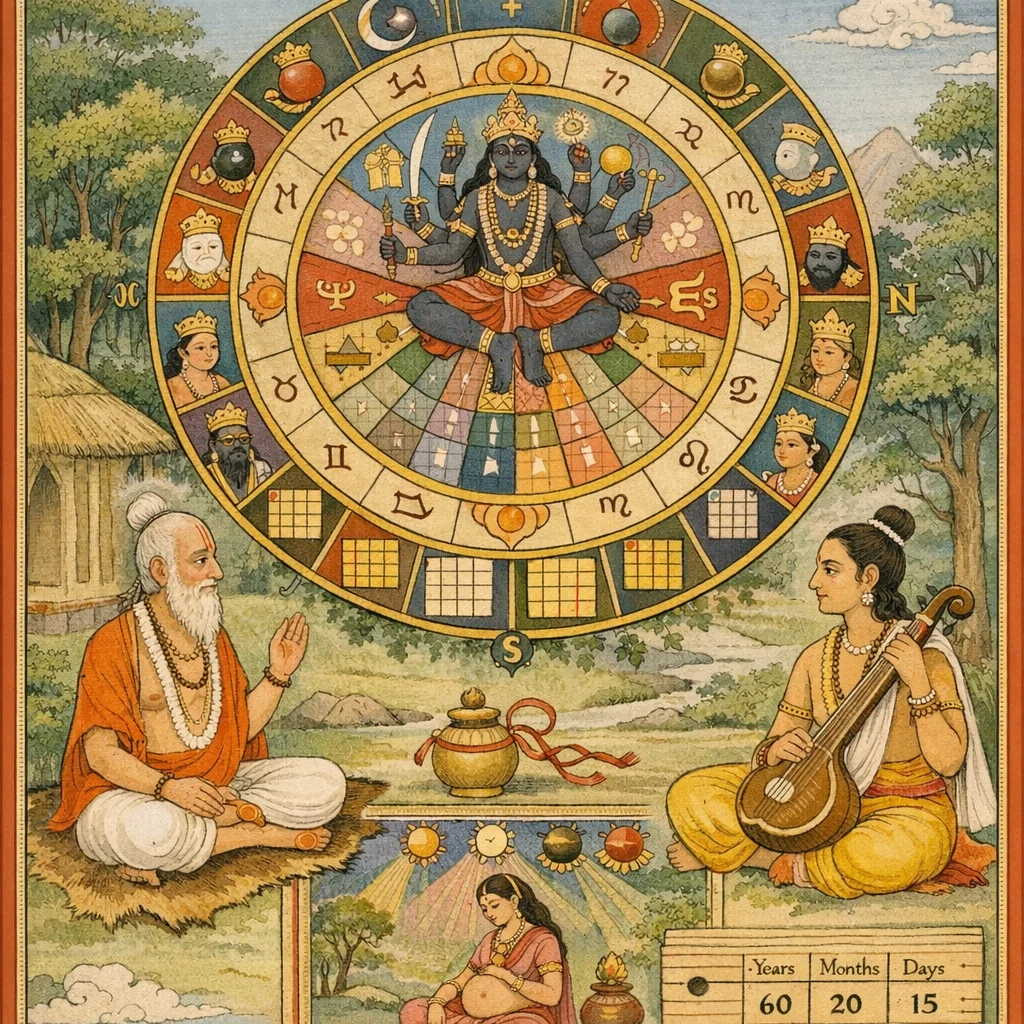
Jyotiṣa-saṅgraha: Varga-vibhāga, Bala-nirṇaya, Garbha-phala, Āyuḥ-gaṇanā
Sanandana instructs Nārada in a dense Jyotiṣa compendium. It begins with a cosmological mapping of Time’s “limbs,” then explains zodiacal lordships and the chief divisional schemes (horā, dreṣkāṇa, pañcāṁśa, triṁśāṁśa, navāṁśa, dvādaśāṁśa), establishing ṣaḍvarga as the interpretive base. Signs are classified by day/night rising, gender, modality, and direction, while houses are grouped as kendra, paṇaphara, āpoklima; trika; riḥpha, linking placement with power, dependence, or decline. Planetary significations are given by color, temperament, social-class lordship, and courtly roles (king/minister/commander), and strengthened through bala doctrines (sthāna, dig, ceṣṭā, kāla). The teaching then turns practical: omens of conception and pregnancy, indications of sex and twins, fetal defects, and yogas of danger to the mother. It culminates in longevity theory (yogaja, paiṇḍa, nisarga) with explicit arithmetic for years/months/days and mentions remedial saṃskāra when lifespan is threatened—uniting predictive technique with a dharmic, devotional response.
Shlokas
Verse 1
सनंदन उवाच । मूर्द्धास्यबाहुहृत्क्रोडांतर्बस्तिव्यंजसोनखः । जानुजंघांघ्नियुगलं कालांगानि क्रियादयः ॥ १ ॥
Sanandana said: The head, mouth, arms, heart, the inner cavity of the trunk, the bladder, the marks and the nails; likewise the knees, shanks, and the pair of feet—these are called the “limbs” of Kāla (Time), along with action (kriyā) and the rest of its operative principles.
Verse 2
भौमास्फुजिबुधेंदुश्च रविसौम्यसिताः कुजः । गुरुमंदार्किगुरवो मेषादीनामधीश्वराः ॥ २ ॥
Mars, Venus, Mercury, and the Moon; the Sun, Mercury, and Venus; Mars; and, in due order, Jupiter, Venus, Saturn, and Jupiter are proclaimed the presiding lords of Aries and the other zodiac signs.
Verse 3
होरे विषमभेर्केदोः समये शशिसूर्ययोः । आदिपञ्चनवाधीशाद्रेष्काणेशाः प्रकीर्तिताः ॥ ३ ॥
In the division called Hōrā, the Moon and the Sun rule in their respective times; and in the Dreṣkāṇa (decanate) division, the lords are declared beginning from the rulers of the first, fifth, and ninth (signs).
Verse 4
पंचेष्टाष्टाद्रिपंचांशा कुजार्कीज्यज्ञशुक्रगाः । ओजे विपर्ययाद्युग्मे त्रिशांशेशाः समीरिताः ॥ ४ ॥
For the Panchāṁśa, the rulers are stated to be Mars, the Sun, Saturn, Jupiter, Mercury, and Venus. In the Triśāṁśa division, for odd signs the lords are given in the regular order, while for even signs they are stated in the reverse order.
Verse 5
क्रियणतौलिकर्काद्या मेषादिषु नवांशकाः । स्वभाद्द्वादशभागेशाः षड्र्गं राशिपूर्वकम् ॥ ५ ॥
For Aries and the other signs, the navāṁśas begin with the sequence Kriya, Tauli, Karka, and so on. For the dvādaśāṁśa (twelvefold division), the lords begin from one’s own sign. Thus the ṣaḍ-varga (sixfold divisional scheme) is to be set out, starting with the rāśi.
Verse 6
गोजाश्च कर्कयुग्मेन रात्र्याख्या पृष्टकोदयाः । शेषा दिनाख्यास्तूभयं तिमिः क्रूरः सौम्यः पुमान् ॥ ६ ॥
Signs such as Go and Ajā, together with the pair Karka and Yugma, when rising from the back (i.e., in reversed orientation), are designated as “night-signs.” The rest are called “day-signs”; and Timi is of both kinds—when fierce it is inauspicious, when gentle it is auspicious, and it is regarded as masculine.
Verse 7
पुमान् स्री च क्लीबश्चरस्थिरद्विःस्वभावकाः । मेषाद्याः पूर्वतोदिक्स्थाः स्वस्वस्थानचरास्तथा ॥ ७ ॥
The zodiacal signs, beginning with Aries, are spoken of as masculine, feminine, and neuter; and likewise as movable, fixed, and dual in nature. Aries and the rest are set forth from the eastern direction onward, and each sign moves within its own proper station in the circle of the zodiac.
Verse 8
अजोक्षेणांगनाकीटझषजूका इनादितः । उच्चानि द्वित्रिमनुयुक्तिथीषुभनखांशकैः ॥ ८ ॥
Here are spoken of goats, oxen, women, insects, fish, and lice, and others of like kind; and their names are also set forth in higher groupings, arranged by twofold and threefold classifications, with subdivisions extending down to the most minute fractions.
Verse 9
तत्तत्सप्तमनीचानि प्राङ्मध्यांत्यांशकाः क्रमात् । वर्गोत्तमाश्चराधेषु भावाद्द्वादश मूर्तिमान् ॥ ९ ॥
In each house (bhāva), the seventh division is held to be the point of debility; the divisions are arranged in order as the first, the middle, and the last portions. For movable signs and the rest, the excellence of divisional strength is determined from the relevant bhāva; thus the twelve houses become concretely embodied in their effects.
Verse 10
सिंहोक्षाविस्रश्चतौ लिकुभाः सूर्यात्रिकोणभम् । चतुरस्रं तूर्यमृत्युत्रिकोणं नवपंचमम् ॥ १० ॥
“Lion” and “bull,” and also the “drooping/relaxed” forms, are said to belong to the fourfold type. The Sun is to be represented as a triangle; the four-sided figure is the “fourth”; and the triangle is connected with death. The ninth and the fifth are likewise to be understood accordingly.
Verse 11
रिःफाष्टषट्कं त्रिकभं केंद्रं प्राक्तुर्यसप्तखम् । नृपादः कीटपशवो बलाढ्याः केंद्रगाः क्रमात् ॥ ११ ॥
The twelfth, eighth, and sixth places are called the Riḥpha group; the third place is termed Trika-bhava; the central places are the Kendras; and the fourth and seventh are auspicious, supporting houses. In due order: those placed in the Kendras become powerful; those in the Trika fall into low conditions, like insects and beasts; and those in the Riḥpha group become dependent on kings, as royal servants.
Verse 12
केंद्रात्परं पणफरमापोक्लिममतः परम् । रक्तः श्वेतः शुकनिभः पाटलो धूम्रपांडुरौ ॥ १२ ॥
Beyond the kendras lie the paṇaphara houses; beyond them, according to this doctrine, are the āpoklima houses. Their hues are spoken of as red, white, parrot-like green, pale-rose, smoky, and pale-yellowish.
Verse 13
चित्रः कृष्णः पीतपिंगौ बभ्रुः स्वच्छः प्रभाक्रियात् । साम्याशाख्यप्लवत्वं स्याद्द्वितीये वशिरर्कभात् ॥ १३ ॥
Variegated, dark, yellowish-tawny, brown, or clear—such forms arise through the working of one’s own radiance (inner power). In the second stage there dawns evenness (sāmya), an ‘unnameable’ state (aśākhya), and a buoyant power to cross over (plavatva), as though lit by the sun’s splendor.
Verse 14
कालात्मार्को मनश्चन्द्रः कुजः सत्वं वचो बुधः । जीवो ज्ञानं सुखं शुक्रः कामो दुःखं दिनेशजः ॥ १४ ॥
The Sun is the very Self as Time; the Moon is the mind. Mars is vital force; Mercury is speech. Jupiter is knowledge; Venus is happiness. The Sun’s son, Saturn, is desire and sorrow.
Verse 15
नृपौ रवीन्दू नेतासृक् कुमारो ज्ञः कवीज्यकौ । सचिवो सूर्यजः प्रेष्यो मतो ज्योतिर्विदां वरैः ॥ १५ ॥
The Sun and the Moon are regarded as the two kings; Mars as the commander; Mercury as the wise prince; Jupiter and Venus as the two poets and preceptors; Saturn as the minister; and Rāhu as the servant—so declare the foremost knowers of astrology.
Verse 16
ताम्रशुक्लरक्तहरित्पीतचित्रासिता रवेः । वर्णा व अव्यहहरीद्रा शचीकौधिपारवेः ॥ १६ ॥
For Ravi, the Sun, the hues are coppery, white, red, green, yellow, variegated, and dark. Likewise for the others, their stated colours are to be understood—such as pale turmeric-yellow, and tones associated with Śacī and the oceanic, watery realm.
Verse 17
रविशुक्रारराह्वर्केन्दुविदीज्या दिगीश्वराः । क्षीणेंद्वर्काररविजाः पापा पापयुतो बुधः ॥ १७ ॥
The Sun, Venus, Mars, Rāhu, the Moon, Mercury, Jupiter, and the Lords of the directions are to be regarded as presiding deities. When the Moon is waning, and when the Sun, Mars, and Saturn are involved, it is inauspicious; and Mercury too, when joined with a malefic, becomes inauspicious.
Verse 18
क्लिबौ बुधार्की शुक्रेन्दू स्रियौ शेषा नराः स्मृताः । शिखिभूमिपयोवारिवासिनो भूसुतादयः ॥ १८ ॥
Mercury and the Sun are said to be of neuter nature; Venus and the Moon are feminine; the rest are remembered as masculine. Likewise, beings who dwell in fire, in earth, in water, and those such as the Son of Earth (Mars) are classified in this manner.
Verse 19
कवीज्यौ कुजसूर्यौ च वेदो ज्ञो वर्णपाः क्रमात् । सौरोंऽत्यजाधिपः प्रोक्तो राहुर्म्लेच्छाधिपस्तथा ॥ १९ ॥
Kavi (Venus), Ijya (Jupiter), Kuja (Mars), and Sūrya (the Sun) are declared, in due order, to be the lords of the social classes. Śauri (Saturn) is said to be the lord of the Antyajas, and Rāhu likewise the lord of the Mlecchas.
Verse 20
चंद्रार्कजीवाज्ञसितौ कुजार्की सात्त्विकादिकाः । देवतेंद्वग्निरैवलाभूकोसखायोपराधिपाः ॥ २० ॥
The Moon, the Sun, Jupiter, Mercury, Venus, and Saturn are to be understood, respectively, as sāttvika and the other temperamental types; while Mars and the Sun are of a fiercer kind. Their presiding deities are Soma (the Moon), Agni (Fire), and the other divine associates who rule over them.
Verse 21
वस्रं स्थलं नवं वह्निकहतं मद्यदं तथा । स्फुटितं रवितस्तांम्रं तारे ताम्रपुनिस्तथा ॥ २१ ॥
Cloth already laid out for use, a place or seat that is new, anything scorched by fire, and a vessel meant for liquor; likewise cracked utensils, copper reddened by the sun’s heat, and copper repeatedly reheated—these are to be regarded as unfit and impure for sacred use.
Verse 22
हेमकांस्यायसी त्र्यंशैःशिशिराद्याः प्रकीर्तिताः । सौरशुक्रारचंद्रज्ञगुरुषूद्यत्सु च क्रमात् ॥ २२ ॥
The three portions are proclaimed as golden, of kāṃsya (bell‑metal), and of iron; and the three divisions beginning with Śiśira are taught to arise in proper sequence when the Sun, Venus, Rāhu, the Moon, Mercury, and Jupiter are in ascendance.
Verse 23
त्र्याशत्रिकोणतुर्याष्टसप्तमान्येन वृद्धितः । सौरेज्यारापरे पूर्णे क्रमात्पश्यंति नारद ॥ २३ ॥
O Nārada, by applying the successive augmentations through the triad, the trines, the fourth, the eighth, and the seventh, they then perceive—step by step—the complete results in the Saura, Jya, and Āra divisions.
Verse 24
अयनक्षणघस्रर्तुमासार्द्धशरदो रवेः । कटुतिक्तक्षारमिश्रमधुराम्लकषायकाः ॥ २४ ॥
Of the Sun (Ravi) are the divisions of time—ayana, kṣaṇa, day, season, month, and half‑year; and likewise the tastes are classified as pungent, bitter, alkaline/saline (kṣāra), mixed, sweet, sour, and astringent (kaṣāya).
Verse 25
त्रिकोणात्सांत्यधाधर्मायुः सुखखोद्यपः सुहृत् । जीवो जीवज्ञौ सितज्ञौ व्यर्का व्याराः क्रमादमी ॥ २५ ॥
From the triad (triangular grouping) arise, in graded sequence: tranquillity; the foundation of dharma; longevity; happiness; right exertion that brings uplift; and a well‑wisher (true friend). Then follow the living being, the knower of living beings, and the knower of the bright, pure principle—these are the successive stages, in order.
Verse 26
वींद्वर्का विकुजेंद्वर्काः सुहृदोऽन्येरवेर्धृताः । मिथोधनव्ययायत्रिबंधुव्यापारगः सुहृत् ॥ २६ ॥
Some are friends only in name—fickle and inconsistent—while others are held steady by the Sun (that is, by time and circumstance). A so‑called friend may even become one who causes mutual loss of wealth, entangles one in threefold family obligations, and draws one into worldly dealings.
Verse 27
ध्येकानुभक्ता मयान् ज्ञात्वा मिश्रीदीत्सहजान्मुने । मत्कालोधिसुहृन्मित्रपूर्वकान्कल्पयेत्पुनः ॥ २७ ॥
O sage, having recognized those who are devoted through contemplation and direct inner experience, one should again set one’s life and conduct in order, beginning with proper timing and due measure, together with well-wishers and friends.
Verse 28
स्वोच्चत्रिकोणगेहा प्रनवांशैस्थानजं बलम् । दिक्षु सौम्येज्ययोः सूर्यारयोः सौरे सिताब्जयोः ॥ २८ ॥
Planets gain positional strength (sthānaja-bala) by being in exaltation, in trines, or in their own houses, and also through favourable navāṁśa divisions. Directional strength (dig-bala) belongs to Mercury and Jupiter, to the Sun’s enemies, to Saturn, and to Venus and the Moon, each in their respective quarters.
Verse 29
रवाहृतूदगनेन्ये तु वक्रि च समागमे । उत्तरस्था दीप्तकराश्चेष्टा वीर्ययुता मताः ॥ २९ ॥
But those planets that are borne along by their course and rise northward—especially at the time of a retrograde conjunction—are regarded as endowed with strong motion, blazing rays, and full potency.
Verse 30
निशींदुकुजसौराश्च सर्वदा क्षोह्नि चापरे । क्रूराः कृष्णे सिते सौम्याः मतं कालबलं बुधैः ॥ ३० ॥
Night, the Moon, Mars, and Saturn are regarded as always harsh; some others too become harsh when their influence is disturbed. In the dark fortnight (kṛṣṇa-pakṣa) they are considered severe, while in the bright fortnight (śukla-pakṣa) they are considered gentle—this is the view of the wise regarding the strength of Time (kāla-bala).
Verse 31
सौरारज्ञेज्यशुक्रेंदुसूर्याधिक्यं परस्परम् । पापास्तु बलिनः सौम्या विवक्षाः कण्टकोपगे ॥ ३१ ॥
The relative predominance among Saturn, Mars, Jupiter, Venus, the Moon, and the Sun should be judged in relation to one another. But when the malefics are strong—O gentle one—the benefics are to be treated as ineffective, as though obstructed by a thorny affliction.
Verse 32
क्लीबे तदूशनाद्वापि चंद्रार्कांशसमं जनुः । स्वांशे पापाः परांशस्थाः सौम्यालग्नं वियोनिजम् ॥ ३२ ॥
For one of klība (neuter/impotent) constitution, birth is said to occur when the Moon’s and Sun’s aṁśas (fractional divisions) are equal. If malefics stand in their own divisions while benefics fall into others’ divisions, and if the ascendant is ruled by a benefic, that birth is called “viyonija,” not born from the womb.
Verse 33
निर्बलं च तदादेश्यं वियोनेर्जन्म पंडितैः । शीर्षं वक्रगले पादावंसौ पृष्टमुरस्तथा ॥ ३३ ॥
The learned declare that such a viyonija birth is to be understood as “without strength,” arising from an unnatural (defective) womb. Its marks are described as: head, a crooked neck (throat), feet, shoulders, back, and chest.
Verse 34
पार्श्वे कुक्षी त्वपानांघ्री मेढ्रमुष्कौ तथा स्फिजौ । पुच्छं चतुष्पदांगेषु मेषाद्या राशयः स्मृताः ॥ ३४ ॥
In the bodies of four-footed beings, the zodiacal signs beginning with Aries (Meṣa) are traditionally assigned to these limbs: the flanks and belly, the anus and legs, the penis and testicles, the buttocks, and the tail.
Verse 35
लग्नांशाद्ग्रहयुग्दृष्ट्वा वर्णान्बलयुताद्वदेत् । दृक्समानप्रमाणांश्च इष्टे रेखां स्मरस्थितैः ॥ ३५ ॥
Having examined the planets’ pairings with respect to the ascendant-degree (lagna-aṁśa), one should declare the appropriate varṇas according to their strength. One should also note the degrees of equal aspectual measure (dṛk) and, keeping the desired reference-line (rekhā) in mind, record them accordingly.
Verse 36
खगत्र्यंशे बलाग्नेगे चरमांशे ग्रहान्विते । वांशे स्थलांबुजः सौरेर्द्वीक्षायोगभवा द्विजाः ॥ ३६ ॥
When the third division (tryaṃśa) falls in the sign called Khaga, and the final portion is joined with planets, then—through the influence of Śauri (Saturn) and the combination known as dvīkṣā-yoga—Brahmins are born in the lineage (vāṃśa) called Sthalāmbuja.
Verse 37
विप्रलैस्तनुजचंद्रेज्यार्कैस्तरूणां जनिं वदेत् । स्थलांबुभेंदोशकृतश्चेतरेषामुदाहृतः ॥ ३७ ॥
By Brahmins, by sons, by the Moon, by Bṛhaspati (the Guru), and by the Sun one should proclaim the “birth/origin” of trees; and for other classes of beings, their origin is declared to be from dry land, from water, from the earth, and from excrement.
Verse 38
स्थलांबु च पतिः खेटो लग्नाद्यावन्मिते गृहे । तावंत एव तखः स्थलजा जलजास्तथा ॥ ३८ ॥
The planet that is lord of land and water—when placed in a house counted from the ascendant (Lagna) up to a stated measure—yields results in that very number; likewise, those outcomes pertain to beings born on land and to those born in water.
Verse 39
अंतःसारा रवौ सौरे दुर्भगाः क्षीरिणो विधौ । भौमे कंटकिनो वृक्षा ईज्ये ज्ञे सफलाफलौ ॥ ३९ ॥
Under the Sun, trees are firm and sound at the core; under Saturn, they become ill-fated. Under the Moon, they become milky, bearing white sap. Under Mars, trees grow thorny. Under Bṛhaspati (Jupiter) and Mercury, they bear flowers and fruit.
Verse 40
पुष्पिता भार्गवे स्निग्धाश्चंद्रेऽथ कटुकाः कुजे । अशुभर्क्षे शुभः खेटः शुभं वृक्षं कुभूमिजम् ॥ ४० ॥
When Bhārgava (Venus) prevails, things flourish and bloom; under the Moon they are smooth, unctuous, and pleasing; under Mars they become sharp and pungent. Even if the lunar mansion (nakṣatra) is inauspicious, a planet may still be auspicious; and even if a tree is auspicious, what is born of the earth—its produce—may be inauspicious.
Verse 41
कुर्याद्विलोमगो वापि स्वांशोक्तपरगैः समम् । कुजेंदुहेतुकं स्त्रीणां प्रतिमासमिहार्तवम् ॥ ४१ ॥
Even if the course proceeds in a contrary or irregular way, the monthly menstrual flow of women occurs here all the same, arising from the causation of Mars and the Moon.
Verse 42
नेष्टस्थेज्येऽन्यथास्ते स्त्रीयुंक्तासन्नरेक्षिते । पापयुक्तेक्षिते द्यूने रुषा प्रीत्या शुभग्रहैः ॥ ४२ ॥
When Jupiter is set in an unfavorable place and acts contrary to benefic signs—joined to, or influenced by, a feminine planet or sign and lacking protective aspects—while the seventh house is joined with or aspected by malefics, then the benefic planets, though present, work only at intervals, yielding results mixed with displeasure and occasional favor.
Verse 43
शुक्रार्केंदुजैः स्वांशस्थैरीज्य चांगत्रिकोणगे । भवेदपत्यं विप्रेन्द्र पुंसां सद्वीर्यशालिनाम् ॥ ४३ ॥
O best of brāhmaṇas, when Venus, the Sun, the Moon, and Mars are placed in their own divisions, and Jupiter occupies a trinal place, men endowed with good virility obtain offspring.
Verse 44
अस्रेऽर्केंदो कुजार्की चेत्पुंस्रियोरामयप्रदौ । व्ययखगो युक्तौ चैकदृष्ट्या नृत्युप्रदौ तयोः ॥ ४४ ॥
If the Sun and Moon are in the eighth house, and Mars and Saturn are conjoined, they become givers of disease for both men and women. And if, being joined, they cast a single combined aspect, then for those two it becomes a giver of death.
Verse 45
शुक्रार्क्रौ मातृपितरौ दिवा नक्तं शशीनजौ । मातृष्वसृपितृव्याख्यौ वा पद्मेजि समे शुभौ ॥ ४५ ॥
Venus and the Sun are to be regarded as the mother and the father; Day and Night are likewise as the Moon’s two sons. Or else, O Lotus-born one, the maternal aunt and the paternal uncle are also declared auspicious when they are equal in strength or station.
Verse 46
पापदृष्टे शुभे क्षीणे तुंगे वा लग्नगेयमे । क्षीणेंदुकुजसंदृष्टे मृत्युमेत्य गता ध्रुवम् ॥ ४६ ॥
If a benefic planet is weakened or afflicted by malefic influence, even when placed in exaltation or occupying the ascendant, and if it is also aspected by a waning Moon and Mars, then death is certainly indicated.
Verse 47
युगपद्वा पृथक्सस्थौ लग्नेंदू पापमध्यगौ । यदा तदा गर्भयुता नारी मृत्युमवाप्नुयात् ॥ ४७ ॥
Whether conjoined or set apart, if the ascendant (lagna) and the Moon are hemmed in between malefic planets, then at that time a pregnant woman may meet with death.
Verse 48
लग्नांञ्चद्राच्च तुर्यस्थैः पापैर्निधनगे कुजे । नष्टेंदौ कुजरव्योश्च बंधुरिष्पगयोर्मृतिः ॥ ४८ ॥
When malefic planets occupy the fourth house from both the ascendant and the Moon, and Mars is placed in the house of death, then—if the Moon is afflicted as though “lost” and Mars and the Sun are also involved—death is indicated for the kinsman and for the spouse.
Verse 49
तन्वस्तसंस्थयोर्भौमरव्योः शस्रभवः क्षयः । यन्मासाधिपतिर्नष्टस्तन्मासं संस्रवे त्यजेत् ॥ ४९ ॥
When Mars and the Sun are in the ‘Tanvasta’ and ‘Saṃstha’ positions, there arises a destructive loss caused by weapons. If the presiding lord of a month is afflicted or ‘lost,’ one should avoid that month for important rites and undertakings.
Verse 50
लग्नेंदुगैः शुभैः खेटैस्त्रिकोणार्थास्तभूखगैः । पापैस्त्रिषष्टलाभस्थैः सुखी गर्भो रवीक्षितः ॥ ५० ॥
When benefic planets occupy the ascendant and the Moon, and benefics also stand in the trines and the house of wealth, while malefics are placed in the 3rd, 6th, and 11th houses—if the Sun casts its aspect—the pregnancy is comfortable and auspicious.
Verse 51
ओजभे पुरुषांशेऽर्केज्येंदुलग्नैर्बलान्वितैः । गुर्वर्कौ विषमस्थौ वा युंजन्म प्रवदेत्तदा ॥ ५१ ॥
When the ascendant, the Moon, Jupiter, and the Sun are strong—falling in an odd sign and in a masculine division—one should predict a male birth. Likewise, if Jupiter and the Sun are placed in odd (masculine) positions, the same conclusion is to be stated.
Verse 52
युग्मभांशस्थितैस्तैस्तु वक्रेंदुभृगुभिस्तथा । यामस्थानगतैर्वाच्यं स्रियो जन्म मनीषिभिः ॥ ५२ ॥
When those planets are set in even divisions, and when the Moon and Venus move retrograde and occupy the yāma-sthānas (appointed time‑sector stations), the wise declare that a female birth is indicated.
Verse 53
द्व्यंगस्था बुधसंदृष्टाः स्वपक्षेय मलंकराः । लग्नं विनौजभावस्थः सौरः पुंजन्मकृत्तथा ॥ ५३ ॥
When the relevant planets are placed in dual signs and are aspected by Mercury, they become auspicious and beneficial. Likewise, the Sun—when situated in an even house (not in the ascendant)—is said to bring about the birth of a male child.
Verse 54
मिथो रवींदूर्ज्ञार्की वा पश्यतः समगं रविः । वक्रो वांगविधू ओजे जज्ञौ युग्मौजसंस्थितौ ॥ ५४ ॥
As the Sun and the Moon mutually beheld one another, the Sun came to a poised and balanced state. Then, in the odd (oja) division, the Moon—moving on a curved course—was born and became established in the paired‑odd arrangement.
Verse 55
कुजेक्षितेपुमांशेदुहिता क्लीब जन्मदा । समे सितेन्दू ओजस्था ज्ञारांगोज्या नृवीक्षितौ ॥ ५५ ॥
When Mars aspects the male-sign division, a daughter is born, and the birth may indicate impotence. If Venus and the Moon are equal in strength or position, the birth is endowed with vigor; and when Mercury, the Sun, and Mars are conjoined, and the ascendant is aspected by Jupiter, a male child is indicated.
Verse 56
लग्नेंदुसमगौ युग्मस्थाने वा यमलंकराः । ग्रहोदयस्थान्द्यंगांशान्पश्यति ज्ञे स्वभागगे ॥ ५६ ॥
When the Ascendant and the Moon are conjoined, or when they are placed in a dual sign, the native becomes endowed with a twin-like, paired bodily formation. If Mercury is in its own division (its own sign or portion), it casts its influence upon the rising-place of the planets and upon the bodily limbs and their parts.
Verse 57
त्रितयं ज्ञांशकाद्युग्मममिश्रैः सममादिशेत् । लग्ने चापांत्यभागस्थे तदंशस्थबलिग्रहैः ॥ ५७ ॥
One should prescribe the triad and the pair beginning with the Jñāṃśaka in equal measure, without mixing them with other factors. And when the ascendant stands in the latter part of Dhanu (Sagittarius), the result is to be declared according to the strong planets occupying that very aṃśa.
Verse 58
वीर्याढ्यज्ञार्किसदृष्टैः कोशस्थावहवोगिनः । सितारेज्यार्कचंद्रार्किज्ञांगेशोर्केंदवोऽधिपाः ॥ ५८ ॥
Endowed with valour, with the knowledge of yajña, and with the seer’s insight, those stationed in the “treasury” (kośa), those who bear the burden of governance, and those who enjoy their allotted fruits are spoken of as rulers. Likewise Śita (Venus), the stars, Bṛhaspati, the Sun, the Moon, the Sun’s offspring (Śani), the Knower (Budha), Aṅgiras, and the lordly Sun and Moon are declared to be authorities.
Verse 59
मासानां तत्समं वाच्यं गर्बगस्थस्य शुभाशुभम् । त्रिकोमे ज्ञे परैर्नष्टैर्द्विमुखाह्निकपान्वितः ॥ ५९ ॥
The auspicious and inauspicious indications concerning the foetus in the womb should be declared in accordance with the months. When the astrological knower finds the tri-koṇa configuration and the other indications are lost or absent, the result is said to be “two-faced”, accompanied by irregular daily rites and drinking habits.
Verse 60
अवागावाटावशुभैर्भसंधिस्थैः प्रजायते । वीरान्सगीश्चदष्टेध्वष्टार्कातभसंहिताः ॥ ६० ॥
From inauspicious sound-combinations and faulty sandhi, defective formations arise. And from corrupted recitational sequences and damaged textual arrangements, the intended heroic and sacred sense is as though bitten away—distorted and lost.
Verse 61
आरार्की चेज्यभांशस्थौ सदंतोगर्भकस्तदाः । खर्भेजे भुविमंदारदृष्टे कुब्जस्तु गर्भगः । पर्गुर्मीने यमेद्वारैर्दष्टेथांगेभघसंधिगे ॥ ६१ ॥
When the relevant planets are situated in Bṛhaspati’s (Jupiter’s) portion, the condition called “Sadaṃta-garbha” arises. If, in the sign of Kharbha, the earthly Mandāra tree is seen, the foetus is said to become “Kubja” (hunch-backed). And when Pargur is in Mīna (Pisces) and Yama’s “gates” are afflicted, defects arise in the limbs at the joints.
Verse 62
पापैर्जडो विधौ गर्भः शुभदृष्टिविवर्जिते । मृगांत्यगे वामनकः सौरेंद्रर्कनिरीक्षिते । धीनयोदपगैस्त्र्यंशैः पापास्तैरसिरोह्रदाः ॥ ६२ ॥
When conception (garbha) takes place under an afflicted Saturn (Vidhu) with no benefic aspect, the child becomes dull-witted. If it occurs at the end of Mṛgaśīrṣa, the child becomes a dwarf (Vāmana). When the Sun and Indra (Jupiter) cast their gaze, and when the decans (tryaṃśa) are occupied by malefic divisions such as dhīna, yodapa, and others, those malefics bring suffering—ailments of the head and disorders of the blood.
Verse 63
रवींदुयुक्ते सिंहेंगे माहेयार्किनिरीक्षिते । नेत्रहीना मिश्रखेटैर्दृष्टे बुद्धुदलोचनाः । व्ययेजो वामनयनं दक्षं सूर्यो विनाशयेत् ॥ ६३ ॥
When the Sun and Moon are conjoined in Leo (Siṃha) and are aspected by Mars and Saturn, and when the luminaries are afflicted by mixed planets, people become weak-minded and dull-eyed. If such a configuration occurs in the house of loss (vyaya), it destroys the left eye; if the Sun is the cause, it destroys the right eye.
Verse 64
नेष्टा योगाः शुभैर्दृष्टाः पापाः स्युर्नात्र संशयः । मंदेऽस्ते मंदभांशेंगे निषैकेब्दत्रये जनिः ॥ ६४ ॥
Even yogas ordinarily deemed auspicious become inauspicious when they are “seen” and overruled by malefic influences—there is no doubt of it. When Saturn is set (asta) and the ascendant (lagna) falls in a Saturnine portion, birth occurs within a period of three years under that condition.
Verse 65
द्वादशाब्दे शशिन्येवं सुतावपि विचिंतयेत् ॥ ६५ ॥
When twelve years have passed, one should reflect in the same way regarding the Moon—and also regarding one’s son.
Verse 66
आधानेंदुद्वादशांशा पापास्तद्राशिभिः पुरः ॥ ६६ ॥
At the time of ādhāna (conception), the twelve lunar divisions (dvādaśāṃśa) are deemed inauspicious when afflicted by malefic influences, especially when they precede—or are placed before—the corresponding zodiacal signs.
Verse 67
शशांके जन्मभागादिद्वि घ्नमिष्टकलाः स्मृताः ॥ ६७ ॥
When the Moon is taken into account, the auspicious time-units (kalās) are remembered as those obtained by doubling the natal portion, beginning from the birth-degree or segment.
Verse 68
पितुः परोक्षे जन्मस्यादिन्दौ लग्नमपश्यति ॥ ६८ ॥
When the father is absent (unseen), birth takes place; and when the Moon is not seen, the ascendant (lagna) is not observed or known.
Verse 69
मध्याद्भ्रष्टेर्के विदेशस्थे जनने नारिजन्म वै । मंदेंगस्थे कुजेस्ते च ज्ञोस्फुजि मध्यगे विधौ ॥ ६९ ॥
If, at the time of birth, the Sun has slipped from the mid-heaven and stands in a foreign region, a female birth is indicated. Likewise, when Saturn is in an inauspicious place and Mars is so placed, and when Mercury is in the sign called Sphujit while the Moon abides in the middle position—these configurations are taught as indicators of that result.
Verse 70
पापांगेब्जे त्रिभागे लौ स्वायगैः सद्भिरुद्गतः । सूर्यस्तद्दृष्टिगो वापि ज्ञेयो ज्योतिर्विदां वरैः ॥ ७० ॥
In the lotus-like sphere of the zodiac, when the Sun rises in the third division of the sign called Lau, as computed by well-trained practitioners—or when the Sun is found within that very line of sight (dṛṣṭi)—the foremost knowers of Jyotiṣa declare it to be so.
Verse 71
चतुष्पदर्क्षगे भानौ शेर्षैबलयुतैः खगैः । कोशादतौ तु यमलौ जायेते मुनिसत्तम ॥ ७१ ॥
O best of sages, when the Sun is in the lunar mansion Catuṣpada, two twin beings are born from the womb, bearing marks upon the head and endowed with strength, and having the nature of birds.
Verse 72
सार्क्यारसिंहोज्ञाजांसे भांशतुत्यांगनालयुक् । लग्नमिंदुं च सार्केंदुं न पश्यति यदा गुरुः ॥ ७२ ॥
When Guru (Jupiter) casts no aspect upon the ascendant, the Moon, or the Moon conjoined with Saturn, and when malefic forces prevail in portions such as Leo and in the divisions of Mercury and the rest—then the native is said to be bound to an inauspicious dwelling and afflicted conditions.
Verse 73
सपापगोऽर्को जायो वा परवीर्यप्रसूतिकृत् । पापभस्थौ पापखेटैः सूर्यार्घानत्रिकोणगौ ॥ ७३ ॥
If the Sun (Arka) is conjoined with a sinful influence, it makes one a “jāya” (subordinate, ruled by another) or causes offspring to be begotten through another man’s potency. Likewise, when malefic planets occupy malefic places, and when the Sun and the Moon stand in the triangular positions of the Sun’s argha (a technical division), such results are indicated.
Verse 74
विदेशगः पितावृद्धः खेवा राशिवशात्यये । पूर्ण इंढौ स्वभेशेज्ञे शुभे मुव्यंवुजे तनौ ॥ ७४ ॥
When one is abroad and the father is aged, the indication is to be judged according to the governing zodiacal sign. If the Moon is full, benefic, and placed in its own sign or in the sign of its lord—especially in an auspicious configuration affecting the body—then favorable results are obtained.
Verse 75
द्यूनस्थे वा विधौ यातेंगना नारी प्रसूयते । अब्धांगमन्भगः पूर्णे ज्यो वा पश्यति नारद ॥ ७५ ॥
O Nārada, when Budha (Mercury) is situated in the seventh house, or has moved into that position, a woman gives birth to a girl. And when the Moon’s portion (aṅga/bhāga) becomes complete, one beholds a radiant light.
Verse 76
स्वबंलग्नगः सूतिः सलिले नात्र संशयः । पापदृष्टे यमे गुद्यां जन्मांगाजव्ययस्थिते ॥ ७६ ॥
When the natal ascendant falls in a watery sign, the delivery takes place in water or near water—without doubt. When Yama casts an inauspicious aspect, and the relevant point lies in the region of the anus, with the birth-significator placed in the twelfth house (the house of loss), such unfavourable indications are declared.
Verse 77
कर्कातिलग्नगेशौरेवटे जन्माब्जवीक्षिते । मंदे जन्मगते लग्ने बुधसूर्येंदुवीक्षिते ॥ ७७ ॥
When Cancer is the Ascendant and its lord abides in Taurus, and Śukra (Venus) casts its aspect upon the natal Ascendant; and when Śani (Saturn) is placed in the Ascendant while the Ascendant is aspected by Budha (Mercury), Sūrya (the Sun), and Candra (the Moon)—such is the configuration being described.
Verse 78
क्रीडास्थाने देवगेहेप्यूषरे च क्रमाज्जनिः । श्मशाने लग्नदृगसृग्राम्यस्थानेब्जभार्गवौ ॥ ७८ ॥
In a place of play, in a deva’s shrine, and upon barren ground—respectively—Śani (Saturn) is said to bring forth its results in due order. In a cremation-ground are shown attachment and a harsh gaze; and in a village setting are shown the Lotus-born (Brahmā) and Bhārgava (Śukra/Venus).
Verse 79
अग्निहोत्रगृहे जीवोऽर्को भूषाभरणे गृहे । शिल्पालये बुधो जन्म कुर्याद्बलसमन्वितः ॥ ७९ ॥
In a house where the Agnihotra is upheld, Guru (Jupiter) becomes strong; in a house devoted to ornaments and adornment, Sūrya (the Sun) becomes strong; and in a house of crafts and artistry, Budha (Mercury) becomes strong at birth—bestowing vitality and capability.
Verse 80
भासमाने सरे मार्गे स्थिरे स्वर्क्षांशगे गृहे । त्रिकोणगज आरार्क्योरस्ते वा सृज्यतेऽम्बया ॥ ८० ॥
When the lake shines and the path is clear, and when the dwelling stands firm under the influence of its own nakṣatra; if the auspicious elephant-sign appears in a trine, and if Sūrya (the Sun) is in its proper course (or sets in the due quarter), then Ambā, the Mother, brings forth a favorable fruit.
Verse 81
गुरुदृष्टे तु दीर्घायुः परं च प्राप्यते पुनः । पापदृष्टे विधौलग्नेऽस्तेकुजे तु विनश्यति ॥ ८१ ॥
When Guru (Jupiter) casts its aspect, one gains long life and again attains a higher state. But if the Ascendant is afflicted by malefic influence—when Budha (Mercury) is rising and Kuja (Mars) is combust—then that promised longevity is destroyed.
Verse 82
भवे कुजार्क्योः संदृष्टे परहस्तगतः सुखी । पापेद्यतायुर्भवति मासः सार्थैः परैरपि ॥ ८२ ॥
When Mars and the Sun mutually aspect each other in the house of existence, the person is happy yet dependent on others, as though living in another’s hands. If this configuration is afflicted by malefics, the span of life is shown as only a month, even when other supportive factors are present.
Verse 83
पितृमातृगेहे जन्म तदधीशबलान्मुने । तरुगेहे शुभे नीचे नैकस्थदृष्टौ लग्नेंदुः ॥ ८३ ॥
O sage, when the lord of the fourth house is strong, birth occurs in the house of one’s father or mother. If the Moon, as lord of the ascendant, is debilitated, placed in a benefic ‘tree/wooded’ sign-house, and aspected by many planets, one is born in a dwelling associated with trees, such as a grove or forest settlement.
Verse 84
एतल्लक्षणसंपन्ना प्रसीतिर्विजने तदा । मंदर्क्षांशे विधौ तुर्ये मंददृष्टेऽब्जगेऽपि वा ॥ ८४ ॥
A birth endowed with these signs occurs then in a secluded place—when the Moon is in a gentle lunar mansion and in its fourth quarter, and when Saturn’s influence is mild, even if Mercury too is weak.
Verse 85
मंदार्चने वा तमसि शयनं नीचगेभुवि । शीर्षे पृष्टोदये जन्म तद्वदेव विनिर्दिशेत् ॥ ८५ ॥
If one sleeps in darkness, or lies down on low ground, or is born when the ascendant is in the head region and the back is rising, one should understand the indicated result to be the same as stated earlier.
Verse 86
चंद्रास्तसुखगः पापैर्मातुः पीडां समादिशेत् । जीर्णोद्धृतं गृहं मंदे सृजि दग्धं न वा विधौ ॥ ८६ ॥
If the Moon, tainted by sinful influences, enters a setting (inauspicious) condition, it indicates affliction to the mother. And when Saturn is weak, it points to a house grown old and then repaired—either it is burned by fire, or else, by fate, it does not properly endure.
Verse 87
काष्टाढ्यमदृढं सूय बहुशिल्पयुतं बुधे । चित्रयुक्तं नवं शुक्रे दृढे रम्ये गुरौ गृहम् ॥ ८७ ॥
When the Sun prevails, the house is rich in timber yet not very firm; when Mercury prevails, it is furnished with many crafts; when Venus prevails, it is new and adorned with paintings; and when Jupiter prevails, the house is firm and pleasing.
Verse 88
धटाजकर्क्यलिघटे पूर्वे ज्ञेज्यगृहे ह्युदक् । वृषे पश्चान्मृगे सिंहे दक्षिणे वसतिर्भवेत् ॥ ८८ ॥
For those born under Aquarius, Aries, Cancer, Libra, or Capricorn, the auspicious direction for dwelling is the east (and, in the case of Mercury and Jupiter’s houses, the northern quarter). For Taurus it is the west; and for Capricorn and Leo the southern direction is prescribed as suitable for residence.
Verse 89
गृहप्राच्यादिगौ द्वौ द्वौ व्द्यंगाः कोणेष्वजादयः । पर्यंके वास्तुवत्पादास्रिषदंकांत्यराशयः ॥ ८९ ॥
In the house-mandala, in the eastern direction and the others, (the deities/parts are arranged) two by two; in the corners are Ajā and the rest. On the central couch (platform) are the quarters (pādas) as in the Vāstu arrangement—(marked) by the seats, numbers, and the sequence of the signs/portions.
Verse 90
चंद्रागांतरगैः खेटैः सूतिकाः समुदाहृताः । चक्राद्धि बहिरंतश्च दृश्यादृश्योपरेऽन्यथा ॥ ९० ॥
Those planetary indications that occur within the Moon’s course are called “sūtikā” (portents). For they may appear outside or within the (celestial) circle; and in the higher regions they may be visible or invisible, in other ways.
Verse 91
लग्राशयसमानांगोबालिखेटंसमोपि वा । चंद्रनंदांशवद्वर्णः शीर्षाद्यंगविभाग युक् ॥ ९१ ॥
His body is well-proportioned and balanced—either comparable to a well-set (auspicious) configuration or evenly aligned. His complexion shines like the pleasing rays of the Moon, and his limbs are properly differentiated and arranged, beginning from the head.
Verse 92
शीर्षकं दक्श्रवे नासा कपोलहनवो मुखम् । कंठांसपार्श्वहृद्द्वोषः क्रोडंनाभिश्च बास्तिकाः ॥ ९२ ॥
The head, the right ear, the nose, the cheeks and jaws, and the mouth; the throat, shoulders, sides, the heart and the space between the brows; the abdomen, the navel, and the bladder—these are the bodily parts being enumerated.
Verse 93
शिंश्नापाते च वृषणौ जघने जानुनी तथा । जंघेपादौ चोभघयत्र त्र्यंशैः समुदितैर्वदेत् ॥ ९३ ॥
At the base of the penis and at the testicles; at the buttocks and likewise at the knees; at the shanks and at the feet—at each of these places one should state (the measure/position) as constituted by three parts taken together.
Verse 94
पापयुक्ते व्रणस्तस्मिन्नंगे लक्ष्म च तद्युते । स्वर्क्षांशे स्थिरयुक्ते तु नैज आगंतुकोऽन्यथा ॥ ९४ ॥
If, in a limb associated with a sinful indication, there is a wound and a bodily mark is found together with it, then—when that mark occurs in one’s own lunar mansion (nakṣatra) or its division and is joined with a stable factor—it is considered innate (naija); otherwise it is regarded as accidental/acquired (āgantuka).
Verse 95
मंदेऽनिलाश्मजो भौमे विषशस्राग्निजो बुधे । भुजेऽर्के काष्टपशुजो जेतुः श्रृंग्यजयोनिजः ॥ ९५ ॥
For Saturn, the omens arise from wind and stones; for Mars, from the earth; for Mercury, from poison, weapons, and fire; for Jupiter, from the Sun, from wood, and from animals; and for Venus, from horned creatures and from the unborn (embryo).
Verse 96
यस्मिन्संज्ञास्रयः खेटा अंगेस्युस्तत्र निश्चितम् । व्रणोशुभकृतः पृष्टेतनौ राशिसमाश्रिते ॥ ९६ ॥
It is certain that whichever limb of the body the planets occupy as their indicated seat, in that very part an inauspiciously caused wound arises. When the sign (rāśi) is lodged in the body—specifically, for the ‘tanu’ indication, at the back—this result manifests.
Verse 97
तिलकृन्मसकृदष्टसौम्यैर्युक्तश्च लक्ष्मवान् । चतुरस्रः पिंगदृक् च पैत्तिकोऽल्पकचो रविः ॥ ९७ ॥
Ravi (the Sun-type man) bears auspicious marks such as a tilaka and small moles, and is endowed with eight gentle (saumya) traits; he is fortunate and prosperous. He is square-built, tawny-eyed, pitta-dominant in constitution, and sparse-haired.
Verse 98
वृतो वातकफी प्राज्ञो मंदवाक् शुभदृक् शशी । क्रृरदृक्तरुणो भौमः पैत्तिकश्चपलस्तथा ॥ ९८ ॥
Śaśī (the Moon-type) is round, marked by vāta and kapha, wise, soft-spoken, and auspicious in vision; Bhauma (the Mars-type) is harsh-looking, youthful, pitta-dominant, and fickle.
Verse 99
त्रिधानुपवृतिर्हास्यरुचिज्ञः श्लिष्टवाक्तथा । पिंगके श्लक्षणो दीर्घः कफीधीमान्गुरुर्मतः ॥ ९९ ॥
One whose conduct is threefold and disciplined, who knows what is pleasing in humor, and whose speech is well-knit and refined; tawny-eyed, handsome and well-proportioned, tall, kapha-dominant, and keen in intellect—such a person is regarded as a “guru,” a true teacher.
Verse 100
सुवपुर्लोचनः कृष्णवक्रकेशो भृगुः सुखी । दीर्घः कपिलदृड्भंदो निलीखरकचोलसः ॥ १०० ॥
He is handsome and bright-eyed, with black, curly hair. By lineage he is of the Bhṛgu line and is contented. He is tall, kapila-hued (tawny-golden), firm-limbed, and bears distinctive marks: a faint bluish line and a tufted lock of hair.
Verse 101
स्नाय्वस्थिरक्तत्वक्शुक्रवसामज्जास्तु धातवः । मंदार्कचंद्रसोम्यास्पुजिज्जीवकुभुवः क्रमात् ॥ १०१ ॥
The bodily dhātus (constituents) are: sinews, bones, blood, skin, semen, fat, and marrow. Their presiding powers, in due order, are Mandā, the Sun, the Moon, Somyā, Pūjī, Jīvaka, and Bhuva.
Verse 102
चंद्रांगपापैर्भांत्यस्थैः सेंवुपापचतुष्टयैः । चक्रपूर्वापरे पापसौम्यैः कीटतनौ मृतिः ॥ १०२ ॥
Through sins bound to the Moon’s asterisms and the stations of the planets, through a set of four particular sins, and through sins deemed harsh and mild in the earlier and later cycles, one meets death while dwelling in the body of a worm (insect).
Verse 103
उदयास्तगतौ पापौ चंद्रः क्रूरयुतैः शुभैः । न चेद्दृष्टस्तदा मृत्युर्जातस्य भवति ध्रुवम् ॥ १०३ ॥
If at birth the Moon is afflicted by malefics at both its rising and its setting, and is not aspected by benefic planets, then the death of the newborn is certain.
Verse 104
क्षीणेऽब्जे व्ययगे पापैर्लग्नाष्टस्थैः शुभा न चेत् । केंद्रेषु वाब्जोसंयुक्तः स्मरांत्यमृतिलग्नगः ॥ १०४ ॥
If the “Lotus” (Venus) is weakened and placed in the twelfth house, with benefic influences absent while malefics occupy the ascendant and the eighth, then—especially when the “Lotus” is joined to a planet in the kendras—the ascendant becomes a sign of final remembrance and of death.
Verse 105
केंद्राद्या हस्त सन्खेटैरदृष्टो मृत्युदस्तथा । षष्टेमेब्जेऽसदृष्टेसद्यो मृत्युः शुभेक्षिते ॥ १०५ ॥
If the chief places beginning with the kendras are not “seen” (not supported or linked by proper benefic aspects) as determined by the hand‑sign counts, that configuration becomes a giver of death. Likewise, when the sixth and the eleventh houses are not duly aspected it indicates immediate death; but when favorably aspected, the outcome is auspicious.
Verse 106
समाष्टके मिश्रखेटैर्दृष्टे मृतिः शिशोः । क्षीणेब्जेंगे रन्ध्रकेन्दे पापे पापान्तरस्थिते ॥ १०६ ॥
When the eighth house is aspected by a mixture of planets, the death of the infant is indicated; likewise, if a debilitated planet occupies the watery‑sign sector and a malefic stands in the eighth (“hole”) place and also in a kendra, hemmed in by other malefics.
Verse 107
भूद्यूननिधने वाब्जे लग्नेऽप्येवं शिशोर्मृतिः । पापैश्चन्द्रास्तगैर्मात्रा सार्द्धं सदृष्टिमंतरा ॥ १०७ ॥
If at birth the Moon stands in the house of death, or if the ascendant is Kumbha (Aquarius) under such afflictions, it signifies the infant’s death. Likewise, when the Moon is astagata (set/obscured), struck by malefics and lacking any benefic protecting aspect, the child perishes together with the mother.
Verse 108
शुभादृष्टे भान्त्यगेब्जे त्रिकोणोपरतैः खलैः । सग्नस्थे वा विधौपापैरस्तस्थैर्मृतिमाप्नुयात् ॥ १०८ ॥
If a benefic is under auspicious aspect yet shines in an inimical sign and is hemmed in by malefics placed in the trines; or if the Moon, though in its own ascendant, is made astagata by malefics—then death may befall.
Verse 109
ग्रस्तेऽब्जेऽसद्भिरष्टस्थै सृज्यवात्मजयोर्मृतिः । लग्ने रवौ तु शस्रेण सवीर्यासद्भिरष्टगैः ॥ १०९ ॥
When the Moon is seized (eclipsed) and malefics occupy the eighth place, death is indicated for the native and for his son. And if the Sun is in the ascendant while powerful malefics are placed in the eighth, death is said to occur by a weapon.
Verse 110
कर्केन्द्वीज्ययुते लग्ने केंद्रे सौम्ये च भार्गवे । शषैस्त्र्यरीशगैरायुरमितं भवति ध्रुवम् ॥ ११० ॥
When the ascendant is Cancer joined by the Moon and Jupiter, and benefics occupy the kendras along with Bhārgava (Venus), then by such a disposition the lifespan is certainly immeasurable—very long.
Verse 111
वंर्गोत्तमे मीनलग्ने वृषेऽब्जे तत्त्वलिप्सिके । स्वतुंगस्थेष्वशेषेषु परमायुः प्रकीर्तितम् ॥ १११ ॥
When the ascendant is Pisces, and the relevant planets are in Vṛṣa (Taurus) and Kumbha (Aquarius), yearning for tattva—the true principle—and when all are placed in their own exaltations, the highest span of life is proclaimed.
Verse 112
शुभैर्दृष्टः सवीर्योगे केंद्रस्थे चायुरर्थदः । स्वच्चोब्जे स्वर्क्षगैः सौम्यैः सवीर्येंगाधिपे तनौ ॥ ११२ ॥
When a planet is aspected by benefics, endowed with its own strength, and placed in a kendra, it becomes a giver of longevity and prosperity. If it is clear and situated in its own sign or in exaltation, together with gentle benefics, and if the strong lord of the ascendant abides in the ascendant itself, then robust vitality is indicated.
Verse 113
षष्ट्यब्दकेंद्रसौम्येभेष्टशुद्धे सप्ततिर्गुरौ । मूलत्रिकोणगैः सौम्यैर्गुरो स्वोच्चसमन्विते ॥ ११३ ॥
When the sixtieth-year point (ṣaṣṭyabda) is placed in a kendra and joined with benefics, and when Guru (Jupiter) is in the seventieth-year position (saptati); and when benefics occupy their own mūlatrikoṇa signs while Guru is also endowed with his own exaltation—then highly auspicious results are indicated.
Verse 114
लग्नाधिपे बलयुतशीत्यब्दं त्वायुरीरितम् । सवीर्ये सत्सु केंद्रेषु त्रिंशच्छुद्धियुतेऽष्टमे ॥ ११४ ॥
When the lord of the ascendant is endowed with strength, the lifespan is said to be eighty years. If it is vigorous and placed in auspicious kendras, and the eighth house bears a purity/strength measure of thirty, then full longevity is indicated.
Verse 115
लयेशे धर्मगेजीवेष्टस्थे क्रूरक्षिते जिताः । लग्नाष्टमेशावष्टस्थौ भाब्दमायुः करौ मतौ ॥ ११५ ॥
When the lord of dissolution (Saturn) is placed in the ninth house of dharma, Guru (Jupiter) occupies the eighth, and Mars is overcome; and when the lords of the ascendant and the eighth house are both situated in the eighth—then, according to the teachers, the span of life is considered to be only one year.
Verse 116
लग्नेऽशुभेज्यौ ग्लौदृष्टौ मृत्यौ कश्चन चाकृतिः । धर्मांगस्थेशनौ शुक्रे केंद्रेऽब्जे व्ययधर्मगे ॥ ११६ ॥
When the ascendant is afflicted, Guru (Jupiter) is in an inauspicious condition, and the Moon is under the aspect of malefics, a configuration indicating death is formed. It is also indicated when Saturn occupies the dharmāṅga-sthāna, Venus is in a kendra, and Mercury is placed in the twelfth and ninth houses.
Verse 117
शताब्दं गीष्पतौ कर्के कटकस्थसितेज्ययोः । लयेशेंगे शुभैर्हीनेऽष्टमे रवाब्धिमितं वयः ॥ ११७ ॥
When Jupiter is in Cancer, and when the Moon and Jupiter are situated in Cancer, one attains a lifespan of a hundred years. But if the lord of the ascendant is weak and deprived of benefic influences, then in the eighth house the span of life is measured as only twelve years.
Verse 118
लग्ने शेष्टमगेष्टेशे तनुस्थे पंचवत्सरम् । कवीज्ययोगे सौम्याब्जौ लग्ने मृत्यौ च स्वेषवः ॥ ११८ ॥
If the lord of the ascendant and the lord of the eighth house are placed in the body (the ascendant), it indicates a lifespan of five years. And when Venus and Jupiter are in conjunction, and Mercury and the Moon are in the ascendant, then the native meets death in that very ascendant.
Verse 119
एतद्योगजमायुः स्यादथ स्पष्टमुदीयते । सूर्याधिक बले पैंडं निसर्गाञ्च विधोर्बले ॥ ११९ ॥
This is said to be the lifespan arising from the combination (yogaja). Now it is stated clearly: when the Sun’s strength predominates, the computed (paiṇḍa) lifespan applies; and when the Moon’s strength predominates, the natural (nisarga) portion is to be taken.
Verse 120
अंशायुः सबले लग्ने तत्साधनमथो श्रृणु । गोब्जास्तत्त्वतिथी सूर्यास्तिथिः स्वर्गा नखाः क्रमात् ॥ १२० ॥
When the ascendant (lagna) is endowed with strength, the span of life is determined by degrees (aṃśa). Now listen to the method for calculating it: in order, ‘go’, ‘abja’, ‘tattva’, ‘tithi’, ‘sūrya’, ‘tithi’, ‘svarga’, and ‘nakha’ indicate the numbers to be taken sequentially.
Verse 121
नखा विधुर्द्वावंकाश्च धृतिः स्वाक्षिखमार्गणाः ॥ १२१ ॥
‘Nakha’ is said to signify the Moon; ‘two’ denotes the numeral two; and ‘dhṛti’ means steadiness, likened to one’s own eye and to the act of seeking out the path.
Verse 122
पिंडे निसर्गे रवोच्चे नो ग्रहः षट्भाल्पको यदा । चक्रशुद्धस्तदा ग्राह्येस्यांशा आयुषिसंमताः ॥ १२२ ॥
When, in the bodily configuration (piṇḍa) at birth, the Sun is not in exaltation and no planet is weakened by six bhāgas, then the horoscope is deemed “purified”; and the degrees (aṁśas) to be adopted are those accepted for determining longevity.
Verse 123
अंशोनाः शंत्रुभे कार्या ग्रहं वक्रगतिं विना । मंदशुक्तौ विनार्द्धोना ग्रहस्यास्तंगतस्य च ॥ १२३ ॥
In an inauspicious (hostile) configuration, a planet’s effect is to be taken as diminished by a certain portion—provided it is not in retrograde motion (vakra). In a weak or sluggish state, and also when a planet is set/invisible (astaṅgata), its potency is to be reckoned as reduced by half.
Verse 124
हानिद्वयेऽधिकाः कार्या यदा क्रूरस्तनौ तदा । विहायारीनंशाद्यैर्हन्यादायुर्लवान् भजेत् ॥ १२४ ॥
When confronted with two kinds of loss, one should choose the lesser. And when a cruel aggressor assails one’s own body, then—casting aside hesitation—one may strike down such enemies and the like, thereby preserving one’s remaining span of life.
Verse 125
भगणांशैर्लब्धहीनास्तेषां कार्या विचक्षणैः । पापस्यांशाः समग्रोना सौम्यस्यार्द्धविवर्जिताः ॥ १२५ ॥
The wise should compute the values for those cases that fall short of what is obtained from the divisions of the planetary hosts (bhagaṇa). The portions (aṁśas) tied to malefic (pāpa) influences are taken as complete yet reduced, whereas those tied to benefic (saumya) influences are taken with half omitted.
Verse 126
स्पष्टास्तेंशाः खषट्त्र्यासा गुणयित्वा स्वकैर्गणैः । वर्षाणि शेषमर्कध्नं हारात्संमासकाः स्मृताः ॥ १२६ ॥
After multiplying the clearly stated parts (aṁśas) by their respective factors, the remainder yields the years; and what remains as the ‘arkadhna’ (Sun-based remainder) is, from the divisor (hāra), understood as the counted months.
Verse 127
तच्छेषश्च त्रिगुणितः तेनैवाप्तं दिनानि च । शेषे षष्ट्या हते भक्ते हारेण घटिकादिकम् ॥ १२७ ॥
That remainder is to be tripled; by it the number of days is obtained. From what still remains, multiply by sixty and divide by the divisor, and one obtains the ghaṭikās and the finer units of time.
Verse 128
हित्वा भाज्यंगभागादीन्कलीकृत्य खखाक्षिभिः । भजेद्वर्षाणि शेषे तु गुणिते द्वादशादिभिः ॥ १२८ ॥
Setting aside the earlier divisor-units and fractional parts, and converting the remainder into the Kali-era reckoning by the “kha-kha-akṣi” numerals, one should compute the years; and if a remainder still persists, it is to be multiplied by twelve and related factors to yield the subsidiary measures.
Verse 129
द्विसप्तांशे च मासादिलग्रायुर्जायते स्फुटम् । अशायुषी सलग्नानां खेटानामंशका हृताः ॥ १२९ ॥
And in the Dvi-saptāṁśa (the 1/14th division), the longevity pertaining to the month and related factors, together with the ascendant (lagna), becomes clearly determined. For those ascendants that are ‘non-longevity-giving’ (aśāyuṣī), the planets’ allotted portions (aṁśa) are to be subtracted.
Verse 130
खयुगैरायुरंशाः स्युस्तत्संस्कारं वदामि ते । ग्रहनलग्नं षड्रात्यं चेत्संस्कारोऽन्यथा नहि ॥ १३० ॥
The portions of one’s lifespan are indicated by the yugas; I shall tell you the corresponding corrective rite (saṃskāra). If the ascendant at the time of an eclipse endures for six nights, then the saṃskāra is to be performed; otherwise, it is not to be done in that manner.
Verse 131
तदंशः स्वाग्नयो भक्ता लब्धोनोभूर्गुणो भवेत् । यदैकाल्यं तदास्तांशाः स्वाग्र्याप्तोना च भूर्गुणः ॥ १३१ ॥
If that allotted share is received by one’s own sacred fires and by devoted recipients, the merit is not greatly multiplied. But when it is offered as a single, unified act (aikālya), those shares reach what is foremost, and the merit indeed increases vastly.
Verse 132
सौमयस्यार्द्धेन पापस्य समग्रेणेति निश्चयः । गुमकध्नाश्चायुरंशाः संस्कारोऽयमुदाहृतः ॥ १३२ ॥
It is firmly determined that this saṃskāra (purificatory rite) yields half the merit of the Saumya-sacrifice and utterly destroys sin. It is also said to remove wasting ailments and to secure portions of longevity—such is this saṃskāra as declared.
Verse 133
आयुरंशकलाभक्ताद्विंशत्याब्दा इनाहतम् । शेषं द्विशतभक्तं स्युर्मासाः शेषा दिनादिकम् ॥ १३३ ॥
From the quotient obtained by dividing the lifespan (āyus) into parts and sub-parts, multiply by twenty to obtain the number of years. Divide the remainder by two hundred: the quotient gives the months, and what remains thereafter yields the days and the smaller units.
Verse 134
लग्नायुरंशास्त्रिगुणा दिग्भिक्ता स्युः समास्ततः । शेषेऽर्कादिगुणे भक्ते दिग्भर्मासादिकं भवेत् ॥ १३४ ॥
The degrees of the ascendant (lagna) and the life-span are to be tripled and then divided by the directions; the resulting quotient gives the total measure. From the remainder, when divided by the Sun and other planetary factors, the directional divisions—beginning with the ‘directional bhāga’—are obtained.
Verse 135
सबलेंगेभतुल्याब्दैर्युतमायुर्भवेत्स्फुटम् । अंशद्विध्नमक्षांशं मासाः खत्र्यादिसंगुणात् ॥ १३५ ॥
When the relevant factors are strong, the computed lifespan becomes clear: add years equal to the number corresponding to the rāśi beginning with Leo. Take the akṣāṃśa (latitude) doubled in degrees, and by multiplying with the appropriate constants (beginning with ‘kha’ and so on), the result is obtained in months.
Verse 136
शेषा दिनादिकं योज्यं नैतत्पिंडनिसर्गयोः । लग्नार्कचन्द्रमध्ये तु यो बली तद्दशा पुरा ॥ १३६ ॥
The remaining portion should be added as days and the like—this does not apply in the cases of piṇḍa and nisarga. But among the ascendant, the Sun, and the Moon, whichever is stronger—its daśā (period) is to be applied first.
Verse 137
ततः केंद्रादिगानां तु द्वित्र्यादौ सबलस्य च । बह्वायुर्यो वीर्यसाम्येर्काद्युतस्य प्राक् याचकः ॥ १३७ ॥
Then, among the angular houses (kendras) and the rest, if the second, third, and those that follow are strong, one is long-lived. And when the strengths are evenly balanced, that which rises first takes precedence—namely, the factor connected with Sūrya (the Sun), and likewise the others.
Verse 138
षड्वर्गार्द्धस्य त्रिंशस्य त्रिकोणगश्च स्मरगः । सप्तमासस्य तूर्यस्य चतुरस्रगतस्य च ॥ १३८ ॥
For the thirtieth division, which is half of the sixfold group (ṣaḍvarga), there is also the ‘Smaraga’ factor—connected with Kāma—situated in a triangular placement; likewise, for the seventh part, called the ‘fourth’, it is said to be set in a quadrangular (square) formation.
Verse 139
क्रमः केंद्रादिकोऽत्रापि द्वित्र्यादौ सबलस्य च । पाकपस्याब्धिनागाश्च ह्यर्णवा सहगस्य च ॥ १३९ ॥
Here too, the order begins with the angular houses (kendras) and then proceeds through the second, third, and so on, taking the planet’s strength into account. The results are to be understood for the planet’s maturation (pāka), and also through the indications of oceans, nāga-kings, and seas, together with its accompanying factors.
Verse 140
त्रिकोणस्थस्य चाष्टाक्षिसूर्याद्यूनगतस्य च । तुर्याष्टगस्य तु स्वर्गा गुणकाः परिकीर्तिताः ॥ १४० ॥
For one situated in the trine (trikoṇa), and likewise for the ‘eight-eyed’ (aṣṭākṣi) configuration and for one whose motion is diminished in relation to the Sun and the rest, the heavens (svargas) are declared to be their multiplying factors (guṇakāḥ).
Verse 141
दशागुणैर्हता भक्त्या गुणैक्येन समागताः । शेषेऽर्कादिहते भक्ते मासाद्यैक्येन नारद ॥ १४१ ॥
When bhakti has subdued the tenfold multiplicity of the guṇas, one attains the oneness of the guṇas. And when the remaining trace of devotion is further consumed—like impurity burnt away by the Sun—then, O Nārada, within a month one reaches complete unity with the Supreme.
Verse 142
अंतर्दशासु विदशास्तासु चोपदशास्तथा । दशेशमित्रस्वोच्चक्षंगोब्जोब्ध्येकाद्रिवृद्धिगः ॥ १४२ ॥
In the sub-periods (antardaśās), in special daśās, and likewise in secondary daśās, when the lord of the daśā stands in a friendly sign or in its own sign, or is exalted, and occupies auspicious divisions and strong stations, that period becomes a giver of growth and increase.
Verse 143
शुभगो यद्भगस्तद्भिस्न्वादिस्थेन तद्धिकृत् । प्रोक्तेतरस्थानगतस्तत्तद्भावक्षयं करः ॥ १४३ ॥
When the form “śubhaga” (auspicious) is used, it denotes “one who possesses good fortune.” But when that same element is used with an affix of the snvādi group, it becomes an agent-form meaning “one who brings about that result.” And when a stated term is placed in another syntactic position, it conveys the diminution or destruction of that very state.
Verse 144
खगस्य यद्भवेद्द्रव्यं भावभे क्षणयोगजम् । जीविकादिफलं सर्वं दशायां तस्य योजयेत् ॥ १४४ ॥
Whatever wealth accrues to a planet from its placement in a house and a nakṣatra, and from its momentary combinations, all such results—livelihood and the rest—should be assigned to that planet’s daśā.
Verse 145
विशन्यापदशायां यो वैरिदृष्टो विपत्तिकृत् । शुभमत्रेक्षितश्चेष्टसद्वर्गस्थश्च यो ग्रहः ॥ १४५ ॥
In an inauspicious or calamitous daśā, a planet afflicted by an enemy’s aspect becomes a cause of misfortune. Yet that very planet, when it receives benefic aspects and is well placed in the auspicious divisions (ṣaḍvarga), becomes a giver of good results.
Verse 146
तत्काले बलवानापन्नाशकृत्समुदाहृतः । यस्याष्टवर्गजं चापि फलं पूर्णशुभं भवेत् ॥ १४६ ॥
At that time a powerful rite is proclaimed, known as the “remover of adversity”; for the one who performs it, the fruit arising from the aṣṭa-varga (eightfold divisions) becomes wholly auspicious and fulfilled.
Verse 147
यश्च मूर्तितनुग्लावो वृद्धिगः स्वोच्चभस्थितः । स्वत्रिकोणसुहृद्भस्थस्तस्य मध्यमसत्फलम् ॥ १४७ ॥
Even if a planet is weak in bodily strength—its form and vigor diminished—yet when it is increasing and placed in its own sign, its exaltation sign, its own trine, or a friend’s sign, it yields moderately good results.
Verse 148
श्रेष्ठं शुभतरं वाच्यं विपरीतगतस्य तु । नेष्टमुत्कटमिष्टं तु स्वल्पं ज्ञात्वा बलं वदेत् ॥ १४८ ॥
To one who has gone astray, speak what is best and most auspicious. Do not utter what is unpleasant or harsh; knowing your own limited strength, speak gently and with restraint.
Verse 149
चरे सन्मध्यदुष्टाभ्यामंगभंगे विपर्ययात् । स्थिरे नेष्टष्टमध्या च होरायास्त्र्यं शकैः फलम् ॥ १४९ ॥
In movable signs, the results are declared as good, middling, or harmful according to the condition of the horā; but in cases of bodily injury, the indications are to be taken in reverse. In fixed signs, the outcomes are regarded as undesirable—especially when linked with the eighth place and the middle. Thus the Śakas teach the threefold result of the horā.
Verse 150
स्वामीज्यज्ञयुता होरा दृष्टा वा सत्पलावहा । विनाश दृष्टयुक्ता च पापांतरगतान्यथा ॥ १५० ॥
When a horā is seen to be connected with worship of one’s lord and with yajña (sacrifice), it brings good results. But when it is seen joined with a sign of destruction, it leads to ruin; otherwise it indicates entry into yet another sinful state.
Verse 151
प्राग्ध्वांक्षा बंधु मृत्याय तयोर्द्यूने रविः स्वभात् । वक्रात्स्वादिवसाञ्चार्के शुक्राद्यूनां तु षड्रतः ॥ १५१ ॥
When the lunar day lies in the eastern half and is waning, it is deemed inauspicious for one’s kinsmen and may tend toward death. In that same division of the day, the Sun shines by his own radiance. And when the Sun’s course is retrograde, beginning from the day called “Svādi,” the periods (rata, measures) for Venus and the other planets are said to be sixfold.
Verse 152
धर्मध्यायारिगो जीवादिकत्र्यारिगो विधोः । पृध्यंत्यधीतपाः सुज्ञा ततोवृद्ध्यंत्यबंधुराः ॥ १५२ ॥
The wise, well-taught ascetics dispute about the Lord’s enemies—those who oppose Dharma and sacred contemplation, and those who harm living beings; and from that disputation the quarrelsome, lacking true kinship of concord, only grow ever more.
Verse 153
वृद्धिगोंगात्सधनघीतपः स्वाराच्छशी शुभः । स्वदूवृध्यस्तादिषु पृधात्ससाष्टौ पंचयोपगः ॥ १५३ ॥
This verse, in the reading as provided, is textually corrupt and yields no stable Sanskrit syntax or meaning; without emendation or a reliable critical Narada Purana text, it cannot be translated with doctrinal accuracy.
Verse 154
षट्त्र्यायधीस्थो मंदाञ्च ज्ञाद्द्वित्र्यायाष्टकेंद्रगः । केंद्राष्टायांत्य इज्याद्वा ज्ञज्यायास्तत्र स्वे कवेः ॥ १५४ ॥
If Saturn is placed in the sixth or third house, and Mercury is in the second or third, or in the eighth or an angular house; and if Jupiter is in an angle, in the eighth, or in the last house—then in that nativity Mercury becomes predominant over Venus.
Verse 155
वृद्धाविनात्सादिधिया मंगा मायारिगो विधोः । केंद्राष्टापार्थगः स्वर्क्षान्मंदाद्गोष्टायकेंद्रगः ॥ १५५ ॥
When Mars is joined with (or afflicted by) Saturn and the intellect is harmed, it becomes an enemy to the Moon. Placed in a kendra or in the eighth house, even in its own sign, it causes—through Saturn—association with low company and confinement in a base, herd-like environment when Saturn occupies a kendra.
Verse 156
षट् त्रिधी भवतः सौम्यात्षड्वांशाष्टगो भृगोः । कर्मायव्ययषष्टस्थो जीवाद्भौमः शुभः स्मृतः ॥ १५६ ॥
From Mercury (Saumya), in the tri-divisions, the result is “six”; from Venus (Bhṛgu), in the sixth-part divisions, the result is “eight”. Mars (Bhauma), when placed in the sixth house—signifying action, disease, and expenditure—and arising from the “jīva” factor, is remembered as auspicious.
Verse 157
कवेर्द्ध्याषष्टमोध्याये सन्ज्ञोमंदान्सधीत्रये । साक्षास्ते भूमिजाज्जीवाद्ययारिभवमृत्युगः ॥ १५७ ॥
In Kavi’s sixty-second chapter, the deity named Manda—together with Dhī (intelligence) and the triad—is directly described as Earth-born, moving among beings from birth to death, and as a foe that brings decline.
Verse 158
धर्मायारिसतांत्येर्कात्साद्यत्रिस्वगता स्वभात् । षट्खायाष्टाब्धिखोष्विज्यात्सहाद्येषु विलग्नतः ॥ १५८ ॥
From the Sun’s own radiance, as it moves through the zodiacal divisions beginning with Aries, the result is to be understood by the Lagna (ascendant): in the six “houses” and the other eight classes, together with the accompanying factors beginning with the nakṣatras—thus one should determine the rising sign.
Verse 159
दिक्वाष्टाद्यस्तबंध्याये कुजात्खात्सत्रिके गुरुः । सात्र्यंके सन् रवेः शुक्राद्धीखगो दिग्भवारिगः ॥ १५९ ॥
When the directional (dik) scheme begins from the eighth in the “barren/blocked” arrangement, it indicates Guru (Jupiter). In the triad beginning from Kuja (Mars), it is likewise Jupiter. In the triad marked by Saturn, taking from the Sun and from Venus, the “bird of intellect” (Mercury) becomes the directional indicator, the house-indicator, and the destroyer of enemies.
Verse 160
चंद्राद्वीशार्थगोस्तेषु मन्दाद्धीत्रिषडंत्यगः । गोब्धिधीषट्खखाद्या ये ज्ञात्सद्यूने विलग्नतः ॥ १६० ॥
Beginning from the Moon, in the scheme of lords (īśa), meanings, and the “go” designations, one should take the final letter after the triad and the sixfold set, and also those beginning with “go, bdhi, dhī, ṣaṭ, kha, kha”. When these are known, the intended result is immediately fixed with respect to the conjunction with the Lagna.
Verse 161
आशु तेशाष्टगोष्वंगःत्सांतेष्वब्जात्सितः शुभः । स्वात्सज्ञेषु त्रिधीगोब्धी दिक्छिद्रासिगतोर्कजात् ॥ १६१ ॥
Swiftly, within those eight limbs and their associated placements, one should contemplate or install the auspicious, radiant (sattvic) principle born of the lotus. In the positions denoted by their own technical names, the threefold intelligence and the “ocean of cows” are to be arranged according to the directions, the interspaces, and the sword-like divisions, as taught in the Arka (solar) tradition.
Verse 162
रंध्रायव्यचगः सूर्यादोष्टधीखे सगोर्गुरो । ज्ञाब्धित्र्यायारिगोरात्रिषट्ध्यध्यांत्यगोषु च ॥ १६२ ॥
This verse sets forth a coded sequence of syllables—mnemonic for mantra-nyāsa and technical recitation—prescribing precise placements and combinations of sounds: beginning with “randhra,” then groups such as “āya-vya-ca-ga,” and further series linked with “sūrya,” “doṣṭa-dhī-khe,” “sa-goḥ-guro,” and the like, intended for exact ritual use rather than narrative meaning.
Verse 163
त्रिधीशारिषु मन्दः खात्साक्षांत्येषु शुभो सृजः । केंद्रायाष्टधनेष्वर्का लग्नाद्वृद्ध्याद्यबंधुषु ॥ १६३ ॥
Saturn (Śani) is auspicious in the 3rd, 6th, and 11th houses. Benefic planets yield good results in the 2nd, 10th, and 7th. The Sun (Sūrya) is favorable in the angular houses (kendra), and also in the 8th and 2nd; and from the ascendant (lagna) it is favorable in the 11th (gain), 9th (fortune), and 4th (home/kin).
Verse 164
गोध्वष्टापारिखांत्येज्ञाच्चंद्राल्लाभत्रिषद्भतः । षडष्टांत्यगतः शुक्राद्गुरीर्द्वीशांत्यशत्रुषु ॥ १६४ ॥
With the Moon (Candra) as the reference, one should assess gains and the condition of the 3rd and 6th houses; and with Venus (Śukra), when it is placed in the 6th, 8th, or 12th, difficulties are indicated—especially in the 2nd, 6th, and 12th, and in inimical positions.
Verse 165
उक्तस्थानेषु रेखादो ह्यनुक्तेषु तु बिंदुदाः । जन्मभाद्वद्विमित्रोच्चस्वभेधिष्टं परेष्वसत् ॥ १६५ ॥
In the positions that have been stated, one should mark them with lines and the like; but in places not explicitly stated, one should indicate them with dots. In the natal nakṣatra and those that follow, what is friendly, exalted (uccha), or in its own division is held to be most effective; in the others it is ineffective.
Verse 166
कष्टमर्थक्षयः क्लेशः समतार्थसुखागमः । धनाप्तिः सुखमिष्टाप्तिरिति रेखाफलं क्रमात् ॥ १६६ ॥
In order, the results indicated by the lines (in reading bodily marks) are: hardship; loss of wealth; distress; equanimity; the coming of prosperity and happiness; attainment of wealth; happiness; and the gaining of what is desired—thus the fruit of line-reading is described step by step.
Verse 167
पितृमातृद्विषन्मित्रभ्रातृस्त्रीभृतकाद्रवेः । स्वामिलग्राजयोः स्वस्थाद्भेदर्कस्वयशोशयात् ॥ १६७ ॥
From the Sun arise afflictions connected with father and mother, enemies, friends, brothers, wife, and servants; from the Sun also come troubles concerning one’s master, the lagna (ascendant), and kings. Even a strong, healthy Sun may bring divisions and the wasting away of one’s own fame.
Verse 168
तृणस्वर्णाश्वधोरणाद्यैरर्कांशे वृत्तिमादिशेत् । कृष्यंबुजस्रीभ्योब्जांशे कौजे धात्वस्रसाहसैः ॥ १६८ ॥
In the Sun’s division (arkāṃśa), one should indicate a livelihood connected with grass or fodder, gold, horses, and the like. In the Moon’s division (abjāṃśa), livelihood comes through agriculture, water, and prosperity; while in Mars’s (kauja), through metals, bloodshed, and daring ventures.
Verse 169
काव्यशिल्पादिभिर्बोधे जवे देवद्विजाकरैः । शौक्रे रजतगोरत्नैर्मांदे हिंसश्रमाधमैः ॥ १६९ ॥
Under Mercury’s influence there is understanding through poetry, craftsmanship, and the like. Under Jupiter’s influence there is swiftness and gains connected with the gods, Brahmins, and mines. Under Venus’s influence there are silver, cattle, and jewels; under Saturn’s influence there are low pursuits marked by violence and toil.
Verse 170
स्वोञ्चेष्वार्की तथा ज्यारैरुक्तैकांगे नृ पाधिपाः । लग्रे वर्गोत्तमेऽब्जे वा चतुरादिग्रहेक्षिते ॥ १७० ॥
When Saturn is in its own sign or exaltation, and Jupiter likewise stands in the stated configuration as a single dominant factor; and when the ascendant is either vargottama or placed in Aquarius and is aspected by the planets beginning from the fourth house, one becomes a lord among kings.
Verse 171
द्वाविंशभूपास्तुंगेसृक्चापेर्केन्दूयमस्तनौ । भूपकृत्तुंगगोर्कोगेस्तेसाजार्कोखभे गुरौ ॥ १७१ ॥
In the twenty-second division, the “lords” are reckoned according to the exaltation points: in Sagittarius and in Cancer are the Sun, the Moon, and Yama. The royal-giving factor, the “maker of kings,” is declared with reference to the exalted sign; and in the sign of the Sun’s division, in the sky-sign (Aquarius), Jupiter is to be considered.
Verse 172
यमेंदुतुंगगौ लग्ने षष्टेऽर्कज्ञौ तुलाजगौ । सितासृजो गुरौ कर्को साराजे लग्नगे नृपाः ॥ १७२ ॥
When Yama and the Moon (in exaltation) stand in the ascendant, and in the sixth house the Sun and Mercury are placed in Libra and Sagittarius; when Venus and Mars are with Jupiter, Cancer is strong, and the Moon is in the ascendant—then such a native becomes a king.
Verse 173
वृषेगेब्जेर्केज्यसौरैः सुहृज्जायाखगैर्नृपः । मंदे मृगांगेत्र्यर्यकांशस्थैरजादिभिर्नृप ॥ १७३ ॥
O king, when the ascendant is Taurus conjoined with Mercury, Jupiter, and Saturn, the ruler gains friends, a wife, and sons. And when Saturn is in Capricorn, placed in the aṁśas of Aryaman and the like, together with signs such as Aries, O king, similar results are indicated.
Verse 174
सेज्याजेश्वे मृगमुखे कुजे तुंगेर्क्षभागेवौ । लग्नेऽथ सेज्यकर्केंगे ज्ञाजशुक्रैर्भवोपगैः ॥ १७४ ॥
When Jupiter is the lord of the relevant place and Mars is exalted in Capricorn; and when the ascendant is Cancer with Jupiter placed there, accompanied by Mercury, Mars, and Venus occupying their respective houses—these planetary placements are said to produce the stated yoga and its result in the horoscope.
Verse 175
मेषेऽर्के भूमिपासेंदौ एषे षांग्रेर्कपपासृजः । सिंहकुंभमृगस्थाश्चेद्भूपः सारेतनावजे ॥ १७५ ॥
When the Sun is in Aries and the Moon is joined with planets of regal power; and when the relevant significators are placed in Aries while also occupying Leo, Aquarius, or Capricorn—then the native becomes a king, endowed with strength and an excellent army.
Verse 176
आर्केजीवे तनौ वापि नृपोऽथोः कुजभास्करौ । धीस्थौ गुर्विदुकवयो भूमौ स्त्र्यगे बुधैर्नृपः ॥ १७६ ॥
If the relevant indicator falls in the ascendant (tanu) in the sign of Saturn or of Jupiter, the person is fit to be a king; likewise if Mars and the Sun are in the seventh. If Jupiter occupies the ninth, one becomes a teacher; if Mercury is in the second, one becomes learned and eloquent; and if the Moon is in the fourth, the wise declare him a ruler.
Verse 177
मृगास्यलग्नगैः सौरेजाब्जर्क्षहरयः सयाः । कविक्षौ तुलयुरमस्थौ वै भूपः कीर्तिमान्भवेंत् ॥ १७७ ॥
If at birth Saturn, Jupiter (Guru), Venus, the Sun, the Moon, and Mercury occupy the ascendant in Mṛgāsya (Mṛgaśīrṣa), and the remaining planets are placed in Libra and in the seventh house, then the native becomes a king, renowned for fame.
Verse 178
यस्य कस्यापि तनयः प्रोक्तैर्योगैर्नृपो भवेत् । वक्ष्यमाणैर्नृपसुतो ज्ञेयो भूयो मुनीश्वर ॥ १७८ ॥
By the yogas already stated, the son of anyone at all may become a king. But, O lord among sages, by the criteria that will now be explained, one should again discern who truly qualifies as a “king’s son” (a prince).
Verse 179
स्वोच्चे त्रिकोणभगतेस्त्र्याद्यैर्बलयुतैर्नृपः । सिंहेऽर्के मेषलग्नेऽजे मृगे भौमे घटेऽष्टमे ॥ १७९ ॥
O King, when the planets beginning with the Sun are endowed with strength—being in their own signs, exaltation, or trinal divisions—and when the Sun is in Leo, the ascendant is Aries, Mars is in Capricorn, and the eighth house is Aquarius, such a configuration is indicated.
Verse 180
चापे धरानाथःस्यादथ स्वर्क्षगे भृगौ । पातालगे धर्मगेऽब्जे शुभदृष्टे युते मुने ॥ १८० ॥
O sage, when the lord of the earth is in Sagittarius and Venus is in its own sign, while Jupiter is in the lower region (pātāla) and the Sun is in Libra—conjoined and receiving benefic aspects—then it becomes auspicious.
Verse 181
त्रिलग्नभवगैःशेषैर्धराधीशः प्रजायते । सौम्ये वीर्ययुतेंऽगस्थे बलाढ्येशुभगे शुभे ॥ १८१ ॥
When the remaining auspicious factors arise through the three lagnas and the bhāvas, a ruler of the earth is born—if the relevant significator is benefic, endowed with vigor, rightly placed, strong, well-aspected, and auspicious.
Verse 182
धर्मार्थोपचयस्थैश्चशेषैर्धर्मयुतोनृपः । मेषूरणायतनुगाः शशिसूर्यजसूरयः ॥ १८२ ॥
And by the remaining factors established for the increase of dharma and artha, the king becomes endowed with righteousness; and the sages born of the Moon and the Sun are connected with Meṣa (Aries), Uraṇa, and Āyatana as their respective abodes.
Verse 183
ज्ञारौ धनेशितरवा हिबुके भूपतिस्तदा । वृषेंऽगेऽब्जोधनारिस्थो जीवार्की लांभगाः परे ॥ १८३ ॥
In the chin are Jñāra and the two luminaries; in the throat are the Lord of wealth and the two divine physicians; then, in the palate is the king. In the shoulder of the Bull (Vṛṣa), one stands between the lotus-born and the foe of wealth; elsewhere, Jupiter and the Sun are declared to be the “lambhagas,” bearers of gain.
Verse 184
सुखे गुरुः खेरवींदूयमो लग्ने भवे करै । लग्ने वक्रासितौ चंद्रेज्यसितार्कबुधाः क्रमात् ॥ १८४ ॥
Jupiter is in the fourth house, the seat of comforts. In the ascendant are Khera, Ravi, Indu, and Yama; and in the ascendant too, in due order, are the retrograde and direct planets—Moon, Jupiter, Venus, Sun, and Mercury.
Verse 185
सुखास्तु शुभखाप्तिस्थानरेशं जनयंत्यपि । कर्मलग्नगरवेटस्य दशायां राज्यसंगतिः ॥ १८५ ॥
Even comforts and auspicious gains may arise, bringing forth the lord of the place of fortunate acquisitions; and during the daśā (period) of the planet linked with karma and the ascendant, association with royal power—state authority—is obtained.
Verse 186
प्रबलस्य दशायां वा शत्रुनीचा दिगार्तिदाः । आसन्नकेंद्रद्वयगैर्वर्गदाख्यः सकलग्रहैः ॥ १८६ ॥
Even during the daśā (period) of a strong planet, if the other planets are in inimical or debilitated positions and bring afflictions from the directions, then—when all the planets occupy places close to the two kendras—this configuration is known as “Vargada.”
Verse 187
तन्वस्तगैश्च सकटं विहगो राज्यबंधुगैः । श्रृङ्गाटकं धिगौगस्थैर्लग्नायस्थैर्हलं मतम् ॥ १८७ ॥
By the planets stationed in the Tanv and Astaga positions it is called a “cart”; by those in the Vihaga and Rājya-bandhu positions it is a “triangular junction” (śṛṅgāṭaka); and by those placed in the Lagna and Āya positions it is regarded as a “plough” (hala).
Verse 188
वर्ज्जोङ्गेस्थे सत्स्वसत्सु तुर्यखस्थैर्यवोन्यथा । विमिश्रैः कमलं प्राहुर्वायाकंटकबाह्यगैः ॥ १८८ ॥
When the mind is lodged in the body yet mingles with both the real and the unreal, and when steadiness in the fourth state (turyā) is disturbed—then, by such mixture, the sages speak of it as a “lotus” outwardly touched by wind and thorns.
Verse 189
लग्नाच्चतुर्भुगैर्यूपःशरस्तूर्याच्चतुर्भुगैः । द्यूनाद्वेदक्षगैः शक्तिं र्दऽखादिचतुर्भगैः ॥ १८९ ॥
From the Ascendant (Lagna), by the fourfold divisions, one assigns the sacrificial post (yūpa); from the fourth (tūrya), by the fourfold divisions, the arrow (śara). From the seventh (dyūna), through the computed letter/syllable groups (vedākṣa-ga), one assigns the spear-weapon (śakti); and from the remaining divisions beginning with “rda-kha” and the like, one assigns according to their fourfold parts.
Verse 190
लग्नात्क्रमात्सप्तभगैर्नोकाकूटस्तु नुर्यतः । छत्रमस्तात्स्वभाद्यायोन्यस्मादर्द्धेन्दुनामकः ॥ १९० ॥
From the Ascendant (Lagna), proceeding in order by divisions into seven parts, one derives the point called Nokākūṭa. From that point, on the western side, one obtains the point called Chatra; and from another related basis one derives what is known as Ardhendu (“half-moon”).
Verse 191
लग्नादेकांतरगतैश्चक्रमर्थात्सरित्पतिः । षह्युस्थानेषु वीणाद्याः समसप्तर्क्षगैः ॥ १९१ ॥
From the Ascendant (Lagna), placing them at alternate intervals, the wheel (chakra) is formed—so it is taught. There the “Lord of Rivers” (Sarit-pati) is set; and in the stations called “ṣa-hyu”, the Vīṇā and the other marks are to be placed, together with the evenly arranged Seven Sages (Saptarṣis).
Verse 192
वीणादामपाशकेदारभूशूलयुगगोलकाः । ग्रहैःश्चरभगै राजयोगः प्रकीर्तितः ॥ १९२ ॥
When the planets occupy the movable signs and the odd (masculine) signs, forming the patterns called vīṇā, dāma, pāśa, kedāra, bhū, śūla, yuga, and golaka, this is proclaimed as rājayoga—a kingly combination that bestows power.
Verse 193
स्थिरस्थैर्यमुसलं नाम द्विशरीणतैर्नलः । भाला केंद्रस्थितैः सौम्यैः पापैस्सर्प उदाहृतः ॥ १९३ ॥
Its name is “Sthira-sthairya-musala”; by the condition of “two bodies” it is called “Nala.” O gentle one, when benefic planets occupy the angular houses while malefics stand in the central positions, it is declared to be the (yoga/omen) named “Sarpa”.
Verse 194
ईर्य्युरध्वरुची रज्ज्वां मुसले धनमानयुक् । व्यंगा स्थिरा लोनलजो मोनीस्रग्जोहिजोर्द्दितः ॥ १९४ ॥
He is swift in movement and delights in the rites of yajña; as though he were the rope itself and the pestle. Endowed with wealth and honor, he is unblemished, unwavering, and steady. Born of salt and fire, he is a silent muni, garland-bearing, and a proclaimer of the sacrifice.
Verse 195
वीणोद्भवोतिनिपुणागीतनृत्यरुचिर्भृशम् । दाता समृद्धो दामास्थः पाशजो धनशीलयुक् ॥ १९५ ॥
He becomes highly skilled in music born of the vīṇā and delights greatly in song and dance. He is generous and prosperous, steady in his livelihood, born in a lineage connected with the pāśa (noose), and endowed with wealth and good character.
Verse 196
केदारोत्थः कृषिकरः शूले शूरोक्षतो धनः । युगं पाषंडयुर्गोले विधनो मलिनस्तथा ॥ १९६ ॥
Born in Kedāra, he lives by farming; in the śūla (trident) pattern he is a valiant warrior, yet wounded, and in wealth he becomes affluent. But in an age marked by heresy and disorder, he becomes destitute and likewise stained in conduct.
Verse 197
भूपवंद्यपदश्चक्रे समुद्रे नृपभोगयुक् । सुभगांगोर्द्धचंपात्सुखीशूरश्च चामरः ॥ १९७ ॥
He established in the ocean a realm whose feet were revered by kings; endowed with royal enjoyments, he became fair of form, and by the merit of the “Half-Campā” tīrtha/rite he became happy, heroic, and possessed of a cāmara (the royal yak-tail fan).
Verse 198
मित्रो पकारकृच्छत्रे कूटे चानृतबंधराट् । तौजः सकीर्तिः सुखभाक् मानवो भवति ध्रुवम् ॥ १९८ ॥
One who is a true friend and performs helpful deeds—without resorting to deceit and without becoming a lord of falsehood—surely becomes endowed with vigor, good fame, and happiness.
Verse 199
त्यागी यज्वात्मवान् यूथे हिंस्रो गुह्याधिपः शरैः । शक्तौ नीचोऽलसो निःस्वो दण्डे प्रियवियोगभाक् ॥ १९९ ॥
With arrows, one becomes a renouncer, a performer of yajña, and self-possessed; among bands or in an army one becomes violent and a lord of secret affairs. With the spear one becomes low, lazy, and poor; with the daṇḍa (rod of punishment) one becomes subject to separation from the beloved.
Verse 200
व्यर्कैः स्वांत्योभयगतैः खेटैः स्यात्सुनफानफा । दुरुधरा चैव विधौ ज्ञेयः केमुद्रुमोऽन्यथा ॥ २०० ॥
When planets (other than the Sun) occupy the second house, the twelfth house, or both from the Moon, the yogas called Sunaphā and Anaphā (and their combined form) arise. In the same scheme, the yoga named Durudharā is also to be understood; otherwise, it is Kemadruma.
Frequently Asked Questions
The chapter foregrounds the ṣaḍvarga approach beginning from rāśi and detailing horā, dreṣkāṇa, navāṁśa, and dvādaśāṁśa, with additional treatment of pañcāṁśa and triṁśāṁśa rules (including odd/even reversal), indicating a practical hierarchy for strength and results.
It groups houses into kendras (power), paṇapharas and āpoklimas (secondary strength), and identifies trika and riḥpha clusters as challenging zones—associating kendra placements with potency, trika with low or suffering conditions, and riḥpha with dependence (e.g., service under kings).
It distinguishes longevity arising from combinations (yogaja) and from Sun- or Moon-dominant measures (paiṇḍa vs nisarga), then provides stepwise arithmetic for converting computed remainders into years, months, days, and smaller units, with mention of a corrective saṃskāra when lifespan is threatened.