The Account of the Ekādaśī Vow Observed Throughout the Twelve Months
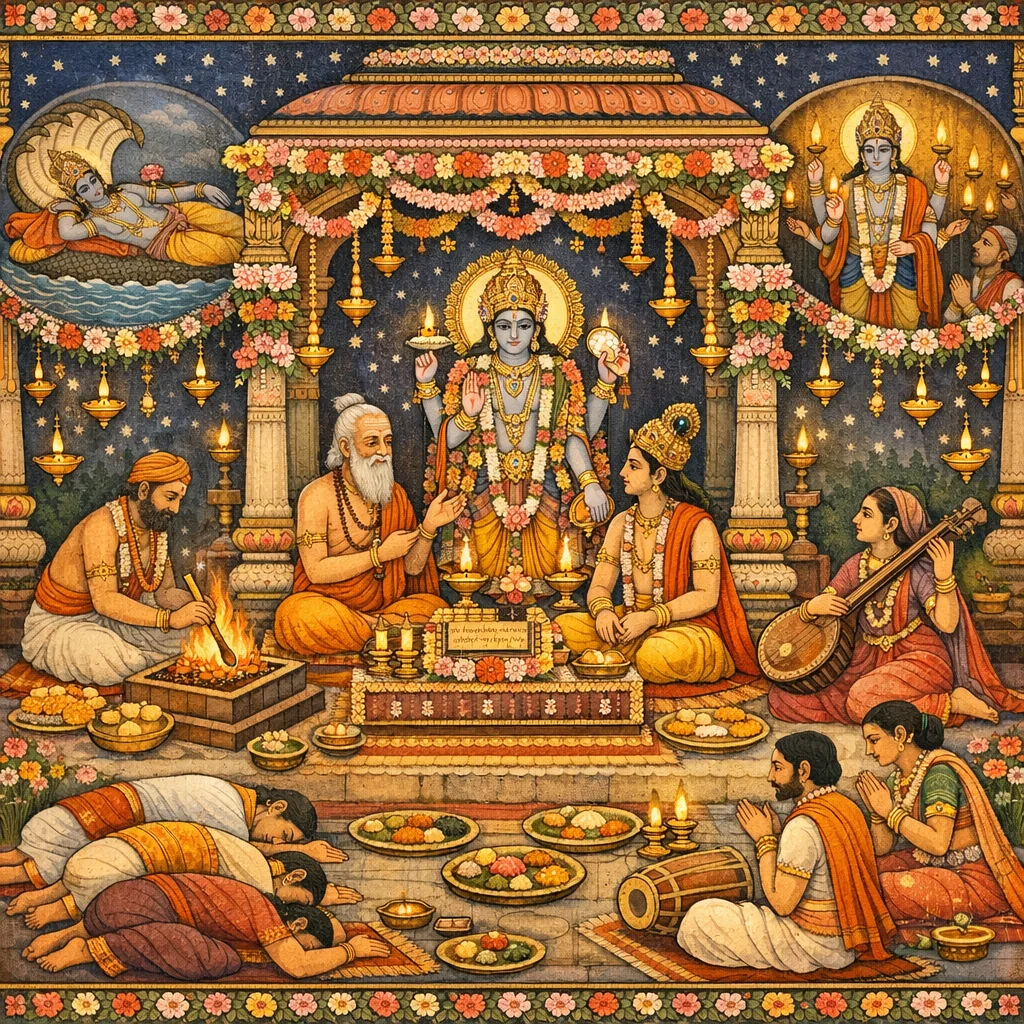
Sanātana instructs Nārada in a standardized Ekādaśī-vrata: prepare a flower-adorned maṇḍapa, bathe as prescribed, worship Viṣṇu with mantra, homa, circumambulation, stotra-recitation, devotional music, full prostrations, victory-cries, and a night vigil. The chapter then lists the Ekādaśīs month by month and their completion on Dvādaśī—typically worship with sixteen upacāras, feeding brāhmaṇas, and giving dakṣiṇā—promising destruction of sins, prosperity, progeny, and attainment of Vaikuṇṭha. It highlights Varūthinī’s gifts (gold, food, cows, etc.), Nirjalā’s merit equal to twenty-four Ekādaśīs, Yoginī’s charity-merit, Śayanī Ekādaśī’s image-installation and Pauruṣa Sūkta worship ushering in Cāturmāsya, and Prabodhinī’s “awakening” rites with Vedic mantras and festive offerings. The closing section codifies the three-day discipline (Daśamī–Ekādaśī–Dvādaśī): reduced meals, utensil/food restrictions, and ethical restraints—truthfulness, non-violence, purity, and avoidance of slander and sensuality.
Shlokas
Verse 1
सनातन उवाच । एकादश्यां तु दलयोर्निराहारः समाहितः । नानापुष्पैर्मुने कृत्वा विचित्रं मण्डपं शुभम् ॥ १ ॥
Sanātana said: “On Ekādaśī, being self-controlled and fasting, one should, O sage, fashion an auspicious and beautiful pavilion (maṇḍapa), adorned with many kinds of flowers.”}]}}
Verse 2
स्रात्वा सम्यग्विधानेन सोपवासो जितेंद्रियः । संपूज्य विधिवद्विष्णुं श्रद्धया सुसमाहितः ॥ २ ॥
Having bathed properly according to the prescribed rites, fasting and restraining the senses, one should worship Lord Viṣṇu in due ritual order—steadfast, with faith, and with a well-collected mind.
Verse 3
उपचारैर्बहुविधैर्जपैर्होमैः प्रदक्षिणैः । स्तोत्रपाठैर्बहुविधैर्गीतवाद्यैर्मनोहरैः ॥ ३ ॥
With many kinds of ritual services, with mantra-recitation, with fire-offerings, with circumambulations, with diverse recitations of hymns, and with delightful singing and instrumental music—(the Lord is worshiped).
Verse 4
दंडवत्प्रणिपातैश्च जयशब्दैर्मनोहरैः । रात्रौ जागरणं कृत्वा याति विष्णोः परं पदम् ॥ ४ ॥
By offering full-length prostrations like a staff and by uttering delightful cries of “Victory!”, and by keeping vigil through the night, one attains the supreme abode of Viṣṇu.
Verse 5
चैत्रस्य शुक्लैकादश्यां सोपवासो नरोत्तमः । कृत्वा च नियमान्सर्वान्वक्ष्यमाणान्दिनत्रये ॥ ५ ॥
On the bright (waxing) eleventh day of the month of Caitra, O best of men, one should observe the fast; and, having undertaken all the disciplines that will be described, one should follow them for three days.
Verse 6
द्वादश्यामर्चयेद्भक्तया वासुदेवं सनातनम् । उपचारैः षोडशभिस्ततः संभोज्य बांधवान् ॥ ६ ॥
On Dvādaśī, one should worship the eternal Vāsudeva with devotion, using the sixteen ritual offerings; thereafter, one should feed one’s relatives.
Verse 7
दत्वा च दक्षिणां तेभ्यो विसृज्याश्नीत च स्वयम् ॥ । इयं तु कामदा नाम सर्वपातकनाशिनी ॥ ७ ॥
Having given them the prescribed dakṣiṇā, one should respectfully dismiss them and then partake of the meal oneself. This observance is called “Kāmadā,” and it destroys all sins.
Verse 8
भुक्तिमुक्तिप्रदा विप्र भक्त्या सम्यगुपोषिता । वैशाखकृष्णैकादश्यां समुपोष्य विधानतः ॥ ८ ॥
O brāhmaṇa, when this fast is properly observed with devotion, according to the prescribed rite, on the Kṛṣṇa Ekādaśī of the month of Vaiśākha, it bestows both worldly enjoyment and liberation.
Verse 9
वरूथिनीं परदिने पूजयेन्मृधुसूदनम् । स्वर्णान्नकन्याधेनूनां दानमत्र प्रशस्यते ॥ ९ ॥
On the following day of Varūthinī, one should worship Madhusūdana (Viṣṇu). In this context, the giving of gifts—gold, cooked food, the gifting of a maiden in marriage according to dharma, and cows—is especially praised.
Verse 10
वरूथिनीव्रतं कृत्वा नरो नियमतत्परः । सर्वपाप विनिर्मुक्तो वैष्णवं लभते पदम् ॥ १० ॥
A person who performs the Varūthinī Vrata with steadfast discipline becomes freed from all sins and attains the Vaiṣṇava state—Viṣṇu’s supreme abode.
Verse 11
वैशाखशुक्लैकादश्यां समुपोष्य च मोहिनीम् । स्नात्वा परेऽह्नि संपूज्य गंधाद्यैः पुरुषोत्तमम् ॥ ११ ॥
On the bright fortnight’s Ekādaśī in the month of Vaiśākha, one should observe the Mohinī Ekādaśī fast. Then, on the following day, after bathing, one should duly worship Puruṣottama (Lord Viṣṇu) with fragrance and other offerings.
Verse 12
संभोज्य विप्रान्मुच्येत पातकेभ्यो न संशयः । ज्येष्ठस्य कृष्णकादश्यां समुपोष्य परां नृप ॥ १२ ॥
By feeding the brāhmaṇas, one is freed from sins—there is no doubt. And, O best of kings, by observing a complete fast on the Ekādaśī of the dark fortnight (Kṛṣṇa pakṣa) in the month of Jyeṣṭha, one attains the highest spiritual state.
Verse 13
द्वादश्यां नैत्यिकं कृत्वा समभ्यर्च्य त्रिविक्रमम् । ततो द्विजाग्र्यान्संभोज्य दत्वा तेभ्यश्च दक्षिणाम् ॥ १३ ॥
On the Dvādaśī day, having performed the daily obligatory rites and duly worshipped Trivikrama (Viṣṇu), one should then feed the foremost of the twice-born (brāhmaṇas) and also give them the prescribed dakṣiṇā.
Verse 14
सर्वपापविनिर्मुक्तो विष्णुलोकं व्रजेन्नरः । ज्येष्ठस्य शुक्लैकादश्यां निर्जलां समुपोष्य तु ॥ १४ ॥
A person who fully observes the Nirjalā (waterless) fast on the bright Ekādaśī (Śukla pakṣa) of the month of Jyeṣṭha becomes freed from all sins and attains Viṣṇu’s world (Viṣṇuloka).
Verse 15
उदयादुदयं यावद्भास्करस्य द्विजोत्तम । प्रभाते कृतनित्यस्तु द्वादश्यामुपचारकैः ॥ १५ ॥
O best of the twice-born, from one sunrise to the next, having performed the morning daily duties, on Dvādaśī one should worship the Lord with the prescribed upacāras (services of devotion).
Verse 16
ह्यषीकेशं समभ्यर्च्य विप्रान् संभोज्य भक्तितः । चतुर्विंशैकादशीनां फलं यत्तत्समाप्नुयात् ॥ १६ ॥
By devoutly worshipping Hṛṣīkeśa (Lord Viṣṇu) and respectfully feeding the brāhmaṇas, one attains the very merit that is said to arise from observing twenty-four Ekādaśī fasts.
Verse 17
आषाढकृष्णैकादश्यां योगिनीं समुपोष्य वै । नारायणं समभ्यर्च्य द्वादश्यां कृतनित्यकः ॥ १७ ॥
Indeed, on Yoginī Ekādaśī in the dark fortnight of Āṣāḍha, one should duly observe the fast; then, having worshipped Nārāyaṇa, on Dvādaśī one should perform one’s regular daily rites.
Verse 18
ततः संभोज्य विप्राग्र्यान्दत्वा तेभ्यश्च दक्षिणाम् । सर्वदानफलं प्राप्य मोदते विष्णुमन्दिरे ॥ १८ ॥
Then, after feeding the foremost Brāhmaṇas and giving them the prescribed dakṣiṇā, one attains the merit of all forms of charity and rejoices in the temple-abode of Viṣṇu.
Verse 19
आषाढशुक्लैकादश्यां यद्विधानं श्रृणुष्व तत् । उपोष्य तस्मिन् दिवसे विधिवन्मंडपे शुभे ॥ १९ ॥
Now listen to the prescribed procedure for the Ekādaśī that falls in the bright fortnight of Āṣāḍha. Having observed a fast on that day, one should perform the rites according to rule in a pure and auspicious maṇḍapa.
Verse 20
स्थापयेत्प्रतिमां विष्णोः शंखचक्रगदांबुजैः । लसच्चतुर्भुजामग्र्यां कांचनीं वाथ राजतीम् ॥ २० ॥
One should install an image of Lord Viṣṇu bearing the conch, discus, mace, and lotus—an excellent, radiant four-armed form—made either of gold or of silver.
Verse 21
पीतांबरधरां शुभ्रे पर्य्यंके स्वास्तृते द्विज । ततः पंचामृतैः स्नाप्य मन्त्रैः शुद्धजलेन च ॥ २१ ॥
O twice-born one, place the deity clad in a yellow garment upon a pure couch properly spread; then bathe it with the five nectars (pañcāmṛta), and also with pure water accompanied by mantras.
Verse 22
पौरुषेणैव सूक्तेन ह्युपचारान् प्रकल्पयेत् । नीराजनांतान्पाद्यादींस्ततः संप्रार्थयेद्धरिम् ॥ २२ ॥
With the Pauruṣa Sūkta alone, one should arrange the upacāras of worship—beginning with offerings such as pādya (water for the Lord’s feet) and continuing up to nīrājana (the waving of lights); thereafter one should earnestly pray to Hari.
Verse 23
सुप्ते त्वयि जगन्नाथ जगत्सुप्तं भवेदिदम् । विबुद्धे त्वयि बुद्धं च जगत्सर्वं चराचरम् ॥ २३ ॥
O Jagannātha, Lord of the universe: when You sleep, this whole world falls asleep; and when You awaken, all creation—moving and unmoving—awakens.
Verse 24
इति संप्रार्थ्य देवाग्रे चातुर्मास्यप्रचोदितान् । नियमांस्तु यथाशक्ति गृह्णीयाद्भक्तिमान्नरः ॥ २४ ॥
Thus, having duly prayed before the Lord, a devoted person should undertake—according to his capacity—the observances enjoined for Cāturmāsya, the sacred four-month period.
Verse 25
ततः प्रभाते द्वादश्यां समर्चेच्छेषशायिनम् । उपचारैः षोडशभिस्ततः संभोज्य वाडवान् ॥ २५ ॥
Then, at dawn on the Dvādaśī day, one should duly worship Viṣṇu, who reclines upon Śeṣa, with the sixteen ritual offerings; thereafter one should feed the brāhmaṇas.
Verse 26
प्रतोष्य दक्षिणाभिश्च स्वयं भुञ्जीत वाग्यतः । ततः प्रभृति विप्रेंद्र गन्धाद्यैः प्रत्यहं यजेत् ॥ २६ ॥
Having duly satisfied (the officiants) with dakṣiṇā, gifts of honor, one should then eat oneself, restraining one’s speech. From that time onward, O best of brāhmaṇas, one should worship every day with fragrances and other offerings.
Verse 27
कृत्वैवं विधिना विप्र देवस्य शयनीव्रतम् । भुक्तिमुक्तियुतो मर्त्यो भवेद्विष्णोः प्रसादतः ॥ २७ ॥
O brāhmaṇa, when a mortal performs the Lord’s Śayanī-vrata in this prescribed manner, by the grace of Viṣṇu he is endowed with both worldly enjoyment and liberation.
Verse 28
श्रावणे कृष्णपक्षे तु एकादश्यां द्विजोत्तम । कामिकां समुपोष्यैव नियमेन नरोत्तम ॥ २८ ॥
O best of the twice-born, in the dark fortnight of Śrāvaṇa, on the Ekādaśī day, the noble person should observe the Kāmikā (Ekādaśī) fast with due discipline and prescribed restraints.
Verse 29
द्वादश्यां कृतनित्यस्तु श्रीधरं पूजयेद्धरिम् । उपचारैः षोडश भिस्ततः संभोज्य वै द्विजान् ॥ २९ ॥
On the Dvādaśī day, having completed one’s daily obligatory rites, one should worship Hari, Śrīdhara, with the sixteen forms of ritual service; thereafter, one should duly feed the twice-born (brāhmaṇas).
Verse 30
दत्वा च दक्षिणां तेभ्यो विसृज्याश्नीत बांधवैः । एवं यः कुरुते विप्रकामिकाव्रतमुत्तमम् ॥ ३० ॥
Having given them the prescribed dakṣiṇā and formally dismissed them, one should then take the meal together with one’s relatives. Thus is the excellent vow called the Viprakāmikā-vrata properly performed.
Verse 31
स सर्वकामाँल्लब्ध्वेह याति विष्णोः परं पदम् । एकादश्यां नभःशुक्ले पवित्रां समुपोष्य वै ॥ ३१ ॥
Having obtained all desired aims here in this world, he attains the supreme abode of Viṣṇu by duly observing a purifying fast on the Ekādaśī of the bright fortnight in the month of Nabhas (Bhādrapada).
Verse 32
द्वादश्यां नियतो भूत्वा पूजयेच्च जनार्दनम् । उपचारैः षोडशभिस्ततः संभोज्य वाडवान् ॥ ३२ ॥
On Dvādaśī, having become self-restrained, one should worship Janārdana with the sixteen modes of sacred service; thereafter one should feed the brāhmaṇas.
Verse 33
दत्वा च दक्षिणां तेभ्यः पुत्रं प्राप्येह सद्गुणम् । याति विष्णोः पदं साक्षात्सर्वदेवनमस्कृतः ॥ ३३ ॥
And having given them the prescribed dakṣiṇā, one gains in this very life a virtuous son; and, revered by all the gods, one goes directly to the abode of Viṣṇu.
Verse 34
नभस्यकृष्णैकादश्यामजाख्यां समुपोष्य वै । अर्चेदुर्पेंद्रं द्वादश्यामुपचारैः पृथग्विधैः ॥ ३४ ॥
Indeed, having duly fasted on the dark-fortnight Ekādaśī of the month of Nabhasya, called Ajā, one should worship Lord Upendra on Dvādaśī with various distinct upacāras (ritual offerings).
Verse 35
विप्रान्संभोज्य मिष्टान्नैर्विसृजेत्प्राप्तदक्षिणान् । एवं कृतव्रतो विप्रभक्त्याऽजायाः समाहितः ॥ ३५ ॥
After feeding the brāhmaṇas with sweet and choice foods, he should respectfully send them off once they have received the dakṣiṇā. Thus, having completed the vow, he remains composed and attentive, honoring the brāhmaṇas with devotion and keeping his mind fixed on Ajā, the Unborn.
Verse 36
भुक्त्वेह भोगानखिलान्यात्यंते वैष्णवं क्षयम् । नभस्यशुक्लैकादश्यां पद्माख्यां समुपोष्य वै ॥ ३६ ॥
Having enjoyed all worldly pleasures here, one ultimately attains the imperishable Vaiṣṇava abode—the realm of Viṣṇu—by duly observing the fast on the bright-fortnight Ekādaśī of the month of Nabhas (Bhādrapada), known as Padmā.
Verse 37
कृत्वा नित्यार्चनं तत्र कटिदानमथाचरेत् । पूर्वं संस्थापितायास्तु प्रतिमाया द्विजोत्तम ॥ ३७ ॥
After performing the daily worship there, one should then carry out the rite of kaṭidāna, the prescribed offering connected with the waist-girdle or waist-cloth. O best of the twice-born, this is to be done for an image (pratimā) that has already been duly installed beforehand.
Verse 38
समुत्सवविधानेन नीत्वा तां सलिलाशये । कृतांबुस्पर्शनां तत्र संप्रपूज्य विधानतः ॥ ३८ ॥
Having taken her, in accordance with the festive rite (samutsava), to a water-reservoir, and having there performed the rite of touching water (ambusparśana), one should duly worship her according to the injunctions.
Verse 39
आनीय मण्डपे तस्मिन् वामपार्श्वेन शाययेत् । ततः प्रभाप्ते द्वादश्यां गन्धाद्यैरर्च्य वामनम् ॥ ३९ ॥
Having brought (the deity/image) into that maṇḍapa, one should lay it down on its left side. Then, when the Dvādaśī (twelfth lunar day) dawns, one should worship Vāmana with fragrances and other offerings.
Verse 40
संभोज्य वाडवान्दत्वा दक्षिणां च विसर्जयेत् । एवं यः कुरुते विप्र पद्माव्रतमनुत्तमम् ॥ ४० ॥
After feeding (the recipients) and giving cows along with the prescribed dakṣiṇā (honorarium), one should formally conclude the rite. Thus, O brāhmaṇa, whoever performs in this manner truly completes the unsurpassed Padma-vrata (Lotus vow).
Verse 41
भुक्तिं प्राप्येह मुक्तिं तु लभतेंऽते प्रपंचतः । इषस्य कृष्णैका दश्यामिंदिरां समुपोष्य वै ॥ ४१ ॥
Having attained worldly enjoyments here, they finally obtain liberation (mokṣa) from the cycle of worldly existence—indeed, by duly observing Indirā Ekādaśī, the dark-fortnight Ekādaśī of the month of Āśvina.
Verse 42
शालग्रामशिलाग्रे तु मध्याह्ने श्राद्धमाचरेत् । विष्णोः प्रीतिकरं विप्र ततः प्रातर्हरेर्दिने ॥ ४२ ॥
At midday one should perform the śrāddha rite before the Śālagrāma-śilā; O brāhmaṇa, it is pleasing to Viṣṇu. Then, on the day sacred to Hari, one should do it in the morning.
Verse 43
पद्मनाभं समभ्यर्च्य भूदेवान्भोजयेत्सुधीः । विसृज्य दक्षिणां दत्वा ताँस्ततोऽश्नीत च स्वयम् ॥ ४३ ॥
Having duly worshipped Padmanābha (Viṣṇu), the wise person should feed the Bhūdevas (the brāhmaṇas). After respectfully sending them off and giving the prescribed dakṣiṇā, one should then partake of the meal oneself.
Verse 44
एवं कृतव्रतो मर्त्यो भुक्त्वा भोगानिहेप्सितान् । पितॄणां कोटिमुद्धृत्य यात्यंते वैष्णवं गृहम् ॥ ४४ ॥
Thus, a mortal who has duly observed the vow, after enjoying the desired pleasures here, uplifts a koṭi of ancestors and, in the end, attains the Vaiṣṇava abode of Lord Viṣṇu.
Verse 45
एकादश्यामिषे शुक्ले विप्र पाशांकुशाह्वयाम् । उपोष्य विधिवद्विष्णोर्दिने विष्णुं समर्चयेत् ॥ ४५ ॥
O brāhmaṇa, on the bright-fortnight Ekādaśī known as Pāśāṅkuśā, one should fast and, on the day sacred to Viṣṇu, worship Lord Viṣṇu in accordance with proper ritual procedure.
Verse 46
ततः संभोज्य विप्राग्र्यान्दत्वा तेभ्यश्च दक्षिणाम् । भक्त्या प्रणम्य विसृजेदश्नीयाच्च स्वयं ततः ॥ ४६ ॥
Then, after feeding the foremost brāhmaṇas and giving them the prescribed dakṣiṇā, one should bow to them with devotion and respectfully take leave of them; only thereafter should one eat oneself.
Verse 47
एवं यः कुरुते भक्त्या नरः पाशांकुशाव्रतम् । स भुक्त्वेह वरान्भोगान्याति विष्णोः सलोकताम् ॥ ४७ ॥
Thus, the person who performs the Pāśāṅkuśa-vrata with devotion first enjoys excellent blessings and comforts in this very world, and then attains residence in the same realm as Lord Viṣṇu (Viṣṇu-salokya).
Verse 48
कार्तिके कृष्णपक्षे तु एकादश्यां द्विजोत्तम । रमामुपोष्य विधिवद्द्वादश्यां प्रातरर्चयेत् ॥ ४८ ॥
O best of twice-born ones, in the dark fortnight of Kārtika, on Ekādaśī one should observe a fast for Ramā; then, on Dvādaśī morning, one should worship her according to proper rite.
Verse 49
केशवं केशिहंतारं देवदेवं सनातनम् । भोजयेच्च ततो विप्रान्विसृजेल्लब्धदक्षिणान् ॥ ४९ ॥
Having first worshipped Keśava—slayer of Keśin, the eternal God of gods—one should then feed the brāhmaṇas and thereafter respectfully dismiss them after they have received their honorarium (dakṣiṇā).
Verse 50
एवं कृतव्रतो विप्र भोगान्भुक्त्वेह वांछितान् । व्योमयानेन सांनिध्यं लभते च रमापतेः ॥ ५० ॥
Thus, O brāhmaṇa, one who has duly observed the vow enjoys here the desired pleasures; and then, borne in a celestial aerial car, he attains close proximity to Rāmāpati (Viṣṇu, the Lord of Lakṣmī).
Verse 51
ऊर्जस्य शुक्लैकादश्यां समुपोष्य प्रबोधिनीम् । केशवं बोधयेद्रात्रौ सुप्तं गीतादिमंगलैः ॥ ५१ ॥
On the bright eleventh day of the month of Ūrja (Kārttika), having duly observed the fast of Prabodhinī (Ekādaśī), one should awaken Keśava at night—who is spoken of as ‘asleep’—with auspicious acts such as devotional songs and other sacred celebrations.
Verse 52
ऋग्यजुःसाममंत्रैश्च वाद्यैर्नानाविधैरपि । द्राक्षेक्षुदाडिमैश्चान्यै रंभाश्रृंगाटकादिभिः ॥ ५२ ॥
With mantras from the Ṛg, Yajur, and Sāma Vedas, and with many kinds of musical instruments; and with offerings of grapes, sugarcane, pomegranates, and other items such as bananas and water-chestnuts, and the like.
Verse 53
समर्पणैस्ततो रात्र्यां व्यतीतायां परेऽहनि । स्नात्वा नित्यक्रियां कृत्वा गदादामोदरं यजेत् ॥ ५३ ॥
Then, after spending the night in acts of devotional offering, on the following day—having bathed and completed the daily obligatory rites—one should worship Lord Dāmodara, the bearer of the mace (Gadā).
Verse 54
उपचारैः षोडशभिः पौरुषेणापि सूक्ततः । संभोज्य विप्रान्विसृजेद्दक्षिणाभिः प्रतोषितान् ॥ ५४ ॥
Having worshipped with the sixteen customary services—and also by duly reciting the Pauruṣa hymn—one should feed the Brahmanas and then respectfully send them off, fully satisfied with appropriate gifts (dakṣiṇā).
Verse 55
ततस्तां प्रतिमां हैमीं सधेनुं गुरवेऽर्पयेत् । एवं यः कुरुते भक्त्या बोधिनीव्रतमादृतः ॥ ५५ ॥
Then one should present that golden idol—together with a milch-cow (sadhenu)—to the guru. Whoever performs the Bodhinī-vrata in this manner, with devotion and reverence, truly fulfills its observance.
Verse 56
स भुक्त्वेह वरान्भोगान्वैष्णवं लभते पदम् । मार्गस्य कृष्णैकादश्यामुत्पन्नां समुपोष्य वै ॥ ५६ ॥
Having enjoyed excellent pleasures here in this world, he attains the supreme Vaishnava state—indeed, by duly observing the fast of the Krishna Ekadashi that arises in the month of Mārgaśīrṣa.
Verse 57
द्वादश्यां कृष्णमभ्यर्चेद्गंधाद्यैरुपचारकैः । ततः संभोज्य विप्राग्र्यान्दत्वा तेभ्यश्च दक्षिणाम् ॥ ५७ ॥
On Dvādaśī one should worship Lord Kṛṣṇa with offerings such as fragrance and other sacred services; then, having respectfully fed the foremost brāhmaṇas, one should also bestow upon them the prescribed dakṣiṇā.
Verse 58
विसृज्य पश्चाद्भुंजीत स्वयमिष्टैः समाहितः । एवं यो भक्तिभावेन उत्पन्नाव्रतमाचरेत् ॥ ५८ ॥
After completing the offering, one should then eat oneself, composed in mind, taking foods that are suitable. Whoever thus performs this newly undertaken vow with a spirit of bhakti truly observes it in the proper way.
Verse 59
स विमानं समारुह्य यात्यंते वैष्णवं पदम् । मार्गस्य शुक्लैकादश्यां मोक्षाख्यां समुपोष्य वै ॥ ५९ ॥
Mounting a celestial vimāna, he goes at last to the Vaiṣṇava abode—after duly observing the fast on the bright Ekādaśī of the month of Mārgaśīrṣa, known as “Mokṣā.”
Verse 60
द्वादश्यां प्रातरभ्यर्च्य ह्यनंतं विश्वरूपकम् । सर्वैरेवोपचारैस्तु विप्रान्संभोजयेद्द्विजः ॥ ६० ॥
On Dvādaśī, having worshipped in the morning Ananta—the boundless Lord of the universal form—one should, with all customary offerings and services, feed the brāhmaṇas.
Verse 61
विसृज्य दक्षिणां दत्वा स्वयं भुंजीत बांधवैः । एवं कृत्वा व्रतं विप्र भुक्त्वा भोगानिहेप्सितान् ॥ ६१ ॥
Having dismissed (the officiants/guests) and given the prescribed dakṣiṇā, one should then partake of the meal oneself together with one’s relatives. O brāhmaṇa, having thus completed the vow, one enjoys in this world the desired comforts and pleasures.
Verse 62
दश पूर्वान्दश परान्समुद्धृत्य व्रजेद्धरिम् । पौपस्य कृष्णैकादश्यां सफलां समुपोष्य वै । द्वादश्यामच्युतं प्रार्च्य सर्वैरेवोपचारकैः ॥ ६२ ॥
Having uplifted ten ancestors and ten generations of descendants, one attains Hari. Indeed, on the dark-fortnight Ekādaśī in the month of Pauṣa one should observe a fruitful fast; and on the Dvādaśī, worship Acyuta with all the prescribed offerings and services.
Verse 63
संभोज्य विप्रान्मधुरैर्विसृजेल्लब्धदक्षिणान् । एवं कृत्वा व्रतं विप्र सफलाया विधानतः ॥ ६३ ॥
Having fed the brāhmaṇas with sweet dishes, one should respectfully send them off after giving the prescribed dakṣiṇā. O brāhmaṇa, when the vow is performed in this manner according to rule, it becomes fruitful and successful.
Verse 64
भुक्त्वेह भोगानखिलान्यात्यंते वैष्णवं पदम् । पौषस्य शुक्लैकादश्यां पुत्रदां समुपोष्य वै ॥ ६४ ॥
Having enjoyed all pleasures here in this world, one ultimately attains the supreme abode of Viṣṇu—by duly observing the Putradā Ekādaśī fast on the bright fortnight’s eleventh day in the month of Pauṣa.
Verse 65
द्वादश्यां चक्रिणं प्रार्येदर्घाद्यैरुपचारकैः । ततः संभोज्य विप्राग्र्यान्दत्वा तेभ्यस्तु दक्षिणाम् ॥ ६५ ॥
On the Dvādaśī day, one should worship the Lord who bears the discus (Viṣṇu) with arghya and other prescribed ritual services. Thereafter, having fed the foremost brāhmaṇas, one should give them an appropriate dakṣiṇā.
Verse 66
विसृज्य स्वयमश्नीयाच्छेषान्नं स्वेष्टबांधवैः । एवं कृतव्रतो विप्र भुक्वा भोगानिहेप्सितान् ॥ ६६ ॥
Having first distributed the food/offering, one should then eat oneself, and the remaining food should be given to one’s dear relatives and kinsmen. Thus, O brāhmaṇa, having duly completed the vow, one enjoys in this world the desired comforts and enjoyments.
Verse 67
विमानवरमारुह्य यात्यंते हरिमंदिरम् । माघम्य कृष्णैकादश्यां षट्तिलां समुपोष्य वै ॥ ६७ ॥
Mounting an excellent celestial chariot, they ultimately reach the temple-abode of Hari—indeed, by duly observing the Ṣaṭtilā fast on the dark (Kṛṣṇa) Ekādaśī of the month of Māgha.
Verse 68
स्नात्वा दत्वा तर्पयित्वा हुत्वा भुक्त्वा समर्च्य च । तिलैरेव द्विजश्रेष्ठ द्वादश्यां प्रातरेव हि ॥ ६८ ॥
Having bathed, given gifts, satisfied the ancestors with libations (tarpaṇa), offered oblations into the fire (homa), taken one’s meal, and duly worshipped—O best of the twice-born—on the Dvādaśī day all this should indeed be done in the morning, using sesame seeds alone.
Verse 69
वैकुंठं सम्यगभ्यर्व्य सर्वैरेवोपचारकैः । द्विजान्संभोज्य विसृजेद्दत्वा तेभ्यश्च दक्षिणाम् ॥ ६९ ॥
Having duly worshipped Vaikuṇṭha (Lord Viṣṇu) with all the prescribed offerings and services, one should feed the twice-born (brāhmaṇas) and then respectfully send them off, after giving them an honorarium (dakṣiṇā).
Verse 70
एवं कृत्वा व्रतं विप्र विधिना सुसमाहितः । भुक्त्वेह वांछितान्भोगानंते विष्णुपदं लभेत् ॥ ७० ॥
O brāhmaṇa, one who performs the vow in this manner, duly and with steady concentration, enjoys the desired pleasures here in this world and, in the end, attains the abode of Viṣṇu.
Verse 71
माघस्य शुक्लैकादश्यां समुपोष्य जयाह्वयाम् । प्रातर्हरि दिनेऽभ्यर्च्चेच्छ्रीपतिं पुरुषं द्विज ॥ ७१ ॥
O twice-born one, having duly observed the fast on the bright eleventh day of Māgha—known as Jaya (Ekādaśī)—one should, on the morning of Hari’s sacred day, worship Śrīpati, the Supreme Person.
Verse 72
भोजयित्वा दक्षिणां च दत्वा विप्रान्विसृज्य च । स्वयं भुंजीत तच्छेषं प्रयतो निजबांधवैः ॥ ७२ ॥
After feeding the brāhmaṇas, offering the prescribed dakṣiṇā, and respectfully taking leave of them, one should then, with self-control, partake of the remaining food together with one’s own relatives.
Verse 73
य एवं कुरुते विप्र व्रतं केशवतोषणम् । स भुक्त्वेह वरान्भोगानंते विष्णोः पदं व्रजेत् ॥ ७३ ॥
O brāhmaṇa, whoever thus performs this vow that pleases Keśava, after enjoying excellent blessings and noble pleasures in this world, will at the end attain the abode of Viṣṇu.
Verse 74
तपस्यकृष्णैकादश्यां विजयां समुपोष्य वै । द्वादश्यां प्रातरभ्यर्च्य योगीशं गंधपूर्वकैः ॥ ७४ ॥
Indeed, on the dark-fortnight Ekādaśī of the month of Tapasya (Phālguna), one should duly observe the Vijayā fast; and on the Dvādaśī morning, having begun worship, one should adore the Lord of Yogins with fragrances and the like.
Verse 75
ततः संभोज्य भूदेवान्दक्षिणाभिः प्रतोष्य तान् । विसृज्य बांधवैः सार्द्धं स्वयमश्नीत वाग्यतः ॥ ७५ ॥
Then, having fed the brāhmaṇas—the ‘gods on earth’—and having gratified them with dakṣiṇā, he respectfully dismissed them; thereafter, together with his relatives, he himself should eat, remaining restrained in speech.
Verse 76
एवं कृतव्रतो मर्त्यो भुक्त्वा भोगानिहेप्सितान् । देहांते वैष्णवं लोकं याति देवैः सुसत्कृतः ॥ ७६ ॥
Thus, a mortal who has duly observed the vow—having enjoyed the desired pleasures here in this world—at the end of the body goes to the Vaiṣṇava realm, honored and well-received by the gods.
Verse 77
फाल्गुनस्य सिते पक्षे एकादश्यां द्विजोत्तम । उपोष्यामलकीं भक्त्या द्वादश्यां प्रातरर्चयेत् ॥ ७७ ॥
O best of the twice-born, on the bright-fortnight Ekādaśī of Phālguna one should fast with bhakti, observing the Āmalakī vow; and on the Dvādaśī, in the morning, one should worship the Āmalakī.
Verse 78
पुंडरीकाक्षमखिलैरुपचारैस्ततो द्विजान् । भोजयित्वा वरान्नेन दद्यात्तेभ्यस्तु दक्षिणाम् ॥ ७८ ॥
Then, having worshipped Puṇḍarīkākṣa (Viṣṇu) with every kind of reverential offering, one should feed the twice-born (brāhmaṇas) with excellent food and also give them fitting dakṣiṇā.
Verse 79
एवं कृत्वा विधानेनामलक्यां पूजनादिकम् । सितैकादश्यां तपस्ये व्रजेद्विष्णोः परं पदम् ॥ ७९ ॥
Thus, having performed according to the prescribed rule the worship of Āmalakī and the related rites, on the bright Ekādaśī of the month Tapasya (Phālguna) one attains the supreme abode of Viṣṇu.
Verse 80
चैत्रस्य कृष्णैकादशीं पापमोचनिकां द्विज । उपाष्य द्वादश्यांप्रातर्गोविंदं पूजयेत्तथा ॥ ८० ॥
O twice-born one, having observed by fasting the Pāpamocanī Ekādaśī that falls in the dark fortnight of Caitra, one should likewise worship Govinda early in the morning on the following Dvādaśī.
Verse 81
उपचारैः षोडशभिर्द्विजान्संभोज्य दक्षिणाम् । दत्वा तेभ्यो विसृज्याथ स्वयं भुंजीत बान्धवैः ॥ ८१ ॥
Having honored the twice-born with the sixteen customary services and fed them, one should give them the prescribed dakṣiṇā. Then, having respectfully taken leave of them, one should oneself eat together with one’s relatives.
Verse 82
एव यः कुरुते विप्र पापमोचनिकाव्रताम् । स याति वैष्णवं लोकं विमानेन तु भास्वता ॥ ८२ ॥
Thus, O brāhmaṇa, whoever performs the Pāpamocanikā vow is freed from sin and goes to the Vaiṣṇava realm, borne upon a radiant celestial chariot (vimāna).
Verse 83
इत्थं कृष्णो तथा शुक्ले व्रतं चैकादशीभवम् । मोक्षदं कीर्तितं विप्र नास्त्यस्मिन्संशयः क्वचित् ॥ ८३ ॥
Thus, in both the dark fortnight and the bright fortnight, the Ekādaśī vow has been proclaimed, O brāhmaṇa, as a bestower of liberation; of this there is no doubt whatsoever.
Verse 84
यतस्त्रिदिनसंसाध्यं कीर्तिनं पापनाशनम् । सर्वव्रतोत्तमं विप्र ततो ज्ञेयं महाफलम् ॥ ८४ ॥
Since it can be duly accomplished in just three days, and since its observance destroys sins and is proclaimed the best of all vows—therefore, O brāhmaṇa, it should be understood to yield great fruit.
Verse 85
त्यजेच्चत्वारि भुक्तानि नारदै तद्दिनत्रये । आद्यंतयोरेकमेकं मध्यमे द्वयमेव हि ॥ ८५ ॥
O Nārada, in the three-day observance one should forgo four meals: one meal on the first day, one on the last day, and two meals on the middle day.
Verse 86
अथ ते नियमान्वच्मि व्रते ह्यस्मिन्दिनत्रये । कांस्यं मांसं मसूरान्नं चणकान्कोद्रवांस्तथा ॥ ८६ ॥
Now I shall tell you the rules for this three-day vow: one should avoid bell-metal (kāṃsya) utensils, meat, food made of masūra lentils, chickpeas (caṇaka), and kodrava grain as well.
Verse 87
शाकं मधु परान्नं च पुनर्भोजनमैथुने । दशम्यां दश वस्तूनि वर्जयेद्वैष्णवः सदा ॥ ८७ ॥
On the Daśamī day, a Vaiṣṇava should ever abstain from ten things—such as leafy greens, honey, richly seasoned cooked foods, eating again (a second meal), and sexual union.
Verse 88
द्यूतक्रीडां च निद्रां च तांबूलं दंतधावनम् । परापवादं पैशुन्यं स्तेयं हिंसां तथा रतिम् ॥ ८८ ॥
Gambling and gaming, indulgent sleep, chewing betel, cleaning the teeth, slandering others and malicious tale-bearing, theft, violence, and sexual indulgence—these are to be renounced.
Verse 89
कोपं ह्यनृतवाक्यं च एकादश्यां विवर्ज्जयेत् । कांस्यं मांसं सुरां क्षौद्रं तैलं विण्म्लेच्छभाषणम् ॥ ८९ ॥
On Ekādaśī one should avoid anger and false speech; and also abstain from bell-metal (kāṃsya), meat, liquor, honey, oil, filth, and speaking in impure, barbarous language.
Verse 90
व्यायामं च प्रवासं च पुनर्भोजनमैथुने । अस्पृश्यस्पर्शमाशूरे द्वादश्यां द्वादश त्यजेत् ॥ ९० ॥
On Dvādaśī, the wise should avoid strenuous exercise, travel, eating again (a second meal), sexual intercourse, and contact with those who are ritually impure.
Verse 91
एवं नियमकृद्विप्र उपवासं समाचरेत् । शक्तोऽशक्तुस्तु मतिमानेकभुक्तं न नक्तकम् ॥ ९१ ॥
Thus, O brāhmaṇa, one who undertakes the prescribed restraints should duly practice upavāsa (fasting). A wise person—whether able or unable to fast strictly—should adopt ekabhukta (a single meal) rather than naktaka (a night meal).
Verse 92
अयाचितं वापि चरेन्न त्यजेद्व्रतमीदृशम् ॥ ९२ ॥
Even if one must live on alms received without asking, one should not abandon such a sacred vow.
Verse 93
इति श्रीबृहन्नारदीय पुराणे पूर्वभागे बृहदुपाख्याने चतुर्थभागे द्वादशमासस्थितैकादशीव्रतकथनं नाम विंशत्यधिकशततमोऽध्यायः ॥ १२० ॥
Thus ends Chapter 120 of the First Part of the Śrī Bṛhannāradīya Purāṇa, in the Great Narrative, in the Fourth Section, entitled “The Account of the Ekādaśī vow observed throughout the twelve months.”
Frequently Asked Questions
Dvādaśī functions as the vrata’s ritual ‘completion’ (pāraṇa context): after the fast, one performs Viṣṇu-pūjā with ṣoḍaśopacāra, feeds brāhmaṇas, gives dakṣiṇā, formally dismisses them, and then eats—sealing the vow’s merit and restoring regulated nourishment.
It is defined as a complete waterless fast and is praised as so potent that worship of Hṛṣīkeśa plus brāhmaṇa-feeding yields merit equivalent to observing twenty-four Ekādaśī fasts.
After installing and worshiping Viṣṇu (notably via Pauruṣa Sūkta) and praying about the Lord’s cosmic ‘sleep’ and ‘awakening,’ the devotee undertakes Cāturmāsya observances according to capacity, with continued daily worship from that point onward.
Across Daśamī/Ekādaśī/Dvādaśī the chapter stresses controlled diet (meal reductions), avoidance of specific foods/utensils (e.g., bell-metal; meat; certain grains/legumes), and ethical purity: no slander, theft, violence, sexual indulgence; on Ekādaśī specifically, avoidance of anger and false speech.