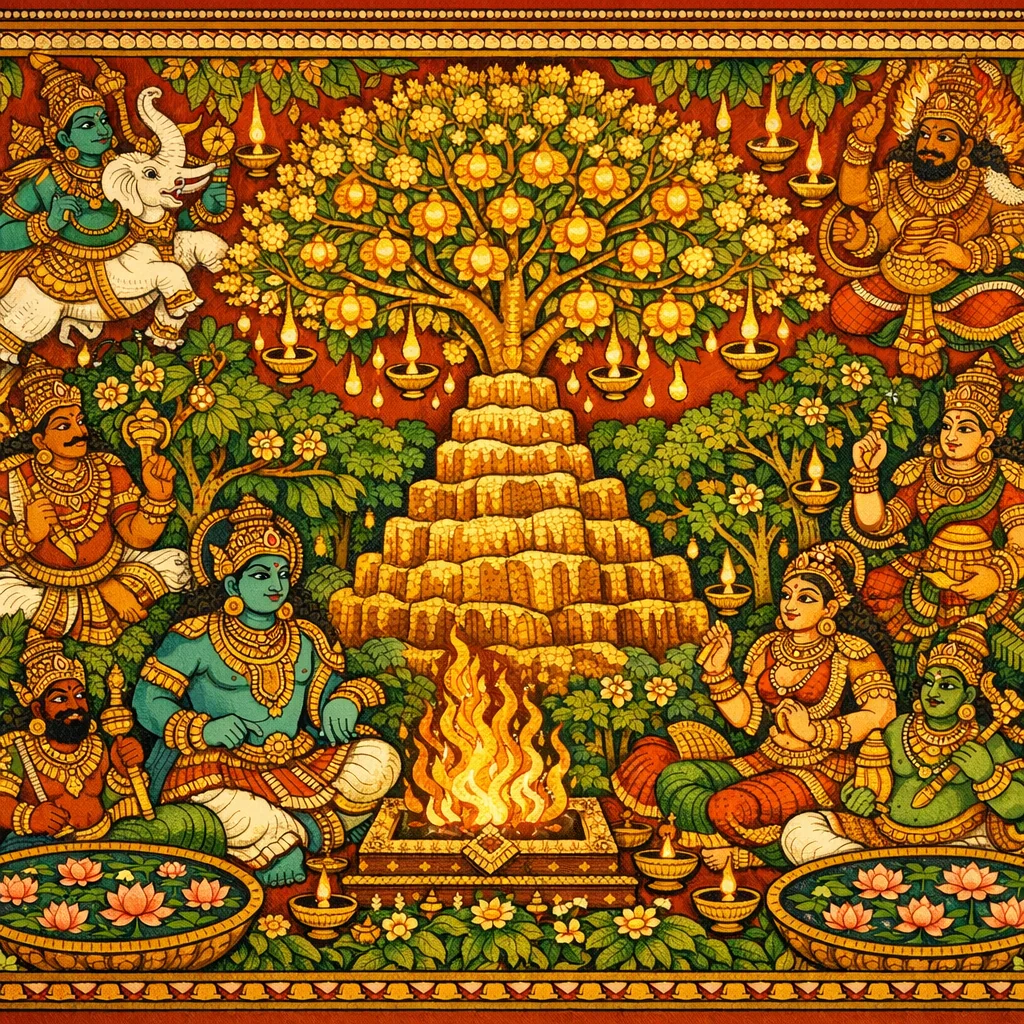
Adhyaya 85: Rite of Donating the ‘Mountain of Jaggery’ (Guḍa-parvata Dāna)
गुडपर्वतदानविधिः
Speaker: Īśvara (the Lord, speaking as the authoritative instructor)
In samvāda (dialogue) form, the Lord continues his instruction on meritorious gifts by introducing the “excellent” Guḍa-parvata, the donation of a “Mountain of Jaggery.” He first classifies donors by wealth measured in bhāra, then lays out the ritual sequence: invitations and worship; honoring the deities connected with the golden tree; reverencing sacred terrains (the Viṣkambha mountains, lakes, and forest deities); performing homa and a night vigil; and conducting Lokapāla adhivāsana patterned on the grain-mountain rite. He then gives a mantra arranged as cosmic superlatives—Janārdana, Sāmaveda, Mahādeva, Oṁ, Pārvatī—culminating in sugarcane juice as the supreme rasa, and petitions the Guḍa-parvata, linked with Pārvatī/Gaurī, for prosperity and peace. The chapter ends with its phalaśruti: honor from Gandharvas, exaltation in Gaurī’s world, and—after vast time—universal-style kingship over the seven continents, with longevity, health, and victory.
Key Concepts
Shlokas in Adhyaya 85
Verse 1
*ईश्वर उवाच अतः परं प्रवक्ष्यामि गुडपर्वतमुत्तमम् यत्प्रदानान्नरः स्वर्गम् आप्नोति सुरपूजितम् //
The Lord said: “Now I shall explain the excellent ‘mountain of jaggery’ (Guḍa-parvata). By donating it, a man attains heaven—honoured and worshipped by the gods.”
Verse 2
उत्तमो दशभिर्भारैर् मध्यमः पञ्चभिर्मतः त्रिभिर्भारैः कनिष्ठः स्यात् तदर्धेनाल्पवित्तवान् //
A man is regarded as ‘excellent’ if he possesses ten bhāras (loads/standard measures of wealth); ‘middling’ if he has five; ‘inferior’ if he has three; and one with half of that is deemed poor.
Verse 3
तद्वदामन्त्रणं पूजां हेमवृक्षसुरार्चनम् विष्कम्भपर्वतांस्तद्वत् सरांसि वनदेवताः //
Likewise, one should perform formal invitations and acts of worship, and also adore the deities at the “golden tree.” In the same manner, one should honour the Viṣkambha mountains, the lakes, and the deities presiding over the forests.
Verse 4
होमजागरणं तद्वल् लोकपालाधिवासनम् धान्यपर्वतवत् कुर्याद् इमं मन्त्रमुदीरयेत् //
In the same manner, one should arrange the homa and the night vigil. Likewise, one should perform the adhivāsana (ritual installation/invocation) of the Lokapālas, forming it like a “mountain of grains”; and then one should recite this mantra.
Verse 5
यथा देवेषु विश्वात्मा प्रवरो ऽयं जनार्दनः सामवेदस्तु वेदानां महादेवस्तु योगिनाम् //
Just as, among the gods, Janārdana—the Universal Self—is the foremost, so among the Vedas the Sāmaveda is foremost, and among yogins Mahādeva is foremost.
Verse 6
प्रणवः सर्वमन्त्राणां नारीणां पार्वती यथा तथा रसानां प्रवरः सदैवेक्षुरसो मतः //
Just as the Pranava (Om) is foremost among all mantras, and Pārvatī is foremost among women, so too—among all tastes and essences—the sugarcane juice is always regarded as the best.
Verse 7
मम तस्मात्परां लक्ष्मीं गुडपर्वत देहि वै यस्मात्सौभाग्यदायिन्या भ्राता त्वं गुडपर्वत निवासश्चापि पार्वत्यास् तस्माच्छान्तिं प्रयच्छ मे //
Therefore, O Guḍa-parvata, grant me the highest Lakṣmī—supreme prosperity; since you are called the “brother” of the bestower of good fortune (Goddess Pārvatī), and you are also her abode; therefore bestow peace upon me.
Verse 8
अनेन विधिना यस्तु दद्याद्गुडमयं गिरिम् पूज्यमानः स गन्धर्वैर् गौरीलोके महीयते //
Whoever, following this prescribed rite, gives a mountain made of jaggery—being honored by the Gandharvas—attains great eminence in Gaurī’s world, the realm of the Goddess.
Verse 9
ततः कल्पशतान्ते तु सप्तद्वीपाधिपो भवेत् आयुरारोग्यसम्पन्नः शत्रुभिश्चापराजितः //
Then, at the close of a hundred kalpas, he becomes the lord of the seven continents—endowed with long life and perfect health, and unconquered by enemies.
Frequently Asked Questions
Adhyaya 85 instructs the procedure and mantra for performing Guḍa-parvata dāna—donating a ‘mountain’ made of jaggery. It lays out eligibility by wealth (bhāra measures), the required worship sequence (āmantṛaṇa, pūjā, landscape-deity honors), homa and night vigil, and Lokapāla adhivāsana modeled on a grain-mountain rite. The chapter emphasizes that sweetness (sugarcane juice/jaggery) is ritually supreme and promises exaltation in Gaurī’s realm and long-term sovereignty as the fruit of correct performance.
This chapter is primarily Dharma—specifically Dāna-dharma and ritual procedure (vidhi) for a material offering. It touches cosmology and devotional theology through the mantra’s hierarchy (Janārdana, Oṁ, Sāmaveda, Mahādeva, Pārvatī/Gaurī) and through the phalaśruti (Gaurī-loka, Gandharvas, seven continents). It does not present Vastu-śāstra measurements or genealogical lists in these verses.
The comparisons create a chain of ‘foremost’ exemplars across domains—deity, scripture, yogic ideal, mantra, feminine archetype—culminating in ikṣu-rasa (sugarcane juice) as the supreme taste/essence. This rhetorical structure sacralizes sweetness and legitimizes jaggery as a high-potency ritual substance, making the Guḍa-parvata offering symbolically aligned with cosmic excellence.
The text promises divine-style honor: the donor is worshipped/esteemed, honored by Gandharvas, and attains eminence in Gaurī’s world. It further states that after a hundred kalpas the donor becomes lord of the seven continents (saptadvīpādhipa), endowed with longevity and perfect health, and remains unconquered by enemies.