Adhyaya 94: Iconographic Standards for the Navagrahas (Planetary Deities) and Celestial Portents
ग्रहप्रतिमालक्षणवर्णनम्
Speaker: Śiva
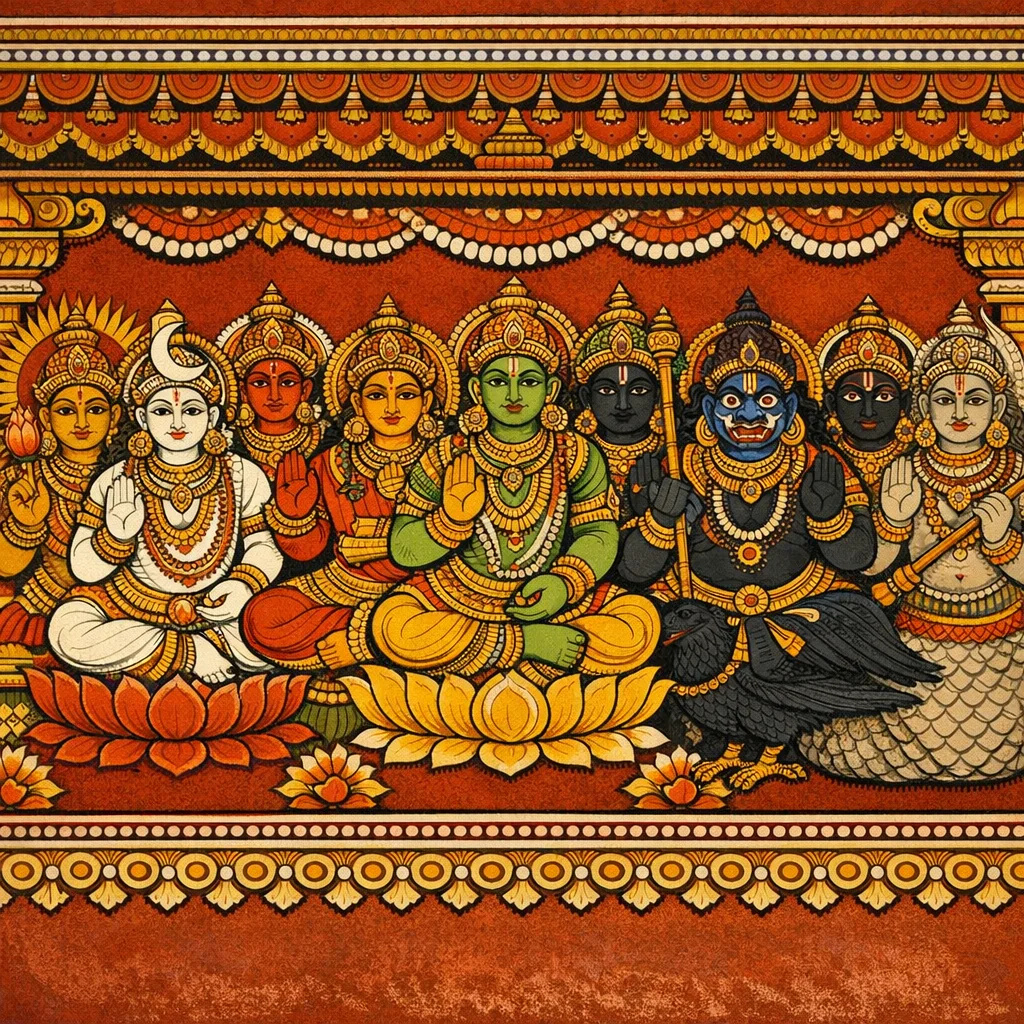
In direct instruction, Śiva sets out how each Graha is to be depicted in temple or ritual imagery. The order proceeds from Ravi (Sun) and Śaśin (Moon) through Mars and Mercury, then the two planetary preceptors Bṛhaspati and Śukra, followed by Śani, Rāhu, and the collective Ketus. Their defining marks are given—āsana (seat), varṇa (color), vāhana (mount), āyudha (weapon), and hasta-mudrā (hand-gesture). The teaching ends with a universal rule: all Grahas should be crowned, world-benefiting, and made to the standard height of 108 aṅgulas, measured by the patron’s own finger-breadths.
Key Concepts
Shlokas in Adhyaya 94
Verse 1
*शिव उवाच पद्मासनः पद्मकरः पद्मगर्भसमद्युतिः सप्ताश्वः सप्तरज्जुश्च द्विभुजः स्यात्सदा रविः //
Śiva said: Ravi (the Sun-god) should always be depicted seated upon a lotus, holding lotuses in his hands, radiant like the inner glow of a lotus-bud, drawn by seven horses and furnished with seven reins, and shown with two arms.
Verse 2
श्वेतः श्वेताम्बरधरः श्वेताश्वः श्वेतवाहनः गदापाणिर्द्विबाहुश्च कर्तव्यो वरदः शशी //
He should be fashioned with a white complexion, clad in white garments, associated with a white horse and a white vehicle; holding a mace in his hand, two-armed, and shown as the boon-giver, radiant like the moon.
Verse 3
रक्तमाल्याम्बरधरः शक्तिशूलगदाधरः चतुर्भुजः श्वेतरोमा वरदः स्याद् धरासुतः //
Dharāsuta should be depicted wearing a red garland and red garments, holding a spear (śakti), a trident, and a mace; four-armed, white-haired, and granting boons.
Verse 4
पीतमाल्याम्बरधरः कर्णिकारसमद्युतिः खड्गचर्मगदापाणिः सिंहस्थो वरदो बुधः //
He wears a yellow garland and yellow garments, shining like the karṇikāra flower. In his hands are a sword, a shield, and a mace; seated upon a lion, Budha the wise bestows boons.
Verse 5
देवदैत्यगुरू तद्वत् पीतश्वेतौ चतुर्भुजौ दण्डिनौ वरदौ कार्यौ साक्षसूत्रकमण्डलू //
Likewise, the preceptors of the gods and the daityas should be fashioned in yellow and white, four-armed, bearing a staff (daṇḍa), displaying the boon-giving gesture, and holding the sacred cord and the kamaṇḍalu (water-pot).
Verse 6
इन्द्रनीलद्युतिः शूली वरदो गृध्रवाहनः बाणबाणासनधरः कर्तव्यो ऽर्कसुतस् तथा //
Likewise, Śani—the son of Arka (the Sun)—should be fashioned with sapphire-like radiance, bearing a spear, granting boons, riding upon a vulture, and holding arrows and a bow.
Verse 7
करालवदनः खड्गचर्मशूली वरप्रदः नीलसिंहासनस्थश्च राहुरत्र प्रशस्यते //
Here Rāhu is praised as one with a fearsome face—bearing a sword, a hide (as a shield), and a trident—granting boons, and seated upon a blue throne.
Verse 8
धूम्रा द्विबाहवः सर्वे गदिनो विकृताननाः गृध्रासनगता नित्यं केतवः स्युर्वरप्रदाः //
All the Ketus are smoke-hued, two-armed, club-bearing, and fierce of face; ever seated upon a vulture-seat—yet they are said to be bestowers of boons.
Verse 9
सर्वे किरीटिनः कार्या ग्रहा लोकहितावहाः स्वाङ्गुलेनोच्छ्रिताः सर्वे शतमष्टोत्तरं सदा //
All the planetary deities (Grahas) should be fashioned wearing crowns, as benefactors of the world. Their images should always be made to a height of one hundred and eight (measures), reckoned by one’s own finger-breadths.
Frequently Asked Questions
It lays down iconographic rules for making Navagraha images—posture, complexion, clothing colors, mounts, weapons, and boon-giving gestures—ending with a standardized height rule that all Graha idols should be crowned and made to 108 aṅgulas (using one’s own finger-breadths as the measuring unit).
This chapter is primarily Vastu/Śilpa (iconography and measurements) rather than genealogy or Rajadharma. It functions as a practical architectural-art manual for temple/ritual installations of planetary deities (Navagraha), including Rahu and Ketu.