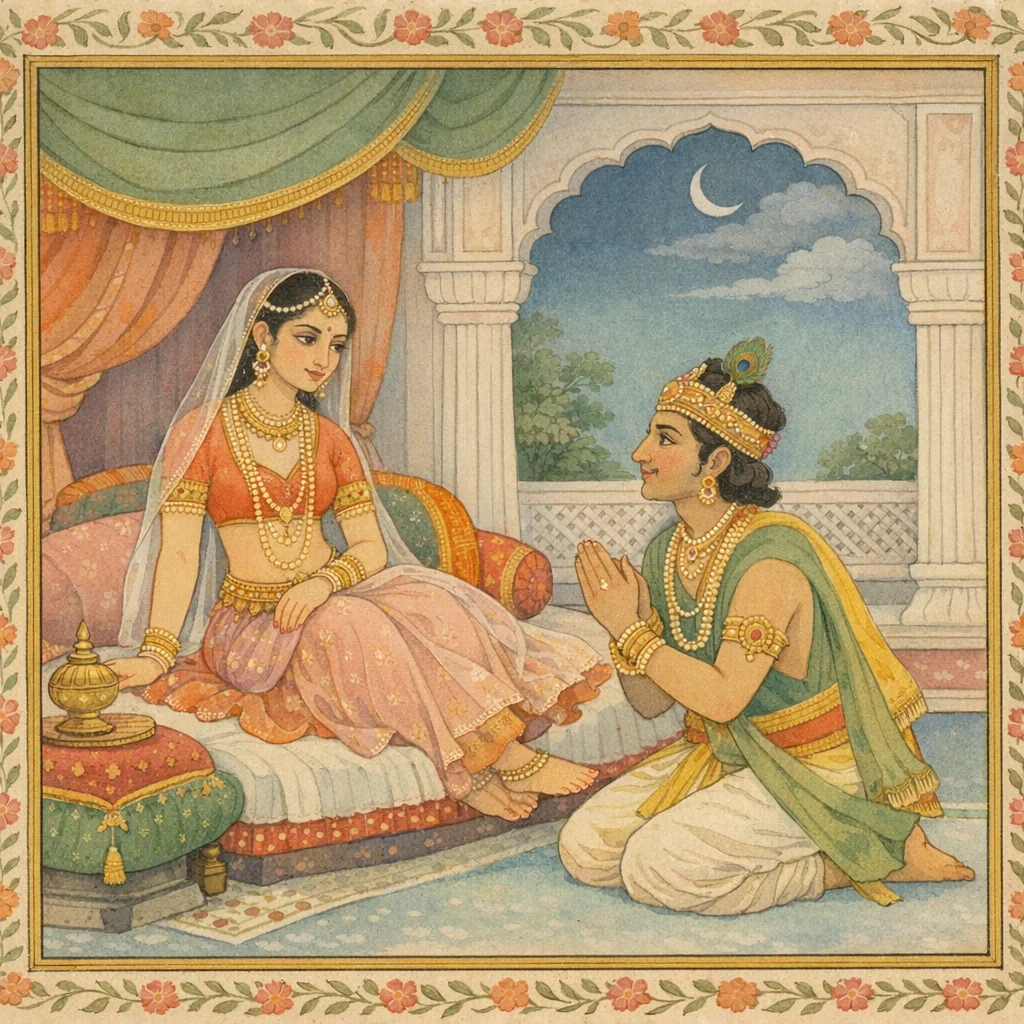
Adhyaya 45
Arjuna Honored in Indra’s Court; Lomāśa’s Audience; Indra’s Disclosure of Lineage and Mission (Book 3, Chapter 45)
Upa-parva: Indraloka-gamana / Divyāstra-adhigama Episode (Arjuna in Indra’s abode)
Vaiśaṃpāyana reports that the gods and Gandharvas, acting in accordance with Indra’s intent, honor Arjuna with formal offerings and conduct him into Purandara’s residence. Arjuna resides in his father’s abode, receiving instruction in major celestial weapons together with their saṃhāra (methods of withdrawal/containment), and is further directed to learn divine music, dance, and instruments from the Gandharva Citrasena, who is assigned as his companion. The wandering sage Lomāśa arrives to see Indra, observes Arjuna seated near Indra, and internally questions how a kṣatriya has attained such a station. Indra, discerning the thought, explains that Arjuna is not merely human: he is Indra’s son born to Kuntī, present for the purpose of acquiring weapons. Indra then identifies Kṛṣṇa (Hṛṣīkeśa) and Arjuna (Dhanaṃjaya) as the ancient ṛṣi-pair Nara–Nārāyaṇa associated with Badarī, linking their incarnation to the task of relieving Earth’s burden. Indra outlines the threat posed by the Nivātakavaca adversaries and states Arjuna’s capacity to counter them. Finally, Indra commissions Lomāśa to return to Kāmyaka forest to inform Yudhiṣṭhira not to worry—Arjuna will return soon, now properly trained—and advises pilgrimage and protective vigilance against dangers during forest wandering. Lomāśa assents and reaches Kāmyaka, where he finds Yudhiṣṭhira surrounded by ascetics and his brothers.
Chapter Arc: इन्द्र, स्वर्ग में अर्जुन के तेज और संयम को देखकर, गन्धर्वराज चित्रसेन को एकान्त में बुलाकर एक गुप्त कार्य सौंपते हैं—उर्वशी को अर्जुन के पास भेजना। → चित्रसेन उर्वशी के पास पहुँचकर अर्जुन के गुणों का वर्णन करता है—एकाकी रक्षक, प्रियंवद, मानयिता, और स्वर्गफल का अधिकारी। उर्वशी के भीतर आकर्षण जागता है; वह इन्द्र की आज्ञा और अपने मन के प्रणय—दोनों के बीच खिंचती है। → उर्वशी स्पष्ट स्वीकार करती है कि इन्द्र के नियोग और चित्रसेन के वर्णन से वह अर्जुन के गुणसमूह पर मोहित हो गई है और उसके पास जाने का निश्चय करती है। → चित्रसेन को अनुमति देकर उर्वशी कहती है कि वह स्वयं सुखपूर्वक अर्जुन के पास जाएगी; दूत का कार्य पूर्ण होता है और स्वर्ग की योजना आगे बढ़ती है। → उर्वशी का अर्जुन के समीप गमन—और अर्जुन की प्रतिक्रिया—अगले प्रसंग के लिए उत्कंठा छोड़ देती है।
Shlokas
Verse 1
/ हि आय न [छुक हि ० पजञज्चचत्वारिशो< ध्याय: चित्रसेन और उर्वशीका वार्तालाप वैशम्पायन उवाच आदावेवाथ त॑ शक्रश्नित्रसेनं रहो5ब्रवीत् । पार्थस्य चक्षुरुर्वश्यां सक्तं विज्ञाय वासव:,वैशम्पायनजी कहते हैं--जनमेजय! एक समय इन्द्रने अर्जुनके नेत्र उर्वशीके प्रति आसक्त जानकर चित्रसेन गन्धर्वको बुलाया और प्रथम ही एकान्तमें उनसे यह बात कही --
Vaiśampāyana said: “O Janamejaya, once Śakra (Indra), having perceived that Pārtha (Arjuna)’s gaze had become attached to Urvaśī, summoned the Gandharva Citrasena and, at the very outset, spoke to him in private about the matter.”
Verse 2
गन्धर्वराज गच्छाद्य प्रहितो5प्सरसां वराम् । उर्वशीं पुरुषव्याघप्र सोपातिष्ठतु फाल्गुनम्,“गन्धर्वराज! तुम मेरे भेजनेसे आज अप्सराओंमें श्रेष्ठ उर्वशीके पास जाओ। पुरुषश्रेष्ठ! तुम्हें वहाँ भेजनेका उद्देश्य यह है कि उर्वशी अर्जुनकी सेवामें उपस्थित हो
“O king of the Gandharvas, go today at my bidding to Urvaśī, the foremost of the Apsarases. O best of men, I send you so that Urvaśī may present herself and attend upon Phālguna (Arjuna).”
Verse 3
यथार्चितो गृहीतास्त्रो विद्यया मन्नियोगत: । तथा त्वया विधाततयं स्त्रीषु संगविशारद:,/ !/ +कि ५ // 4 (४ गा 'जैसे अस्त्रविद्या सीख लेनेके पश्चात् अर्जुनको मेरी आज्ञासे तुमने संगीतविद्याद्वारा सम्मानित किया है, उसी प्रकार वे स्त्रीसंगविशारद हो सकें, ऐसा प्रयत्न करो”
“Just as, at my command, you honored him through the lore of music after he had received his weapons and learned the science of arms, so too—being skilled in the ways of women—contrive that he may become adept in the company of women.”
Verse 4
एवमुक्तस्तथेत्युक्त्वा सो<नुज्ञां प्राप्प वासवात् | गन्धर्वराजो5प्सरसमभ्यगादुर्वशीं वराम्,इन्द्रके इस प्रकार कहनेपर “तथास्तु” कहकर उनसे आज्ञा ले गन्धर्वराज चित्रसेन सुन्दरी अप्सरा उर्वशीके पास गये
Thus addressed, he replied, “So be it.” Having obtained permission from Vāsava (Indra), the Gandharva-king Citraseṇa then approached the excellent Apsaras Urvaśī.
Verse 5
तां दृष्टवा विदितो हृष्ट: स्वागतेनार्चितस्तया । सुखासीन: सुखासीनां स्मितपूर्व वचो<ब्रवीत्,उससे मिलकर वे बहुत प्रसन्न हुए। उर्वशीने चित्रसेनको आया जान स्वागतपूर्वक उनका सत्कार किया। जब वे आरामसे बैठ गये, तब सुखपूर्वक सुन्दर आसनपर बैठी हुई उर्वशीसे मुसकराकर बोले--
Seeing her, he—now recognized—was delighted. She welcomed him with due hospitality and honored him. When he had seated himself comfortably, he smiled and spoke pleasantly to her as she too sat at ease on a fine seat.
Verse 6
विदितं ते<स्तु सुश्रोणि प्रहितो5हमिहागत: । त्रिदिवस्यैकराजेन त्वत्प्रसादाभिनन्दिना,'सुश्रोणि! तुम्हें मालूम होना चाहिये कि स्वर्गके एकमात्र सम्राट् इन्द्रने, जो तुम्हारे कृपाप्रसादका अभिनन्दन करते हैं, मुझे तुम्हारे पास भेजा है। उन्हींकी आज्ञासे मैं यहाँ आया हूँ
Vaiśaṃpāyana said: “O fair-hipped lady, let it be known to you: I have been dispatched and have come here by the command of the sole sovereign of heaven, Indra—who gratefully acknowledges the grace you have shown.”
Verse 7
यस्तु देवमनुष्येषु प्रर्यात: सहजैर्गुणै: । श्रिया शीलेन रूपेण व्रतेन च दमेन च । प्रख्यातो बलवीर्येण सम्मत: प्रतिभानवान्
Vaiśampāyana said: “But he who, among gods and men alike, is renowned for his innate virtues—endowed with prosperity, good conduct, and beauty; steadfast in vows and self-restraint; celebrated for strength and valor; esteemed by all and gifted with keen intelligence—(such a one is being described).”
Verse 8
वर्चस्वी तेजसा युक्त: क्षमावान् वीतमत्सर: । साड्रोपनिषदान वेदांश्ष॒तुराख्यानपञ्चमान्
Vaiśampāyana said: He was endowed with spiritual radiance and vigor, patient and forbearing, and free from envy. He had mastered the Vedas together with their subsidiary lore and the Upaniṣads, and he knew the traditional narratives as a fifth branch.
Verse 9
यो<थीते गुरुशुश्रूषां मेधां चाष्टगुणा श्रयाम् । ब्रह्मचर्येण दाक्ष्येण प्रसवैर्वयसापि च
Vaiśampāyana said: “He who has pursued devoted service to his teachers, and has taken refuge in keen intelligence endowed with eightfold excellence—supported as well by celibate discipline, practical competence, the maturity that comes through life’s stages, and even by age—(is fit for the intended responsibility).”
Verse 10
एको वै रक्षिता चैव त्रिदिवं मघवानिव । अकत्थनो मानयिता स्थूललक्ष्य: प्रियंवद:
Vaiśaṃpāyana said: “He was indeed a solitary protector—like Maghavān (Indra) guarding the heaven of the gods. Free from boastfulness, he honored others; straightforward in aim and plain to read, he spoke with pleasing words.”
Verse 11
सुहृदश्चान्नपानेन विविधेनाभिवर्षति । सत्यवाक् पूजितो वक्ता रूपवाननहंकृत:
Vaiśampāyana said: He showers his friends with varied food and drink; he is truthful in speech, honored as a speaker, handsome, and free from arrogance.
Verse 12
भक्तानुकम्पी कान्तश्न प्रियश्न स्थिरसंगर: । प्रार्थनीयैर्गुणगणैमहेन्द्रवरुणोपम:
Vaiśampāyana said: He was compassionate toward his devotees and dependents, moderate in his eating, and steadfast in battle. By a multitude of admirable qualities he was worthy to be sought and honored, resembling Mahendra and Varuṇa in excellence.
Verse 13
विदितस्ते<र्जुनो वीर: स स्वर्गफलमाप्नुयात् । त्वं तु शक्राभ्यनुज्ञाता तस्य पादान्तिकं व्रज । तदेवं कुरु कल्याणि प्रसन्नस्त्वां धनंजय:
Vaiśaṃpāyana said: “Arjuna, the heroic one, is already known to you; he will attain the fruit of heaven. But you, having been granted permission by Śakra (Indra), go to his very feet. So do this, auspicious lady: Dhanaṃjaya (Arjuna) will be pleased with you.”
Verse 14
'सुन्दरी! जो अपने स्वाभाविक सदगुण, श्री, शील (स्वभाव), मनोहर रूप, उत्तम व्रत और इन्द्रियसंयमके कारण देवताओं तथा मनुष्योंमें विख्यात हैं। बल और पराक्रमके द्वारा जिनकी सर्वत्र प्रसिद्धि है; जो सबके प्रिय, प्रतिभाशाली, वर्चस्वी, तेजस्वी, क्षमाशील तथा ईर्ष्यारहित हैं, जिन्होंने छहों अंगोंसहित चारों वेदों, उपनिषदों और पंचम वेद (इतिहास- पुराण)-का अध्ययन किया है। जिन्हें गुरुशुश्रूषा तथा आठ गुणोंसे- युक्त मेधाशक्ति प्राप्त है, जो ब्रह्मचर्यपालन, कार्य-दक्षता, संतान तथा युवावस्थाके द्वारा अकेले ही देवराज इन्द्रकी भाँति स्वर्गलोककी रक्षा करनेमें समर्थ हैं, जो अपने मुँहसे अपने गुणोंकी कभी प्रशंसा नहीं करते, दूसरोंको सम्मान देते, अत्यन्त सूक्ष्म विषयको भी स्थूलकी भाँति शीघ्र ही समझ लेते और सबसे प्रिय वचन बोलते हैं, जो अपने सुहृदोंके लिये नाना प्रकारके अन्न-पानकी वर्षा करते और सदा सत्य बोलते हैं, जिनका सर्वत्र आदर होता है, जो अच्छे वक्ता तथा मनोहर रूपवाले होकर भी अहंकारशून्य हैं, जिनके हृदयमें अपने प्रेमी भक्तोंके लिये अत्यन्त कृपा भरी हुई है, जो कान्तिमान्, प्रिय तथा प्रतिज्ञापालन एवं युद्धमें स्थिरतापूर्वक डटे रहनेवाले हैं, जिनके सदगुणोंकी दूसरे लोग स्पृहा रखते हैं और उन्हीं गुणोंके कारण जो महेन्द्र और वरुणके समान आदरणीय माने जाते हैं, उन वीरवर अर्जुनको तुम अच्छी तरह जानती हो। उन्हें स्वर्गमें आनेका फल अवश्य मिलना चाहिये। तुम देवराजकी आज्ञाके अनुसार आज अर्जुनके चरणोंके समीप जाओ। कल्याणि! तुम ऐसा प्रयत्न करो, जिससे कुन्तीकुमार धनंजय तुमपर प्रसन्न हों” ।। एवमुक्ता स्मितं कृत्वा सम्मान बहु मन््य च | प्रत्युवाचोर्वशी प्रीता चित्रसेनमनिन्दिता,चित्रसेनके ऐसा कहनेपर उर्वशीके अधरोंपर मुसकान दौड़ गयी। उसने इस आदेशको अपने लिये बड़ा सम्मान समझा। अनिन्द्य सुन्दरी उर्वशी उस समय अत्यन्त प्रसन्न होकर चित्रसेनसे इस प्रकार बोली--
Vaiśampāyana said: “Fair one! You know Arjuna well—the hero renowned among gods and men for his innate virtues: prosperity, noble character, pleasing beauty, excellent vows, and mastery over the senses. His fame, born of strength and valor, is everywhere. He is beloved by all, gifted, radiant in influence, brilliant, patient, and free from envy. He has studied the four Vedas together with their six auxiliaries, the Upaniṣads, and the ‘fifth Veda’—the Itihāsa and Purāṇa. Through service to his teachers and the eightfold excellences, he has attained keen intelligence. By his celibate discipline, efficiency in action, the vigor of youth, and the strength of lineage, he is able—like Indra himself—to safeguard the realm of heaven. He never praises his own qualities; he honors others, grasps even subtle matters swiftly as though they were obvious, and speaks words dear to everyone. For his friends he provides abundant food and drink, and he always speaks truth. He is respected everywhere; though eloquent and handsome, he is without pride. His heart is filled with compassion toward those who love him devotedly. He is radiant, dear, faithful to his vows, and steadfast in battle. Others long for his virtues, and by those virtues he is honored like Mahendra and Varuṇa. Such a man deserves the reward of coming to heaven. Therefore, by the command of the king of the gods, go today to Arjuna’s feet. Auspicious one, strive so that Dhanañjaya, Kuntī’s son, may be pleased with you.” When Citrasena spoke thus, Urvaśī’s lips curved into a smile. Taking the command as a great honor, the blameless beauty Urvaśī, delighted, replied to Citrasena as follows.
Verse 15
यस्त्वस्य कथित: सत्यो गुणोद्देशस्त्वया मम । त॑ श्रुत्वाव्यथयं पुंसो वृणुयां किमतो<र्जुनम्,“गन्धर्वराज! तुमने जो अर्जुनके लेशमात्र गुणोंका मेरे सामने वर्णन किया है, वह सब सत्य है। मैं दूसरे लोगोंके मुखसे भी उनकी प्रशंसा सुनकर उनके लिये व्यथित हो उठी हूँ। अतः इससे अधिक मैं अर्जुनका क्या वरण करूँ?”
Vaiśaṃpāyana said: “O king of the Gandharvas, the brief account of Arjuna’s virtues that you have related to me is entirely true. Hearing his praise even from the mouths of others, I am moved with anxious concern for that man. Therefore, what more is there for me to choose in Arjuna beyond this?”
Verse 16
महेन्द्रस्य नियोगेन त्वत्त: सम्प्रणयेन च । तस्य चाहं गुणौघेन फाल्गुने जातमन्मथा । गच्छ त्वं हि यथाकाममागमिष्याम्यहं सुखम्,“महेन्द्रकी आज्ञासे, तुम्हारे प्रेमपूर्ण बर्तावसे तथा अर्जुनके सदगुणसमुदायसे मेरा उनके प्रति कामभाव हो गया है। अतः: अब तुम जाओ। मैं इच्छानुसार सुखपूर्वक उनके स्थानपर यथासमय आऊँगी”
Vaiśampāyana said: “By Mahendra’s command, by your affectionate mediation, and by the flood of Phālguna’s virtues, desire has arisen in me for him. Therefore go now as you please; I shall come to him in due course, at my own will, and in comfort.”
Verse 45
इति श्रीमहाभारते वनपर्वणि इन्द्रलोकाभिगमनपर्वणि चित्रसेनोर्वशीसंवादे पज्चचत्वारिंशो5 ध्याय:,इस प्रकार श्रीमहाभारत वनपर्वके अन्तर्गत इन्द्रजोकाथिगमनपर्वमें चित्रयेन- उर्वशीसंवादविषयक पैंतालीसवाँ अध्याय पूरा हुआ
Thus, in the Śrī Mahābhārata, within the Vana Parva, in the section concerning the journey to Indra’s world, the dialogue between Citraseṇa and Urvaśī concludes; this is the forty-fifth chapter. The colophon marks the formal close of the episode, signaling a transition in the narrative from the completed exchange to what follows, and reminding the listener that the text is carefully organized into parvans and sub-sections to frame its moral and narrative progression.
Frequently Asked Questions
The chapter implicitly addresses the ethics of capability: whether a leader may responsibly enter high-stakes conflict without adequate preparation. Indra’s counsel indicates that confronting formidable figures requires disciplined training and controlled power, not mere valor.
Arjuna’s role is framed within a larger cosmic and historical order: personal effort (training, discipline) operates inside a providential mission (bhūmer bhāra-avataraṇa), integrating agency with transcendental purpose.
No explicit phalaśruti formula appears here; the meta-function is achieved through Indra’s directive and reassurance to Yudhiṣṭhira, which positions the episode as narrative validation that ethical success in future engagements depends on prior qualification and guided instruction.