Adhyaya 319
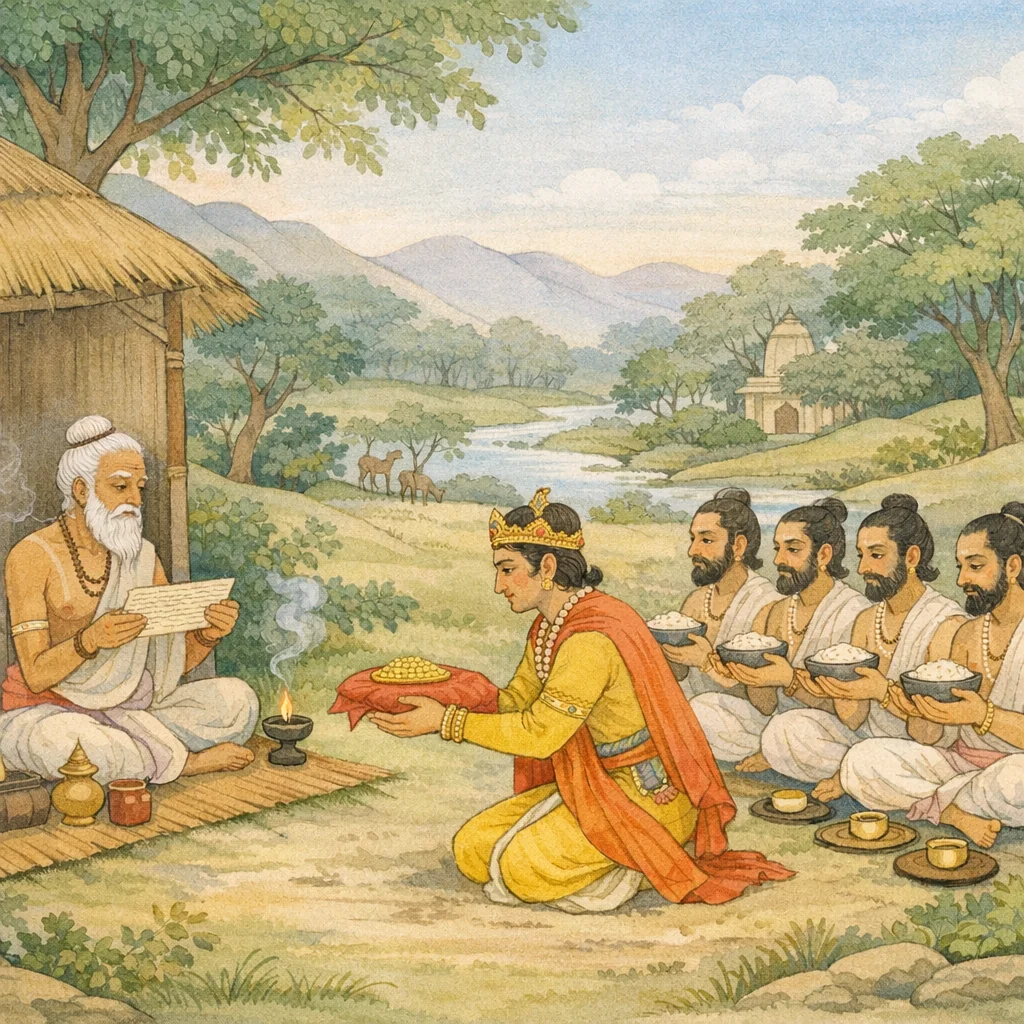
Chapter Arc: The narrator proclaims the vastness and sanctity of the Vana Parva’s Aranyaka portion, declaring that merely hearing it loosens the knots of great sin. → The promise intensifies: whatever a pure-minded listener—woman or man—prays for while hearing this Aranyaka, that desire is said to be granted without doubt; the text then turns from promise to prescription, outlining the proper acts of honoring Brahmanas and the reciter. → The ritual peak is named with specificity: feed Brahmanas with payasa and other offerings, honor them with garments, cows, gold, jewels; and above all, gift the Mahabharata-reciter a special kapila cow—bronze-milking vessel, silver hooves, golden horns, adorned—explicitly ‘for the satisfaction of the sons of Pandu.’ → With Brahmanas pleased, the cosmos itself is portrayed as pleased—Brahma, Vishnu, Rudra, Indra, the hosts of gods, beings, sages, goddesses, and the Pitrs—sealing the chapter’s assurance that the listener attains all desired ends and ultimately heaven.
Shlokas
Verse 1
वनपर्वकी सम्पूर्ण शलोक-संख्या १२२७६॥- #++ २० ()) #अअज अप वनपव्व-श्रवण-महिमा इदमारण्यकं श्रुत्वा महापापै: प्रमुच्यते । अधनो धनमाप्रोति पुत्रपौत्रसमन्वित:,इस वनपर्वको सुनकर मनुष्य बड़े-बड़े पापोंसे मुक्त हो जाता है, निर्धन धन पाता है और पुत्र-पौत्रोंसे सम्पन्न होता है
Vaiśampāyana said: By hearing this Āraṇyaka (the Vana Parva), a person is released even from great sins. One who is poor attains wealth, and one becomes blessed with children and grandchildren. Thus the text proclaims the purifying and auspicious merit of listening to the Vana Parva.
Verse 2
य॑य॑ प्रार्थयते काम॑ त॑ त॑ प्राप्नोत्यसंशयम् । नारी वा पुरुषो वापि शुचि: प्रयतमानस:,वह जिस-जिस मनोवाञ्छित वस्तुके लिये प्रार्थना करता है, उसे निश्चय ही पा लेता है। स्त्री हो या पुरुष; शुद्ध एवं एकाग्रचित्त होकर इस वनपर्वका श्रवण अथवा पाठ करनेपर वस्त्र, गौ, सुवर्ण तथा रत्नोंके दानसे ब्राह्मणोंका सम्मान करके उन्हें खीर आदिका भोजन करावे
Vaiśaṃpāyana said: Whatever desired object a person prays for, that very object he or she attains without doubt. Whether woman or man—if one is pure and disciplined in mind—the merit of hearing or reciting this Vana-parvan is declared to be unfailing, bringing the fruits associated with pious giving and honoring the worthy.
Verse 3
आरण्यके श्रुते5धीते ब्राह्मणान् पायसादिभि: । भोजयेद् वस्त्रगोस्वर्णदानै रत्नै: प्रपृूजितान्,वह जिस-जिस मनोवाञ्छित वस्तुके लिये प्रार्थना करता है, उसे निश्चय ही पा लेता है। स्त्री हो या पुरुष; शुद्ध एवं एकाग्रचित्त होकर इस वनपर्वका श्रवण अथवा पाठ करनेपर वस्त्र, गौ, सुवर्ण तथा रत्नोंके दानसे ब्राह्मणोंका सम्मान करके उन्हें खीर आदिका भोजन करावे
Vaiśampāyana said: “When the Āraṇyaka portion has been heard or duly studied, one should feed the brāhmaṇas with rice-milk and other offerings, honoring them with gifts of garments, cows, gold, and jewels. By such pure and focused recitation or listening—followed by respectful giving and hospitality—whatever desired object a person prays for is surely obtained, whether one is a woman or a man.”
Verse 4
ब्राह्मणेषु च तुष्टेषु संतुष्टा: पाण्डुनन्दना: । ब्रह्मा विष्णुस्तथा रुद्र: शक्रो देवगणास्तथा,ब्राह्मणोंके संतुष्ट होनेपर पाण्डव, ब्रह्मा, विष्णु, रुद्र, इन्द्र, देवगण, भूतगण, मुनिगण, देवियाँ तथा पितृगण--ये सभी संतुष्ट होते हैं। अपनी शक्तिके अनुसार अन्न-वस्त्र और आभूषण देकर वाचककी पूजा करनी चाहिये
Vaiśampāyana said: When the Brāhmaṇas are pleased, the sons of Pāṇḍu are pleased; so too are Brahmā, Viṣṇu, Rudra, Śakra (Indra), and the hosts of gods. Thus the dharmic teaching is declared: to honor and satisfy learned Brāhmaṇas—through fitting gifts and reverent worship—brings harmony and auspiciousness, for it is held to please the divine order itself.
Verse 5
भूतानि मुनयो देव्यस्तथा पितृगणाश्च ये । वाचकं पूजयेच्छक्त्या वस्त्रान्नै: स्वर्णभूषणै:,ब्राह्मणोंके संतुष्ट होनेपर पाण्डव, ब्रह्मा, विष्णु, रुद्र, इन्द्र, देवगण, भूतगण, मुनिगण, देवियाँ तथा पितृगण--ये सभी संतुष्ट होते हैं। अपनी शक्तिके अनुसार अन्न-वस्त्र और आभूषण देकर वाचककी पूजा करनी चाहिये
Vaiśampāyana said: “All those—spirits and elemental beings, sages, goddesses, and the hosts of the Pitṛs—are gratified when the Brāhmaṇas are gratified. Therefore, according to one’s capacity, one should honor the reciter of sacred lore with offerings of food and clothing, and with ornaments of gold.”
Verse 6
विशेषतस्तु कपिला देया तु जयपाठके । कांस्यदोहा रौप्यखुरा स्वर्णशृज्जी सभूषणा । पाण्डूनां परितोषार्थ दद्यादन्नं द्विजातये,महाभारतके वाचकको विशेषत: एक कपिला गौ देनी चाहिये। उसके साथ काँसेका एक दुग्धपात्र होना चाहिये। गायके खुरोंमें चाँदी और सींगोंमें सोना मढ़ा दे। उसे अन्य आभूषणोंसे भी विभूषित करे। पाण्डवोंके संतोषके लिये ब्राह्मणोंको अन्नदान करे
Vaiśampāyana said: In particular, a tawny kapilā cow should be given to the reciter of the Jaya. She should be accompanied by a bronze milking vessel; her hooves should be plated with silver and her horns with gold, and she should be adorned with other ornaments as well. For the satisfaction of the Pāṇḍavas, one should also give food in charity to the twice-born (Brāhmaṇa) recipients.
Verse 7
आरण्यकाख्यमाख्यानं शृणुयाद् यो नरोत्तम: । स सर्वकाममाप्रोति पुन: स्वर्गतिमाप्तुयात्,जो नरश्रेष्ठ इस वनपर्वकी कथाको सुनता है, वह सम्पूर्ण कामनाओंको प्राप्त कर लेता है एवं शरीरका अन्त होनेपर स्वर्गलोकमें जाता है
Vaiśampāyana said: “That best of men who listens to this narrative called the ‘Āraṇyaka’ attains the fulfillment of all desired aims; and when life ends, he reaches the heavenly path once again.”
Verse 87
७ दक्षिण भारतीय पाठसे लिये गये छलोक-- ८२ (४) ५
Vaiśampāyana said: “Seven verses have been taken from the Southern (Dakṣiṇa) recension—(noted here as) 82 (4) 5.” This is an editorial notice indicating a textual variant or insertion from the Southern manuscript tradition, rather than a narrative utterance advancing the story.
Verse 12988
हि (हुक अप आ अपा5 वनपर्वकी श्लोक-संख्या अनुष्टप् छऊद्द (अन्य बढ़े छन््द ) बड़े छन्दोंका ३२ अक्षरोंक गद्य. कुल योग अनुष्टुप् मानकर गिननेपर उत्तर भारतीय पाठसे लिये गये श्लोक -- १०९३७ (७८५ ) ५०८० ।« १७९१
The provided line is not a complete Mahābhārata verse; it appears to be an editorial/metrical note from the Gītā Press apparatus rather than narrative śloka text. With only the particle “hi” (“indeed/for”), no coherent translation of the intended passage can be produced.