Adhyaya 166
समुद्रदर्शनं दैत्यपुरोपगमनं च (Ocean Vision and Approach to the Daitya City)
Upa-parva: Nivātakavaca-Daityāḥ (Arjuna’s celestial campaign and engagement near the Daitya city)
Arjuna reports that, while being praised by great sages, he beholds the immense, imperishable ocean—its foam, towering waves likened to moving mountains, and countless vessels laden with jewels. Marine beings (timiṅgila, turtles, makaras) and submerged conches appear in vast number, and gem-clusters drift amid strong, whirling winds, establishing a cosmographic tableau of scale and wonder. Passing beyond this high-velocity seascape, Arjuna sights a Daitya city crowded with Dānavas, near the domain associated with the Nivātakavaca. Mātali descends swiftly and advances with a thunderous chariot-sound, which the Dānavas misinterpret as the approach of the lord of the gods; they become alarmed, take up varied weapons, close the gates, and organize defenses. Arjuna then blows his great conch Devadatta, producing a reverberation that startles even formidable beings; the Nivātakavacas emerge in large numbers, armored and armed. Movement and counter-movement intensify, marine life is disturbed by the great noise, and the Dānavas launch a massed arrow-assault. A tumultuous, severe engagement begins, drawing assemblies of divine and semi-divine witnesses who praise Arjuna in victory-seeking tones, framing the confrontation as a formally observed trial of prowess and resolve rather than a private quarrel.
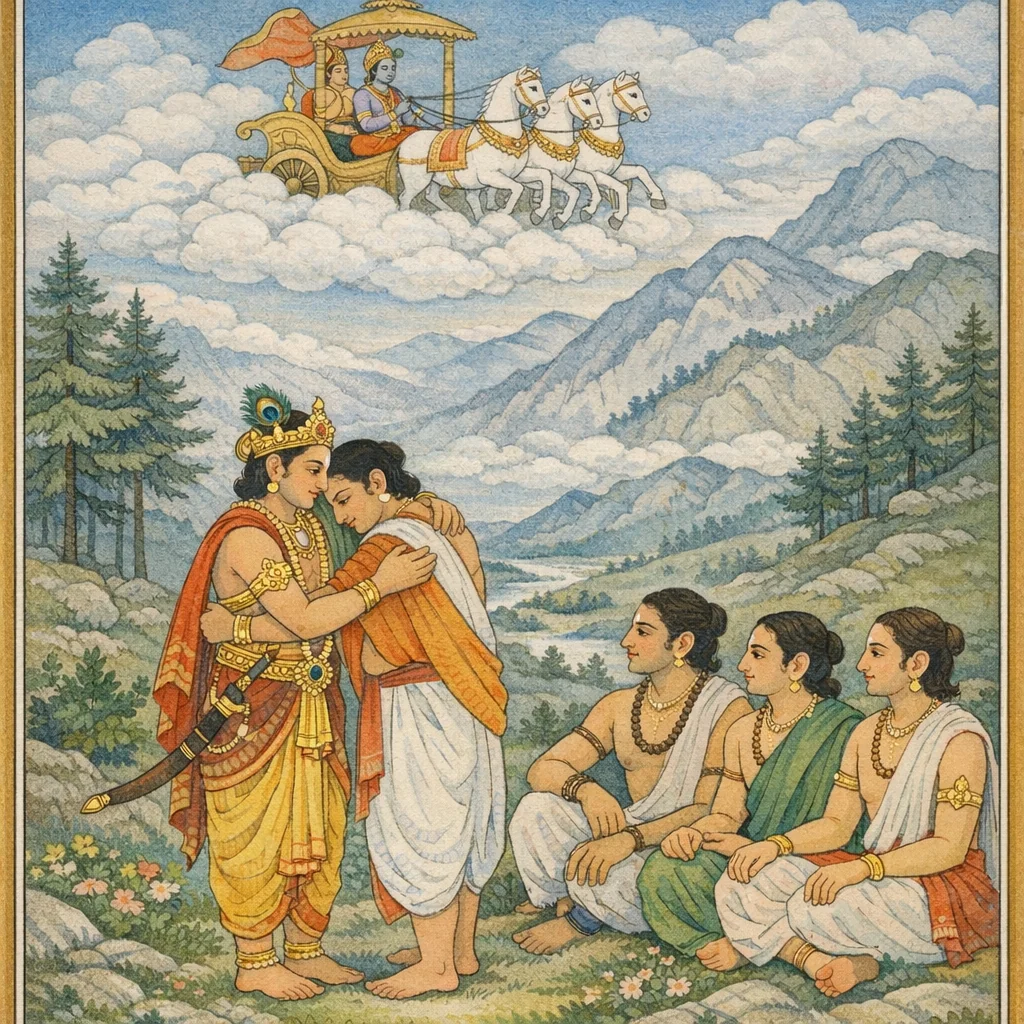
Chapter Arc: स्वर्ग-यात्रा और असुर-वध के बाद दिव्य रथ पर आरूढ़ किरीटधारी अर्जुन गन्धमादन पर्वत की ओर उतरता है—आकाश को प्रकाशित करता हुआ मातलि-चालित रथ मानो मेघों में धधकती महोल्का हो। → पाण्डवों के मन में उत्कंठा और आशंका साथ-साथ उठती है—अर्जुन क्या वरदान और दिव्यास्त्र लेकर लौटा है, और क्या वह वही अर्जुन है जो तपस्या को गया था? दिव्य तेज, नये आभूषण, और इन्द्र-सम वैभव उसके आगमन को असाधारण बना देते हैं। → अर्जुन का धर्मराज युधिष्ठिर को प्रणाम और भाइयों से पुनर्मिलन—समागतों का ‘परम प्रहर्ष’—यही अध्याय का शिखर है; स्वर्ग-प्रवास और देवताओं की प्रसन्नता का संक्षिप्त वृत्तान्त भी यहीं उद्घाटित होता है। → मातलि पाण्डवों का अभिनन्दन कर पिता-वत कर्तव्य-शिक्षा देता है और फिर अपने अनुपम, कान्तिमान रथ सहित लौट जाता है; अर्जुन अपने भाइयों के साथ आश्रम-आवास में विश्राम करता है। → अर्जुन के स्वर्ग-प्रवास से प्राप्त सामर्थ्य और दिव्यास्त्र अब वन-जीवन के आगामी संकटों में कैसे निर्णायक बनेंगे—यह संकेत देकर कथा आगे के संघर्षों की ओर मुड़ती है।
Shlokas
Verse 1
हि मय न () है 7 (निवातकवचयुद्धपर्व) पजञ्चषष्ट्यधिकशततमो< ध्याय: अर्जुनका गन्धमादन पर्वतपर आकर अपने भाइयोंसे मिलना वैशम्पायन उवाच ततः कदाचिटद्धरिसम्प्रयुक्तं महेन्द्रवाहं सहसोपयातम् । विद्युत्प्रभं प्रेक्ष्य महारथानां हर्षोडर्जुनं चिन्तयतां बभूव,वैशम्पायनजी कहते हैं--जनमेजय! तदनन्तर किसी समय हरे रंगके घोड़ोंसे जुता हुआ देवराज इन्द्रका रथ सहसा आकाशमें प्रकट हुआ, मानो बिजली चमक उठी हो। उसे देखकर अर्जुनका चिन्तन करते हुए महारथी पाण्डवोंको बड़ा हर्ष हुआ
Vaiśampāyana said: Then, at a certain time, Indra’s chariot—yoked with tawny-green horses—suddenly appeared in the sky, shining like a flash of lightning. Seeing that radiant car, the great chariot-warriors (the Pāṇḍavas), their minds fixed on Arjuna, were filled with joy.
Verse 2
स दीप्यमान: सहसान्तरिक्ष॑ प्रकाशयन् मातलिसंगृहीत: । बभौ महोल्केव घनान्तरस्था शिखेव चाग्नेज्वलिता विधूमा,उस रथका संचालन मातलि कर रहे थे। वह दीप्तिमान् रथ सहसा अन्तरिक्षलोकको प्रकाशित करता हुआ इस प्रकार सुशोभित होने लगा, मानो बादलोंके भीतर बड़ी भारी उल्का प्रकट हुई हो अथवा अग्निकी धूमरहित ज्वाला प्रज्वलित हो उठी हो
Vaiśaṃpāyana said: Guided by Mātali, the radiant chariot suddenly lit up the mid-air, shining forth in splendor—like a great meteor appearing within the clouds, or like a smokeless flame of fire flaring up.
Verse 3
तमास्थित: संददृशे किरीटी स्रग्वी नवान्याभरणानि बिश्रत् । धनंजयो वज्रधरप्रभाव: श्रिया ज्वलन् पर्वतमाजगाम,उस दिव्य रथपर बैठे हुए किरीटधारी अर्जुन स्पष्ट दिखायी देने लगे। उनके कण्ठमें दिव्य हार शोभा पा रहा था और उन्होंने स्वर्गलोकके नूतन आभूषण धारण कर रखे थे। उस समय धनंजयका प्रभाव वज्रधारी इन्द्रके समान जान पड़ता था। वे अपनी दिव्य कान्तिसे प्रकाशित होते हुए गन्धमादन पर्वतपर आ पहुँचे
Vaiśampāyana said: Seated upon that divine chariot, the diadem-crowned Arjuna was clearly seen—garlanded, wearing new celestial ornaments. Dhanaṃjaya’s presence seemed like that of Indra the wielder of the thunderbolt; blazing with auspicious splendor, he arrived at Mount Gandhamādana.
Verse 4
स शैलमासाद्य किरीटमाली महेन्द्रवाहादवरुह्म तस्मात् । धौम्यस्य पादावभिवाद्य धीमा- नजातशत्रोस्तदनन्तरं च,पर्वतपर पहुँचकर बुद्धिमान् किरीटधारी अर्जुन देवराज इन्द्रके उस दिव्य रथसे उतर पड़े। उस समय सबसे पहले उन्होंने महर्षि धौम्यके दोनों चरणोंमें मस्तक झुकाया। तदनन्तर अजातशत्रु युधिष्ठिर तथा भीमसेनके चरणोंमें प्रणाम किया। इसके बाद नकुल और सहदेवने आकर अर्जुनको प्रणाम किया तत्पश्चात् द्रौपदीसे मिलकर अर्जुनने उसे बहुत आश्वासन दिया और अपने भाई युधिष्ठिरके समीप आकर वे विनीत भावसे खड़े हो गये
Having reached the mountain, the diademed Arjuna—wise and self-controlled—alighted there from Indra’s divine chariot. First he bowed his head at the feet of the sage Dhaumya; then, immediately after, he paid homage to Ajātaśatru (Yudhiṣṭhira) as well.
Verse 5
वृकोदरस्यापि च वन्द्यपादौ माद्रीसुता भ्यामभिवादितश्च । समेत्य कृष्णां परिसान्त्व्य चैनां प्रह्मो$भवद् भ्रातुरुपह्दरे सः,पर्वतपर पहुँचकर बुद्धिमान् किरीटधारी अर्जुन देवराज इन्द्रके उस दिव्य रथसे उतर पड़े। उस समय सबसे पहले उन्होंने महर्षि धौम्यके दोनों चरणोंमें मस्तक झुकाया। तदनन्तर अजातशत्रु युधिष्ठिर तथा भीमसेनके चरणोंमें प्रणाम किया। इसके बाद नकुल और सहदेवने आकर अर्जुनको प्रणाम किया तत्पश्चात् द्रौपदीसे मिलकर अर्जुनने उसे बहुत आश्वासन दिया और अपने भाई युधिष्ठिरके समीप आकर वे विनीत भावसे खड़े हो गये
Vaiśaṃpāyana said: Arjuna—whose conduct was worthy of reverence—was also saluted by Mādrī’s two sons (Nakula and Sahadeva). Meeting Kṛṣṇā (Draupadī), he consoled her with gentle reassurance; then, coming near his elder brother, he stood by Yudhiṣṭhira with humility and deference.
Verse 6
स्वर्गसे लौटकर अर्जुन धर्मराजको प्रणाम कर रहे हैं बभूव तेषां परम: प्रहर्ष- स्तेनाप्रमेयेण समागतानाम् । स चापि तानू प्रेक्ष्य किरीटमाली ननन्द राजानमभिप्रशंसन्,अप्रमेय वीर अर्जुनसे मिलकर सब पाण्डवोंको बड़ा हर्ष हुआ। अर्जुन भी उन सबसे मिलकर बड़े प्रसन्न हुए तथा राजा युधिष्ठिरकी भूरि-भूरि प्रशंसा करने लगे
Vaiśampāyana said: When they were reunited with the immeasurable hero (Arjuna), the Pāṇḍavas were filled with the highest joy. And Arjuna too, the diadem-wearing warrior, on seeing them, rejoiced and repeatedly praised the king (Yudhiṣṭhira).
Verse 7
यमास्थित: सप्त जघान पूगान् दिते: सुतानां नमुचेर्निहन्ता । तमिन्द्रवाहं समुपेत्य पार्था: प्रदक्षिणं चक्कुरदीनसत्त्वा:,नमुचिनाशक इन्द्रने जिसपर बैठकर दैत्योंके सात यूथोंका संहार किया था, उस इन्द्ररथके समीप जाकर उदार हृदयवाले कुन्तीपुत्रोंने उसकी परिक्रमा की
Vaiśampāyana said: Mounted upon that chariot by which Indra—the slayer of Namuci, son of Diti—had destroyed seven companies of Dānava foes, the Pāṇḍavas approached the famed vehicle of Indra and, with undaunted hearts and noble intent, circumambulated it in reverent acknowledgment of divine protection and righteous power.
Verse 8
ते मातलेश्वक्रुरतीव हृष्टा: सत्कारमग्रयं सुरराजतुल्यम् । सर्वान् यथावच्च दिवौकसस्ते पप्रच्छुरेनं कुरुराजपुत्रा:,साथ ही, उन्होंने अत्यन्त हर्षमें भरकर मातलिका देवराज इन्द्रके समान सर्वोत्तम विधिसे सत्कार किया। इसके बाद उन पाण्डवोंने मातलिसे सम्पूर्ण देवताओंका यथावत् कुशल-समाचार पूछा
Vaiśampāyana said: Overjoyed, the sons of the Kuru king—the Pāṇḍavas—honored Mātali with the finest hospitality, as one would honor Indra himself. Then, in due and proper manner, they asked him about the welfare of all the gods.
Verse 9
तानप्यसौ मातलिरभ्यनन्दत् पितेव पुत्राननुशिष्य पार्थान् । ययौ रथेनाप्रतिमप्रभेण पुनः सकाशं त्रिदिवेश्वरस्य
Vaiśampāyana said: Mātali too warmly commended them; and, like a father instructing his sons, he counselled the Pārthas. Then, mounting his chariot of incomparable radiance, he departed again to the presence of the Lord of the three worlds.
Verse 10
मातलिने भी पाण्डवोंका अभिनन्दन किया और जैसे पिता पुत्रको उपदेश देता है, उसी प्रकार पाण्डवोंको कर्तव्यकी शिक्षा देकर वे पुनः अपने अनुपम कान्तिशाली रथके द्वारा स्वंगलोकके स्वामी इन्द्रके समीप चले गये ।। गते तु तस्मिन् नरदेववर्य: शक्रात्मज: शक्ररिपुप्रमाथी । (साक्षात् सहस्राक्ष इव प्रतीत: श्रीमान् स्वदेहादवमुच्य जिष्णु: ।) शक्रेण दत्तानि ददौ महात्मा महाधनान्युत्तमरूपवन्ति
Vaiśampāyana said: Mātali greeted the Pāṇḍavas and, like a father instructing his son, taught them what their duty required. Then, mounting his incomparable, radiant chariot, he returned to Indra, lord of Svarga. After Mātali had departed, that foremost of royal men—Indra’s son, the crusher of Indra’s foes—appearing like the thousand-eyed Indra himself, the illustrious Jishnu, having cast off his former guise, presented the great and splendid riches that had been granted by Indra.
Verse 11
दिवाकरा भाणि विभूषणानि प्रिय: प्रियायै सुतसोममात्रे । मातलिके चले जानेपर इन्द्रशत्रुओंका संहार करनेवाले देवेन्द्रकुमार नृपश्रेष्ठ महात्मा श्रीमान् अर्जुनने, जो साक्षात् सहस्रलोचन इन्द्रके समान प्रतीत होते थे, अपने शरीरसे उतारकर इन्द्रके दिये हुए बहुमूल्य, उत्तम तथा सूर्यके समान देदीप्यमान दिव्य आभूषण अपनी प्रियतमा सुतसोमकी माता द्रौपदीको समर्पित कर दिये ।। ततः स तेषां कुरुपुड़वानां तेषां च सूर्याग्निसमप्रभाणाम्,तदनन्तर उन कुरुश्रेष्ठ पाण्डवों तथा सूर्य और अग्निके समान तेजस्वी ब्रह्मर्षियोंके बीचमें बैठकर अर्जुनने अपना सब समाचार यथावत् रूपसे कह सुनाया। “मैंने अमुक प्रकारसे इन्द्र, वायु और साक्षात् शिवसे दिव्यास्त्रोंकी शिक्षा प्राप्त की है
Vaiśampāyana said: Arjuna—the illustrious son of Indra, famed as the slayer of Indra’s foes and appearing like Indra of the thousand eyes—took off the priceless, excellent, sun-bright divine ornaments that Indra had given him and presented them to his beloved Draupadī, the mother of Sutasoma. Then, seated among those foremost of the Kurus, the Pāṇḍavas, and among brahmarṣis radiant like the sun and fire, Arjuna related his entire account in due order: how he had received instruction in divine weapons from Indra, from Vāyu, and from Śiva himself.
Verse 12
विप्रर्षभाणामुपविश्य मध्ये सर्व यथावत् कथयांबभूव । एवं मयास्त्राण्युपशिक्षितानि शक्राच्च वाताच्च शिवाच्च साक्षात्,तदनन्तर उन कुरुश्रेष्ठ पाण्डवों तथा सूर्य और अग्निके समान तेजस्वी ब्रह्मर्षियोंके बीचमें बैठकर अर्जुनने अपना सब समाचार यथावत् रूपसे कह सुनाया। “मैंने अमुक प्रकारसे इन्द्र, वायु और साक्षात् शिवसे दिव्यास्त्रोंकी शिक्षा प्राप्त की है
Vaiśampāyana said: Seated in the midst of those bull-like Brahmin sages, Arjuna related everything exactly as it had happened. He declared, “Thus have I been duly instructed in divine weapons—directly from Śakra (Indra), from Vāta (the Wind-god), and from Śiva himself.”
Verse 13
तथैव शीलेन समाधिनाथ प्रीता: सुरा मे सहिता: सहेन्द्रा: । संक्षेपतो वै स विशुद्धकर्मा तेभ्य: समाख्याय दिवि प्रवासम्,“मेरे शील-स्वभाव तथा चित्तकी एकाग्रतासे इन्द्रसहित सम्पूर्ण देवता मुझपर बहुत प्रसन्न रहते थे। निर्दोष कर्म करनेवाले अर्जुनने अपने स्वर्गीय प्रवासका सब समाचार उन सबको संक्षेपसे बताकर नकुल-सहदेवके साथ निश्चिन्त होकर उस आश्रममें शयन किया
“In the same way, through my conduct and through the steadiness of my concentrated mind, all the gods—together with Indra—were greatly pleased with me. Then that doer of stainless deeds (Arjuna), having briefly related to them the account of his sojourn in heaven, lay down to rest in that hermitage, free from anxiety, along with Nakula and Sahadeva.”
Verse 14
माद्रीसुता भ्यां सहित: किरीटी सुष्वाप तामावसतिं प्रतीत:,“मेरे शील-स्वभाव तथा चित्तकी एकाग्रतासे इन्द्रसहित सम्पूर्ण देवता मुझपर बहुत प्रसन्न रहते थे। निर्दोष कर्म करनेवाले अर्जुनने अपने स्वर्गीय प्रवासका सब समाचार उन सबको संक्षेपसे बताकर नकुल-सहदेवके साथ निश्चिन्त होकर उस आश्रममें शयन किया
Vaiśampāyana said: The diademed Arjuna, accompanied by Mādrī’s two sons (Nakula and Sahadeva), lay down to sleep in that well-regarded hermitage-dwelling. Having briefly conveyed to them the news of his sojourn in heaven—how the gods, together with Indra, were pleased with his disciplined conduct and concentrated mind—Arjuna, whose actions were blameless, rested there without anxiety.
Verse 164
इस प्रकार श्रीमहाभारत वनपर्वके अन्तर्गत यक्षयुद्धपर्वमें अर्जुनाभिगमनविषयक एक सौ चौंसठवाँ अध्याय पूरा हुआ
Thus ends the one hundred and sixty-fourth chapter of the Vana Parva of the Śrī Mahābhārata, within the Yakṣa-yuddha section, dealing with Arjuna’s arrival/approach. This is the formal colophon marking the completion of the chapter.
Verse 165
इति श्रीमहाभारते वनपर्वणि निवातकवचयुद्धपर्वण्यर्जुनसमागमे पज्चषष्ट्यधिकशततमो<ध्याय:
Thus, in the Śrī Mahābhārata, within the Vana Parva—specifically in the section concerning the battle with the Nivātakavacas, in the episode of Arjuna’s encounter—ends the one hundred and sixty-fifth chapter. This closing colophon situates the narrative within its larger dharmic frame.
Frequently Asked Questions
The chapter frames a transition from awe and observation to necessary confrontation: Arjuna must shift from contemplative perception of vast nature to regulated kṣātra action, initiating force within a context that is publicly witnessed and thus ethically accountable.
Communication and posture are strategic instruments: controlled signaling can establish presence, coordinate initiative, and shape opponent expectations, while disciplined readiness (rather than panic) is implied as the proper response to perceived threat.
No explicit phalaśruti is stated in these verses; the meta-commentary is structural—cosmic spectators assemble and praise, signaling that the episode is meant to be read as a sanctioned trial whose significance lies in demonstrating capability and dharmically framed resolve.