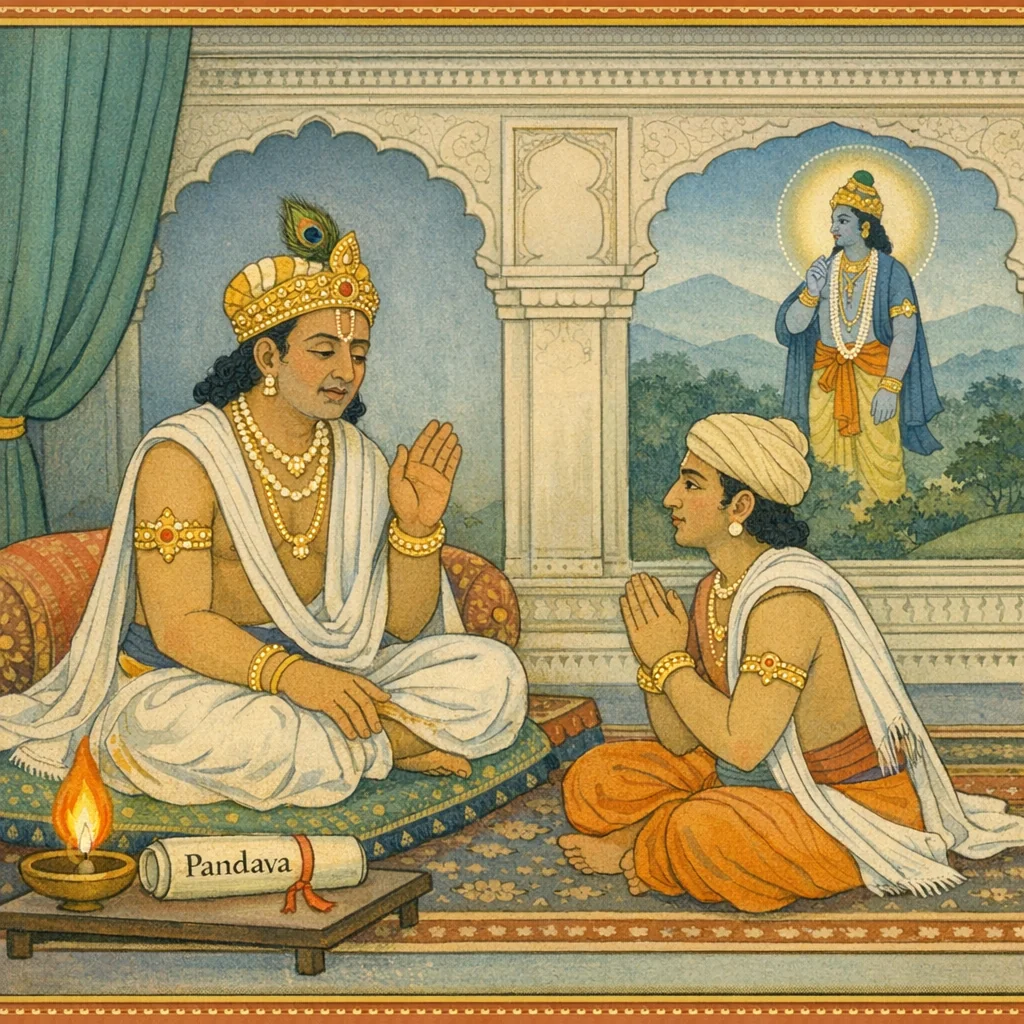
Adhyaya 52
Udyoga Parva, Adhyaya 52: Dhṛtarāṣṭra’s Appraisal of Pāṇḍava Strength and the Case for Restraint
Upa-parva: Sanjaya–Dhritarashtra Strategic Appraisal (Udyoga Parva context)
Dhṛtarāṣṭra addresses Saṃjaya with an assessment of the Pāṇḍavas as resolute and victory-oriented, paralleling their allies’ determination. He recalls Saṃjaya’s earlier enumeration of powerful supporting kingdoms and emphasizes that Kṛṣṇa’s alignment with the Pāṇḍavas is strategically decisive, implying a force capable of bringing even vast domains under control. The chapter notes Sātyaki’s rapid acquisition of Arjuna’s martial knowledge and highlights Dhṛṣṭadyumna as a formidable commander skilled in advanced weaponry. Dhṛtarāṣṭra then articulates fear arising from Yudhiṣṭhira’s principled anger, Arjuna’s valor, the twins’ capacity, and Bhīma’s power, envisioning an overwhelming, coordinated strike against his forces. He proceeds to praise the Pāṇḍava leader’s virtues—appearance, intellect, dharmic disposition, social support networks, self-control, generosity, and learning—using the metaphor of an unapproachable fire that the imprudent would rush into. Concluding, he argues that avoiding engagement is preferable because war risks the destruction of the entire lineage; peace is presented as his supreme mental pacification. Yet he acknowledges a constraint: Yudhiṣṭhira, repelled by adharma and identifying Dhṛtarāṣṭra as a causal agent, may not simply overlook their conduct even if they seek to be “taught” or corrected.
Chapter Arc: हस्तिनापुर के अंधे सम्राट धृतराष्ट्र संजय से कहते हैं कि जिन वीरों की शक्ति का बखान कभी स्वयं उन्होंने सुना/किया था, वही अब उनके पुत्रों के लिए प्रलय बनकर खड़ी है। → धृतराष्ट्र पाण्डव-पक्ष की शक्ति-श्रृंखला गिनाते हैं—पांचाल, केकय, मत्स्य, मगध, वत्स आदि—और फिर उससे भी ऊपर श्रीकृष्ण की सर्वसमर्थता का स्मरण करते हैं, मानो यह स्वीकार करते हुए कि यह युद्ध साधारण राजाओं का नहीं, जगत्-नियन्ता की इच्छा से जुड़ा है। → वे स्पष्ट भय व्यक्त करते हैं: युधिष्ठिर के क्रोध, अर्जुन के पराक्रम, और भीमसेन तथा दोनों जुड़वाँ भाइयों से उन्हें अपने कुल के विनाश का साक्षात् आभास होता है; पाण्डवों को ‘अग्नि’ कहकर बताते हैं कि उस अनावार्य ज्वाला पर कौन मूढ़ पतंगा बनकर गिरेगा। → धृतराष्ट्र युद्ध को ‘अशुभ’ और ‘कुल-नाशक’ मानते हुए कहते हैं कि कौरवों को पाण्डवों से युद्ध नहीं करना चाहिए; वे संकेत देते हैं कि युधिष्ठिर अधर्म से घृणा करता है और अपने कारण कौरवों को क्लेश में देखकर उपेक्षा नहीं करेगा—अर्थात् अभी भी संधि का द्वार खुला है, यदि दुर्योधन झुके। → संधि की संभावना धृतराष्ट्र के शब्दों में है, पर निर्णय दुर्योधन के हठ पर टिका है—क्या वह इस भय-भरे विवेक को मानेगा या विनाश की ओर बढ़ेगा?
Shlokas
Verse 1
अपन का छा 2 - कुछ दिद्वान् “त्रयस्त्रिंशत् समा55हूय” ऐसा पाठ मानकर आर्ष संधिकी कल्पना करके यह अर्थ करते हैं कि तैंतीस वर्षकी अवस्था बीत जानेपर अर्जुनने अग्निदेवको खाण्डववनमें बुलाकर तृप्त किया था। त्रिपञज्चाशत्तमो<्ध्याय: कौरवसभामें धृतराष्ट्रका युद्धसे भय दिखाकर शान्तिके लिये प्रस्ताव करना धृतराष्ट्र रवाच यथैव पाण्डवा: सर्वे पराक्रान्ता जिगीषव: । तथैवाभिसरास्तेषां त्यक्तात्मानो जये धृता:,धृतराष्ट्र बोले--संजय! जैसे समस्त पाण्डव पराक्रमी और विजयके अभिलाषी हैं, उसी प्रकार उनके सहायक भी विजयके लिये कटिबद्ध तथा उनके लिये अपने प्राण निछावर करनेको तैयार हैं
Dhṛtarāṣṭra said: “Sañjaya, just as all the Pāṇḍavas are valiant and intent on victory, so too are their supporters—firmly resolved for triumph, ready to stake even their lives for that cause.”
Verse 2
त्वमेव हि पराक्रान्तानाचक्षी था: परान् मम । पञज्चालान् केकयान् मत्स्यान् मागधान् वत्सभूमिपान्,तुमने ही मेरे निकट पराक्रमशाली पांचाल, केकय, मत्स्य, मागध तथा वत्सदेशीय उत्कृष्ट भूमिपालोंके नाम लिये हैं--(ये सभी पाण्डवोंकी विजय चाहते हैं)
Dhṛtarāṣṭra said: “Indeed, it was you who named to me those mighty kings—Pañcālas, Kekayas, Matsyas, Māgadhas, and the lords of the Vatsa land—renowned rulers of excellent realms, all of whom favor the Pāṇḍavas’ victory.”
Verse 3
यश्न सेन्द्रानिमॉल्लोकानिच्छन् कुर्याद् वशे बली । स स््रष्टा जगत: कृष्ण: पाण्डवानां जये धृत:
Dhṛtarāṣṭra said: “Even a mighty man, desiring fame, might seek to bring these worlds—together with Indra—under his control. Yet Kṛṣṇa, the very creator of the universe, stands firmly resolved for the Pāṇḍavas’ victory.”
Verse 4
इनके सिवा जो इच्छा करते ही इन्द्र आदि देवताओंसहित इन सम्पूर्ण लोकोंको अपने वशमें कर सकते हैं, वे जगत्स्ष्टा महाबली भगवान् श्रीकृष्ण भी पाण्डवोंको विजय दिलानेका दृढ़ निश्चय कर चुके हैं ।। समस्तामर्जुनाद् विद्यां सात्यकि: क्षिप्रमाप्तवान् शैनेय: समरे स्थाता बीजवत् प्रवपठ्छरान्,शिनिके पौत्र सात्यकिने थोड़े ही समयमें अर्जुनसे उनकी सारी अस्त्रविद्या सीख ली थी। इस युद्धमें वे भी बीजकी भाँति बाणोंको बोते हुए पाण्डवपक्षकी ओरसे खड़े होंगे
Dhṛtarāṣṭra said: “Apart from these, there are those who, by mere will, could bring all the worlds—together with Indra and the other gods—under their control. And even that mighty Lord Śrī Kṛṣṇa, the creator and sustainer of the world, has firmly resolved to secure victory for the Pāṇḍavas. Moreover, Sātyaki, the grandson of Śini (Śaineya), quickly learned the entire science of weapons from Arjuna; in this war he too will stand on the Pāṇḍava side, showering arrows as if sowing seeds.”
Verse 5
धष्टद्युम्नश्व॒ पाज्चाल्य: क्रूरकर्मा महारथ: । मामकेषु रणं कर्ता बलेषु परमास्त्रवित्,उत्तम अस्त्रोंका ज्ञाता और क्रूरतापूर्ण पराक्रम प्रकट करनेवाला पांचालराजकुमार महारथी धृष्टद्युम्न भी मेरी सेनाओंमें घुसकर युद्ध करेगा
Dhṛtarāṣṭra said: “And Dhṛṣṭadyumna, the Pāñcāla prince—fierce in action and a great chariot-warrior—will enter my forces and wage battle against my men. He is a master of supreme missiles, a knower of excellent weapons, and he will display a harsh, relentless valor in the fight.”
Verse 6
युधिष्ठिरस्य च क्रोधादर्जुनस्य च विक्रमात् । यमाभ्यां भीमसेनाच्च भयं मे तात जायते,तात संजय! मुझे युधिष्ठिरके क्रोधसे, अर्जुनके पराक्रमसे, दोनों भाई नकुल और सहदेवसे तथा भीमसेनसे बड़ा भय लगता है। संजय! इन नरेशोंके द्वारा मेरी सेनाके भीतर जब अलौकिक अस्त्रोंका जाल-सा बिछा दिया जायगा, तब मेरे सैनिक उसे पार नहीं कर सकेंगे; इसीलिये मैं बिलख रहा हूँ
Dhṛtarāṣṭra said: “My son, fear rises in me—because of Yudhiṣṭhira’s wrath, because of Arjuna’s heroic might, because of the twin brothers Nakula and Sahadeva, and because of Bhīmasena. O Sañjaya, when these kings spread within my army, as it were, a net of wondrous celestial weapons, my soldiers will not be able to cross through it; therefore I lament.”
Verse 7
अमानुषं मनुष्येन्द्रैजीलं विततमन्तरा । न मे सैन्यास्तरिष्यन्ति ततः क्रोशामि संजय,तात संजय! मुझे युधिष्ठिरके क्रोधसे, अर्जुनके पराक्रमसे, दोनों भाई नकुल और सहदेवसे तथा भीमसेनसे बड़ा भय लगता है। संजय! इन नरेशोंके द्वारा मेरी सेनाके भीतर जब अलौकिक अस्त्रोंका जाल-सा बिछा दिया जायगा, तब मेरे सैनिक उसे पार नहीं कर सकेंगे; इसीलिये मैं बिलख रहा हूँ
Dhṛtarāṣṭra said: “O Sañjaya, when the kings among men spread within my army a superhuman net of weapons, my troops will not be able to cross beyond it. Therefore I cry out in anguish.”
Verse 8
दर्शनीयो मनस्वी च लक्ष्मीवान् ब्रह्म॒वर्चसी । मेधावी सुकृतप्रज्ञो धर्मात्मा पाण्डुनन्दन:
Dhṛtarāṣṭra said: “That son of Pāṇḍu is pleasing to behold and high-minded; endowed with fortune and the radiance of sacred learning. He is intelligent, possessed of well-formed judgment born of merit, and devoted to dharma.”
Verse 9
मित्रामात्यै: सुसम्पन्न: सम्पन्नो युद्धयोजकै:ः । भ्रातृभि: श्वशुरैवीरैरुपपन्नो महारथै:
Dhṛtarāṣṭra said: “He is well provided with friends and counsellors; he is furnished with those skilled in arranging war. He is supported by brothers and by valiant fathers-in-law—great chariot-warriors—thus fully equipped with powerful allies.”
Verse 10
धृत्या च पुरुषव्याप्रो नैभृत्येन च पाण्डव: । अनृशंसो वदान्यश्व हीमान् सत्यपराक्रम:
Dhṛtarāṣṭra said: “The Pāṇḍava is energetic through steadfast resolve, and disciplined through loyal service. He is compassionate and generous; he is self-controlled, and his valor is grounded in truth.”
Verse 11
बहुश्रुतः कृतात्मा च वृद्धसेवी जितेन्द्रिय: । त॑ सर्वगुणसम्पन्न॑ं समिद्धमिव पावकम्
Dhṛtarāṣṭra said: “He is widely learned, self-disciplined, devoted to serving elders, and master of his senses—endowed with every virtue, blazing like a well-kindled fire.”
Verse 12
तपन्तमभि को मन्द: पतिष्यति पतड्भवत् । पाण्डवाग्निमनावार्य मुमूर्षुर्नष्टचेतन:
Dhṛtarāṣṭra said: “Who, being so foolish, would rush toward what is blazing—like a moth falling into a flame? Yet, with mind lost and courting death, one would still plunge into the uncheckable fire of the Pāṇḍavas.”
Verse 13
पाण्डुनन्दन युधिष्ठिर दर्शनीय, मनस्वी, लक्ष्मीवान्, ब्रह्मर्षियोंके समान तेजस्वी, मेधावी, सुनिश्चित बुद्धिसे युक्त, धर्मात्मा, मित्रों तथा मन्त्रियोंसे सम्पन्न, युद्धके लिये उद्योगशील सैनिकोंसे संयुक्त, महारथी भाइयों और वीरशिरोमणि श्वशुरोंसे सुरक्षित, धैर्यवान्, मन्त्रणाको गुप्त रखनेवाले, पुरुषोंमें सिंहके समान पराक्रमी, दयालु, उदार, लज्जाशील, यथार्थ पराक्रमसे सम्पन्न, अनेक शास्त्रोंके ज्ञाता, मनको वशमें रखनेवाले, वृद्धसेवी तथा जितेन्द्रिय हैं। इस प्रकार सर्वगुणसम्पन्न और प्रज्वलित अग्निके समान ताप देनेवाले उन युधिष्ठिरके सम्मुख युद्ध करनेके लिये कौन मूर्ख जा सकेगा? कौन अचेत एवं मरणासन्न मनुष्य पतंगोंकी भाँति दुर्निवार पाण्डवरूपी अग्निमें जान-बूझकर गिरेगा? ।। ८ --१२ || तनुरुद्धः शिखी राजा मिथ्योपचरितो मया । मन्दानां मम पुत्राणां युद्धेनानतं करिष्यति,राजा युधिष्ठिर सूक्ष्म और एक स्थानमें अवरुद्ध अग्निके समान हैं। मैंने मिथ्या व्यवहारसे उनका तिरस्कार किया है, अतः: वे युद्ध करके मेरे मूर्ख पुत्रोंका अवश्य विनाश कर डालेंगे
Dhṛtarāṣṭra said: “Yudhiṣṭhira, the son of Pāṇḍu, is pleasing to behold, high-minded, and endowed with fortune. He shines with a radiance like that of the Brahmarṣis; he is intelligent, firm in judgment, righteous in spirit, and supported by friends and wise counsellors. He is joined by soldiers eager for battle, protected by his great chariot-fighting brothers and by heroic, foremost fathers-in-law. He is steadfast, able to keep counsel secret, lion-like in valor among men—yet compassionate, generous, and modest; his prowess is real, not pretended. He knows many śāstras, has mastery over his mind, serves the elders, and is self-controlled. Who, then, would be so foolish as to go to war against such a man—complete in every virtue and scorching like a blazing fire? What senseless person, already near death, would knowingly fall like a moth into the irresistible fire that is the Pāṇḍavas? “Yudhiṣṭhira is like a fire confined to a narrow space—intense and unstoppable once released. I have wronged him through false dealings; therefore, by war he will surely bring my dull-witted sons to their end.”
Verse 14
तैरयुद्धं साधु मनन््ये कुरवस्तन्निबोधत । युद्धे विनाश: कृत्स्नस्यथ कुलस्य भविता ध्रुवम्,कौरवो! मैं पाण्डवोंके साथ युद्ध न होना ही अच्छा मानता हूँ। तुमलोग इसे अच्छी तरह समझ लो। यदि युद्ध हुआ तो समस्त कुरुकुलका विनाश अवश्यम्भावी है। मेरी बुद्धिका यही सर्वोत्तम निश्चय है। इसीसे मेरे मनको शान्ति मिलती है। यदि तुम्हें भी युद्ध न होना ही अभीष्ट हो तो हम शान्तिके लिये प्रयत्न करें
Dhṛtarāṣṭra said: “I judge it best that the Kurus do not go to war with them; understand this well. If war is fought, the complete destruction of the whole lineage will surely follow. This is my firmest conclusion, and it is by this resolve that my mind finds peace. If you too desire that there be no war, then let us strive for reconciliation.”
Verse 15
एषा मे परमा बुद्धिर्यया शाम्यति मे मन: । यदि त्वयुद्धमिष्टं वो वयं शान्त्ये यतामहे,कौरवो! मैं पाण्डवोंके साथ युद्ध न होना ही अच्छा मानता हूँ। तुमलोग इसे अच्छी तरह समझ लो। यदि युद्ध हुआ तो समस्त कुरुकुलका विनाश अवश्यम्भावी है। मेरी बुद्धिका यही सर्वोत्तम निश्चय है। इसीसे मेरे मनको शान्ति मिलती है। यदि तुम्हें भी युद्ध न होना ही अभीष्ट हो तो हम शान्तिके लिये प्रयत्न करें
Dhṛtarāṣṭra said: “This is my highest resolve, and by it my mind finds peace: if you truly desire non‑war, then let us strive for peace.”
Verse 16
न तु नः क्लिश्यमानानामुपेक्षेत युधिष्ठिर: । जुगुप्सति हाधर्मेण मामेवोद्धिश्य कारणम्,युधिष्छिर हमें (युद्धकी चर्चासे) क्लेशमें पड़े देख हमारी उपेक्षा नहीं कर सकते। वे तो मुझे ही अधर्मपूर्वक कलह बढ़ानेमें कारण मानकर मेरी निन्दा करते हैं (फिर मेरे ही द्वारा शन्तिप्रस्ताव उपस्थित किये जानेपर वे क्यों नहीं सहमत होंगे?)
Dhṛtarāṣṭra said: “But Yudhiṣṭhira will not ignore us when he sees us afflicted. Indeed, he condemns me—taking me alone as the cause—because of unrighteous conduct that has fueled this conflict. (Therefore, when a proposal for peace is presented through me, why would he not agree?)”
Verse 52
इस प्रकार श्रीमहाभारत उद्योगपर्वके अन्तर्गत यानसंधिपर्वमें धृतराष्ट्रवाक्यविषयक बावनवाँ अध्याय पूरा हुआ
Thus ends the fifty-second chapter of the Udyoga Parva of the Śrī Mahābhārata, within the Yāna–Saṃdhi section, concerning the words of Dhṛtarāṣṭra. This closing colophon marks a pause in the narrative, formally sealing the king’s discourse and preparing the reader for the next movement in the diplomacy-and-war sequence.
Verse 53
इति श्रीमहाभारते उद्योगपर्वणि यानसंधिपर्वणि धृतराष्ट्रवाक्ये त्रिपड्चाशत्तमो5ध्याय:
Thus ends the fifty-third chapter in the Udyoga Parva of the Śrī Mahābhārata, within the section on the mission and negotiations for peace, in the portion spoken by Dhṛtarāṣṭra. The colophon marks a formal close to the chapter, underscoring that the narrative is situated in the ethical tension between diplomacy and the looming war.
Frequently Asked Questions
Whether a ruler should proceed toward confrontation despite recognizing disproportionate risk and collective ruin, or prioritize restraint and peace even when prior actions have generated legitimate grievance.
Strategic clarity and ethical accountability must be paired: accurate appraisal of power and consequence is necessary, but peace-making is unstable if it does not address the moral causes that the aggrieved party identifies as adharma.
No explicit phalaśruti appears in the provided verses; the chapter’s meta-level function is archival and instructional—demonstrating how fear, virtue-assessment, and consequence forecasting operate within royal deliberation.